

- The coral reef problem is the question of how barrier reefs and atolls came to stand on foundations far deeper than the water in which reef-building corals can live. They thrive only in warm, clear, shallow water, mostly above about 50–60 m, yet many reefs rise from depths of hundreds of metres.
- Fringing reefs are easy to explain. Corals settle on a shallow platform beside a coast, grow up to low-tide level and then spread seaward on their own debris.
- Atolls are the hardest case. About 440 atolls exist, most of them in the Pacific. Each is a ring of reef round a shallow lagoon, rising like a pillar from the deep floor with no visible foundation.
The Problem and Its Variables
Two controls behind every theory
- Every theory turns on two variables:
- the stability of the land, which may be subsiding, stationary or emerging;
- the level of the sea, above all its Pleistocene swings between glacial and interglacial stages.
- The theories fall into two broad families:
- subsidence theories, in which the foundation sinks and the reef grows up to keep pace;
- non-subsidence (stand-still) theories, in which a suitable platform already exists and the land stays put.
- Glacial control is a third strand. It keeps the land stable but lets the sea fall and rise.
| Group | Proponents | Land | Sea level | Key idea |
|---|---|---|---|---|
| Subsidence | Charles Darwin (1837, 1842); James Dwight Dana; W. M. Davis (1928) | Sinks slowly | Constant (Davis adds Pleistocene changes) | Fringing → barrier → atoll as one sequence |
| Stand-still | John Murray (1880); Karl Semper; Alexander Agassiz | Stable | Constant | Reefs grow outward on pre-existing platforms; lagoons by solution |
| Antecedent platform | J. Stanley Gardiner; Hoffmeister and Ladd (1944) | Stable | Need not change | Any platform at a suitable depth can carry a reef |
| Glacial control | Reginald Aldworth Daly (1910, 1915) | Stable | Falls in glacials, rises after | Low sea level planes platforms; the rising sea lets reefs grow on them |
Subsidence Theories
Darwin’s subsidence theory
- Charles Darwin worked the theory out during the voyage of HMS Beagle (1831–36), before he had seen a coral reef.
- He reasoned that if the Andes were rising, parts of the ocean floor must be sinking, and then tested the idea at Tahiti (1835) and the Cocos (Keeling) Islands (1836).
- He presented it to the Geological Society of London in 1837 and set it out in The Structure and Distribution of Coral Reefs (1842).
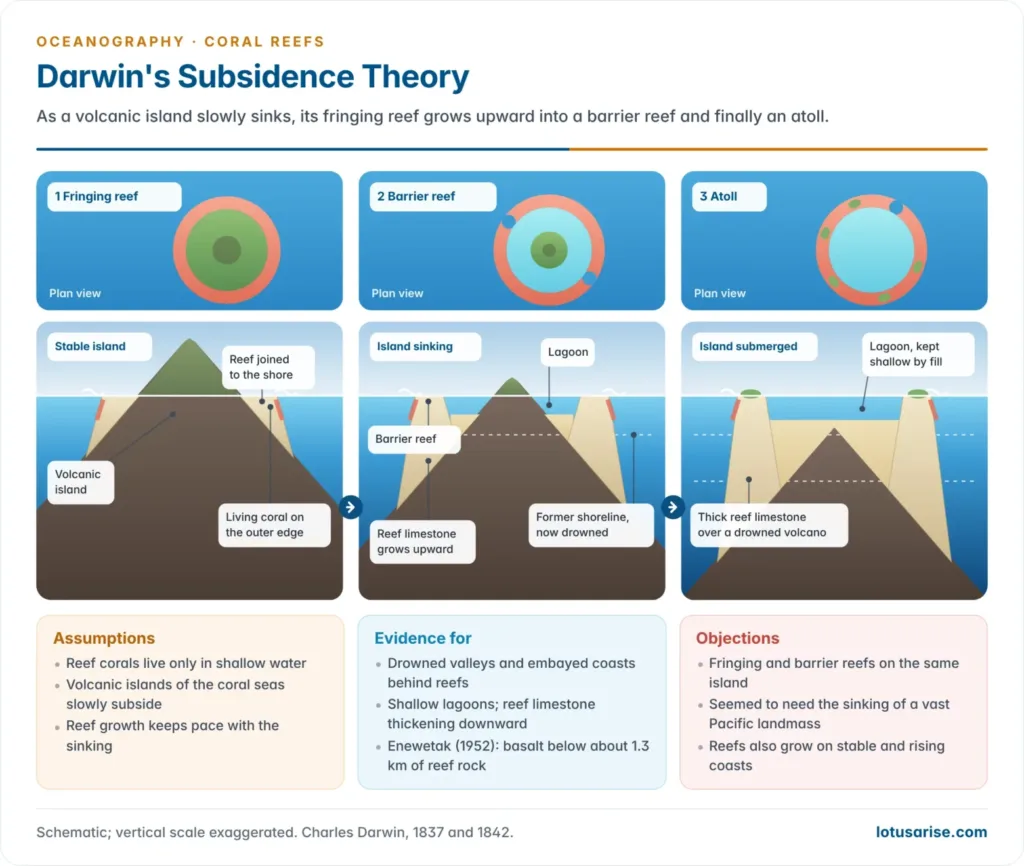
- Assumptions: reef corals grow only in shallow water; the volcanic islands of the coral seas are slowly subsiding; and upward reef growth can keep pace with the sinking.
- Three stages of one sequence:
- Fringing reef. Corals colonise the shallow margin of a volcanic island and grow up to sea level.
- Barrier reef. The island begins to sink. Corals on the outer edge, which get the most food, oxygen and clean water, grow up vigorously, while those near the shore lag and die. A lagoon opens between the reef and the shrinking island.
- Atoll. The island sinks out of sight, leaving a reef ring at the surface round a central lagoon.
- The lagoon stays shallow despite continued sinking, because sediment and reef debris keep settling on its floor.
- Implication: barrier reefs and atolls occur only where the foundation has subsided, and the thickness of reef limestone beneath them measures how far it has sunk.
- James Dwight Dana reached the same conclusion on the United States Exploring Expedition (1838–42), so the idea is often called the Darwin–Dana hypothesis.
- He added the point Darwin had missed: subsidence drowns valleys. Stream-cut valleys on reef-girt islands end in embayed mouths, showing that the land later sank, as on the coasts of Queensland and eastern Indonesia.
| Evidence for subsidence | Objections raised |
|---|---|
| Drowned valleys and embayed coasts behind barrier reefs | Fringing and barrier reefs side by side on one island, as in parts of Fiji |
| Shallow lagoons that sediment would otherwise have filled | Atolls everywhere seemed to need the sinking of a vast Pacific landmass |
| No cliffs on most islands inside barrier reefs | Reefs also grow on stable or rising coasts, such as the raised reefs of Timor |
| Steep outer slopes; reefs thickening downward | Wide, flat lagoon floors of fairly uniform depth |
| Raised beaches, which mark rising land, generally lack barrier reefs and atolls | Early bores could not show what lay beneath the reef |
Davis’s physiographic support
- William Morris Davis studied Pacific reefs from about 1914. In The Coral Reef Problem (1928) he revived subsidence with landform evidence, after earlier writers had treated reefs mainly as a biological question.
- His main arguments:
- Embayed shorelines in the coral seas prove submergence.
- Unconformable contacts show that reefs rest on older, eroded foundations.
- Lagoon floors are depositional. Their flatness is not the true foundation, and a subsiding lagoon can take any amount of debris without filling up.
- The cliff test. If waves had planed islands at glacial low sea levels, as Daly held, cliffs should stand behind reefs. They occur only in the marginal belts where cold killed the corals. In the warm heart of the coral seas, reef growth never stopped, the reefs sheltered the land, and cliffs are absent.
- His conclusion: combine subsidence with Pleistocene changes of temperature and sea level. His drowned valleys were far deeper than any glacial fall of sea level could explain.
- Weakness: he could not prove that the buried foundations of lagoons lie at unequal depths.
Non-Subsidence Theories
Murray’s stand-still theory
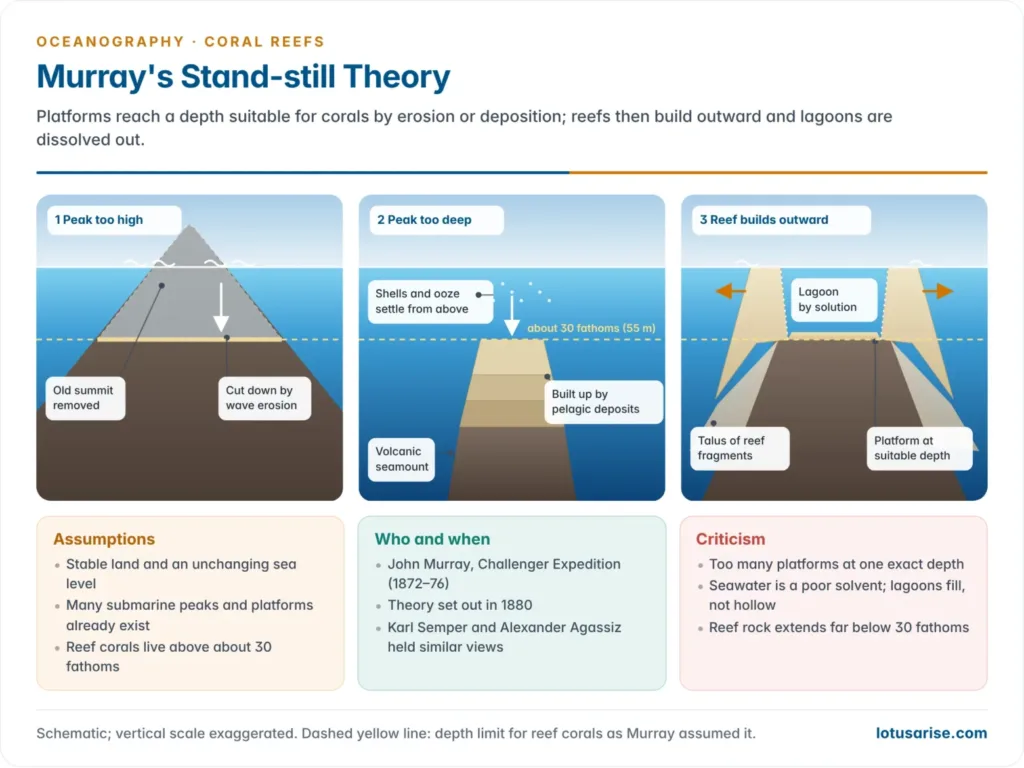
- John Murray, naturalist of the Challenger Expedition (1872–76), proposed the stand-still theory in 1880. Karl Semper, working in the Palau Islands, and Alexander Agassiz, working in Florida, the Bahamas and Fiji, held similar views.
- Assumptions: a stable land, an unchanging sea level and many submarine platforms already available.
- Platforms reach a suitable depth of about 30 fathoms (roughly 55 m) in two ways:
- peaks rising above it are cut down by waves;
- peaks lying below it are built up by pelagic deposits such as oozes and shell debris.
- Mechanism: a fringing reef advances seaward on a talus of its own fragments and becomes a barrier reef. The dead inner reef is dissolved by seawater, opening the lagoon. On an isolated platform, outward growth in all directions gives an atoll round a solution lagoon.
- Criticism:
- So many platforms at exactly the same depth is improbable, and erosion and deposition cannot both work at that depth on neighbouring peaks.
- Seawater is a poor solvent of carbonate in warm shallow water. Lagoons are sites of deposition, and solution strong enough to hollow them would also dissolve the oozes the theory relies on.
- Loose talus could not stand on the very steep outer slopes of atolls.
- Reef rock extends far below 30 fathoms, and a stable lagoon should fill with detritus.
Antecedent-platform theory
- John Stanley Gardiner, working in the Maldives and Lakshadweep (1899–1900), stressed that reefs build outward on platforms of any origin and that coralline algae share the work of building them.
- J. Edward Hoffmeister and Harry Stephen Ladd (1944) generalised this as the antecedent-platform theory: any platform at a suitable depth, whether eroded, depositional or volcanic, can carry a reef, with no change of land or sea level.
- It explains reefs on stable or rising foundations, but not the thick limestone columns beneath many atolls.
Daly’s glacial control theory
- Reginald Aldworth Daly saw glacial marks on Mauna Kea, Hawaii (1909), and was struck by how narrow the Hawaiian reefs were. He linked reef growth to Pleistocene temperature and sea level in 1910 and set out the full glacial control theory in 1915.
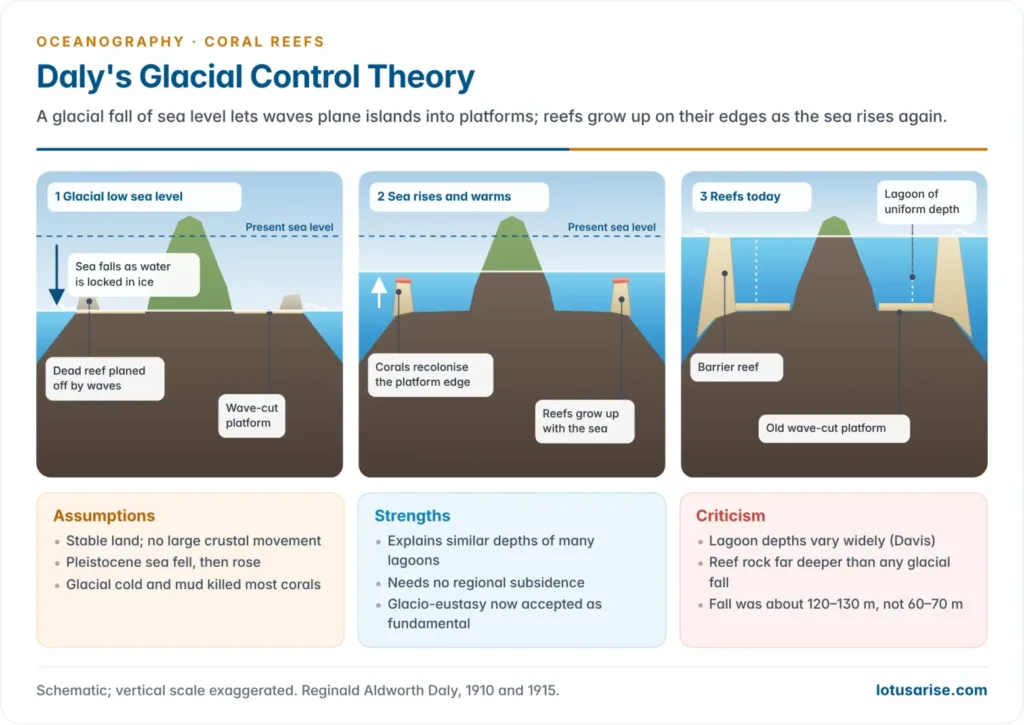
- Assumptions: stable land. The sea fell during Pleistocene glaciation as water was locked up in ice sheets, and rose when they melted.
- Mechanism:
- Glacial stage. Sea level fell, by about 60–70 m in Daly’s estimate. Colder, muddier water killed most corals, and exposed reefs and islands were planed by waves into platforms at the lowered level.
- Post-glacial stage. As the sea rose and warmed, surviving corals recolonised the outer edges of the drowned platforms and grew upward with the rising water.
- Outcome: fringing reefs on narrow platforms, barrier reefs on broad ones such as the shelf off Queensland, and atolls on planed-off island tops. Because every platform was cut to the same level, lagoons should have roughly uniform depths.
- Strengths: it needs no large crustal movement, explains the similar depths of many lagoons, and recognises glacio-eustatic sea-level change, now accepted as fundamental.
- Criticism:
- Lagoon depths are not uniform. Davis showed that they vary widely, even within one lagoon.
- Some platforms, such as the great banks of the Mascarene Plateau, are too broad to have been planed in a short glacial low stand, and the expected glacial cliffs are mostly absent.
- Reef rock lies far deeper than any glacial fall of sea level, so Daly had to allow local subsidence.
- Glacial cooling is unlikely to have reached the equatorial coral seas, and his 60–70 m fall was too small: the last glacial maximum, about 20,000 years ago, lowered the sea by about 120–130 m.
Testing the Theories: Drilling and the Modern Synthesis
What the drill holes showed
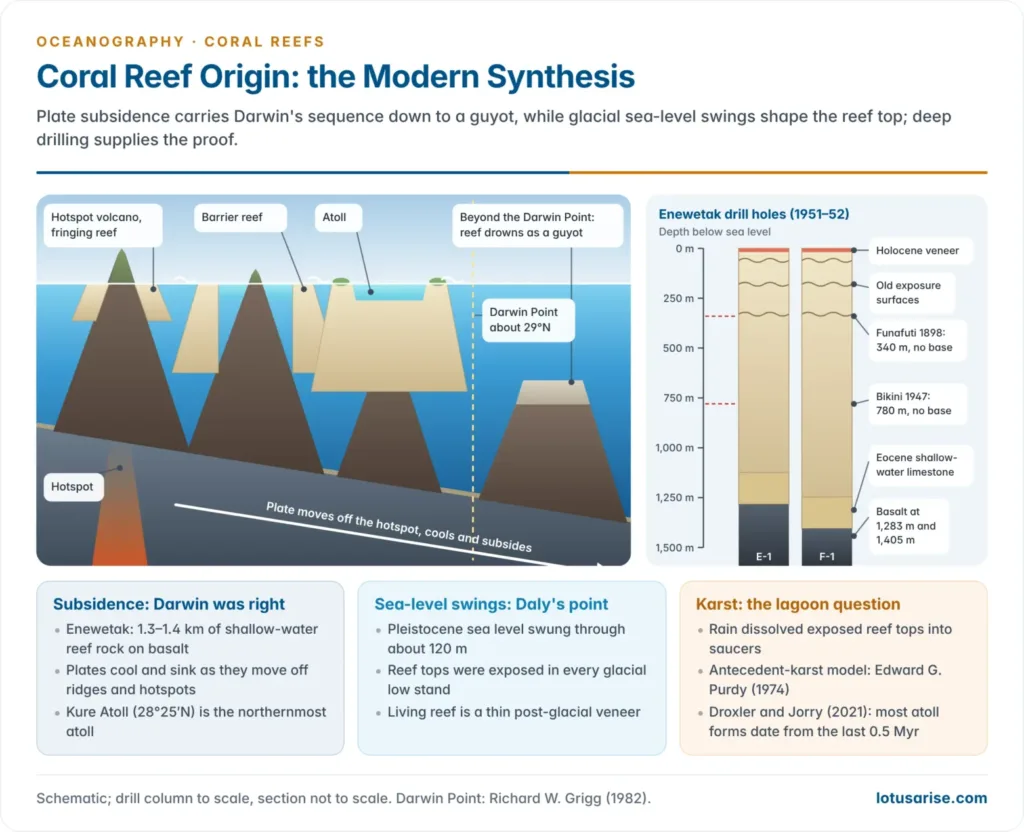
- Funafuti, Tuvalu (1896–98). Royal Society expeditions, led first by William Johnson Sollas and then by Edgeworth David, bored to 1,114 ft (about 340 m). The core was reef limestone all the way down, but it never reached a volcanic base.
- Bikini (1947). A hole reached about 780 m, still in limestone.
- Enewetak, Marshall Islands (1951–52). Two holes drilled by a US Geological Survey team under Harry Stephen Ladd struck basalt at about 1,283 m and 1,405 m.
- The limestone just above the basalt is Eocene and formed in shallow water.
- The atoll is therefore a volcano capped by about 1.3–1.4 km of reef limestone, whose summit has sunk that far while the reef grew upward. This proved Darwin right.
Plate tectonics explains the subsidence
- The sinking Darwin needed comes from plate tectonics. Volcanic islands form at mid-ocean ridges or over hotspots. The plate carries them away and cools, thickens and subsides, and the weight of each volcano also bows the crust down.
- Subsidence is slow, about 1.3 km in some 50 million years at Enewetak. Reef growth of up to several millimetres a year easily keeps pace.
- The Darwin Point. Richard W. Grigg (1982) showed that near 29°N in the Hawaiian chain, cooler water slows reef growth until it falls behind subsidence.
- Kure Atoll (28°25′N) is the northernmost atoll.
- Islands carried beyond this latitude drown and become guyots, the flat-topped seamounts first described by Harry Hammond Hess.
Glacio-eustasy and karst shape the reef top
- Daly was right about the top of the reef. Pleistocene sea level swung repeatedly through about 120 m. Reef tops stood exposed as limestone islands in each glacial low stand and were flooded again in each interglacial.
- The antecedent-karst model of Edward G. Purdy (1974) follows from this. Rainwater dissolved the exposed limestone fastest in the centre, so the lagoon began as a karst saucer with a raised rim that corals later recolonised.
- The living reef is a thin Holocene veneer, grown over the last 8,000–10,000 years on an older, karst-eroded Pleistocene surface.
- The debate continues. André Droxler and Stéphan Jorry (2021), drawing mainly on Maldives evidence, argue that most modern atolls took shape only in the last 500,000 years or so, as large sea-level swings karstified older flat-topped carbonate banks. Others point to Darwin-type reefs at Tahiti and stress that atolls form in more than one way.
Indian examples
- Lakshadweep and the Maldives are atolls on the Chagos–Laccadive Ridge, a volcanic trail left as the Indian Plate moved north over the Réunion hotspot. Their subsided volcanic basement carries a thick carbonate cap, a Darwin-type history reshaped by glacial sea-level swings.
- The Gulf of Mannar and Gulf of Kachchh carry fringing and patch reefs on a stable continental shelf, where stand-still and antecedent-platform ideas fit best.
- The 2004 Sumatra–Andaman earthquake raised parts of the North Andaman coast by about a metre, leaving reef flats dry and dead, while parts of the Nicobars sank. Tectonics still sets the stage on which reefs grow.
Theories compared
| Basis | Darwin (subsidence) | Murray (stand-still) | Daly (glacial control) | Modern view |
|---|---|---|---|---|
| Land | Slowly sinking | Stable | Stable | Sinking oceanic islands; stable or rising shelves |
| Sea level | Constant | Constant | Fell and rose in the Pleistocene | Repeated glacio-eustatic swings of about 120 m |
| Reef sequence | Fringing → barrier → atoll | Fringing grows outward into barrier | Reefs on wave-cut platforms of different widths | Darwin sequence on sinking islands; separate origins on shelves |
| Lagoon | Sinks; kept shallow by sediment | Dissolved out of dead reef | Platform floor of uniform depth | Subsidence plus karst solution in low stands, then infill |
| Thick reef limestone | Explained | Not explained | Not explained | Explained (Enewetak) |
| Main weakness | Seemed to need vast sinking | Many platforms at one depth; weak solution | Non-uniform lagoons; reef rock too deep | Relative weight of karst and subsidence still debated |
Why atolls remain the hardest case
- No single theory covers every reef. The theories are complementary rather than rival:
- subsidence explains the deep foundations;
- glacial control and karst explain the upper reef, lagoon shape and platform levels;
- antecedent platforms explain reefs on stable shelves.
- Atolls are the most challenging because their foundations lie hidden beneath kilometre-thick limestone, and the lagoon form may owe more to glacial-age solution than to the sinking that carried the reef down.
- The question is live again under present-day sea-level rise.
- Holocene reefs are classed as keep-up, catch-up or give-up reefs, depending on whether their growth matched the post-glacial rise.
- A 2018 study of more than 200 western Atlantic and Indian Ocean reefs found that most may not keep pace with projected rise under moderate emissions, as warming and bleaching slow their growth.
- Atoll islands are not simply drowning. Tuvalu’s 101 reef islands, Funafuti among them, gained about 2.9% in net land area between 1971 and 2014, as waves reworked reef sediment.
Previous Year Questions
2013Compare the Subsidence and Glacial control theories on the formation of coral reefs.2012“Atolls present the most challenging explanation in the evolution of coral reefs” Discuss.2008Describe the ideal conditions for coral reef formation and discuss the glacial control theory of coral reef formation.2001Write short note: Formation of coral reefs.1997Examine critically the theories of the formation of coral reefs and atolls.1990Discuss the theories of the formation of coral reefs proposed by Daly, Darwin and Davis.





Sir pls tell me how to become a member of lotus arise to read all the pdf and these notes are sufficient for optional geography plss reply as soon as possible
https://lotusarise.com/subscribe/geography-optional-prime/