

- Solar energy is energy received from the Sun. The Sun delivers enough to meet human power demand many times over, if only it could be harnessed properly.
- India’s low-latitude, largely tropical position, its clear winter and pre-monsoon skies and the Thar and Kachchh drylands make solar its largest renewable source.
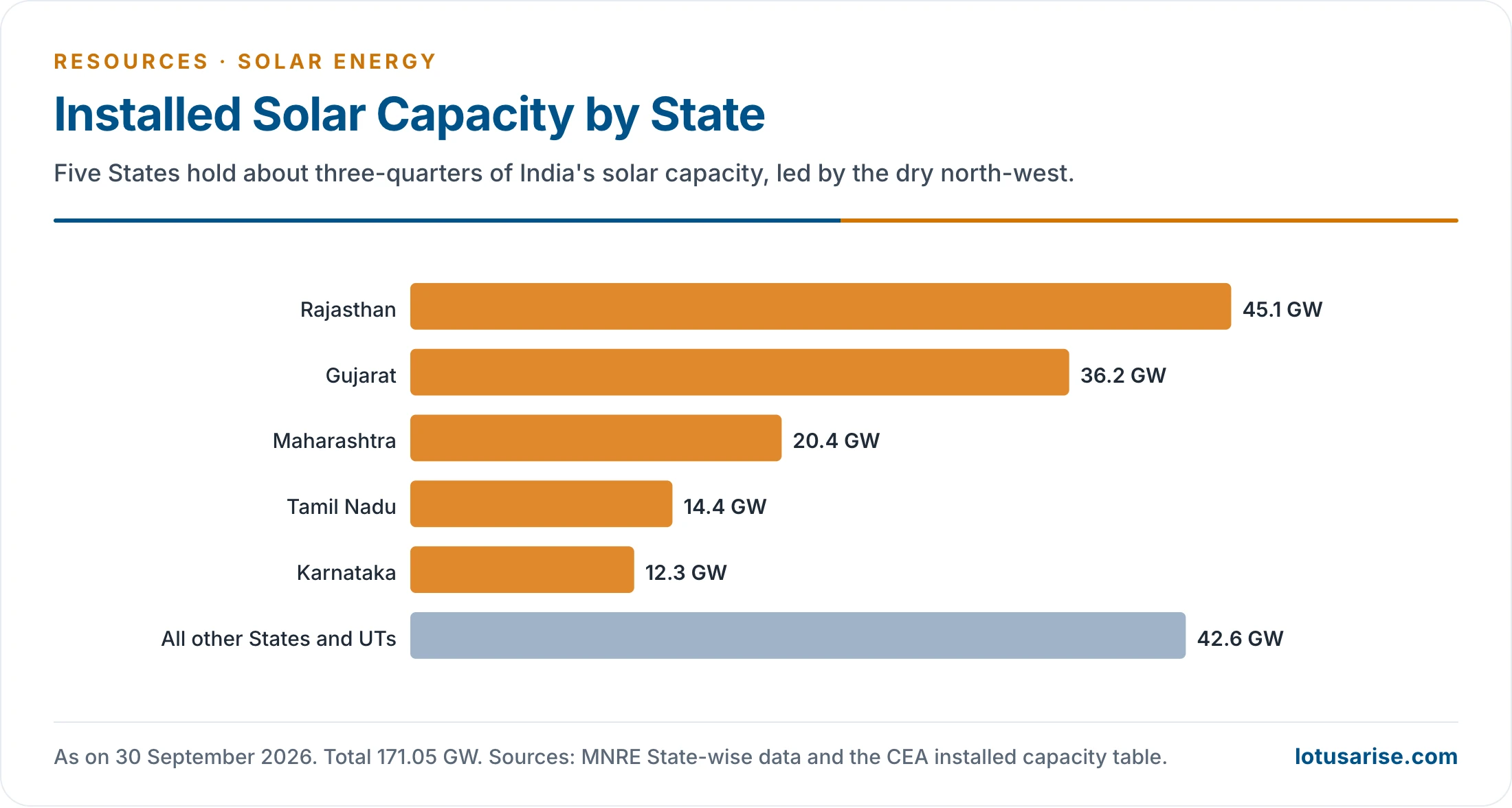
- As on 30 September 2026, installed solar capacity was 1,71,051.47 MW, about 30.6% of the national capacity of 5,58,896.39 MW (CEA).
Solar Energy
- The Earth uses the energy it absorbs in everyday ways: drying clothes, photosynthesis in plants, heating homes, and heating the ocean, which drives winds and currents.
- Solar energy can be used directly as heat, or converted to electricity through a thermal route or a photovoltaic route.
Major Applications
- Solar thermal power production: sunlight heats a working fluid, such as a gas, water or another volatile liquid. A turbine turns that heat into mechanical energy, and a coupled conventional generator turns this into electricity.
- Solar heating systems: these heat a liquid or air, then pass the heat directly to the interior space or to a storage system. An auxiliary or backup system covers any shortfall.
- Photoelectric (photovoltaic) cells: the most popular way of making electricity from sunlight. Silicon-based materials absorb light, the light sets electrons moving in one direction, and that flow is a direct current.
- Everyday devices: India’s programmes spread these well before large power projects arrived.
| Device | Working and use | Scale or saving |
|---|---|---|
| Solar water heater | Flat plate collector raises water to about 80°C, for homes, hotels, hostels and hospitals | 100–300 litres a day for a home; pays back in 3–6 years; technical potential 140 million sq m of collector area |
| Solar air heater and dryer | Drying in tea, food processing, dal and spice units; space heating in cold regions | Saves conventional fuel |
| Box solar cooker | Simple household cooker | Family of 4–5; saves 3–4 LPG cylinders a year |
| Dish solar cooker | Fast concentrating cooker | 10–15 people; saves up to 10 cylinders |
| Community (Scheffler) cooker | Cooks inside the kitchen | About 40 people; saves 35 cylinders |
| Solar steam cooking | Large institutions and pilgrim kitchens | Shirdi; Tirumala Tirupati, for 15,000 pilgrims (2002) |
| Solar greenhouse, solarised hut | Off-season vegetables and warm buildings in cold, dry areas | Leh, Kargil, Jammu and Kashmir, Himachal Pradesh |
- Water heating also trims peak demand. 1,000 domestic systems of 100 litres each can shave about 1 MW of peak load.
- By 2010-11, decentralised systems had reached 1,82,200 street lights, 7,33,245 home lights, 8,31,604 lanterns and 7,334 water pumps.
Advantages of Solar Energy
- Renewable: this is the chief benefit. It can be harnessed in almost all parts of the world and is available every day, subject to weather and season.
- High energy yield: a building whose panels meet its whole need can run free of the grid.
- Clean in use: solar power causes no greenhouse gas emissions after installation.
- Low running cost: grid-tied systems earn returns through net metering.
- Long life: the equipment needs little maintenance, which adds to energy infrastructure security.
- Decentralised: it suits remote villages, hamlets, islands, hospitals and forest and desert settlements.
- Silent: photovoltaic conversion needs no moving parts.
Disadvantages of Solar Energy
- Storage is expensive: solar power must be used at once or held in large batteries. These allow night-time use, including in off-grid systems, but are costly.
- Land hungry: more electricity means more panels. Utility plants need wide tracts, and many roofs are too small for the panels an owner would like.
- Not pollution free over its life: far cleaner than other sources, but transport and installation emit greenhouse gases.
- Toxic materials and hazardous products used in making photovoltaic systems can harm the environment indirectly.
- Intermittent: output stops at night and falls in cloud and the monsoon, so the grid needs balancing from pumped hydro or batteries.
Solar Energy in India: The Two Routes
- With its plentiful sunshine, India can make electricity from sunlight in two ways.
| Feature | Photovoltaic (SPV) | Solar thermal (CSP) |
|---|---|---|
| Principle | Semiconductor cell turns light directly into electricity | Mirrors concentrate sunlight to raise steam |
| Moving parts | None | Turbine and generator |
| Output | Direct current, converted to alternating current by inverters | Alternating current from a conventional generator |
| Sunlight used | Direct and diffuse | Direct only |
| Forms | Rooftop, ground-mounted, floating, canal-top | Parabolic trough, tower, Fresnel |
| Indian share | Nearly all capacity | Very small; Dhursar in Rajasthan is a 125 MW Fresnel plant |
Photovoltaic Electricity
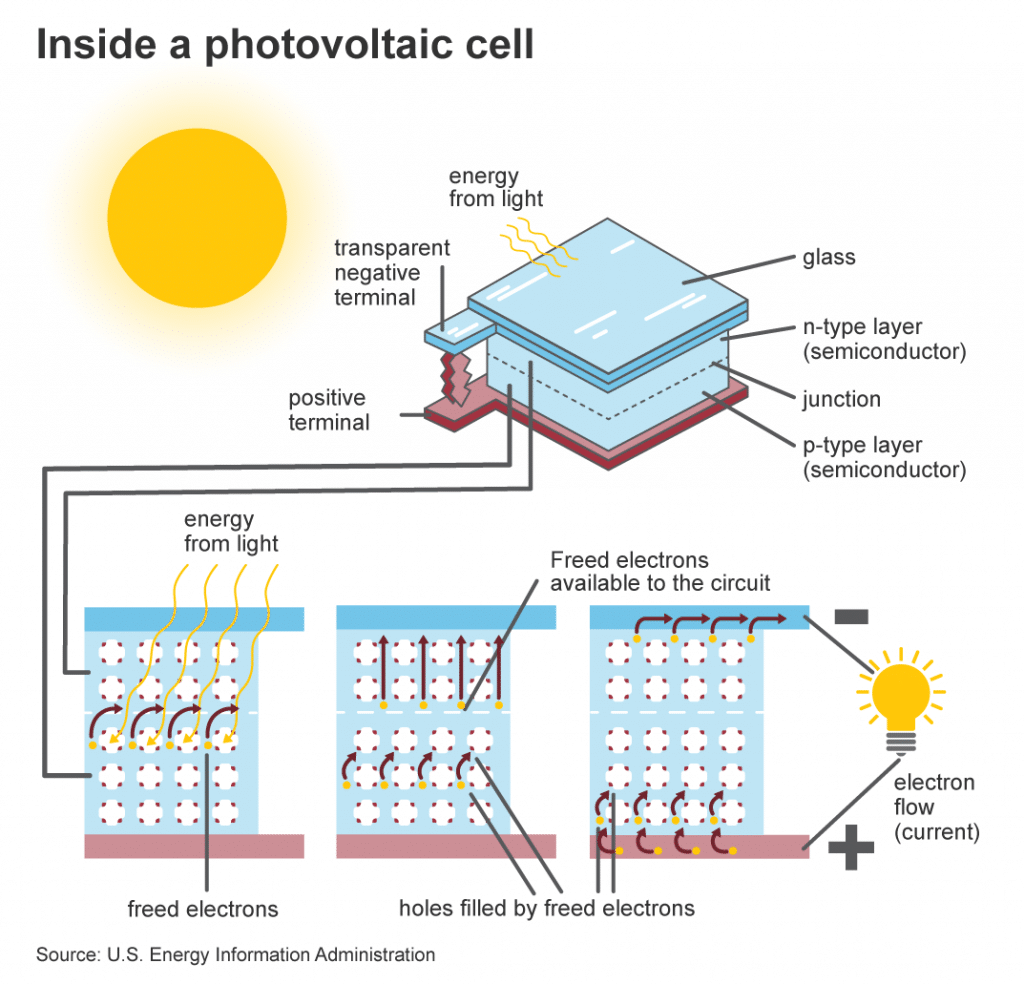
- A solar cell is a semiconducting device of silicon or other materials. It generates electricity when exposed to sunlight. Panels sit on an aluminium mounting system.
- Each cell has at least two semiconductor layers, one with a positive charge and one with a negative charge, meeting at a junction.
- Photons striking a cell are reflected, pass through or are absorbed.
- Absorbed photons free electrons.
- The junction drives the freed electrons to the n-type (negative) side, which creates a voltage difference.
- Connecting the two layers to an external load lets the electrons flow through the circuit. This is electricity.
- The output is direct current (DC), which inverters convert to alternating current (AC).
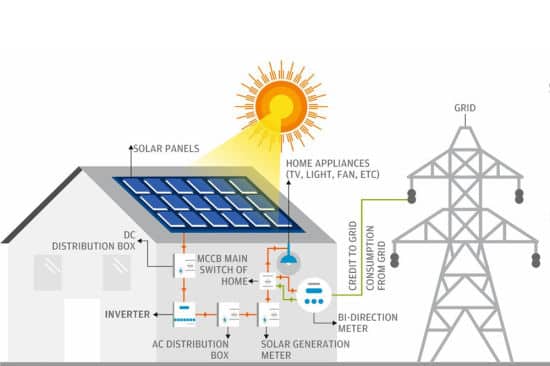
- This second figure is a rooftop net-metering set-up: the bi-directional meter records both the credit to the grid and the consumption from it.
Solar-Thermal Electricity
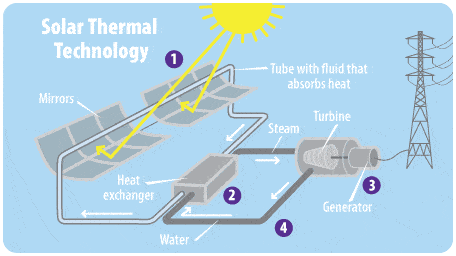
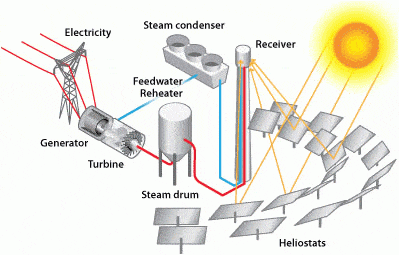
- Focused sunlight becomes high-temperature heat, which is channelled through a conventional generator.
- Collectors capture and concentrate sunlight to heat a fluid. Their shapes vary, and parabolic troughs are the commonest.
- In a trough plant, a curved, mirrored trough reflects direct radiation onto a glass tube carrying fluid. The hot fluid raises steam, which turns a turbine.
- Common fluids: synthetic oil, molten salt and pressurised steam.
- In a tower plant, a field of heliostats focuses sunlight on a central receiver.
- The generator gives alternating current directly. Inverters belong to the photovoltaic route.
Solar Energy Scenario in India
Resource and Distribution
- Sunshine: the tropical belt gives India peak radiation on about 300 days, or 2,300–3,000 hours of sunshine a year.
- This equals over 5,000 trillion kWh a year, far above national consumption.
- Daily incidence: 4–7 kWh per sq m, depending on the location.
- Where it is best: nearly the whole country, except parts of the high Himalaya.
- Thar Desert: holds the greatest promise. Older estimates gave 700–2,100 GW from 35,000 sq km, and a large part was named a Solar Energy Enterprise Zone, on the Nevada model.
- Others: the Kathiawar peninsula, Maharashtra, Karnataka, Andhra Pradesh, Telangana, Madhya Pradesh, West Bengal, Jharkhand, Bihar, Uttar Pradesh, Haryana and Punjab.
- Pattern: conversion potential is highest over western Rajasthan and Gujarat and falls towards the north-east, in line with the monsoon’s cloud cover.
- Potential: the National Institute of Solar Energy estimated about 748 GW, assuming that panels cover 3% of wasteland.
- A 2025 study by the same institute raised deployable ground-mounted potential to 3,343 GWp.
- An older outlook gave 363 GW of future capacity and 8% of global solar capacity by 2035.
Growth of Installed Capacity
| Date | Installed solar | Context |
|---|---|---|
| 2007-08 | 2.12 MW | Before the Solar Mission |
| 2012-13 | 1,446.76 MW | Phase I of the Mission |
| January 2014 | 2,208.36 MW | Gujarat leads |
| 31 March 2018 | 21,651 MW | A record 9,363 MW added in the year |
| 31 August 2021 | 44.3 GW | Dated figure kept |
| 31 December 2022 | 63.30 GW | Against the 100 GW target for 2022 |
| 30 September 2026 | 171.05 GW | Ground-mounted 125.65, rooftop 33.41, off-grid 6.63, hybrid solar component 5.36 |
- India had established nearly 42 solar parks by 2021 to give promoters ready land.
- Global position: India was described as the third-largest solar producer in 2026, after China and the USA.
- Why it matters:
- Energy security, in a country short of energy, with the energy crisis in view.
- Climate: the global warming debate is pushing the world from fossil fuels towards clean and green energy.
- Nature of the resource: pollution free, virtually inexhaustible and globally distributed, which makes it very attractive.
- Jobs: 1 GW of solar manufacturing gives about 4,000 direct and indirect jobs, and deployment, operation and maintenance add recurring work.
- Storage: advances here could transform the sector. Until then, rising renewable share can gradually cut dependence on fossil fuels.
- Leadership: India can become a global leader in turning this advantage into economic gain.
| State | January 2014 (MW) | 30 September 2026 (MW) |
|---|---|---|
| Rajasthan | 666.75 | 45,121.44 |
| Gujarat | 860.40 | 36,234.55 |
| Maharashtra | 237.25 | 20,399.93 |
| Tamil Nadu | 31.82 | 14,353.58 |
| Karnataka | 31.00 | 12,348.02 |
Constraints on Solar Growth
- Target shortfall: capacity passed 100 GW only by June 2025, about three years late. Rooftop solar, at 33.41 GW even in September 2026, is still short of its 40 GW goal.
- Land: large parks compete with pasture, farmland and fragile drylands.
- Wildlife: Great Indian Bustard habitat in Rajasthan and Gujarat constrains overhead lines. The Supreme Court acted on 19 April 2021, and recalibrated its order on 21 March 2024 with an expert committee.
- Evacuation: the best sites lie far from consumers. Green Energy Corridors address this, while the inter-State transmission waiver ended for projects commissioned after 30 June 2025, giving way to graded charges.
- Import dependence: in June 2026 India had 233 GW of module capacity but only about 42 GW of cells and 8.12 GW of ingots and wafers.
- Distribution companies: weak finances and late payments deter buyers. Letters of credit are now required for dispatch.
- Time of day: midday surplus and evening shortage make storage and flexible generation necessary.
India’s Climate Commitments
- India’s INDC (2015), to be met mainly by 2030:
- 40% of installed electricity capacity from non-fossil sources, with technology transfer and low-cost finance, including from the Green Climate Fund.
- Emissions intensity of GDP down by about a third, 33–35% from the 2005 level.
- An additional carbon sink (a means of absorbing carbon dioxide from the atmosphere) of 2.5–3 billion tonnes of CO₂ equivalent through added forest and tree cover.
- 100 GW of solar within 175 GW of renewable energy by 2022.
- Updated in August 2022: 45% intensity cut and 50% non-fossil capacity by 2030, with 500 GW of non-fossil capacity as the national goal. The 50% capacity share was reached in June 2025.
- NDC for 2031–35, approved by the Cabinet on 25 March 2026 and submitted on 24 April 2026:
- 47% intensity cut by 2035.
- 60% non-fossil capacity.
- Sink of 3.5–4 billion tonnes.
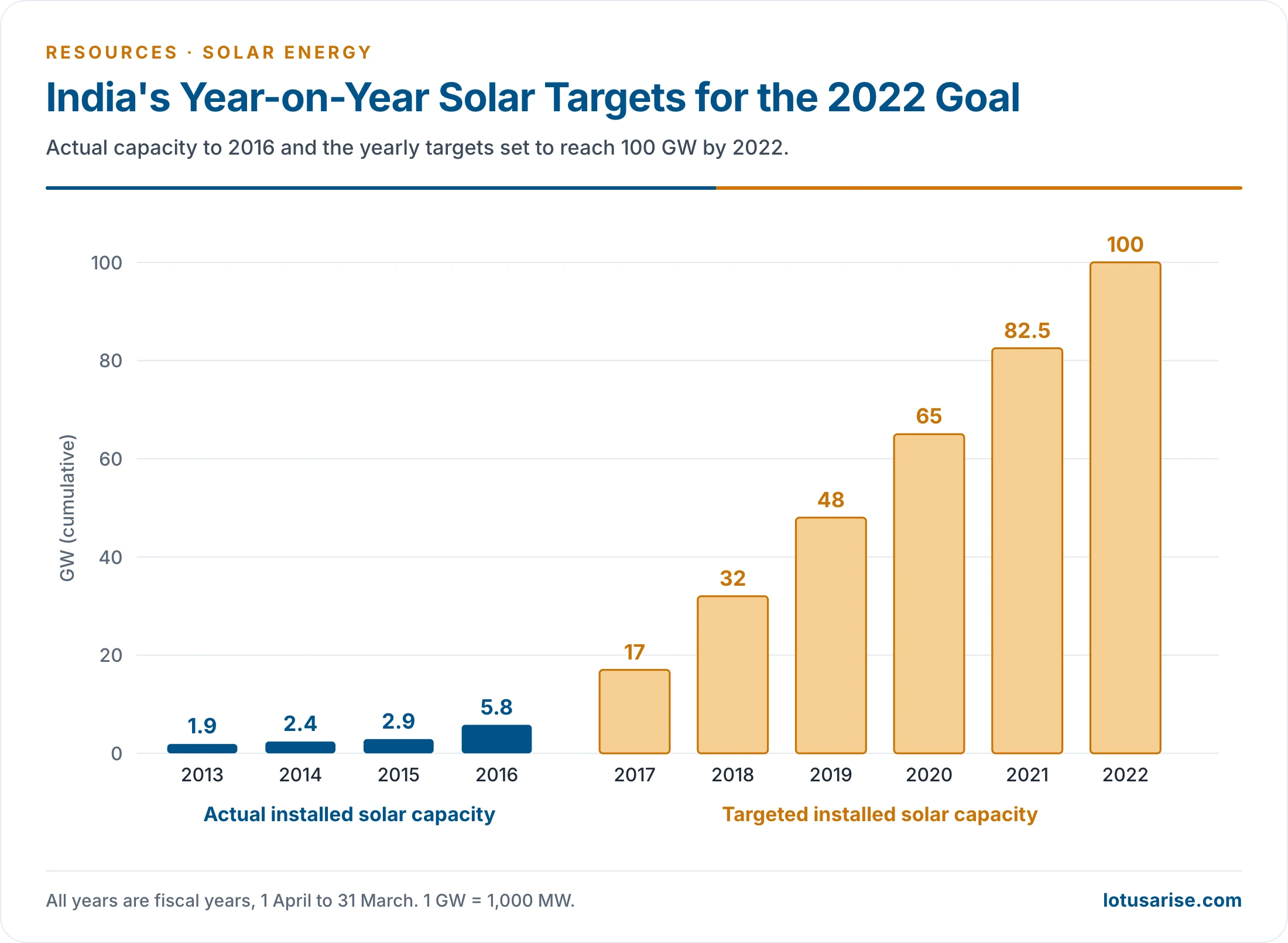
- This chart shows the old yearly path to 100 GW, with the actual figures ending at 5.8 GW in 2016. The real capacity at the end of 2022 was 63.30 GW.
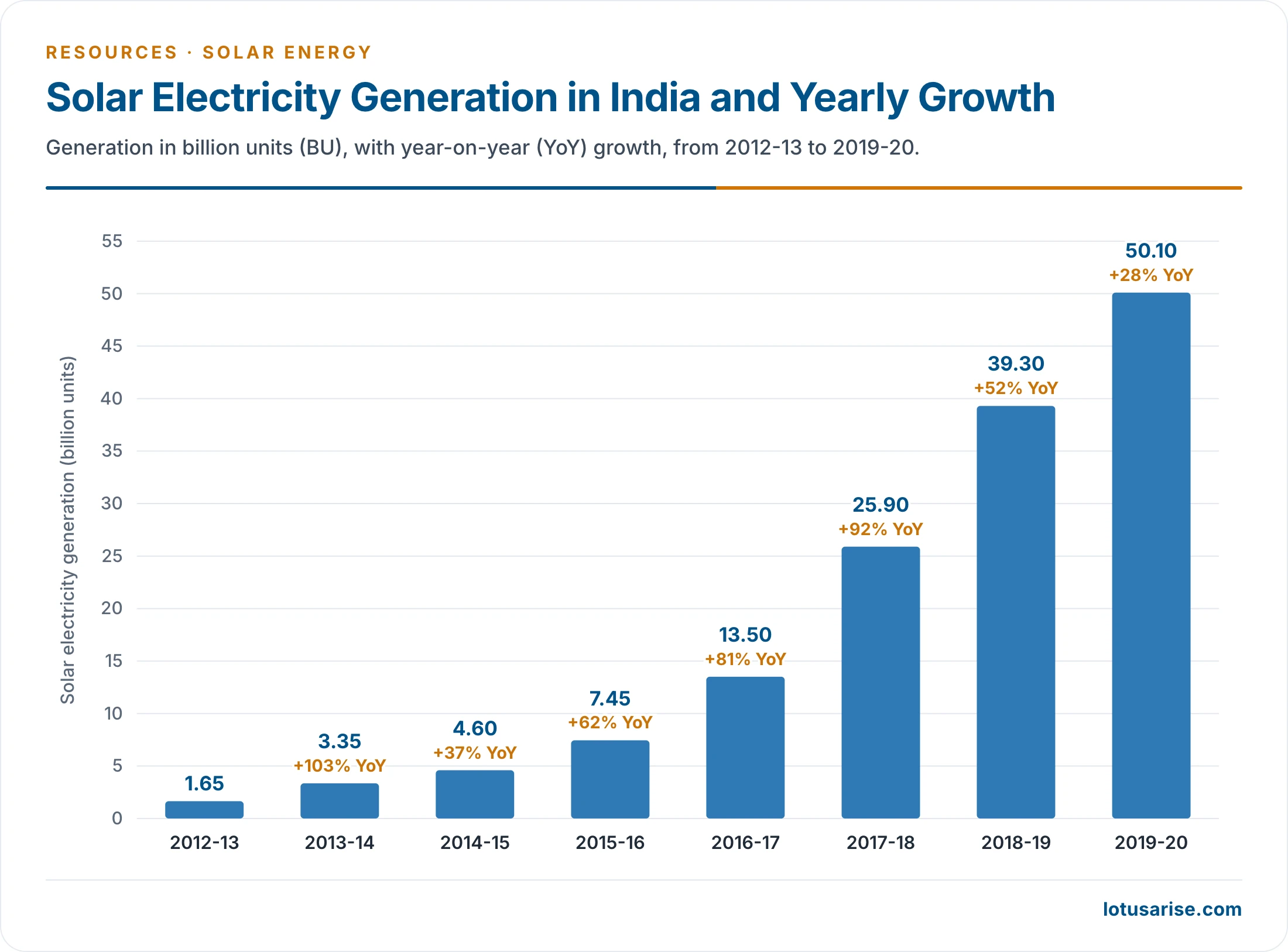
- This chart ends at 50.10 billion units in 2019-20, and solar generation has grown strongly since.
Government and International Initiatives
Government Initiatives
- The Ministry of New and Renewable Energy is the nodal agency.
- Lineage: Department of Non-conventional Energy Sources (1982), Ministry of Non-conventional Energy Sources (1992), and MNRE since 2006.
- Older estimates put non-conventional potential at about 1,95,000 MW, with 31% from the Sun.
- National Solar Mission: the main joint initiative of the Centre and States for ecologically sustainable growth and energy security.
- Indian Renewable Energy Development Agency (IREDA): set up in 1987, a non-banking financial institution under the Ministry, lending to renewable energy and energy efficiency projects.
- National Institute of Solar Energy (NISE): an autonomous body and the apex institution for research and development.
- Solar parks and ultra mega solar projects, with stronger grid connectivity.
- Canal-bank and canal-top solar: panels along or over canals, saving land and cutting evaporation.
- Sustainable Rooftop Implementation of Solar Transfiguration of India (SRISTI): a scheme for rooftop projects.
- Suryamitra: trains a qualified workforce.
- Renewable purchase obligation for large consumers, since followed by a renewable consumption obligation to 2029-30.
- Green energy programme and Green Energy Corridor: dedicated lines for renewable power.
- PM Surya Ghar: Muft Bijli Yojana (February 2024): ₹75,021 crore for rooftop solar and up to 300 free units a month for one crore households by 2026-27.
- By 18 July 2026, 47.26 lakh households had benefited.
- Older programmes: a subsidy-based thermal extension programme (1984–93), then market-led schemes covering solar cookers, buildings, research and Aditya Solar Shops.
Jawaharlal Nehru National Solar Mission
- One of the eight missions under the National Action Plan on Climate Change (NAPCC), released on 30 June 2008.
- The Mission itself was launched on 11 January 2010, with a first target of 20 GW by 2022.
- In June 2015, the Cabinet Committee on Economic Affairs (CCEA) raised this to 100 GW by 2022. The clearance matched the wider national goal.
- The 100 GW was split into two parts:
- 40 GW of grid-connected rooftop solar.
- 60 GW of large and medium grid-connected projects.
- The Mission’s other targets ran alongside:
- Solar thermal collector area: 7 million sq m in Phase I (2010–13), 15 million by 2017 and 20 million by 2022.
- 20 million solar lighting systems for rural areas by 2022.
- Its tools: generation-based incentives, preferential tariffs and purchase obligations, along with research for indigenous technology.
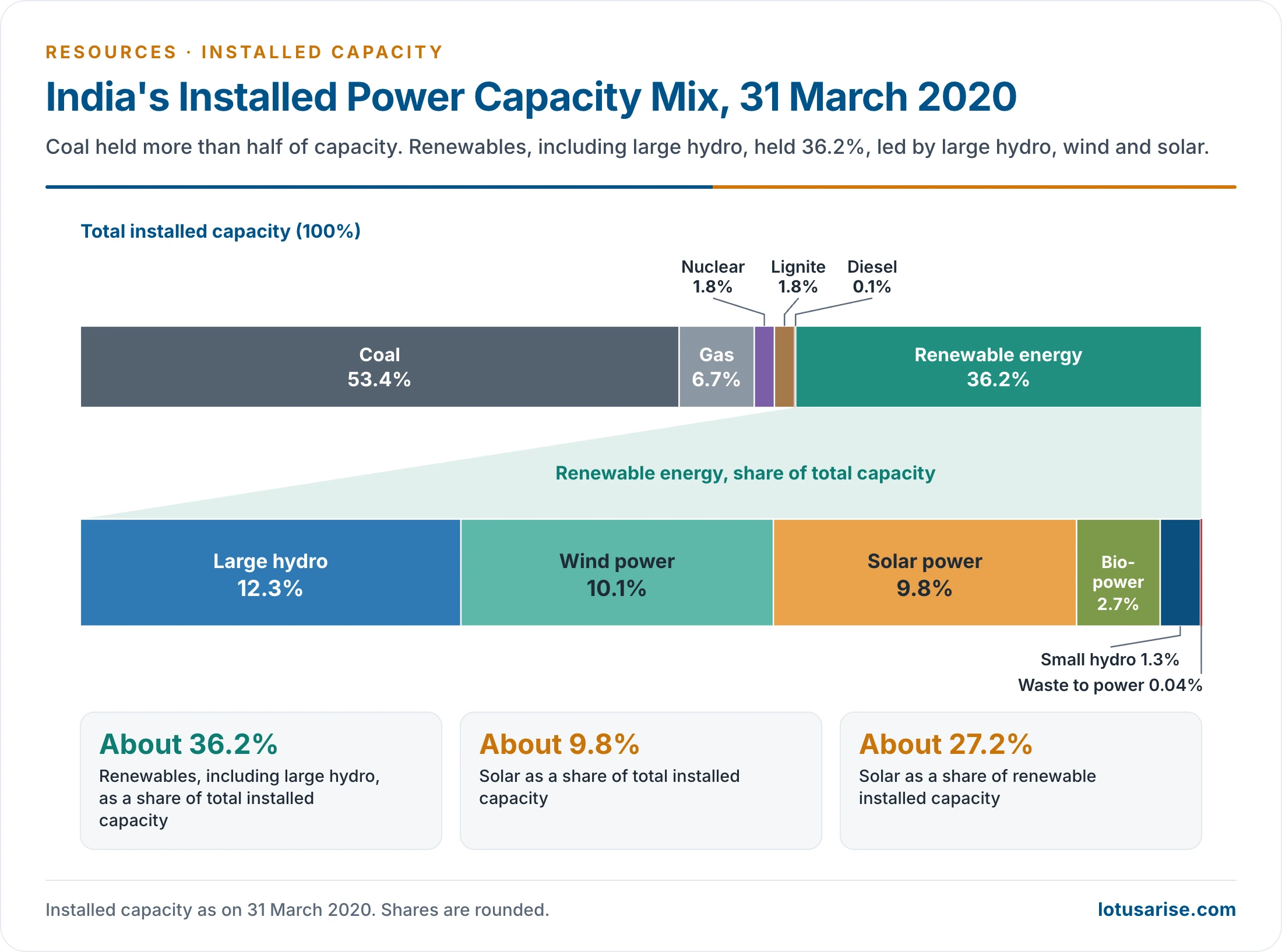
- This chart shows the mix on 31 March 2020, when solar had 9.8% of capacity. It had risen to 30.6% by 30 September 2026.
International Initiatives
- Paris commitments: the emissions-intensity and 40% capacity pledges were India’s offer at the Paris climate talks.
- International Solar Alliance (ISA): launched by India and France at Paris in 2015, with headquarters at Gurugram.
- Membership: first aimed at sunshine countries lying wholly or partly between the Tropics of Cancer and Capricorn, once counted as more than 122. It has been open to all UN members since 15 July 2020. In June 2024 there were 119 signatories and 98 ratifications.
- Goal: to mobilise more than US$1,000 billion of investment by 2030 for massive deployment of solar energy, and to prepare future technologies suited to members’ needs.
Major Solar Power Parks in India
| S.No | Solar park | State | Capacity (MW) |
|---|---|---|---|
| 1 | Bhadla | Rajasthan | 2,245 |
| 2 | Pavagada | Karnataka | 2,050 |
| 3 | Kurnool Ultra Mega | Andhra Pradesh | 1,000 |
| 4 | NP Kunta | Andhra Pradesh | – |
| 5 | Rewa Ultra Mega | Madhya Pradesh | 750 |
| 6 | Charanka | Gujarat | 500 planned |
| 7 | Kamuthi | Tamil Nadu | 648 |
| 8 | Ananthapuramu – II | Andhra Pradesh | – |
| 9 | Galiveedu | Andhra Pradesh | – |
| 10 | Mandsaur | Madhya Pradesh | – |
- More plants appear in the list of solar power plants.
Bhadla Solar Park
- Location: Bhadla in Phalodi in the Thar Desert, Rajasthan. Phalodi was a tehsil of Jodhpur district and now has its own district.
- Area: about 14,000 acres (about 56 sq km). An older figure of 45 sq km understates it.
- Capacity: 2,245 MW, built in four phases, with an investment of about ₹10,000 crore (US$1.3 billion).
- Rank: once called the world’s largest, it stood about 11th in the world in 2026.
- Site: described as “almost unlivable”, with temperatures of 46–48°C, frequent hot winds and sand storms, and sandy, dry, arid land.
Pavagada Solar Park
- Location: Pavagada taluk, Tumakuru (Tumkur) district, Karnataka, over 53 sq km (13,000 acres).
- Capacity: 2,050 MW, completed in 2019.
- Rank: described as the world’s second largest photovoltaic park, after Bhadla, when finished.
Kurnool Ultra Mega Solar Park
- Location: Panyam mandal, Kurnool district, Andhra Pradesh, over 5,932.32 acres.
- Capacity: 1,000 MW, built for around ₹7,000 crore (US$980 million) by developers and the Central and State governments.
- Commissioned from 29 March 2017, reaching full capacity that October. Owned by Andhra Pradesh Solar Power Corporation Private Limited (APSPCL).
NP Kunta Ultra Mega Solar Park
- Also known as the Ananthapuram Ultra Mega Solar Park.
- Location: Nambulapulakunta mandal, Ananthapur district, Andhra Pradesh, over 7,924.76 acres.
- First commissioned in May 2016; owned by APSPCL.
Rewa Ultra Mega Solar
- Location: Gurh tehsil, Rewa district, Madhya Pradesh. Capacity: 750 MW, full by January 2020, and dedicated on 10 July 2020.
- Grid parity: it was the first Indian solar project to break the grid parity barrier, and was described as Asia’s largest single-site plant.
- Implementing agency: Rewa Ultra Mega Solar Limited (RUMSL), a joint venture of Madhya Pradesh Urja Vikas Nigam Limited (MPUVNL) and the Solar Energy Corporation of India (SECI).
- Firsts: the first to supply an inter-State open access customer, the Delhi Metro, which takes about 24% of its power, and the first where solar power serves railway traction.
- It won the World Bank Group President’s Award for its transaction structure.
Charanka Solar Park
- Gujarat Solar Park-1, on a 2,000-hectare (4,900-acre) plot near Charanka village, Patan district, northern Gujarat. It was once described as Asia’s largest park, and generated 345 MW by March 2016.
Kamuthi Solar Power Project
- A photovoltaic power station of 648 MW over 2,500 acres at Kamuthi, Ramanathapuram district, about 90 km from Madurai, Tamil Nadu. It was completed on 21 September 2016.
Kadapa Ultra Mega Solar Park
- Location: Mylavaram mandal, Kadapa district, Andhra Pradesh, over 5,927.76 acres. Planned at 1,000 MW, approved in August 2015.
- Implemented by APSPCL, a joint venture of SECI, Andhra Pradesh Power Generation Corporation and the New & Renewable Energy Development Corporation of Andhra Pradesh.
Khavda Renewable Energy Park
- In the Kachchh salt desert, Gujarat, over about 538 sq km, this solar and wind complex aims at 30 GW by 2029. It had reached about 9.4 GW by April 2026.
Ultra Mega Solar Power Projects
- Also called Ultra Mega Solar Parks, these are a series of projects planned by the Ministry of New and Renewable Energy.
- January 2014: the Ministry announced a first project of 4,000 MW at Sambhar in Rajasthan, with similar plans for Kharaghoda (Gujarat) and for Ladakh and Kargil.
- December 2014: a scheme was introduced for at least 25 solar parks and ultra mega projects, adding over 20 GW, with Central financial support.
- July 2026: 56 parks of 39,461 MW had been sanctioned in 14 States, with 18,919 MW commissioned.
Previous Year Questions
2023Discuss the green energy initiatives of India as a signatory nation to the Paris Agreement.2022The peninsular location of India provides scope for harnessing non-conventional energy resources. Discuss with examples.2021Discuss the importance of solar energy in the future economic development of India.2018Keeping the recent developments in view, how can the energy crisis of India be circumvented by harnessing non-conventional energy resources?2017Why has solar energy in India not been developed to the desired level in spite of its high potential?2016Give an account of the development of renewable resources of India.2005“Non-conventional energy is the energy of the future in India.” Justify this statement.





Thanku god….
Thankyou so much Lotus arise following since 2021