

- The determinants of agriculture are the conditions that decide what a region grows, how it farms and how much it harvests, and so explain its farm practices, cropping pattern and productivity.
- Their roots are geo-climatic, socio-economic and cultural-political, and they fall into four working groups:
- Physical factors: terrain, topography, climate and soil.
- Institutional factors: land tenure, tenancy, size of holdings and fields, and land reforms.
- Infrastructural factors: irrigation, electricity, roads, credit and marketing, storage, crop insurance and research.
- Technological factors: high-yielding varieties of seed brought in by the Green Revolution, chemical fertilizers, insecticides, pesticides and farm machinery.
- These factors work singly and in combination, so the level of farm development and crop yield in any region is the product of all four.
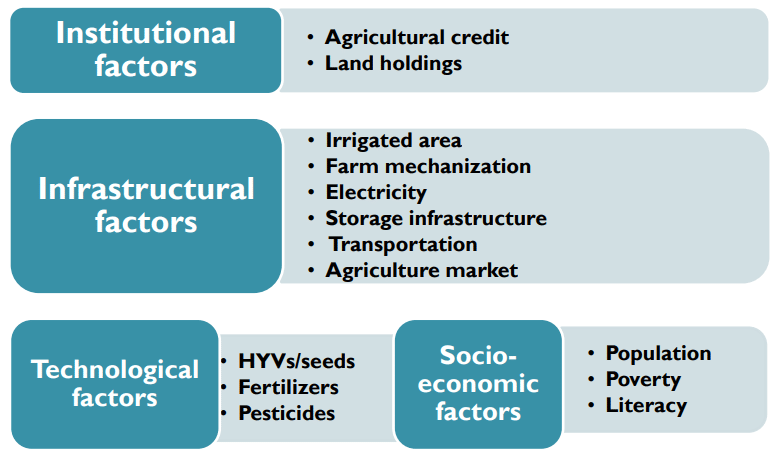
- The chart adds a fifth group, socio-economic factors (population, poverty, literacy). It lists credit as institutional, though credit is equally a service, like roads and storage.
- Human effort eases physical limits but never removes them. Irrigation has carried cultivation into dry lands, manures restore tired soil and pesticides protect crops, yet the physical base still sets the wider frame.
Physical Factors
- Terrain, topography, climate and soil act together on farming, each to a different degree.
Terrain, Topography and Altitude
- Farming depends closely on geo-ecological conditions: the lie of the land, its slope and its height. Temperature falls steadily with height, so altitude alters crop choice, productivity and farm operations.
| Landform | Why it helps or hinders | Farming that results |
|---|---|---|
| Plains | Low altitude, gentle slope, easy ploughing and harvest, usually fertile soil | Intensive rice and wheat, with cotton, jute, sugarcane, pulses and coarse grains in the Great Plain; rice and coconut on the coasts |
| Plateaus | Usable in parts; dissected surfaces, scarps, bare rock and shallow soil elsewhere | Rice, wheat, cotton, sugarcane, tobacco and some plantations in the Peninsula |
| Mountains | High, steep, cold, thin air and immature soils | Terraced fields; tea and coffee on the eastern Himalayan and Nilgiri slopes |
- Crops seek particular ground:
- Paddy needs levelled fields that hold standing water.
- Tea does well on undulating land, because standing water harms its roots.
- Coconut keeps to low altitudes near the sea, and apple orchards in tropical and sub-tropical latitudes do well above 1,500 m.
- Height limit: in these latitudes crops are rarely grown above 3,500 m, where thin air, cold and scarce oxygen hamper both cropping and dairy cattle.
- Slope: steep ground erodes, resists tillage and rules out machinery, so farm power and machinery spread first on the plains, and terrace farming is the answer on steep slopes.
- Gullied land is the least suited to cropping: the Chambal ravines of Madhya Pradesh, Rajasthan and Uttar Pradesh have taken thousands of hectares of good farmland out of use.
- Relief steers rainfall: the windward Western Ghats get about 250–300 cm, the leeward side about 75–100 cm. Rainfall in turn decides the crop: West Bengal can grow jute, and Rajasthan cannot.
- The western Himalaya shows the altitude effect as a ladder of agro-climatic belts:
| Height | Climate type | Land use |
|---|---|---|
| Up to about 750 m | Sub-tropical continental monsoon | Wheat, barley, rice, maize, vegetables |
| About 750–1,500 m | Warm temperate continental monsoon | Wheat, barley, rice, maize, potato, ginger, peach, pear, plum, apricot, almond |
| About 1,500–2,500 m | Cool temperate continental monsoon | Wheat, barley, rice, potato, apple, pear, cherry, walnut |
| About 2,500–3,250 m | Cold temperate continental monsoon | Small millets, barley, apple, sheep-farming |
| About 3,250–4,500 m | Alpine continental | Alpine meadows and elfin scrub |
| Above about 4,500 m | Frigid continental | Snow |
Climate
- Climate is among the most powerful controls on agricultural land use and cropping patterns, and temperature governs every form of farming.
- Regions short of heat are short of agriculture, because heat is the one element people cannot yet supply cheaply on a large scale.
- Temperature fixes the length of the growing period. In low latitudes, India among them, nearly the whole year is a growing season and farm work is timed by rainfall; in high latitudes, long summer days make up for the short season.
Temperature
- Each crop has a specific zero, below which it will not grow, and an optimum, at which it is most vigorous. Each stage (germination, foliation, blossoming, fruiting) has its own zero and optimum.
- Wheat can be grown in Punjab in November–December because the season is cool; Keralam (Kerala) cannot grow it then.
- Apples grow in Himachal Pradesh and Jammu and Kashmir, not in Chennai.
- Plant metabolism starts at a minimum temperature, quickens up to the optimum, then slows and stops at the maximum. These three values are the cardinal temperature points.
| Crop | Minimum (°C) | Optimum (°C) | Maximum (°C) |
|---|---|---|---|
| Rice | 10–12 | 30–32 | 36–38 |
| Wheat | 4–5 | 25 | 30–32 |
| Maize | 8–10 | 31.5–35 | 38–40 |
| Lentil | 4–5 | 30 | 36 |
| Tobacco | 12.7–14 | 28 | 35 |
| Sugarcane | 21.1 | 32.2–37.7 | 38.5 |
- Heat units: every crop needs a set total of effective heat to germinate, stalk, mature and ripen. This is its thermal constant, and it differs from crop to crop.
- Crop groups:
- Tropical crops such as cocoa, coffee, spices and rubber need over 18 °C even in the coldest months.
- Wheat, gram, peas, lentil, potato, mustard and rapeseed need about 20 °C while growing, cooler at sowing and warmer (over 25 °C) at ripening and harvest.
- Indian pattern: cool north-western winters favour wheat.
- Ladakh grows wheat as a summer crop, because its winter is too cold for any crop, while Punjab and Haryana grow it in winter.
- Sugarcane grows in both north and south, but the south is warmer, and cultivation has been drifting there.
Frost
- The frost-free season, the days on which temperature stays above freezing, is effectively the growing season.
- Frost kills or damages rice, sugarcane, jute, cotton, chilli and tomato. South India is free of the danger; in North India winter frost is common, and a sudden spell can ruin standing crops.
Moisture
- Every crop needs moisture, which it draws from the soil, fed by rain or irrigation. Within wide temperature limits, moisture matters more to crop production than any other element of climate.
- There is an optimum for moisture, as for temperature:
- Too much water cuts soil oxygen, builds up compounds toxic to roots, stunts the plant and carries nutrients deep out of reach. Drainage is the remedy.
- Too little can be made up by irrigation.
- Heavy rain damages plants directly or disturbs flowering and pollination. It lodges (flattens) cereals, and rain at maturity of wheat, gram, millets, oilseeds and mustard costs both grain and fodder.
Rainfall
- Rainfall has the strongest single hold on where and how intensively farming takes place, and on the farmer’s choice of crop. It turns into a hazard when it is scanty, concentrated, intense, variable or unreliable.
- Amount: the 100 cm isohyet broadly divides India’s rice lands (above it) from its wheat lands (below it). Below about 50 cm, low-water crops such as jowar, bajra and maize take over.
- Timing: most crops want rain while growing and a dry spell at ripening.
- September rain matters for rice in northern India.
- Winter rain helps wheat in the north-west.
- Ragi in the south suffers without rain in October and November.
Drought
- Soil drought sets in when the water needed for transpiration and direct evaporation exceeds the water held in the soil, so plants can no longer draw enough moisture.
- Drought-prone areas lie mainly in Rajasthan, Gujarat, Maharashtra, Karnataka, Telangana, Andhra Pradesh, Tamil Nadu and Bundelkhand, with pockets in other States.
- Where annual rainfall is below 75 cm, farming is a gamble on the monsoon. The Vidarbha region of Maharashtra, with thin irrigation cover, has a high incidence of farmer suicides after crop failure in drought.
- Response: drought-prone areas practise dryland farming, and wetter regions carry intensive paddy.
Snow
- Snow lowers ground temperature and keeps fields frozen, which delays sowing and growth, and melting snow can bring summer floods.
- In the higher Himalaya, thick snow buries pasture and suspends farm work till summer, so flocks move downhill in winter and uphill in summer (transhumance), as in Jammu and Kashmir and Himachal Pradesh.
- Snow also helps: snowmelt feeds irrigation and springs, the cold suits apple orchards at lower altitudes, and snow over potato fields in Himachal Pradesh is welcomed as the sign of a good crop.
Winds
- Direct effects are mechanical: stems break, cereals and fodder lodge, seed-heads shatter, mangoes fall in the May–June storms, cyclones ruin coastal orchards and blown sand buries seedlings.
- Indirect effects come through the transport of moisture and heat: moving air raises evaporation and transpiration, and can leave plants short of water.
- Wind erosion in Rajasthan and the adjoining parts of Haryana and Gujarat can strip soil down to rock and end cultivation.
Sunlight
- Plants use sunlight for photosynthesis and for making chlorophyll. Better light gives sturdier, more compact plants.
Soils
- Soil governs cropping patterns, crop associations and output through its texture, structure, humus and fertility.
| Soil | Typical area | Crops suited |
|---|---|---|
| Alluvial | River valleys | Wheat, maize, barley, gram, oilseeds, pulses, sugarcane |
| Clayey loam, fine-grained | Ganga–Brahmaputra delta | Rice, jute |
| Black (regur) | Maharashtra and the Deccan lava | Cotton, wheat, oilseeds |
| Sandy and sandy loam | Rajasthan | Jowar, bajra, groundnut, guar, pulses (green, black and red gram) |
| Red and yellow | Peninsula | Jowar, groundnut, sugarcane |
- Saline and alkaline tracts, often the result of faulty irrigation, as in parts of Punjab and Haryana, give no useful crop until reclaimed with amendments, manures and fertilizers, which is slow and costly.
Institutional Factors
Land Tenure and Tenancy
- Land tenure is the system that settles who holds rights in land.
- Land held collectively by early and shifting-cultivator societies later passed to rulers, the state, or zamindars and talukdars, and British rule set up the zamindari, ryotwari and mahalwari systems to secure revenue.
- After Independence, land reforms abolished zamindari and sought to give land to the tiller, with partial success.
- Why tenure matters: a tenant on an insecure, oral lease, or paying a heavy crop share, has little reason to invest in wells, soil or new inputs.
- Former zamindari tracts of Bihar and eastern Uttar Pradesh took up Green Revolution technology later than owner-cultivated Punjab.
- Operation Barga (from 1978) in West Bengal raised output by recording and securing sharecroppers.
Land Holdings
- The average operational holding keeps shrinking as landholders multiply: 2.28 hectares in 1970-71, 1.15 hectares in 2010-11 and 1.08 hectares in 2015-16.
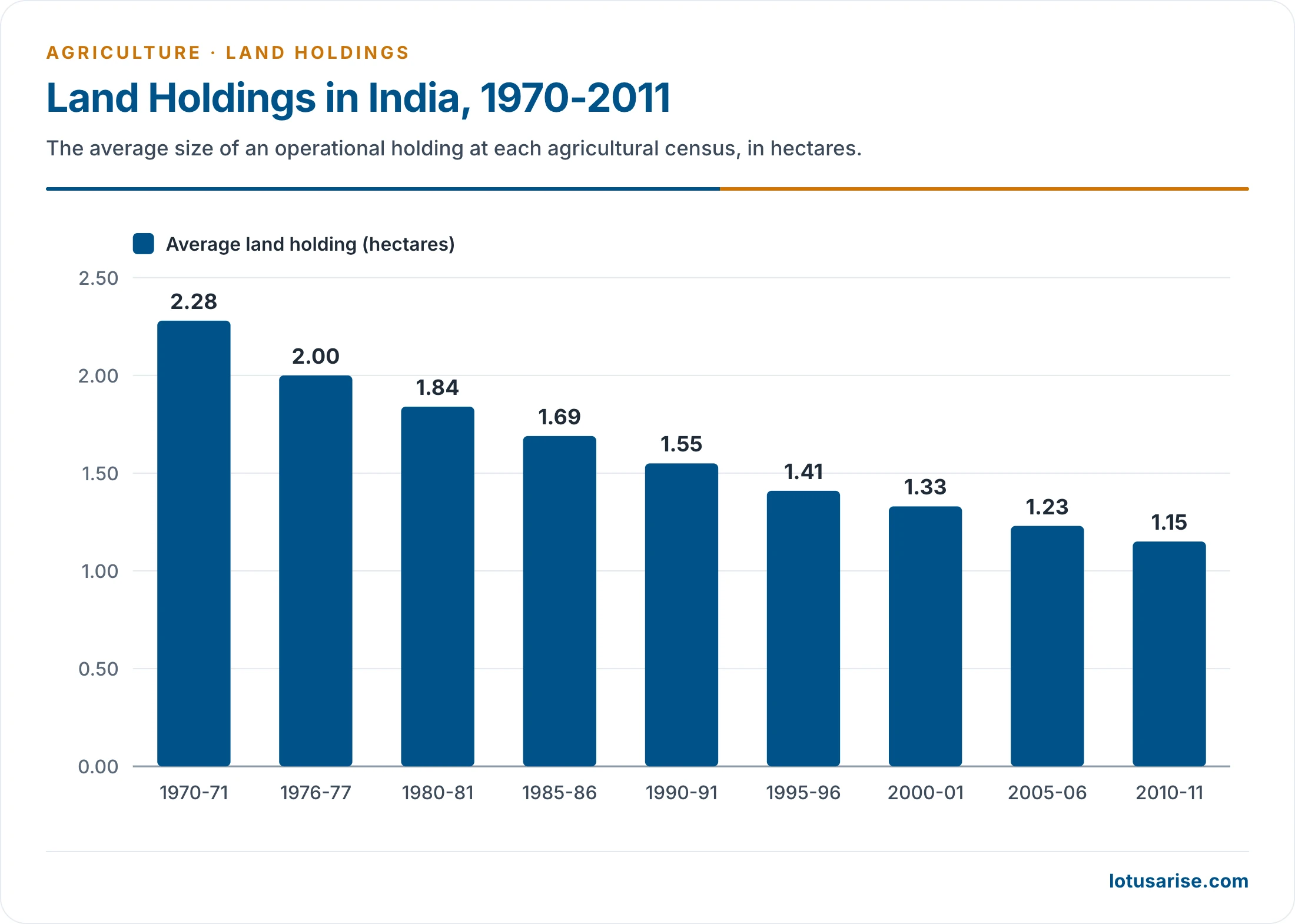
- Small and marginal farmers, with under 2 hectares, held 86.08% of holdings in 2015-16 but operated only 46.94% of the area. Holdings this small are rarely viable.
- Causes:
- Fragmentation of holdings into scattered plots.
- Few off-farm jobs, which keeps families on the land.
- Inheritance laws that divide property equally among heirs.
- Effects:
- Small and marginal farmers have a poor economic base, which holds back the farm sector as a whole.
- High fragmentation has hindered the spread of modern technology.
- Small owners can seldom afford irrigation, fertilizers, pesticides, better seeds and machinery, and yields stay low.
- Crop pattern: small holders favour subsistence food crops and low-risk mixtures, while larger owner-cultivators with credit and assured procurement move into rice-wheat, sugarcane or cotton, as in Punjab and Haryana.
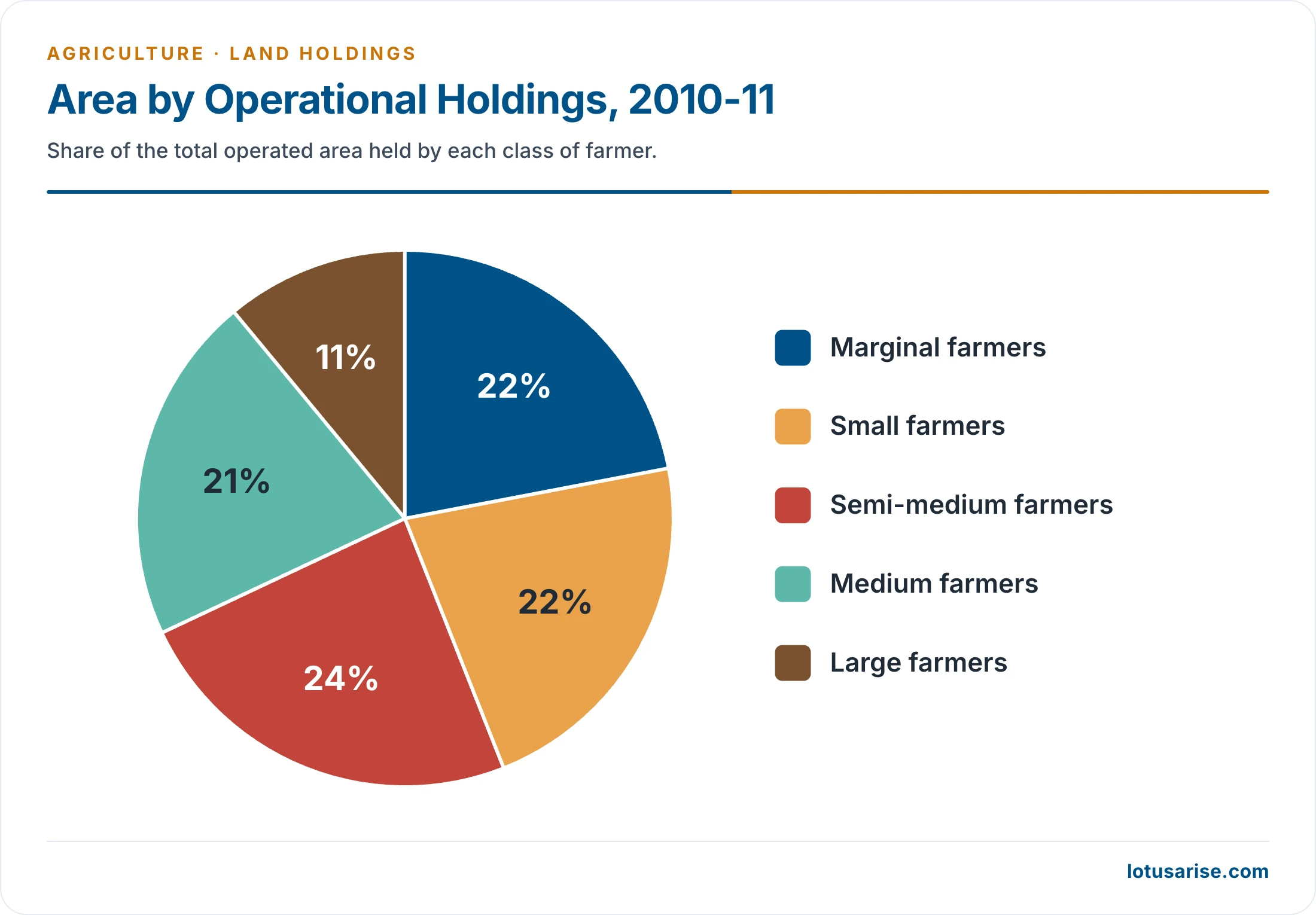
- The pie shows 2010-11; the table gives the 2015-16 census.
| Class (hectares) | Share of holdings, 2015-16 | Share of area, 2015-16 | Average size (hectares) |
|---|---|---|---|
| Marginal (under 1) | 68.45% | 24.03% | 0.38 |
| Small (1–2) | 17.62% | 22.91% | 1.40 |
| Semi-medium (2–4) | 9.55% | 23.84% | 2.69 |
| Medium (4–10) | 3.80% | 20.16% | 5.72 |
| Large (10 and above) | 0.57% | 9.07% | 17.07 |
- Economic holding: the Congress Agrarian Reforms Committee (1949) defined it as a holding that gives a reasonable living and full employment to a family of normal size.
- Its size falls with fertile soil, assured irrigation and intensive farming, and rises with mechanisation, which pays only on larger holdings.
- About 2 hectares of vegetables can keep a family busy all year, whereas wheat may need about 8.
- State pattern (2010-11): from 0.22 hectare in Keralam to 5.99 hectares in Nagaland.
- Large averages in Nagaland and Arunachal Pradesh (rough terrain, forest, shifting cultivation) and Rajasthan (desert) mean little.
- In Punjab, Haryana, Uttar Pradesh and Madhya Pradesh, inheritance has undone much of the gain from consolidation.
Agricultural Credit
- Farmers need credit for both investment and working capital, and demand rose sharply after the mid-1960s, when costly inputs became central to farming.
- Credit for farmers must be easy, adequate and timely. Yet a large part of the rural population remains outside formal banking, despite a wide network of rural financial institutions (RFIs).
- Reasons for thin credit flow:
- The long gestation of farm investment.
- Too few trained staff to identify viable activity.
- Weak eligibility and poor security.
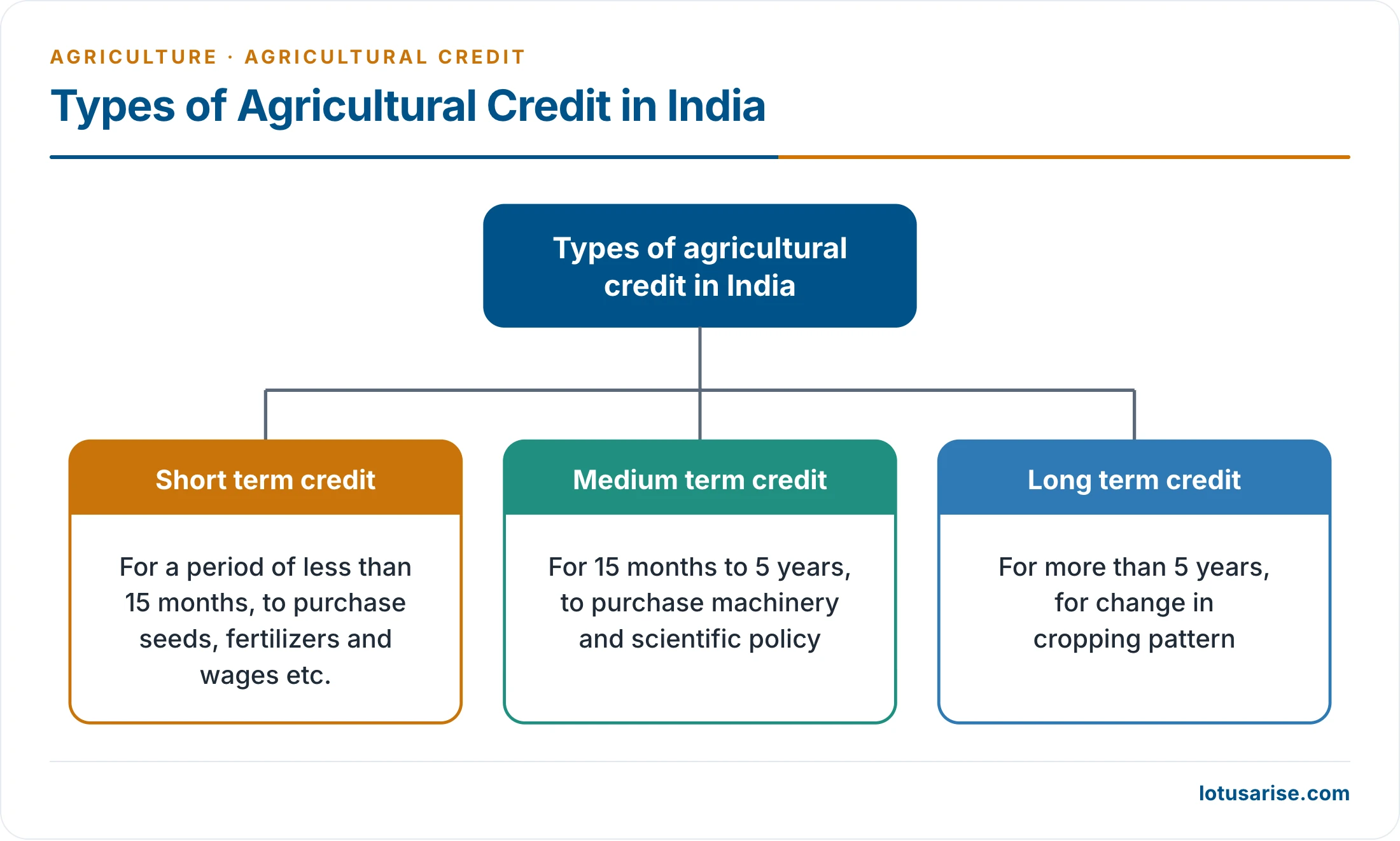
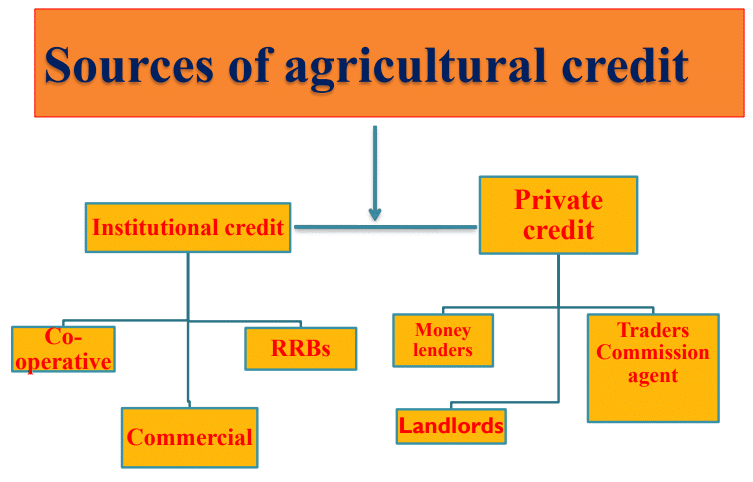
- Non-institutional lenders: the village moneylender is easy to reach but charges high interest, and failure to repay can cost the farmer his mortgaged land.
- Institutional growth came in three phases:
| Phase | Period | Main agency |
|---|---|---|
| First | 1947–1969 | Cooperatives |
| Second | 1969–1975 | Commercial banks, after the nationalisation of 14 banks in 1969 |
| Third | From 1975 | Regional Rural Banks, for small and marginal farmers and weaker sections |
- Cooperative structure:
- Short-term credit runs through three tiers: State Cooperative Banks, District Central Cooperative Banks and Primary Agricultural Credit Societies.
- Long-term credit runs through the cooperative agricultural and rural development banks.
- Supporting bodies and schemes:
- NABARD, set up in 1982, refinances the system, and handles development and supervision.
- The Rural Infrastructure Development Fund dates from 1995-96.
- Kisan Credit Cards came in 1998-99. On 3 August 2026, 7.28 crore accounts were operational, with Rs 10.08 lakh crore outstanding.
- Self-help group–bank linkage began in 1992.
- Scale: institutional credit to farming reached about Rs 25.49 lakh crore in 2023-24, against Rs 6.07 lakh crore in 2012-13.
Recent Institutional Changes
- Tenancy and land records: the Model Agricultural Land Leasing Act, 2016 seeks to legalise and secure leasing, and land records are being digitised.
- Markets and collectives: e-NAM (2016) links regulated markets online, and 10,000 Farmer Producer Organisations are being formed under a 2020 scheme. The three farm laws of 2020 were repealed in 2021.
- Income support: PM-KISAN (2019) pays Rs 6,000 a year to landholding farmers.
- Impact: few States have adopted the leasing model, and e-NAM and FPOs still reach a small share of farmers, so tiny holdings and informal tenancy remain the main institutional drag.
Infrastructural and Technological Factors in Brief
- Irrigation: assured water, the main route to higher and steadier output. In 2023-24, 59.3% of net sown area was irrigated.
- Power: runs pumps and machines. Farming took 19.29% of India’s electricity in 2022-23.
- Roads: villages need all-weather links to sell produce and buy inputs, above all perishables. Pradhan Mantri Gram Sadak Yojana was launched in December 2000.
- Insurance: it compensates for yield losses from natural risks. Pradhan Mantri Fasal Bima Yojana dates from 2016 and has paid about Rs 1.96 lakh crore in claims up to December 2025.
- Marketing: regulated markets rose from 286 in 1950 to 7,157 in 2010, under State laws, to protect sellers from malpractice.
- Storage: the Food Corporation of India, the Central and State Warehousing Corporations and rural godowns reduce distress sale and grain loss.
- Seeds, fertilizers and machinery: the technological package. Other inputs are only as useful as the seed they serve.
Previous Year Questions
2024Institutional factors are playing a dominant role in controlling agricultural prosperity in India. Justify with evidence.2022Discuss the recent changes brought about in institutional frameworks of agriculture in India. Evaluate its impact on the agrarian economy of the country.2015Explain how modernisation of Indian agriculture is affected by unfavourable institutional factors with suitable examples.2013Discuss the role of institutional factors in shaping the pattern of Indian agriculture.2007“The institutional factors have grip over the crop pattern and crop productivity on Indian agriculture.” Justify.1999Critically examine the role of infrastructural and institutional factors in the recent transformation of Indian agriculture.1998Discuss the role of institutional factors in the efficiency and productivity of agriculture in India.1995Discuss the role of infrastructural, scientific and technological developments in the recent transformation of Indian agriculture.1993Explain the role of institutional factors in the development in agriculture in India.1986Give an account of the infrastructural factors necessary for promoting agricultural development in the dry zones of India with specific examples.





Excellent Sir ji 🙏🙏🙏
Thanks, Mohit
Superv sir ji
thanku so much sir you have done a great job.
🙂
Aise notes dalte rho
Join the Discussion
Please sir write a easy determinants of agriculture land use – physical, economic,social and technological, land holding and land tenure system
Social economics