

- A multinational company (MNC), also called a transnational corporation (TNC) or multinational enterprise (MNE), carries on business in more than one country besides its home country. The theme belongs to the Industry unit of Geography of India.
- MNCs operate at once in many countries, so they are also called global enterprises.
- Main offices (headquarters) stay in the home country.
- Secondary offices, assets and factories lie in host countries.
- The United Nations treats an MNC as a firm that owns or controls production or service units abroad, beyond its base country.
- In India, MNCs moved from tight restriction before 1991 to near parity with Indian firms afterwards, and they now shape clusters, exports and regional imbalance.
Multinational Companies
Nature and Scale
- MNCs are multi-process and multi-product enterprises. Sony of Japan, IBM of the USA, Siemens of Germany, and Videocon and ITC of India are examples.
- Counts have grown fast in the estimates of the United Nations trade body (UNCTAD):
- 1993: about 37,000 parent companies, with over 1,70,000 foreign affiliates.
- Older common figure: over 40,000 MNCs, with over 2,50,000 overseas affiliates.
- 1999: over 60,000 companies, with over 5,00,000 affiliates.
- 2008: about 79,000 companies, with about 7,90,000 affiliates.
- The top 300 MNCs were once said to control over 25% of the world economy.
- American firms once ruled the field, but Japanese, Korean, European and Indian multinationals have now spread widely.
- Before entering a country, experts at headquarters in political science, economics, commerce, international trade and diplomacy study its business environment and advise top management.
Origin
- Trading companies came first, before and during colonisation: the East India Company, the Dutch East India Company, the Royal African Company and the Hudson’s Bay Company.
- They sought new markets and raw materials for their home industries, and sold finished goods in the territories they controlled.
- After the Second World War, the USA became the largest industrial nation and spread its influence through direct foreign investment.
- Better communications made modern MNCs possible: containers, rapid travel, quick information and mobile capital. A saturated market can then be replaced by another, since foreign plants cut transport costs and ease tariff barriers.
Characteristics
- MNCs always look out for opportunities. They carry out risk analysis, send personnel to learn the business climate, and build expertise in a country’s culture, politics, economy and law before entry.
- The true multinational is committed to manufacturing, marketing, research and development, and finance across the world, and does not think only of its domestic position.
- Management by professionals: suitable managers run operations, technology, finance and external affairs.
- Control: units in a host country have their own offices and management, but ultimate control stays with head office.
- Huge assets and turnover: global operations bring large physical and financial assets.
- The market capitalisation of Microsoft had already reached about US$ 1,000.76 billion in the older count.
- Annual sales of the largest firms exceed the national product of many small countries.
- Advanced technology: they use sophisticated, capital-intensive technology in manufacturing and marketing.
- Worldwide operations: Coca-Cola was in over seventy countries in older counts.
- Mobility of resources: capital, technology and enterprise move across borders.
- Integrated activities: one firm commonly holds manufacturing, marketing and research together.
- Several forms: branches, subsidiaries, franchises and joint ventures.
- Mode of transfer:
- An MNC can pick its financial channel for moving funds or profits. Patents and trademarks may be sold outright or licensed for royalties.
- It can also move profit and cash between units by adjusting transfer prices on its internal sales of goods and services.
- These channels may be used singly or together, depending on circumstances.
- Value for money:
- Shifting profit from high-tax to low-tax countries cuts its global tax bill.
- Moving funds among units lets it get around currency controls and reach otherwise closed investment and financing openings.
- Flexibility:
- Some internal claims have a fixed schedule, and others can be brought forward or delayed.
- Trade credit to subsidiaries on open account may run from 90 to 180 days, which gives financial leverage.
- Fees and royalties can be retimed when all parties are related.
Reasons for the Growth of MNCs
- Non-transferable knowledge:
- An MNC can sell patent rights and license foreign producers, and so avoid direct investment.
- Yet some know-how comes only from years of experience and cannot be sold, so producing abroad itself may pay more.
- Exploiting reputation:
- Sometimes the motive is to use a name, not guard it. It matters most in banking, where an international reputation attracts deposits.
- Goodwill and quality service build a strong customer base, which helps explain the growth of Citibank, Grindlays and Standard Chartered in India.
- Protecting reputation:
- A name crosses borders, and a foreign licensee’s poor work would damage it. So MNCs often invest directly and transfer expertise to protect it.
- Protecting secrecy:
- A licensee may guard a patent less carefully than its owner, so direct investment is preferred when secrecy matters.
- Availability of capital:
- Firms in one country lack the cheap funds open to a large firm with access to many capital markets. Many critics reject this as a cause.
- Product life cycle hypothesis:
- Associated with Raymond Vernon (1966). As gains at home dry up, a firm goes abroad to less penetrated and less competitive markets.
- It fits American MNCs, which can exploit every stage of a product’s life abroad. Gillette in shaving systems is the usual case.
- Avoiding tariffs and quotas:
- Producing inside a market avoids import duties and quotas. Foreign car and truck makers opened plants in the USA for this reason.
- Fiat, Volkswagen, Honda and Mazda have entered countries with technology and money, not just products.
- Strategic foreign direct investment:
- Firms enter to protect market share threatened by local firms or rival multinationals.
- Symbiotic relationships:
- Some firms follow their clients abroad, especially in accounting and consulting.
- Large US accounting firms know a parent company’s special needs, and a client may prefer one firm so that fewer people see sensitive data.
- Templeton, Goldman Sachs and Ernst & Young have moved with clients even to small countries such as Sri Lanka, Panama and Mauritius.
Country Risk
- Country risk is the possibility of loss from economic, political and social events in a particular country, and it is a special issue for MNCs.
- Forms of risk:
- Risks from the local economy.
- Confiscation, a government takeover without compensation.
- Expropriation, a government takeover with compensation, at times generous.
- Wars, revolutions and insurrections, which are not aimed at an MNC but can still destroy an investment.
- Currency non-convertibility and limits on sending income home.
- Magazines such as Euromoney and The Economist regularly evaluate country risk to help MNCs.
Methods of Reducing Country Risk
- Controlling crucial elements of operations:
- An MNC can stop local entities running a unit without it by keeping one key element in its own hands.
- Food and soft drink makers keep special ingredients secret. Car makers may build engines elsewhere and stop supplies if a plant is seized.
- Programmed stages of planned disinvestment:
- Ownership and control pass to local people in planned stages. Host governments sometimes require this.
- Joint ventures:
- Ownership is shared from the beginning, with private or official partners, instead of being promised for later.
- Private local partners resist interference by their own government, which lowers the risk of expropriation.
- Where the partner is the government, concern over future investment acts as the check.
- Multiple joint ventures across countries reduce risk even without local participation, since a government that expropriates risks being isolated by several foreign powers.
Problems from the Growth of MNCs
- Size causes much of the concern, as MNCs may press host governments to favour their own shareholders at the cost of local citizens and shareholders.
- Monetary policy is blunted, as MNCs with outside finance can keep expanding through foreign borrowing when a government wants to curb activity.
- Expansion plans may be frustrated if MNCs move funds abroad for better returns. Any firm can do so in integrated markets, but MNCs are quicker to seize such chances.
- Tax base: they can shift profit to low-tax countries to reduce their total tax burden.
- Local control may be lost, even where a plant brings jobs and markets.
Multinational Companies of India
Before 1991
- MNCs were in India before Independence: Singer, Parry, Philips and Unilever. Procter & Gamble arrived in 1964.
- They worked as subsidiaries, or collaborated with Indian firms through sale of technology and foreign brand names.
- Entry was controlled by the industrial policy statements, the Monopolies and Restrictive Trade Practices (MRTP) Act of 1969 and the Foreign Exchange Regulation Act (FERA) of 1973.
- FERA pressed firms with more than 40% foreign equity to seek fresh approval or dilute. Coca-Cola and IBM left India in the late 1970s.
- Lever Brothers India (1933) became Hindustan Lever in 1956 and Hindustan Unilever in 2007. Its parent Unilever is based in Britain.
- Operations remained restricted until the reforms.
| Phase | Framework | Position of MNCs |
|---|---|---|
| Up to 1973 | Industrial policy statements; MRTP Act (1969) | Subsidiaries and technical collaborations |
| 1973–1991 | FERA, 40% foreign equity norm | Restricted; Coca-Cola and IBM left |
| 1991 onward | New Industrial Policy; FEMA from 2000 | Near parity with Indian firms |
| 2020 onward | Press Note 3, eased in 2026 | Review of land-border investors |
Major Companies in India
- The large firms split into foreign MNCs in India and Indian multinationals. Popularity lists of the “best 25” often name them, and one placed Microsoft first.
Foreign MNCs
- Microsoft: offices in nine cities in older counts: Ahmedabad, Bengaluru, Chennai, Hyderabad, Kochi, Kolkata, Mumbai, the National Capital Region (New Delhi and Gurugram) and Pune.
- It committed US$ 17.5 billion for 2026–2029 to cloud, AI and skilling in India.
- Apple Inc: Macintosh, iPod, iPhone, Apple Watch, Apple TV, iOS, tvOS, iLife, iWork and Logic Pro. It describes itself as an equal opportunity employer committed to inclusion and diversity.
- iPhones have been assembled in India since 2017. Output was 23.9 million units in January–June 2025, and in 2024-25 about US$ 22 billion of iPhones were made, 80% for export.
- Foxconn remains the largest assembler, and Tata has plants in Hosur and Karnataka.
- IBM (International Business Machines Corporation): cognitive computing, data and analytics, Internet of Things, mobile, security and infrastructure.
- Facilities in Bengaluru, Ahmedabad, Delhi, Kolkata, Mumbai, Chennai, Pune, Gurugram, Noida, Bhubaneswar, Coimbatore, Visakhapatnam and Hyderabad.
- Google: branches in Bengaluru, Mumbai, Gurugram and Hyderabad, with jobs in software engineering, operations, product management, technical client work, sales, customer support and business strategy.
- It announced about US$ 15 billion over five years for an AI hub at Visakhapatnam in October 2025.
- Amazon: Appstore, Echo, Kindle, Prime, Video and ComiXology, with jobs in Bengaluru, Delhi, Chennai, Hyderabad and Mumbai.
- It plans over US$ 35 billion of investment in India by 2030.
- The Coca-Cola Company: a market leader in soft drinks, with Diet Coke, Coca-Cola Cherry, Coca-Cola Life and Coca-Cola Citra.
- After leaving in 1977, it returned in 1993 and bought the Parle brands, including Thums Up.
- PepsiCo: Pepsi, Lay’s, Seven Up, Mountain Dew, Tropicana and Mirinda. It is based in New York, and Indra Nooyi was its former Chairman and CEO. It entered India in 1989, with its colas on sale from 1990.
- Procter & Gamble: came to India in 1964, with Olay, Gillette, Vicks and Tide across beauty, grooming, health and household care.
- Sony Corporation: a Japanese MNC in televisions, mobile phones, cameras, PlayStation, headphones and memory cards. Sony India is based in New Delhi, and the parent is in Japan.
- Samsung: founded in 1938 in Daegu, in Korea under Japanese rule. Long the largest smartphone maker, it stood second to Apple in 2025 (241.2 against 247.8 million units).
- Accenture: global management consulting and professional services across strategy, consulting, digital, technology and operations. It had about 1,50,000 employees in India in 2015.
- Nestlé: baby food, medical food, bottled water, breakfast cereals, coffee and tea, confectionery, dairy products, ice cream, frozen food, pet foods and snacks. It has ranked as the world’s largest food company by revenue since 2014.
- Hewlett Packard Enterprise: Hewlett-Packard, an American electronics and IT firm, split on 1 November 2015.
- HP Inc kept printers and personal systems (printers, digital cameras, scanners, PDAs, calculators, workstations, and computers for home and small business).
- Hewlett Packard Enterprise took enterprise hardware, software and services, including servers. Bengaluru has been its Indian base.
- Deloitte: audit, tax, consulting, enterprise risk and financial advisory services, with over 2,86,200 professionals and record revenue of US$ 43.2 billion in 2018.
- Dell: personal computers, servers, data storage, network switches, software, peripherals, HDTVs, cameras, printers, MP3 players and electronics. It employed nearly 1,45,000 people worldwide in older counts.
- Unilever: foods, beverages, personal care and cleaning agents. It is among the oldest MNCs, with research facilities in the United Kingdom, the Netherlands, China, India and the USA.
- Citigroup: operated in India through Citibank, with over 40 branches in over 30 cities in older counts. It is one of the world’s largest financial groups.
- It sold its Indian consumer business to Axis Bank on 1 March 2023, and keeps its institutional business.
- Nike Inc: design, development, manufacture and worldwide marketing of footwear, apparel, equipment and accessories. Offices across Japan and Asia-Pacific employ thousands, in Japan, Korea, India, Singapore, Malaysia, Indonesia, Vietnam, Thailand, Sri Lanka, South Africa, New Zealand and Australia.
- Johnson & Johnson: in India, organised as Johnson & Johnson Pvt. Limited in three segments of consumer healthcare, medical devices and pharmaceuticals. It ranked No. 37 on the 2018 Fortune 500.
- Its consumer health arm became the separate company Kenvue, fully independent from August 2023.
- Adidas: shoes, clothing and accessories; second in the world after Nike. Its Indian headquarters is at Gurugram, and it hoped to double revenue of ₹805 crore by 2020.
Indian Multinationals
- Mahindra Group: headquartered in Mumbai, in aerospace, agribusiness, aftermarket, automotive, components, construction equipment, defence, energy, farm equipment, finance and insurance, industrial equipment, IT, leisure and hospitality, logistics, real estate, retail and two-wheelers.
- Tata Group (TCS and Tata Motors):
- Tata Motors makes passenger cars, trucks, vans, coaches, buses, sports cars, construction equipment and military vehicles. The business split in October 2025 into a passenger vehicle company and a commercial vehicle company.
- TCS is an IT services and consulting multinational, then ranked second among Indian companies by market capitalisation.
- Infosys: headquartered in Bengaluru, with offices in the USA, China, the Middle East, Japan and Europe. Its products include the NIA AI platform, Infosys Consulting, Infosys Information Platform, EdgeVerve Systems and Panaya Cloud Suite.
- Aditya Birla Group: headquartered in Mumbai, in 35 countries with over 1,20,000 employees in older counts. Sectors include viscose staple fibre, metals, cement, viscose filament yarn, branded apparel, carbon black, chemicals, fertilizers, insulators, financial services, telecom, BPO and IT services.
- LTI (LTIMindtree): L&T Infotech merged with Mindtree in November 2022 to form LTIMindtree. LTI had been placed as a leader in the Zinnov Zones 2018 for IoT technology services, had 39 offices in 27 countries, and Institutional Investor ranked its then CEO, Sanjay Jalona, among the best in technology.
- Other industrial houses, such as Hinduja and Bharti, also run large operations abroad.
New Industrial Policy 1991 and MNCs
- The New Industrial Policy of 1991, a turning point in the evolution of industries, removed entry restrictions through various concessions, and the 1993 amendment of FERA gave more.
- What MNCs may now do:
- Raise foreign equity to 51% by remittance in specified high-priority areas, and later own a majority in most products.
- Borrow money or accept deposits without Reserve Bank of India permission.
- Transfer shares from one non-resident to another.
- Disinvest equity at market rates on stock exchanges.
- Go up to 100% foreign equity through the automatic route in specified sectors.
- Deal in immovable property in India.
- Carry on trading, commercial or industrial activity, except for a very small negative list.
- MNCs have thus been placed at par with Indian companies, free of special limits under FERA.
- Later law followed:
- FEMA (1999) replaced FERA from 1 June 2000.
- The Competition Act (2002) superseded the MRTP framework.
- Press Note 3 of 2020 put FDI from countries sharing a land border under the government route. A 2026 revision eased it for small non-controlling stakes.
Role of MNCs in the Indian Economy
- Before 1991, MNCs played little part, as public enterprises dominated.
- The 1956 industrial policy did not let private firms grow beyond a point, in order to prevent concentration of economic power, and MNCs are large by definition.
- They aided growth and trade in South-East Asia, but not in India, which followed import substitution.
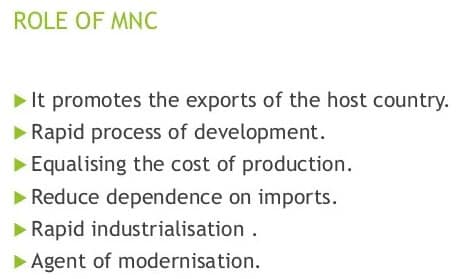
- Since 1991, under liberalisation and privatisation, private foreign capital has been accepted as important for rapid growth. MNCs supply most of it, and work subject to some regulation.
- Reasons for the change in policy:
- Promotion of foreign investment.
- Non-debt-creating capital inflows.
- Technology transfer.
- Promotion of exports.
- Most industries at Independence made consumer goods. Steel rested on just three firms (TISCO, IISCO and MISCO), and capital goods were almost absent. Foreign finance, technology and expertise helped widen this base.
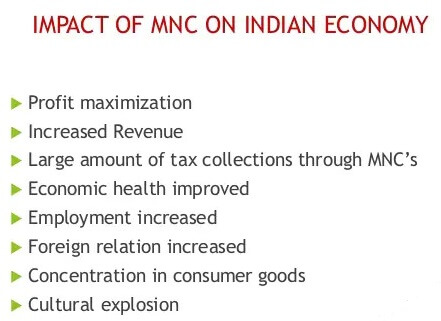
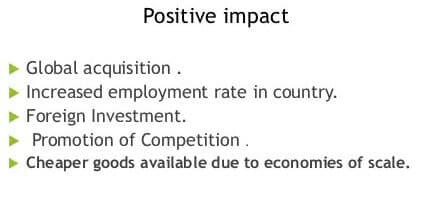
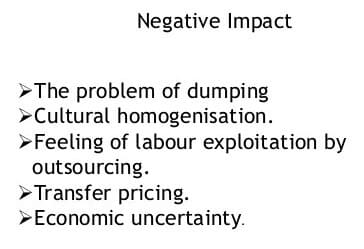
- The images set out the gains (revenue, tax, jobs, competition, cheaper goods through economies of scale) and the costs (dumping, cultural homogenisation, transfer pricing, labour concerns over outsourcing, economic uncertainty).
Growth in the Liberalised Economy
- FDI inflows have grown steadily:
- Total FDI was US$ 81.04 billion in 2024-25 and US$ 94.52 billion in 2025-26.
- FDI equity alone was US$ 58.85 billion in 2025-26.
- The cumulative inflow from April 2000 to March 2026 stood at about US$ 1.16 trillion.
- Sources: Singapore and Mauritius lead on a cumulative basis. Singapore gave about 30% in 2024-25, with Mauritius 17% and the USA 11%.
- Sectors: computer software and hardware led FDI equity in 2025-26 with US$ 13.9 billion, ahead of services.
- States: Maharashtra led in 2025-26 with about US$ 18.4 billion, followed by Karnataka.
- Regional imbalance: investment has favoured States that were already advanced, while Bihar, the north-eastern States and others lag. This widens the regional disparities in industry.
- MNC clusters show how market, skills and policy draw foreign firms to a few places:
- Gurugram: Suzuki came in through Maruti, which began production there in 1983, drawn by the market of the national capital region and later by a ring of suppliers.
- Bidadi, near Bengaluru: Toyota Kirloskar, founded in 1997, with commercial output from 1999.
- Hosur and Bengaluru-Karnataka: the iPhone supply chain, in which Foxconn is building a large plant near Bengaluru and Tata runs factories in Hosur and Karnataka.
- Visakhapatnam: the planned Google hub, a coastal site for data and power.
- Global capability centres are offshore units that MNCs run themselves for technology, research and business support. 3,728 centres employed 2.36 million people in 2025-26, up from about 1.9 million in 2023-24.
- Bengaluru, Hyderabad, the National Capital Region, Pune, Mumbai and Chennai host 92% of them, which shows how strongly this growth favours a few cities.
Effects on India
- Positive effects:
- Capital and technology: new technology raised the quality and volume of industrial output.
- Replacement of obsolete plant with more efficient methods.
- Multi-industry growth: ITC, once Imperial Tobacco, moved into hotels, flour, biscuits, matches and agarbatti.
- Exports and jobs, as in mobile phones and IT services.
- Negative effects:
- Harm to cottage and small-scale units, which cannot match large-scale goods and may disappear without safeguards.
- Heavy remittance abroad of profits.
- Weak technology transfer, which critics have called a myth in practice.
- Environmental and social cost: the Union Carbide gas leak at Bhopal in 1984, and groundwater protest against Coca-Cola at Plachimada, Kerala, where the plant shut in March 2004.
- Land conflict: POSCO signed for a steel plant near Paradip in 2005, and withdrew in March 2017.
Liberalisation and Industry
- Liberalisation means freeing industry from undue government interference and bureaucratic control, so that it can face market forces. It began on 24 July 1991, when Finance Minister Manmohan Singh introduced the new policy in the P. V. Narasimha Rao government.
- Its main steps, beyond licensing reform, were to open the gates to foreign investment, cut subsidies, reduce import tariffs, remove limits on many exports and imports, and start disinvestment in the public sector.
- Good effects: more FDI, faster growth of GDP and exports, a quick recovery from the 1991 slump, and heavy investment in transport and power.
- Bad effects:
- Wider regional gaps in industry and infrastructure, as investors chose States already ahead.
- Job losses through labour-saving methods, despite heavy investment.
- Harm to small units, which could not match the finance and technology of big firms.
- Investment in selected goods, and the neglect of agriculture in comparison with industry.
- A fear that too much dependence on foreign capital could limit economic and political freedom.
Criticisms against MNCs in India
- More interested in mergers and acquisitions than in fresh projects.
- Raise much of their finance from within the country.
- Supply second-hand plant and machinery declared obsolete at home.
- Focus on short-term profit, generally ignoring national interests and problems.
- Use expatriate management rather than competitive Indian managers.
- Repatriate huge profits, though most capital is collected in India.
- Make no effort to adopt appropriate technology, and the transfer of technology proves costly.
- Once in a venture, try to raise their holding to a majority.
- Can destabilise the economy once financial liberalisation allows free movement.
- Prefer mass-consumption and non-essential items.
- Liberalisation itself has drawn similar complaints: reduced employment through labour-saving technology, portfolio money preferred to direct investment, and investment in white goods more than wage goods.
Previous Year Questions
2021Assess the growth of multinational corporations in the liberalised economic environment of India.2019Critically analyse the role of multinational corporations in India’s economic development with suitable examples.2013Explain the role of multinationals in globalisation of industries in India.





role of mnc in regional development you can add this point and elaborate that.
2nd paper is focusing more on that
by the way nice research and start a daily based geography optional answer writing