

Crime and Punishment: Corruption, Mass Violence, Genocide, Capital Punishment.
Official Syllabus: Paper II, Section A, Unit 7
Mass violence — riots, terrorist bombings, massacres, lynchings, ethnic cleansing, wars against civilians — is violence that strikes many people at once, often strangers chosen not for anything they did but for who they are or where they happened to be. India has known it from Partition in 1947 to the riots and terror attacks of recent decades; the world has known it in every century. Philosophy asks two questions about it: What causes mass violence? and Can it ever be morally justified? This article explains the meaning and forms of mass violence and terrorism, Johan Galtung’s idea that violence can be structural and cultural as well as direct, its causes, the defenders of revolutionary violence (Fanon, Sorel, Marx), the just-war tradition, the critics — Hannah Arendt, who argued that violence destroys power, Walter Benjamin, and Gandhi, who insisted that means and ends are inseparable — the problem of the “terrorist vs freedom fighter”, violence in the name of religion, and remedies.
In simple words
A single angry man throws a stone — that is violence. Now imagine a rumour spreading on phones that “they” have attacked “us“. Within hours, hundreds of people who have never met the victims burn shops and homes in a neighbourhood, and the police stand by. No one in the mob feels personally responsible; each feels he is only “one of many“. That is mass violence: violence that grows from groups, ideas and structures, not just from individual anger.
Context & Problem
Meaning of Mass Violence
- Definition: mass violence is generally defined as an intentional violent criminal act that results in physical, emotional or psychological injury to a large number of people.
- Forms:
- Mass shootings — one of the most common ways it manifests in some countries.
- Terrorist bombings and attacks on crowds.
- Mass riots — communal, caste or ethnic riots.
- Aircraft and transport hijackings.
- Bioterrorism and chemical attacks.
- Lynching by mobs; massacres of villages.
- State violence against its own citizens — massacres, “disappearances”, torture on a large scale.
- War directed at civilians; ethnic cleansing; at the extreme, genocide (Article 11).
- Its psychological after-effects: mass violence is unpredictable and less common than ordinary crime, so when it happens, victims and witnesses may feel extremely distressed — and these feelings can surface days, weeks or months later (trauma, fear, anxiety, depression).
- Indian examples: the Partition violence of 1947, the anti-Sikh riots of 1984, the Gujarat riots of 2002, the Mumbai terror attacks of 2008, mob lynchings spread by rumours, and the ethnic violence in Manipur since 2023.
Terrorism
- Meaning: the use of intentional violence — usually against civilians — for political or religious purposes, aiming to spread fear far beyond the immediate victims.
- Origin of the word: in the West, “terrorism” first meant the Reign of Terror imposed by the Jacobins in revolutionary France (from the fall of 1793 to the summer of 1794). Its aim was to destroy the old regime, suppress all enemies of the revolutionary government, and enforce civic virtue — by the guillotine. Terror began as a method of the State.
- Key features: political motive; violence or its threat; civilians as targets; psychological effect (fear) as the goal; often carried out by non-State groups.
- No agreed global definition: India proposed a Comprehensive Convention on International Terrorism at the UN in 1996; it is still not adopted, largely because States disagree on how to treat liberation movements and State violence.
Core Doctrine
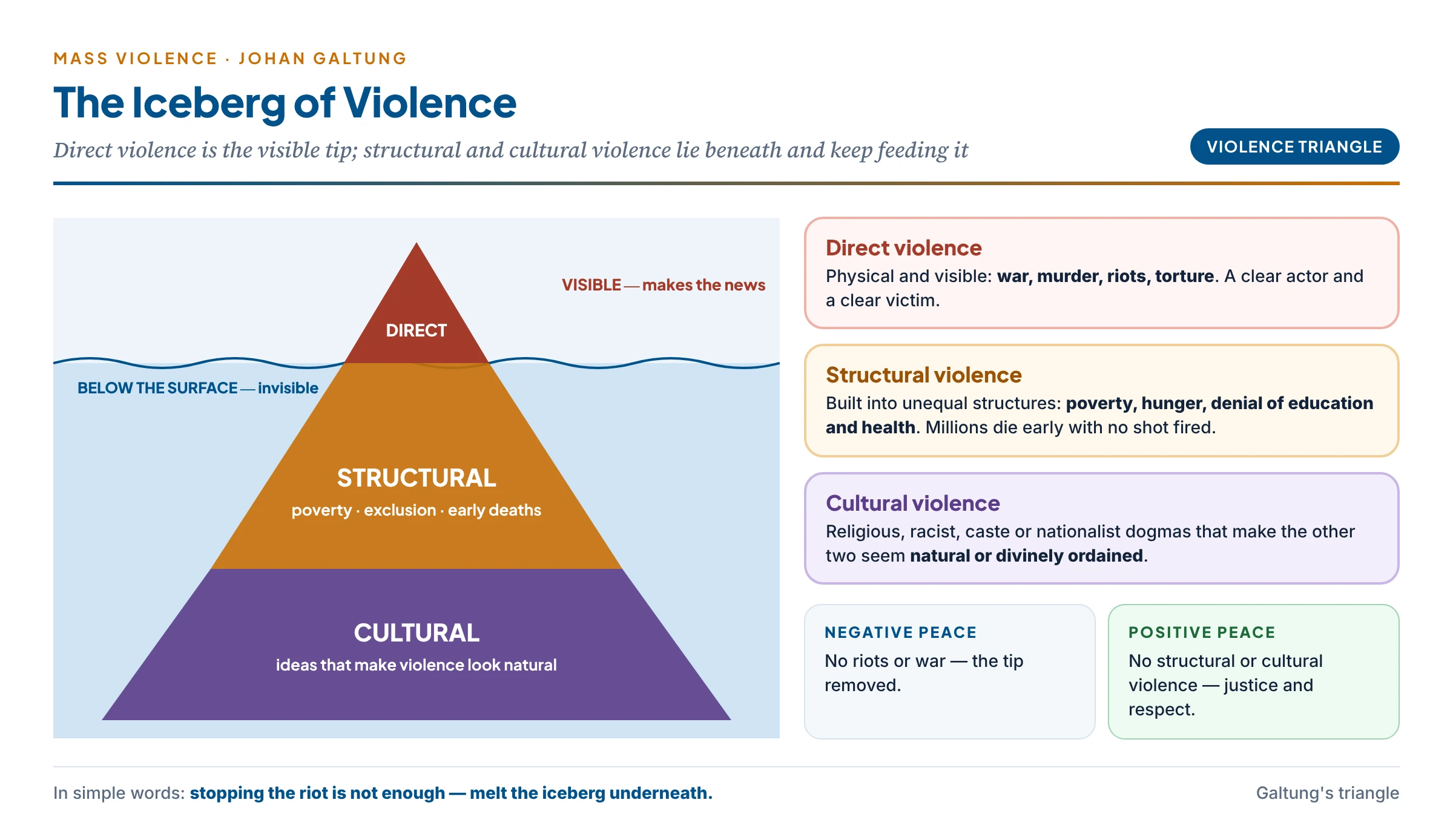
Galtung’s Violence Triangle — Direct, Structural and Cultural Violence
The Norwegian peace thinker Johan Galtung showed that violence cannot be reduced to physical attacks.
- Direct violence — visible, physical: war, murder, riots, torture. There is a clear actor and a clear victim.
- Structural violence — invisible, built into unequal social and economic structures: poverty, hunger, denial of education and health care, exclusion. If millions die prematurely from preventable diseases because of an unjust distribution of wealth, structural violence is occurring — even though no one fires a shot.
- Cultural violence — the ideas, symbols and beliefs — religious, racist, caste or nationalist dogmas — that make direct and structural violence appear natural, deserved or even divinely ordained.
- How they feed each other:
- Cultural violence (e.g. a belief that some groups are inferior) legitimises structural violence (exclusion, untouchability, discrimination).
- Structural violence (deprivation, humiliation) breeds direct violence (revolt, riots, crime).
- Direct violence then hardens cultural hatred — and the cycle continues.
- Negative vs positive peace: Galtung distinguished negative peace (the mere absence of direct violence) from positive peace (the absence of structural and cultural violence too — justice, equality, mutual respect).
- Why it matters: if we look only at riots and bombs, we miss the hidden violence of caste, poverty and humiliation that often lies beneath them. Corruption that kills through stolen medicines is also structural violence (Article 8).
In simple words
Think of an iceberg. The part above water — the riot, the bombing — is what makes the news. But most of the iceberg lies below the surface: decades of discrimination, poverty, humiliation, and beliefs that “those people” are less than human. Galtung asks us to see the whole iceberg, because melting only the tip changes nothing.
Causes of Mass Violence
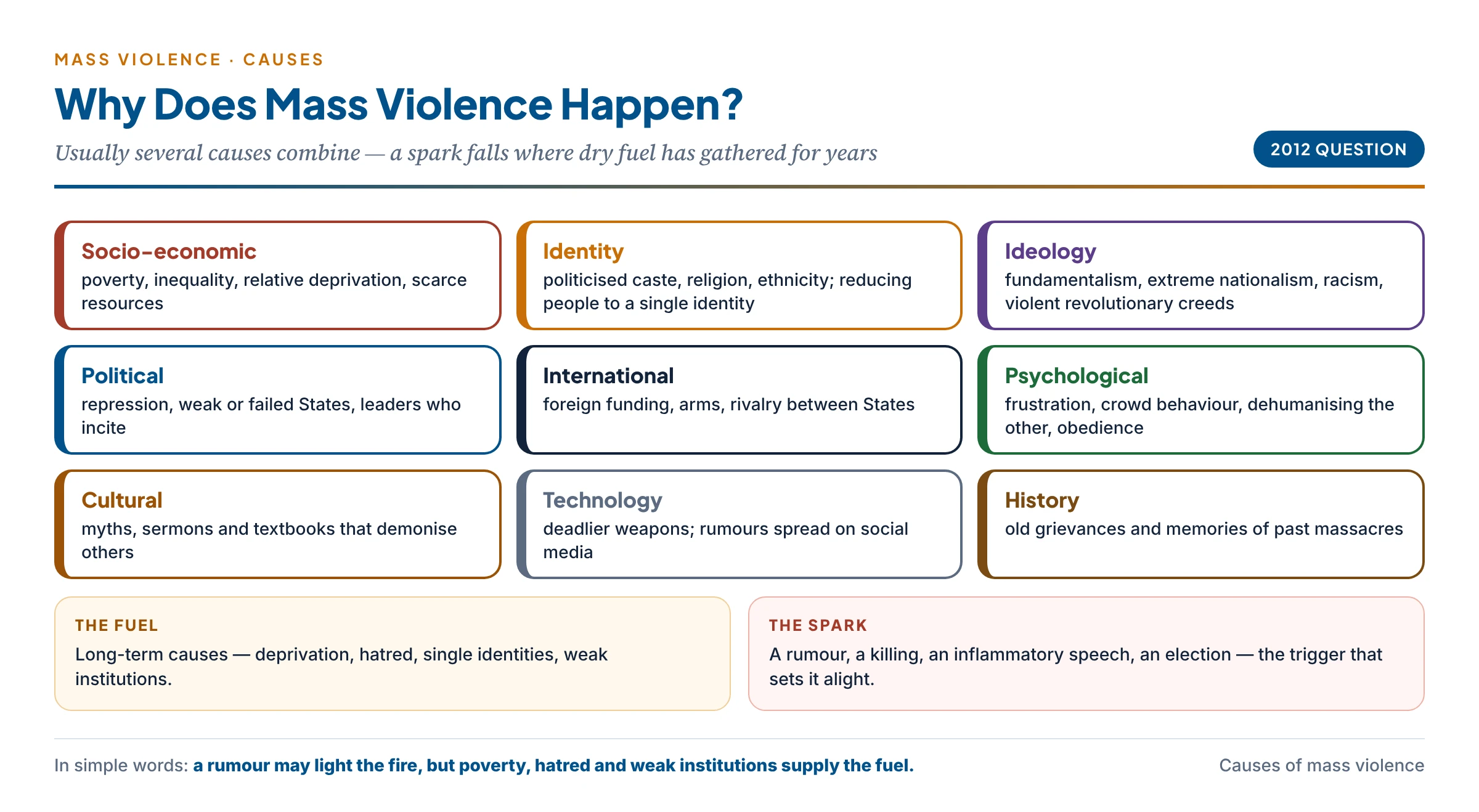
The 2012 paper asked: “What can be the causes of mass violence?“
- Socio-economic causes:
- Poverty, unemployment and inequality — especially relative deprivation, the gap between what people expect and what they get (Ted Gurr, Why Men Rebel).
- Competition for scarce resources — land, water, jobs.
- Structural violence — exclusion breeds resentment.
- Identity-based causes:
- Ethnic, religious, caste and linguistic divisions that are politicised.
- Amartya Sen (Identity and Violence, 2006): violence is fomented when people are reduced to a single, exclusive identity (“solitarist” identity) — only Hindu, only Muslim, only Tutsi — ignoring the many identities everyone has.
- Disregard or humiliation of identity — when a community’s identity is not recognised or is insulted, the reaction may come in the form of violence, even terrorism.
- Ideological causes:
- Religious fundamentalism, extreme nationalism, racism, and revolutionary ideologies that justify violence.
- Organisations driven by extreme ideologies, including on the far left, have taken to terrorism to destroy what they consider an unjust, oppressive economic, social and political system.
- Political causes:
- Authoritarian repression, absence of peaceful channels for grievance.
- Weak or failed States unable to keep order.
- Contested legitimacy of borders and governments.
- Politicians who incite violence for electoral gain.
- International causes:
- Foreign funding, arms and training.
- Competition between nation-States in the international sphere — proxy wars.
- Psychological causes:
- Frustration–aggression: blocked goals produce aggression.
- Crowd psychology: in a mob, individuals lose their sense of personal responsibility (“deindividuation”) and do what they would never do alone.
- Dehumanisation: describing others as “vermin”, “cockroaches”, “infiltrators” makes killing them easier.
- Obedience to authority: ordinary people commit atrocities when ordered (Article 11).
- Cultural causes: cultural violence — myths, songs, textbooks and sermons that glorify violence or demonise others.
- Technological causes: modern weapons multiply the power to kill; social media spreads rumours at speed (India’s WhatsApp-rumour lynchings of 2017–18 are an example).
- Historical causes: unresolved grievances and memories of past massacres, passed down generations.
Common confusion
Did Amartya Sen say that terrorism results from “identity disregard”? Many notes put it this way, but it is only half of Sen’s argument. Sen’s main claim in Identity and Violence is that violence is fomented by imposing a single, exclusive identity on people — the “illusion of destiny” that one is only a Hindu or only a Muslim, only a Hutu or only a Tutsi — and ignoring the plurality of identities (nationality, language, profession, gender, politics) that everyone has. It is true that humiliation and non-recognition of identity can provoke violent reaction; but Sen’s warning is equally against over-emphasising one identity. His remedy is to recognise our many identities and our freedom to choose among them.
The Defence of Violence
1. Frantz Fanon — violence as liberation (The Wretched of the Earth, 1961)
- Colonialism is pure violence: the colonial world is a divided, “Manichean” world — settlers and natives, good and evil — established and maintained by soldiers and police bayonets.
- Decolonisation is necessarily violent: it is the complete overturning of an unnatural order; the colonised can only reply to violence with counter-violence.
- Violence as a cleansing force:
“At the level of individuals, violence is a cleansing force. It frees the native from his inferiority complex and from his despair and inaction; it makes him fearless and restores his self-respect.” — Frantz Fanon
- Collective effect: shared struggle unites the oppressed into a nation and gives them a new identity.
2. Georges Sorel — proletarian violence (Reflections on Violence, 1908)
- The working class should use the “myth of the general strike” and direct action; proletarian violence is heroic and morally regenerating, unlike the cunning force of the bourgeois State.
3. Marx and Engels — the midwife of history
- “Force is the midwife of every old society pregnant with a new one.” Ruling classes never surrender power peacefully; revolution may require force (Marx’s Capital).
4. The State’s violence — Max Weber
- The modern State is defined by its monopoly of the legitimate use of physical force within a territory. Police, prisons and armies are violence made legitimate by law. So violence is not only the act of rebels; the State itself rests on it.
5. The just-war tradition
- From Augustine and Aquinas to modern thinkers like Michael Walzer, this tradition holds that some collective violence (war) can be just, under strict conditions:
- Going to war (jus ad bellum) — just cause (self-defence, stopping aggression or massacre), legitimate authority, right intention, last resort, reasonable chance of success, proportionality.
- Conduct in war (jus in bello) — discrimination (never deliberately target civilians) and proportionality of force.
- Indian parallels: the dharma-yuddha rules of the epics (no attacking the unarmed, the fleeing, the sleeping); the Bhagavad Gītā, where Kṛṣṇa urges Arjuna to fight a righteous war; Kauṭilya’s distinction between the righteous conqueror (dharma-vijayī), the greedy conqueror (lobha-vijayī) and the demonic conqueror (asura-vijayī) who takes everything, even lives.
The Critique of Violence
1. Hannah Arendt — power vs violence (On Violence, 1969)
- Arendt rejected the old idea (shared by Marxists and by Weber) that power and violence are the same thing.
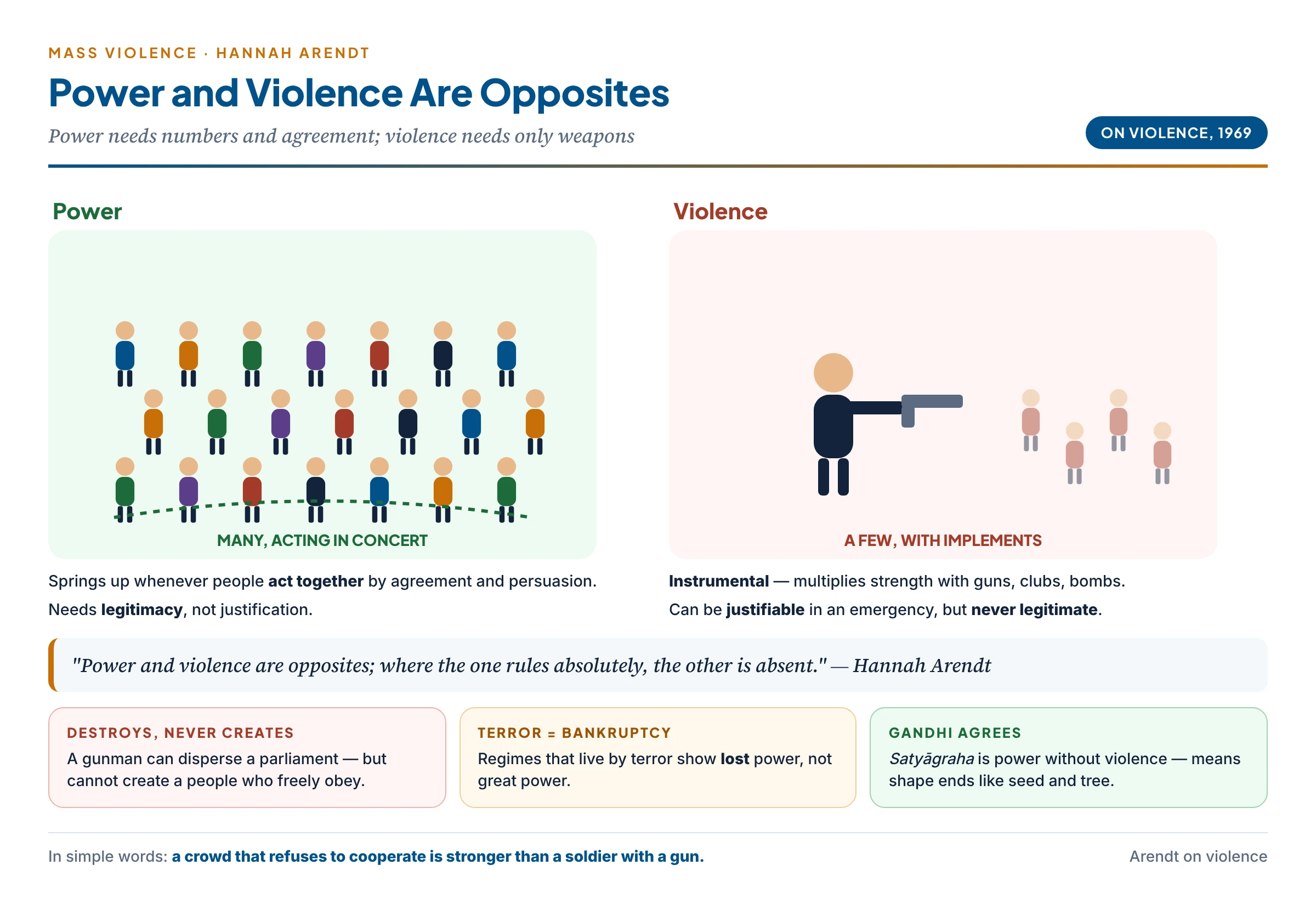
- Power springs up “whenever people get together and act in concert” — through agreement, persuasion and public deliberation. It needs numbers, not weapons; it needs no justification, only legitimacy.
- Violence is instrumental — it relies on implements (guns, clubs, bombs) to multiply natural strength; a few can use it against many.
- They are opposites:
“Power and violence are opposites; where the one rules absolutely, the other is absent.” — Hannah Arendt
- Violence can destroy power, but never create it. A gunman can disperse a parliament; he cannot create a community that freely obeys.
- Terror is the bankruptcy of power. Regimes that rely on permanent terror do not show the peak of power but its collapse: they use violence because they have lost genuine support.
- Violence may be justifiable, but never legitimate: in an emergency, violence can sometimes be justified by a short-term goal (self-defence); but it can never become a legitimate foundation of political life.
- Against Fanon and Sartre: Arendt warned that the glorification of violence as “cleansing” produces new tyrannies — “the practice of violence, like all action, changes the world, but the most probable change is to a more violent world.”
- Criticism of Arendt: in practice, even legitimate power often needs coercive sanctions to enforce laws against violent criminals; her sharp line between power and violence may be too neat.
In simple words
When thousands of people simply refuse to obey — workers stop work, shops shut, officials resign — even an army can do little; this is the power Arendt describes, and what Gandhi’s satyāgraha used. A tyrant with guns can scatter the crowd, but he cannot make people willingly cooperate again. That is why Arendt says violence can destroy power but cannot create it.
2. Walter Benjamin — violence and law (“Critique of Violence”, 1921)
- Benjamin distinguished law-making violence (the violence that founds a new legal order — revolutions, conquests) from law-preserving violence (the police and courts that maintain it).
- His point: law itself is born of violence and preserved by it; the line between “legal force” and “violence” is less clear than we assume.
3. Gandhi — the inseparability of means and ends
- In Hind Swaraj (1909), Gandhi exposed the fallacy of using violent means to build a just and peaceful society:
“The means may be likened to a seed, the end to a tree; and there is just the same inviolable connection between the means and the end as there is between the seed and the tree.” — Mahatma Gandhi
- You cannot grow a rose by planting a poisonous weed.
- Violence corrupts the victor: a revolution won by blood installs a new military-police dictatorship to defend its gains — the history of many revolutions confirms it.
- True swarāj requires ahiṃsā (non-violence in thought, word and deed) and satyāgraha (firmness in truth), which seek to convert the opponent, not destroy him.
- Non-violence is not cowardice: Gandhi said that where the only choice is between cowardice and violence, he would advise violence; but non-violence is the strength of the brave.
Can Mass Violence Be Justified on Moral Grounds?
The 2012 paper asked whether mass violence can be justified morally. The main positions:
- Never — pacifism and ahiṃsā (Gandhi, Tolstoy, the Jainas, the Buddha): violence breeds violence; every life is sacred; means shape ends.
- Sometimes — just war and self-defence: limited, discriminating force as a last resort to stop aggression or massacre may be justified — but never deliberate violence against civilians.
- Yes — revolutionary violence (Fanon, Sorel, Marx): when structures are themselves violent, counter-violence can be liberation.
- Consequentialist view: violence is justified if it prevents greater violence — but outcomes are uncertain, and violence tends to escalate.
Evaluation:
- Deliberate mass violence against innocents — massacres, terrorist bombings, riots, lynchings — can never be morally justified. It treats people merely as means (Kant), punishes the innocent for others’ acts, and violates the most basic human rights.
- Limited force in self-defence, or to stop an atrocity, may be justified under strict just-war conditions — necessity, last resort, discrimination, proportionality.
- Non-violence is not only morally superior but often more effective: a large study of resistance campaigns between 1900 and 2006 (Erica Chenoweth and Maria Stephan) found that non-violent campaigns succeeded about twice as often as violent ones — and more often led to lasting democracy.
- Arendt’s verdict: violence may sometimes be justifiable in the short term, but it is never legitimate as a foundation for a political community.
In simple words
A doctor may cut a patient with a scalpel to remove a tumour — a limited, careful, unavoidable “violence” for the patient’s own good. But no doctor may set fire to a hospital ward to kill one infected patient. The just-war tradition is like surgery: force only when necessary, only against the threat, and never against innocents. Mass violence against civilians is the burning ward — never justified.
Terrorists and Freedom Fighters
- The problem: groups that use violence against a State often call themselves freedom fighters; the State calls them terrorists.
- Insurgents who practise terrorism portray their actions as a struggle for liberation and seek to be treated as soldiers, not as terrorists or criminals.
- When a State agency uses violence, it is called war, reprisal, or defence of the security of the State and its citizens; when an insurgent group does the same, it is called terrorism.
- Hence the saying: “one person’s terrorist is another person’s freedom fighter.”
- The revolutionary justification: some argue that terrorist acts are justified by their political effects and moral consequences — when they are politically effective weapons in a revolutionary struggle against an oppressive regime. Examples often cited are revolutionary movements in India’s freedom struggle.
- A principled distinction:
- The difference lies not in the cause but in the means: a freedom fighter may be one who fights for a just cause, but deliberately killing civilians to spread fear is terrorism, whatever the cause.
- Bhagat Singh himself drew this line in his statement in court (1929): revolution “did not necessarily involve sanguinary strife, nor was there any place in it for individual vendetta. It is not the cult of the bomb and the pistol.” By revolution he meant a change in the order of things.
- States, too, can commit terror against civilians — the label must apply to acts, not only to non-State actors.
- Evaluation: a just cause does not justify unjust means. The test is Galtung’s and the just-war tradition’s: discrimination between combatants and civilians, and proportionality.
Can There Be a Philosophical Argument for Violence in the Name of Religion?
The 2019 paper asked this question.
- Arguments that have been offered:
- Divine command — if God commands holy war, it is right.
- Defence of the faith — violence to protect believers or sacred places.
- Martyrdom — death in a holy cause brings salvation.
- Scriptural examples — wars fought at divine prompting in many traditions (the Gītā‘s battlefield; holy wars in Abrahamic histories).
- Philosophical objections:
- Euthyphro’s problem (Plato): is killing right because God commands it, or does God command it because it is right? If the first, morality becomes arbitrary; if the second, the act must be justified by reason and morality — and killing innocents fails that test.
- Kant: religion must stay within the limits of reason; a supposed divine command to kill an innocent should be doubted, because we can be more certain that murder is wrong than that a voice is God’s.
- The core ethics of religions themselves — ahiṃsā in Hinduism, Buddhism and Jainism; love of neighbour in Christianity; the Qur’ānic verse that killing one innocent is like killing all humanity — condemn such violence.
- Gandhi’s reading of the Gītā: the battlefield is allegorical — the war is within the soul; the Gītā‘s ideal is selfless action, not killing.
- Sen and Galtung: religious violence is usually politics and identity wearing religious dress — cultural violence used to mobilise people.
- Dehumanisation: violence in God’s name requires treating others as less than human — contradicting the dignity that religions affirm.
- Conclusion: there can be arguments, but no sound philosophical argument: those offered depend on unverifiable claims of divine command, ignore the ethical core of the religions themselves, and violate the dignity of persons. Philosophy can explain why people commit religious violence; it cannot justify it.
Impact and Remedies
- Impact:
- Anti-development — investment flees; tourism collapses.
- Destruction of infrastructure — homes, shops, schools, roads.
- Psychological impact — trauma, fear, distrust between communities, often lasting generations.
- Polarisation of politics; erosion of rule of law when the guilty go unpunished.
- Remedies:
- Eliminate socio-economic deprivation — attack structural violence.
- Due representation to oppressed communities in nation-building.
- Strengthen intelligence agencies and police capacity; impartial, accountable policing.
- Proper safeguards for external borders.
- Cut the financing of terrorism; control access to weapons.
- Prevent radicalisation — education, counter-narratives, community engagement, regulation of hate speech and rumour on social media.
- Justice and reconciliation — punish perpetrators of riots, compensate victims, truth-telling (Article 4).
- Unmask cultural violence — textbooks, media and leaders that demonise others.
- Revitalise democratic power (Arendt) — spaces where people act together peacefully.
- Gandhian ahiṃsā and peace education — positive peace, not merely the absence of riots.
Critical Evaluation
Critics and Defenders
Criticism — Defenders of (some) violence
- Fanon: anti-colonial violence cleanses the colonised of inferiority and restores self-respect.
- Sorel: proletarian violence is heroic and regenerating.
- Marx: force is the midwife of history.
- Just-war thinkers (Augustine, Aquinas, Walzer): limited force can be just as a last resort.
- Weber: the State itself rests on legitimate violence.
- Revolutionary nationalists: armed struggle against colonial rule was resistance, not crime.
Defence — Critics of violence
- Arendt: violence destroys power and never creates it; it is at most justifiable, never legitimate.
- Gandhi: means and ends are like seed and tree; violence corrupts every victory.
- Benjamin: even law is born of violence — a warning against trusting any violence as “clean”.
- Galtung: direct violence grows from structural and cultural violence, which must be removed.
- Sen: violence feeds on solitarist identities; recognising plural identities defuses it.
- Evidence (Chenoweth and Stephan): non-violent movements succeed more often than violent ones.
Cross-Tradition Comparison
Violence and Non-violence in Indian and Western Thought
| Point | Indian thought | Western thought | Shared insight |
|---|---|---|---|
| Absolute non-violence | Jainism, Buddha, Gandhi (ahiṃsā) | Tolstoy, Christian pacifists | Violence breeds violence |
| Limited, rule-bound force | Dharma-yuddha, the Gītā, Kauṭilya’s righteous conqueror | Just-war theory (Augustine, Aquinas, Walzer) | Force only for just cause, never against innocents |
| Liberating violence | Some revolutionary nationalists | Fanon, Sorel, Marx | Oppression invites resistance — but at a cost |
| Power without violence | Satyāgraha — collective, non-violent power | Arendt — power as acting in concert | Real power comes from people together, not guns |
| Hidden violence | Caste, untouchability (Ambedkar) | Galtung’s structural and cultural violence | Remove injustice to remove violence |
Indian Connect — Aśoka’s conquest by dhamma
After the conquest of Kaliṅga, in which (by his own edict) a hundred thousand were killed and many more died, the emperor Aśoka was filled with remorse. In his Thirteenth Rock Edict he declared that the only true conquest is conquest by dhamma — by righteousness, not arms. His later rule — tolerance among sects, care for the sick, restraint in punishment — is one of history’s earliest examples of a ruler turning from mass violence to positive peace, exactly the transition Galtung and Gandhi urged.
Synthesis (Siddhānta)
- Mass violence — riots, terrorism, massacres, lynchings, State terror, war against civilians — harms many people at once, often chosen for who they are; its trauma outlasts the event.
- Galtung showed that direct violence is only the tip of an iceberg of structural (injustice, deprivation) and cultural (legitimising ideologies) violence; lasting positive peace requires removing all three.
- Its causes are many — deprivation, politicised identity (Sen’s warning against single identities), extremist ideology, repression, foreign interests, crowd psychology, dehumanisation, technology and historical grievance.
- Fanon, Sorel and Marx defended violence as liberation; the just-war tradition allows limited force under strict conditions; Arendt answered that violence destroys power and is never legitimate; Gandhi that means determine ends.
- Can mass violence be justified? Deliberate violence against innocents — whether by terrorists, mobs or States — never. Limited force to stop greater violence may be justified as a last resort. Non-violence is morally superior and, the evidence suggests, often more effective.
- Terrorist vs freedom fighter: the cause does not justify the means; deliberately killing civilians is terrorism, by any actor. Violence in the name of religion has no sound philosophical justification.
- Contemporary relevance: from WhatsApp-driven lynchings to ethnic conflict and global terrorism, the remedy lies in justice, impartial policing, de-radicalisation, accountability for perpetrators, and a culture of plural identities and non-violence.
“Violence can destroy power; it is utterly incapable of creating it.” — Hannah Arendt
Previous Year Questions
- 2019Can there be a philosophical argument to support violence in the name of religion? Discuss.
- 2019Is corruption not a form of mass violence? Discuss.
- 2012What can be the causes of mass violence? Can mass violence be justified on moral ground? Discuss.