

Crime and Punishment: Corruption, Mass Violence, Genocide, Capital Punishment.
Official Syllabus: Paper II, Section A, Unit 7
Genocide is often called “the crime of crimes“. It is not simply many murders: it is the attempt to destroy a whole human group — a nation, an ethnic, racial or religious community — as such, because of who they are. The word was coined only in 1944, by the Polish-Jewish lawyer Raphael Lemkin, with the Holocaust in mind; four years later the United Nations made genocide a crime under international law. Yet the twentieth century saw genocide again and again — against the Armenians, the Jews and Roma, the Cambodians, the Tutsi of Rwanda, the Bosnian Muslims of Srebrenica. Philosophy asks: What makes genocide uniquely evil? How do ordinary people come to take part in it? What “sanctions” have been used to justify it, and how are they answered? Is racial supremacy its main cause? This article covers the meaning and legal definition of genocide, its kinds and conditions, its causes, Hannah Arendt’s “banality of evil”, Karl Jaspers’ four kinds of guilt, modern studies of ordinary perpetrators, the stages of genocide, the ethical case against it, and prevention — including India’s position.
In simple words
A murderer takes a life. A genocide tries to erase a whole branch of humanity — its people, language, songs, prayers, memories and future children — as if a library were burned not because of one dangerous book but because the books were written in a language someone hated. That is why genocide is called the crime of crimes: it attacks not only individuals but human diversity itself.
Context & Problem
Meaning and Origin of the Word
- Coined by Raphael Lemkin (1944) in Axis Rule in Occupied Europe, from the Greek genos (“race, tribe, people”) and the Latin -cide (“killing”).
- Lemkin had the Holocaust in mind — for him it signified the return of an “enlightened” people to barbarism — and also the earlier killing of the Armenians.
- Simple meaning: mass violence aimed at an ethnic (or national, racial, religious) group, to destroy it.
- Lemkin’s broader idea: genocide is not only physical killing but a coordinated plan to destroy the essential foundations of a group’s life — its culture, language, religion, economy and institutions.
The Legal Definition — The Genocide Convention (1948)
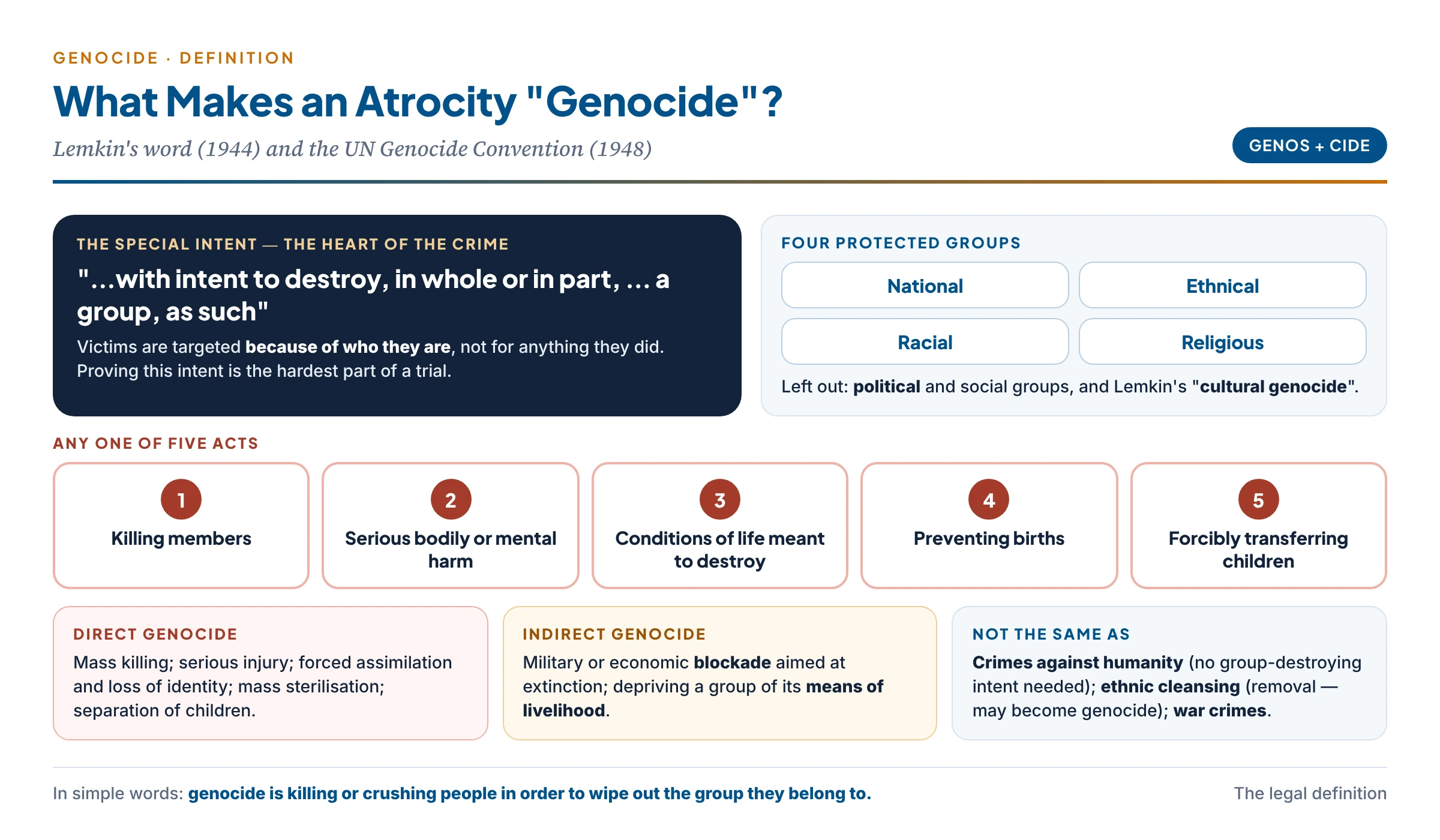
- The UN Convention on the Prevention and Punishment of the Crime of Genocide (adopted 9 December 1948, the day before the Universal Declaration of Human Rights) defines genocide as any of the following acts committed “with intent to destroy, in whole or in part, a national, ethnical, racial or religious group, as such“:
- Killing members of the group;
- Causing serious bodily or mental harm to members of the group;
- Deliberately inflicting on the group conditions of life calculated to bring about its physical destruction in whole or in part;
- Imposing measures intended to prevent births within the group;
- Forcibly transferring children of the group to another group.
- The special intent: what makes genocide unique is the intent to destroy the group “as such” — the victims are targeted because of their membership, not for anything they did. Proving this intent is often the hardest part of a genocide trial.
- Protected groups: national, ethnical, racial, religious. Political and social groups were left out (partly at the insistence of some States), and so was “cultural genocide” that Lemkin wanted — a gap many scholars criticise.
- Genocide vs related crimes:
- Crimes against humanity — widespread or systematic attacks on civilians (murder, enslavement, torture, persecution) — need no intent to destroy a group.
- Ethnic cleansing — forcibly removing a group from a territory; it may become genocide if the intent is to destroy the group.
- War crimes — violations of the laws of war.
Direct and Indirect Genocide
- Direct genocide:
- Mass killing;
- Serious physical and mental injury;
- Forced assimilation resulting in the loss of identity;
- Preventing births — e.g. mass sterilisation;
- Separation of children from their group.
- Indirect genocide:
- Military or economic blockade imposed for the purpose of extinction;
- Depriving a group of its means of livelihood — land, water, food — so that it perishes.
Why Genocide Is the “Crime of Crimes”
- Ordinary murder extinguishes an individual human life.
- Genocide aims to extinguish an entire form of human culture, a collective heritage — destroying human plurality itself.
- Arendt: plurality — the fact that “men, not Man, live on the earth” — is the basic condition of human life. Genocide is an attack on this condition: an attempt to decide who may share the earth.
- Lemkin: every group contributes something unique to world civilisation; its destruction makes all humanity poorer.
Core Doctrine
Major Genocides of the Twentieth Century
- The Armenian genocide (1915–1923) — during the First World War, the Ottoman leaders, suspecting the Armenians of cooperating with Russia, organised deportations and massacres; estimates of the dead range up to about 1.5 million.
- The Holocaust (1941–1945) — Nazi Germany’s systematic murder of about six million Jews, along with Roma, disabled people and others.
- Cambodia (1975–1979) — the Khmer Rouge regime caused the deaths of an estimated 1.5–2 million people; its tribunal later convicted leaders of genocide against the Cham Muslims and Vietnamese.
- Rwanda (1994) — around 800,000 people, mostly Tutsi, were killed in about 100 days; the Rwanda tribunal’s Akayesu judgment (1998) was the first international conviction for genocide and recognised rape as an act of genocide.
- Srebrenica (1995) — about 8,000 Bosniak (Muslim) men and boys were killed; both the Yugoslavia tribunal and the International Court of Justice (2007) found it to be genocide.
- Many scholars count three twentieth-century genocides — the Armenian, the Holocaust and Rwanda — as the clearest cases that fit the legal definition; others add Cambodia and Srebrenica.
- Recent cases before the International Court of Justice: The Gambia v Myanmar (over the Rohingya; merits hearings were held in January 2026) and South Africa v Israel (over Gaza; filed in December 2023, with provisional measures ordered in 2024) — both concern whether States have violated their duties under the Genocide Convention.
Common confusion
Did the Ottoman massacre of the Armenians take place during the Second World War? No — some notes say “Second”, but it was during the First World War (from 1915). The Ottoman leaders suspected the Armenians of siding with Russia, an enemy in that war, and used this as the pretext for mass deportation and killing. The point the notes make is correct: war creates the fear, secrecy and “enemy within” thinking that so often prepare the way for genocide.
Conditions Conducive to Genocide
- Difficult life conditions — such as war or an economic crisis — are an important warning sign:
- War shapes the psyche of a population: it creates “enemies”, accustoms people to killing, and makes their willingness to kill certain groups more likely; it also provides secrecy and pretexts (the Armenians as a “fifth column”).
- Economic crisis creates a sense of crisis that makes a population ready to scapegoat a vulnerable out-group and softens popular reluctance to kill. The Nazi party blamed the Jews for Germany’s misery after the 1929 crash.
- Risk factors identified by genocide researchers (notably Barbara Harff):
- Political upheaval — revolution, coup, collapse of order.
- Prior genocide or mass killing — impunity invites repetition.
- Ethnic or religious character of the ruling elite — an elite drawn from one group, ruling over others.
- Ethnic cleavages — deep divisions between groups.
- Autocratic regime — no checks on rulers.
- Exclusionary ideology — belief that some groups do not belong or are threats.
- Economic and political autarky — isolation from the outside world, which removes international pressure.
Explanations of Genocide
- Biological explanation — claims that genetic or evolutionary factors make people intolerant of out-groups. (Weak: it cannot explain why genocide happens in some times and places and not others.)
- Economic exploitation — if a minority controls a large share of resources and is seen to exploit the majority, the majority may retaliate; competition for land and wealth.
- Marxian view — the greed of the capitalist class and colonial expansion lead to the destruction of peoples (colonial genocides; class war).
- Psychological explanation — defective psychological views that make people intolerant; frustration, scapegoating, fear, obedience to authority, dehumanisation.
- Racial, ethnic or religious superiority — the belief that one’s own group is superior and others are inferior, impure or dangerous.
- Radicalisation and fundamentalism — extreme religious or nationalist ideologies that call for the removal of the “other”.
- Political explanation — genocide as a strategy used by elites to seize or keep power, unite a group against an “enemy”, or eliminate rivals.
- Modernity (Zygmunt Bauman, Modernity and the Holocaust, 1989) — the Holocaust was not a lapse into barbarism but a product of modern features: bureaucracy, division of labour, technology and the distance between those who decide and those who suffer. A “garden State” sought to weed out what did not fit its plan.
Is Racial Supremacy the Main Reason for Genocide?
The 2014 paper asked this question.
- Where racial supremacy was central:
- The Holocaust — Nazi ideology of an “Aryan” master race and Jews as a racial poison.
- Colonial genocides — such as the destruction of the Herero and Nama (1904–08) — justified by racial hierarchy and the “civilising mission”.
- Rwanda — colonial rulers had racialised the Hutu–Tutsi difference (the myth of Tutsi as foreign “Hamites”), which genocidal propaganda later used.
- Where other causes were as important or more so:
- Armenians — religious difference, nationalism and wartime security fears.
- Cambodia — mainly a political-class ideology (destroying “class enemies”, the educated, city-dwellers), though ethnic minorities were also targeted.
- Bosnia — ethno-religious nationalism and the struggle for territory.
- Economic crisis, war, fear and political opportunism appear in almost every case.
- What is common: not race as such, but a sense of superiority and exclusion — a division of humanity into “us” and “them“, with “them” seen as inferior, impure or dangerous — whether the line is drawn by race, religion, ethnicity, nation or class.
- Answer: racial supremacy is a major reason, central in some genocides, but not the only or always the main reason. Genocide results from a combination — an exclusionary ideology (racial, religious, national or class), crisis (war, economic collapse), an authoritarian State, dehumanising propaganda, and the obedience of ordinary people.
Arendt — The Banality of Evil
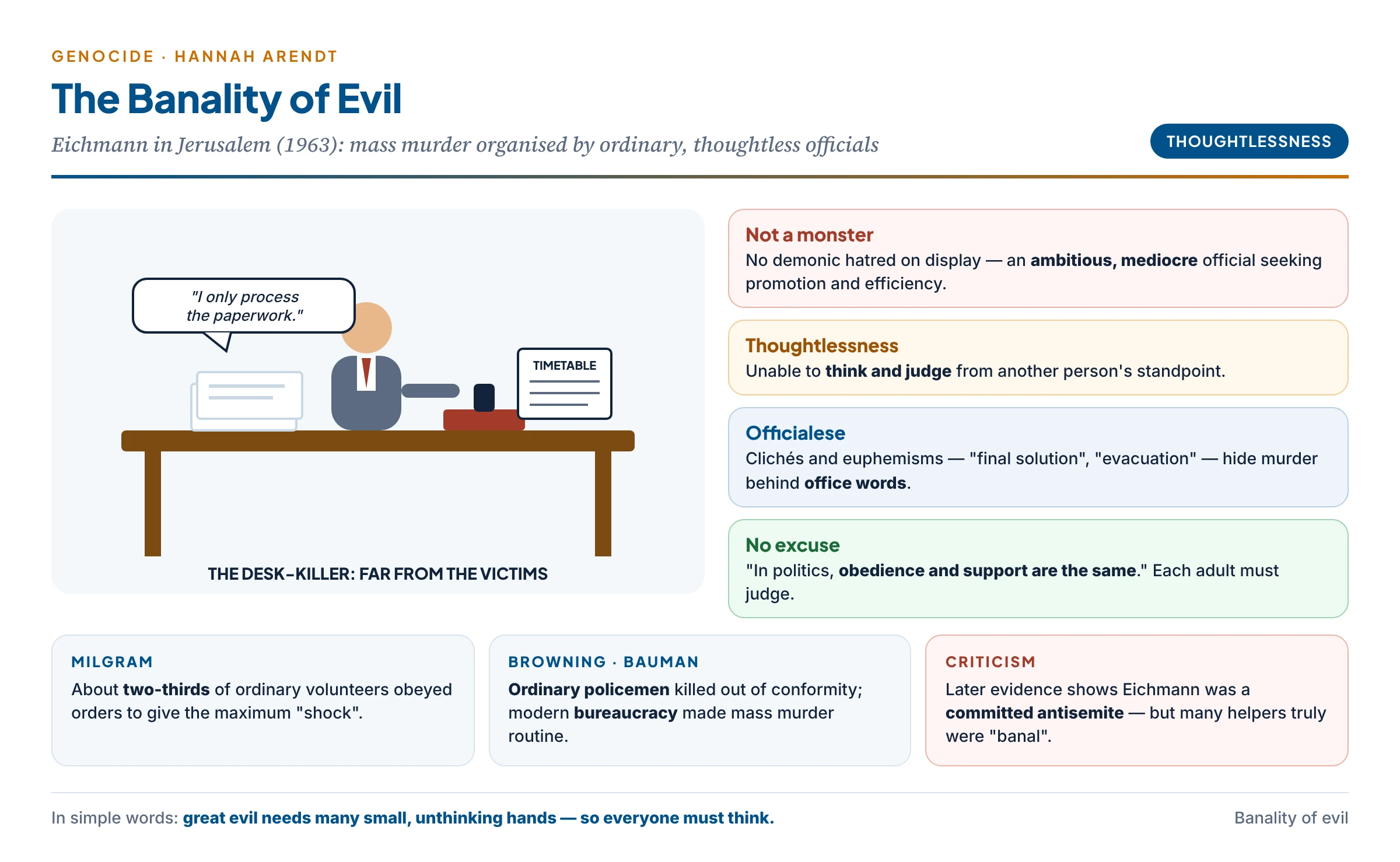
Reporting on the trial of the Nazi official Adolf Eichmann in Jerusalem (1961), Hannah Arendt wrote Eichmann in Jerusalem: A Report on the Banality of Evil (1963) — one of the most important and controversial works of modern moral philosophy.
- No demonic motives: Eichmann, who organised the transport of millions to the death camps, was neither an Iago nor a Macbeth; Arendt saw no insane hatred. He seemed an ambitious, mediocre civil servant whose main concern was career advancement and organisational efficiency.
- Thoughtlessness: his defining defect was sheer thoughtlessness — an inability to think and judge from the standpoint of another person.
- Clichés and officialese: he spoke almost entirely in stock phrases and bureaucratic jargon; the Nazi regime itself used “language rules” — euphemisms like “final solution” and “evacuation” — that hid murder behind administrative words. “Officialese is my only language,” Eichmann said.
- The desk-killer: modern genocide does not need sadists at every level; it needs desk-killers — officials who sign, schedule and organise, far from the victims, and who stop exercising moral judgement.
- The “banality” of evil: evil on a vast scale can be done by terrifyingly normal people who simply do their jobs, follow orders and do not think. Evil is not always deep or demonic; it can spread “like a fungus on the surface”.
- No excuse of obedience: Arendt rejected the defence of “only following orders“: “in politics, obedience and support are the same.” Every adult remains responsible for judging what he is asked to do.
- Criticisms of Arendt:
- Later historians, using documents not available in 1961, showed that Eichmann was in fact a committed antisemite who was proud of his role — he may have played the clerk at his trial.
- Some felt the phrase trivialised the Holocaust; Arendt replied that “banal” did not mean “commonplace” or “trivial”, but that the evil came from thoughtlessness, not from great wickedness.
- Lasting value: even if Eichmann was less banal than she thought, thousands of ordinary officials, railway workers, police and neighbours who made genocide possible were. Her lesson stands: the duty to think and judge cannot be handed over to the State.
In simple words
Imagine a factory that makes a poison. The clerk who orders the chemicals says, “I only process forms.” The driver says, “I only drive the truck.” The guard says, “I only check passes.” Each does a small, “harmless” task; none feels like a killer. Yet together they produce mass death. Arendt’s point is that evil can be divided into small, ordinary jobs — and the only defence is for each person to stop and think about what the whole adds up to.
How Ordinary People Become Perpetrators
- Stanley Milgram’s obedience experiments (1960s): ordinary volunteers, told by an authority figure to give what they believed were increasingly painful electric shocks to another person, mostly obeyed — about two-thirds went to the maximum level.
- Christopher Browning, Ordinary Men (1992): a battalion of middle-aged German reserve policemen — not fanatics — shot thousands of Jews; most took part even when offered the chance to opt out, because of conformity, peer pressure and careerism.
- Dehumanising language: in Rwanda, radio broadcasts called the Tutsi “cockroaches“; Nazi propaganda called Jews “vermin“. When people are made to seem less than human, killing them seems less like murder.
- Lesson: genocide needs leaders with an ideology — but it also needs millions of ordinary people who obey, look away or join in. Preventing genocide means strengthening conscience, independent judgement and the courage to refuse.
Karl Jaspers — The Four Kinds of Guilt
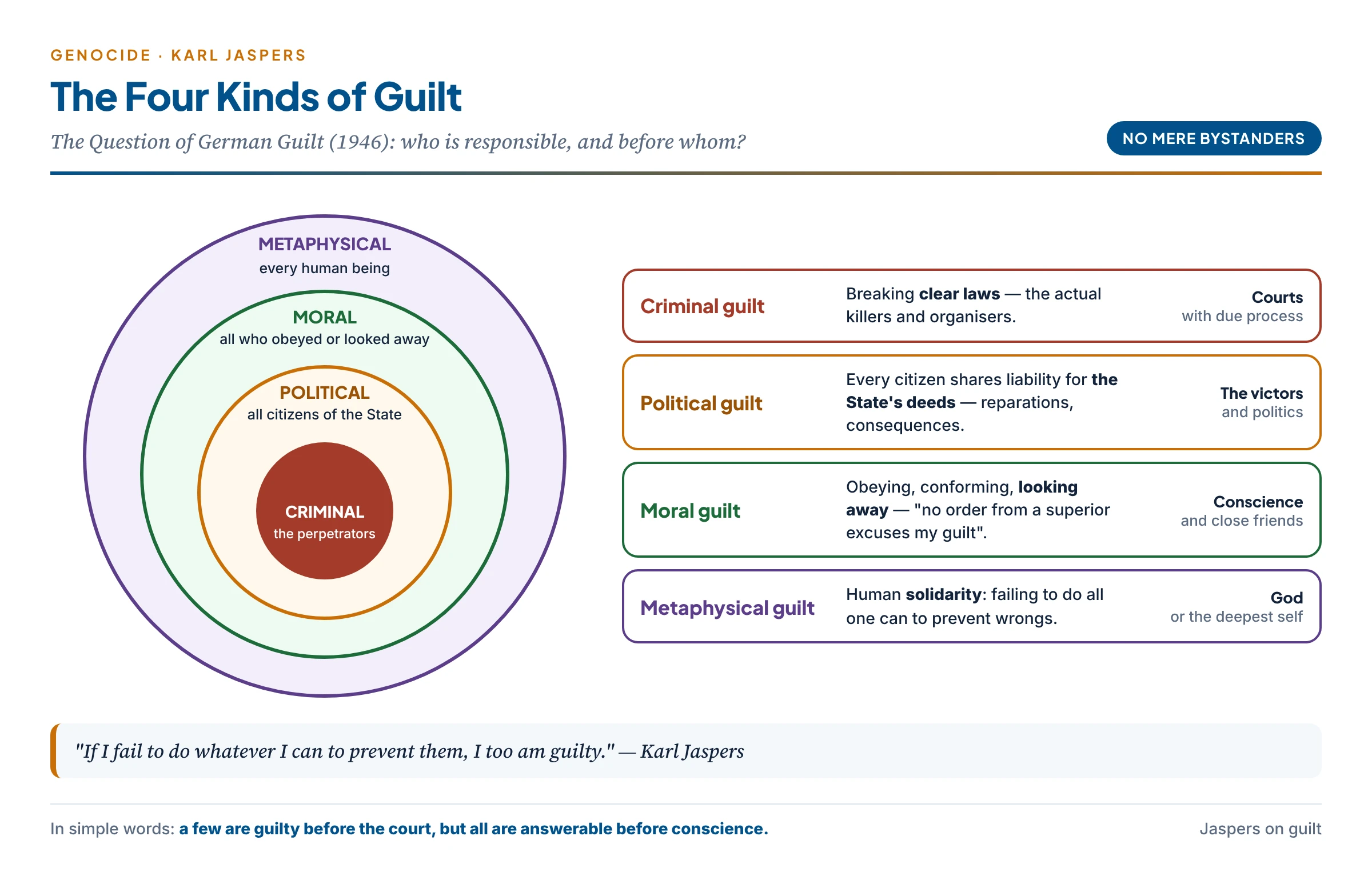
In The Question of German Guilt (1946), the philosopher Karl Jaspers asked how Germans should think about responsibility after the Holocaust. He distinguished four kinds of guilt:
- Criminal guilt — for acts that violate clear laws; proved in a court with due process; belongs to the actual perpetrators.
- Political guilt — the responsibility of all citizens for the deeds of the State in whose name they were done. Even an innocent citizen must bear the political consequences (reparations, occupation, loss of sovereignty). Judged by the victors and the political process.
- Moral guilt — for what one personally did or failed to do: obeying, conforming, looking away, accommodating an evil regime. “No order from a superior excuses my guilt.” Judged by one’s own conscience and by friends who care.
- Metaphysical guilt — rooted in human solidarity itself: each person is co-responsible for every wrong he could have tried to prevent. Judged only by God (or, for a non-believer, by one’s deepest self).
“There exists a solidarity among men as human beings that makes each co-responsible for every wrong and every injustice in the world, especially for crimes committed in his presence or with his knowledge. If I fail to do whatever I can to prevent them, I too am guilty.” — Karl Jaspers
- Why it matters:
- It rejects collective criminal guilt — a whole people cannot be criminally guilty — while insisting on collective political responsibility.
- It demolishes the “I was only following orders” defence at the level of moral guilt.
- It makes bystanders morally answerable — a basis for the modern idea of a duty to prevent genocide.
The Stages of Genocide
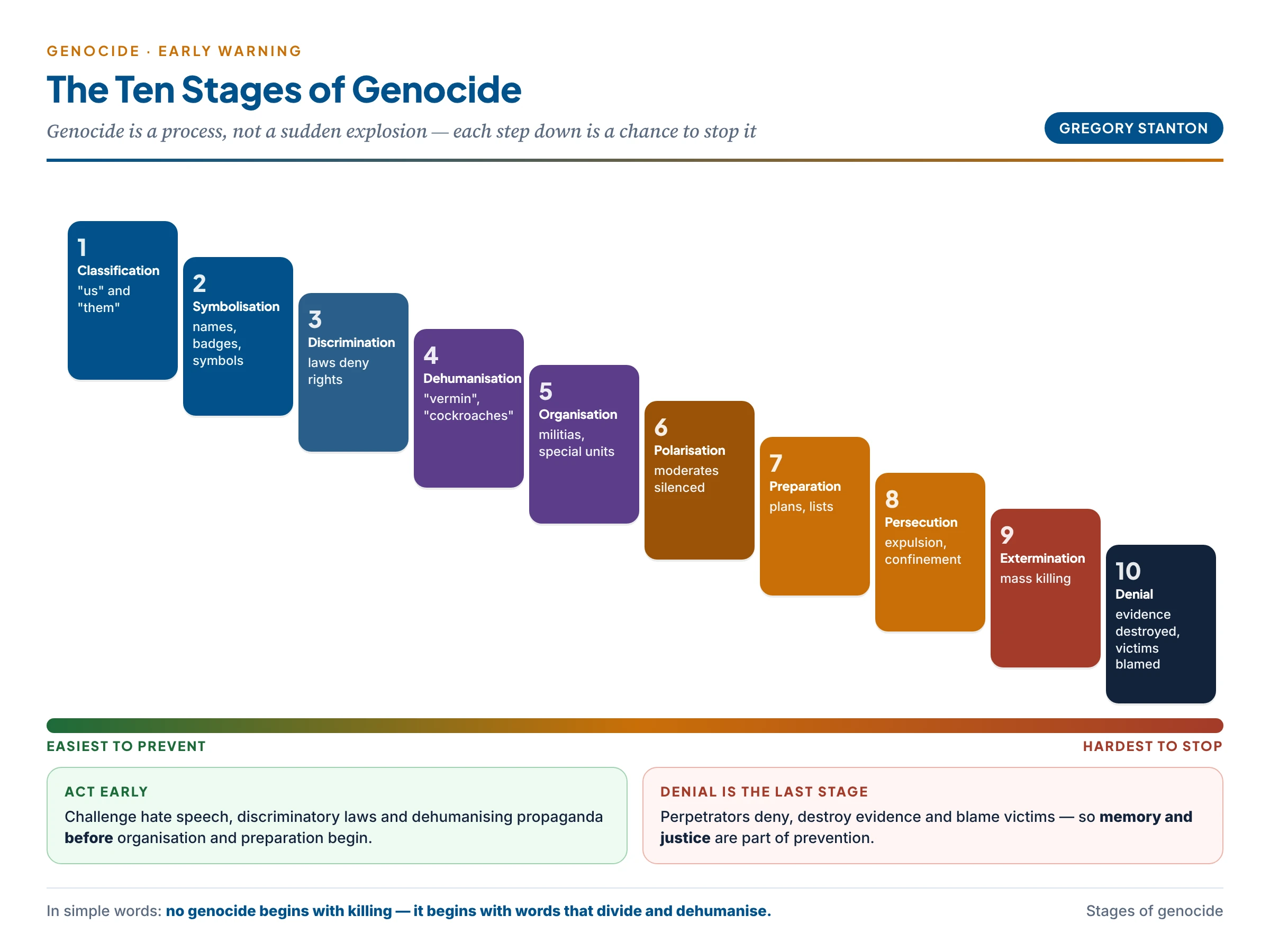
Genocide is a process, not a sudden explosion. The scholar Gregory Stanton described ten stages, which help with early warning:
- Classification — dividing people into “us” and “them”.
- Symbolisation — names, symbols or badges attached to the groups.
- Discrimination — laws and customs denying rights to the targeted group.
- Dehumanisation — propaganda calling them animals, vermin or disease.
- Organisation — militias, special units, plans.
- Polarisation — extremists silence moderates; the groups are driven apart.
- Preparation — leaders plan the “final solution”; lists are drawn up.
- Persecution — victims are identified, expelled, confined, their property seized.
- Extermination — mass killing.
- Denial — perpetrators deny the crime, destroy evidence, blame the victims.
- Lesson: each stage is a chance for prevention; by the time of extermination, it is almost too late.
In simple words
A house fire rarely starts as a blaze. First there is a smell of smoke, then a smouldering wire, then flames in one room. A smoke alarm is useful precisely because it warns at the first stage, when a bucket of water is enough. The stages of genocide work like a smoke alarm for societies: hate speech, discriminatory laws and dehumanising propaganda are the smoke — and the time to act is then, not when the house is burning.
The “Sanctions” Permitting Genocide and the Ethical Counter-Arguments
The 2010 paper asked us to list the various sanctions permitting genocide and bring out the ethical counter-arguments. “Sanctions” here means the justifications that perpetrators have used to make genocide seem permitted or even required.
| “Sanction” used to permit genocide | Example | Ethical counter-argument |
|---|---|---|
| Racial–biological — racial superiority, “racial hygiene”, Social Darwinism | Nazi ideology; colonial genocides | “Race” is not a valid basis for moral worth; every human being has equal dignity (Kant, UDHR); Social Darwinism misuses biology |
| Religious — holy war, heresy, divine command | Wars of religion; religious massacres | Euthyphro’s problem; the core ethics of all religions forbid killing innocents; religion within the limits of reason (Kant) |
| Nationalist — purity of the nation, “living space”, the “enemy within” | Armenians as a “fifth column”; ethnic cleansing | The nation is a community of citizens, not of blood; minorities have equal rights; plurality enriches |
| Political–ideological — class enemies, revolutionary purity | Cambodia; mass killings of “enemies of the people” | Persons cannot be destroyed for belonging to a class or party; ideology cannot override human rights |
| Security and necessity — “they will kill us first”, wartime emergency | Pretexts in Armenia, Rwanda | Collective guilt is a fallacy — individuals are responsible only for their own acts; children and civilians threaten no one |
| Legal sanction — “it was the law”, “I was following orders” | Nazi race laws; obedience of officials | Nuremberg principle: superior orders are no defence; a law ordering mass murder is not law (natural-law tradition) |
| Utilitarian — a better future for the majority | Utopian projects of “purification” | No future good can justify using people merely as means (Kant); the actual consequences are catastrophic |
| Colonial–civilisational — “civilising mission”, empty land | Destruction of indigenous peoples | Every people has a right to exist and to its culture; “civilisation” that kills is barbarism |
| Revenge and historical grievance | Cycles of ethnic retaliation | Individual responsibility; revenge on the innocent perpetuates the cycle; reconciliation over retaliation |
General ethical counter-arguments:
- Human dignity (Kant): every person is an end in himself; no one may be destroyed for what he is rather than what he does.
- Universal human rights: the UDHR begins with the “inherent dignity and equal and inalienable rights of all members of the human family“.
- The fallacy of collective guilt: guilt is individual; to kill a child for belonging to a group is to punish the innocent.
- Plurality (Arendt) and cultural value (Lemkin): human diversity is the condition of human life and a treasure of civilisation.
- Personal responsibility (Jaspers, Nuremberg): obedience does not excuse; every adult must judge.
- Non-violence (Gandhi, the Buddha, Mahāvīra): all life is one; hatred cannot be ended by hatred.
- Consequences: genocide brings unimaginable suffering, lasting trauma, cycles of revenge and the moral ruin of the perpetrators’ own society.
In simple words
Ask a simple question about each “sanction”: would the justification still work if the roles were reversed? If “they are inferior” justified killing them, it would justify killing us whenever someone thought we were inferior. If “my government ordered it” excused killing, it would excuse anyone’s government ordering our deaths. Every sanction for genocide fails Kant’s test: it cannot be made a universal law.
Preventing and Punishing Genocide
- International law:
- The Genocide Convention (1948) obliges States to prevent and punish genocide.
- The Nuremberg and Tokyo trials (1945–48) established that individuals, including leaders, are criminally responsible; superior orders are no defence.
- International tribunals for the former Yugoslavia (1993) and Rwanda (1994); the International Criminal Court (Rome Statute, 1998; in force 2002) — making leadership accountable.
- Universal jurisdiction — some States allow their courts to try genocide wherever it occurred.
- The Responsibility to Protect (R2P) (UN World Summit, 2005): each State must protect its people from genocide, war crimes, ethnic cleansing and crimes against humanity; the international community must help, and act collectively if a State manifestly fails.
- The International Court of Justice hears cases between States under the Convention (Bosnia v Serbia, 2007; The Gambia v Myanmar; South Africa v Israel).
- Domestic and social measures:
- Strengthening democracy — free press, independent courts, minority rights.
- Removal of theories of ethnic superiority — in education, media and politics.
- Effective laws and institutions — including hate-speech laws and impartial police.
- Making leadership accountable — national and international courts.
- Early warning — monitoring the stages of genocide (Stanton).
- Cultivating critical moral thinking (Arendt) and human solidarity (Jaspers) — “never again” must be taught, not assumed.
- India’s position:
- India signed the Genocide Convention in 1949 and ratified it in 1959, but has not enacted a domestic law making genocide (or crimes against humanity) a specific crime; mass killings are prosecuted as ordinary murder, rioting and similar offences.
- India is not a party to the Rome Statute of the International Criminal Court.
- In 2018, the Delhi High Court, convicting a political leader for the 1984 anti-Sikh killings, described those killings as “crimes against humanity” and observed that “neither ‘crimes against humanity’ nor ‘genocide’ is part of our domestic law of crime” — a loophole that, it said, needs to be addressed urgently, noting a pattern of mass killings enjoying political patronage.
Indian Connect — Vasudhaiva kuṭumbakam and the oneness of life
The Upaniṣadic ideal of vasudhaiva kuṭumbakam — “the world is one family” — and the Vedāntic vision that the same Self (ātman) dwells in every being stand directly against the logic of genocide, which divides humanity into those who may live and those who must die. The Jaina principle of ahiṃsā extends respect to all life; the Buddha taught that “hatred is never ended by hatred, but by non-hatred alone“. Gandhi, who died at the hands of a communal fanatic during the Partition violence, spent his last months walking through riot-torn villages to stop the killing. India’s own experience of Partition shows how quickly a plural society can turn on itself — and why its constitutional promise of fraternity must be actively defended.
Critical Evaluation
Critics and Defenders
Criticism — Debates and criticisms
- Narrow legal definition: excluding political and social groups, and “cultural genocide”, leaves many mass atrocities outside the term.
- The intent problem: proving the special intent to destroy a group “as such” is very hard, so many atrocities are never legally called genocide.
- Selective enforcement: international justice has often reached the leaders of weak States, not the powerful.
- Critics of Arendt: Eichmann was a committed antisemite, not merely thoughtless; “banality” may understate ideological hatred.
- Critics of R2P: “humanitarian intervention” can be misused as a cover for great-power interests.
- Single-cause theories: biological or purely economic explanations cannot account for when and where genocide occurs.
Defence — Insights and responses
- Lemkin: naming the crime made it possible to outlaw and prosecute it.
- Arendt: genocide is carried out by ordinary, thoughtless people; the duty to think and judge cannot be delegated.
- Jaspers: criminal, political, moral and metaphysical guilt — no one is merely a bystander.
- Bauman, Milgram, Browning: modern bureaucracy and obedience make genocide possible; conscience must be cultivated.
- Stanton: genocide unfolds in stages, so it can be foreseen and prevented.
- International law (Nuremberg, ICTR, ICC, ICJ): leaders and followers alike can be held to account; superior orders are no defence.
Cross-Tradition Comparison
Genocide in Western and Indian Moral Thought
| Point | Western thought | Indian thought | Shared insight |
|---|---|---|---|
| Worth of every person | Kant’s dignity; UDHR | The same ātman in all beings; vasudhaiva kuṭumbakam | No group is less human |
| Plurality | Arendt: “men, not Man, live on the earth” | Jaina anekāntavāda; tolerance of many paths | Diversity is the condition of human life |
| Responsibility of the ordinary person | Arendt’s duty to judge; Jaspers’ moral guilt | Gandhi’s refusal to cooperate with evil (satyāgraha) | Obedience is no excuse |
| Solidarity | Jaspers’ metaphysical guilt | Buddhist compassion (karuṇā); Gandhi’s walks through riot areas | Each is co-responsible for wrongs he could prevent |
| Answer to hatred | Reconciliation, human rights law | “Hatred is not ended by hatred, but by non-hatred” | Breaking the cycle of revenge |
Synthesis (Siddhānta)
- Genocide — a word coined by Lemkin in 1944 — is the destruction, in whole or in part, of a national, ethnical, racial or religious group as such, through killing, serious harm, destructive living conditions, preventing births or transferring children (Genocide Convention, 1948). It may be direct or indirect, and it is the “crime of crimes” because it attacks human plurality itself.
- It usually arises from a combination of conditions — war, economic crisis, political upheaval, autocracy, ethnic cleavages, exclusionary ideology and isolation — and is explained by economic, psychological, ideological, political and modern-bureaucratic factors. Racial supremacy is a major cause in some cases (the Holocaust, colonial genocides) but not the only or always the main one; the common root is a dehumanising division of humanity into “us” and “them”.
- Arendt showed that genocide is carried out by ordinary, thoughtless functionaries — the banality of evil — and that obedience is no excuse; Jaspers distinguished criminal, political, moral and metaphysical guilt, making even bystanders answerable; Milgram, Browning and Bauman confirmed how ordinary people and modern bureaucracy make it possible.
- Every “sanction” for genocide — racial, religious, nationalist, ideological, security, legal, utilitarian, colonial — fails before the ethical counter-arguments of human dignity, individual responsibility, plurality, universal rights and non-violence.
- Prevention requires international law and courts (Convention, Nuremberg principles, ICC, ICJ, R2P), early warning of its stages, democracy and minority rights, accountable leadership, and the cultivation of independent moral judgement and human solidarity. For India, the 2018 call to make genocide and crimes against humanity part of domestic law remains an unfinished task.
“Hatred is never ended by hatred, but by non-hatred alone; this is an eternal law.” — the Buddha, Dhammapada
Previous Year Questions
- 2014Can we say that racial supremacy is the main reason for genocide? Give reasons for your answer.
- 2012What can be the causes of mass violence? Can mass violence be justified on moral ground? Discuss.
- 2010List the various sanctions permitting genocide and clearly bring out the ethical counter-arguments against it.