

Crime and Punishment: Corruption, Mass Violence, Genocide, Capital Punishment.
Official Syllabus: Paper II, Section A, Unit 7
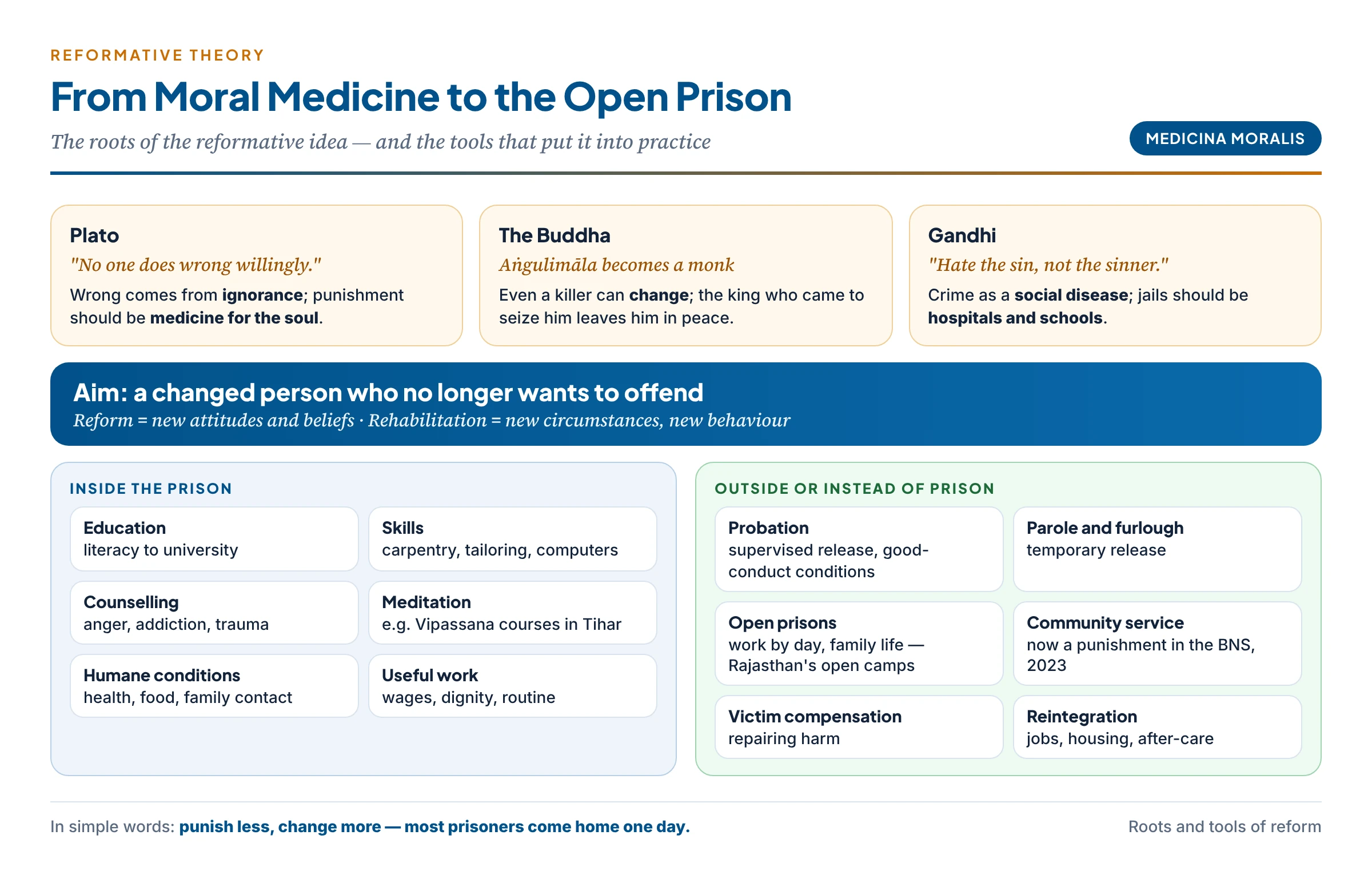
The reformative theory asks a different question from retribution and deterrence. Not “What does he deserve?” nor “How do we frighten others?” but “How can this person be changed so that he no longer wants to do wrong?” It treats crime more like a disease to be cured than a debt to be paid, and the prison more like a hospital or a school than a cage. Its roots go back to Plato, for whom no one does wrong willingly, and to Gandhi’s “Hate the sin, not the sinner“. Its younger cousin, the restorative theory, asks yet another question: “Who has been hurt, and how can the harm be repaired?” This article explains both theories, the famous critique by C.S. Lewis that “humane” reform can become the worst tyranny, whether reform is in tune with human dignity, whether restorative justice is preferable to retribution, and how proportionality applies to juvenile offenders.
In simple words
When a child breaks a neighbour’s window, one parent shouts and takes away pocket money (retribution). Another warns, “Do it again and you’ll be grounded for a month” (deterrence). A third sits with the child, finds out why he was throwing stones, teaches him better ways, and walks him to the neighbour’s door to apologise and help pay for the glass. The third parent is doing reform (changing the child) and restoration (repairing the harm) together.
Context & Problem
Meaning of the Reformative Theory
- Core claim: the primary objective of criminal justice is the moral, psychological and social regeneration of the offender. Punishment is justified only to the extent that it reforms.
- Crime as a symptom: crime is not seen as an act of pure evil deserving vengeance, but as a symptom of individual pathology, psychological trauma, ignorance, or defective socio-economic conditions.
- Replacing punishment: the theory seeks to replace punishment itself by an effort to reform and rehabilitate the offender.
- Two key terms:
- Reform — a change in attitudes or beliefs (the offender comes to see why his act was wrong).
- Rehabilitation — a change in circumstances (skills, job, housing, family support) leading to a change of behaviour.
- Prison as a rehabilitation centre: the jail becomes a reformatory, hospital or school — medicina moralis, “moral medicine“.
- A different picture of crime: the reformative theory does not regard crime as a fully voluntary breach of law, nor punishment as the deliberate infliction of suffering.
- Where it fits best: some crimes are committed under heavy psychological and economic pressure, out of frustration after utter failure in one’s fight against injustice. In such cases the reformative approach bears fruit.
- Type of punishment: mild, and supplemented by reform and rehabilitation.
Historical Roots
- Plato:
- “No one does wrong willingly.” Wrongdoing comes from ignorance of the good; no one who truly knew what was good for him would choose evil.
- So punishment should work like medicine for the soul: as a doctor cures the body, the judge should cure the soul of its injustice.
- In the Gorgias, Socrates argues that the wrongdoer who escapes punishment is more wretched than one who is punished, because he stays sick.
- In the Protagoras, punishment is said to look to the future, which shows that virtue can be taught.
- Religious traditions: repentance, confession and conversion — the sinner can be redeemed.
- The Enlightenment and after: John Howard’s prison reform movement; the penitentiary (literally, a place for penitence); probation and parole in the nineteenth and twentieth centuries.
- The positivist school of criminology (Lombroso, Ferri): crime has causes — biological, psychological, social — and should be treated, not merely punished.
- The “rehabilitative ideal” dominated twentieth-century penology until the 1970s, when studies claiming that “nothing works” led to a swing back towards deterrence and “just deserts”. It has since revived, with better evidence for education, vocational training, therapy and drug treatment.
Core Doctrine
Gandhi — Hate the Sin, Not the Sinner
- “Hate the sin, not the sinner.” Gandhi separated the act, which must be condemned and resisted, from the person, who must be respected and helped to change.
- Every person has a divine soul (ātman): no human being is beyond redemption; the criminal is a brother who has strayed.
- Crime as a social disease: Gandhi saw much crime as the product of poverty, injustice and a corrupt social order. Criminals should be treated like patients, and jails should become hospitals for their cure.
- Prisons as reform homes (sudhār gṛha): moral counselling, prayer, spinning and useful work, education and dignified treatment.
- “An eye for an eye makes the whole world blind.” Retaliation only multiplies violence.
- Non-violence (ahiṃsā) and satyāgraha aim to convert the wrongdoer, not to crush him.
Indian Connect — Aṅgulimāla and Vālmīki
Two of the most famous stories in Indian tradition are stories of reform. Aṅgulimāla was a robber and murderer who wore a garland of his victims’ fingers; the Buddha met him on a lonely road, and through a single conversation he became a monk. When King Pasenadi arrived with soldiers to capture him and found him transformed, he left him in peace. Ratnākara, a highway robber, is said to have become the sage Vālmīki, author of the Rāmāyaṇa. Both stories teach the reformative creed: no one is beyond change, and the goal of justice is a changed person, not a punished one.
Common confusion
Did Gandhi coin “Hate the sin, not the sinner”? Gandhi made the phrase famous, but he presented it as an old precept: in his Autobiography he wrote that “‘Hate the sin and not the sinner’ is a precept which, though easy enough to understand, is rarely practised”. The idea is much older — St Augustine wrote of loving persons while hating their vices. Gandhi’s contribution was to make it a practical rule of politics and justice, through satyāgraha and his view of prisons as places of reform.
Methods of Reform and Rehabilitation
- Within prison:
- Education — literacy, school and university courses.
- Vocational training — carpentry, tailoring, computer skills, bakery — so that the prisoner can earn honestly on release.
- Counselling and therapy — for anger, addiction, trauma and mental illness.
- Moral and spiritual programmes — the Vipassana meditation courses introduced in Tihar Jail in the 1990s are a well-known Indian example.
- Humane conditions — decent food, health care, contact with family.
- Outside or instead of prison:
- Probation — the offender is released under supervision and good-conduct conditions instead of being jailed (the Probation of Offenders Act, 1958, especially for first and young offenders).
- Parole and furlough — temporary release for family reasons or as a reward for good conduct.
- Open prisons — prisoners live with their families, work outside during the day and return at night; Rajasthan’s open camps (such as Sanganer) are a celebrated model.
- Community service — the Bharatiya Nyaya Sanhita, 2023, for the first time lists community service as a punishment (for petty offences such as a first theft of property worth under ₹5,000, public intoxication causing annoyance, and defamation).
- Policy direction: the Model Prisons and Correctional Services Act, 2023, prepared by the Union Home Ministry, treats prisons as correctional institutions, with stress on reform, skills and reintegration.
“The Goal in Punishing Should Be to Reform the Individual”
This statement, set in the 2016 paper, is the creed of the reformative theory.
- In its favour:
- Most offenders return to society. Unless they are changed, prison simply sends back more dangerous people.
- Reform is the best protection. A reformed offender commits no further crime — better than deterrence (which fails with the impulsive) or incapacitation (which ends at release).
- Respects humanity. It treats the offender as a person who can grow, not as a mere object of pain.
- Addresses causes. It looks at why the crime happened — poverty, addiction, abuse, ignorance.
- Constitutional and international support. The ICCPR states that the essential aim of the prison system “shall be reformation and social rehabilitation“; the Indian Supreme Court has repeatedly held that reformation is a central aim of punishment.
- Against it as the only goal:
- Not fit for hardened criminals, whose proportion is large; some do not want to change.
- Totally ignores the deterrent role of punishment — others may see mild treatment as an invitation.
- Overlooks justice to the victim — the victim’s suffering is pushed aside while the offender receives care.
- Coddles habitual offenders — repeat offenders may exploit soft programmes.
- Unequal outcomes — two people who committed the same crime may serve very different terms depending on how “cured” they seem.
- The C.S. Lewis problem — “cure” can become a cover for indefinite and coercive control.
- Balanced comment: reform should be a goal, not the only goal; and it must work within the limits of desert and due process.
C.S. Lewis — The Humanitarian Theory as Tyranny
In his essay “The Humanitarian Theory of Punishment” (1949), C.S. Lewis argued that the reformative (“humanitarian”) theory, though it seems kind, robs a person of his humanity.
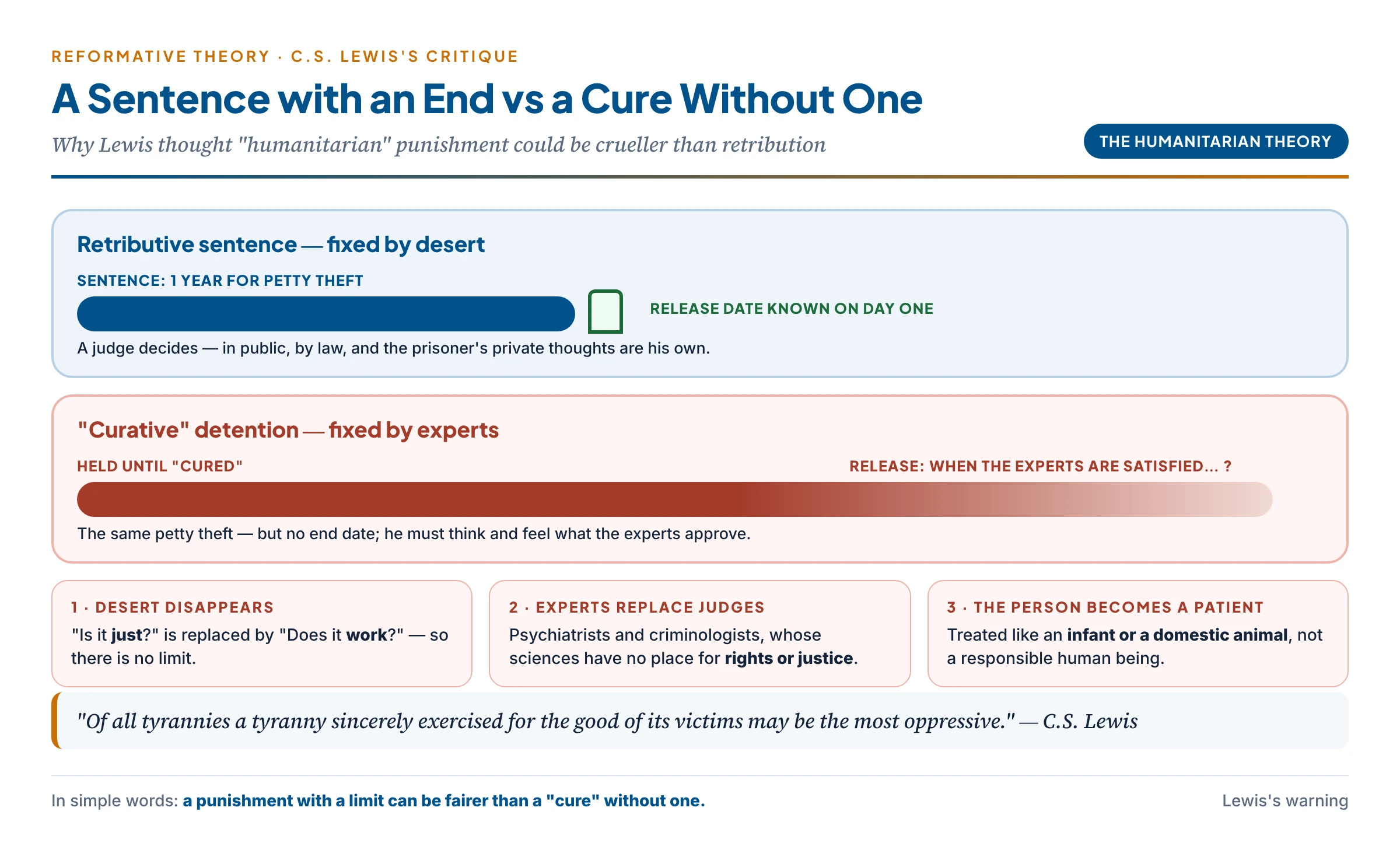
- It removes desert. When we treat a criminal as a moral agent, we ask “Did he do it? What does he deserve?” — questions that set limits. When we treat him as a patient to be cured, the concept of desert disappears.
- Experts replace judges. Sentences pass from judges, whom public conscience can criticise in terms of justice, to technical experts — psychiatrists and criminologists — whose sciences do not even use the categories of rights or justice.
- Indefinite detention. Under retribution, a person sentenced for petty theft serves a fixed term and walks out free, whatever his private thoughts. Under pure reform, the criterion of release is “cure”, so the State may keep him until the experts are satisfied — which could be forever.
- Compulsory remaking. He may be subjected to “all those assaults on personality which modern psychotherapy knows how to deliver“, to be remade after a pattern of “normality” he never accepted.
- The most oppressive tyranny:
“Of all tyrannies a tyranny sincerely exercised for the good of its victims may be the most oppressive. It may be better to live under robber barons than under omnipotent moral busybodies.” — C.S. Lewis
- Lost dignity:
“To be ‘cured’ against one’s will and cured of states which we may not regard as disease is to be put on a level with those who have not yet reached the age of reason or those who never will… But to be punished, however severely, because we have deserved it, because we ‘ought to have known better,’ is to be treated as a human person.” — C.S. Lewis
- Political danger: a government could label dissent a “disease” and “treat” dissidents — as some authoritarian regimes did with psychiatric hospitals for political prisoners.
- Literature has pictured this danger: in Anthony Burgess’s novel A Clockwork Orange (1962), a violent youth is “cured” by conditioning that makes him physically sick at the thought of violence — he becomes harmless but no longer free to choose good. The novel asks whether a person made good by force is really good at all.
In simple words
Imagine two students caught copying. The first is told: “Three days’ suspension.” He serves it and returns. The second is told: “You will be suspended until the counsellor decides your attitude has improved.” He may wait three days or three years, and he must say and feel whatever the counsellor wants to hear. Which is more humane? Lewis says: the first — because it treats the student as responsible, and it has a limit.
Is the Reformative Theory in Tune with Human Dignity?
The 2021 paper asked whether reform is in tune with human dignity.
Yes — in important ways:
- It rejects cruelty — torture, mutilation, degrading conditions.
- It affirms the moral potential of every human being — no one is written off.
- It treats the offender as an end: punishment aims at his good, not only society’s (Kant’s formula of humanity in a positive sense).
- It recognises that much crime springs from deprivation, trauma or ignorance, and responds with help.
- It seeks restoration to civic life — a dignified return to family, work and community.
- Indian law: the Supreme Court has held that prisoners keep their fundamental rights (Sunil Batra, 1978), that reformation and rehabilitation are aims of sentencing, and that prisons must respect Article 21.
No — in other ways:
- Denies moral agency: by treating crime as disease, it strips the offender of the status of a responsible person (Lewis; Kant’s dignity as rational agent).
- Paternalism: forcing a person to be “cured” by the State’s standard violates autonomy.
- Indefinite custody and unequal sentences for equal crimes violate fairness.
- Manipulation of the mind — conditioning or coercive therapy invades the inner self.
- Ignores the victim’s dignity — the person harmed is left out.
Synthesis: reform is in tune with dignity when it is (1) offered, not forced — education and therapy as opportunities; (2) carried out within a fixed, deserved sentence — reform shapes how punishment is carried out, desert limits how long; (3) addressed to the offender as a responsible person — through dialogue and moral persuasion, not conditioning. This is the position of mixed theories (Hart) and of “moral education” and “communicative” theories (Article 5): punishment that speaks to the offender’s reason rather than operating on his mind.
The Restorative Theory
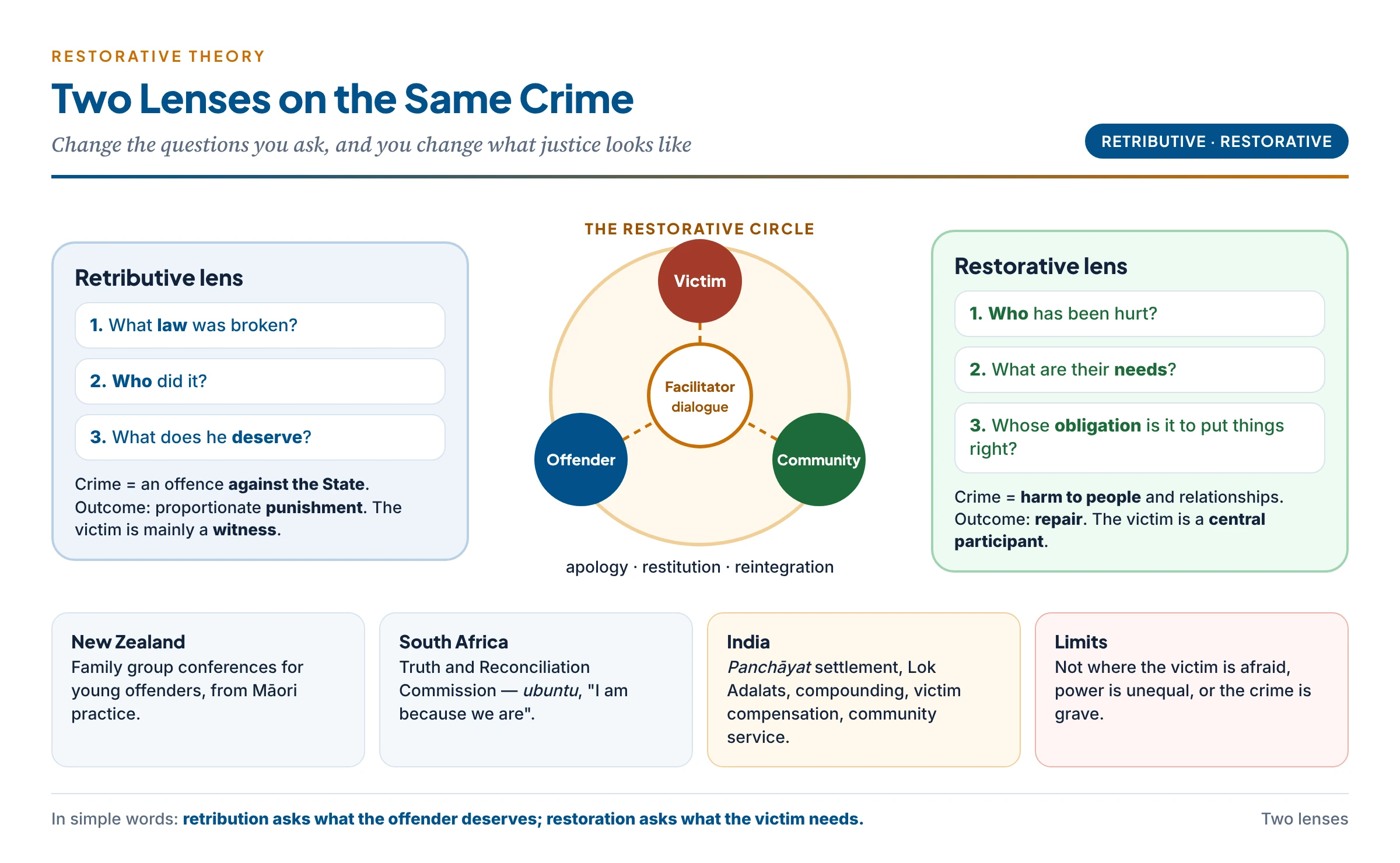
- Meaning: restorative justice sees crime mainly as harm done to people and relationships, not only as a violation of the State’s law. Its aim is to repair the harm, involving the victim, the offender and the community.
- Two lenses (Howard Zehr):
- The retributive lens asks: What law was broken? Who did it? What does he deserve?
- The restorative lens asks: Who has been hurt? What are their needs? Whose obligation is it to put things right?
- Key features:
- Voluntary meeting of victim and offender (with a trained facilitator) — the victim can tell his story and ask “Why me?”
- Offender accountability — the offender faces the human consequences of his act and accepts responsibility.
- Repair — apology, restitution, compensation, community work.
- Reintegration — the offender is welcomed back once he has made amends; shame is followed by acceptance, not exclusion.
- Examples:
- New Zealand’s family group conferences (from 1989), drawing on Māori traditions, for young offenders.
- Truth and Reconciliation Commission in South Africa (1995 onwards) — restorative justice for a whole nation after apartheid; Desmond Tutu called it the way of ubuntu — “I am because we are”.
- India: traditional panchāyat settlements; Lok Adalats; compounding of minor offences (the parties may settle); plea bargaining (since 2005); victim compensation schemes; and the new emphasis on community service in the BNS.
- Strengths:
- Gives the victim a voice — the person most affected, ignored by both retribution and deterrence.
- Higher victim satisfaction and often lower reoffending, especially for young and first offenders.
- Humanises the offender and the victim to each other.
- Heals communities and prevents feuds.
- Limits:
- Depends on voluntary participation; not suitable where the victim is unwilling or afraid.
- Risky in cases of power imbalance — domestic violence, caste violence, sexual offences — where “reconciliation” can mean pressure on the victim.
- Hard to apply to grave crimes like murder or terrorism, and to victimless offences.
- Can be unequal: a rich offender can “repair” easily, a poor one cannot.
- Some argue it can trivialise serious crime if it replaces punishment entirely.
In simple words
A boy on a scooter knocks down an old woman’s vegetable cart. In court, he might get a fine paid to the State, and she gets nothing. In a restorative meeting, he hears how she lost a week’s earnings and was frightened; he apologises, pays for the vegetables, and helps her rebuild the cart. She feels heard, he feels the real weight of what he did, and the neighbourhood sees the matter settled rather than buried in a file.
Retributive or Restorative — Which to Recommend?
The 2014 paper asked which theory one would recommend, and why.
| Point | Retributive theory | Restorative theory |
|---|---|---|
| Crime is | A violation of law and moral order | A harm to people and relationships |
| Focus | The offender’s guilt and desert | The victim’s needs and the repair of harm |
| Key question | What does he deserve? | Who was hurt, and how do we put it right? |
| Role of victim | Witness for the State | Central participant |
| Offender | Passive recipient of punishment | Active — accepts responsibility, makes amends |
| Outcome | Proportionate pain | Apology, restitution, reconciliation |
| Strength | Limits, equality, moral seriousness | Healing, victim voice, lower reoffending |
| Weakness | Neglects victim and reform | Unsuitable for grave crimes and power imbalances |
- A reasoned recommendation:
- For minor, first and juvenile offences, and for many property and neighbourhood disputes — restorative justice is better: it heals, repairs and prevents a young person from being turned into a hardened criminal by prison.
- For grave crimes — murder, rape, terrorism, crimes involving deep power imbalance — the retributive framework must remain, to guarantee proportion, equality and public condemnation; restorative elements (victim participation, compensation, dialogue where the victim wishes it) can be added within it.
- So the best answer is not “either–or” but restorative justice within retributive limits: desert sets the ceiling and the floor; restoration fills the space with repair and reconciliation.
Juveniles and the Principle of Proportionality
The 2023 paper quoted the principle that “severity of punishment should be proportionate to the seriousness of the crime” and asked whether, in punishing a juvenile, the nature of the crime should be considered.
- The case for considering the nature of the crime:
- Proportionality demands it: a sixteen-year-old who commits a brutal rape or murder cannot be treated like one who steals a bicycle.
- Victims and society need to see that grave crimes are taken seriously; the 2012 Delhi gang-rape case, in which one accused was a juvenile who received the maximum of three years in a special home, provoked public outrage.
- Older adolescents may understand the consequences of their acts.
- The case for treating juveniles differently even for grave crimes:
- Reduced culpability: adolescents have less developed judgement and impulse-control; brain development continues into the twenties. Seriousness = harm + culpability, so even great harm by a child carries less blame (Article 2).
- Greater capacity for reform: young people change much more than adults; a young offender is not a finished person.
- Peer pressure and environment — many child offenders come from abuse, neglect and poverty.
- International standards: the UN Convention on the Rights of the Child forbids death and life imprisonment without possibility of release for those under eighteen.
- The Indian answer — the Juvenile Justice (Care and Protection of Children) Act, 2015:
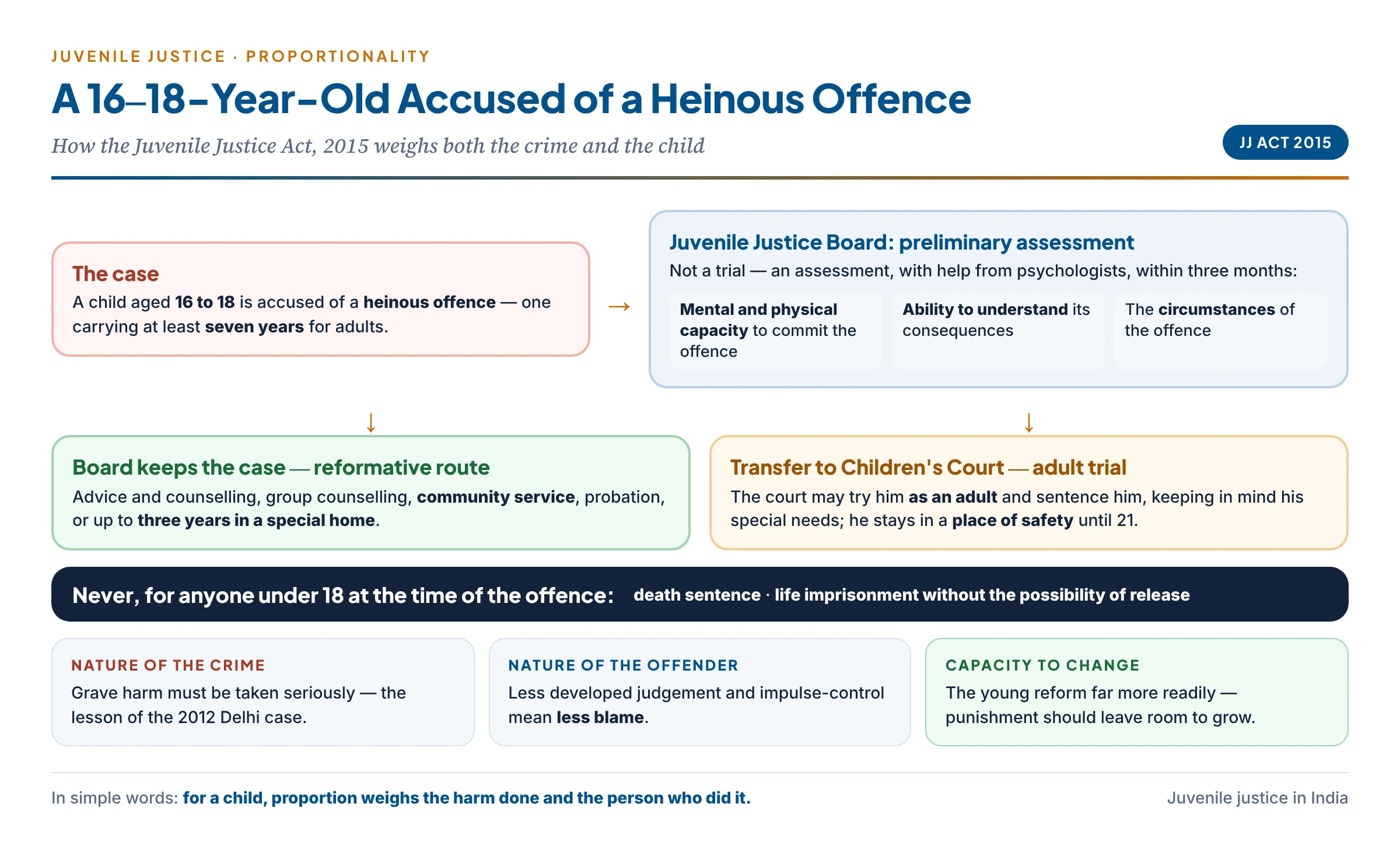
- A child is anyone under 18; offences are graded petty, serious and heinous (heinous = a minimum punishment of seven years or more for adults).
- For a child aged 16–18 accused of a heinous offence, the Juvenile Justice Board makes a preliminary assessment of his mental and physical capacity to commit the offence, his ability to understand its consequences, and the circumstances of the offence.
- The Board may then dispose of the case itself (reformative measures — counselling, community service, up to three years in a special home) or transfer it to a Children’s Court, which may try him as an adult.
- Even then, no death sentence and no life imprisonment without the possibility of release can be imposed on anyone who was a child at the time of the offence.
- The Supreme Court (Shilpa Mittal, 2020) held that offences without a minimum sentence of seven years are not “heinous” for this purpose — keeping the adult-trial route narrow.
- Evaluation: the Act considers the nature of the crime (heinous vs others) and the nature of the offender (capacity, maturity, circumstances) — exactly what proportionality properly understood requires. Critics on one side say it still lets grave offenders off lightly; critics on the other say transfer to adult courts abandons the reformative promise of juvenile justice. The balanced view: the nature of the crime should be considered, but always together with the reduced culpability and greater reformability of the young.
In simple words
Think of two plants damaged in a storm. One is an old tree with a broken trunk; the other is a young sapling bent to the ground. A gardener does not treat them alike. The sapling can be straightened and tied to a stick — it will grow upright. That is why the law treats a young offender differently: not because his act was less harmful, but because he is still growing.
Critical Evaluation
Criticisms of the Reformative Theory
- Not fit for hardened criminals — whose proportion is very large; some offenders are not interested in reform.
- Totally ignores deterrence — mild treatment may encourage others to offend.
- Overlooks justice to the victim — the victim’s pain and claims are neglected.
- Coddles habitual offenders — reform programmes can be exploited.
- Denies responsibility — treating crime as disease treats the offender as a child or animal (Lewis).
- Indefinite and unequal sentences — release tied to “cure” means equal crimes can receive very unequal terms.
- Expert tyranny — sentencing passes from judges to technicians beyond public criticism.
- Coercive therapy — “treatment” can become brainwashing (the danger pictured in A Clockwork Orange).
- Mixed evidence — some programmes work, many do not; overcrowded prisons rarely reform.
- Uncertain diagnosis — who decides when a person is “cured”?
Defences and Strengths
- The only lasting protection — a changed person commits no further crime.
- Humane — rejects cruelty and affirms everyone’s capacity to change.
- Looks at causes — poverty, addiction, mental illness, abuse.
- Evidence-based programmes work — education, job skills and drug treatment do reduce reoffending.
- Suits young and first offenders best, preventing them from being hardened by prison.
- Constitutionally grounded — dignity under Article 21; reformation as a sentencing aim; ICCPR 10(3).
- Answer to Lewis — reform need not be compulsory or indefinite; within a fixed, deserved sentence, it is an opportunity, not a tyranny.
Critics and Defenders
Criticism — Critics
- C.S. Lewis: “humanitarian” punishment removes desert, hands sentencing to experts, and permits indefinite cure — a tyranny of moral busybodies.
- Kant and Hegel: treating crime as disease denies the offender’s dignity as a rational, responsible agent.
- Deterrence theorists: mild treatment weakens fear of the law.
- Victims’ advocates: the offender gets care while the victim is forgotten.
- “Nothing works” critics: reform programmes often fail to reduce reoffending.
- Sceptics of restorative justice: unsuitable where victims are afraid or the crime is grave.
Defence — Defenders and strengths
- Plato: no one does wrong willingly; punishment should be medicine for the soul.
- Gandhi: hate the sin, not the sinner; jails should be hospitals and schools.
- The Buddha: Aṅgulimāla shows that even a killer can change.
- Modern penology: education, skills and therapy reduce reoffending; reform is the best protection.
- Restorative justice (Zehr, Tutu): crime is harm to people; repair heals victims and reintegrates offenders.
- International and Indian law: reformation is the essential aim of imprisonment; children are never sentenced to death.
Cross-Tradition Comparison
Reform and Restoration in Indian and Western Thought
| Point | Indian thought | Western thought | Shared insight |
|---|---|---|---|
| Cause of wrongdoing | Ignorance (avidyā), desire, social neglect (Cakkavatti Sīhanāda Sutta) | Ignorance (Plato); social causes (positivist criminology) | Wrongdoing has causes that can be removed |
| Possibility of change | Aṅgulimāla, Vālmīki; every soul is divine (Gandhi) | Repentance and redemption; rehabilitation | No one is beyond reform |
| Method | Moral counsel, meditation, work, prayer | Education, therapy, vocational training | Change the person, not just the penalty |
| Restoration | Panchāyat settlement, compensation, Lok Adalat | Restorative conferences, truth commissions | Repair harm, reconcile parties |
| Danger | Paternal authority of elders | Expert tyranny (Lewis) | Reform must respect freedom |
Indian Connect — Gandhi and Lewis, an unexpected meeting
Gandhi and C.S. Lewis seem to stand at opposite ends: Gandhi wanted prisons to become hospitals; Lewis feared exactly that. But they agree on something deeper. Gandhi’s reform was always by persuasion and self-suffering, never by force — satyāgraha appeals to the wrongdoer’s conscience and leaves him free to respond. That is the kind of reform Lewis could accept: one that addresses a responsible person, not one that operates on a patient.
Synthesis (Siddhānta)
- The reformative theory holds that the aim of punishment is to change the offender — through education, skills, therapy and humane treatment — because most offenders return and a reformed person is the best protection. Its roots run from Plato to Gandhi, and its Indian emblems are Aṅgulimāla and Vālmīki.
- C.S. Lewis showed its danger: without desert as a limit, “cure” can mean indefinite detention, expert rule and coerced remaking — a tyranny “exercised for the good of its victims”.
- Is it in tune with human dignity? Yes, when reform is offered within a fixed, deserved sentence and addresses the offender as a responsible person; no, when it becomes compulsory, open-ended treatment of a “patient”.
- The restorative theory adds what both retribution and reform neglect — the victim and the repair of harm — and works best for minor, first and juvenile offences; for grave crimes and unequal power relations, it should operate within retributive limits.
- For juveniles, proportionality must weigh both the nature of the crime and the offender’s reduced culpability and greater capacity for change — as India’s JJ Act tries to do.
- Balanced position: desert limits, reform guides, restoration heals. Punishment should be deserved in amount, reformative in method and restorative in spirit.
“Hate the sin, not the sinner.” — Mahatma Gandhi
Previous Year Questions
- 2023“Severity of punishment should be proportionate to the seriousness of the crime.” — Do you agree that while punishing a juvenile, the nature of the crime should be considered? Justify your answer.
- 2021Explain the reformative theory of punishment and discuss whether this is in tune with human dignity.
- 2016“The goal in punishing should be to reform the individual.” Comment.
- 2014Which theory of punishment retributive or restorative, do you recommend and why?