

Crime and Punishment: Corruption, Mass Violence, Genocide, Capital Punishment.
Official Syllabus: Paper II, Section A, Unit 7
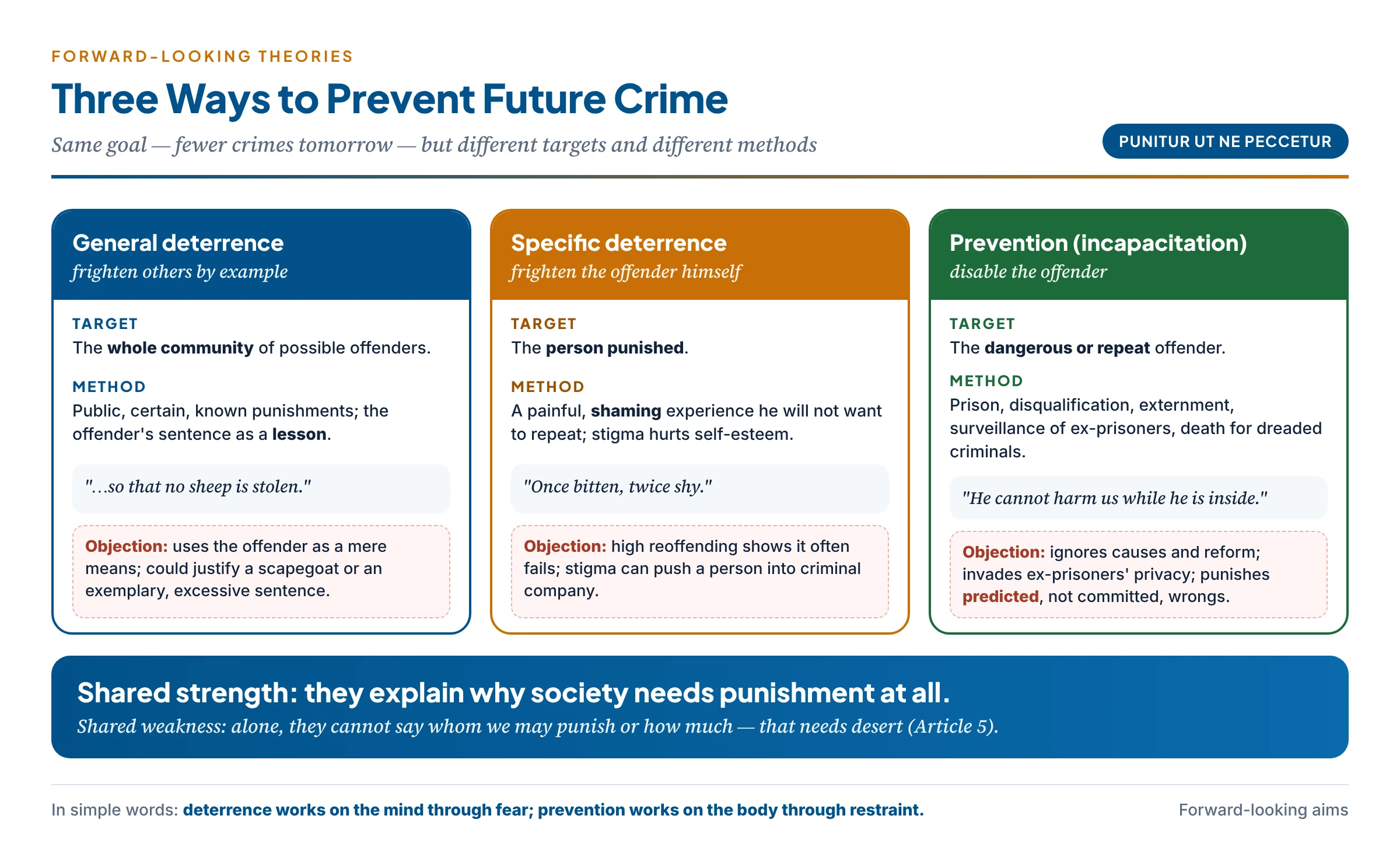
Where the retributivist looks back at the crime, the deterrent and preventive theories look forward to the future. Their motto is punitur ut ne peccetur — “he is punished so that wrong may not be done“. Punishment, they say, is in itself an evil — it causes pain — and pain can be justified only if it prevents a greater evil: future crimes. The deterrent theory prevents crime by fear: it makes the offender, and everyone watching, afraid to offend. The preventive theory prevents crime by disabling the offender — locking him up, watching him, or removing the means to offend. This article explains both theories, the reforming work of Beccaria and Bentham, the famous maxim about stealing horses (or sheep), and the strong objections — that deterrence may punish the innocent, punish too harshly, and treat a person as a mere means.
In simple words
Why do most drivers slow down near a speed camera? Not because they have suddenly become saints, and not because the camera “deserves” anything — but because they know a fine will follow if they don’t. And why is a drunk driver’s licence suspended? So that, whatever he feels, he simply cannot drive for a while. The first is deterrence (prevention by fear); the second is prevention (prevention by disabling).
Context & Problem
The Teleological (Consequentialist) Approach
- Teleological means “judged by its goal or results“. On this approach, punishment is right if it brings good consequences, wrong if it does not.
- Utilitarian basis: based on the utilitarian theory of Bentham, punishment is treated as a means to secure “the greatest happiness of the greatest number“.
- Punishment is itself an evil. Bentham put it bluntly: all punishment is mischief; all punishment in itself is evil. It should be used only if it excludes some greater evil.
- Forward-looking (ex ante): the question is not “What did he do?” but “What will happen if we punish him — or if we don’t?“
- The main forward-looking aims:
- Deterrence — preventing crime through fear of punishment.
- Prevention (incapacitation) — preventing crime by removing the capacity to offend.
- Reform — preventing crime by changing the offender (Article 4).
- An ancient idea: in Plato’s Protagoras, the sophist says that no one who punishes rationally punishes for the sake of the past wrong, which cannot be undone, but for the sake of the future — so that neither the wrongdoer nor anyone who sees him punished will do wrong again. The Roman philosopher Seneca repeated it: a wise man punishes “not because a wrong has been done, but so that wrong may not be done“.
A Limitation Noted at the Start
- The teleological approach fails to relate the amount of punishment to the seriousness of the crime. If a harsh penalty for a trivial offence would deter well, utility would recommend it; if a murderer posed no future danger, utility might recommend letting him go. This gap — between what works and what is deserved — is the deepest problem for these theories.
Core Doctrine
The Deterrent Theory
- Main purpose: to discourage people from committing crime by making them afraid of the consequences.
- Two kinds of deterrence:
- Individual (specific) deterrence — aimed at the offender himself, so that he does not repeat the crime. Because punishment carries a stigma, the offender feels ashamed; it undermines his self-esteem and he fears going through it again.
- General deterrence — aimed at the whole community. When a criminal is punished, it sets an example: others see what happens and are discouraged.
- The maxim: “You are punished not only because you stole, but so that others may not steal.“
- What makes deterrence work: the potential offender must
- know about the punishment;
- believe he is likely to be caught;
- think rationally about costs and benefits;
- find the expected pain of punishment greater than the expected gain from the crime.
Beccaria — Prevention, Not Torment
Cesare Beccaria, an Italian thinker of the Enlightenment, wrote On Crimes and Punishments (1764), the founding text of modern penal reform.
- The purpose of punishment is neither to torment a sensitive being nor to undo a crime already committed (which is impossible). It is only to prevent the criminal from doing further harm to society and to deter others from doing the same.
- “It is better to prevent crimes than to punish them.” Good laws, education and clear rules prevent more crime than cruel penalties.
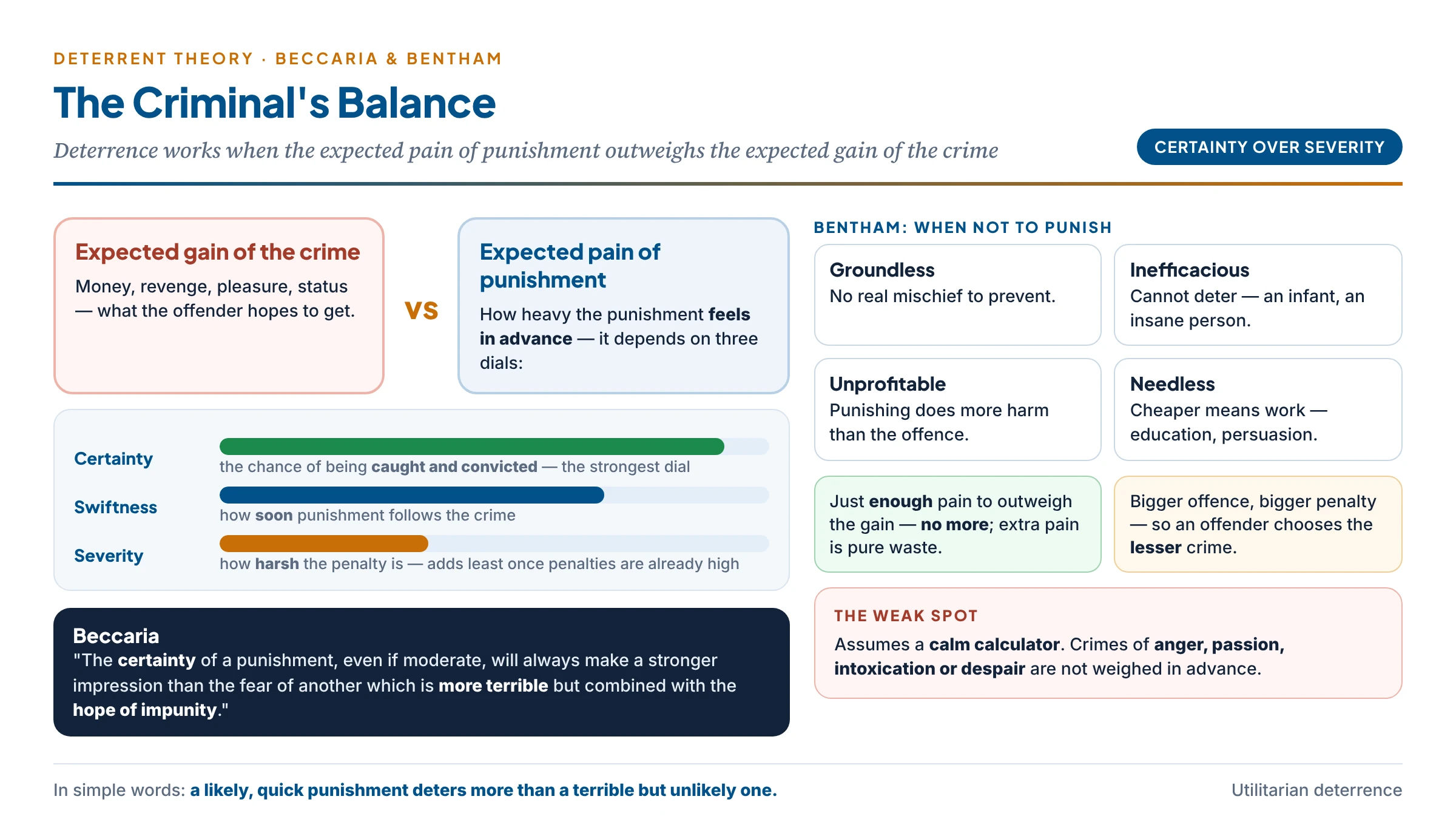
- Certainty over severity — Beccaria’s most famous insight:
“The certainty of a punishment, even if it be moderate, will always make a stronger impression than the fear of another which is more terrible but combined with the hope of impunity.” — Beccaria
- Promptness: the punishment should follow the crime quickly, so that people firmly link the two ideas — crime and punishment.
- Proportion: penalties must be proportionate; if theft and murder carried the same punishment, a thief would have no reason not to kill the witness.
- Clear, public laws: people can avoid crime only if they know the law; laws must be written plainly and published.
- Minimum necessary: any punishment beyond what is necessary to protect society is tyrannical.
- Against torture and the death penalty: torture punishes before guilt is proved and favours the strong; the death penalty is neither necessary nor useful, and no one in the social contract gave the State the right to take his life (Article 6).
Bentham — The Calculus of Punishment
Jeremy Bentham (An Introduction to the Principles of Morals and Legislation, 1789) built a complete theory of punishment on utility.
- Human beings are pleasure-seekers and pain-avoiders. A potential criminal is a calculator: he weighs the pleasure or profit of the crime against the pain of the punishment.
- The rule: the pain of punishment must be just enough to outweigh the expected profit of the offence — no more, because extra pain is pure waste.
- Factors that make a punishment weigh more (from his “felicific” or hedonistic calculus): its intensity, duration, certainty, and nearness in time. An uncertain or distant punishment must be heavier to have the same effect.
- Four cases where punishment should not be inflicted at all (“cases unmeet for punishment”):
- Groundless — where there is no real mischief to prevent (a harmless act between consenting adults).
- Inefficacious — where punishment cannot deter (an infant, an insane person, an act done in ignorance or under compulsion).
- Unprofitable — where the mischief of punishing would be greater than the mischief of the offence.
- Needless — where the mischief can be prevented more cheaply by other means (education, persuasion).
- Rules of proportion:
- The punishment must at least outweigh the profit of the offence.
- The greater the offence, the greater the punishment — so that a person who is going to offend will choose the lesser offence.
- The punishment should be no greater than necessary (frugality).
- The Panopticon: Bentham designed a model prison — a circular building with a central watchtower from which every cell can be seen, but the inmates never know when they are watched. Constant possible observation would make them discipline themselves.
Common confusion
Were the utilitarians champions of harsh punishment? The opposite is true. Because they held that all punishment is in itself an evil, Beccaria and Bentham used deterrence to argue against torture, cruel and needless penalties, and the death penalty for minor crimes. Beccaria’s book was the most powerful attack on cruel punishment of the eighteenth century; Bentham designed reforms to make punishment frugal. The objection that deterrence “can justify draconian penalties” is about what pure deterrence logic could allow — not about what its founders recommended.
“Men Are Not Hanged for Stealing Horses…”
- The maxim: the English statesman Lord Halifax (George Savile, seventeenth century) wrote: “Men are not hanged for stealing horses, but that horses may not be stolen.“
- The variant set in the 2009 paper: “You are not punished for stealing the sheep, but you are punished so that no sheep is stolen.“
- Which theory does it belong to? Primarily the deterrent theory, specifically general deterrence:
- “Not for stealing the sheep” — the theft already committed is not the reason; this rejects the retributive “because he stole”.
- “So that no sheep is stolen” — the reason is future prevention: others who see the thief punished will be afraid to steal.
- It also has a preventive element: the punished thief himself is stopped from stealing again (through fear, or through confinement).
- Contrast with the other theories:
- A retributivist would say: “You are punished because you stole the sheep — and only as much as the theft deserves.”
- A reformist would say: “You are punished so that you stop wanting to steal sheep.”
- Problems the maxim exposes:
- If the aim is only that no sheep be stolen, why must the punished person be the thief? Punishing a look-alike in public would deter equally well.
- If hanging for horse-theft deters better than prison, why not hang? — it ignores proportion (hanging for theft was once English law).
- The person punished is used as a lesson for others — a means to an end.

In simple words
A school puts a student who was caught bunking on stage in the morning assembly. The principal says, “This is not really about the one class he missed — it is so that the other 900 students do not bunk.” That is general deterrence. Notice the danger: if the real aim is the effect on the 900, the principal might be tempted to choose a dramatic penalty — or even the wrong boy, if no one can tell the difference.
Modern Deterrence — Certainty, Speed and Rational Choice
- Rational choice theory (Gary Becker, economist): a potential offender weighs the chance of being caught and the size of the penalty against the expected gain.
- What research shows (in plain terms):
- The likelihood of being caught deters far more than the severity of the penalty — confirming Beccaria.
- Swift consequences deter more than delayed ones.
- Raising already-long prison terms adds little deterrence.
- Visible policing, CCTV, and well-run courts often reduce crime more than harsher laws.
- Everyday deterrence works: traffic fines, tax penalties, plagiarism checks, ticket inspectors — in all these areas, where enforcement is certain, behaviour changes.
- The Indian reality: where conviction rates are low and trials take years, even very severe punishments deter weakly — the “hope of impunity” Beccaria warned about. This is why many argue that India needs faster and surer justice more than harsher punishments.
In simple words
In an examination hall with no invigilator, some students copy even if the rulebook threatens expulsion. Put one alert invigilator in the room and copying almost stops — though the penalty has not changed at all. What changed is the chance of being caught. That is Beccaria’s point in a single classroom.
Severe Punishment and Crimes Against Women
The 2017 paper asked whether severe punishment for crimes against women will change the mindset of society.
- For: severe penalties express society’s condemnation, may deter calculating offenders, and signal that the State takes such crimes seriously (the 2013 and 2018 criminal-law amendments raised penalties for rape after the 2012 Delhi case).
- Against:
- Most sexual crimes are committed by known persons; fear of severe penalties may lead families to pressure victims not to report, and may tempt offenders to kill the victim to remove the witness.
- Certainty and speed of justice matter more than severity; low conviction rates weaken deterrence.
- Mindset — patriarchy, objectification, honour culture — is a matter of values, which change through education, equality and social reform, not fear alone.
- Balanced view: punishment can restrain behaviour and declare values, but by itself it cannot change attitudes. Deterrence must be joined to sure enforcement, gender-sensitive policing, education and women’s empowerment.
The Preventive Theory
- Aim: to protect the public from further harm by the offender — not by frightening him, but by disabling him (incapacitation).
- Methods:
- Imprisonment — while in jail, he cannot harm the public.
- Capital punishment for dreaded criminals — the ultimate incapacitation.
- Disqualification — cancelling a driving licence, banning a corrupt official from office, debarring a fraudster from business.
- Confinement and externment — keeping a person out of a district or area.
- Surveillance — keeping ex-prisoners and habitual offenders under watch (history-sheets, registers, electronic monitoring).
- Community service in place of prison for minor offenders.
- Indian examples: preventive detention (Article 22 permits it with safeguards), security for good behaviour from habitual offenders, externment under State laws, sex-offender registers.
- Strength: it gives society a sense of security — especially against repeat and dangerous offenders.
Criticisms of the Preventive Theory
- Indifferent to the origin of crime — it pays no attention to the causes of crime or to the reformation of the offender; it only contains him.
- No respect for the privacy of ex-prisoners — permanent surveillance makes a fresh start impossible.
- Unfit for modern times — when social science has given a proper analysis of the causes of crime and methods of crime prevention, merely locking people away is crude.
- Punishing the future, not the past — preventive measures often rest on predictions of what a person might do. Predictions are unreliable, and the “false positives” — people locked up who would never have offended — suffer real injustice.
- Danger to liberty — preventive detention without trial is easily misused against political opponents; that is why it is surrounded by strict safeguards.
- Prisons as schools of crime — locking an offender away with hardened criminals may make him more, not less, dangerous on release.
Critical Evaluation
Criticisms of the Deterrent Theory
- Disproportionate punishment — to deter effectively, it may make punishment far harsher than the crime deserves: exemplary penalties, public executions for petty theft.
- Assumes crime is a rational choice — but in reality much crime is impulsive, stemming from anger, passion, intoxication, despair or mental illness. A man who kills in a sudden quarrel does not weigh the penal code first. The theory ignores the impulsive factor.
- Depends on enforcement — deterrence is effective only if the police are capable of arresting offenders. Certainty is more effective than severity; where the chance of being caught is small, even a severe penalty deters little.
- Treats the criminal as a mere means — Kant’s objection: the offender is used as an advertisement to frighten others, violating the principle that a person must never be treated merely as a means. Hegel: it is “like raising a stick at a dog“.
- Punishing the innocent — if the aim is only to deter, then framing and punishing an innocent scapegoat would be justified whenever the public believed him guilty and the effect was good. Philosophers give the example of a sheriff in a riot-torn town who could stop a deadly riot by framing an innocent man for a crime that inflamed the mob. C.S. Lewis: “the punishment of a man actually innocent will [deter], provided the public think him guilty“.
- Draconian logic — if a minor crime is widespread, pure deterrence might justify extreme penalties for it, offending the human conscience.
- Hard to measure — we can rarely know how many crimes did not happen because of a penalty; claims about deterrence are often unprovable.
- Repeat offenders — high rates of reoffending show that specific deterrence often fails.
- Stigma can backfire — labelling a person “criminal” can push him into criminal company and identity, increasing crime.
- Ignores reform and the victim — the offender’s change and the victim’s healing are not its concern.
Defences of the Deterrent Theory
- It explains why we have punishment at all. A system of punishment that deterred no one would be pointless; deterrence is the general justifying aim (Hart — Article 5).
- It works where enforcement is sure — everyday experience (traffic, tax, exams) shows that people respond to likely consequences.
- Humane in its founders’ hands — Beccaria and Bentham used it to abolish torture and reduce needless suffering.
- Reply to “punishing the innocent”: a rule-utilitarian answers that a practice of framing innocents would, once suspected, destroy public trust in the law and cause far more harm. So utility itself forbids it (Rawls’s “Two Concepts of Rules” — Article 5).
- Reply to “disproportion”: Bentham’s own rules require frugality and graded penalties; disproportionate punishment is unprofitable.
- General prevention is more than fear: law also educates — by punishing certain acts, it builds habits and moral attitudes that keep most people law-abiding without any calculation.
Are Retributive and Deterrent Theories Complementary?
The 2003 paper asked whether they are “mutually complementary“.
- Yes, in important ways:
- Deterrence explains why society should have punishment (to prevent crime); retribution explains whom and how much (only the guilty, in proportion). Together they form Hart’s mixed theory (Article 5).
- Deserved punishment usually also deters — as C.S. Lewis put it, in giving the man what he deserved, “you set an example to others” and “killed two birds with one stone“.
- Proportionality serves both: it is just (retribution) and it gives criminals a reason to choose lesser offences (Bentham’s marginal deterrence).
- But they clash in hard cases:
- The useless but deserved punishment (Kant’s island) — retribution says punish; deterrence says no point.
- The useful but undeserved punishment (the scapegoat, the exemplary sentence) — deterrence says punish; retribution forbids it.
- Conclusion: they are complementary only when one is given the job of aim and the other the job of limit. As rival complete theories, they conflict.
In simple words
A school’s rule against bullying can be explained in two ways: “Bullies deserve to be punished” and “Punishing bullies keeps other children safe“. Most of the time both reasons point the same way. They split only in odd cases — a bully who has already left the school (punish? no one is protected), or a wrongly accused boy whose punishment would scare the real bullies (punish? he deserves nothing). The theories are partners in ordinary cases and rivals in hard ones.
Critics and Defenders
Criticism — Critics of deterrence and prevention
- Kant: never use a person merely as a means to deter others.
- Hegel: deterrence is like raising a stick at a dog.
- C.S. Lewis: pure deterrence would punish the innocent if the public thought him guilty.
- Criminologists: most crime is impulsive; severity adds little; certainty matters more.
- Civil libertarians: preventive detention and surveillance punish predicted, not committed, wrongs.
- Reformists: neither fear nor confinement touches the causes of crime or changes the offender.
Defence — Defenders and strengths
- Plato’s Protagoras and Seneca: rational punishment looks to the future, since the past cannot be undone.
- Beccaria: certain, prompt, proportionate punishment prevents crime without cruelty.
- Bentham: punishment is an evil, justified only when it prevents a greater evil — and never when groundless, inefficacious, unprofitable or needless.
- Halifax: punishment’s point is that horses may not be stolen.
- Rule-utilitarians: a practice of punishing innocents would itself be disastrous, so utility forbids it.
- Hart: prevention is the general aim of punishment, limited by desert in distribution.
Cross-Tradition Comparison
Deterrence and Prevention in Indian and Western Thought
| Point | Kauṭilya and Manu | Beccaria and Bentham | Common ground |
|---|---|---|---|
| Basis of order | “Through fear of punishment the whole world yields” (Manu) | Pleasure–pain calculation (Bentham) | Fear of sanction restrains conduct |
| Measure | Just rod — neither too harsh nor too mild | Minimum necessary; proportion | Excess defeats the purpose |
| Certainty | Network of spies, tests of officials’ integrity | Certainty over severity; Panopticon | Watchfulness deters more than cruelty |
| Prevention | Removal, banishment, fines, confinement | Imprisonment, disqualification | Disable the dangerous |
| Limit | Unjust rod destroys the king | Groundless or needless punishment is evil | Punishment must serve, not exceed, its aim |
Indian Connect — Hiri and ottappa, the inner deterrents
The Buddha called two qualities the “guardians of the world“: hiri, an inner sense of shame at doing wrong, and ottappa, a fear of wrongdoing and its consequences. Without them, he said, people would fall into confusion like animals. Deterrence works by planting ottappa from outside, through fear of the State. But a society held together only by external fear is fragile; lasting order needs hiri too — conscience that restrains people when no one is watching. This is the gap between the deterrent theory and the reformative ideal of Article 4.
Synthesis (Siddhānta)
- The deterrent theory justifies punishment by its future effect: discouraging the offender (specific deterrence) and others (general deterrence). The preventive theory protects society by disabling the offender.
- Beccaria and Bentham made deterrence a reforming force: punishment must be certain, prompt, proportionate and minimal, and never groundless, inefficacious, unprofitable or needless.
- The maxim “not for stealing the sheep but so that no sheep is stolen” belongs to general deterrence (with a preventive element) — and exposes the theory’s weakness: if only the effect matters, the guilt of the punished person and the proportion of the penalty seem to drop out.
- The decisive objections are moral: deterrence alone could justify punishing the innocent, punishing excessively, and using a person merely as a means. Empirically, much crime is impulsive, and certainty deters far more than severity.
- Balanced position: deterrence and prevention are legitimate aims of the institution of punishment, but they must work within the limits of desert — only the guilty, only as much as deserved — and alongside reform and social measures that reduce the causes of crime. For India, the lesson is Beccaria’s: surer and swifter justice deters more than harsher punishment.
“It is better to prevent crimes than to punish them.” — Beccaria
Previous Year Questions
- 2026“Retributivism presents a deontological justification for capital punishment, whereas deterrence presents a consequential justification for it.” Explain.
- 2024On what grounds would you accept or reject the idea of capital punishment as an effective deterrent? Discuss.
- 2017Will a severe punishment for crimes against women change the mindset of society? Justify your position.
- 2009“You are not punished for stealing the sheep, but you are punished so that no sheep is stolen.” Discuss as to which theory of punishment this statement belongs.
- 2006Describe the tension between consequentialist and retributivist theory of punishments. Discuss critically in this context the view that argues that since no existing penal system for crime prevention has adequate justification, state punishment cannot be justified; and therefore, it should be completely abolished.
- 2003Critically examine — “Retributive and deterrent theories of punishment are mutually complementary“.