

Crime and Punishment: Corruption, Mass Violence, Genocide, Capital Punishment.
Official Syllabus: Paper II, Section A, Unit 7
If corruption is both ethical and systemic (Article 8), its cure must work on two fronts at once: on the person, through values, character and conscience; and on the system, through laws, institutions, transparency and accountability. Philosophers have always split along this line. Plato and Gandhi looked first to the education and character of those who hold power; Kauṭilya and Montesquieu looked first to checks, watchers and the division of power. Modern anti-corruption strategy — from Hong Kong’s famous commission to India’s Lokpal — combines them. This article explains value-based education and how it addresses corruption (the 2026 question), the classical remedies of Plato, Gandhi and Kauṭilya, the measures to eradicate corruption in Indian democracy (the 2018 question) — institutional, legal, technological, electoral and civic — and the limits of each approach.
In simple words
Think of keeping a cricket match clean. You need players who do not want to cheat — that comes from upbringing and the spirit of the game. You also need umpires, cameras, a third umpire and penalties — because some players will cheat if they can. A match with honest players but no umpire, or with umpires but players who think cheating is normal, will not stay clean for long. Fighting corruption is the same: character and checks together.
Context & Problem
Two Approaches to Remedy
| Approach | Assumption about people | Main tools | Thinkers |
|---|---|---|---|
| Ethical (inner) | People can be made honest by character and conscience | Moral and value-based education, role models, codes of conduct, public culture | Plato, Aristotle, Gandhi, Vivekananda |
| Systemic (outer) | People respond to incentives and risks; some will always be tempted | Laws, watchdogs, transparency, technology, checks and balances, punishment | Kauṭilya, Montesquieu, Bentham |
- Why both are needed:
- Institutions without values become paper tigers — laws are evaded, watchdogs captured.
- Values without institutions become sermons — honest people are isolated or crushed by a corrupt system.
- The best results come where certainty of detection is high and a culture of integrity makes honesty normal.
The Solutions Listed in Most Notes
- Creating moral awareness among power-holders.
- Effective checks and balances — e.g. an ombudsman (Lokpal and Lokayuktas).
- Transparency in public dealings — e.g. RTI and e-governance.
- Strict enforcement of laws and norms.
- Creating a work culture of honesty and integrity.
- An effective role for civil society.
- More broadly: a transparent institutional architecture, radical accountability, and anti-bribery deterrence.
Core Doctrine
Value-Based Education — How It Addresses Corruption
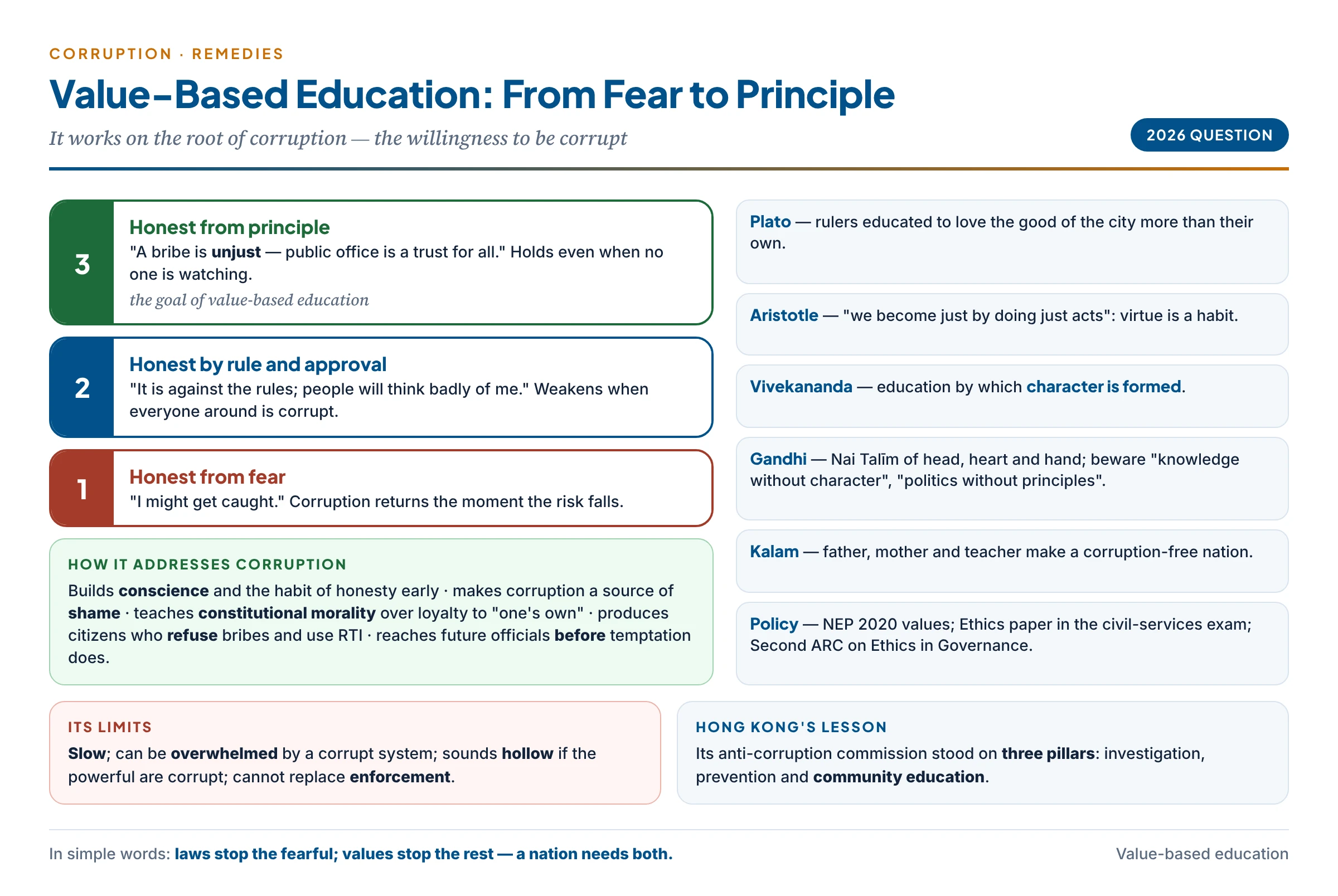
The 2026 paper asked: “How does value based education address the problem of corruption?“
What it is: education that aims not only at knowledge and skills but at character — honesty, integrity, empathy, a sense of duty and fairness, and respect for constitutional values (justice, liberty, equality, fraternity).
How it addresses corruption:
- It changes the person from within. Corruption begins with a choice; value-based education builds the inner resistance — conscience, self-respect, shame at wrongdoing — that makes the corrupt choice unthinkable, not merely risky.
- It moves people from fear to principle. In terms of moral development (Lawrence Kohlberg), people at the lowest stage avoid wrong only from fear of punishment; at the middle stage, to follow rules and win approval; at the highest stage, from principles of justice. Corruption thrives at the first stage; value education aims at the third.
- It builds the habit of honesty early. Aristotle: “we become just by doing just acts” — virtue is formed by habit. Small honesties practised in school (no copying, returning lost property) become the character of the future official.
- It changes the culture of expectation. Where corruption is “normal”, people pay and take bribes without shame. Education can make integrity the norm and corruption a source of social stigma — reviving what the Buddha called hiri (moral shame).
- It strengthens universalistic values. Corruption often lives in the gap between loyalty to one’s own and fairness to all (Article 8). Teaching constitutional morality helps citizens see that public office is a trust for everyone.
- It empowers citizens. Educated, rights-aware citizens refuse to pay bribes, use RTI, demand accountability and support whistle-blowers.
- It shapes future leaders and officials. Every politician, judge and officer was once a student; value-based education reaches them before temptation does.
Thinkers behind the idea:
- Plato: the guardians’ long education in music, gymnastics and philosophy was meant to make them love the good of the city more than their own; rulers must be trained to rule for others.
- Swami Vivekananda: “We want that education by which character is formed, strength of mind is increased, the intellect is expanded, and by which one can stand on one’s own feet.“
- Gandhi — Nai Talīm (basic education): education of head, heart and hand, joining knowledge to work and ethics. Among his “seven social sins” were politics without principles, wealth without work, knowledge without character and commerce without morality.
- A.P.J. Abdul Kalam: a corruption-free nation needs three key members of society — the father, the mother and the teacher.
- Policy: the National Education Policy 2020 stresses ethical and constitutional values; India’s civil-services examination has included a paper on Ethics, Integrity and Aptitude since 2013; the Second Administrative Reforms Commission’s report on Ethics in Governance (2007) recommended codes of ethics and value training for public servants.
Limits of value-based education:
- Slow — it shapes the next generation, not today’s officials.
- Values can be overwhelmed by incentives — an honest graduate entering a corrupt system faces pressure, isolation and transfers.
- Hypocrisy — moral lessons from a society that tolerates corruption ring hollow.
- Risk of indoctrination — “values” can become propaganda if not rooted in reasoning and constitutional principles.
- It cannot replace enforcement — Kauṭilya’s lesson: even good people need watchers.
Conclusion: value-based education addresses the root of corruption — the willingness to be corrupt — and builds a culture in which honesty is expected. But it works only together with institutions that make corruption hard to commit and likely to be caught. Hong Kong’s anti-corruption model is the best proof: its commission combined investigation, prevention and community education — and education was one of the three pillars.
In simple words
Two shopkeepers both refuse to sell adulterated milk. One refuses because a food inspector visits every week; the other because he would be ashamed to make a child sick. If the inspector stops coming, the first may start adulterating; the second never will. Value-based education tries to produce the second shopkeeper — while institutions keep the inspector coming for the first.
Classical Remedies — Plato, Gandhi and Kauṭilya
- Plato — remove the temptation:
- The guardians (rulers and soldiers) should live without private property and private families — “communism” of the guardians — so that they have nothing to gain by misusing power.
- Rulers should be philosophers who love truth and the good, not wealth.
- Lesson: separate power from private wealth (modern parallels: conflict-of-interest rules, asset declarations, blind trusts).
- Gandhi — purify the means and the person:
- Trusteeship: the rich and powerful hold their wealth and power in trust for society.
- Simplicity and aparigraha (non-possession) for public servants; Gandhi’s own austere life as an example.
- Purity of means: no good end can be reached by corrupt means.
- Lesson: public service as service, not as a path to wealth.
- Kauṭilya — watch, test, rotate, reward, punish:
- Many eyes — several officers in each department; spies; audits.
- Integrity tests (upadhā) before appointment.
- Rotation of officials; confiscation of illicit wealth; heavy fines.
- Rewards for informers and compensation for victims.
- Lesson: assume temptation; design the system to catch it.
- Montesquieu — divide power: “power should be a check to power” — legislature, executive and judiciary watching one another.
In simple words
Plato would make sure the cook has no reason to steal from the kitchen — give him enough, and no private store to fill. Kauṭilya would count the rice every evening and move the cook to a new kitchen each year. Gandhi would teach the cook that the food is held in trust for the hungry. A good household uses all three.
Measures to Eradicate Corruption in Indian Democracy
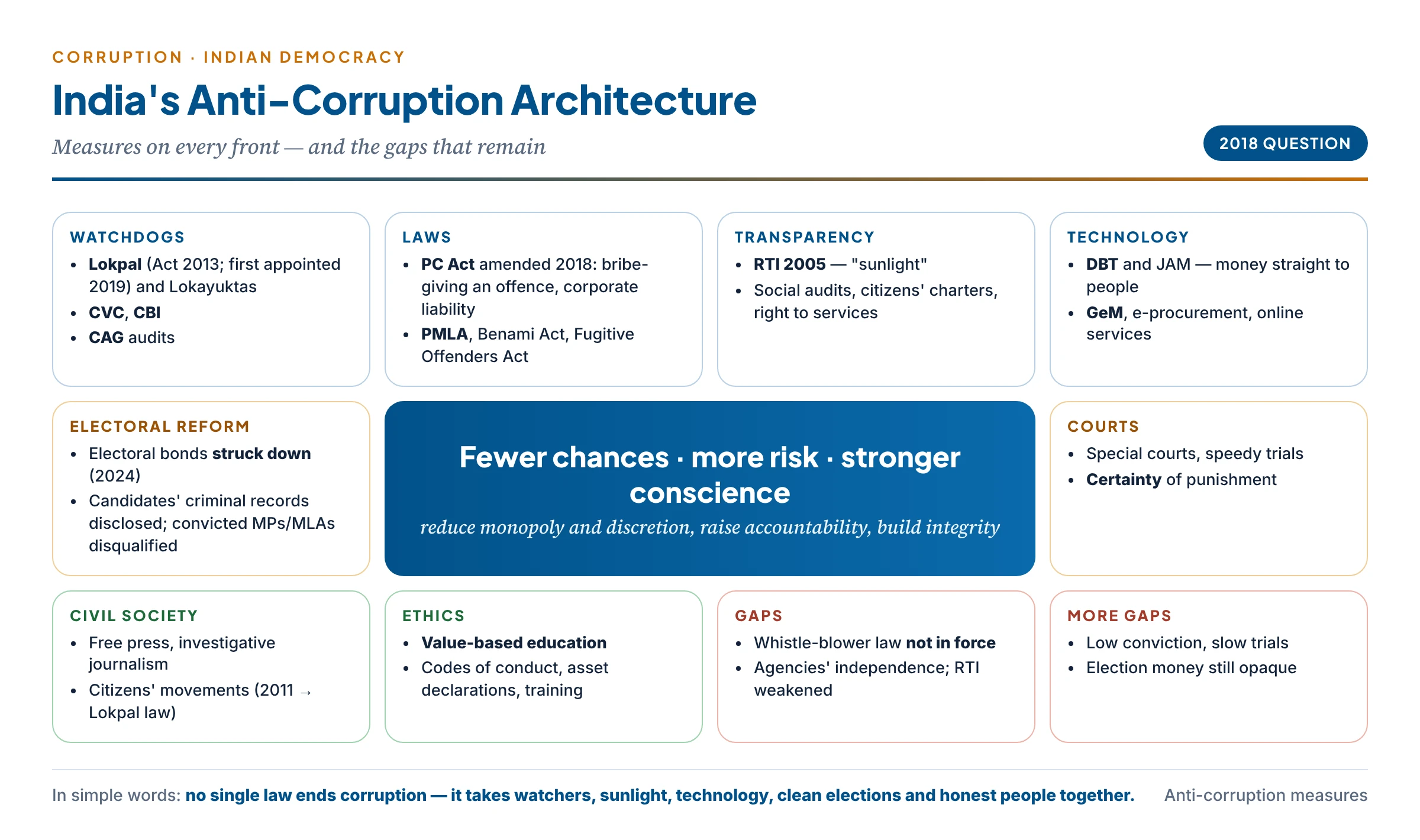
The 2018 paper asked what measures one would suggest. A comprehensive answer covers several fronts:
1. Institutional watchdogs
- Lokpal and Lokayuktas Act, 2013 — an independent ombudsman to inquire into corruption by public functionaries, including (with safeguards) the Prime Minister; the first Lokpal was appointed only in 2019, and its effectiveness depends on independence, staff and investigative capacity.
- Central Vigilance Commission (statutory since 2003) and the CBI; State Lokayuktas (whose strength varies widely).
- Comptroller and Auditor General (CAG) — audits that have exposed major scams.
- Reform needed: greater autonomy of investigative agencies from political control; filling vacancies; time-bound inquiries.
2. Laws
- Prevention of Corruption Act, 1988, as amended in 2018:
- made giving a bribe a specific offence (with protection for those coerced who report within seven days);
- made commercial organisations liable for bribes paid on their behalf;
- required prior approval before investigating a public servant for decisions taken in official functions — a safeguard for honest officers, but criticised as a shield for the corrupt;
- aimed at trials within two years.
- Prevention of Money Laundering Act, 2002; Benami Transactions (Prohibition) Amendment Act, 2016; Fugitive Economic Offenders Act, 2018 — to trace and seize illicit wealth.
- Whistle Blowers Protection Act, 2014 — passed but never brought fully into operation; whistle-blowers remain vulnerable.
3. Transparency
- Right to Information Act, 2005 — “sunlight is the best disinfectant” (in the American judge Louis Brandeis’s phrase): citizens can demand records, exposing many scams. Recent amendments (2019 on the tenure and pay of information commissioners; 2023 on personal information) have been criticised for weakening it.
- Proactive disclosure, social audits (as in MGNREGA), citizens’ charters and right-to-services laws with time limits and penalties.
4. Technology and administrative reform
- Direct Benefit Transfer (with the JAM trinity — Jan Dhan accounts, Aadhaar, mobile) — money goes straight to the beneficiary, removing middlemen and “ghost” beneficiaries.
- e-Procurement and the Government e-Marketplace (GeM) — transparent public purchasing.
- Online services for land records, licences, taxes and certificates — less face-to-face discretion, fewer chances for bribes.
- Simplifying rules and reducing discretion (Klitgaard’s insight — Article 8); rotation of officials in sensitive posts (as Kauṭilya advised); fair pay and merit-based promotion.
5. Electoral and political reform
- Election funding is the root of much grand corruption. In Association for Democratic Reforms v Union of India (2024) the Supreme Court struck down the electoral bonds scheme as violating voters’ right to information; transparent and capped funding, possibly State funding of elections, are widely recommended.
- Decriminalising politics — disclosure of criminal records by candidates; disqualification of convicted legislators (Lily Thomas, 2013); fast-track courts for cases against MPs and MLAs.
- Inner-party democracy and accountability of parties under RTI.
6. Judicial reform
- Speedy trials of corruption cases; more judges and special courts; certainty of punishment (Beccaria’s lesson — Article 3).
- Transparency and accountability in the judiciary itself.
7. Economic reform
- Reducing licences and permits, which create rents (the lesson of the licence-raj era).
- Digital payments and formalisation of the economy, shrinking black money.
- Competition in public services to reduce monopoly.
8. Civil society, media and citizens
- Free press and investigative journalism.
- Citizens’ movements — the 2011 anti-corruption movement led to the Lokpal law.
- Citizen refusal to pay bribes; reporting platforms; social audits by village communities.
9. Ethics and values
- Value-based education (above); codes of ethics for ministers, legislators and civil servants (as the Second ARC recommended); training in integrity (Mission Karmayogi); role models in public life; asset declarations and conflict-of-interest rules.
In simple words
Earlier, a widow’s pension passed through several hands — the clerk who “processed” the form, the officer who “approved” it, the postman who delivered the cash — and each could take a cut. Now, in many States, the pension goes directly into her bank account, and she can check the status online. No single change made the officials honest; the system simply removed the hands through which the money used to leak.
Reducing the Conditions of Corruption
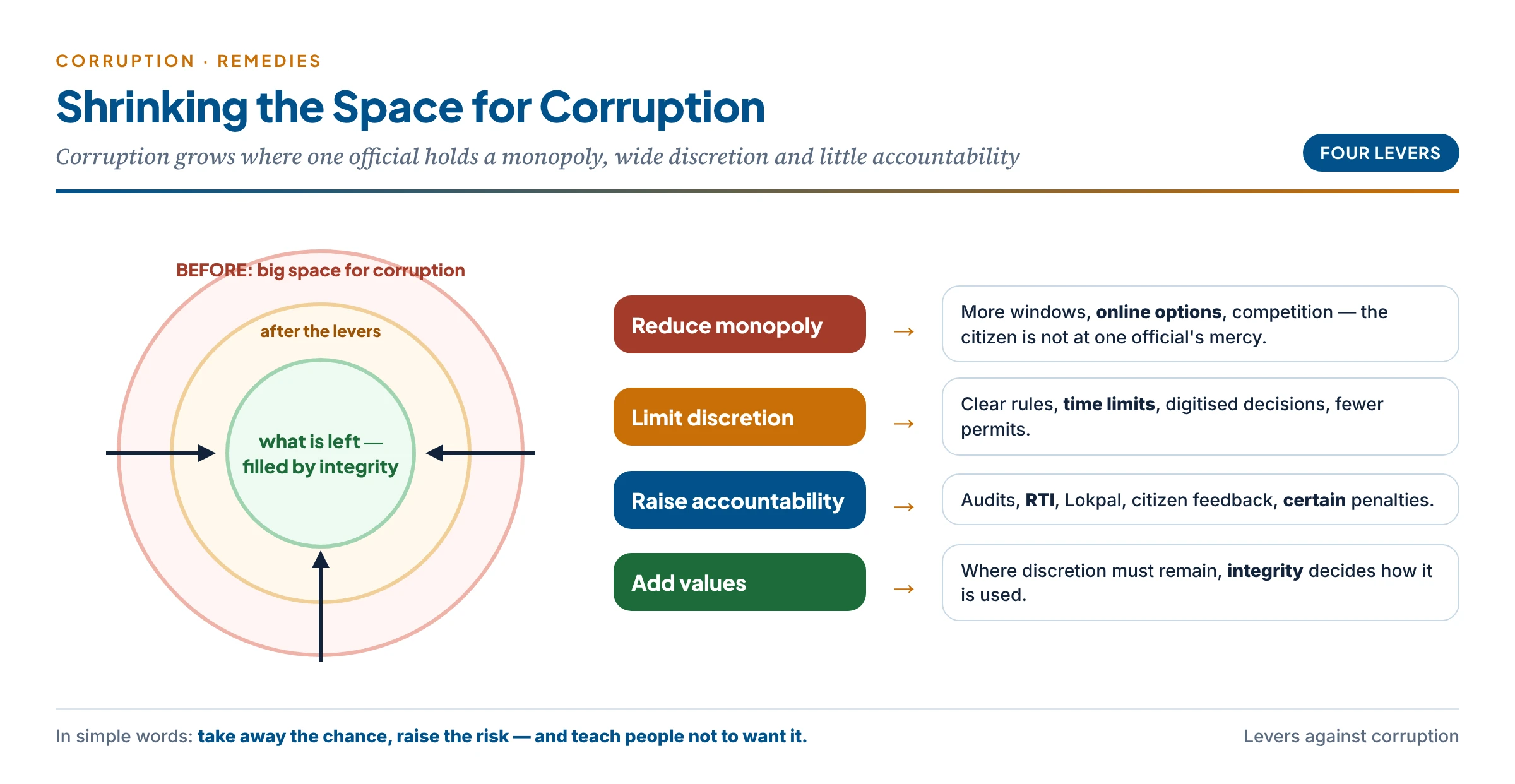
- Klitgaard’s insight, as a plan of action — corruption grows where an official has a monopoly, wide discretion and little accountability. So:
- Reduce monopoly — more service windows, online options, competition.
- Limit discretion — clear rules, time limits, digitised decisions.
- Raise accountability — audits, RTI, ombudsman, citizen feedback, penalties.
- Add values — so that where discretion remains, it is used honestly.
Common confusion
Is the Lokpal a cure-all for corruption? Many expected so in 2011–13. But an ombudsman is only one lever. The Lokpal law took six years to bring into operation (the first Lokpal was appointed in 2019), and any watchdog is only as strong as its independence, staff, investigative powers and public trust. Hong Kong’s success came from three pillars together — investigation, prevention (redesigning systems) and education. A Lokpal without transparency, technology, electoral reform and a culture of integrity cannot “eradicate” corruption; it can only punish some of it.
Critical Evaluation
Limits of the Main Remedies
- Laws without enforcement — India has many anti-corruption laws but low conviction rates and long trials.
- Watchdogs can be captured — agencies under executive control may be used selectively against opponents.
- Technology can be gamed — digital systems create new forms of fraud and exclusion (failed authentication denying rations to the poor).
- Transparency can be weakened — RTI amendments, unfilled commissions.
- Election money is the root — without reform of political funding, other measures attack branches, not roots.
- Values take a generation — and can be undercut by the example of the powerful.
- Over-correction — fear of investigation can produce “policy paralysis“, where honest officers avoid decisions.
Critics and Defenders
Criticism — Sceptics of the main remedies
- Kauṭilya’s realism: corruption is like a fish drinking unseen — moral sermons will not stop it.
- Public-choice theorists: as long as the State controls scarce permissions, rent-seeking will continue.
- Critics of watchdogs: agencies under political control punish opponents and spare friends.
- Critics of value education: lectures on honesty mean little when students see corruption rewarded.
- Marxists: corruption is rooted in class power and capital; reforms leave the structure intact.
Defence — Defenders of a combined strategy
- Plato and Gandhi: rulers must be educated to serve, and detached from private gain.
- Kauṭilya and Montesquieu: watchers, rotation and divided power make corruption risky.
- RTI and the free press: sunlight is the best disinfectant.
- Hong Kong’s model: investigation, prevention and education together can transform a corrupt system.
- Supreme Court (2024): transparency in political funding is part of the voter’s right to know.
- Ambedkar: constitutional morality must be cultivated, not assumed.
Cross-Tradition Comparison
Remedies for Corruption in Indian and Western Thought
| Remedy | Indian source | Western source | Modern form |
|---|---|---|---|
| Character of rulers | Rāja-dharma; Gandhi’s purity of means | Plato’s philosopher-kings; Aristotle’s virtue | Value-based education, ethics codes |
| No private gain | Gandhi’s trusteeship and aparigraha | Plato’s propertyless guardians | Asset declarations, conflict-of-interest rules |
| Watchers | Kauṭilya’s spies and audits | Bentham’s Panopticon; Montesquieu’s checks | Lokpal, CVC, CAG, RTI |
| Rotation and tests | Kauṭilya’s transfers and upadhā | Merit-based civil service (Weber) | Rotation in sensitive posts, vigilance clearance |
| Rewards and punishment | Informer’s one-sixth share; heavy fines | Bentham’s deterrence | Whistle-blower protection, PC Act penalties |
| Citizens’ role | Public proclamation for victims (Kauṭilya) | Free press, civil society | Social audits, RTI activism |
Indian Connect — Kalam’s three teachers and Gandhi’s seven sins
A.P.J. Abdul Kalam said that a nation free of corruption depends on three key members of society: the father, the mother and the teacher — the first school of values is the home. Gandhi’s list of seven social sins reads like a diagnosis of corruption: politics without principles, wealth without work, pleasure without conscience, knowledge without character, commerce without morality, science without humanity, worship without sacrifice. Value-based education in the Indian tradition means teaching the young to avoid these sins before they hold any power.
Synthesis (Siddhānta)
- Corruption must be fought on two fronts: the inner (values, conscience, character) and the outer (laws, institutions, transparency, technology, accountability).
- Value-based education addresses the root — the willingness to be corrupt — by building conscience, habits of honesty, constitutional morality and a culture in which corruption brings shame. It moves people from avoiding wrong out of fear to avoiding it out of principle. But it is slow and can be overwhelmed by a corrupt system.
- Systemic measures — Lokpal, CVC, CAG, the PC Act (2018), PMLA, RTI, DBT and e-governance, electoral reform (electoral bonds struck down in 2024), speedy trials, whistle-blower protection, a free press and civil society — make corruption hard to commit and likely to be caught, reducing monopoly and discretion and raising accountability.
- The classical thinkers already knew this: Plato and Gandhi educate and detach rulers from private gain; Kauṭilya and Montesquieu watch, test, rotate and divide power.
- Balanced position: no single measure “eradicates” corruption. What works is a combination — as in Hong Kong’s three pillars of investigation, prevention and education — sustained by political will and a public culture that treats public office as a trust for all.
“We want that education by which character is formed, strength of mind is increased, the intellect is expanded, and by which one can stand on one’s own feet.” — Swami Vivekananda
Previous Year Questions
- 2026How does value based education address the problem of corruption?
- 2022Is corruption a systemic issue or an ethical issue? Give your critical comments.
- 2020How far do the social and political regimes condition corrupt practices in a nation-state? Discuss.
- 2018What measures do you suggest to eradicate corruption in Indian democracy?