

Crime and Punishment: Corruption, Mass Violence, Genocide, Capital Punishment.
Official Syllabus: Paper II, Section A, Unit 7
Corruption is the oldest disease of government. Kauṭilya, writing over two thousand years ago, listed forty ways in which officials steal from the treasury; Lord Acton, in the nineteenth century, warned that power tends to corrupt; and today India is ranked 91st of 182 countries on the global corruption index. Philosophically, corruption is far more than taking a bribe: it is the betrayal of a public trust for private gain, a perversion of an institution away from its purpose, and — on some views — a hidden form of violence against the poor. This article explains the meaning and kinds of corruption, why it is morally wrong (Kant, Rawls, Locke), how it appears in institutions (Dennis Thompson), Kauṭilya’s realism, the tension between particularistic and universalistic norms, Acton’s maxim, whether corruption is systemic or ethical, how regimes shape it, its economic and moral dimensions, and whether it is a form of mass violence. Remedies follow in Article 9.
In simple words
A traffic policeman is given a uniform, a whistle and the power to fine — not for himself, but so that the roads are safe for everyone. When he takes ₹500 to let a drunk driver go, he is using a public power for a private purpose. Nobody’s wallet seems hurt — the driver even “agrees” to pay. But the road is now less safe for everyone, and the honest driver who refused to pay is treated worse than the one who did. That is the essence of corruption.
Context & Problem
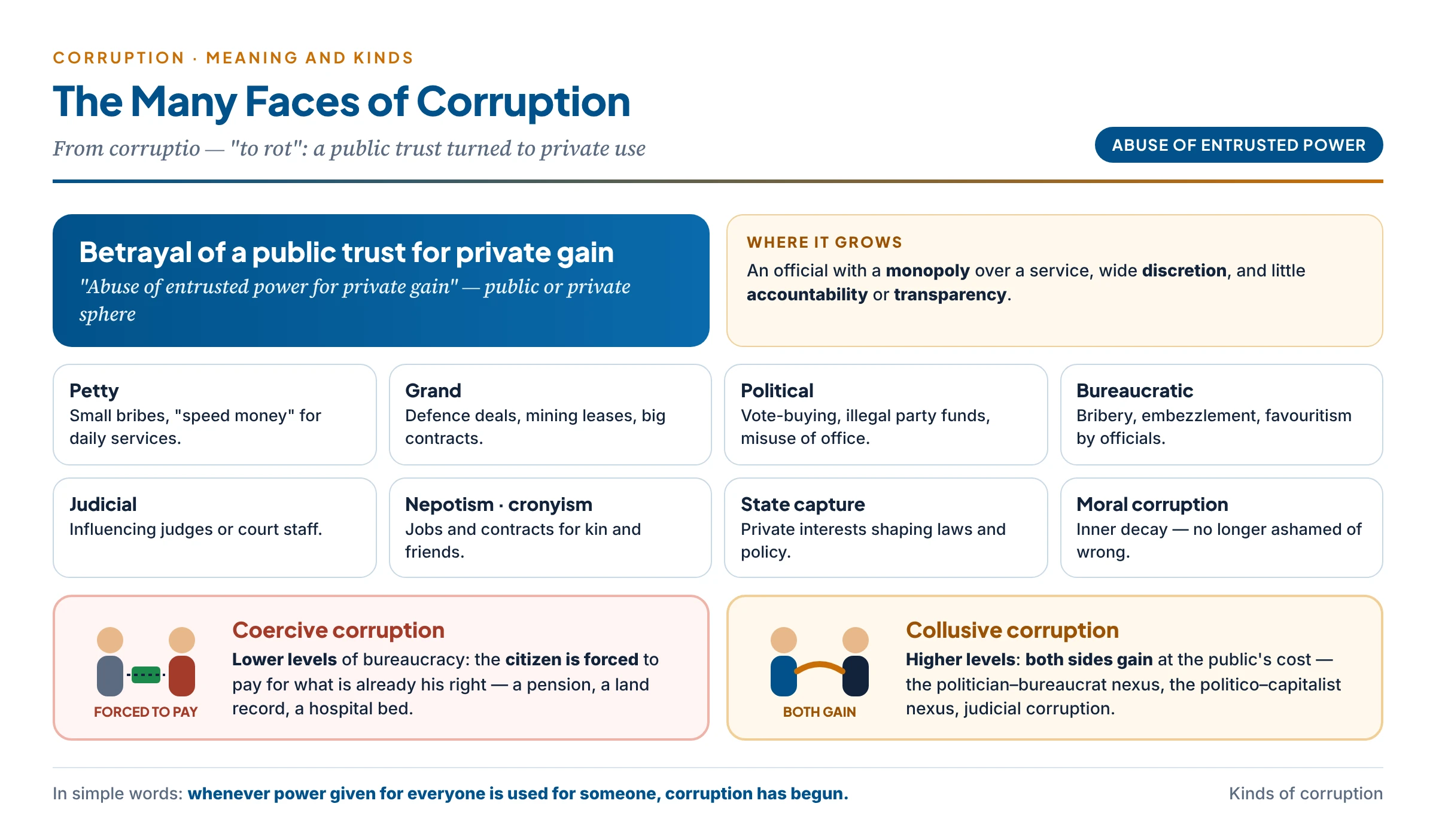
Meaning of Corruption
- Etymology: from the Latin corruptio — “to ruin, break, pervert or decay“. To corrupt something is to make it rot from within, so that it no longer serves its proper end.
- Philosophical definition: corruption is the perversion or betrayal of a public, institutional or fiduciary trust for private, factional or illicit advantage.
- Common definitions:
- World Bank: “the abuse of public office for private gain“.
- Transparency International: “the abuse of entrusted power for private gain” — covering the private sector too.
- Many notes: an act involving immoral practices, such as drawing an undue advantage from one’s dominant position, in the public or private sphere.
- Moral meaning: corruption is regarded as a manifestation of moral depravity and a betrayal of trust.
- A useful rule of thumb (Robert Klitgaard): corruption flourishes where an official has a monopoly over a service, wide discretion in deciding, and little accountability — or, in another version, where authority and monopoly are combined with lack of transparency.
Kinds of Corruption
- Petty corruption — small bribes in daily dealings (“speed money” for a ration card, licence or certificate).
- Grand corruption — at the highest levels: defence deals, mining leases, spectrum allocation, large contracts.
- Political corruption — vote-buying, illegal party funding, misuse of office for electoral gain.
- Bureaucratic corruption — bribery, embezzlement and favouritism by officials.
- Judicial corruption — bribing judges or court staff; influencing outcomes.
- Nepotism and cronyism — favouring relatives or friends in jobs and contracts.
- State capture — powerful private interests shaping laws and policies in their favour.
- Private-sector corruption — kickbacks, insider deals, corporate fraud.
- Moral corruption — the inner decay of character: when a person no longer feels shame at wrongdoing.
- Two types in India at various levels (a widely used classification):
- Coercive corruption — at the lower levels of bureaucracy, where the citizen is forced to pay a bribe to obtain a service he is entitled to (a pension, a land record, a hospital bed).
- Collusive corruption — at the higher levels, where both bribe-giver and bribe-taker benefit, often at the public’s expense: the politician–bureaucrat nexus, the politico–capitalist nexus, judicial corruption.
Core Doctrine
Why Corruption Is Wrong — Philosophical Critiques
1. Kant — the categorical imperative
- Failure of universalisation: Kant’s first formula says, “Act only on a maxim that you could will to become a universal law.” Try the maxim “It is permissible to take a bribe to bypass public rules.” If everyone acted on it, the very idea of a rule, a public office and legal authority would dissolve — there would be no rules left to bypass.
- The free-rider: the corrupt person is a moral parasite. He depends on the general public’s honest compliance with laws to create the social order that makes his cheating profitable. A bribe is valuable only because most people do not pay bribes.
- Treating others as mere means: Kant’s second formula (the formula of humanity) is violated: a corrupt official treats citizens not as ends with equal rights, but as financial instruments to be milked for private gain.
2. Rawls — justice as fairness
- Rawls’s second principle requires fair equality of opportunity: positions and benefits must be open to all on fair terms.
- Corruption turns public goods — jobs, admissions, medical care, legal justice — into commodities sold to the highest illicit bidder.
- It destroys the neutrality of institutions, so that life chances depend on wealth and connections rather than merit or need. The least advantaged, who cannot pay, lose most.
3. Locke — breach of fiduciary trust
- For Locke, government is a trust: people hand power to rulers only to protect their life, liberty and property.
- A corrupt official uses that trusted power against the people who gave it — a breach of trust that, at its extreme, dissolves the moral basis of obedience.
4. Plato and Aristotle — corruption of the soul and of constitutions
- Plato: the guardians must have no private property and no private families, precisely so that they are not tempted to rule for private gain. In the Republic, constitutions decay (timocracy → oligarchy → democracy → tyranny) as love of wealth and power corrupts rulers.
- Aristotle: every good constitution has a corrupt form — kingship becomes tyranny, aristocracy becomes oligarchy, polity becomes democracy (in his sense, rule by the poor for themselves) — and the difference is exactly whether rulers govern for the common good or for their own interest. Corruption, for Aristotle, is rule for oneself.
5. Gandhi — means and ends
- Gandhi held that impure means corrupt even good ends; politics without morality is a sin. A corrupt public life cannot produce swarāj (true self-rule).
Institutional Corruption — Dennis Thompson
In Ethics in Congress (1995), the American political philosopher Dennis Thompson distinguished two forms:
- Individual corruption — an official takes money directly for personal gain — the “bad apple“.
- Institutional corruption — systemic practices within an institution that undermine its democratic purpose and public trust, even if no individual breaks any law. Example: unlimited corporate campaign funding that quietly shapes which laws a legislature passes. Each legislator may act “legally”, yet the institution as a whole serves donors rather than citizens.
- Why it matters: fighting corruption is not only about catching bad apples; it is also about fixing bad barrels — the rules, incentives and money flows that corrupt institutions.
In simple words
Imagine a school where no teacher ever takes a bribe, but the school accepts big “donations” from parents and, somehow, the donors’ children always get the lead roles in plays and seats in the front row. No single act is illegal — but the institution has stopped serving all students equally. That is institutional corruption.
Kauṭilya’s Realism — Corruption as Inevitable, Control as Essential
In the Arthaśāstra, Kauṭilya treated corruption with remarkable realism:
- The honey and the fish:
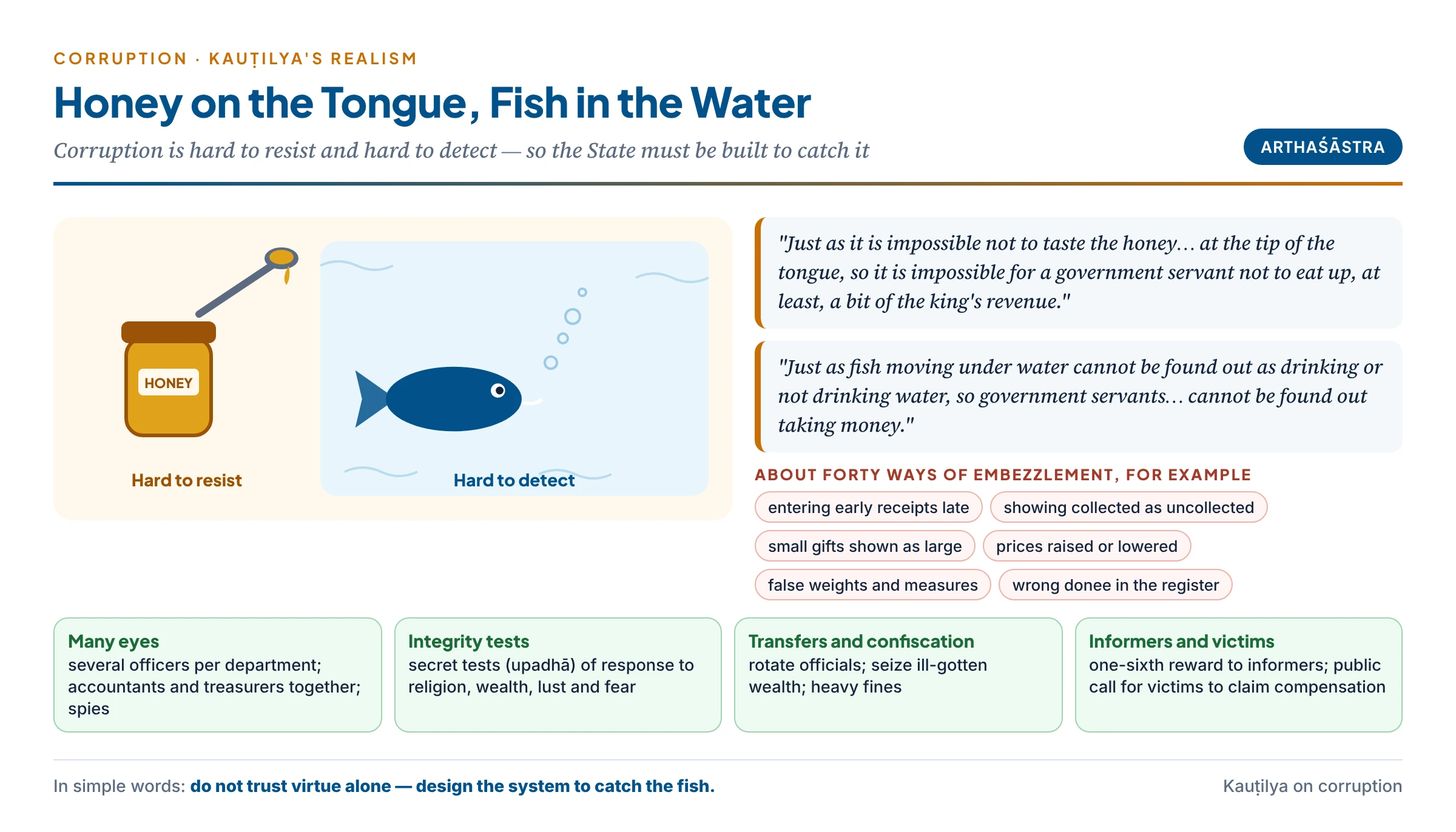
“Just as it is impossible not to taste the honey or the poison that finds itself at the tip of the tongue, so it is impossible for a government servant not to eat up, at least, a bit of the king’s revenue. Just as fish moving under water cannot possibly be found out either as drinking or not drinking water, so government servants employed in the government work cannot be found out (while) taking money.” — Kauṭilya
- “It is possible to mark the movements of birds flying high up in the sky; but not so is it possible to ascertain the movement of government servants of hidden purpose.”
- About forty ways of embezzlement: entering what was realised earlier as realised later; showing what was collected as not collected; making small gifts look large; raising or lowering the recorded prices of goods; using false weights and measures; and many more.
- Remedies — ethical appeals alone are not enough:
- Multiple officers in each department, so that one watches another; accountants and treasurers working together.
- Spies to watch the conduct of officials.
- Secret tests of integrity (upadhā) before appointing ministers — tests of their response to temptations of religion, wealth, lust and fear.
- Rotation (transfer) of officials, so that they cannot build networks of corruption.
- Confiscation of ill-gotten wealth; fines many times the amount embezzled.
- Rewards for informers — one-sixth of the amount recovered.
- Public proclamation inviting anyone who suffered at an official’s hands to come forward and receive compensation.
- Rewarding and confirming in service those officials who increase revenue honestly.
Particularistic vs Universalistic Norms
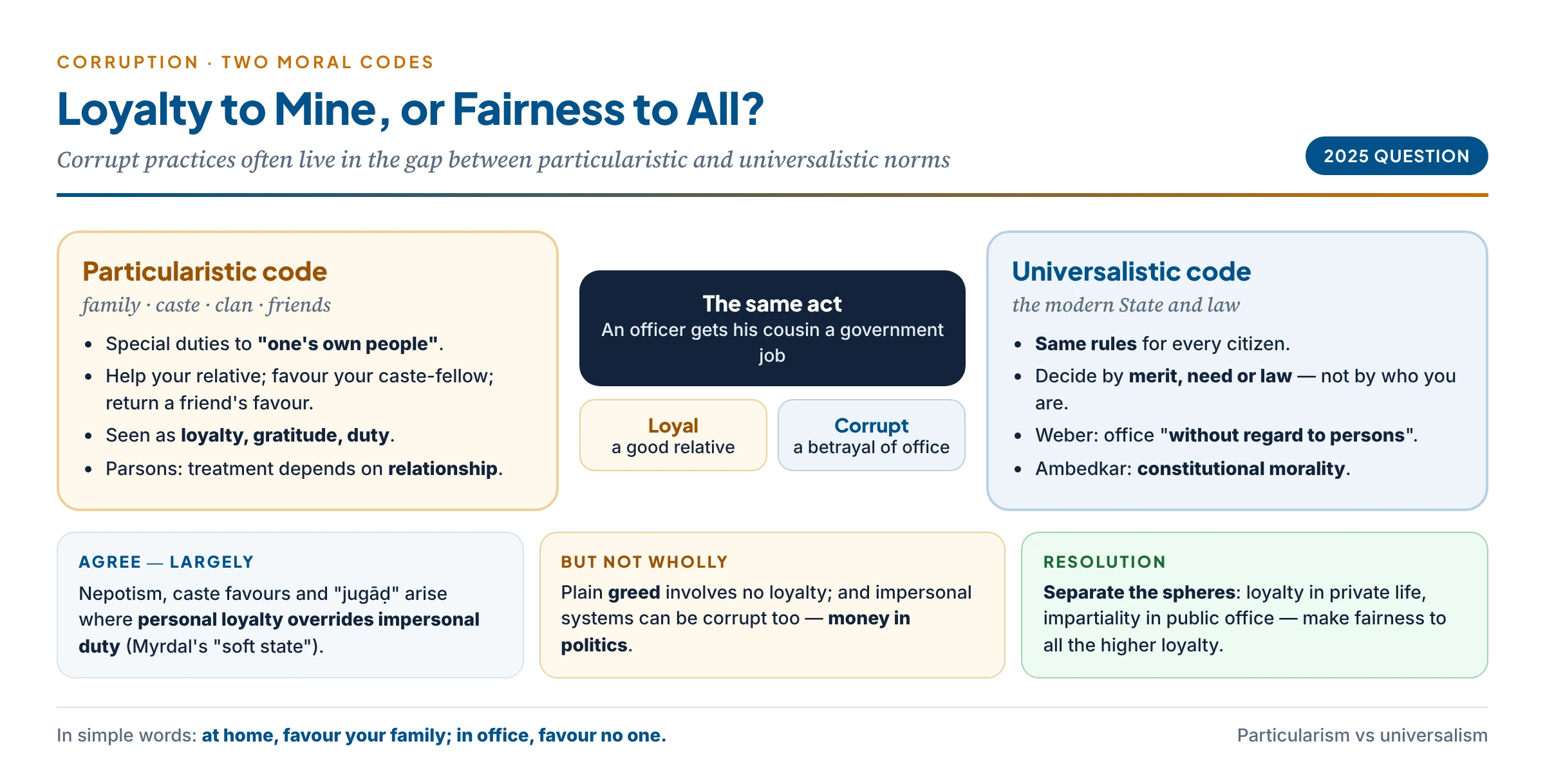
The 2025 paper asked whether “corrupt practices reveal an inherent tension between particularistic and universalistic normative standards“.
- Universalistic standards — the norms of the modern State and law:
- treat every citizen alike, by impersonal rules;
- decide by merit, need or law, not by who the person is;
- Weber’s rational-legal bureaucracy: the official acts “without hatred or passion“, “without regard to persons“.
- Particularistic standards — the norms of family, caste, clan, village and friendship:
- special obligations to “one’s own people” — help your relative, favour your caste-fellow, return a friend’s favour;
- in many societies these are not seen as corrupt at all, but as loyalty, gratitude and duty.
- Where they clash: the same act can be a virtue by one standard and corruption by the other.
- A clerk who gets his cousin a government job is a good relative (particularistic) but a corrupt official (universalistic).
- A gift to an officer after a favour is gratitude in village custom, bribery in law.
- Thinkers who analysed this tension:
- Talcott Parsons contrasted universalism (same rules for all) and particularism (treatment depends on relationship) as basic choices every society makes.
- Gunnar Myrdal (Asian Drama, 1968) described the South Asian “soft state“, where officials bend rules for kin and patrons and where a “folklore of corruption” makes people expect it.
- Modern scholars describe corruption as the persistence of particularism inside institutions built on ethical universalism.
- Do I agree? Largely yes:
- Much everyday corruption in India — nepotism, caste-based favours, “jugāḍ” through connections — arises precisely where personal loyalties override impersonal duties.
- But not all corruption is particularistic: greed for oneself (embezzlement) involves no loyalty at all; and universalistic systems can also be corrupt (institutional corruption through money in politics).
- And particularistic ties are not evil in themselves — families and communities are sources of care and trust. The problem is when they invade the public sphere.
- Resolution: the answer is not to abolish loyalty but to separate spheres — personal loyalty in private life, impartial rules in public office — and to build a public culture in which serving all citizens equally is itself seen as the highest loyalty (constitutional morality, in Ambedkar’s phrase).
In simple words
At a wedding, an uncle proudly says, “My nephew is a big officer — he got three of our boys jobs in his department.” In the family, he is a hero. In the department, three better-qualified candidates were cheated. The uncle and the law are using two different moral codes. Corruption often lives in the gap between them.
“Power Corrupts, Absolute Power Corrupts Absolutely”
The 2014 paper asked us to analyse this statement with reasons.
- Source: Lord Acton, in an 1887 letter to Bishop Mandell Creighton. His actual words were: “Power tends to corrupt and absolute power corrupts absolutely. Great men are almost always bad men.“
- What Acton meant: historians must judge rulers by the same moral standard as ordinary people — indeed, the presumption should run against the powerful, “increasing as the power increases“. “There is no worse heresy than that the office sanctifies the holder of it.”
- Reasons why power corrupts:
- Temptation and opportunity — power gives control over resources and people.
- Impunity — the powerful are less likely to be checked or punished.
- Flattery and isolation — the powerful hear only praise and lose touch with reality.
- Self-justification — the powerful come to believe their ends justify any means (“the end learns to justify the means”, as Acton put it).
- Psychological evidence — studies of power suggest that it tends to reduce empathy and increase risk-taking and rule-breaking; Zimbardo’s prison experiment showed how quickly ordinary people abuse unchecked authority.
- An old maxim holds that power and virtue cannot easily live together — the more of one, the harder the other.
- Plato’s Ring of Gyges — a shepherd who finds a ring of invisibility soon seduces the queen and seizes the throne; Glaucon argues that even a just man, given such power without accountability, would act unjustly.
- Indian echoes: Manu warns that a king who is lustful, partial and deceitful is destroyed by his own punishment; the epics show Rāvaṇa and Duryodhana undone by arrogance of power; Kauṭilya builds checks precisely because he expects power to corrupt.
- Qualifications and criticisms:
- Acton said power “tends” to corrupt — not that it always does. The popular version drops this word.
- Power can also reveal character, or even ennoble it — leaders like Gandhi, Lincoln or Aśoka (after Kaliṅga) used power with self-restraint.
- Powerlessness also corrupts — the humiliated and helpless may turn to bribery, cynicism or violence.
- The lesson: do not rely on the virtue of rulers; limit and divide power. Montesquieu: “power should be a check to power” — separation of powers, rule of law, free press, independent courts, elections.
Common confusion
Did Lord Acton say “Power corrupts, and absolute power corrupts absolutely”? Not exactly. His words were “Power tends to corrupt and absolute power corrupts absolutely.” The word “tends” matters: Acton was not claiming that every person with power becomes corrupt, but that power creates a standing temptation, which is why the powerful must be judged strictly and checked institutionally. The popular version, as in the 2014 question, drops “tends” and turns a warning into a law of nature.
Is Corruption a Systemic Issue or an Ethical Issue?
The 2022 paper asked for critical comments.
- As an ethical issue:
- Corruption is ultimately a choice by individuals to betray their duty; every bribe has a giver and a taker who could have refused.
- It reflects weak character, greed and a lack of integrity — the inner corruption Plato and Gandhi described.
- Remedy: moral education, personal integrity, role models (Article 9).
- As a systemic issue:
- Where monopoly, discretion and opacity are built into a system — licence raj, cash-based services, complex rules, low salaries, slow courts — corruption becomes the normal way of getting things done; even honest people are pushed to pay.
- Institutional corruption (Thompson) can exist without any individual’s dishonesty.
- Kauṭilya’s view: given human nature, corruption is inevitable unless the system is designed to detect and deter it.
- Remedy: institutional reform — transparency, digitisation, accountability, checks and balances.
- Critical comment — both, and they reinforce each other:
- Bad systems corrupt good people (an honest officer in a corrupt department faces pressure and isolation).
- Bad people corrupt good systems (even well-designed rules can be gamed).
- A society where corruption is expected produces a culture in which individuals stop feeling shame — the ethical and the systemic merge.
- So the remedy must be two-handed: institutions that make corruption hard and risky, and ethics that make it unthinkable.
How Social and Political Regimes Condition Corruption
The 2020 paper asked how far regimes condition corrupt practices in a nation-state.
- Authoritarian regimes:
- Absence of a free press, independent courts and opposition means corruption can flourish unchecked (Acton’s absolute power).
- But some authoritarian states have low petty corruption due to harsh, centralised control — though grand corruption often remains hidden.
- Democratic regimes:
- Elections, free media, RTI, courts and opposition expose and punish corruption.
- But democracies have their own corruption: election financing, vote-buying, patronage and criminalisation of politics — money is needed to win power, and power is used to recover money.
- Economic regimes:
- Heavy State control (licence-permit raj before 1991) creates rents — scarce permissions that officials can sell.
- Unregulated markets create crony capitalism and state capture by powerful businesses.
- Marxist view: under capitalism, the State serves the propertied class; corruption is a symptom of the class nature of the State.
- Social structure:
- Societies with strong particularistic ties (caste, clan, kinship) and weak civic trust tend to show more nepotism and favouritism.
- High inequality and poverty make people more dependent on patrons and more vulnerable to extortion.
- Evidence: in global indices, the least corrupt countries (Denmark 89, Finland 88, Singapore 84 in 2025) are mostly stable democracies with strong institutions; most countries score below 50; the global average fell to 42 in 2025. India scored 39/100, ranking 91st of 182.
- Conclusion: regimes condition corruption strongly — through incentives, checks and culture — but do not determine it fully: individual integrity and civic culture matter in every regime.
In simple words
Picture the same official in two towns. In the first, every file needs his signature, no deadline exists, and no one can see what he does — he is tempted daily. In the second, applications are online, decisions must be made in 15 days, and every step is visible to the applicant. The same person may behave very differently. Regimes and systems do not make people corrupt by themselves, but they decide how easy and how safe corruption is.
Moral and Economic Dimensions of Corruption
The 2013 paper asked whether corruption has an economic as well as a moral dimension.
- Moral dimension:
- Betrayal of trust; violation of duty; unfairness to honest citizens.
- Erodes character — of individuals and of the society’s moral culture.
- Treats people as means (Kant); denies fair opportunity (Rawls).
- Economic dimension:
- Misallocation of resources — contracts go to the highest briber, not the most efficient firm.
- Higher costs, poorer quality — inflated project costs, substandard roads and buildings.
- Lost revenue — tax evasion, black money, illicit flows abroad.
- Discourages investment and entrepreneurship; raises the cost of doing business.
- A regressive tax on the poor — the poor pay a larger share of their income in bribes for basic services; welfare leaks before reaching them. (A former Prime Minister once said that of every rupee spent on welfare, only about 15 paise reached the intended beneficiary.)
- Inequality and poverty deepen.
- The “grease” debate: some economists once argued that bribes “grease the wheels” of rigid bureaucracies. Most evidence shows the opposite — corruption “sands the wheels“: officials create more delays in order to extract more bribes.
- Link: the two dimensions are inseparable — economic damage flows from moral failure, and economic scarcity and inequality in turn breed moral compromise.
Is Corruption Not a Form of Mass Violence?
The 2019 paper asked this question.
- The case for calling corruption violence:
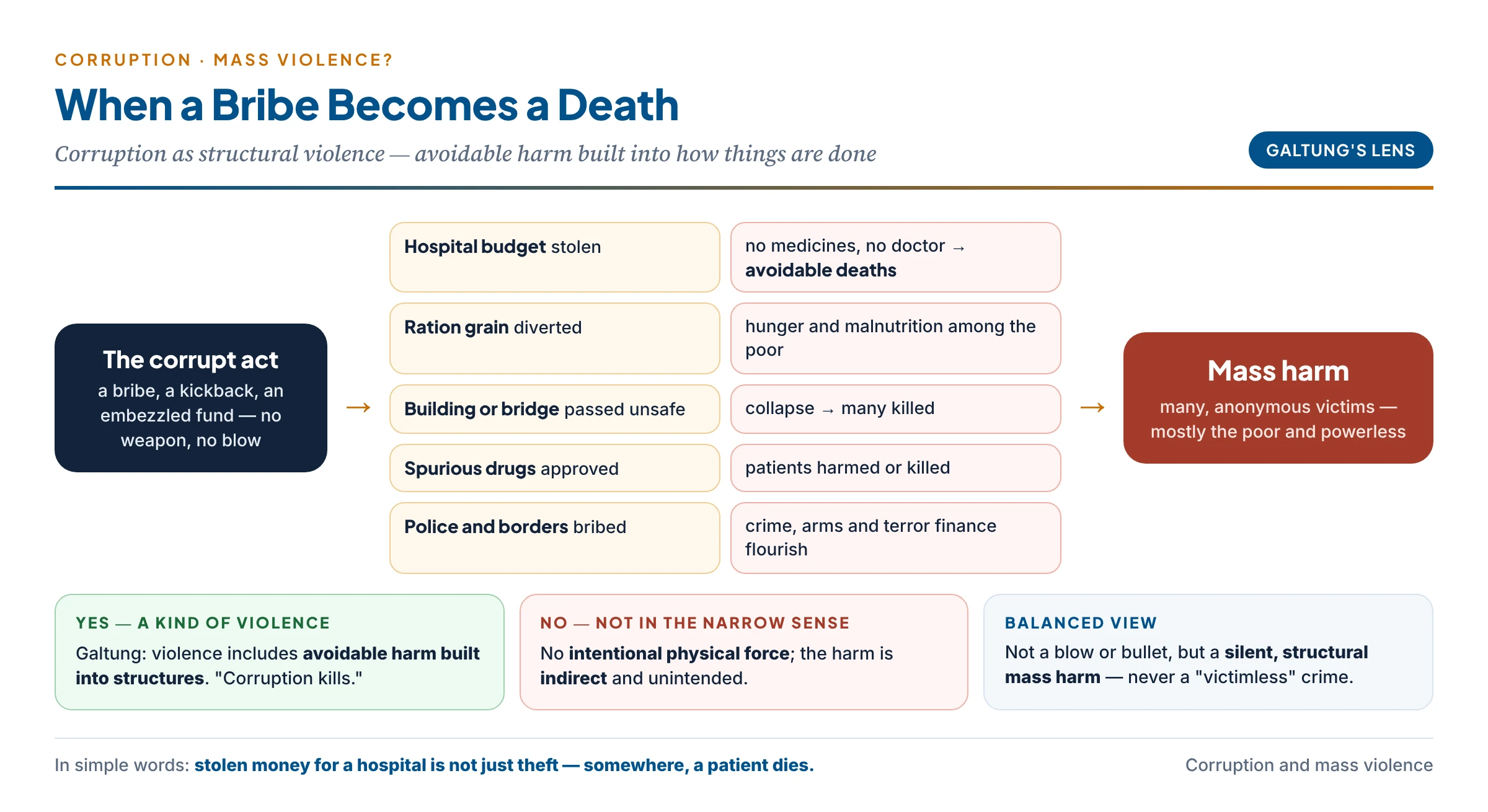
- Galtung’s structural violence (Article 10): violence is not only a blow or a bullet; it is avoidable harm built into structures. When funds for hospitals, food rations, roads and schools are stolen, people die or suffer who need not have.
- Concrete harms: collapsed buildings and bridges built with substandard materials; spurious medicines; diverted public distribution grain; ambulances and doctors that never arrive; disasters made deadlier by corrupt construction.
- Scale: the victims are many and anonymous — the defining mark of mass harm.
- Corruption also feeds direct violence: it funds organised crime, terrorism and arms smuggling, and protects criminals through bribed police.
- Transparency International’s slogan “corruption kills” captures this.
- The case against:
- Ordinary violence involves intentional physical force; corruption is usually non-violent and aims at gain, not harm.
- The harm is indirect and diffuse — the bribe-taker does not intend anyone’s death.
- Stretching “violence” too far may blur important moral distinctions.
- Balanced view: corruption is not violence in the narrow, physical sense, but it is a form of structural violence — a silent, mass harm that falls hardest on the poor and powerless. Calling it so helps us see that corruption is not a “victimless” economic crime but a grave injustice with real, often fatal, human costs.
Critical Evaluation
Critics and Defenders
Criticism — Views that soften or relativise corruption
- “Grease the wheels” economists: bribes can speed up rigid bureaucracies.
- Cultural relativists: gifts and favours to kin are local norms, not corruption.
- Kauṭilya’s realism, read cynically: corruption is inevitable — some leakage must be tolerated.
- Marxists: individual corruption is a surface symptom of class rule; moralising misses the cause.
- Sceptics of indices: corruption rankings measure perceptions, not actual corruption.
Defence — Views that condemn and confront it
- Kant: a bribe-maxim cannot be universalised; the corrupt official uses citizens as mere means.
- Rawls: corruption destroys fair equality of opportunity and harms the least advantaged.
- Locke: corrupt rulers betray the trust on which government rests.
- Thompson: institutional corruption must be fought even where no law is broken.
- Acton and Montesquieu: power tends to corrupt, so it must be checked by power.
- Gandhi: impure means corrupt every end; public life must be moral.
Cross-Tradition Comparison
Corruption in Indian and Western Thought
| Point | Indian thought | Western thought | Shared insight |
|---|---|---|---|
| Inevitability | Kauṭilya: honey on the tongue, fish drinking unseen | Acton: power tends to corrupt; Ring of Gyges | Power without checks breeds corruption |
| Remedy by structure | Spies, transfers, multiple officers, integrity tests | Separation of powers (Montesquieu), audits, free press | Design institutions assuming human weakness |
| Remedy by character | Dharma of the king; Gandhi’s purity of means | Plato’s guardians; Aristotle’s virtue | Rulers need inner integrity |
| Ruler’s duty | King as trustee of the subjects (prajā-hite hitam) | Locke’s fiduciary trust | Power is held in trust |
| Property and temptation | Gandhi’s trusteeship; aparigraha | Plato: guardians without private property | Detach rulers from private gain |
Indian Connect — The king as trustee
Kauṭilya wrote that “in the happiness of his subjects lies the king’s happiness; in their welfare his welfare” — the king is a servant and trustee of the people, not their owner. Gandhi’s later idea of trusteeship — that the wealthy and the powerful hold their wealth and power in trust for society — extends the same thought. Corruption, in this tradition, is not just theft: it is a violation of rāja-dharma, the ruler’s sacred duty to rule for others.
Synthesis (Siddhānta)
- Corruption — from corruptio, “to rot” — is the betrayal of a public or fiduciary trust for private gain. It ranges from petty to grand, from coercive to collusive, from individual “bad apples” to institutional “bad barrels” (Thompson).
- It is morally wrong because it cannot be universalised and treats citizens as means (Kant), destroys fair opportunity (Rawls), betrays the trust of government (Locke), and turns rule for the common good into rule for oneself (Aristotle).
- Kauṭilya saw corruption as near-inevitable and answered it with structures — checks, rotation, integrity tests, rewards for informers; Acton warned that power tends to corrupt; Montesquieu concluded that power must check power.
- Corruption reflects a tension between particularistic loyalties (family, caste, friends) and universalistic duties (equal treatment under impersonal rules); the cure is to keep loyalty in private life and impartiality in public office.
- It is both systemic and ethical, shaped by regimes but not wholly determined by them; it has moral and economic dimensions that feed each other; and in its effects on the poor it is a form of structural mass violence.
- Contemporary relevance: with India at 39/100 in 2025 and the global average falling, corruption remains a central threat to democracy, development and social justice — which is why the remedies of Article 9 must combine institutions and ethics.
“Power tends to corrupt and absolute power corrupts absolutely.” — Lord Acton
Previous Year Questions
- 2025“Corrupt practices reveal an inherent tension between particularistic and universalistic normative standards.” Do you agree with this statement? Give reasons and justification for your answer.
- 2022Is corruption a systemic issue or an ethical issue? Give your critical comments.
- 2020How far do the social and political regimes condition corrupt practices in a nation-state? Discuss.
- 2019Is corruption not a form of mass violence? Discuss.
- 2014Analyse the statement with reasons that “Power corrupts, absolute power corrupts absolutely“.
- 2013Does corruption have not only a moral dimension but also an economic dimension?