

Crime and Punishment: Corruption, Mass Violence, Genocide, Capital Punishment.
Official Syllabus: Paper II, Section A, Unit 7
The moral debate on the death penalty (Article 6) is not only a seminar question in India — it is decided every year in courtrooms, Raj Bhavans and Rashtrapati Bhavan. India retains the death penalty but has hemmed it in: the Constitution’s Article 21, the Supreme Court’s “rarest of rare” doctrine, the requirement of “special reasons”, the mercy powers of the President and Governors, and a growing body of law on mitigation and delay. Meanwhile the world has moved towards abolition, and Indian data show that death sentences fall mostly on the poor and are often wrong. This article traces the Indian law from the Constituent Assembly to the Bharatiya Nyaya Sanhita, 2023, examines whether the death penalty is fit for rape, murder and corruption, whether it weakens social justice, whether a death sentence lawfully awarded should be beyond ethical and political reconsideration, and places India in the global picture.
In simple words
Imagine a cricket umpire who may give a batsman out only if the ball would certainly have hit the middle stump, after looking at every replay, hearing the batsman’s side, and only when no other decision is possible — and even then the captain of the other side may still withdraw the appeal. That is roughly how Indian law treats the death penalty: allowed, but surrounded by so many checks that it is meant to be extremely rare.
Context & Problem
The Constitutional Starting Point
- Article 21: “No person shall be deprived of his life or personal liberty except according to procedure established by law.” The right to life is fundamental but not absolute; since Maneka Gandhi (1978), the procedure must be just, fair and reasonable.
- Article 14: no arbitrary or grossly disproportionate punishment.
- Articles 72 and 161: the President and the Governors may pardon, commute or remit a death sentence (the mercy power).
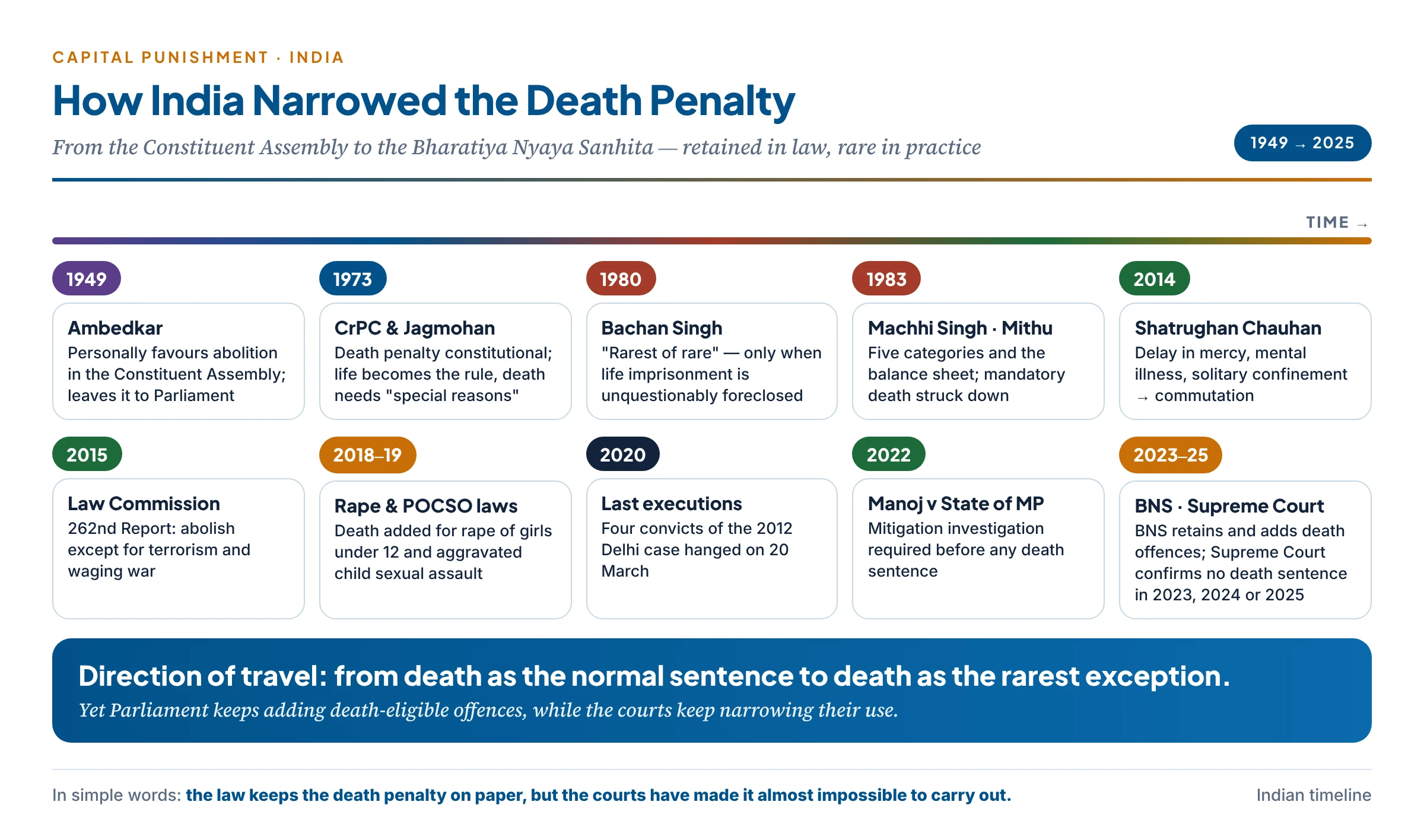
- The Constituent Assembly (1949): members raised the possibility of error, the discriminatory impact on the poor, and the judge-centred nature of death sentences. Dr Ambedkar said he would personally “much rather support the abolition of the death sentence itself“, since India “by and large believe[s] in the principle of non-violence” — but left the decision to Parliament, which retained it.
From “Rule” to “Exception”
- Under the old Code of Criminal Procedure (1898), death was the normal sentence for murder; a judge had to give reasons for not imposing it (the requirement was removed in 1955).
- The CrPC of 1973 (Section 354(3), now in the BNSS) reversed this: for murder, life imprisonment is the rule and death the exception, and a judge awarding death must record “special reasons“.
- Section 235(2) (now in the BNSS) requires a separate hearing on sentence after conviction, so that the accused can present mitigating circumstances.
Core Doctrine
The Supreme Court and the Death Penalty — Key Judgments
- Jagmohan Singh v State of UP (1973): the death penalty is constitutional; judicial discretion in choosing between death and life is not arbitrary.
- Rajendra Prasad (1979): Justice Krishna Iyer held death should be reserved for cases where the security of the State or society is at stake — a narrow view later overruled.
- Bachan Singh v State of Punjab (1980) — the “rarest of rare” doctrine:
- A five-judge bench (4:1, Justice P.N. Bhagwati dissenting) upheld the death penalty for murder.
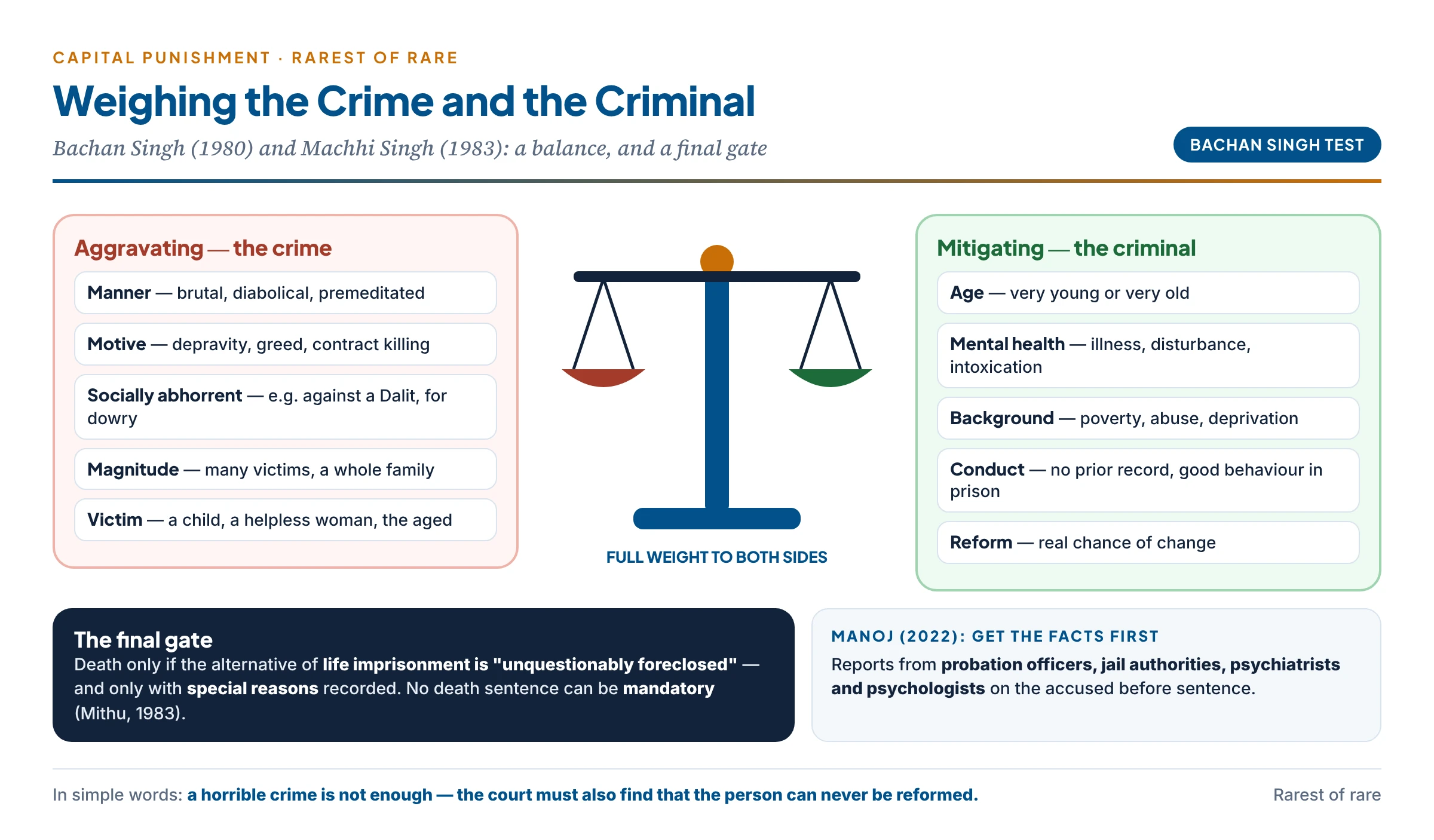
- But it held that “a real and abiding concern for the dignity of human life postulates resistance to taking a life through law’s instrumentality. That ought not to be done save in the rarest of rare cases when the alternative option is unquestionably foreclosed.”
- Courts must give due weight to mitigating circumstances — age, mental state, possibility of reform — as well as aggravating ones; the criminal, not only the crime, must be considered.
- Bhagwati’s dissent: the death penalty is arbitrary in its application, falls mostly on the poor and deprived, and violates Articles 14 and 21.
- Machhi Singh v State of Punjab (1983): laid down five categories where the community’s collective conscience may demand death — the manner of the crime (brutal, diabolical), its motive (depravity, mercenary), its anti-social or socially abhorrent nature (e.g. against a Dalit or for dowry), its magnitude (many victims), and the personality of the victim (a child, a helpless woman, an aged person, a public figure). Courts were to draw up a “balance sheet” of aggravating and mitigating circumstances.
- Mithu v State of Punjab (1983): struck down the mandatory death sentence for murder by a life convict (old Section 303 IPC) as arbitrary — no punishment of death can be automatic; the court must always have discretion.
- Santosh Bariyar (2009) and Sangeet (2013): the Court admitted that the “rarest of rare” test was being applied inconsistently; the possibility of reform must be shown to be impossible before death is imposed.
- Triveniben (1989) and Shatrughan Chauhan v Union of India (2014): inordinate and unexplained delay in deciding mercy petitions, mental illness of the prisoner, and illegal solitary confinement are grounds to commute death to life imprisonment.
- Mohd. Arif (2014): review petitions in death-sentence cases must be heard in open court.
- Manoj v State of Madhya Pradesh (2022): the Court required mitigation investigation — reports from probation officers, jail authorities, psychiatrists and psychologists on the accused’s background, mental health and conduct in prison — before a death sentence can be imposed. In the same year a separate bench referred the question of a meaningful separate sentencing hearing to a five-judge Constitution Bench.
The Rarest of Rare Test — How It Works
- Step 1 — Aggravating circumstances: brutality and premeditation, number of victims, vulnerability of the victim, motive, threat to society.
- Step 2 — Mitigating circumstances: young age or old age, mental illness, poverty and deprivation, emotional disturbance, lack of prior record, good conduct in prison, possibility of reform.
- Step 3 — Weigh both, giving full weight to mitigation.
- Step 4 — The decisive question: is the alternative of life imprisonment “unquestionably foreclosed”? Only if no other punishment can serve the purpose may death be awarded.
- Step 5 — Record special reasons.
In simple words
Think of a doctor deciding whether to amputate a leg. He weighs everything against amputation — the patient’s age, the chance that medicine might still work — and amputates only when every other treatment has failed or is clearly hopeless. “Rarest of rare” asks judges to treat the death sentence the same way: the last option, used only when every alternative is truly closed.
Death Penalty Offences in Indian Law Today
- The Bharatiya Nyaya Sanhita, 2023 (in force from 1 July 2024) retains death for offences including:
- murder, and murder by a mob on grounds of race, caste, community, language or similar (a new provision);
- rape of a girl under 12, gang rape of a girl under 18, rape causing death or a persistent vegetative state, and repeat rape offenders;
- terrorist acts causing death; waging war against the Government of India;
- organised crime resulting in death; kidnapping for ransom with death or threat of death; dacoity with murder;
- giving false evidence that leads to the execution of an innocent person.
- Special laws: the POCSO Act (aggravated penetrative sexual assault on children, since 2019), anti-terror laws, and others.
- Recent expansion: after the 2012 Delhi gang-rape case, the Criminal Law (Amendment) Acts of 2013 and 2018 added death for certain rapes — although the Justice Verma Committee (2013), set up after that case, had advised against the death penalty for rape.
- No mandatory death: following Mithu, every death penalty is discretionary, and life imprisonment remains available.
- Executions: India has carried out very few executions in recent decades — the last were of the four convicts in the 2012 Delhi case, on 20 March 2020.
What the Indian Data Show
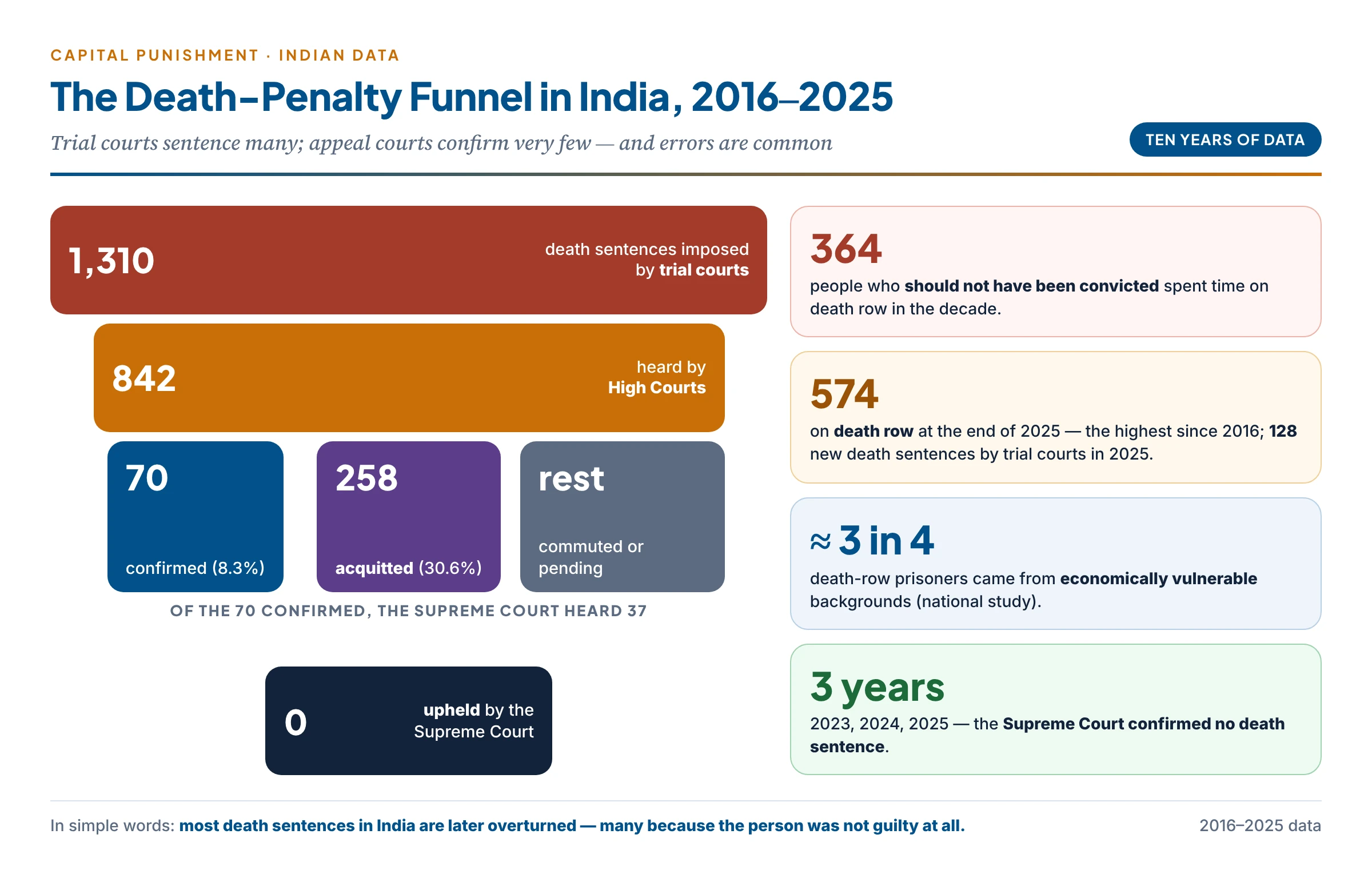
- Trial courts sentence many; higher courts confirm few. Between 2016 and 2025, trial courts imposed 1,310 death sentences. Of the 842 heard by High Courts, only 70 (8.3%) were confirmed and 258 (30.6%) ended in acquittal; the Supreme Court upheld none of the 37 it heard among those confirmed.
- Wrongful convictions: in the decade, 364 persons who should never have been convicted spent time on death row.
- The Supreme Court confirmed no death sentence in 2023, 2024 or 2025.
- Death row is growing: 574 prisoners were on death row at the end of 2025 — the highest since 2016 — and trial courts imposed 128 death sentences in 2025 alone, very few of them after the mitigation investigation that Manoj requires.
- Who is on death row: an earlier nationwide study found that about 74% of death-row prisoners came from economically vulnerable backgrounds, most were from backward classes or religious minorities, and many had never completed school.
The Law Commission’s 262nd Report (2015)
- Recommended abolition of the death penalty for all crimes except terrorism-related offences and waging war.
- Found that the death penalty does not serve the penological goal of deterrence any better than life imprisonment.
- Noted that the “rarest of rare” framework had been applied inconsistently and arbitrarily, and that the poor and marginalised bear the burden of an unequal system.
- Urged a focus on police reform, witness protection and victim compensation — the real needs of victims.
- Parliament has not acted on the recommendation; the BNS has in fact added new death-eligible offences.
The Mercy Power — Articles 72 and 161
- Purpose: a final safety valve — to correct judicial error, to consider facts not before the court (illness, remorse, changed circumstances), and to temper justice with mercy.
- Nature: exercised by the President and Governors on the advice of the Council of Ministers; not a private favour but a constitutional duty.
- Judicial review is limited: courts can review a mercy decision only on narrow grounds — mala fides, irrelevant considerations, or non-application of mind (Kehar Singh, 1989; Epuru Sudhakar, 2006).
- Delay: Shatrughan Chauhan (2014) held that long, unexplained delay in deciding a mercy petition is itself a ground for commutation, because it subjects the prisoner to the torment of uncertainty.
In simple words
A referee’s decision is final on the field — yet football has a disciplinary committee that can later cancel a red card shown by mistake. Nobody says the committee “subverts” the rules; it is part of the rules, there to catch errors the referee could not see. The mercy power plays the same role for the death sentence.
“If Capital Punishment Is Legally Awarded, No Ethico-Political Consideration Should Subvert It”
The 2010 paper asked for an opinion for or against this view.
- For the statement:
- Rule of law and finality — once guilt and sentence are decided by courts after full process, reopening them for political reasons undermines legal certainty.
- Separation of powers — the executive should not second-guess the judiciary.
- Justice for victims — families of victims are wronged when sentences are endlessly delayed or commuted for political convenience.
- Equality — clemency for some (the influential) and not others (the poor) is itself arbitrary.
- Against the statement:
- Ethico-political consideration is built into the law itself. The mercy powers under Articles 72 and 161 exist precisely so that moral, humanitarian and political considerations can be weighed after the courts have spoken. Using them does not “subvert” the law; it completes it.
- Courts err. New evidence, scientific findings or mental illness may appear after the judgment; legality is not the same as justice.
- Changing moral standards — the Constitution is a living document; what was lawful yesterday (mandatory death; long delays) has been held unconstitutional later.
- Irreversibility demands one last moral check before an act that can never be undone.
- Balanced view: political considerations in the narrow sense (vote-banks, communal pressure, partisan bargaining) should never decide life and death. But ethical considerations, exercised through constitutional channels, transparently and without delay, are not a subversion of law — they are its conscience.
Can Capital Punishment Be Justified for Rape, Murder and Corruption?
The 2017 paper asked about three different crimes.
- Murder:
- The strongest case for retention — the only crime where “life for life” has a literal sense.
- Indian law permits death for murder but only in the rarest of rare cases, with full weight to mitigation.
- Against: most murders are unplanned; error and arbitrariness remain; life imprisonment protects society equally.
- Rape:
- For: rape is a grave violation of dignity and bodily integrity; the 2013–2018 amendments reflected public outrage after the 2012 Delhi case and the rape of children.
- Against:
- The Justice Verma Committee (2013) advised against it, warning it could make offenders kill the victim to remove the witness.
- Most rapes are by known persons — family members, neighbours; the threat of death may make families pressure victims not to report.
- Proportionality: where the victim survives, death is more than equal to the crime.
- What deters is certainty — conviction rates for rape remain low; faster trials, better policing and victim support matter more.
- Corruption:
- For: large-scale corruption can destroy lives indirectly (spurious medicines, collapsing buildings, diverted food) — “corruption as mass violence” (Article 8); China imposes death for some corruption.
- Against:
- Corruption is generally a non-violent economic crime; death would be grossly disproportionate.
- International law permits death only for “the most serious crimes” — understood as intentional killing.
- The real remedies are certainty of detection, confiscation of illegal wealth, disqualification from office and institutional reform (Article 9).
- Even Viet Nam abolished the death penalty for embezzlement and bribery in 2025.
- Conclusion: if the death penalty is to exist at all, it is defensible — barely — only for the gravest, premeditated killings proved beyond doubt; it is not justified for rape where the victim survives, and clearly unjustified for corruption.
Does Capital Punishment Weaken the Doctrine of Social Justice?
The 2019 paper asked this question.
- Social justice means a just distribution of rights, burdens and opportunities, with special protection for the weak and disadvantaged — the spirit of the Preamble and the Directive Principles (Article 39A: equal justice and free legal aid).
- Ways the death penalty weakens social justice:
- Unequal impact — most death-row prisoners are poor, less educated, from backward classes or minorities; the rich escape through better lawyers and the “benefit of the doubt“.
- Unequal access to justice — legal aid is often weak; a poor accused may not be able to present mitigating evidence at all.
- Arbitrariness — whether a person lives or dies depends on the judge and the lawyer, not only on the crime (Bhagwati’s dissent; the Law Commission).
- Wrongful convictions fall hardest on those least able to defend themselves.
- No reform, no restitution — social justice aims at inclusion; death permanently excludes.
- Rawls’s test — a just system must be acceptable from the standpoint of the least advantaged; a penalty that mostly kills the least advantaged fails it.
- Counter-arguments:
- Justice for victims is also social justice — many victims are themselves poor, women, children, Dalits; denying the gravest penalty to their killers can seem unjust to them.
- Indian law sometimes uses death to protect the vulnerable (child rape; false evidence that sends an innocent to death; lynching on caste grounds).
- The fault lies in unequal administration, not in the penalty itself; better legal aid would cure it.
- Balanced view: in principle the death penalty need not violate social justice; in practice, in an unequal society with a strained legal-aid system, it does weaken it — because the penalty concentrates on the disadvantaged and its errors are irreversible. Strengthening legal aid, mitigation and fair trial is the minimum; many argue that the only way to make the system socially just is to abolish the penalty.
In simple words
Picture two men accused of the same murder. One can hire a senior advocate, a private investigator and a psychologist who documents his difficult childhood. The other meets his overworked legal-aid lawyer for ten minutes before the hearing, and no one ever tells the court about his background. The law is the same for both, but the outcome may not be. When the penalty is death, that gap becomes a gap between life and death — which is why the question of social justice is so sharp here.
The Global Picture
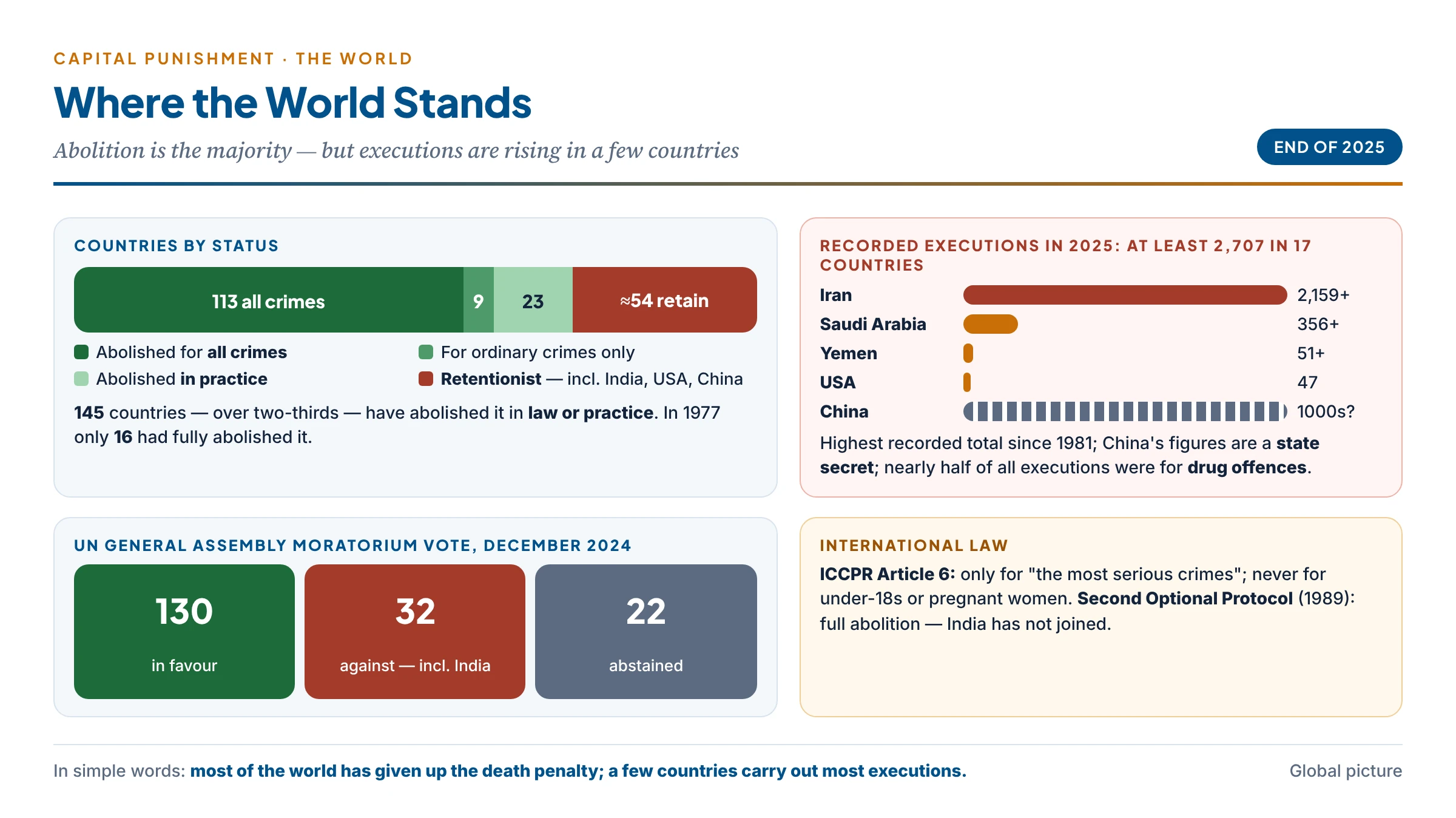
- Abolition is the majority position: at the end of 2025, 113 countries were abolitionist for all crimes and 145 in law or practice; in 1977, only 16 were fully abolitionist.
- Executions are concentrated: in 2025, at least 2,707 executions were recorded in 17 countries — the highest since 1981 — with Iran (at least 2,159) and Saudi Arabia (at least 356) accounting for over 90%; China executes thousands but keeps the figures secret; the USA executed 47.
- The UN moratorium resolution: in December 2024 the General Assembly called for a moratorium on executions by 130 votes to 32 (22 abstentions); India voted against, holding that criminal punishment is a matter of each country’s sovereign law.
- International law: the ICCPR (Article 6) restricts the death penalty to “the most serious crimes” and forbids it for those under 18 and for pregnant women; its Second Optional Protocol (1989) aims at total abolition (India has not ratified it).
- Trends both ways: some States have abolished or narrowed it (Viet Nam for eight offences, the Gambia for murder and treason, in 2025); others have expanded it, especially for drugs and terrorism.
Common confusion
Does “rarest of rare” mean the death penalty is reserved only for the most horrific crime? Not only. Many notes describe it as a test of how brutal the crime was. But Bachan Singh framed it around the alternative: death is permitted only when “the alternative option is unquestionably foreclosed” — that is, when life imprisonment cannot serve the purpose, usually because reform is impossible. A crime can be horrific and yet the offender reformable; then the test forbids death. That is why the Supreme Court insists on mitigation evidence about the offender, not only on the facts of the crime.
Critical Evaluation
Strengths of the Indian Approach
- Death as exception — life is the rule; special reasons are required.
- Individualised sentencing — both crime and criminal are considered; no mandatory death.
- Multiple safeguards — confirmation by the High Court, appeal, review in open court, mercy, judicial review of delay.
- Progressive judicial practice — mitigation investigation (Manoj), commutation for delay and mental illness (Shatrughan Chauhan), and, in practice, almost no confirmations in recent years.
Weaknesses
- Inconsistency — the Supreme Court itself has admitted that “rarest of rare” has been applied arbitrarily.
- Trial-court gap — trial courts continue to impose death sentences without the required mitigation inquiry.
- Error — high rates of acquittal on appeal reveal weak investigation and prosecution.
- Class and caste bias — the burden falls on the poor and marginalised.
- Delay — years on death row add a second punishment.
- Symbolic expansion — new death-eligible offences are added in response to public anger, even when expert bodies advise against it.
Critics and Defenders
Criticism — Critics of India’s retention
- Ambedkar: India’s tradition of non-violence calls for abolition.
- Justice Bhagwati (dissent in Bachan Singh): arbitrary in application and borne by the poor; violates Articles 14 and 21.
- Law Commission (2015): no extra deterrence; abolish except for terrorism.
- Justice Verma Committee (2013): death for rape may endanger victims and reduce reporting.
- Researchers on death row: wrongful convictions and missing mitigation are systemic, not accidental.
- UN and human-rights bodies: India should join the global moratorium.
Defence — Defenders of India’s retention
- Bachan Singh majority: constitutional if confined to the rarest of rare cases.
- Machhi Singh: the collective conscience may demand death for the most brutal crimes.
- Parliament (2013, 2018, 2023): grave crimes against children and terrorism warrant the ultimate penalty.
- Victims’ families: justice must be done and be seen to be done.
- Sovereignty argument: each nation may decide its own penal law, as India said at the UN.
Cross-Tradition Comparison
India and Other Democracies
| Point | India | USA | European Union / UK |
|---|---|---|---|
| Status | Retained; rarely carried out (last executions 2020) | Retained federally and in many states | Abolished; condition of membership |
| Standard | Rarest of rare; life imprisonment the rule | “Death is different”; aggravating factors | — |
| Mandatory death | Unconstitutional (Mithu) | Unconstitutional | — |
| Juveniles | Never for under-18s | Never for under-18s (since 2005) | — |
| Mercy | President and Governors (Articles 72, 161) | President and State Governors | — |
| Key concern | Delay, mitigation, bias against the poor | Racial bias, wrongful convictions | Human dignity as absolute |
Indian Connect — From Aśoka’s respite to Shatrughan Chauhan
The emperor Aśoka, after his conversion to the dhamma, did not abolish the death penalty, but in his Fourth Pillar Edict granted condemned prisoners a three-day respite, so that their relatives might appeal for mercy and the condemned might prepare for the next life through fasting and gifts. Two thousand years later, the Supreme Court in Shatrughan Chauhan held that the condemned must be told of the rejection of mercy, given time to meet family, and must not be kept in torturous uncertainty. The Indian tradition has long tried to place mercy and dignity around even the harshest penalty.
Synthesis (Siddhānta)
- India retains the death penalty but treats it as a constitutional exception: life imprisonment is the rule; death requires special reasons, full mitigation, and the finding that the alternative is “unquestionably foreclosed” (Bachan Singh); mandatory death is unconstitutional (Mithu); delay and mental illness can lead to commutation (Shatrughan Chauhan); and mitigation must be investigated (Manoj).
- The data expose the problem: many death sentences at trial, very few confirmed, many acquittals, wrongful convictions, and a death row drawn mostly from the poor and marginalised. In practice the death penalty weakens social justice.
- For rape and corruption, the death penalty is disproportionate and possibly counter-productive; for murder, it is at most defensible in the gravest, fully proven cases.
- A death sentence legally awarded should not be undone for partisan politics, but ethical review through the mercy power is part of the Constitution’s design — the law’s conscience, not its subversion.
- Globally, abolition is now the majority position; India stands with a shrinking group of retentionists, though its own courts have, in practice, nearly stopped confirming death sentences.
- Balanced position: India’s present path — legal retention, practical rarity — is an uneasy compromise. The Law Commission’s middle course (abolition except for terrorism), combined with strong legal aid, mitigation, victim support and swift, certain justice, would better serve social justice, human dignity and public safety — and would honour Ambedkar’s hope.
“A real and abiding concern for the dignity of human life postulates resistance to taking a life through law’s instrumentality. That ought not to be done save in the rarest of rare cases when the alternative option is unquestionably foreclosed.” — Supreme Court of India, Bachan Singh (1980)
Previous Year Questions
- 2025Can one’s right to life be absolute? Answer with reference to the idea of Capital Punishment.
- 2019Does capital punishment weaken the doctrine of social justice? Discuss.
- 2017Can you justify capital punishment for crimes like rape, murder and corruption? Discuss.
- 2017Will a severe punishment for crimes against women change the mindset of society? Justify your position.
- 2010If capital punishment is legally awarded, then no ethico-politico consideration should subvert it. Express your opinion for or against.