

Major Sea Ports in India
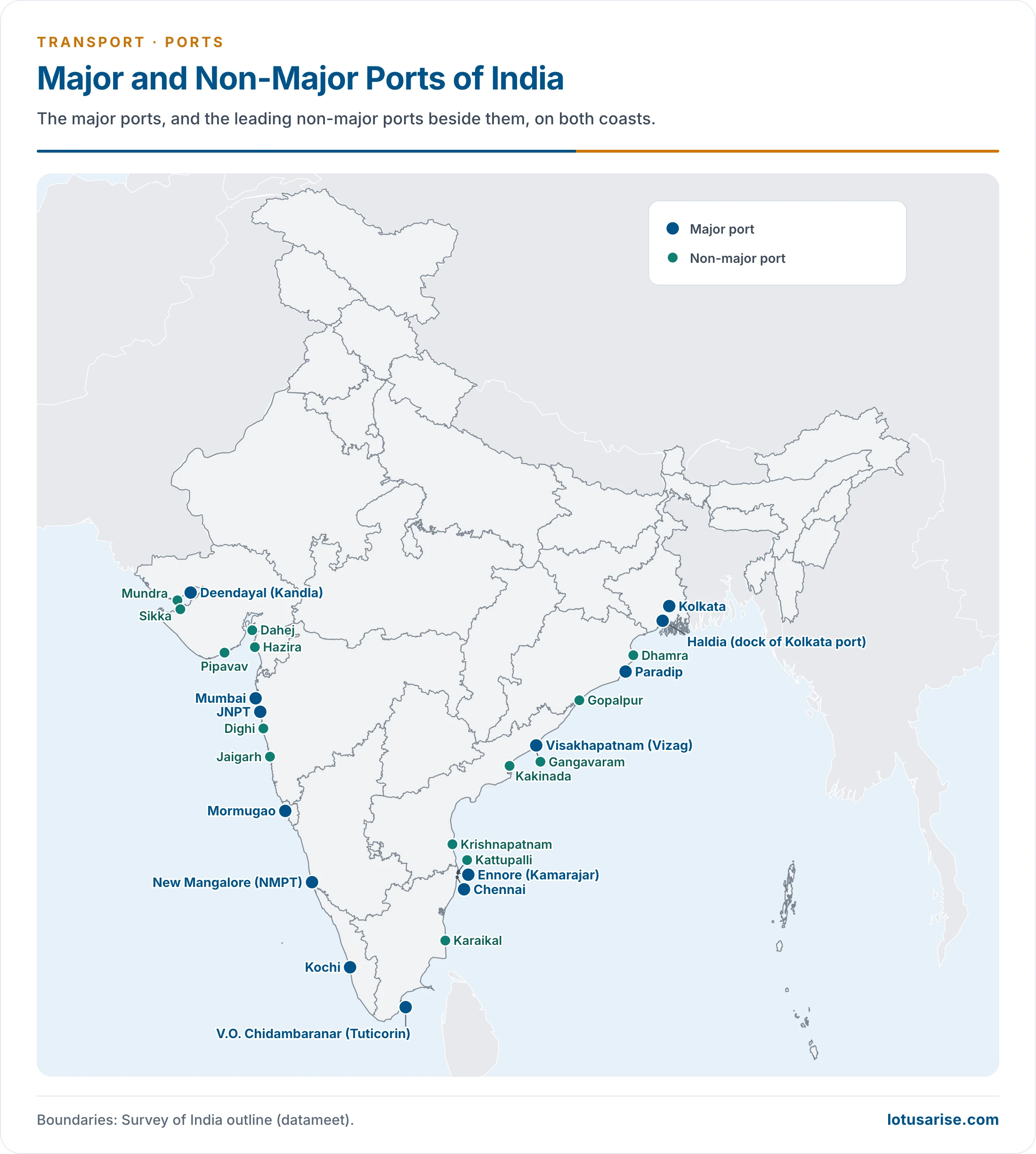
- India has 12 operational major seaports, and two more, Vadhavan and Galathea Bay, notified and under construction. Alongside them stand over 200 notified minor and intermediate ports, long counted at 205.
- The older count was 13 major ports: 12 government-owned port trusts and one company port, Ennore, which is state-owned.
- Ports play a central role in the development of a nation. For cost, capacity and ease of carriage, a port handling bulk freight outdoes the other modes available.
- About 95% by volume and 70% by value of India’s international trade moves by sea (2026). Major and non-major ports together handled 1,597.27 million tonnes in 2024-25.
- Where they lie: India’s long coast, with the Peninsula jutting far out into the Indian Ocean, gives ports to the 9 coastal States: Keralam (Kerala), Karnataka, Maharashtra, Goa, Gujarat, West Bengal, Odisha, Andhra Pradesh and Tamil Nadu. Non-major ports also lie in the coastal Union Territories.
- By coast:
- West coast: Mumbai, Kandla, Mangalore, JNPT, Mormugao and Cochin, with Vadhavan being built.
- East coast: Chennai, Tuticorin, Visakhapatnam, Paradip, Kolkata (with Haldia) and Ennore.
- Andaman and Nicobar Islands: Port Blair, now Sri Vijaya Puram, with Galathea Bay being built on Great Nicobar.
- Mumbai is the largest natural port in India.
- Who runs them: under India’s federal structure, maritime transport is shared between the Centre and the States.
- The Ministry of Ports, Shipping and Waterways administers the major ports. The Major Port Authorities Act, 2021 turned the old port trusts into port authorities.
- The non-major ports fall to the departments and maritime boards of the coastal States. The Indian Ports Act, 2025 is the current general law for all ports.
List of Important Ports in India
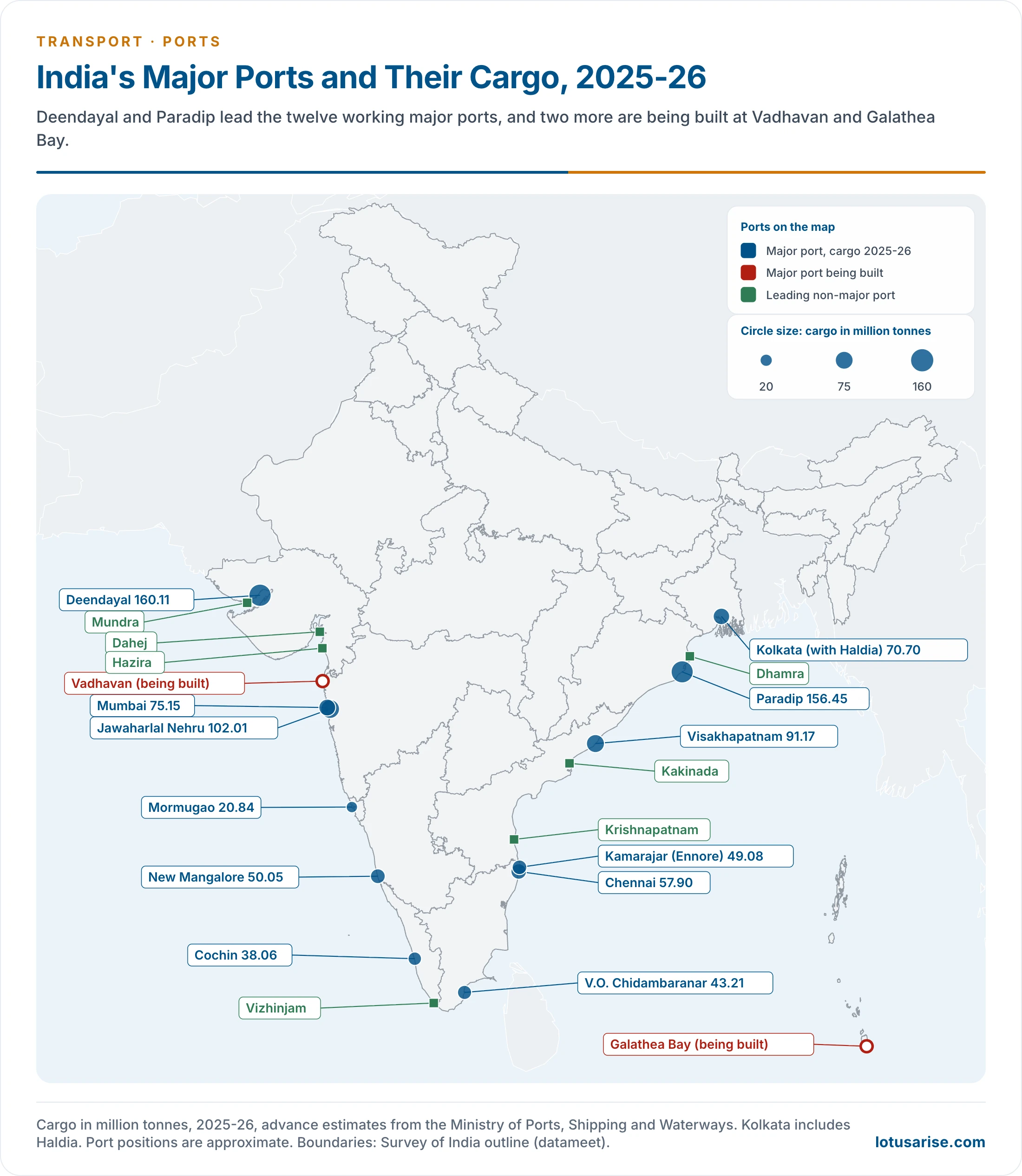
- The table lists the important major ports, with their cargo in 2010 and 2025-26.
| Zone | State | Port | Cargo 2010 (million tonnes) | Cargo 2025-26 (million tonnes) |
|---|---|---|---|---|
| Western Coast | Gujarat | Kandla (Deendayal) | 74.52 | 160.11 |
| Eastern Coast | Odisha | Paradip | 57.01 | 156.45 |
| Western Coast | Maharashtra | Jawaharlal Nehru Port (JNPT), also known as Nhava Sheva, Navi Mumbai | 60.74 | 102.01 |
| Eastern Coast | Andhra Pradesh | Visakhapatnam | 65.50 | 91.17 |
| Western Coast | Maharashtra | Mumbai Port Trust (now Mumbai Port Authority) | 54.54 | 75.15 |
| Eastern Coast | West Bengal | Kolkata (Haldia) | 46.30 | 70.70 |
| Eastern Coast | Tamil Nadu | Chennai | 61.06 | 57.90 |
| Western Coast | Karnataka | Mangalore | 35.53 | 50.05 |
| Eastern Coast | Tamil Nadu | Ennore (Kamarajar) | 10.71 | 49.08 |
| Eastern Coast | Tamil Nadu | Tuticorin (V.O. Chidambaranar) | 23.79 | 43.21 |
| Western Coast | Keralam | Kochi (Cochin) | 17.43 | 38.06 |
| Western Coast | Goa | Mormugao | 48.85 | 20.84 |
| Western Coast | Maharashtra | Vadhavan Port | Not built | Under construction |
- The 2025-26 column adds up to 914.73 million tonnes, an advance estimate. The Ministry’s rounded headline is 915 million tonnes.
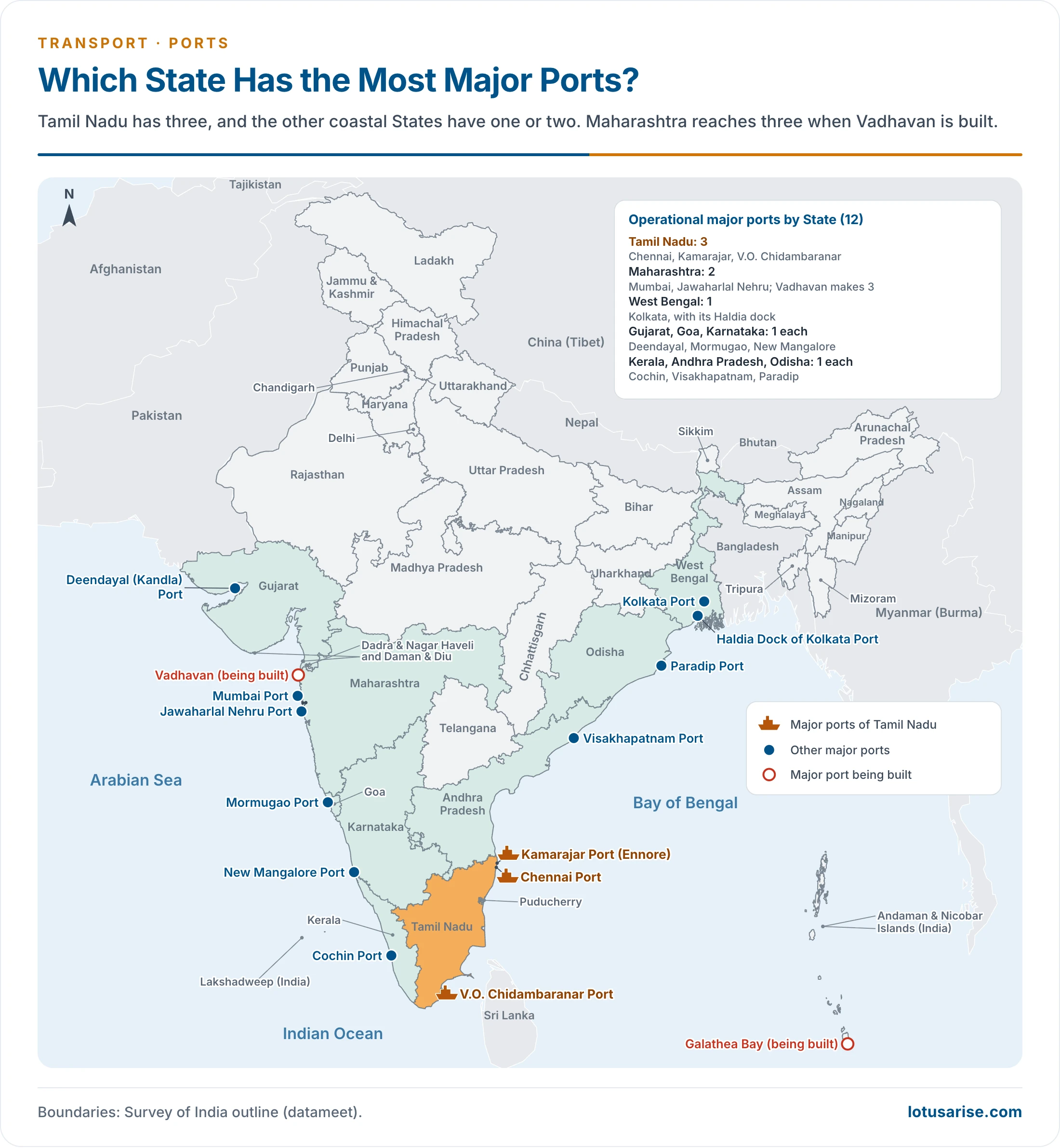
- This map counts three major ports in Tamil Nadu: Chennai, Kamarajar and V.O. Chidambaranar. Maharashtra has two and reaches three with Vadhavan.
Port Models and Hinterlands
What is Landlord Port?
- In this model, a publicly governed port authority acts as regulator and as landlord, while private companies run port operations, chiefly cargo handling.
- The authority keeps ownership of the port and leases the infrastructure to private firms. These firms supply and maintain their own superstructure and install their own equipment.
- In return, the landlord port takes a share of the revenue from the private firm.
Service Port Model
- In a service port, the port authority itself carries out both administration and operation.
- Operation covers navigational services, warehouses, cranes and skilled workers. The authority also builds the infrastructure and superstructure and employs the staff.
- The authority acts in the public interest, and full ownership stays with the State.
Hinterlands of the Major Ports
- A port’s hinterland is the inland area it serves, and its growth depends on how rich that area is and how well road and rail tie the two together.
| Port | Classical hinterland |
|---|---|
| Kandla | Gujarat, Rajasthan, Haryana, Punjab, Delhi, Himachal Pradesh, Jammu and Kashmir, Uttarakhand |
| Mumbai and JNPT | Maharashtra, with much of Madhya Pradesh, Gujarat, Rajasthan and Delhi |
| Mormugao | Goa, north coastal Karnataka, southern Maharashtra |
| New Mangalore | Karnataka and northern Keralam |
| Kochi | Keralam with parts of Tamil Nadu and Karnataka; Keralam gives most of the traffic |
| Tuticorin | Southern Tamil Nadu: Madurai, Kanniyakumari, Ramanathapuram, Tirunelveli |
| Chennai and Ennore | Most of Tamil Nadu, southern Andhra Pradesh, parts of Karnataka |
| Visakhapatnam | Andhra Pradesh, Telangana, and adjoining Chhattisgarh, Madhya Pradesh, Maharashtra and Karnataka |
| Paradip | Odisha |
| Kolkata and Haldia | West Bengal, Bihar, Jharkhand, eastern Uttar Pradesh, the North-East; also Nepal and Bhutan |
Ports of the West Coast
Kandla Port (Deendayal Port)
- Deendayal Port, renamed from Kandla in 2017, lies in the town of Kandla, in Kachchh (Kutch) district, Gujarat, near the city of Gandhidham.
- On the Gulf of Kachchh, it is one of the main west coast ports, about 48 km from Bhuj.
- It is known as a tidal port, set in the sheltered Kandla Creek at an average depth of about 10 m.
- It was built after Partition, when Karachi port went to Pakistan, with construction dated to 1951. It also relieves congestion at Mumbai port.
- Largest major port by volume of cargo handled: 160.11 million tonnes in 2025-26, regaining first place from Paradip, which led in 2023-24 and 2024-25.
- It has been recognised as a free trade zone: Asia’s first export processing zone opened at Kandla in 1965.
- Trade: crude oil, petroleum products, fertilisers, foodgrains, salt, scrap, cotton, sugar, cement and edible oils.
Jawaharlal Nehru Port (JNPT)
- Jawaharlal Nehru Port, also known as Nhava Sheva (Navi Mumbai), was the first major port to become a 100% landlord port, with all berths run on the public-private partnership (PPP) model. It is now the Jawaharlal Nehru Port Authority (JNPA).
- The name Nhava Sheva comes from two villages that stood in the area.
- Largest artificial port and leading container port among the major ports.
- Containers: it handled 7.30 of the 13.53 million TEU at major ports in 2024-25, down from 55–60% of the country’s containers around 2011-12, and passed 8 million TEU in 2025-26.
- Its total cargo reached 102.01 million tonnes in 2025-26.
- It was commissioned on 26 May 1989 to take pressure off Mumbai. In three decades it grew from a bulk-cargo terminal into the premier container port.
- It stands on the eastern shore of Mumbai harbour, off Elephanta Island, and is reached through Thane Creek.
- It is the terminal point of the Western Dedicated Freight Corridor of Indian Railways. The 1,506 km corridor from Dadri was completed with a trial run on the last section to JNPT on 31 March 2026.
- It meets international standards, with modern facilities and direct rail and road links to the hinterland that bypass Mumbai city.
- Vessel size: it handled vessels of 9,000 twenty-foot equivalent units (TEU), with upgrading planned for 12,200 TEU.
- Private terminals began with the Nhava Sheva International Container Terminal, operational from about 2000 on a 30-year Build, Operate and Transfer basis.
- Trade: textiles, sporting goods, carpets, pharmaceuticals and chemicals.
Mumbai Port
- The largest natural port and harbour in India, with deep water of 10–12 m beside the harbour and no sandbanks.
- Earlier, the site was used by the navies of Shivaji.
- The port has 3 enclosed wet docks of about 46 hectares:
- Prince’s Dock
- Victoria Dock
- Indira Dock
- It was long the busiest port in India, handling about a fifth of foreign trade. With Kandla, Paradip and JNPT now ahead, it stood fifth among major ports in 2025-26 with 75.15 million tonnes.
- Jawahar Dweep is an island in the harbour for crude and petroleum products.
- The Suez Canal (1869) brought it much closer to Europe, and it became India’s western gateway.
- Trade: exports of textiles, leather, machinery and chemicals; imports of crude oil, raw cotton, machinery and drugs.
Mormugao Port
- Situated on the estuary of the Zuari in Goa, a natural harbour with a protected anchorage.
- It received major port status in 1963.
- It was long the leading iron-ore exporting port in India. Iron ore now makes up only about 5% of cargo at major ports, and with 20.84 million tonnes in 2025-26, Mormugao is the smallest major port by traffic.
- The Konkan Railway widened its reach, and it is turning multi-commodity. Its hinterland is comparatively small.
New Mangalore Port
- Deep-water, all-weather port at Panambur, north of the Gurupura river.
- Declared a major port on 4 May 1974 and inaugurated on 11 January 1975.
- It deals with iron-ore exports, once chiefly from the Kudremukh mines.
- It is the only major port of the coastal State of Karnataka.
- Trade: exports of tea, coffee, cashew, fish and granite; imports of crude oil, coal, LPG, fertilisers and edible oils.
Kochi (Cochin) Port
- Cochin Port, or Kochi Port, is a major port on the Arabian Sea–Laccadive Sea–Indian Ocean sea-route in the city of Kochi, one of the larger ports in India.
- It has India’s first transshipment terminal.
- The port lies on two islands in the Lake of Kochi: Willingdon Island and Vallarpadam, towards the Fort Kochi river mouth opening onto the Laccadive Sea.
- It is a natural harbour on a tidal backwater, and it became a major port in 1936. It lies close to the international route between Europe and the Far East and Australia.
- It is generally called the natural gateway for the industrial and agricultural produce markets of south-west India.
- Exports of spices, tea and coffee. Imports of mineral oil and fertilisers, which far exceed exports, with crude oil feeding the Kochi refinery.
- It is one of the centres of shipbuilding.
Vadhavan Port
- This will be the 13th major port in India, notified on 19 February 2020.
- With its development, India would have a port among the top 10 container ports in the world.
- Cabinet approval came on 19 June 2024, at ₹76,220 crore including land acquisition, for 298 million tonnes a year. The foundation was laid on 30 August 2024, and the first phase is targeted for 2029.
- A special purpose vehicle (SPV) is implementing it, with Jawaharlal Nehru Port Trust (JNPT) as lead partner. The early plan set its equity at 50% or more. The final split is JNPA 74% and the Maharashtra Maritime Board 26%.
- It will follow the landlord model.
- JNPT has planned it as an “all weather, all cargo” satellite port to handle deep-draft ships and larger vessels.
New Ports on the West Coast
- Beyond the major ports, new capacity on this coast has come mostly from private and State ports.
- Mundra in Gujarat became India’s first port to handle 200 million tonnes in a year (200.7 in 2024-25), more than any major port.
- Hazira, Dahej, Pipavav and Sikka serve the industries and oil trade of Gujarat. Gujarat alone had 64.54% of non-major port traffic in April–September 2025.
- Vizhinjam in Keralam, in commercial operation since December 2024 and dedicated to the nation on 2 May 2025, handled about 1.3 million TEU in 2025-26, nearly all of it transshipment. Nearly 75% of India’s transshipped cargo has been handled abroad, mostly at Colombo, Singapore and Klang.
- Why they matter for external trade:
- Deep draft lets them take larger vessels.
- They lie near the industrial north-west and on the shortest route towards West Asia, Europe and Africa.
- The freight corridor gives the JNPT–Vadhavan area a direct link to the northern hinterland.
- They raise India’s share of container and transshipment traffic and cut the delay of waiting at congested older ports.
Ports of the East Coast and the Islands
Chennai Port
- Chennai Port, formerly Madras Port, was long ranked the second-largest container port of India behind Nhava Sheva (JNPT), and described as the largest on the Bay of Bengal.
- In 2025-26, Paradip, Visakhapatnam and Kolkata all handled more total cargo.
- It is an artificial, all-weather port with wet docks. Work was sanctioned in 1875 and operations began in 1881, making it the east coast’s oldest artificial harbour.
- The port is the reason Chennai came to be known as the Gateway of South India.
- Limits: cyclones in October and November interrupt shipping, and water near the coast is relatively shallow for the largest ships.
- Trade: exports of rice, textiles, leather, tobacco and coffee; imports of coal, crude oil, paper, vehicles, fertilisers and machinery.
Ennore Port (Kamarajar Port Ltd.)
- It is the 12th major port of India and the first port in India that is a public company.
- It was set up as Ennore Port Limited and renamed Kamarajar Port Limited in 2014.
- The Government’s holding, often given as 68%, was 66.67% when it sold out to Chennai Port for ₹2,383 crore in March 2020. It is now a wholly owned subsidiary of that port.
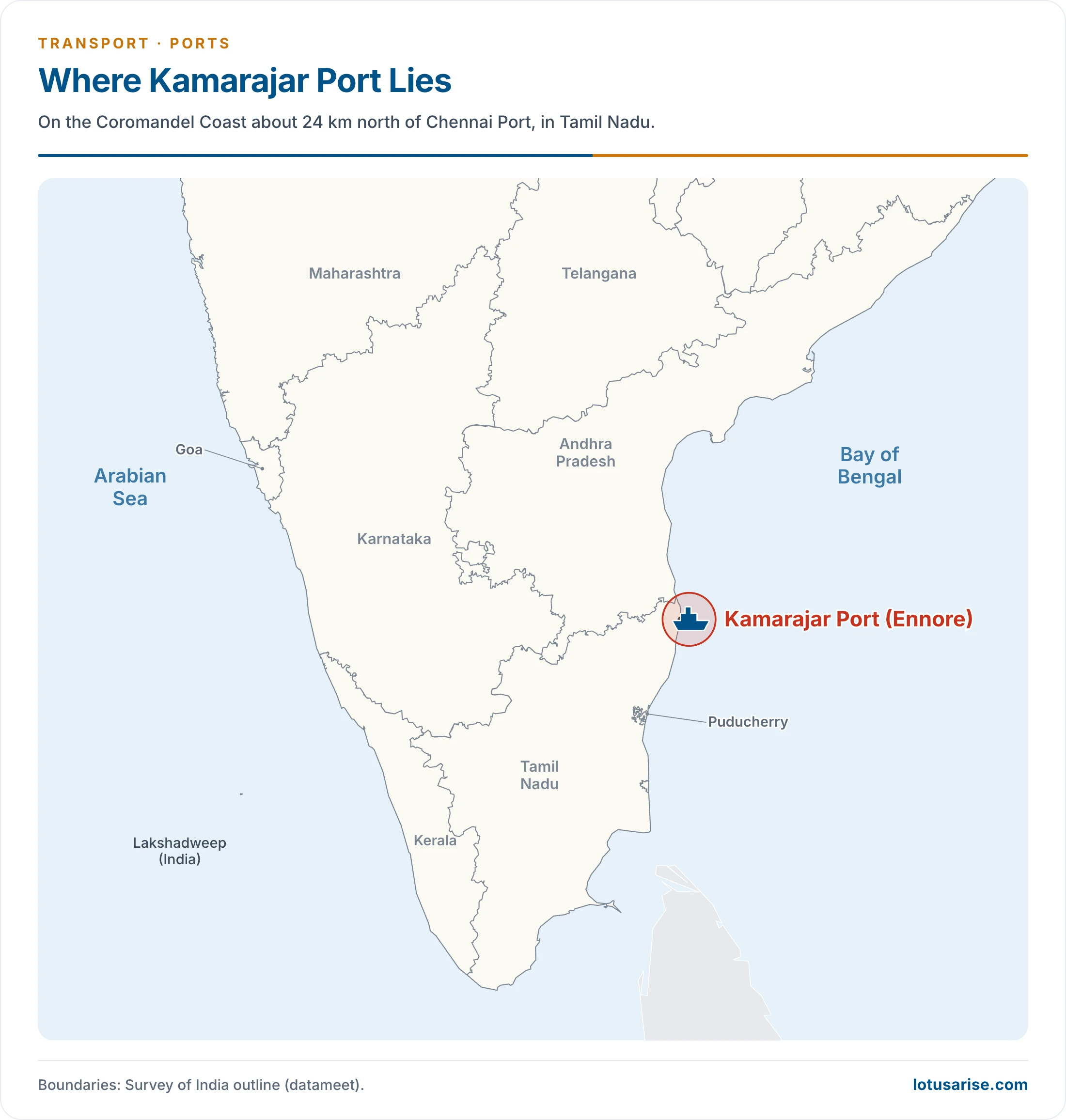
- It lies on the Coromandel Coast about 24 km north of Chennai Port, and was built to reduce pressure there.
- Trades: iron ore, coal, petroleum products and chemicals.
Kolkata Port
- Port of Kolkata, officially Syama Prasad Mookerjee Port, is the only riverine major port of India. The name came through a Trust resolution of 25 February 2020 and Cabinet approval in June 2020.
- It lies on the left bank of the Hooghly, about 203 km from the sea, against 128 km in older accounts.
- It is the oldest operating port in India, begun by the British East India Company, and came under a Trust in 1870.
- Kolkata is a freshwater port with no variation in salinity.
- Diamond Harbour is a town on the lower Hooghly, on the approach to the port.
- It is known for its twin dock systems: Kolkata Dock on the eastern bank and Haldia Dock on the western bank of the Hooghly. In 2025-26, Haldia gave 51.86 of the port’s 70.70 million tonnes.
- Haldia was developed about 105 km downstream of Kolkata, at the meeting of the Hooghly and the Haldi, for vessels too large to reach the city, and has a refinery, a fertiliser plant and petrochemicals.
- Problems of bends, bars and bores:
- The ageing river is silting, tidal bores enter it, and bends and sandbars block a straight passage, so that pilots and constant dredging are needed.
- The Farakka Barrage was built to send water down the Bhagirathi–Hooghly, but the water treaty with Bangladesh limits what reaches the river.
- Silt near Nayachar has also made entry to Haldia harder for large ships.
- Trade: jute, tea, coal and steel, with iron ore, copper, leather and manganese. Imports include machinery, crude oil, paper and chemicals. It is the gateway to eastern India.
Paradip Port
- The first major port commissioned after Independence on the east coast: it opened on 12 March 1966 and was declared a major port on 18 April 1966.
- Located at the confluence of the Mahanadi river and the Bay of Bengal, about 100 km east of Cuttack.
- It deals with the export of iron and aluminium, and iron ore has been exported to Japan in large quantities.
- It has become the leading port for coastal cargo, with 30.83% of the coastal traffic at major ports in 2025-26, and it handled 156.45 million tonnes in all.
Tuticorin Port
- This port has been renamed V.O. Chidambaranar Port.
- It is an artificial, deep-sea port in the Gulf of Mannar, close to Sri Lanka, about 8 km south-west of the old Tuticorin port.
- The town is famous for pearl fishing in the Gulf of Mannar, and so is also known as the pearl city.
- Trade: coal, salt, petroleum products and fertilisers, with foodgrains, edible oils and sugar.
Visakhapatnam Port
- This port is a natural harbour, opened to commercial shipping on 7 October 1933. It was long the 2nd largest port by volume of cargo, and is now fourth among major ports at 91.17 million tonnes (2025-26).
- It is located midway between Chennai and Kolkata.
- Long described as the deepest land-locked port in India, it exports iron ore to Japan, especially from the Bailadila mines. An outer harbour handles this ore. Shipbuilding and ship-repair facilities are available.
- Trade: iron ore, coal, alumina and oil.
Port Blair (Sri Vijaya Puram)
- The port is connected to the mainland by ship and flight. It lies between two international shipping lines, those serving Saudi Arabia and US–Singapore.
- Port Blair was renamed Sri Vijaya Puram on 13 September 2024.
- Galathea Bay on Great Nicobar was notified as a major port on 4 September 2024, as a transshipment port planned in four phases for 16 million TEU, near the Malacca route.
- Its clearance has drawn challenges over the island’s forests and biodiversity.
Changing Composition of Trade Through the Ports
- Older pattern: ports exported raw materials and farm goods, such as jute, tea, cotton, manganese and spices, and imported machinery and manufactures. This reflected the colonial layout, with railways running to port cities.
- After Independence: crude oil, coal and fertilisers came to dominate imports, and iron ore became a leading bulk export from Paradip, Visakhapatnam, Mormugao and New Mangalore.
- Today: petroleum, coal and containers make up about three-quarters of the cargo at major ports.
| Cargo at major ports | Older share | 2025-26 share |
|---|---|---|
| Petroleum, oil and lubricants | 33% | 29.77% |
| Containers | 23% | 23.29% |
| Coal | Part of bulk 44% | 21.03% |
| Iron ore | Part of bulk 44% | 5.47% |
| Fertilisers | Part of bulk 44% | 3.20% |
| Foodgrains | — | 0.35% |
| Others | — | 16.90% |
- Containers reflect the shift to manufactured goods and components. Traffic at major ports reached 14.92 million TEU in 2025-26.
- Coast by coast: Deendayal leads in overseas cargo, with 19.17%, on crude and bulk imports for the north-west. Paradip leads in coastal cargo, chiefly coal.
- Overseas cargo was 76.67% and coastal cargo 23.33% of major-port traffic in 2025-26.
- Non-major ports have taken a large part of this growth, with 45.88% of all port traffic in April–September 2025.
- The links between port cargo and India’s balance of trade are close: the crude and coal imports that fill these ports are a main source of the trade deficit.
Previous Year Questions
2023Map item: Ennore Port2022Discuss the significance of new ports on the Western Coast of India for the external trade of the country.2020Map item: Vadhawan2020Map item: Thoothukudi2018Discuss the changing composition of international trade through major seaports of India.2014Map item: Mundra Port2014Map item: Hazira




Plz make a correction to the post
Port Blair is not a major port now ,in 2010 it was declared as major port but after that it was removed from major port status and now 13th major port of india is vadhavan port of maharashtra
Yeah, I have updated the article, Thanks.
Thank you 🙏