

- Cross-border means a movement or activity across a border between two countries. Cross-border terrorism is the use of one country’s soil to create terror in a neighbouring country.
- It works as a grey-zone conflict: an undeclared war, regarded as the most economical way to bleed a nation over a long period with small effort.
- India’s experience of it has a clear geography: the line it crosses, the terrain on either side, and the people and networks on the ground.
Meaning and Geography
Cross-Border Terrorism
- Terrorism is commonly defined as the systematic use or threat of violence to intimidate a population or government for political, religious or ideological goals.
- Cross-border terrorism applies this to a neighbour: the soil of one country is used for terror against another, across the border, for such goals.
- How it operates: a person or group enters illegally, without the permission of the government, aiming at violence and instability in a region.
- A new field for political geographers: it became a subject of study once international borders and frontiers were fixed and identified.
- India’s exposure: a physiographically diverse country in the Indian subcontinent, India borders seven countries, and many of those lines are porous.
- Diversity as context:
- Administration, race, language and religion vary across these frontiers, and with them ideology, custom and trade.
- Carl Ortwin Sauer led cultural geographers in reading such differences through the cultural landscape.
- Borders and identity: geographers link borders to centripetal forces, part of the geographical basis of Indian federalism, which hold a state together and maintain its identity and sovereignty.
- Reasons geographers identify: strategic location, regional aspiration, radicalism, and the climate or economic geology of a place.
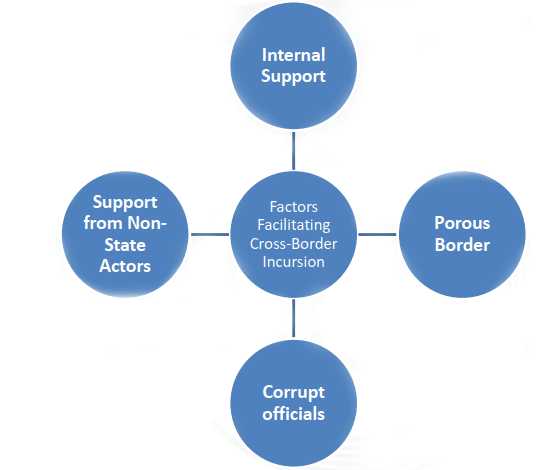
- Factors that ease incursion:
- Porous borders, where terrain or settlement defeats surveillance.
- Support from non-state actors, such as armed groups and smuggling networks.
- Internal support, in the form of local shelter and sleeper cells.
- Corrupt officials, who let people and goods pass.
India’s Borders in Brief
| Item | Position |
|---|---|
| Land border | 15,106.7 km (Ministry of Home Affairs) |
| Coastline | 11,098.81 km on the 2025 re-measurement; older figure 7,516.6 km, both with islands |
| Land neighbours | Pakistan, Afghanistan (through Pakistan-occupied Kashmir, PoK), China, Nepal, Bhutan, Myanmar, Bangladesh |
| Maritime neighbours | Bangladesh, Indonesia, Myanmar, Pakistan, Thailand, Sri Lanka, Maldives |
| States with neither land border nor coast | Madhya Pradesh, Chhattisgarh, Jharkhand, Telangana, Haryana; Delhi and Chandigarh among Union Territories |
| Structure of the Union | 28 States and 8 Union Territories; older lists show 29 States |
- Each of these lines carries boundary disputes of its own, from Aksai Chin to Sir Creek.
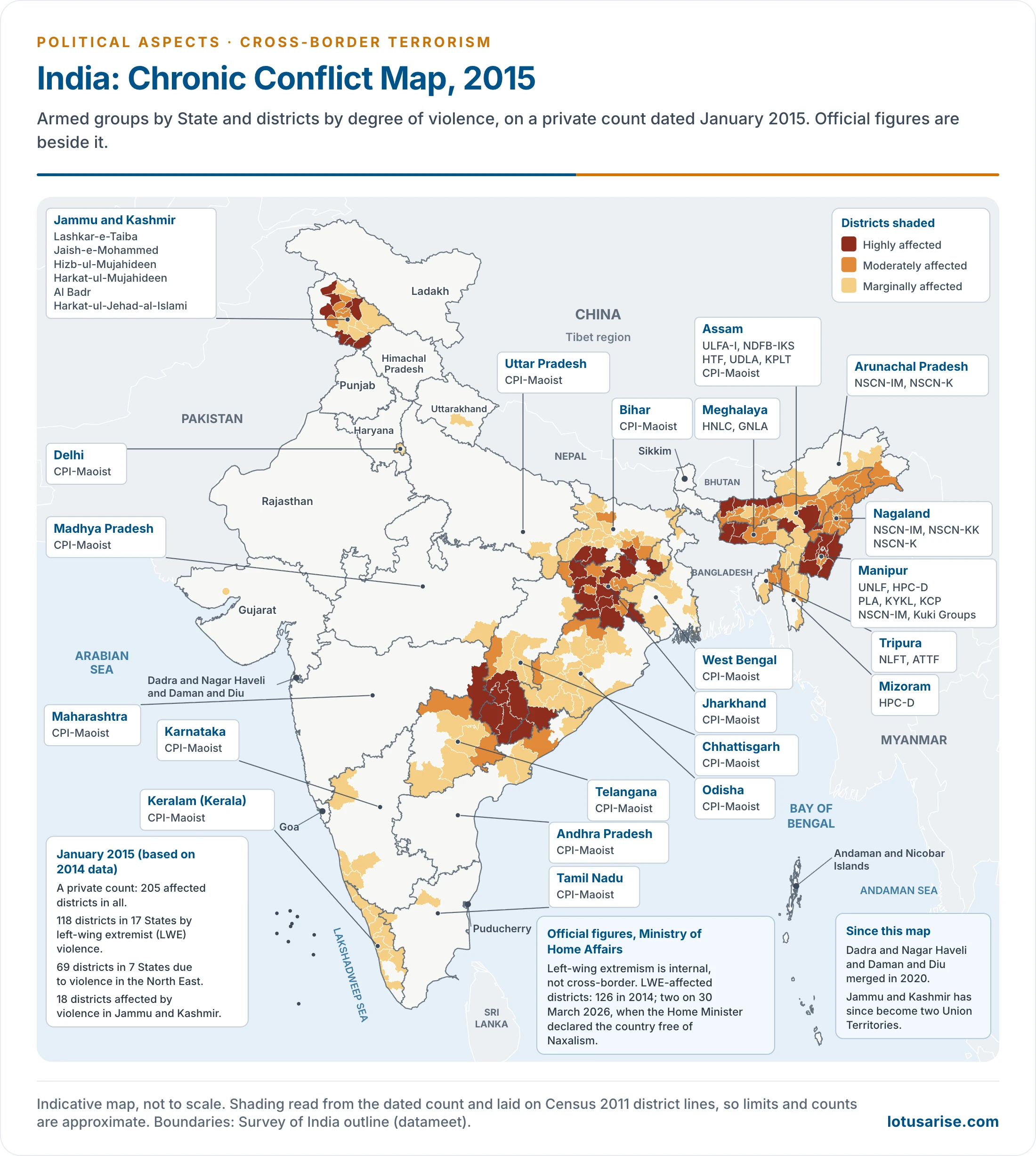
- Left-wing extremism on this map is internal, not cross-border. The Ministry’s count of affected districts fell from 126 in 2014 to none under its revised classification after the 31 March 2026 deadline. Dadra and Nagar Haveli and Daman and Diu merged in 2020.
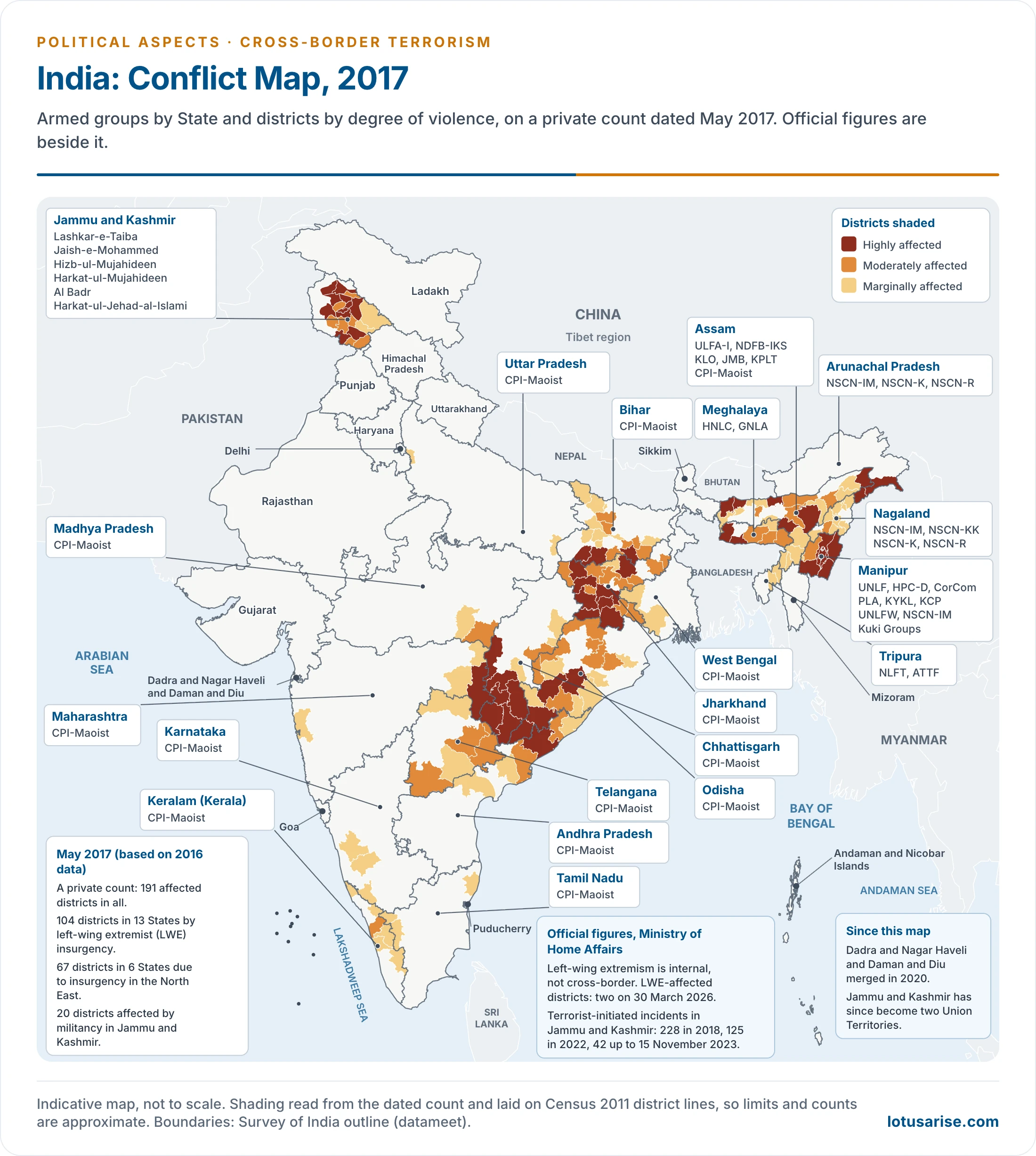
- Jammu and Kashmir has since become two Union Territories. The Ministry’s count of terrorist-initiated incidents there fell from 228 in 2018 to 125 in 2022, and stood at 42 up to 15 November 2023.
Role of Physiography
- Terrain shapes the route, the method and the guarding of every frontier:
| Frontier | Terrain | How it is exploited | Examples |
|---|---|---|---|
| Line of Control | High ridges, forest, snow-closed passes | Infiltration through gaps before winter; launch areas beyond the line | Kashmir, Pir Panjal |
| Jammu International Border | Riverine plain, nullahs | Tunnels and crossings through low ground | BSF found a tunnel at Hiranagar, Kathua, in January 2021, the ninth in a decade |
| Punjab | Flat, irrigated plain, fenced | Drones dropping arms and drugs | Border districts of Punjab |
| Rajasthan and Gujarat | Desert, Rann, creeks | Shifting sand, tidal channels | Sir Creek |
| Coast | Long, broken coast, fishing traffic | Landing by sea | Attackers of 26 November 2008 came from Karachi on a seized trawler, the Kuber |
| Bangladesh | Delta, rivers and chars, dense settlement | Porous line, hard to fence | Dhubri sector, Assam |
| Myanmar | Forested hills, shared tribes | Camps across the line | Manipur, Nagaland |
| Nepal | Open border | Free movement used for transit | India–Nepal foothills |
Causes and Types
Regional Patterns
- North-East: insurgency here has been driven by separatist demands of particular armed groups, such as factions of the National Socialist Council of Nagaland, and has used shelter across the Myanmar and Bangladesh lines.
- India raised action against Indian insurgent groups operating from Bangladesh in the border-force talks of June 2026.
- Pakistan: the groups active across this line, Lashkar-e-Taiba and Jaish-e-Mohammed among them, follow an extremist ideology and are based in Pakistan.
- Bangladesh: this frontier has seen radical groups using its porosity.
- Nepal: older accounts link intrusion here to Maoist ideology. The Maoist conflict in Nepal ended with the peace accord of 2006, and the open border is now the main concern.
Other Causes
- Technology: better communication links give radical groups more sophisticated weapons, cell phones and fast internet.
- Structure: today’s groups are more diffuse, with more sleeper cells and local affiliates.
- State sponsorship: support from states, and the division of groups into “good” and “bad” terrorists, as with the good and bad Taliban.
- Ideology: an extreme fundamentalism and leanings towards such groups.
- Governance: poor governance and deprivation. Economic disparity leaves young people without opportunity, and some turn to crime and insurgency, particularly in the peripheral States of the north-east.
- Economic rivalry: some political geographers apply the model of Walt Whitman Rostow (1960): India is moving from a developing to a developed stage through high investment and manufacturing.
- On this reading, India’s rise as a regional power in Asia clashes with other emerging nations, and terrorism is one way of creating economic and cultural instability in it.
Macro and Micro Levels
- Indian political thinkers separate two levels:
| Level | Source | Example |
|---|---|---|
| Macro (international) | International borders | German Bakery blast, Pune (13 February 2010), 17 dead; the convicted man was described as an Indian Mujahideen operative |
| Micro (national) | Cultural and ethnic diversity; quasi-federal administration | Violence in Chhattisgarh and Assam |
- In India these levels appear as militancy in Jammu and Kashmir, insurgency in the North-East and left-wing extremism, the last of them internal.
Major Events
| Date | Event | Official response |
|---|---|---|
| 18 Sep 2016 | Uri army camp attacked | Strikes across the LoC, announced 29 Sep 2016; India stayed away from the SAARC summit |
| 14 Feb 2019 | Pulwama convoy bombing | Balakot strike on a Jaish-e-Mohammed camp, 26 Feb 2019 |
| 22 Apr 2025 | Pahalgam, 26 killed | Indus Waters Treaty held in abeyance; Attari–Wagah closed; Operation Sindoor (7 May), nine sites struck |
| 10 May 2025 | Understanding to stop military action | PM’s address of 12 May: terrorists and their state sponsors not to be treated separately |
| Jul 2025 | Pahalgam attackers | Three killed by security forces, reported to the Lok Sabha; US lists The Resistance Front as a terrorist group, 17–18 July |
| 10 Nov 2025 | Red Fort car blast, Delhi, 11 killed | National Investigation Agency chargesheet, 14 May 2026: accused linked to Al-Qaida in the Indian Subcontinent and an offshoot |
- India had already banned The Resistance Front under the Unlawful Activities (Prevention) Act in January 2023, as a front of Lashkar-e-Taiba.
- Financial Action Task Force (FATF): on 16 June 2025 it condemned the Pahalgam attack and said such attacks could not occur without money and the means to move it.
Consequences
- Numerous consequences follow:
- Threat to national integrity.
- Hurdles to regional planning, and to border area development above all, as works, investment and tourism stall.
- Stronger cultural regions and regionalism.
- Loss of property, human resources, flora and fauna, and of diversity overall.
- Disturbed demographic dividend: violence is a push factor for migration, so some regions are left underused and others overused.
Border Management and Control
Who Guards What
| Frontier | Force |
|---|---|
| Pakistan (International Border), Bangladesh | Border Security Force |
| Line of Control | Army |
| China | Indo-Tibetan Border Police, with the Army |
| Nepal, Bhutan | Sashastra Seema Bal |
| Myanmar | Assam Rifles |
| Coast | Navy, Coast Guard, marine police |
- Department of Border Management: created in the Ministry of Home Affairs in January 2004.
- Fencing: the Ministry told the Lok Sabha in December 2025 that about 93 per cent of the Pakistan border and 79 per cent of the Bangladesh border were fenced. For the Myanmar line, the Cabinet Committee on Security approved about Rs 31,000 crore in 2024.
- These forces face the wider security challenges in border areas, from smuggling to infiltration, and the terror funding behind them.
Strategies to Control It
- Political geographers suggest the following political and geographical strategies:
- Effective use of international law on borders and frontiers.
- Meeting the economic needs of the people of each region, through schemes such as the Vibrant Villages Programme-II (approved in April 2025, 1,954 villages in 17 States and Union Territories).
- Effective implementation of the UN Convention on the Law of the Sea (UNCLOS), which matters on the coast.
- Space technology: India’s space programme supports surveillance. Older accounts cite the RISAT-1 radar satellite and GSAT-1. The Cabinet Committee on Security cleared 52 surveillance satellites on 8 October 2024.
- Regional cooperation:
- SAARC: its 1987 convention on terrorism stands, but no summit has met since 2014.
- BIMSTEC: a convention signed in December 2009 entered into force in 2021.
- Indian Ocean Rim Association: the rim countries’ body, so named since 2013.
- National agencies:
- The Intelligence Bureau, the Research and Analysis Wing and the National Investigation Agency do the operational work.
- The National Counter Terrorism Centre (NCTC), notified in 2012, was kept in abeyance.
- Terror financing: India is a member of the FATF, which sets international standards against money laundering and terrorist financing.
- It adopted India’s evaluation in June 2024, placing India in the regular follow-up category.
- Pakistan left its grey list in October 2022.
- Comprehensive Integrated Border Management System (CIBMS): it adds electronic surveillance to manual patrols, to improve detection and interception.
- Two pilot projects of about 71 km were completed by 2019: 10 km on the Pakistan border and 61 km on the Bangladesh border. A next stage was planned for about 1,955 km that cannot be physically fenced.
Way Forward
- Reassess policy on managing the international borders: the intelligence apparatus, internal security and border management.
- Tighten control over immigration.
- Coordinate better at home and cooperate abroad to combat the financing of terrorism.
- Strike capability: precision engagement is one means of hitting terror camps across the line without wider war, as the strikes of 2016, 2019 and 2025 showed.
- Technology: technical systems should augment traditional border guarding.
- Coordination: close and effective links between intelligence and security agencies at the Centre and in the States.
Conclusion
- Borders today can stand for peace and prosperity, with due care for regional identity and cultural diversity. Cross-border terrorism threatens both.
- Geographers and political thinkers can contribute by examining a region’s geography, demography and cultural diversity, so that policy serves the people of India.
Previous Year Questions
2020Border area development is an important national priority. What are the resilient steps needed for peaceful borders?2018Cross-border terrorism has implications on border area development in India. Examine it with suitable examples.2010Write about the Role of physiography in cross border terrorism.1994Write short note: Problems of militancy in India’s border states.





Really Helpful….thanks for it!!😇