

- Cotton textiles are India’s oldest manufacturing tradition and its largest organised modern industry by older reckoning, spread today through mills, powerlooms and handlooms.
- The modern industry is an indigenous one, because Indian capital and entrepreneurship started and developed it.
- It is agro-based, resting on a kharif fibre crop of the black-soil and irrigated north-western tracts in India’s cropping pattern.
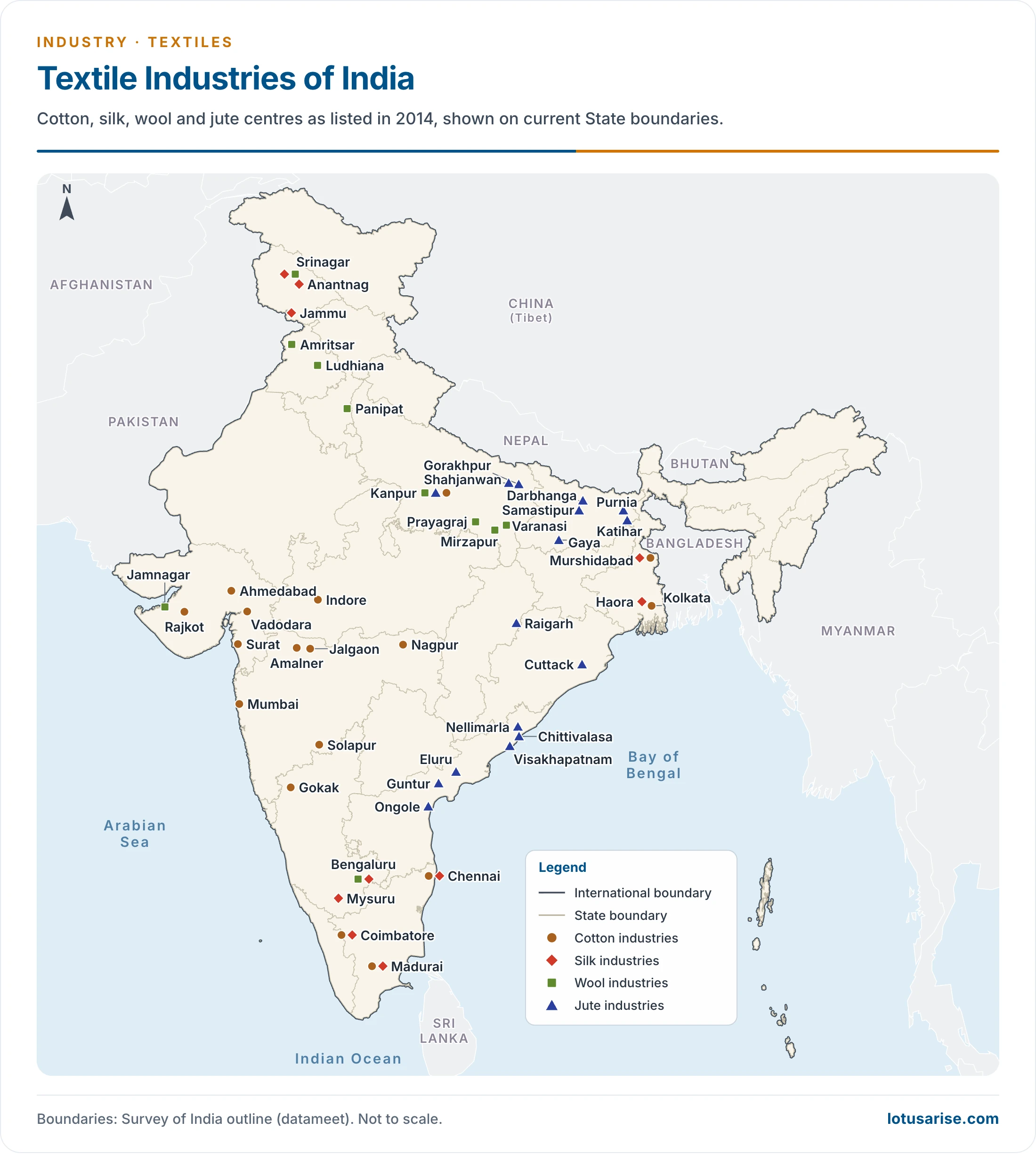
The Textile Sector and Cotton’s Place
India in the World Textile Economy
- Textile is the broad term that takes in cotton, jute, wool, silk and synthetic fibres.
- World standing, as stated by the government in February 2026:
- Jute: largest producer, the base of its jute textile industry.
- Cotton: largest area under the crop and second-largest producer, with about 24% of world output.
- Silk: second-largest producer.
- Man-made fibres: second major global hub, and second-largest producer of polyester and viscose.
- Trade: India is the sixth-largest exporter of textiles and apparel, with about 4% of world exports.
- Its share of global textile and apparel trade was 3.91% in 2023-24, and textiles made up 8.21% of India’s own exports that year.
- Foreign investment: 100% FDI is allowed through the automatic route in the textile sector.
| Measure | Older figure | 2025 estimate | 2026 estimate |
|---|---|---|---|
| Share of GDP | 4% | 2.3% | about 2% |
| Share of industrial production | 12% | 13% | |
| Share of manufacturing value added | about 11% | ||
| Share of exports | 11% | 12% | 8.63–9% |
| Direct employment | 45 million | over 45 million | over 45 million |
- It is the second-largest employer after agriculture, and takes in many women, Scheduled Caste and Scheduled Tribe workers.
- Size: an estimated USD 179 billion in 2026, with about 22,000 million garments made each year.
- About 80% of capacity lies in micro, small and medium clusters.
- Official targets for 2030 are a market of USD 350 billion and exports of USD 100 billion.
- Older accounts rank India first in the world for loomage and ring spindles.
- The cotton chain supports about 6 million farmers and 40–50 million people in all.
- Crop output stood at 29.72 million bales of 170 kg in 2024-25, against mill use of about 323 lakh bales in 2023-24.
- The sector’s self-reliance runs from raw material to finished garment, and in older figures it added only 2–3% to the import bill.
Growth of the Industry
Ancient and Medieval Monopoly
- For some three millennia, from about 1500 BC to AD 1500, India had no rival in cotton textiles.
- In the Middle Ages, Indian cloth was in great demand in Eastern and European markets. Each centre had its own fame:
- Muslins of Dhaka
- Chintzes of Masulipatnam
- Calicos of Calicut
- Baftas of Cambay
- Gold-wrought cotton goods of Burhanpur, Surat and Vadodara
- Collapse: two forces ended this lead.
- Modern mills of the Industrial Revolution turned out cheaper and better goods in Britain.
- British India’s discriminatory policy gave the British industry a political advantage.
Incipient Phase (Up to 1900)
| Year | Event |
|---|---|
| 1818 | First modern mill at Fort Gloster near Kolkata; it soon closed |
| 1854 | Cowasji Nanabhoy Davar, a Parsi entrepreneur, founds the first successful mill at Mumbai |
| 1860s | Shahpur Mill (1861) and Calico Mill (1863) at Ahmedabad |
| 1870s | Real expansion begins |
| 1875-76 | 47 mills, with over 60% in Mumbai alone |
- Ranchhodlal Chhotalal laid the foundation of Ahmedabad’s first textile plant in 1859, and it opened in 1861.
- Mumbai was the focus of early growth, for these reasons:
- Capital: Parsi merchants held large funds from the cotton and opium trade with China and from raw cotton exports during the American Civil War.
- Technical skill came through European firms.
- Raw material: large cotton tracts lay nearby, and their crop was already being exported through Mumbai.
- Port: it allowed import of machinery, chemicals and long-staple cotton, and the export of cloth. The long-staple sources of Egypt, Sudan and East Africa lay within easy sailing distance.
- Railways in and around the region.
- Labour: cheap and unskilled, drawn from the surrounding areas.
- Climate: humidity let thread be spun without breaking.
- Power, market and start: cheap hydroelectricity from nearby, a market at home and abroad, washing and dyeing facilities, and the advantage of an early start.
- Soil: the black cotton soil of its hinterland.
Primary Core (1900–1920)
- World War I raised demand and cut supplies from other countries.
- The Swadeshi movement and later fiscal protection added to the growth.
- The country had 271 mills employing about 2.6 lakh people when war broke out in 1914.
- Ahmedabad became another major centre. Others were Surat, Kalyan, Thane, Vadodara, Bharuch and Pune.
- Why dispersal began:
- Raw material was available elsewhere too.
- Land costs rose in Mumbai.
- Trade unions were emerging in Mumbai.
- Railway lines reached into the Peninsula, especially after 1921.
- Dispersal ran in two directions:
- North, up to Delhi: the Malwa plateau gave cheap raw material, princely states offered free land and capital, labour was cheap, and the markets of North India lay close.
- East: across the Telangana and Deccan lava plateau, up to Nagpur in the east and Hyderabad in the south-east.
- Centres with a special advantage:
- Nagpur: nearness to coal mines
- Kanpur: excellent financial facilities
- Kolkata: port and market
World War II and Partition
- Wartime demand raised the count from 334 mills in 1926 to 389 in 1939 and 417 in 1945.
- Cloth output climbed over the war from 4,012 to 4,726 million yards (1939-40 to 1945-46).
- Partition (1947) left most mills in India but sent most of the long-staple cotton tracts to Pakistan.
- Imports had to fill the gap at a time of scarce foreign exchange, so home output of long staple became the priority.
Post-Independence
- Efforts on the raw material side:
- Grow More Cotton campaign, to answer the loss of cotton land.
- Intensive cotton-growing programmes of 1971-72, for production and productivity.
- Central Institute for Cotton Research, set up by the Indian Council of Agricultural Research at Nagpur in April 1976.
- Technology Mission on Cotton, covering all aspects of cultivation and use.
- The private sector was encouraged to set up units.
- Dispersal trends after 1947:
- Green Revolution tract: irrigation of the old alluvium favoured cotton, and the industry grew fast in Punjab, Haryana, western Uttar Pradesh and Delhi.
- Punjab: Jalandhar, Ludhiana, Pathankot, Amritsar
- Haryana: Ambala, Faridabad
- Uttar Pradesh: Agra, Saharanpur, Ghaziabad, Modinagar
- Cotton needs soil moisture rather than surface water, so soils that hold water for long suit it. New alluvium does not.
- Market pull: India’s tropical climate makes the whole country a market. The Hugli region of West Bengal rose as a major region on this basis.
- Eastern and central Uttar Pradesh: Lucknow, Varanasi and others. By now the industry reached almost all States.
- South: Coimbatore, Madurai and Tirunelveli became the major centres, in Tamil Nadu and on into Keralam (Kerala), because of:
- Hydroelectricity, for example the Pykara project
- Readiness of local industrialists to use favourable conditions
- Raw cotton farming in the Madurai–Coimbatore region
- Available markets
- Labour cost: the industry moved from high-wage to low-wage places, such as Madurai, Ujjain, Agra, Tirunelveli and Coimbatore.
- Green Revolution tract: irrigation of the old alluvium favoured cotton, and the industry grew fast in Punjab, Haryana, western Uttar Pradesh and Delhi.
Present Status
- Rank and weight: one of India’s largest industries by employment, production and exports.
- Older counts gave it about 16% of industrial capital, 14% of industrial production and over 20% of industrial labour.
- The total workforce stood well over 25 million in those counts.
- Mills (older count): 1,719 textile mills, of which 188 were public, 147 cooperative and 1,384 private. About three-fourths were spinning mills and one-fourth composite.
- It is no longer an off-season occupation, as it was in its cottage form. That ancient industry declined for political and economic reasons.
- Cotton cloth is made in three sectors, and the balance has swung sharply away from the mill.
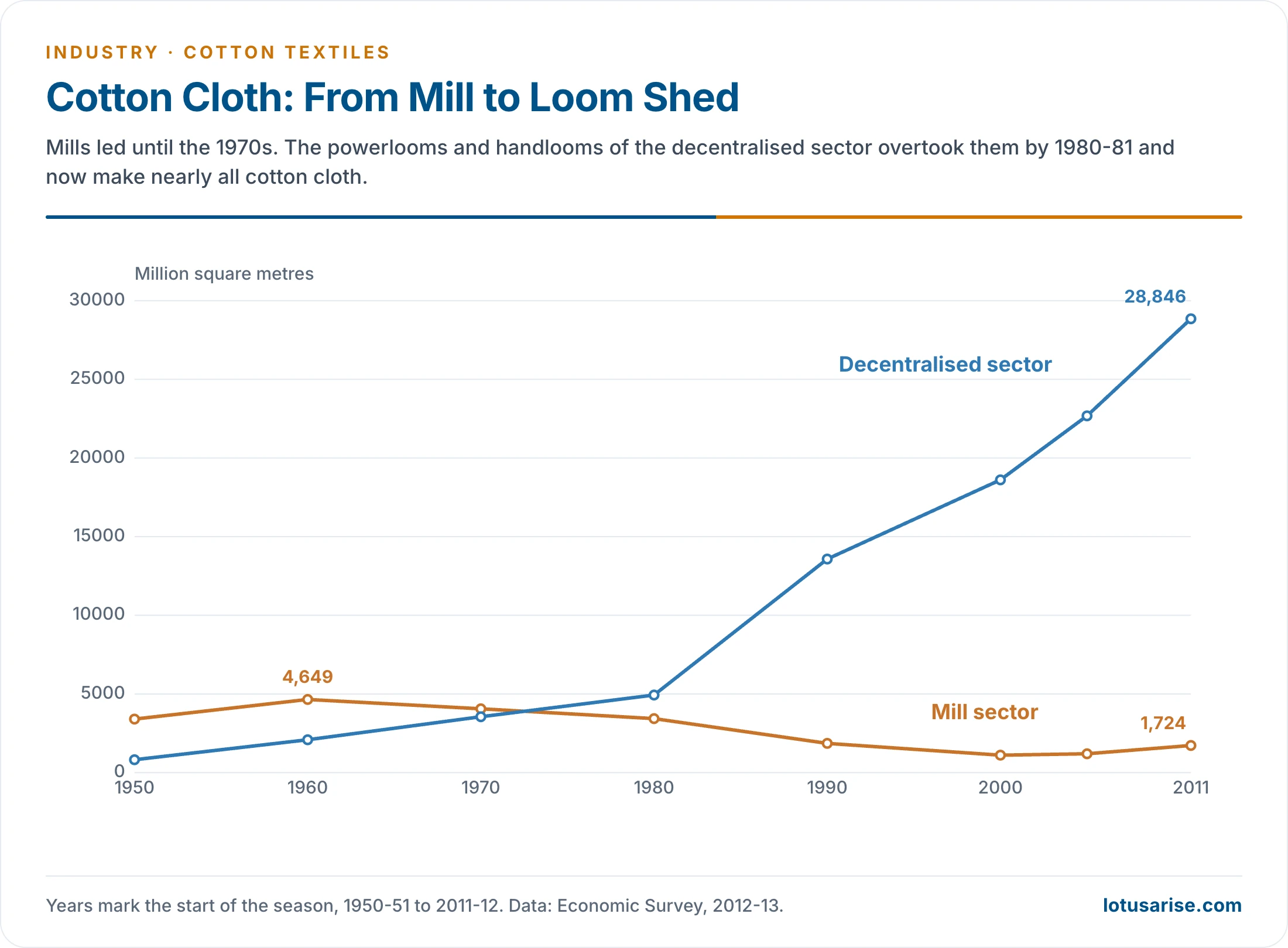
| Sector | 1950-51 | 2005-06 | 2011-12 | 2016-17 (all fabric) |
|---|---|---|---|---|
| Mills | about 80% | 3.3% | 5.64% (cotton cloth) | 3.56% |
| Powerlooms | 82.8–85% with hosiery | about 62% | 56.63%, plus hosiery 27.30% | |
| Handlooms | 12.3–12.5% | about 15% | 12.51% |
- Mills dominated at first and then gave way, as the decentralised sector rose from 19.31% of cotton cloth in 1950-51 to a peak of 95.41% in 2007-08.
- Total cotton cloth grew from 4,215 to 30,570 million square metres between 1950-51 and 2011-12, and spun yarn from 533 to 3,126 million kg.
- A decentralised unit may hold 5–10 looms or just one, so thousands of tiny sheds now outweigh the large mills.
- Powerlooms:
- Older counts: 5.28 lakh units with 23.33 lakh looms in March 2011, of which 1.15 lakh were shuttleless.
- 2013 survey (cited by the ministry in December 2025): 3,85,596 units, 24,86,418 looms and 44.18 lakh workers, with 1,03,141 shuttleless looms.
- Maharashtra leads with 9.49 lakh looms, followed by Tamil Nadu (5.63 lakh) and Gujarat (5.24 lakh).
- Concentration: Maharashtra, Gujarat, Tamil Nadu, Uttar Pradesh, Madhya Pradesh, West Bengal and Karnataka.
- Clusters: Bhiwandi, Erode, Salem, Madurai, Ichalkaranji, Solapur, Burhanpur, Bhilwara, Kishangarh, Ludhiana, Amritsar and Panipat.
- Weight: over 60% of export fabric comes from powerlooms, and ready-made garments and home textiles lean on them for cloth.
- They make almost every variety of cloth, technical textiles included.
- Older output: 30.63 billion square metres in 2005-06, rising to 37.52 billion in 2010-11.
- The share of cotton cloth stood at 58.4% in a 2022 ministry reply.
- Support: 44 Powerloom Service Centres serve the clusters on technology, skills and design.
- Handlooms:
- Older counts: about 38 lakh handlooms employing nearly 6 million people, later 23.77 lakh looms and 43.31 lakh persons.
- Handloom Census 2019-20: 35.22 lakh workers (26.74 lakh weavers and 8.48 lakh allied workers, with about 25.46 lakh women) on 28.20 lakh looms.
- Spread (older): about one-third in Tamil Nadu, Andhra Pradesh, Assam and Uttar Pradesh, with the rest in Maharashtra, West Bengal, Bihar, Odisha, Rajasthan and Karnataka.
- Strengths: unique designs, small batches and eco-friendly cloth.
- Training: Indian Institutes of Handloom Technology at Varanasi, Salem, Guwahati, Jodhpur and Bargarh, and 25 Weavers’ Service Centres.
- Output (older): 6,667 million square metres in 2008-09, rising to 6,936 million in 2012-13.
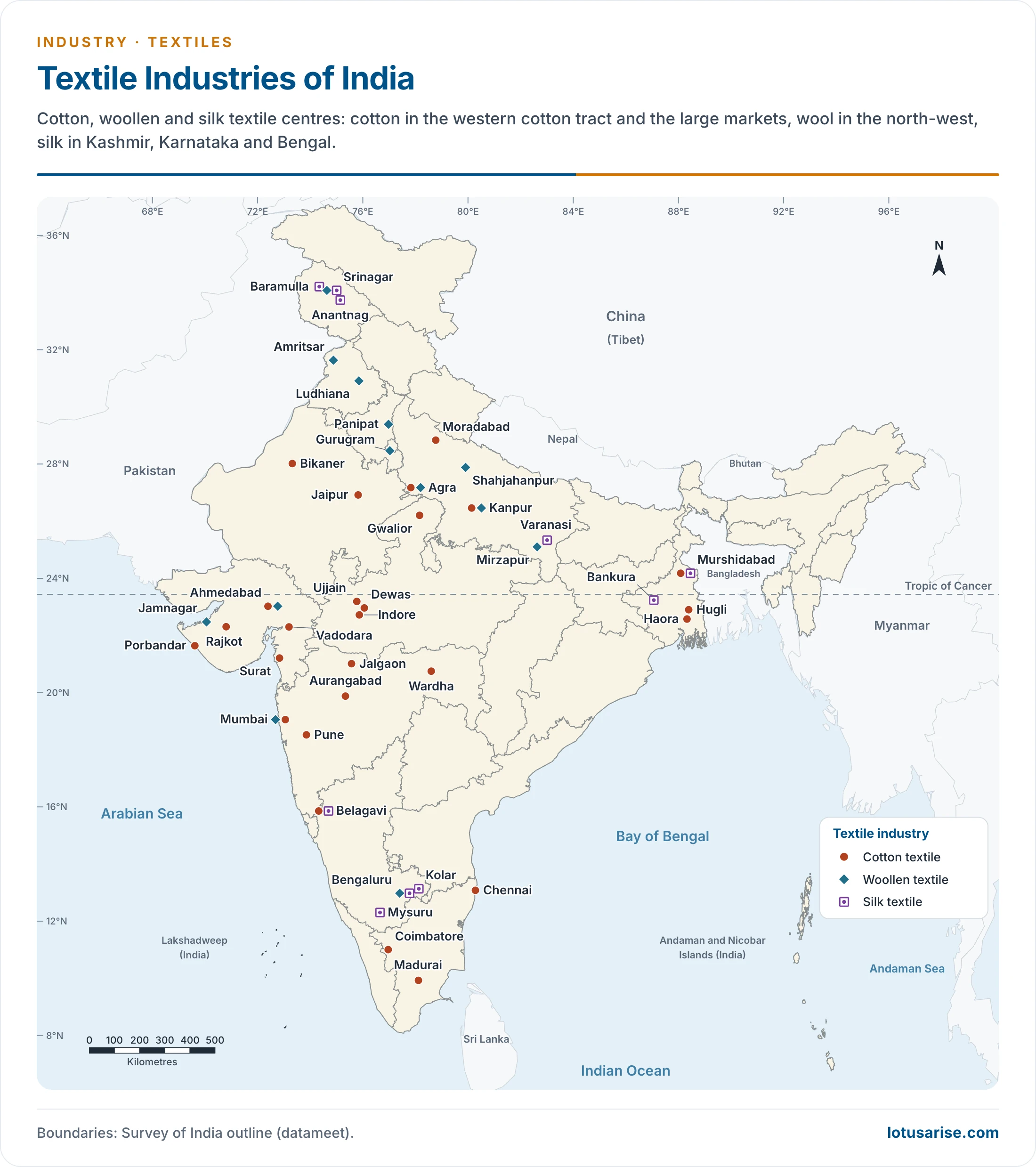
Location and Distribution
Factors of Location
- Raw material:
- Raw cotton is easily transported, and many mill towns do not grow it. Its availability still helps fix mills, alongside other advantages.
- Older estimates put 80–90% of the industry in step with the cotton tracts of the drier western Peninsula and the Great Plains.
- Ahmedabad, Coimbatore, Solapur, Nagpur and Indore lie in areas of large-scale cultivation. Mumbai has this advantage to a lesser degree, through the cotton lands of Maharashtra and Gujarat.
- Cotton is a pure raw material. It loses little weight in manufacture, and sizing materials make up for even that.
- Market:
- It ranks close behind raw material among the factors of location.
- Since raw cotton and cloth cost about the same to carry, the industry tends to seek good transport towards the market. This makes it primarily market-oriented.
- The country lies in the tropics and sub-tropics, so cotton is worn all year in the Peninsula and most of the year on the Great Plains.
- Large centres also stand in States with little or no cotton, such as West Bengal, Bihar, Uttar Pradesh, Keralam and Odisha.
- Labour:
- Cotton weaving was a traditional cottage craft of the cotton tracts, so cheap skilled labour was at hand there.
- Other factors:
- Cheap and efficient transport, abundant power, fresh water and, above all, enterprise.
- Geographical inertia and the government’s policy of decentralisation.
- Mills are localised even within a State, in particular districts, almost to the exclusion of others.
Distribution
- It is among the most widely distributed industries, with mills in over 80 towns and cities in older counts.
- Maharashtra and Gujarat together make a major share of India’s cloth.
- State ranks below come from older tables. Output has since shifted towards powerloom clusters.
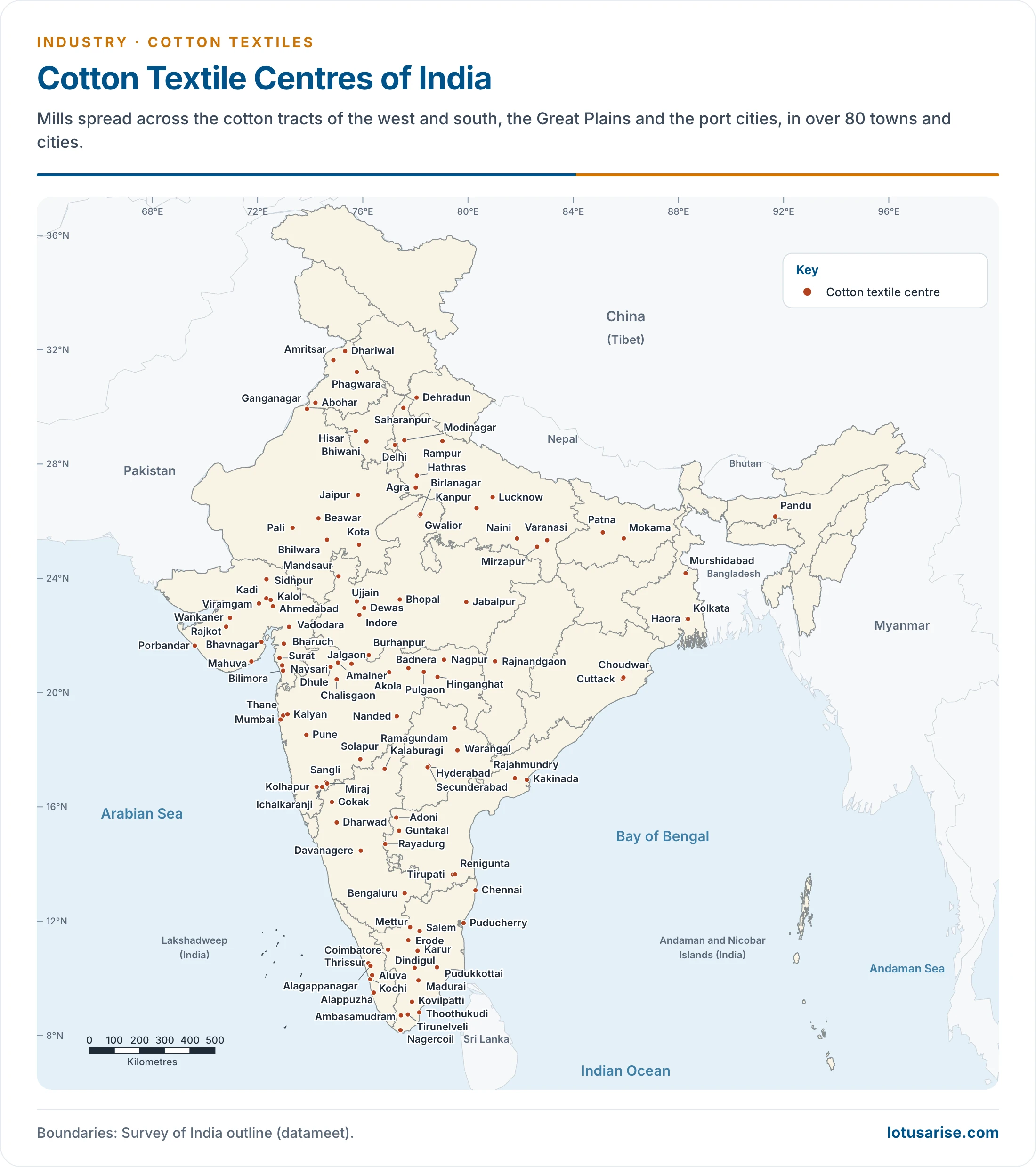
Maharashtra
- Leading producer of yarn and cloth in the older tables, and third by number of mills.
- About 39% of mill cloth, 10.79% of yarn, about three lakh workers and 122 mills, of which 63 stood in Mumbai.
- Mumbai is the Cottonopolis of India.
- Other centres: Solapur, Nagpur, Pune, Jalgaon, Kolhapur, Satara, Wardha, Aurangabad, Amravati, Akola, Sangli, Chalisgaon, Miraj and Nanded.
- The decline of Mumbai’s mills turned on the Great Bombay textile strike, which began on 18 January 1982 under Datta Samant.
- Nearly 2.5 lakh workers of about 65 mills came out, and the stoppage ran into 1983.
- It ended without concessions, and many mills closed or moved out of the city.
Gujarat
- Second in yarn and cloth and in number of mills in the older tables: over 33% of mill cloth, over 8% of yarn and 118 mills.
- Ahmedabad is the second-largest centre, with 73 mills in those counts. Its advantages:
- Nearness to the main cotton belt
- A humid climate
- Cheap power and skilled labour from nearby
- Rail and road links
- Cheaper land than Mumbai
- Cheap cloth for a mass market
- Other centres: Surat, Bharuch, Vadodara, Bhavnagar, Khambhat, Rajkot, Kalol, Porbandar, Morbi, Viramgam, Sidhpur and Kadi.
Tamil Nadu
- Largest number of mills (439 in older counts), mostly small. It gave only about 6% of mill cloth but over 44% of India’s yarn.
- Coimbatore, with about 200 of these mills, is the Manchester of South India.
- Other centres: Chennai, Madurai, Tirunelveli, Thoothukudi, Tiruchirappalli, Salem and Perambur.
Other States
| State | Character | Centres |
|---|---|---|
| Uttar Pradesh | West of the State, where most of its cotton grew; 52 mills in older counts | Kanpur (Manchester of Uttar Pradesh), Modinagar, Moradabad, Aligarh, Agra, Etawah, Meerut, Ghaziabad, Varanasi, Bareilly, Saharanpur, Rampur, Lucknow, Mirzapur |
| West Bengal | Large market, coal, port; far from cotton | Kolkata, Haora, Sodepur, Serampore, Shyamnagar, Murshidabad, Hugli, Panihati; North 24 Parganas |
| Madhya Pradesh | Western Malwa cotton tract, local coal, cheap labour | Gwalior, Indore, Ujjain, Dewas, Bhopal, Jabalpur, Ratlam |
| Chhattisgarh | Now a separate State | Raipur |
| Karnataka | Bengaluru, Ballari, Mysuru, Davanagere, Belagavi, Mangaluru, Chitradurga, Kalaburagi, Channapatna | |
| Andhra Pradesh | Guntur, East Godavari, Udayagiri, Tirupati | |
| Telangana | Cotton-growing areas | Hyderabad, Secunderabad, Warangal, Ramagundam |
| Keralam | Aluva, Kochi, Alappuzha, Alagappanagar, Thiruvananthapuram, Kollam, Thrissur | |
| Rajasthan | Kota, Jaipur, Jodhpur, Ganganagar, Bhilwara, Pali, Beawar, Vijaynagar, Kishangarh, Udaipur, Ajmer | |
| Haryana | Hisar, Bhiwani, Rohtak | |
| Punjab | Rising cotton State; Bt cotton and research on better varieties | Amritsar, Ludhiana, Phagwara |
| Bihar | Gaya, Patna, Bhagalpur | |
| Delhi | Huge market | Delhi |
- Mega clusters bring raw material, design, technology, infrastructure and marketing support to weavers and artisans, including self-help groups:
- Handloom: Varanasi, Sivasagar, Murshidabad, Virudhunagar
- Handicraft: Moradabad, Narsapur, Bhadohi–Mirzapur, Srinagar, Jodhpur
- Powerloom: Bhiwandi, Erode, Bhilwara
Technical Textiles and Exports
- Technical textiles are products used for their performance rather than appearance, in aerospace, shipping, sports, agriculture, defence, medicine and manufacturing.
- The older Scheme for Growth and Development of Technical Textiles (2007-08) was followed by the National Technical Textiles Mission.
- Older market figures: about USD 136 billion globally, and Rs 70,151 crore in India in 2012-13.
- Export growth: garments drove the rise in cotton textile exports, and made up over 62% of them by 2013-14. Indian textiles reached more than a hundred countries.
| Year | Yarn, fabrics, made-ups (Rs crore) | Ready-made garments (Rs crore) | Total (Rs crore) |
|---|---|---|---|
| 1960-61 | 65 | 1 | 66 |
| 1980-81 | 408 | 550 | 958 |
| 2000-01 | 16,030 | 25,478 | 41,508 |
| 2013-14 | 53,914 | 90,402 | 1,44,316 |
- All textiles and apparel, including handicrafts: USD 37.75 billion in 2024-25, up from USD 35.87 billion a year before.
- In rupees: Rs 3,19,573 crore in 2024-25 and Rs 3,25,339 crore in 2025-26.
- Markets: the USA and European Union take about 47%, down from about two-thirds in older figures.
- Others include China, the UAE, Sri Lanka, Saudi Arabia, South Korea, Bangladesh, Turkey, Brazil, Hong Kong, Canada and Egypt.
Problems of the Industry
- Raw material:
- The industry depends heavily on raw cotton, and mills in areas of small output suffer most.
- Rising cotton prices push up the cost of production substantially.
- Long-staple shortage forces imports. The older sources were Pakistan, Kenya, Uganda, Egypt and the USA.
- Older hopes of easier cotton from Pakistan have closed: India prohibited all imports from Pakistan on 2 May 2025.
- Trade figures: imports of 6.73 lakh bales and exports of 26.24 lakh bales in 2023-24, up to June 2024.
- Duty on raw cotton was waived from August to December 2025.
- Responses: the industry has been set up in traditionally non-cotton belts. Bt cotton and research on better varieties have spread, with Punjab among the gainers.
- Productivity: India ranks 36th in cotton yield despite the largest area, the gap behind the Mission for Cotton Productivity.
- Power:
- Power cuts and load shedding hurt the industry badly, as they do industry in general.
- Answers: mega power plants, new hydroelectric plants, private power and more energy-efficient technology.
- Obsolete machinery:
- Many mills are old, which brings high costs and poor quality.
- In older figures, 60–75% of machinery was 25–30 years old, and only 18–20% of looms were automatic, against 100% in Hong Kong and the USA, 92% in Sweden and 45% in China.
- Hurdles to change: shortage of capital, and labour’s resistance to automation, which displaces workers.
- Responses: older subsidies of 75–100% for modernisation, and the Technology Upgradation Fund Scheme.
- China shows the way on modern technology and low costs.
- Labour:
- Low productivity: a worker in India handled about 2 looms, against 30 in Japan and 60 in the USA. With American productivity at 100, the index stood at 51 for the UK, 33 for Japan and 13 for India.
- Strikes: frequent, of which Mumbai in 1982 was the longest.
- Reforms: voluntary retirement schemes, training and rehabilitation, under second-generation reforms.
- High cost and foreign competition:
- Low productivity and high costs keep Indian cloth dear, a paradox in a country of low wages and home-grown cotton.
- The wage advantage is offset by raw material and outdated machinery.
- China, Taiwan and South Korea use the latest machinery.
- Low productivity and high costs keep Indian cloth dear, a paradox in a country of low wages and home-grown cotton.
- Sick mills:
- Competition and the problems above have made many mills sick, with low profits pushing some to close, and closures leaving workers unemployed.
- Older counts: 177 mills sick and 483 closed.
- The National Textile Corporation (1968) took over 125 sick mills.
- Competition from the decentralised sector:
- The excise concessions and other privileges given to small units have hurt the mill sector.
- Synthetic fibres and duties:
- Durable and cheap synthetics draw poorer buyers away from cotton.
- Heavy excise and duties on imported cotton have added to costs and hurt sales abroad.
- Foreign investment: these challenges have kept foreign investors cautious.
- Cumulative FDI in textiles was about USD 4,473 million from January 2000 to March 2024.
| Problem | Effect |
|---|---|
| Scarcity of raw cotton | Import of raw cotton |
| Obsolete machinery | Low productivity, inferior finished product |
| Erratic power supply | Lower efficiency, lost production |
| Stiff competition from synthetics and imports | Loss of competitiveness |
| Loss of foreign markets | Lower foreign exchange earnings |
New Patterns
- Specialisation: mills are encouraged to concentrate on spinning, while small units and handloom cooperatives specialise in weaving.
- The decentralised sector matters more and more in fabric.
- Mills and handlooms once competed and are now becoming interdependent.
- Policy now favours large integrated parks and clusters.
Key Advantages
- Raw cotton: India grows it on the largest area in the world, which gives an edge in low-cost sourcing.
- Wages: the average wage was 50–60% lower than in developed countries in older comparisons, which helps India gain from outsourcing in garments and home textiles.
- Design and fashion: these strengthen relations with global retailers and help against Chinese rivals.
- Value chain: facilities exist from spinning to garments, with investment going into technology and capacity.
- Large firms such as Arvind Mills, Welspun India, Alok Industries and Raymond have become volume producers in the world market.
Recent Schemes
| Scheme | Features |
|---|---|
| Amended Technology Upgradation Fund Scheme | Credit-linked capital subsidy for technology, supporting exports through Make in India with Zero Effect, Zero Defect; budget Rs 17,822 crore |
| Scheme for Integrated Textile Parks (2005) | World-class common facilities such as roads and power. Older count: 14 of the first 40 parks complete and 13 operating. December 2025: 50 sanctioned, 30 complete, 20 ongoing |
| North-East Region Textile Promotion Scheme | Infrastructure, skills and marketing; Apparel and Garment Making Centre at Bodhjungnagar, Agartala |
| SAMARTH | Skills across the value chain except organised spinning and weaving |
| PM MITRA Parks | Seven parks, Rs 4,445 crore up to 2027-28 |
| Production Linked Incentive | Rs 10,683 crore for man-made fibre apparel, fabrics and technical textiles |
| National Technical Textiles Mission | Rs 1,480 crore, 2020-21 to 2025-26 |
| Textile Cluster Development Scheme | Integrated workspaces for units and clusters; Rs 853 crore |
- SAMARTH began for 2017-18 to 2019-20 as a demand-driven, placement-oriented scheme under the National Skills Qualification Framework.
- It requires tracking after placement and offers concessional credit under Pradhan Mantri MUDRA Yojana for self-employment.
- By 19 March 2025, about 3.82 lakh people had been trained and 2.97 lakh placed.
- PM MITRA sites: Virudhunagar (Tamil Nadu), Warangal (Telangana), Navsari (Gujarat), Kalaburagi (Karnataka), Dhar (Madhya Pradesh), Lucknow (Uttar Pradesh) and Amravati (Maharashtra).
- Infrastructure works worth Rs 2,590.99 crore had begun by early 2026.
- Cotton initiatives: Kasturi Cotton Bharat for branding and traceability, the Kapas Kisan app for procurement, and a five-year Mission for Cotton Productivity, with extra-long staple in focus.
- Union Budget 2026-27: an Integrated Programme covers a National Fibre Scheme, a Textile Expansion and Employment Scheme, a National Handloom and Handicraft Programme, the Tex-Eco Initiative and Samarth 2.0, along with Mega Textile Parks in challenge mode.
- Export support: the Rebate of State and Central Taxes and Levies (2019) refunds embedded taxes on garments and made-ups.
Previous Year Questions
2016Analyse the location, distributional pattern and problems of cotton textile industries in India.2014Describe the problems of agro-based industries in India in general and cotton textiles in particular.2012Describe the development of textile industry in India.





Nice
thank you
Superb..
And thankyou
I really like your content.i follow this site since 5 years..it always enrich my knowledge
Amazing content loved it …
😍