

- A rock is a naturally formed, coherent aggregate of one or more minerals, and sometimes of non-mineral matter such as volcanic glass or organic remains (coal).
- The scientific study of rocks is petrology; the study of the minerals that build them is mineralogy.
- Rocks make up the lithosphere (literally the “rock sphere”) and the silicate mantle beneath it; the metallic core at the centre of the Earth’s interior is not rock.
- By mode of formation, rocks fall into three groups: igneous (from molten material), sedimentary (from deposited sediments) and metamorphic (from the solid-state alteration of older rocks).
- Rocks seen at the surface either formed there (lava flows, lime precipitated from sea water) or formed at depth and were exposed by tectonic uplift and erosion of the cover (granite batholiths, gneisses).
Rocks and Minerals
Elements, Minerals and Rocks
- The chain of organisation is element → mineral → rock.
- Elements combine into minerals: naturally occurring, inorganic solids with a definite chemical composition and an ordered crystal structure.
- More than 6,000 mineral species are now recognised, but only about two dozen are common rock-formers.
- The whole Earth is dominated by iron, oxygen, silicon and magnesium (about 90% of its mass), because the core is metallic.
- The crust is dominated by oxygen and silicon, so silicate minerals rule it.
| Rank | Whole Earth (% of mass) | Crust (% by weight) |
|---|---|---|
| 1 | Iron (about 32) | Oxygen (46.6) |
| 2 | Oxygen (about 30) | Silicon (27.7) |
| 3 | Silicon (about 15) | Aluminium (8.1) |
| 4 | Magnesium (about 14) | Iron (5.0) |
| 5 | Sulphur (about 3) | Calcium (3.6) |
| 6 | Nickel (about 2) | Sodium (2.8) |
| 7 | Calcium (about 1.5) | Potassium (2.6) |
| 8 | Aluminium (about 1.4) | Magnesium (2.1) |
Rock-forming Mineral Groups
- Silicates make up over 90% of the crust and are the true rock-builders.
- Feldspars are the most abundant mineral group; they weather readily by hydrolysis into clay minerals (kaolinite), which is why feldspar-rich rocks rot into clay.
- Quartz (pure silica) is hard and chemically resistant, so it survives as sand grains.
- Ferromagnesian minerals (olivine, pyroxene, amphibole, biotite) are dark and weather fast; rocks rich in them give weak foundations for dams, roads and tunnels.
- Carbonates (calcite, dolomite) dissolve in slightly acidic water, producing caves and collapse-prone ground in humid areas.
- Sulphides (pyrite) oxidise to sulphuric acid, causing acid mine drainage.
- Oxides (haematite, magnetite, bauxite minerals) are the main commercial ores.
Why Rocks Matter in Geomorphology
- William Morris Davis (1899) made structure (rock type and its arrangement) the first of the three controls on landforms in his cycle of erosion: structure, process and stage.
- Armin Kohl Lobeck saw a rock as a product of its environment: change the environment and the rock changes, which is the logic of the rock cycle.
- Rocks are “the pages of Earth history”: their order, fossils and radiometric ages build the geological time scale.
- Resistant and weak rocks side by side produce differential erosion: ridges, scarps, tors and vales.
Classification of Rocks
- Rocks are classed on several grounds (origin, chemistry, texture, location), but the standard scheme is by mode of formation.
| Feature | Igneous | Sedimentary | Metamorphic |
|---|---|---|---|
| Origin | Cooling of magma or lava | Lithification of sediments | Solid-state change of older rocks |
| Texture | Crystalline, interlocking | Clastic or precipitated grains | Recrystallised, often foliated |
| Layering | No true strata | Stratified | Foliation or banding |
| Fossils | None | Common | Rare, usually destroyed |
| Share of land surface | Smaller | About 73% | Smaller |
| Examples | Granite, basalt | Sandstone, limestone, shale | Marble, slate, gneiss |
Igneous Rocks
Meaning and Characteristics
- Igneous comes from the Latin ignis (fire): the rocks form by cooling, solidification and crystallisation of magma (molten rock below the surface) or lava (molten rock at the surface).
- They are called primary or parent rocks: the first crust formed this way, and every other rock derives from them directly or indirectly.
- They are still forming today at ridges, rifts, hotspots and subduction zones.
- Crystalline and massive: grains interlock; there is no stratification.
- Stacked lava flows can look layered, but these are flow units, not strata; the Deccan basalts show dozens of flows near Khandala and Mahabaleshwar and along the Koyna and Krishna valleys.
- Unfossiliferous: the earliest ones formed before life, and molten rock destroys organic remains.
- Joints increase upward in an igneous body, from cooling contraction, unloading as cover is eroded, temperature changes and earth movements; mineral-sealed joints make the rock tougher.
- Weathering behaviour depends on type.
- Massive granite resists chemical attack but breaks along joints.
- Basalt, rich in ferromagnesian minerals, decomposes quickly in humid climates (the black cotton soils of the Deccan).
- Most are associated with volcanic and plutonic activity.
Classification by Mode of Occurrence
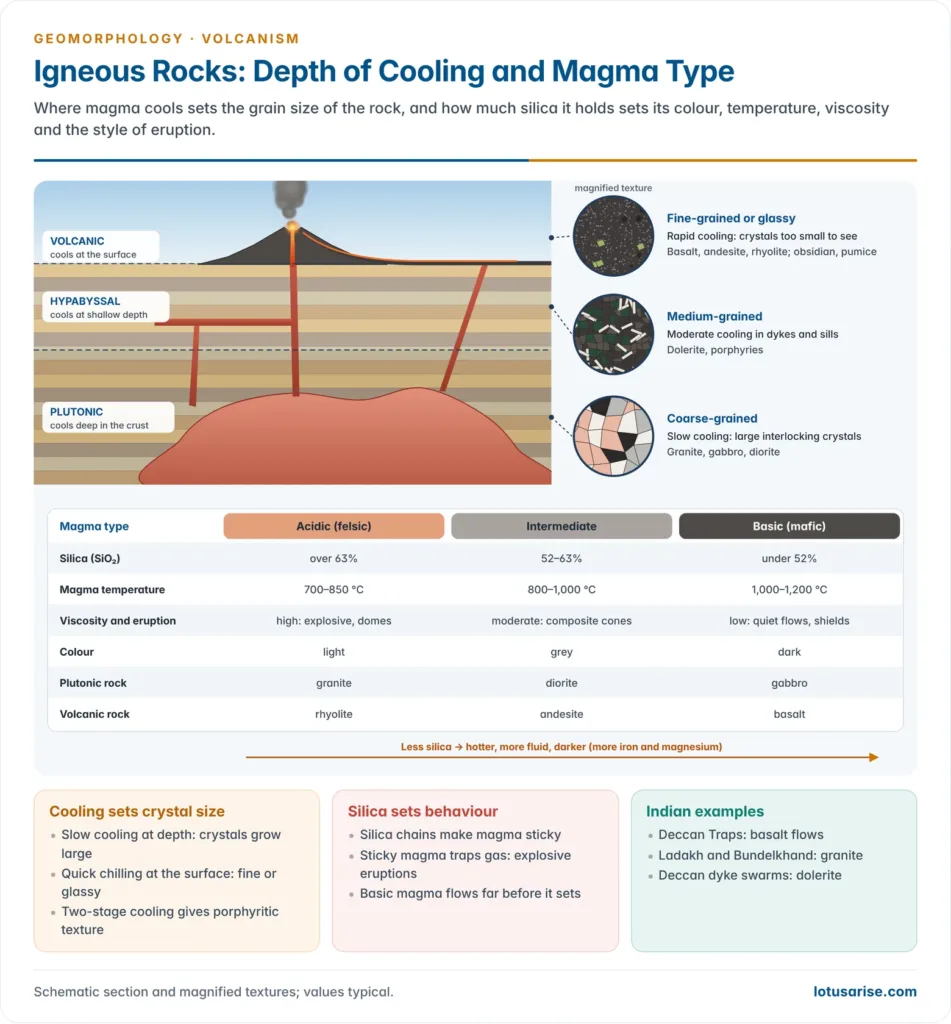
- Intrusive igneous rocks solidify below the surface.
- Plutonic rocks cool at great depth, very slowly, so grains grow large: granite, diorite, gabbro.
- Hypabyssal rocks cool at shallow depth in cracks and cavities, at an intermediate rate, so they are medium-grained: dolerite, porphyries.
- They appear at the surface only after uplift and denudation remove the cover.
- Extrusive (volcanic) igneous rocks solidify at the surface, so cooling is rapid and grains are fine or absent (glass): basalt, andesite, rhyolite, obsidian.
Intrusive Bodies and Their Landforms
- The shapes that intruded magma takes are forms of occurrence, not rock types; the same granite can make a batholith or a dyke.
| Body | Shape and setting | Landform after denudation | Example |
|---|---|---|---|
| Batholith | Huge, dome-topped mass, steep walls, base never seen | Granite domes, tors, inselbergs | Ranchi batholiths (Murha Pahar near Pithauriya) |
| Laccolith | Mushroom-shaped; magma arches overlying strata | Domed hills | Henry Mountains, Utah |
| Lopolith | Saucer-shaped, sagging in the centre | Basin-rimmed uplands | Bushveld Complex, South Africa |
| Phacolith | Lens along the crest or trough of folds | Follows fold relief | Folded mountain belts |
| Sill / sheet | Horizontal, parallel to bedding (thin = sheet) | Cuesta, hogback, ledge | Whin Sill, England |
| Dyke | Vertical wall cutting across bedding | Ridge, trench or no relief | Dyke swarms of the Deccan and Dharwar craton |
- A dyke’s relief depends on relative resistance.
- Harder than the country rock: it stands up as a wall-like ridge.
- Softer: it is eroded into a trench, which may hold a dyke lake.
- Equal resistance: both wear down together, leaving no feature.
Extrusive Rocks: Explosive and Quiet Types
- Explosive (pyroclastic) type: fragments blasted out in violent eruptions.
- Volcanic bombs (large blobs), lapilli (pea-sized) and ash and dust.
- Consolidated ash is tuff; a mix of large angular fragments is volcanic breccia or agglomerate.
- These are poorly consolidated and erode easily.
- Quiet (effusive) type: fluid basaltic lava wells out of fissures in repeated flows, building flood basalts, lava plateaus and lava plains.
- The Deccan Traps erupted about 66 million years ago at the Cretaceous–Palaeogene boundary; they still cover about 500,000 km² (perhaps 1.5 million km² originally) and are over 2 km thick in the Western Ghats.
- The Columbia River basalts (USA) cover over 210,000 km², erupted mainly 16.7–15.6 million years ago.
- The Antrim plateau of Northern Ireland is another classic lava plateau.
Classification by Chemical Composition
- The traditional basis is silica (SiO₂) content, expressed in older texts as acid and basic; silica content is not literally a measure of acidity.
- The modern equivalent uses mineral colour: felsic (feldspar + silica, light), mafic (magnesium + ferric, dark) and ultramafic.
| Group | Silica (% by weight) | Dominant minerals | Colour and density | Intrusive / extrusive |
|---|---|---|---|---|
| Acid (felsic) | Over 63 | Quartz, orthoclase, muscovite | Light; about 2.6–2.7 | Granite / rhyolite |
| Intermediate | 52–63 | Plagioclase, hornblende | Medium grey | Diorite / andesite |
| Basic (mafic) | 45–52 | Plagioclase, pyroxene, olivine | Dark; about 2.9–3.0 | Gabbro / basalt |
| Ultrabasic (ultramafic) | Under 45 | Olivine, pyroxene | Very dark; up to 3.3 | Peridotite, dunite / komatiite |
- Acid rocks are hard, light and resistant, and make durable building stone.
- Basic rocks are heavy and dark from iron, and weather quickly where moisture is constant.
Classification by Texture
- Texture (grain size and shape) is set by three factors.
- Depth and place of cooling: deep magma stays hot and cools slowly.
- Rate of cooling: slow cooling grows large crystals; quick chilling gives fine grains or glass.
- Water and gas content: volatiles slow solidification and let crystals grow bigger.
- The main textures are listed below.
- Pegmatitic: very coarse, crystals centimetres to metres long (pegmatite veins in granite).
- Phaneritic (Greek phaneros, visible): coarse, grains visible to the eye (granite, gabbro).
- Aphanitic (invisible): fine, grains need a microscope (basalt, rhyolite).
- Glassy: no crystals at all (obsidian, pumice).
- Porphyritic: large crystals set in a fine matrix, recording two stages of cooling.
- Vesicular: riddled with gas holes (scoria, pumice).
- Fragmental (pyroclastic): tuff and breccia.
Granite and Basalt Compared
| Feature | Granite | Basalt |
|---|---|---|
| Mode | Plutonic intrusive | Extrusive |
| Grain | Coarse (phaneritic) | Fine (aphanitic) to glassy |
| Silica | Acid, over 63% | Basic, 45–52% |
| Main minerals | Quartz, orthoclase feldspar, mica, some hornblende | Plagioclase feldspar, augite (pyroxene), olivine, iron oxides |
| Colour | Light; pink with orthoclase, grey to dark with hornblende or biotite | Dark grey to black (iron) |
| Weathering | Resistant, but jointed granite breaks into blocks | Decomposes fast in humid climates |
| Typical landforms | Tors, domes, inselbergs | Lava plateaus, trap (step-like) terrain, columnar joints |
- Columnar jointing forms as a thick flow cools and contracts into polygonal columns (Giant’s Causeway, Antrim).
- The columns of St. Mary’s Islands off Udupi (Karnataka) are a rarer rhyolite–rhyodacite example about 88 million years old, formed as India separated from Madagascar; the site is a National Geological Monument and was placed on UNESCO’s World Heritage Tentative List in 2025.
- Tors are left where joint blocks of granite survive deep chemical weathering and stripping.
Igneous Rocks in India
- Deccan basalts: Maharashtra, Gujarat, Madhya Pradesh and Karnataka; parent of the black cotton soil.
- Rajmahal Traps (Jharkhand): older Cretaceous basalts of eastern India.
- Granites and granitic gneisses: Bundelkhand, the Ranchi plateau, Karnataka and Tamil Nadu.
- Malani rhyolites (western Rajasthan): India’s largest felsic volcanic suite.
Sedimentary Rocks
Meaning and Formation
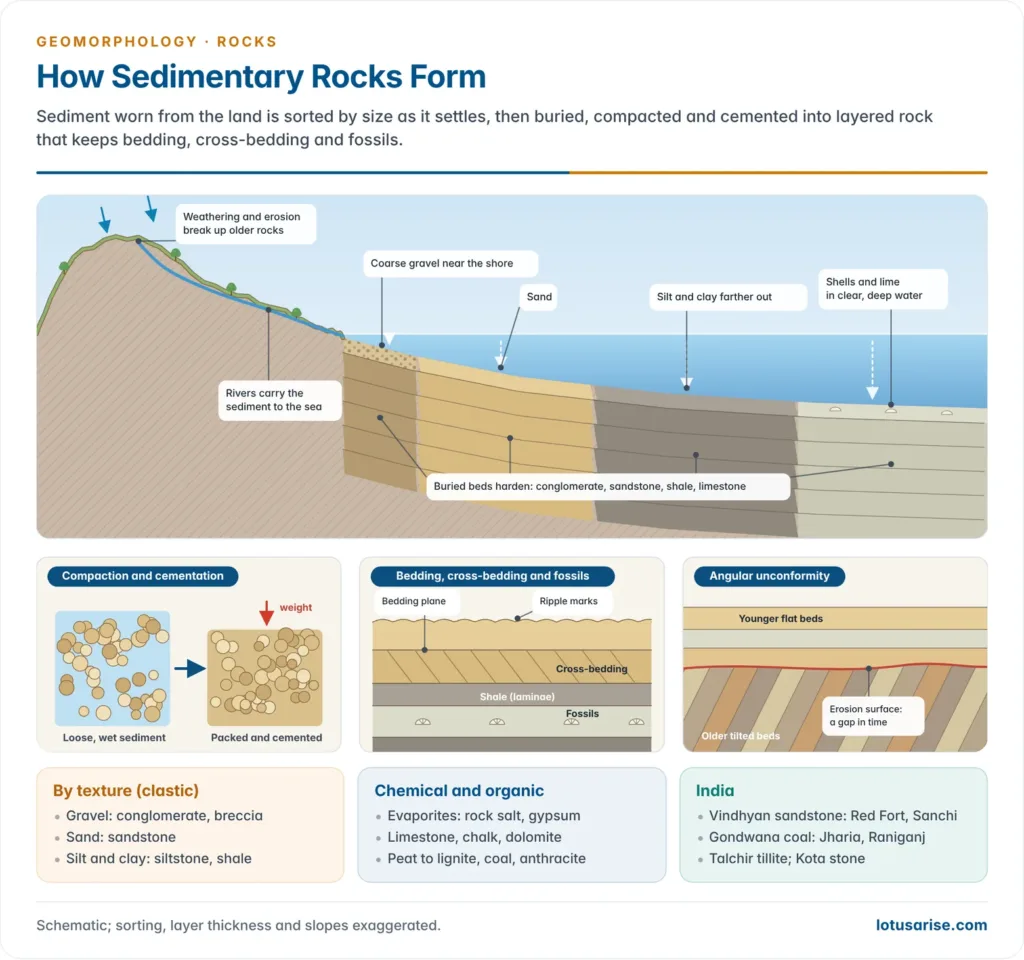
- Sedimentary comes from the Latin sedimentum (settling down): these rocks form from sediments derived by weathering and erosion of older rocks, and from plant and animal remains.
- Sediments are transported by rivers, wind, glaciers and waves, deposited in basins (mostly under water) and turned to rock by lithification.
- Compaction: the weight of overlying layers squeezes out water and packs the grains.
- Cementation: minerals precipitated from pore water (silica, calcite, iron oxides, clay) bind the grains.
- Some form on land: loess, dune sands, alluvial fans and cones.
Characteristics
- Stratified: they are laid down in layers (strata), hence “stratified rocks”; unlayered loess is an exception.
- A bed is a unit thicker than 1 cm; units thinner than 1 cm are laminae.
- The surface between two beds is a bedding plane; the base of a bed is its sole.
- Beds laid at an angle to the depositional surface give cross-bedding, which records current or wind direction.
- Fossiliferous: fossils date the rocks and reconstruct past environments.
- Extensive but thin: they cover about 73% of the land surface but make up only about 8% of the crust’s volume, a veneer over igneous and metamorphic basement.
- Sorted: grain size usually decreases from shore to basin centre (boulders and sand near the coast, silt and clay offshore, lime farther out).
- Mostly non-crystalline, and never found as massive bodies such as batholiths or dykes.
- Rarely horizontal now: compressive and tensional forces fold and fault the beds.
- Joints usually run perpendicular to bedding planes.
- Surface markings such as ripple marks and mud (sun) cracks, the polygonal cracks of dried flood muds, are preserved in the rock.
- Degree of consolidation varies from hard, well-cemented rock to loose sediment.
- Porosity (the share of voids) and permeability vary widely: sandstones hold water and oil, while shales seal them.
Unconformities
- Conformity: beds laid down continuously, one on another, without a break.
- An unconformity is a break in the stratigraphic sequence, where deposition stopped for a long time (often with erosion) before it resumed.
- James Hutton (1788) used the angular unconformity at Siccar Point (Scotland) to argue for an immensely old Earth.
| Type | What lies above and below |
|---|---|
| Nonconformity | Sedimentary beds resting on eroded igneous or metamorphic rock |
| Angular unconformity | Flat beds lying over tilted or folded older strata |
| Disconformity | Parallel beds with a visible erosion surface between them |
| Paraconformity | Parallel beds with no visible erosion surface; the gap shows only in fossils or dates |
Classification by Mode of Formation
- By the nature of the sediment, sedimentary rocks are mechanically formed (clastic), chemically formed or organically formed.
Mechanically Formed (Clastic) Rocks
- Clastic rocks are built of fragments (clasts) of older rocks, broken by mechanical weathering and rounded by attrition in transport.
- They are sub-divided by grain size on the scale of Chester Keeler Wentworth (1922).
- Wentworth grades used in naming clastic rocks:
- Gravel: granule (2–4 mm), pebble (4–64 mm), cobble (64–256 mm) and boulder (over 256 mm).
- Sand: very coarse (1–2 mm), coarse (1/2–1 mm), medium (1/4–1/2 mm), fine (1/8–1/4 mm) and very fine (1/16–1/8 mm).
| Texture group | Sediment and size | Rock | Nature |
|---|---|---|---|
| Rudaceous | Gravel (over 2 mm): granules, pebbles, cobbles, boulders | Conglomerate (rounded clasts), breccia (angular clasts) | Very hard if silica-cemented |
| Arenaceous | Sand (1/16–2 mm) | Sandstone | Hard, porous, permeable |
| Argillaceous | Silt (1/256–1/16 mm) and clay (under 1/256 mm) | Siltstone, mudstone, claystone, shale | Soft, fine, largely impermeable |
- Sandstones vary in colour with the cement: red to brown with iron oxide, white or grey with calcite; silica cement makes them the hardest.
- Quartz arenite: almost pure quartz sand.
- Arkose: feldspar-rich, from quickly eroded granite.
- Lithic arenite: rich in rock fragments.
- Greywacke: quartz, feldspar and rock fragments in a clay matrix.
- Arenaceous rocks make the best reservoirs for groundwater and petroleum.
- Shale splits into thin laminae (fissility); being impermeable, it acts as a cap rock that traps oil and gas beneath it.
- Clays do not dissolve and resist chemical weathering, but erode easily.
Chemically Formed Rocks
- Chemically formed rocks are precipitated from water that carries dissolved minerals.
- Evaporites form where saline water evaporates in closed seas, salt lakes and lagoons.
- Rock salt (halite): from old sea beds and lakes (Salt Range, Pakistan; Mandi, Himachal Pradesh).
- Gypsum: from evaporating salt lakes and lagoons (western Rajasthan).
- Potash and nitrate salts form in the same way.
- Travertine and tufa are lime deposited from springs.
- Cave stalactites and stalagmites belong here.
- Geyserite (siliceous sinter): silica deposited around geysers and hot springs, white, grey or pink with impurities.
Organically Formed Rocks
- Organically formed rocks are built from the remains of plants and animals.
- Calcareous rocks are rich in calcium carbonate.
- Limestone forms from shells, skeletons and coral reefs, and partly by precipitation.
- Chalk is a soft, porous limestone made of coccoliths (microscopic algal plates) and foraminifera (the white cliffs of Dover).
- Dolomite is a calcium–magnesium carbonate, less soluble than limestone.
- Carbonaceous rocks form from buried vegetation, which pressure and heat enrich in carbon.
- The sequence is peat → lignite → bituminous coal → anthracite, each darker and richer in carbon; coal occurs in seams.
- These rocks matter more for the economy than for landforms.
- Siliceous rocks form from silica-secreting organisms: diatomite (diatoms), radiolarian chert and sponge-spicule beds.
Behaviour of Carbonate Rocks
- Carbonate rocks dissolve in water charged with carbon dioxide.
- Rain absorbs CO₂ to form weak carbonic acid (H₂O + CO₂ → H₂CO₃).
- This converts insoluble calcite into soluble calcium bicarbonate (CaCO₃ + H₂CO₃ → Ca(HCO₃)₂), which is carried away.
- In humid regions the result is karst landforms: sinkholes, caves and dry valleys.
- In hot deserts the same limestone is resistant: little water is available, and its uniform texture resists expansion and contraction.
Classification by Agent of Deposition
| Group | Environment | Examples |
|---|---|---|
| Aqueous: marine | Sea and ocean floors, mostly continental shelves; well sorted from coast outward | Sandstone, limestone, dolomite, chalk |
| Aqueous: lacustrine | Lake floors, exposed when a lake dries, fills or is uplifted; poorly sorted | Lake clays, varves, lacustrine limestone |
| Aqueous: fluvial | River beds and floodplains, renewed by floods | Alluvium, channel sandstones |
| Aeolian | Deserts and their margins, wind-blown | Loess, dune sandstone |
| Glacial | Deposits left by ice | Till, moraines; lithified till is tillite |
- Loess is wind-blown, unstratified, porous and lime-rich silt that stands in vertical walls yet erodes very easily.
- The Loess Plateau of China is the largest example, hundreds of metres thick.
- Erosion of the plateau gave the Yellow River a historic load of about 1.6 billion tonnes of sediment a year; terracing, re-vegetation, check dams and reservoirs have cut this by more than 80% in recent decades.
- India has loess mantles in the Karewas of the Kashmir Valley.
Sedimentary Rocks in India
- Vindhyan sandstone (Madhya Pradesh, Rajasthan, Uttar Pradesh): the red and buff stone of the Red Fort, Fatehpur Sikri, Sanchi, Humayun’s Tomb and Parliament House, recognised by the International Union of Geological Sciences as a Global Heritage Stone Resource.
- Gondwana coal (Damodar, Son, Mahanadi and Godavari valleys): Jharia and Raniganj.
- At the base of the Gondwana sequence lies the Talchir tillite (Odisha), a relic of Permo-Carboniferous glaciation.
- Limestones of the Vindhyan and Cuddapah basins feed the cement industry; Kota stone (Rajasthan) is a flaggy limestone.
- Tertiary sandstones and shales of Assam and Gujarat hold oil and gas, and the Siwalik conglomerates and sandstones fringe the Himalaya.
- The Indo-Gangetic alluvium is sediment not yet lithified.
Metamorphic Rocks
Meaning
- Metamorphic means “change of form”: the rocks form when heat, pressure and chemically active fluids alter existing rocks in the solid state, changing mineralogy, texture or both.
- There is no melting (melting would make magma) and no disintegration (that would make sediment).
- Minerals recrystallise and reorganise; new minerals may grow and old ones re-align.
- Any rock, igneous, sedimentary or already metamorphic, can be metamorphosed; repeated alteration is remetamorphism (polymetamorphism).
- Intense metamorphism can erase all trace of the parent, as in the Dharwar schists and gneisses of peninsular India.
- Metamorphism can be physical (texture changes) or chemical (composition changes), and usually both act together.
- It usually makes rocks harder and more resistant (limestone → marble, sandstone → quartzite) and destroys fossils.
- Rocks meet these conditions when tectonic burial carries them down, when rising magma heats their walls, or when plates collide.
Agents of Metamorphism
- Heat is the most important agent.
- It comes from intruding magma, the geothermal gradient during deep burial, and friction along faults.
- Minerals recrystallise without melting.
- Pressure is of two kinds.
- Confining (lithostatic) pressure acts equally on all sides from the overlying load.
- Directed stress during orogeny squeezes rocks, aligning minerals at right angles to it and producing foliation.
- Chemically active fluids, hot water and gases from magma or pore water, carry ions in and out and change composition (metasomatism).
Types of Metamorphism
- These are classed by agent (thermal, dynamic, hydro, hydrothermal) and by area (contact, regional); a combined scheme is given below.
| Type | Main agent | Scale | Typical change |
|---|---|---|---|
| Contact (thermal) | Heat of an intrusion | Local: an aureole around the intrusion | Limestone → marble, sandstone → quartzite, shale → hornfels |
| Regional: dynamic | Directed pressure plus heat in fold belts | Hundreds of km | Shale → slate → schist → gneiss |
| Regional: static (burial) | Load of overlying rocks at depth | Wide basins | Low-grade recrystallisation |
| Dynamic (cataclastic) | Shearing along faults | Narrow fault zones | Crushed and streaked rock (mylonite) |
| Hydrothermal | Hot water and gases with heat | Veins, ridge flanks | Peridotite → serpentinite; ore veins |
| Hydro-metamorphism | Chemically active water, or the load of a large water body | Local | Minor alteration; of little geomorphic importance |
- Contact metamorphism: the width of the aureole depends on the temperature and size of the intrusion and its depth in the crust.
- Dynamo-thermal (regional) metamorphism: directed pressure and heat act together, giving near-complete recrystallisation and new structures; it is typical of mountain roots.
- Himalayan example: the summit of Mount Everest is Ordovician marine limestone, about 450 million years old, with fossils of brachiopods and crinoids.
- It has been deformed and only weakly altered by tectonic (dynamic) metamorphism, not baked by an intrusion.
- The Yellow Band just below it is marble.
Metamorphic Textures
- Foliation: parallel alignment of platy minerals (mica, chlorite) produced by directed pressure, often cutting across original bedding.
- Fine-grained rocks foliate perfectly (schist from shale); coarse ones imperfectly (gneiss from granite).
- Lineation: the parallel alignment of elongated minerals in lines.
- Slaty cleavage: closely spaced parallel planes along which slate splits into thin sheets, formed at right angles to the compression and usually oblique to bedding.
- Schistosity: coarser foliation with visible mica flakes.
- Gneissic banding: minerals segregated into alternating light (quartz–feldspar) and dark (biotite–hornblende) bands.
- Non-foliated rocks recrystallise into interlocking grains without alignment (marble, quartzite, hornfels).
Classification of Metamorphic Rocks
- By parent rock
- Para-metamorphic (meta-sedimentary): from sedimentary rocks, such as marble, quartzite and slate.
- Ortho-metamorphic (meta-igneous): from igneous rocks, such as gneiss from granite, serpentinite from peridotite or gabbro, and eclogite from basalt.
- By texture: foliated (slate, phyllite, schist, gneiss) and non-foliated (marble, quartzite, hornfels, serpentinite).
- By grade: shale passes with rising temperature and pressure through slate → phyllite → schist → gneiss.
| Parent rock | Main agent | Metamorphic rock |
|---|---|---|
| Limestone, dolomite, chalk | Heat (contact) or regional | Marble |
| Sandstone | Heat and pressure | Quartzite |
| Shale, clay | Low-grade regional | Slate, then phyllite |
| Shale (higher grade), basalt | Regional pressure and heat | Schist (mica schist; hornblende schist from basalt) |
| Granite, conglomerate | High-grade regional | Gneiss |
| Coal | Heat and pressure | Anthracite, then graphite |
| Basalt, gabbro | High pressure | Eclogite; greenschist at low grade |
Important Metamorphic Rocks
- Marble is recrystallised calcite from limestone or dolomite.
- Pure limestone gives white marble (Carrara, Italy); impurities add colour.
- The pink and white marble of the Bheraghat gorge of the Narmada near Jabalpur is a well-known example.
- It is more resistant to erosion than its parent, and a prized building stone.
- Schist is fine to medium-grained and strongly foliated, and named after its dominant mineral: mica schist (commonest, from shale), hornblende schist, greenschist.
- Poorly foliated green rocks are greenstones.
- Schists from basalt or dolerite are metabasites.
- Slate comes from shale under low-grade regional pressure, with slaty cleavage; further metamorphism makes phyllite.
- It is used for roofing and writing slates, and is less resistant than schist or gneiss.
- Gneiss is coarse and banded, and feldspar-rich; it comes from granite or conglomerate, including augen gneiss with “eye-shaped” feldspars.
- Granitisation turns high-grade schists into granite-like gneiss.
- It weathers into rounded, domed topography.
- Quartzite is sandstone whose pores have been filled with silica and whose grains are welded, making it very hard.
- As a cap rock over weaker shale, it forms bold escarpments: the Kaimur scarp along the Son, the Bhander scarps (Satna–Panna) and the Rewa scarps facing the Ganga plain.
- Cemented but unmetamorphosed “quartzitic sandstones” are softer and break down into sandy soils.
Metamorphic Rocks in India
- Gneisses and schists are widespread in the Himalaya, Assam and Meghalaya, West Bengal, Bihar and Jharkhand, Odisha, Madhya Pradesh and Rajasthan.
- The Dharwar schist belts of Karnataka hold gold at Kolar and Hutti.
- Quartzite caps the Aravalli–Delhi ridges (including the Delhi Ridge) and occurs in Bihar, Madhya Pradesh and Tamil Nadu.
- Marble is found at Makrana, Alwar, Ajmer, Jaipur and Jodhpur, and in the Narmada valley.
- Makrana marble, used for the Taj Mahal and the Victoria Memorial, was metamorphosed from Delhi Supergroup carbonates.
- It carries a GI tag (2015) and is an IUGS Global Heritage Stone Resource (2019).
- Slate occurs at Rewari (Haryana), Kangra (Himachal Pradesh) and in parts of Bihar.
- Khondalite is found in the Eastern Ghats of Odisha and Andhra Pradesh.
- Charnockite, named by Thomas Henry Holland (1893) after the tombstone of Job Charnock, is a metamorphosed igneous rock of St. Thomas Mount (Chennai) and the granulite belts of Tamil Nadu and Kerala.
- Graphite occurs in Odisha and Andhra Pradesh.
Rock Cycle and Rock Control on Landforms
Rock Cycle
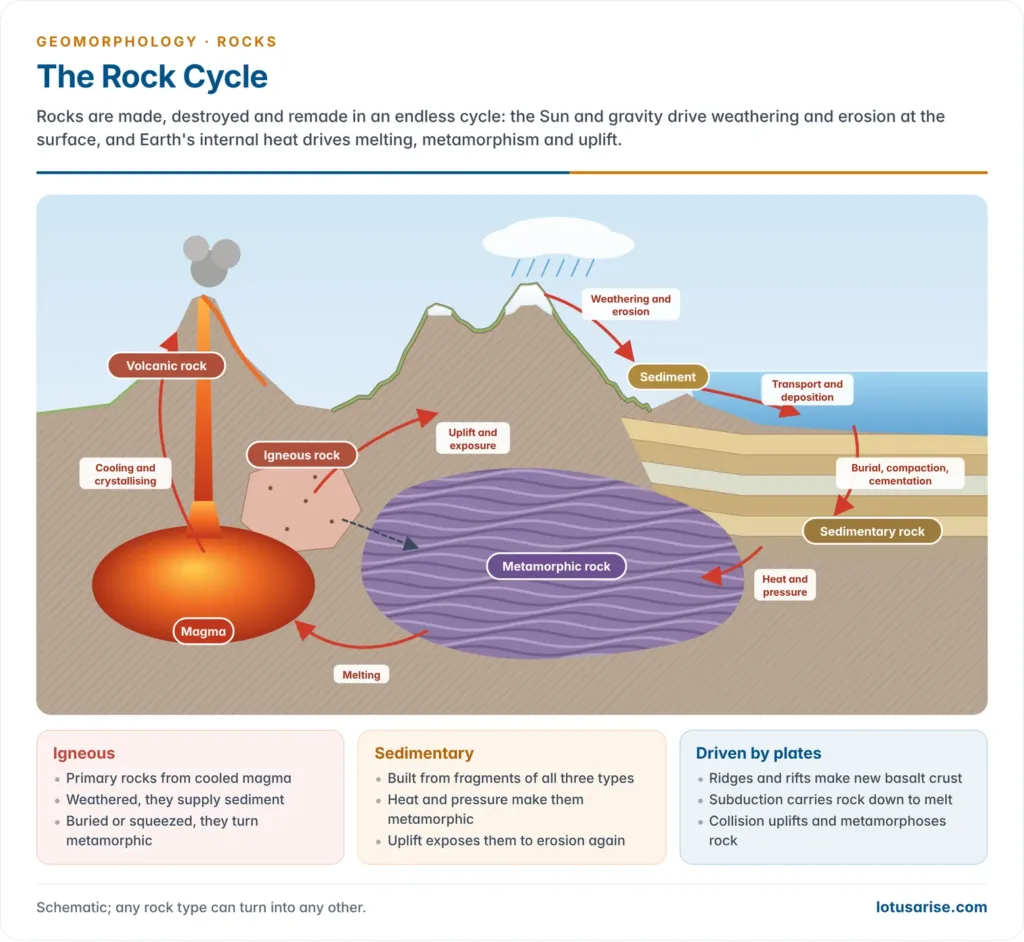
- The rock cycle is the endless set of processes by which rocks are formed, destroyed and re-formed, each type able to become any other.
- Its cyclic, self-renewing view of the Earth goes back to James Hutton (Theory of the Earth, 1788).
- Igneous rocks are primary: weathered, they supply sediment; buried or squeezed, they become metamorphic.
- Sedimentary rocks form from fragments of all three types, and turn metamorphic under heat and pressure.
- Metamorphic rocks can be re-metamorphosed, eroded into sediment, or melted into magma at high temperature.
- Plate tectonics drives the cycle.
- Ridges and rifts make new basaltic crust.
- Subduction carries crustal rocks into the mantle, where they are metamorphosed (to eclogite) and partly melted; water released from the slab lowers the melting point and feeds arc volcanoes.
- Collision uplifts and metamorphoses rock, which erosion then returns to sediment.
- John Tuzo Wilson (1967) described this opening and closing of ocean basins, now called the Wilson cycle.
- Exogenic processes (weathering, erosion, deposition) run the surface half of the cycle, powered by the Sun and gravity; endogenic heat runs the deep half.
Rock Type and Landforms
- Rock type, one of the factors controlling landform development, acts through hardness, jointing, permeability and solubility, and the same rock can behave differently in different climates.
| Rock | Key property | Typical landforms | Indian example |
|---|---|---|---|
| Granite, gneiss | Massive, jointed | Tors, domes, inselbergs | Ranchi plateau, Hosur–Bengaluru uplands |
| Basalt | Flow layers, columnar joints | Trap (stepped) plateaus, mesas, buttes | Western Ghats near Mahabaleshwar |
| Sandstone, quartzite | Resistant, permeable | Scarps, cuestas, gorges | Kaimur and Bhander scarps |
| Shale, clay | Soft, impermeable | Vales, badlands, landslide-prone slopes | Shale slopes of the Siwaliks and Lesser Himalaya |
| Limestone | Soluble | Karst: sinkholes, caves | Meghalaya caves, Borra Caves |
| Loess | Porous, cohesive when dry | Vertical bluffs, gullies | Karewas, Kashmir |
Previous Year Questions
- No direct PYQ has been asked on this sub-topic yet.


Thankyou so much…. this is very helpful….
Welcome
You’ve done amazing job sir. Please continue.
thank youu so so much..🤗
Thanku so much.
very helpful keep doing this work sir
Thanks a lot. 🙏
Thank you so much Lotus team