

- Biomass is renewable organic matter from plants and animals. Biomass energy, or bio-energy, is energy obtained from living or once-living organisms.
- It holds stored chemical energy from the sun, fixed by plants through photosynthesis. It may be burned as it is for heat, or processed into liquid and gas fuels.
- Households across the developing world still cook and keep warm with it, while richer countries turn to it for transport and electricity, to avoid carbon dioxide from fossil fuels.
- In India it runs from the village biogas plant to sugar mill cogeneration, ethanol-blended petrol and pellets burned with coal. Installed bio-energy stood at 11.61 GW on 31 December 2025.
Biomass as an Energy Source
Sources of Biomass
- Wood and wood processing wastes: firewood, pellets and chips; sawdust and scrap from lumber and furniture mills; black liquor from pulp and paper mills.
- Agricultural crops and wastes: corn, soybeans, sugar cane, switchgrass, woody plants and algae, along with residues of crops and food processing.
- Biogenic matter in municipal solid waste: paper, cotton and wool products, and food, yard and wood wastes.
- Animal manure and human sewage.
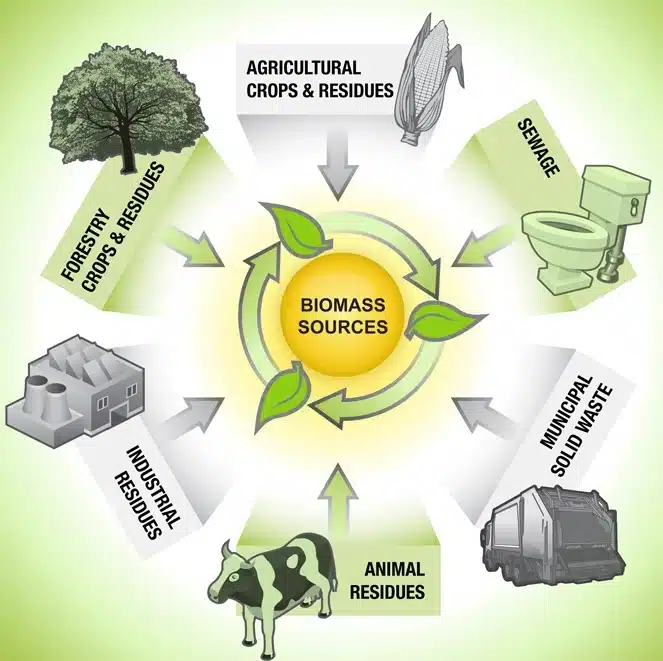
Converting Biomass to Energy
| Route | Process | Main product |
|---|---|---|
| Direct combustion | Burning | Heat, steam power |
| Thermochemical | Pyrolysis, gasification | Solid, liquid and gaseous fuels |
| Chemical | Transesterification | Biodiesel |
| Biological | Fermentation, anaerobic digestion | Ethanol, biogas |
| Cogeneration | Heat and power from one fuel | Electricity with useful heat |
- Direct combustion is the commonest route. Any biomass can be burned to warm buildings and water, to supply industrial process heat, or to raise steam for turbines.
- Thermochemical conversion covers pyrolysis and gasification. In both, feedstock is decomposed by high heat in closed, pressurized vessels called gasifiers.
- Pyrolysis runs at about 400–500°C with almost no free oxygen, and gives charcoal, bio-oil and gases.
- Gasification runs at about 800–900°C with a controlled supply of oxygen or steam, and gives syngas, a mix rich in carbon monoxide and hydrogen.
- Chemical conversion uses transesterification to turn plant oils, animal fats and greases into fatty acid methyl esters (FAME), the basis of biodiesel.
- Biological conversion works through microbes:
- Fermentation yields ethanol, a vehicle fuel.
- Anaerobic digestion, also called biomethanation or methanogenesis, has microorganisms break down biodegradable matter without oxygen. It runs through three stages in turn: hydrolysis, acidogenesis and methanogenesis.
- Its products are a methane-rich gas and a liquid effluent. The gas, known as biogas, biomethane or renewable natural gas, comes from digesters at sewage plants, dairies and livestock farms, and can also be collected from landfills.
- Cogeneration gets two kinds of energy out of a single fuel. Heat is always one of them, and electricity or mechanical energy the other.
- A conventional plant burns fuel in a boiler to make high-pressure steam, runs a turbine and condenses the exhaust steam back to water for the boiler.
- Much heat is lost in that condensing, so its efficiency is only around 35%.
- A cogeneration plant sends the low-pressure exhaust to factories or houses instead, reaching 75–90% efficiency.
- Meeting power and heat needs together also cuts costs, fuel use and pollutant emissions.
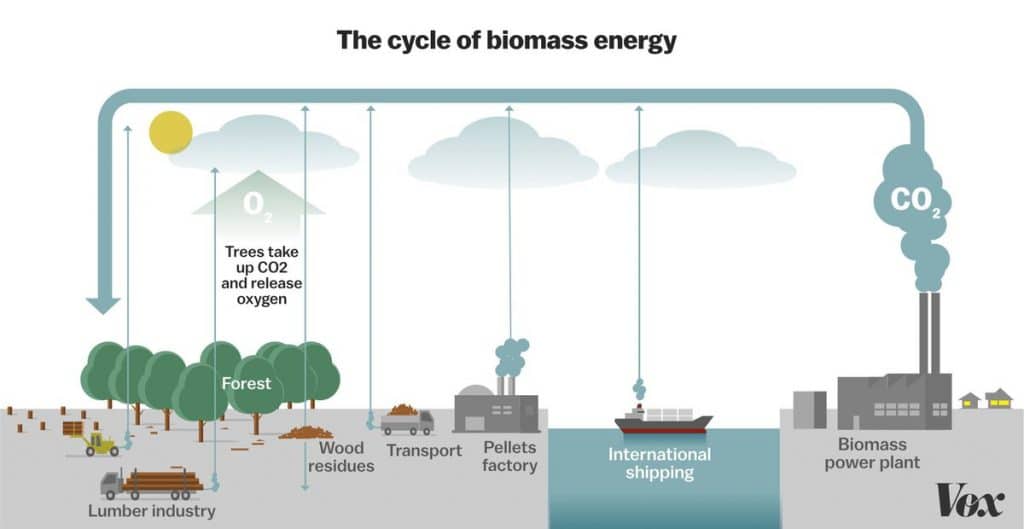
- This figure draws an idealised loop for wood pellets. Its small arrows from harvesting, the pellet factory, transport and shipping show the emissions that keep real biomass from being fully carbon-neutral.
Advantages of Biomass Energy
- Versatile: uses range from cooking gas to power generation, with little effect on the environment when well managed.
- Renewable: nature can supply it in abundance, provided it is regrown as fast as it is used.
- No net carbon dioxide, ideally: regrowing plants take back the carbon released, so emissions run far below those of conventional fuels. Harvest, processing and transport add some in practice.
- Less sulphur dioxide (SO2) and nitrogen oxides (NOx) than fossil fuels: its sulphur and nitrogen pollutants are small.
Disadvantages of Biomass Energy
- Low energy density and yield: ethanol holds less energy per litre than gasoline, and it is usually blended with fossil fuel rather than used alone. Some routes, such as corn-derived bioethanol, may yield little or no net energy.
- Land conversion: land for energy crops may be wanted for conservation, housing or farming. This can cut food output and cause biodiversity loss.
- Problems of intensive agriculture can follow:
- Nutrient pollution
- Soil depletion
- Soil erosion
- Other water pollution problems
- Indoor smoke: traditional burning in simple stoves harms the eyes and lungs of women and children.
Bio-energy in India
Role in Meeting India’s Energy Demand
- Energy demand: bio-energy can serve growing demand, especially in villages.
- Nearly 25% of India’s primary energy has been credited to biomass, and some estimates reach about 32%.
- Close to 70% of the rural population depends on it for daily needs.
- Climate change mitigation: biomass recycles carbon already in the air and replaces fossil fuel, so it adds less fossil carbon from the ground to the atmosphere. Biomass co-firing alone is estimated to have avoided about 5.7 million tonnes of carbon dioxide since 2019–20.
- Market growth: renewable systems have a fast-growing market in town and village alike. Even so, bio-energy is often left out of energy studies and counted as “non-commercial” energy.
- Jatropha, neem and other wild plants are candidates for biodiesel.
- Waste to energy: biofuels help create wealth from waste. Feedstocks include renewable biomass such as forestry residues, agricultural wastes, surplus food grains and municipal solid waste.
- Plastic is also a listed feedstock for fuels, but it is fossil-derived waste, not renewable biomass.
- This was to help reach the 175 GW renewable goal, now followed by the target of 500 GW of non-fossil capacity by 2030.
- Income generation: a market for residues and energy crops can raise farmers’ income and create rural jobs.
- Reducing imports: imports met about 46.13% of total primary energy consumption in older accounts, and about 40–42% in 2024–25. Domestic bio-energy adds to energy security and self-reliance, as the energy crisis makes plain.
Potential and Installed Capacity
- Scale of the resource: the Ministry of Power puts availability at about 750 million tonnes a year, of which about 230 million tonnes of agricultural residue is surplus.
- Older estimates ran lower:
- MNRE counted over 500 million tonnes generated each year, equal in energy to about 175 million tonnes of oil, with 150–200 million tonnes going to waste.
- The exploitable power from residues (excluding bagasse) was put at 16,000 MW, and the Central Statistics Office gave 17,538 MW.
- A far larger 70,000 MW was claimed from biomass grown on wastelands, roadsides and railway land.
- The Ministry of New and Renewable Energy (MNRE) now gives these figures:
| Item | 2014 | Current (MNRE, 2025) |
|---|---|---|
| Power potential from surplus residue | 17,067 MW | 28,446 MW |
| Bagasse cogeneration potential | About 5,000 MW | 13,866 MW |
| Total biomass power potential | — | 42,312 MW |
| Installed biomass power (with cogeneration) | 3,601 MW | 10,757 MW (31 December 2025) |
| Bagasse cogeneration installed | 2,513 MW | 7,935 MW |
| Waste to energy | — | 857 MWeq (31 December 2025) |
- Spread: plants lie mainly in Maharashtra, Uttar Pradesh, Karnataka, Tamil Nadu, Andhra Pradesh, Chhattisgarh, West Bengal and Punjab.
- Residue potential is highest in Punjab, Uttar Pradesh, Gujarat, Maharashtra and Madhya Pradesh. Punjab led the 2014 table too, while Keralam (Kerala) and Jharkhand had nothing installed.
- Barriers named by the government: feedstock availability and high capital cost per MW.
Cogeneration in Industry
- An older survey of 300 units by the Tata Energy Research Institute (1993) found a potential of 7,574 MW, over two-thirds of it (67.7%) in sugar.
- Next came paper, cotton textiles, caustic soda and iron and steel.
- About 30% of the electricity used in pulp and paper is cogenerated with steam, and fertiliser plants meet nearly all their energy needs from waste-heat boilers.
- Bagasse cogeneration was launched in January 1994, with an initial aim of 300 MW. Its share has since grown into the largest part of India’s biomass power.
Biogas
- Nature: organic matter, mainly dung, decomposes without air to give about 55% methane and 45% carbon dioxide.
- Uses: cooking and lighting in stoves and lamps, and running dual-fuel engines in place of diesel for motive power and electricity. The leftover slurry is an enriched manure.
- Efficiency: gobar gas has a thermal efficiency of about 60%, well above kerosene, firewood, dung or charcoal.
- Potential: 1–1.5 billion tonnes of dung a year could yield 22,425 million cubic metres of gas, saving 33,904 million litres of kerosene, and manure rich in nitrogen, phosphate and potash.
- Its spread has been called a “Brown Revolution” in rural India.
- Programmes:
- The National Project on Biogas Development began in 1981–82. It aimed at clean fuel, enriched manure, better sanitation through links with toilets, and less drudgery for women.
- Community and institutional plants followed in 1982–83, and plants linked to community toilets in 1993–94.
- About 44 lakh family plants stood by 2010–11.
- Limits: shortage of dung, water, labour and space, and low winter temperatures in some regions.
- Today: the Biogas Programme (Rs 100 crore in Phase I) runs under the National Bioenergy Programme. Waste-to-energy plants alone had a capacity of 8,80,698 cubic metres of biogas a day by December 2025.
- Compressed biogas (CBG): 59 plants were commissioned in 2025. CBG blending in piped and transport gas became mandatory at 1% in 2025–26, rising through 3% and 4% to 5% from 2028–29.
Improved Chulhas
- The National Programme on Improved Chulhas began in 1986–87 to save fuel wood, cut smoke and drudgery, check deforestation and create rural work.
- Thermal efficiency rises from 8–10% in a traditional chulha to 20–25% in an improved one, saving about 375 kg of biofuel and 3 litres of kerosene a year.
Biomass Gasifiers
- Gasification makes solid biomass easier to handle and use: the gas can be burned for heat or can stand in for diesel in dual-fuel engines.
- The programme began in 1986, on 3.7 kW wood-based units. Systems up to 500 kW came to be built in India.
- Plants were set up in Gujarat, Uttar Pradesh, Andhra Pradesh, Tamil Nadu, West Bengal and Nagaland, among others.
- On Chhottomallakhali Island in the Sundarbans, a 4 x 125 kW plant has supplied power since 29 June 2001, because grid lines across the creeks cost too much.
- Energy plantations of fast-growing fuel-wood species set a goal near 40 tonnes a hectare each year. Research centres reached 12–37 tonnes, against about 0.5 tonne in average forests.
Waste to Energy
- Feedstock: the wastes of towns, factories and farms, among them market and vegetable waste, slaughterhouse waste, crop residues and industrial effluents.
- Municipal waste: urban India generates about 1.5 lakh tonnes a day (2023). About a quarter, some 14 million tonnes a year, was left unmanaged. Earlier estimates (2011 Census) gave 1.1–1.5 lakh tonnes from 377 million urban people.
- Potential and output: MNRE estimated 4,000 MW in 2012, but progress has been held back by environmental issues and costs.
- On 31 December 2025, capacity stood at 856.62 MWeq: 309.34 MW grid-connected and 547.28 MWeq off-grid.
- City power potential depends on both tonnage and calorific value, as a 2012 study shows:
| City | Waste (tonnes a day) | Calorific value (MJ/kg) | Power potential (MW) |
|---|---|---|---|
| Delhi | 11,040 | 7.5 | 186.8 |
| Greater Mumbai | 11,124 | 7.5 | 186.6 |
| Chennai | 6,118 | 10.9 | 149.0 |
| Greater Kolkata | 11,520 | 5.0 | 129.2 |
| Greater Hyderabad | 4,923 | 8.2 | 91.0 |
- Kolkata generates the most waste, yet its low-energy refuse keeps its potential below that of Delhi or Mumbai.
Biofuels
- National Policy on Biofuels (2018) sorts fuels into basic (first-generation ethanol and biodiesel) and advanced (second-generation ethanol, waste-to-drop-in fuels, third-generation fuels and bio-CNG).
- Blending target: the policy aimed at 20% ethanol in petrol by 2030. An amendment in 2022 brought this forward to 2025–26, the “20% by 2025” target.
- Progress: the average blend reached 19.2% in 2024–25, and the government reported 20% in 2025–26, ahead of schedule. No decision has been taken to go beyond 20%.
- Food versus fuel: surplus grain can go to ethanol only with approval of the National Biofuel Coordination Committee.
Government Efforts
Targets and Programmes
- 10 GW national target: MNRE aimed at 10 GW of biomass power by 2022. Installed capacity crossed this figure, at 10.76 GW by December 2025. An older National Bioenergy Mission had proposed 20,000 MW by 2022.
- National Bioenergy Programme: notified on 2 November 2022 for 2021–22 to 2025–26, with Rs 858 crore in Phase I.
- Waste to Energy Rs 600 crore, later raised to Rs 637.5 crore; Biomass Rs 158 crore; Biogas Rs 100 crore.
- Biomass and bagasse cogeneration policy: MNRE’s policy offers financial incentives and subsidies to biomass projects and to sugar mills using this technology.
- Fiscal incentives: these have included a 10-year income tax holiday, lower customs and excise duty on machinery for new biomass power projects, and sales tax relief in some States.
- Waste to energy projects: these are being built across urban, industrial and farm waste streams.
- National Biomass Repository: MNRE planned this through a nation-wide appraisal, to ensure supply of biofuels from domestic feedstock.
National Mission on Biomass in Coal-Based Thermal Power Plants (SAMARTH)
- Why: the Ministry of Power set up the mission to tackle air pollution from farm stubble burning and to cut the carbon footprint of thermal power. Its full name is the Sustainable Agrarian Mission on use of Agri-Residue in Thermal Power Plants (SAMARTH).
- It also supports the National Clean Air Programme (NCAP) and the country’s move towards cleaner energy sources.
- Biomass co-firing means adding biomass as a partial substitute for coal in high-efficiency boilers.
- Objectives:
- To raise co-firing above the present 5%, so that thermal generation gets a bigger carbon-neutral share.
- To fund research on boiler design that copes with the silica and alkali in pellets.
- To ease supply chain limits on pellets and agro-residue, including carriage to the plants.
- To look into regulatory issues in co-firing.
- Current rule (Ministry of Power, 7 November 2025):
- All coal plants must use a 5% blend by weight from 2025–26, of biomass pellets or torrefied charcoal from municipal solid waste.
- Plants in the National Capital Region use 5% pellets plus a further 2%, and at least half the pellet raw material there must be paddy stubble or crop residue from that region.
- The policy replaces those of 8 October 2021 and 16 June 2023.
Previous Year Questions
- No direct PYQ has been asked on this sub-topic yet.





 History Optional Mains Master Kit 2027 Complete Self-Study System — Notes, Mapping & Premium Articles by LotusArise IAS
 History Optional PYQ Master Pack: Topic-wise Model Answers (1985–2025) by LotusArise IAS
 Sociology Optional Mains Master Kit 2027 — Complete Self-Study System: Notes, Thinkers & Premium Articles by LotusArise IAS
SOOO Tesss 🤤😈
Biomass have been in news since a long time and now bio fuels are taking away the news these days. Bio fuels are now being the replacement of crude oil which is simply made out of leftover oils from various sources including household waste oil. It decreases the waste and helps build a system of efficient fuel energy. Even various companies like Aris Bio energy buys oil from your door step makes it more dependable source of sustainable energy for everyone. We should not forget the importance of such small efforts in the direction of our planet safety.