

- Welfare geography is the approach to human geography that puts spatial inequality and territorial justice at its centre: how the good and bad things of life are distributed across space, and why.
- In David M. Smith’s phrase, it studies “who gets what, where, and how”.
- It emerged in the early 1970s as the liberal, reformist stream of the relevance movement within the critical revolution, working within the existing system through state policy and planning.
Emergence and Development

Why It Emerged in the 1970s
- Social crisis in the West: the Vietnam War, urban riots, Black ghettos and environmental degradation exposed deep injustice in the most prosperous societies.
- Growth was not welfare: the social indicators movement of the 1960s argued that GNP does not measure the quality of life, and distribution became urgent once growth slowed.
- Reaction to spatial science: the quantitative revolution had built models of efficient location but said little about poverty, hunger or discrimination.
- Smith held that models matter only if they serve the welfare of society; otherwise human geography risks irrelevance.
- Usable tools: the multivariate methods of the 1960s (factorial ecologies) were now turned to mapping social well-being.
- Moral philosophy: John Rawls’s A Theory of Justice (1971) gave a language of fairness that geographers applied to places.
Pioneers and Their Works
| Scholar | Work | Contribution |
|---|---|---|
| Bleddyn Davies | Social Needs and Resources in Local Services (1968) | Coined “territorial justice” |
| David Harvey | Social Justice and the City (1973) | Territorial social justice |
| David M. Smith | The Geography of Social Well-Being in the United States (1973) | Territorial social indicators |
| Kevin Cox | Conflict, Power and Politics in the City (1973) | Urban conflict over access to power |
| Paul Knox | Social Well-being: A Spatial Perspective (1975) | Mapping levels of living |
| David M. Smith | Human Geography: A Welfare Approach (1977) | Welfare as the integrating theme |
Phases of Development
- Descriptive phase (1970s): mapping territorial inequality with social indicators, using neo-classical welfare economics; the geographer supplied information for planners.
- Process phase (late 1970s–80s): attention turned to how inequality arises. As radical geography grew, Marxian political economy partly replaced neo-classical economics as the explanatory base.
- Explanation worked at two levels: the whole social, economic and political system, which makes uneven development endemic under capitalism, and specific policies, such as housing, which favour some places over others.
- Ethical phase (1990s onwards): once the collapse of the Soviet bloc reopened questions of distribution, the focus moved to social justice, ethics and “moral geographies” (Smith’s Moral Geographies, 2000).
- Themes included welfare-state restructuring (Jamie Peck’s Workfare States, 2001), feminist ethics of care and race, gender and marginalised “others”, and methods turned qualitative.
Core Ideas
Definitions
- Smith adapted two definitions from welfare economics:
- after E. J. Mishan, welfare geography seeks to rank alternative geographical situations on a scale of better or worse;
- after S. K. Nath, it studies the possible effects of geographical policies on the welfare of society.
- A geographical state is any spatial arrangement that bears on the quality of life, such as the spread of poverty or the siting of hospitals and schools.
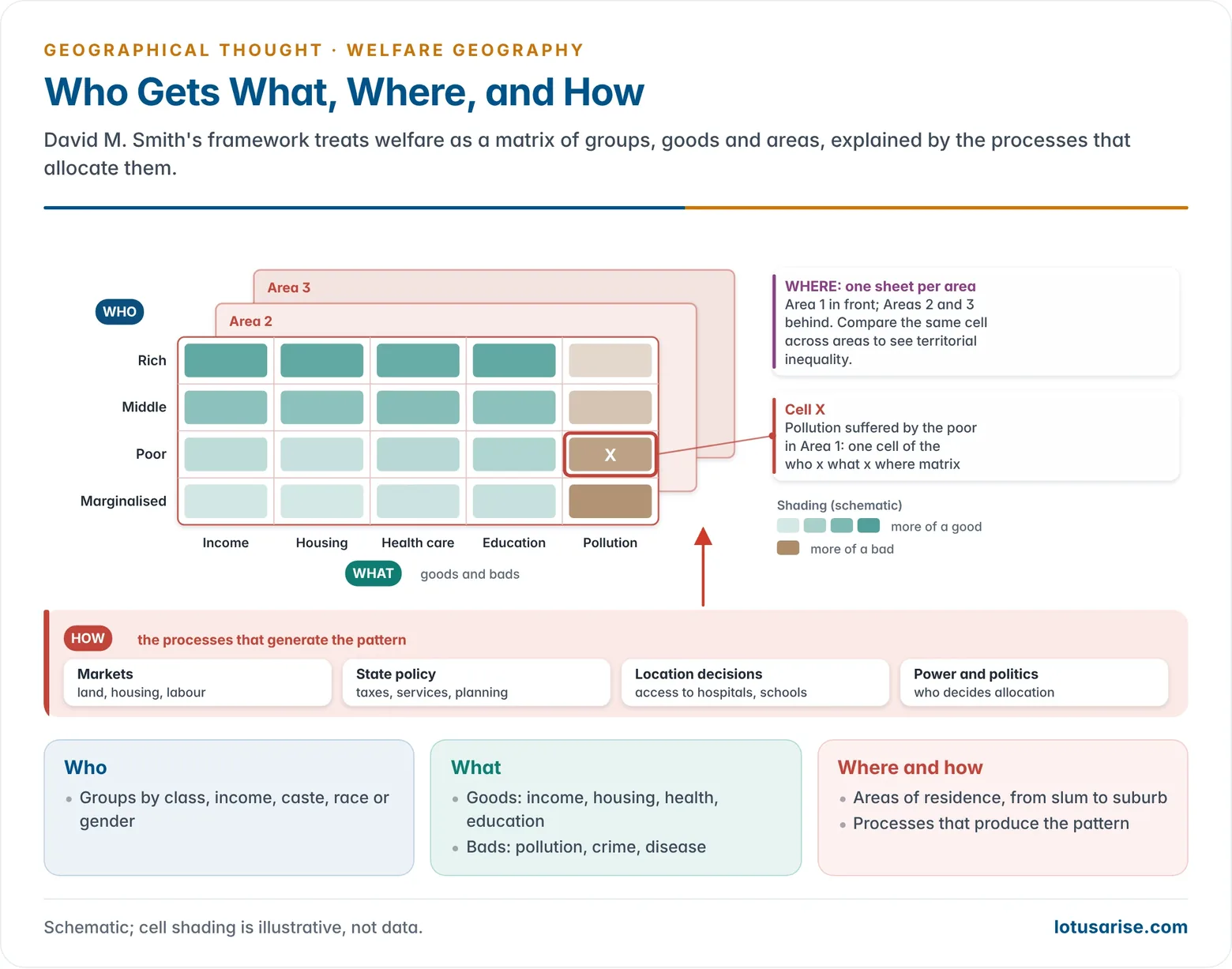
Who Gets What, Where and How
- Who: the population, divided by class, income, race, caste or gender.
- What: the goods (income, housing, health care, education, clean air) and the bads (pollution, crime, disease) that each group receives.
- Where: the area of residence, such as a city’s planned colonies or its slums.
- How: the social and political processes that produce the observed distribution.
- Smith arranged the first three as a three-dimensional matrix: each cell records how much of a good or bad one group receives in one area, and how explains the pattern.
Efficiency, Equity and Pareto
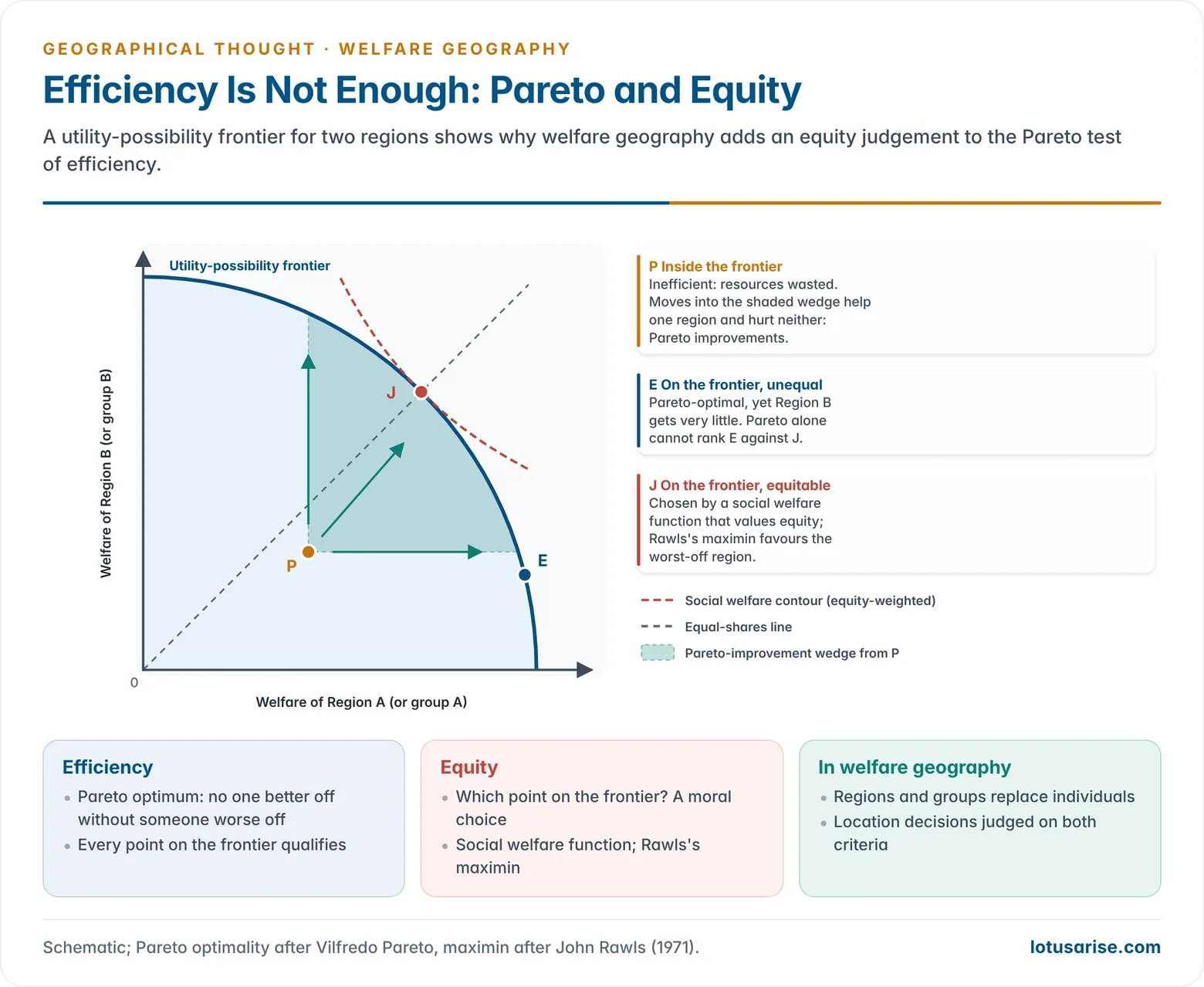
- Pareto optimality, after the economist Vilfredo Pareto (1848–1923), is a state in which no one can be made better off without making someone else worse off.
- Every point on a utility-possibility frontier for two groups or regions is Pareto-optimal, yet the criterion says nothing about how fairly welfare is shared.
- Welfare geography therefore judges by both criteria, adding equity, a moral choice, to efficiency through a social welfare function that ranks points on the frontier.
- Rawls’s maximin principle favours the arrangement that makes the worst-off group or area as well off as possible.
Territorial Social Justice
- Territorial justice means that each area receives public resources in proportion to its needs, a test first proposed by Bleddyn Davies (1968).
- David Harvey (1973) proposed three criteria for distributing social income between territories:
- Need: the needs of each area are met first.
- Contribution to the common good: resources go where they create the largest inter-territorial multiplier effects.
- Merit: extra help goes to areas with environmental or other disabilities, so they can catch up.
- Smith held that the group and place a child is born into already limit its chances, so spatial justice is part of social justice.
Measuring Well-Being: Social Indicators
- Social indicators measure the condition of people in an area and are often combined into a composite index of well-being.
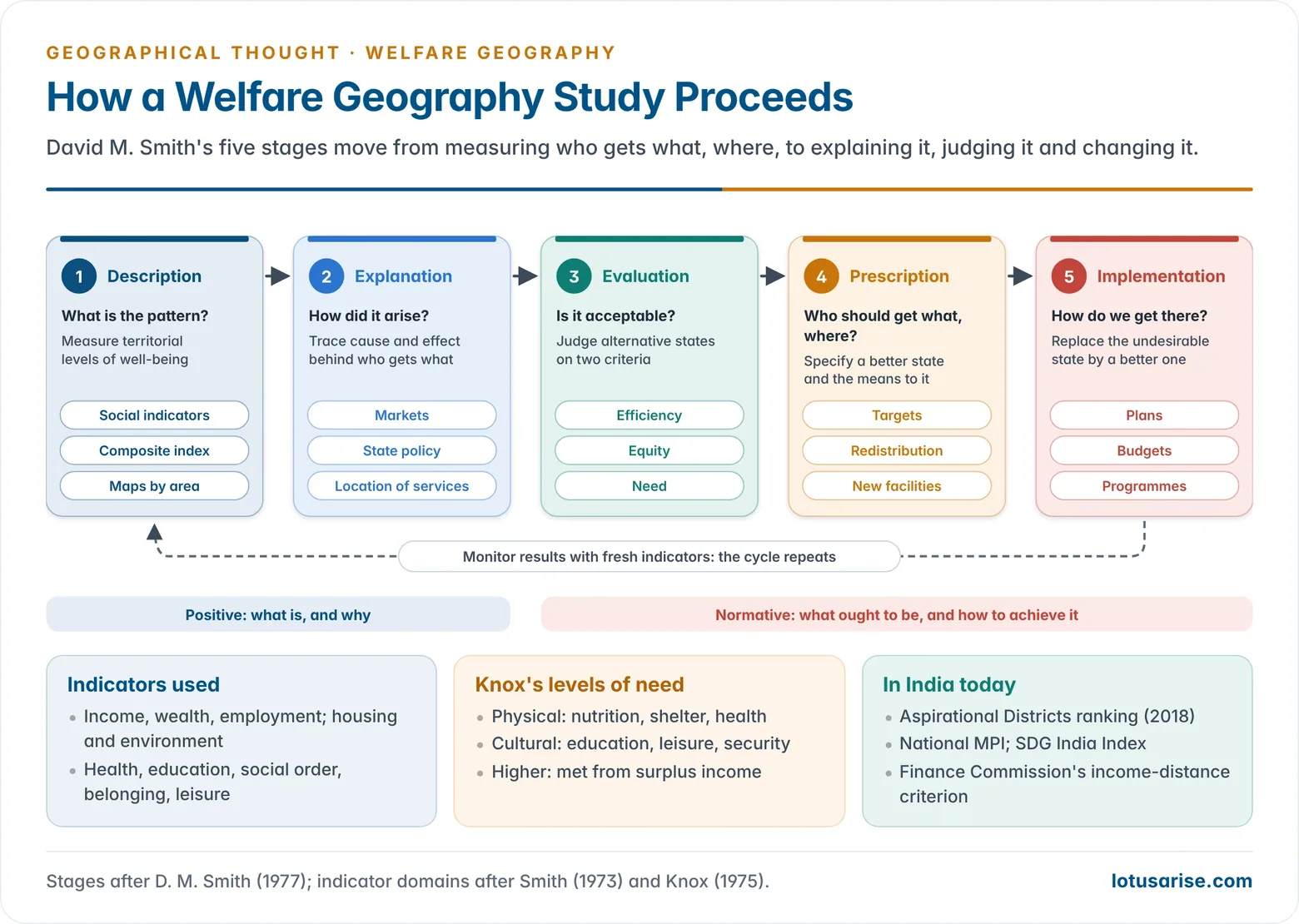
- Smith (1973) grouped indicators under income, wealth and employment; the living environment; health; education; social order; social belonging; and recreation and leisure.
- Paul Knox (1975) grouped human needs into three levels:
- physical needs: nutrition, shelter, health;
- cultural needs: education, leisure, security;
- higher needs: those met from surplus income.
- Smith’s method runs through five stages:
- Description: identify territorial levels of well-being.
- Explanation: trace the cause-and-effect links behind them.
- Evaluation: judge alternative states on efficiency and equity.
- Prescription: decide who should get what, where.
- Implementation: replace the undesirable state with a better one.
- This work is the ancestor of today’s social well-being measures and the Human Development Index.
Scope, Comparison and Evaluation
Scope and Interdisciplinary Character
- Location is distributive: because of distance and accessibility, every hospital, school, road or sewage works benefits some people and places more than others, so location decisions are welfare decisions.
- Subfields grew from it: the geography of crime, health care, housing, poverty, public-service provision and environmental justice.
- Interdisciplinary face: it draws on welfare economics for method, sociology and political science for process, moral philosophy for justice and planning for practice.
- Smith saw welfare as a modern equivalent of the regional concept: a theme that ties geography together and links it to the wider social sciences.
Welfare and Radical Approaches Compared
| Basis | Welfare approach | Radical approach |
|---|---|---|
| Philosophy | Liberal welfare economics; social justice | Marxism; anarchism |
| View of system | Inequality correctable within capitalism | Inequality inherent in capitalism |
| Aim | Redistribution and better planning | Change in relations of production |
| Method | Social indicators, mapping, evaluation | Political economy, structural analysis |
| Role of state | Main agent of reform | Part of the problem |
| Tone | Reformist, policy-oriented | Revolutionary, critical |
| Leading figures | D. M. Smith, Knox, Coates | Harvey, Peet, Bunge |
- Both share the same origin and concern with inequality. Harvey’s Social Justice and the City spans the two, moving from liberal to Marxist formulations, and welfare geography later absorbed much of the radical analysis of process.
Indian Applications
- Area-based programmes target lagging places as well as poor people, for example the Drought Prone Areas Programme and the Aspirational Districts Programme (2018), which ranks 112 districts on social indicators.
- Fiscal territorial justice: the Finance Commission’s income-distance criterion gives poorer states a larger share of central taxes; it carries the largest weight, 42.5%, in the Sixteenth Finance Commission’s formula for 2026–31.
- Measurement: NITI Aayog’s National Multidimensional Poverty Index maps who gets what, and where; its headcount ratio fell from 29.17% to 11.28% between 2013–14 and 2022–23.
Criticisms
- Too descriptive: early work mapped inequality without explaining it, and its remedies treated symptoms.
- Within the system: radicals charged that it legitimised the status quo by leaving untouched the structures that produce inequality.
- Measurement problems: “welfare” means different things in different societies; indicators and their weights are value judgements, and composite indices hide internal variation.
- Scale: welfare regions are hard to delimit, and data are often unavailable at the right scale.
- Diluted geography: some saw it as applied social science with weak links to geography’s traditional concerns.
- Top-down: it relies on the state and planners and gives little voice to the people it studies, a gap humanistic geography addressed.
Evaluation
- Welfare geography made equality and social justice core values of human geography and joined the discipline to planning and public policy.
- Its ideas live on in social indicators, the human development approach, spatial and environmental justice and the geography of care.
Previous Year Questions
2025Why did the Welfare Approach in Human Geography emerge as a significant perspective in 1970s?2018“Welfare geography emphasizes spatial inequality and territorial justice.” Comment with reference to the main ideas and scope of the subfield.2015“The welfare face of geography makes it an inter disciplinary subject.” Elaborate.2011Write short explanatory note on Welfare Approach in Human Geography.2004Distinguish between radical and welfare approaches in geographic studies.





These notes are too good!
Thanks Sumneet
Touche
You are really saving our time. THANKS
A1
REALLY THESE NOTES ARE VERY HELPFUL, SO PLEASE CONTINUE THIS SERIES
Sure
best notes i ever seen from upsc perspective
Your notes are very useful, they clarify all the concepts well in exam point of view
These notes are vey helpful thank you for providing these notes with low fee.
thank u so much …u have really done an amazing work
Sir, you save our lot of time and energy. It’s paradigm shift in upsc history. Please one request sir start pyq series. I hope you will do.🙏🙏🇮🇳