

- Humanistic geography gives a central and active role to human awareness, agency, consciousness and creativity, and seeks to understand the meaning, value and human significance of life events and places.
- It took shape in the 1970s as the most searching reaction against the positivism of the quantitative revolution, and became a major strand of the critical revolution.
- Its aim is a “people’s geography”, about real people and for them, studying the earth as the home of humankind as people experience, feel and interpret it.
- It is one approach within human geography, the whole field:
| Aspect | Human geography | Humanistic geography |
|---|---|---|
| Nature | The whole field | One approach within it |
| Focus | Spatial patterns, human–environment relations | Experience, meaning, values, sense of place |
| Method | Quantitative, qualitative, GIS | Interpretation, ethnography, texts |
| Relation to positivism | Often compatible | Anti-positivist |
| Key figures | Ratzel, Vidal, Sauer, Harvey | Tuan, Relph, Buttimer, Ley, Guelke |
Development of Humanistic Geography

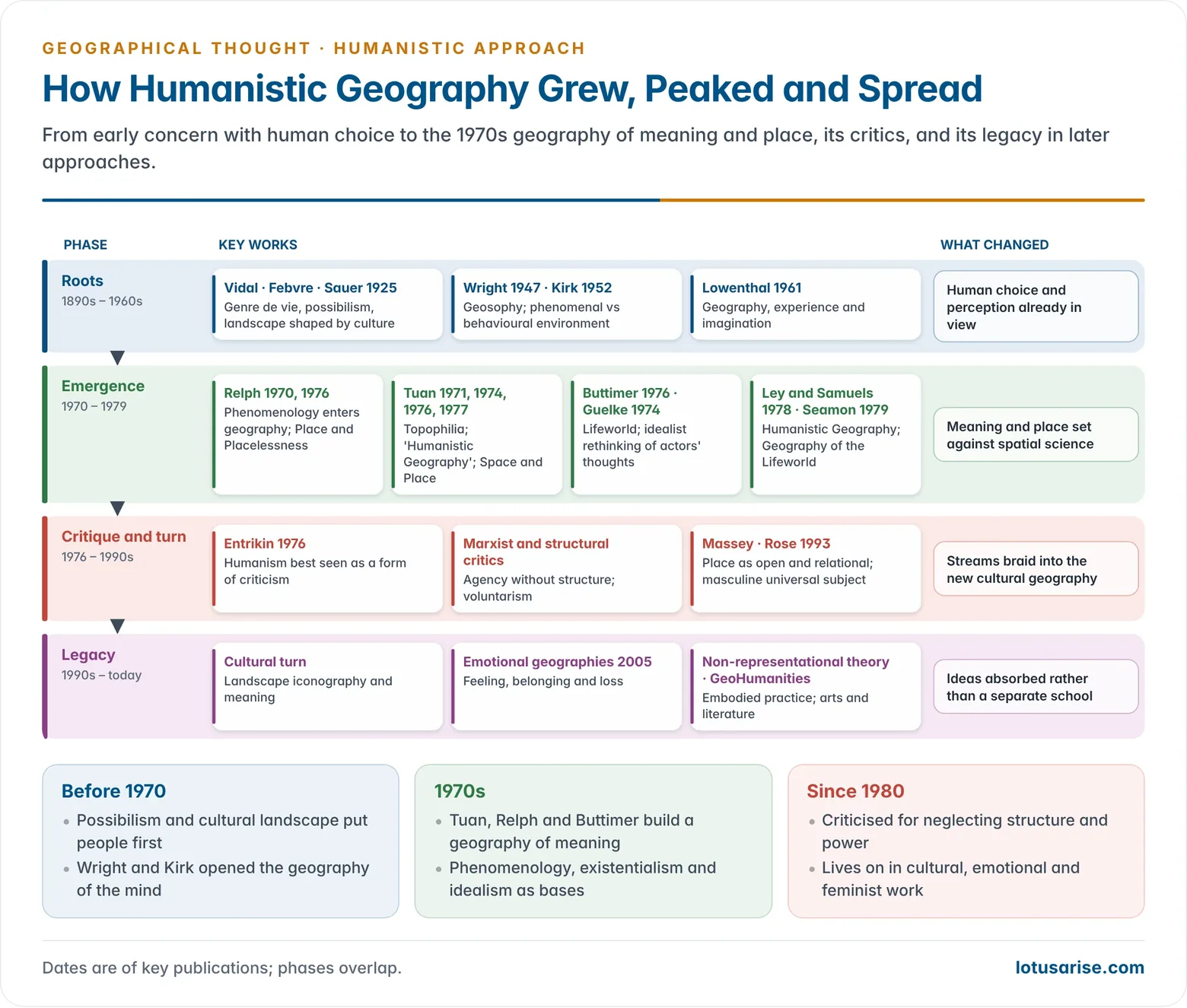
Roots Before the 1970s
- French possibilism stressed human choice. Paul Vidal de la Blache’s *genre de vie* showed ways of life shaping their milieu, with nature only an “adviser”, and Lucien Febvre named the view possibilism (1922).
- Vidal still treated human geography as a natural science with a strong functional streak; humanists later took his holism and regional sensitivity and left the functionalism.
- Carl Sauer’s “The Morphology of Landscape” (1925) treated landscape as shaped by culture. John Kirtland Wright (1947) proposed geosophy, the study of geographical ideas in people’s minds.
- William Kirk (1952) set the perceived behavioural environment against the phenomenal one. David Lowenthal (1961) wrote on geography, experience and imagination.
The Reaction Against Spatial Science
- Logical positivism reached geography through Fred K. Schaefer’s attack on exceptionalism (1953) and sought to remove every anthropomorphic element from knowledge, so that by the late 1960s spatial science treated people as dots on maps, data on graphs and numbers in equations.
- Humanists rejected four of its postulates: rational economic man, geography as pure geometry, the isotropic surface, and the person as a point on that surface.
- David Ley and Marwyn Samuels (Humanistic Geography, 1978) set the wider context: science and technology, once the road to progress, were now blamed for environmental despoliation and for breaking people into fragments, and the humanist project was to “put man back together again”.
- Humanistic geography’s first task, for J. Nicholas Entrikin (“Contemporary Humanism in Geography”, 1976), was to make geographers aware of the hidden assumptions of their methods. It also sought to restore geography’s synthetic character and interest in unique events, and to reconcile understanding with explanation.
- It began alongside behavioural geography, but the two soon parted: humanists accepted the subjectivity of both researcher and researched and rejected behaviourism’s positivist structures, treating each person–environment interaction as a particular case.
| Basis | Behavioural geography | Humanistic geography |
|---|---|---|
| Philosophy | Modified positivism | Phenomenology, existentialism, idealism |
| View of people | Respond to stimuli via perception | Conscious, free, meaning-making agents |
| Aim | Generalisation, prediction, planning | Understanding (verstehen) |
| Method | Surveys, scaling, statistics | Interpretation, participant observation, texts |
| Allied fields | Psychology, social sciences | Humanities, history, literature |
Key Figures and Works
- Yi-Fu Tuan: “Geography, Phenomenology and the Study of Human Nature” (1971), Topophilia (1974), Space and Place (1977), and “Humanistic Geography” (1976), the paper that named and defined the field: understanding the human world through people’s relations with nature, their geographical behaviour, and their feelings and ideas about space and place.
- Edward Relph: brought phenomenology into geography (1970) and wrote Place and Placelessness (1976).
- Anne Buttimer: “Grasping the Dynamism of Lifeworld” (1976), reviving the Vidalian tradition of understanding regions from the inside.
- Leonard Guelke: “An Idealist Alternative in Human Geography” (1974).
- David Seamon: A Geography of the Lifeworld (1979), on the routines of everyday movement.
Philosophical Foundations
Phenomenology
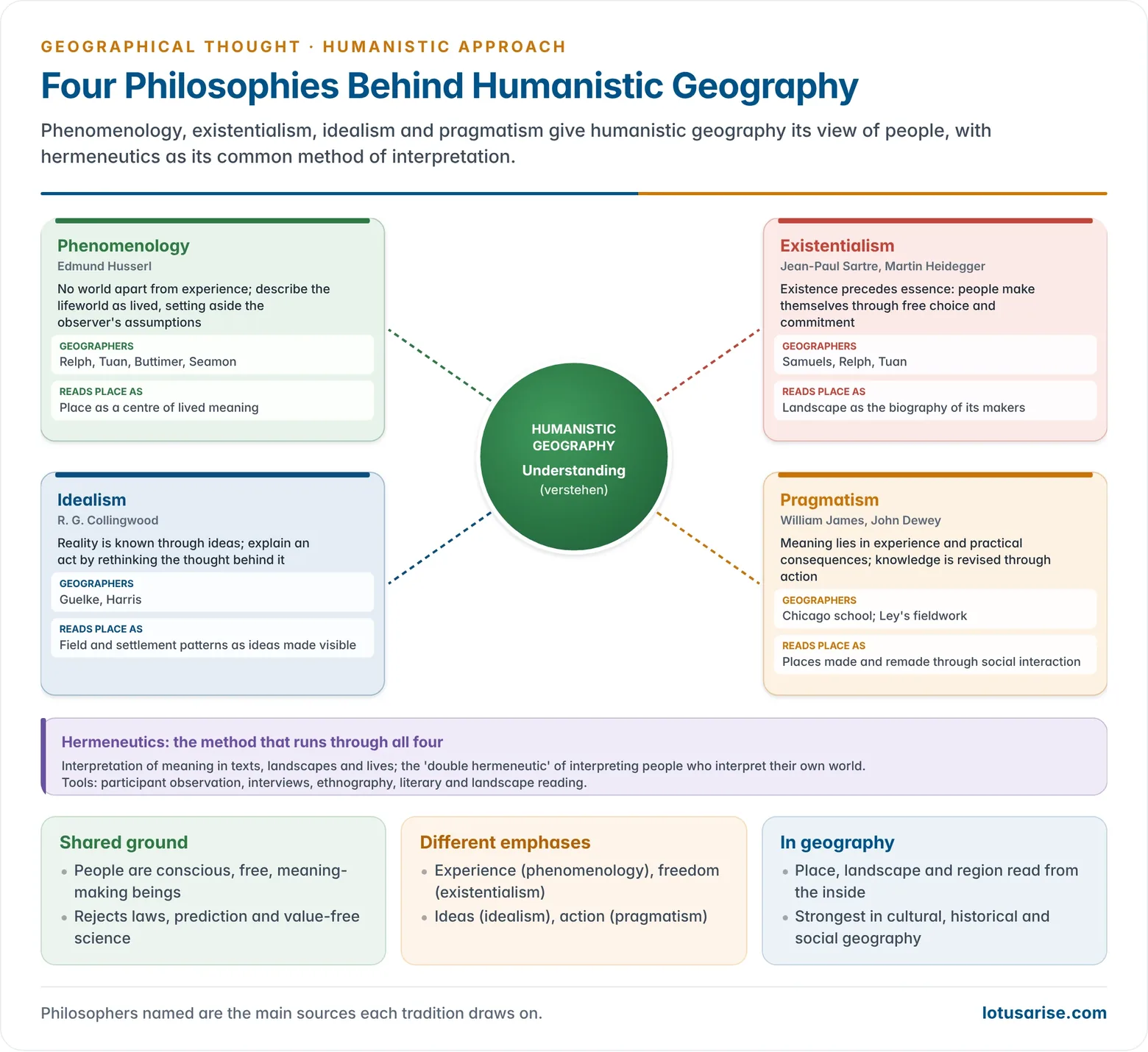
- Phenomenology, founded by Edmund Husserl, holds that there is no objective world apart from human experience: all knowledge arises from the lived world (lifeworld).
- Consciousness is intentional: things mean something to someone. The researcher brackets out his own presuppositions and describes the world as the subject experiences it, because explanation would impose the observer’s constructs on the data of consciousness.
- Alfred Schutz’s “taken-for-granted world” showed that most everyday behaviour is habitual, built on typifications that communities come to share.
- In geography: Relph’s and Tuan’s studies of place, Buttimer’s lifeworld, and Seamon’s “body-ballets” and “place-ballets” of habitual movement.
Existentialism
- Its maxim, from Jean-Paul Sartre, is “existence precedes essence”: people first exist, then make themselves through free choice, decision and commitment. It therefore opposes determinism of every kind.
- In geography:
- Existential space is space given meaning by human projects.
- Landscapes are biographies (Marwyn Samuels): for every landscape, from one person’s home to the works of a civilisation, someone can be held accountable, and it can be read backwards to its makers.
- Indian example: Chandigarh, planned by Le Corbusier in the 1950s, can be read as a biography of the modernist hopes of newly independent India.
- Dwelling, Martin Heidegger’s idea of living closely with places and caring for them, led humanists to see geography as something lived by every person who perceives and acts in space.
Idealism
- Reality is mind-dependent, and the world is known only through ideas; mental activity has a life of its own, free of material processes.
- Cole Harris (1971) likened geography to history: both synthesise whole complexes of phenomena, and the historical mind is contextual and does not seek laws.
- Guelke (1974), drawing on R. G. Collingwood’s philosophy of history, asked geographers to rethink the thoughts behind human actions.
- The explanation of a field pattern, a settlement or a cleared forest is complete once the actor’s goals and beliefs are recovered; the geographer needs no theory of his own.
- The method suits historical and regional geography.
- Critique: it ignores unconscious behaviour and the material consequences of action, and its explanations are hard to verify.
Pragmatism and Hermeneutics
- Pragmatism (William James, John Dewey) defines meaning by its role in experience and problem-solving; knowledge is fallible and revised through action.
- With the symbolic interactionism of the Chicago school, it shaped much humanistic fieldwork, which treats meanings as social and constantly reconstructed and judges a social reality by its consequences for those who live it.
- Hermeneutics, from the German human sciences (Geisteswissenschaften), is the theory of interpretation.
- In its “double hermeneutic” the researcher interprets people who are themselves interpreting their world, and it offers a way to read regions, landscapes and texts.
Concepts and Themes
Characteristics
- Anthropocentrism: people, their experience and their meanings are the core of inquiry.
- Holism: phenomena are seen in their total context, as in Vidal’s regional synthesis.
- Subjectivity and particularity: unique events and places matter more than spurious generalisations.
- Four emphases run through the literature:
- Agency: people act and change their world with their tools and technology, close to the possibilist view of man as an active agent.
- Consciousness: they reflect on their world through perceptions and mental images, the ground shared with behaviouralism.
- Awareness: they know its limits and possibilities and act accordingly, the existentialist strand.
- Creativity: they invent new tools and ways of living and remake a neutral environment.
Place, Topophilia and Placelessness
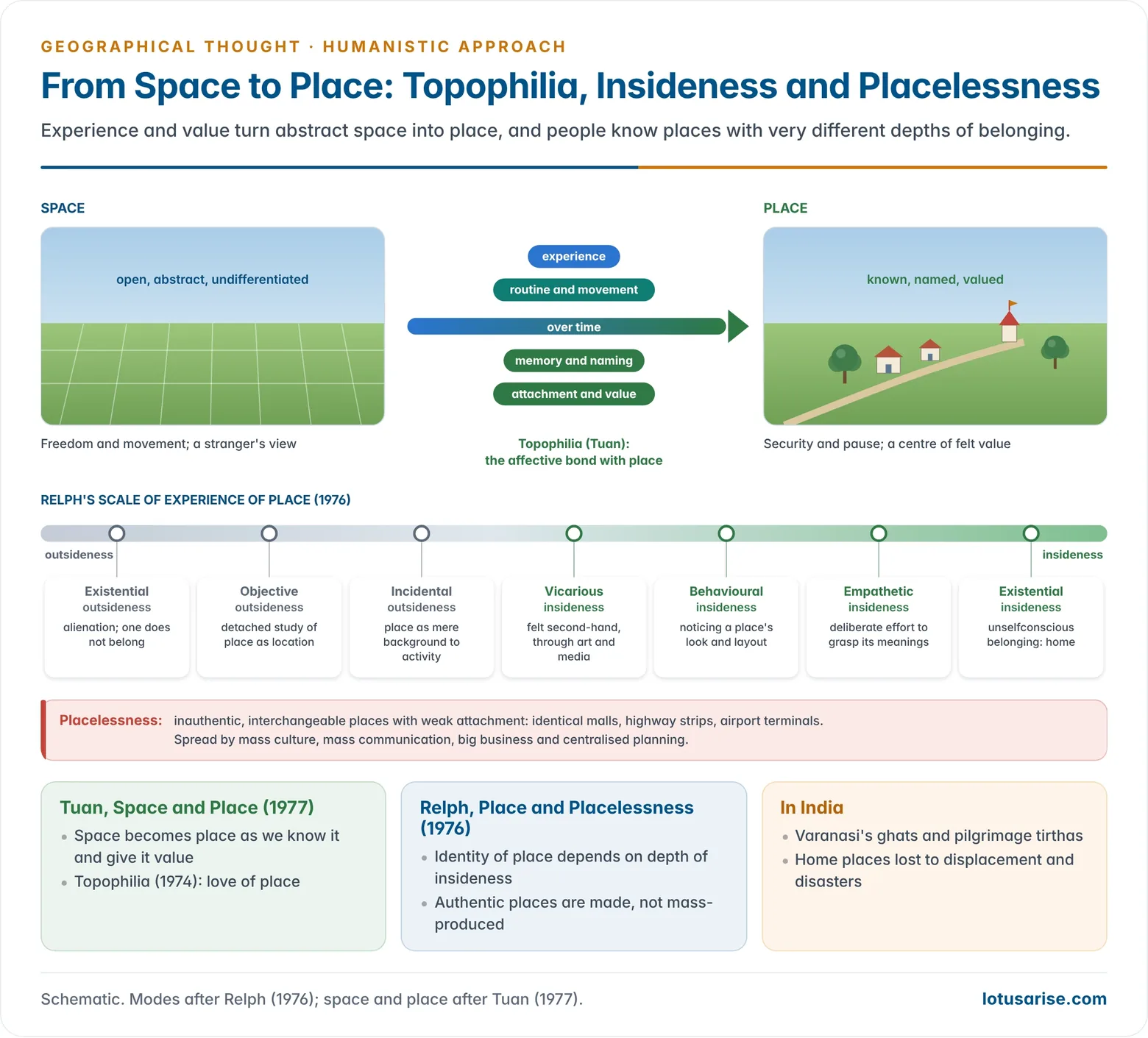
- Space and place (Tuan): undifferentiated space becomes place as we come to know it and endow it with value. Space means freedom and movement; place means security and pause.
- Topophilia (Tuan, 1974): the affective bond between people and place, coupling sentiment with setting. It can be aesthetic, tactile, or rooted in home and memory.
- Indian examples: the ghats of Varanasi for pilgrims and residents, and the village kuldevta shrine.
- Sense of place and insideness (Relph): people experience places from varying degrees of insideness or outsideness, from the stranger’s detached view to the deep, unselfconscious belonging of existential insideness.
- Placelessness (Relph): mass culture, standardised planning and tourism produce inauthentic, interchangeable places such as identical malls, highway strips and airport terminals.
- Indian sacred geography: pilgrimage networks, tirthas and river goddesses bind the subcontinent into a meaningful whole (Diana Eck, India: A Sacred Geography, 2012). Surinder Bhardwaj’s Hindu Places of Pilgrimage in India (1973) mapped pilgrim fields by the meaning places held for devotees.
Tuan’s Five Themes
| Theme | Concern | Illustration |
|---|---|---|
| Geographical knowledge | Personal geographies needed for survival | Folk navigation of Pacific islanders |
| Territory and place | How space becomes a place of identity | Attachment to birthplace and homeland |
| Crowding and privacy | Culture mediates stress of density | Dense cities need not mean more crime |
| Livelihood and economics | Knowledge shapes how people earn a living | Life-sustaining vs life-destroying work |
| Religion | The human search for coherence and meaning | Sacred spaces and pilgrimage |
- Territory: foragers know territory as a network of paths and places, settled cultivators as bounded property, and memory and rites of birth and death turn space into home.
- Crowding and privacy: culture and institutions absorb the stress of density. Crowded Hong Kong was no more crime-prone than roomier Western cities, and the Kalahari San gather closely by choice.
Methods
- Participant observation, in-depth interviews, focus groups and ethnography, using logical inference in place of statistical inference.
- Reading texts: landscapes as repositories of meaning, novels, poetry, art and travel writing, with the tools of literary criticism and art history. Iconography reads a landscape’s symbols the way art historians read a painting.
- Tuan’s model regional geographer was the Victorian novelist, who joined subjective and objective description.
- Reflexivity: researchers acknowledge their own position and values.
Evaluation
Contributions
- It put human experience, perception and action at the heart of geography, and brought into view sense of place, attitudes and values, which positivist methods could not measure.
- It opened the debate on human agency, a central theme of 1980s social theory.
- It established the importance of local difference and particularity of place when theory still assumed an isotropic plain.
- It dissolved the fact–value split and made researchers more self-critical about their values.
- Its focus on meaning and place fed the revival of cultural geography and the “cultural turn”.
- It brought qualitative methods and “thick” description into the discipline.
Criticisms
- No proof: one can never be sure an interpretation is right, though defenders reply that natural science, too, is a history of abandoned theories.
- Methodological obscurity: “understanding experience” can justify any method, and the work does not accumulate.
- Unscientific to its critics: it yields no generalisations, theories or laws, and Entrikin judged it best understood as a form of criticism of science, unable to replace it.
- Splits the discipline: separating human from physical geography on methodological grounds weakens geography’s unity.
- Little applied value: subjective readings rarely give clear policy for industrial location, land use or planning.
- Much preaching, little practice: early humanistic writing was long on programme and short on empirical studies.
- Voluntarism and idealism: Marxist geographers argued it ignores the structures of class, capital and power that constrain choice.
- Fetish of experience: David Ley himself warned against treating subjectivity as cut off from context and material life.
- Static, essentialised place: post-structuralist and feminist geographers, including Doreen Massey with her “global sense of place”, saw place as open, contested and relational. Gillian Rose criticised the universal male subject behind much humanistic writing.
Decline and Continuing Influence
- From the 1980s humanists turned from attacking positivism to criticising structuralism and sharpened their empirical methods in two streams: a humanities stream (the iconography of landscape, often in historical geography) and a social-theory stream (ethnography and symbolic interactionism, often in social geography).
- By the 1990s the streams had merged into the new cultural geography, and many humanists moved to postmodern, postcolonial and post-structural work, so a distinct humanistic geography became hard to identify.
- Its ideas live on in space and place studies, in postmodern and feminist geographies, and in the contrast with welfare geography, which shares its concern for people but not its method.
- Welfare geography, its contemporary, asks in David M. Smith’s phrase “who gets what, where, and how”, mapping well-being with social indicators to guide state policy. Critics found it descriptive, reformist and top-down, and its indicators carry hidden value judgements; humanists answered its neglect of people’s own voices.
Recent Developments
- Emotional geographies: Joyce Davidson, Liz Bondi and Mick Smith (eds), Emotional Geographies (2005), on grief, fear, joy and belonging.
- Non-representational theory: Nigel Thrift (2008) and others study embodied practice and affect, extending the phenomenological interest in the body.
- GeoHumanities: collaboration with the arts and literature, including literary and cinematic geographies.
- Place attachment and displacement: sense of place now informs resettlement after disasters and dams. When subsidence forced families out of Joshimath (2023), they lost a home as well as housing.
Previous Year Questions
2003Present a critical analysis of human and welfare approaches in Human Geography.





The notes are not only too good but are well researched too. I wonder why you are doing all this for us. Anyway, thank you sir.
I have suffered a lot and lost a lot of time and money in making these notes, so I do not want to do the same. Thanks and Most welcome and YES please share these notes with needy people.
humanistic approach 🙂
Effert to make best content has seen in notes I can understand. No any single book provide such type of matter easy to understand .. thanku very much sir
Thanks, Varun
how the humanistic approach is different from human geography?
Humanistic approach(exclusively human centric) is a subset of human geography (interaction of human with environment)
Really really wonderful notes thanx alot 😇😇
i have lacked confidence in thoughts part of paper 1 as always untill i found this amazing site .its like blessing to all the geography optional students. thanks you somuch lotus for providing these notes.
One of the best source. Thank you. I also purchased your previous year’s questions compilation
Can’t thank u enough sir❤️
Bhai Love you ،likh likh kr note Book bhar gyi
i recently purchased geopt. prime , looking at physical geog. summarised approach that is unique / un plagiarised, but here i find text COPIED exactly same from a source…i would request the admin to kindly update the contents in more innovative way…