- A paradigm is the shared framework of a scientific community: the accepted problems, theories, methods and model solutions that tell its members what is worth studying and how.
- The idea comes from the American historian of science Thomas S. Kuhn, in The Structure of Scientific Revolutions (1962). For him, science advances not by steady accumulation but through long calm phases broken by revolutions.
- A paradigm shift is the replacement of one such framework by another after the old one fails to solve mounting problems.
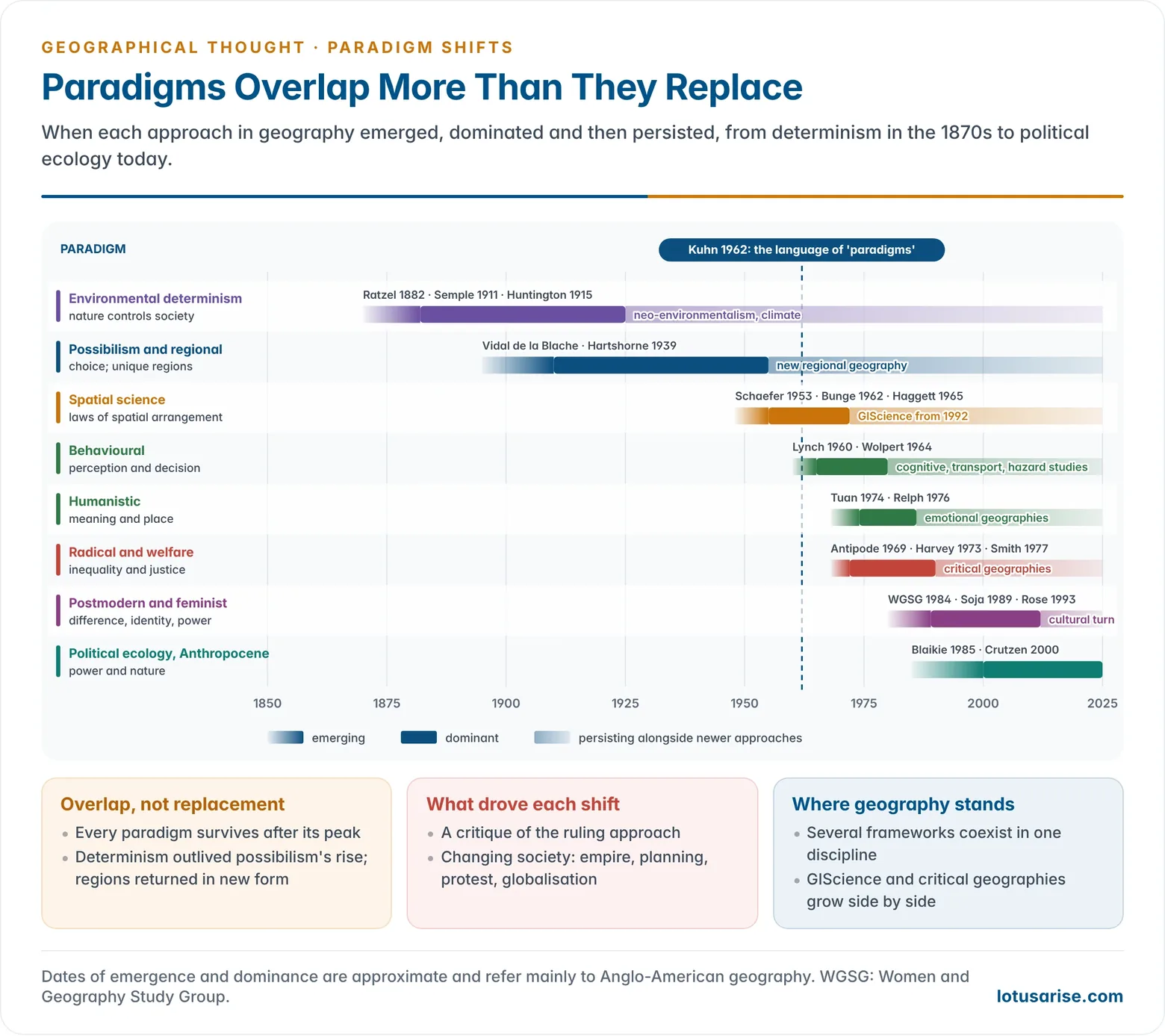
- From the mid-1960s geographers used Kuhn’s language to read their own history as a chain of shifts: from determinism to the regional tradition, then to spatial science, and on to behavioural, humanistic, radical and postmodern geographies.
- The reading is useful but contested. Old approaches rarely die, so geography today is better described as plural and multi-paradigmatic, and its history as written is strongly Eurocentric.
Kuhn’s Model of Scientific Change

What a Paradigm Is
- Kuhn defined paradigms as universally recognised scientific achievements that, for a time, provide model problems and solutions to a community of practitioners.
- Peter Haggett later called a paradigm a kind of “super-model”: a model of what models in a discipline should look like.
- A paradigm does three jobs:
- It defines the questions worth asking and the kinds of answer that count as professional.
- It prescribes methods, so that research becomes recognisably “geographical”, “economic” and so on.
- It trains newcomers through textbooks and exemplary studies, so the community reproduces itself.
- In the postscript to the 1970 second edition, Kuhn narrowed the term to a “disciplinary matrix” (shared symbols, models, values) and “exemplars” (model solutions), after critics found more than twenty senses of “paradigm” in his book.
Phases of Scientific Development
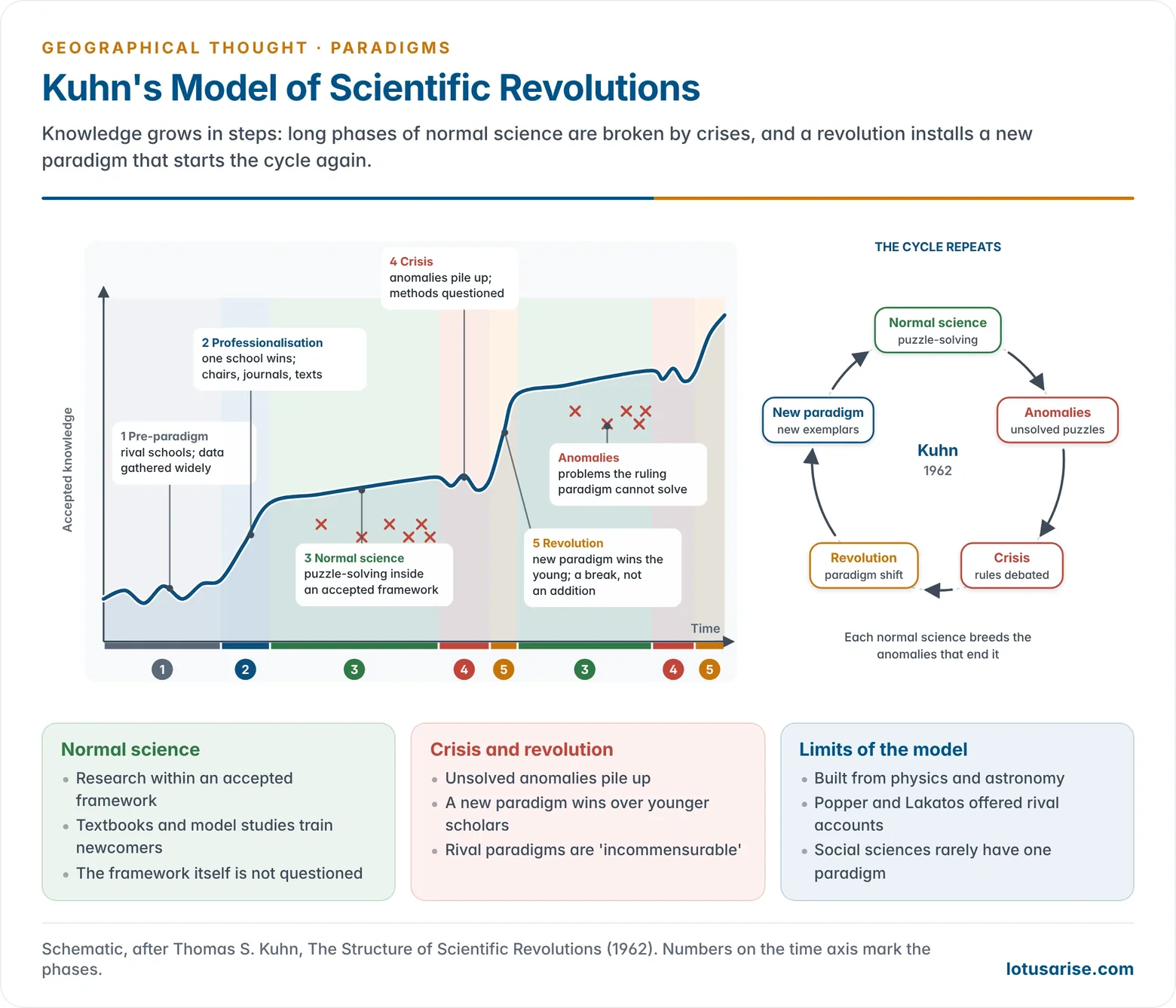
- Pre-paradigm phase: several rival schools grow around individual scholars. Data are collected widely and without selection, specialisation is low, and no school is accepted as more scientific than the others.
- Professionalisation: one school begins to dominate, because it offers new methods or more interesting questions. University posts, journals and textbooks follow.
- Paradigm phase, or “normal science”: research concentrates within a clearly bounded problem area. Kuhn likened it to puzzle-solving: the framework itself is not questioned.
- Anomalies and crisis: problems pile up that the ruling paradigm cannot solve. Old data are reassessed, philosophical and methodological debate revives, and speculation is freer.
- A crisis can end in three ways: the old paradigm solves the problems after all; no better theory appears and work continues in the old frame; or a new paradigm wins a growing following.
- Revolution: the new paradigm brings a break in continuity, a reconstruction of theory rather than an addition to it. Scientists come to see the world differently.
- The change is not wholly rational. The new paradigm solves the problems the old one could not, but may lose some answers the old one gave easily.
- Kuhn called rival paradigms incommensurable: they cannot be judged by a neutral common yardstick.
- Younger scholars usually carry the change. Established figures are seldom converted; their following simply thins out.
- The cycle then repeats: new normal science, new anomalies, new crisis. Plotted against time, knowledge rises in steps: long plateaus, then sharp climbs.
Evaluating Kuhn’s Model
- Merits:
- It explains why disciplines change in bursts and why debates over method become fierce at certain moments.
- It shows that science is a social activity of communities, training and careers, not a purely logical one.
- It made it easier for new frameworks to win acceptance, and it gives a useful lens for a discipline’s history.
- Limits:
- Kuhn built the model from physics and astronomy. He regarded the social sciences as still lacking a single ruling paradigm, so applying it to geography stretches it.
- Karl Popper’s falsification (1934) and Imre Lakatos’s research programmes (1970) offered rival accounts in which rational testing, not group conversion, drives change.
- Critics feared it could license change for its own sake: a group could declare its framework “a new paradigm” without proving it better.
- It offers a guide, not a complete explanation, of how any one discipline developed.
Paradigms in the History of Geography
Applying Kuhn to Geography
- Richard J. Chorley and Peter Haggett, after editing Frontiers in Geographical Teaching (1965), brought the idea into geography in their chapter “Models, paradigms and the new geography” in Models in Geography (1967).
- They argued that the traditional, classificatory paradigm was under severe stress and that geography should adopt a model-based paradigm. The language of revolution helped justify the quantitative revolution.
- David Harvey used the same frame twice. Explanation in Geography (1969) presented positivist method as the way to a unified science. In Social Justice and the City (1973), the “anomalies” of positivism became the case for a Marxist revolution in geography.
- The Kuhnian frame thus became a weapon in debate: each new school described itself as the next paradigm.
The Sequence of Paradigm Shifts
Pre-Paradigm Phase: to the Mid-19th Century
- Read through Kuhn, geography stayed pre-paradigmatic until about the time of Darwin.
- Immanuel Kant clarified geography’s place among the sciences but founded no school and set no paradigm.
- Carl Ritter described his method clearly. It was inductive in the manner of Francis Bacon: observe patterns, then explain them, then test the explanation on other data.
- His explanation was teleological: everything on earth served a purpose planned by God. This cannot be tested, so it is not scientific explanation, though it had the form of a paradigm.
- The Ritterian school did not carry the subject into professional, paradigm-led research.
Determinism: The First Paradigm
- After On the Origin of Species (1859), scholars looked for natural laws governing society as well as nature.
- Darwinism gave geography cause-and-effect explanation, and Friedrich Ratzel led the subject into professional status. His deterministic school, carried on by Ellen Churchill Semple and Ellsworth Huntington, is usually taken as geography’s first paradigm.
- Method changed from induction towards the hypothetico-deductive route: start from an a priori model, derive hypotheses, test them against data.
- William Morris Davis’s cycle of erosion and Halford Mackinder’s heartland were models of this kind, and they won geography respect among the sciences.
- In practice the testing was weak. Generalisations came first and a few selected examples followed as “proof”; true experiments were impossible.
Possibilism and the Regional Paradigm
- Paul Vidal de la Blache and the French school held that people choose among the possibilities nature offers. Field study of small, unique regions (pays) became the method.
- The new paradigm did not displace the old. Determinism survived alongside it, supported by geomorphology and physical geography.
- Griffith Taylor’s stop-and-go determinism and O. H. K. Spate’s probabilism offered middle positions in the long debate over environmentalism.
- Between the wars and just after 1945 the regional paradigm dominated in France, Britain and the United States.
- Richard Hartshorne’s The Nature of Geography (1939) defined geography as the study of areal differentiation, essentially idiographic.
- It generalised without structured explanation, describing parallel topics region by region. In India the same tradition produced R. L. Singh’s India: A Regional Geography (1971).
- By the 1950s the paradigm was losing support. Topical specialisms grew, and the regional method seemed descriptive and stagnant.
Spatial Science: The Classic Kuhnian Revolution
- Fred K. Schaefer’s “Exceptionalism in Geography” (1953) attacked Hartshorne’s claim that geography is a unique, law-free discipline. The Hartshorne–Schaefer debate followed.
- Schaefer held that geography should seek laws of spatial arrangement, the patterns of phenomena rather than the phenomena themselves.
- William Bunge’s Theoretical Geography (1962) made geometry the language of geography. Peter Haggett’s Locational Analysis in Human Geography (1965) and Models in Geography (1967) completed the case.
- The shift has the features Kuhn described: a crisis in the old paradigm, a young generation (Washington, Iowa, Lund, Cambridge), new journals and textbooks, and a new idea of what counts as research: models, statistics and locational analysis.
- India’s growth-centre strategy of regional planning, set out by R. P. Misra, K. V. Sundaram and V. L. S. Prakasa Rao (1974), applied the new central-place and growth-pole models.
Behavioural, Humanistic, Radical and Welfare Geographies
- By the late 1960s spatial science faced its own anomalies: unrealistic assumptions, no place for values or meaning, and silence on poverty, racism and war.
- The response came along several lines at once, together called the critical revolution:
- Behavioural geography replaced economic man with the perceiving, deciding person, while keeping much of positivist method.
- Humanistic geography rejected law-seeking for understanding of meaning and place.
- Radical geography explained spatial inequality through capitalism and class.
- Welfare geography asked “who gets what, where and how” and sought territorial justice within the existing system.
Postmodern, Feminist and Cultural Geographies
- From the 1980s, postmodern and feminist geographies doubted grand theory itself. They stressed difference, identity, gender and the voices of the marginalised.
- The cultural turn of the 1990s treated culture as a shifting system of meanings through which space and identity are made. Space came to be seen as socially produced.
| Paradigm | Main period | Core idea | Method | Key figures |
|---|---|---|---|---|
| Pre-paradigm | to 1859 | Earth as God’s design; description | Induction, teleology | Kant, Ritter |
| Determinism | 1870s–1920s | Nature controls society | Hypothetico-deductive (loose) | Ratzel, Semple, Huntington |
| Possibilism / regional | 1900s–1950s | Human choice; unique regions | Fieldwork, regional synthesis | Vidal, Hartshorne |
| Spatial science | 1950s–60s | Laws of spatial arrangement | Models, statistics | Schaefer, Bunge, Haggett |
| Behavioural / humanistic | 1960s–70s | Perception; meaning of place | Surveys; interpretation | Wolpert, Tuan, Relph |
| Radical / welfare | 1970s | Inequality and justice | Political economy; indicators | Harvey, D. M. Smith |
| Postmodern / feminist | 1980s on | Difference, identity, power | Discourse, qualitative | Soja, Dear, Massey, Rose |
Critique of the Kuhnian Reading
- No complete revolution: determinism lived on beside possibilism, and regional study beside spatial science. Each “new paradigm” added to the field without abolishing its predecessors.
- A distorted Kuhn: David Stoddart (“The paradigm concept and the history of geography”, 1981) and Andrew Mair (“Thomas Kuhn and understanding geography”, 1986) showed that geographers used a simplified caricature of Kuhn.
- The caricature was used prescriptively, to legislate what proper geography should be, rather than to describe how the discipline worked.
- Pluralism, not normal science: Brian J. L. Berry (1978) observed that interparadigm conflict had been more common than calm normal science. R. J. Johnston identified several coexisting disciplinary matrices in Anglo-American geography after 1945.
- Context, not internal logic: Harvey himself criticised Kuhn for ignoring the material and social conditions of science.
- The contextual approach (Vincent Berdoulay, 1981; David Livingstone, The Geographical Tradition, 1992) explains change through the society, politics and institutions of each period.
- In that reading, determinism matched the age of empire, spatial science matched post-war planning, and radicalism matched the protests of 1968.
Positivism and Its Impact
Positivism: Meaning and Origins
- Positivism is the philosophy that science is the only source of true knowledge, and that knowledge must rest on observable, verifiable facts.
- It draws on Francis Bacon’s method of induction and John Locke’s principle that all knowledge comes through the senses.
- Auguste Comte (1798–1857) systematised it in his Cours de philosophie positive (6 volumes, 1830–42).
- He wrote against the speculative, romantic “negative philosophy” of the revolutionary era. Comte wanted a “positive”, constructive science that would organise society, not overturn it.
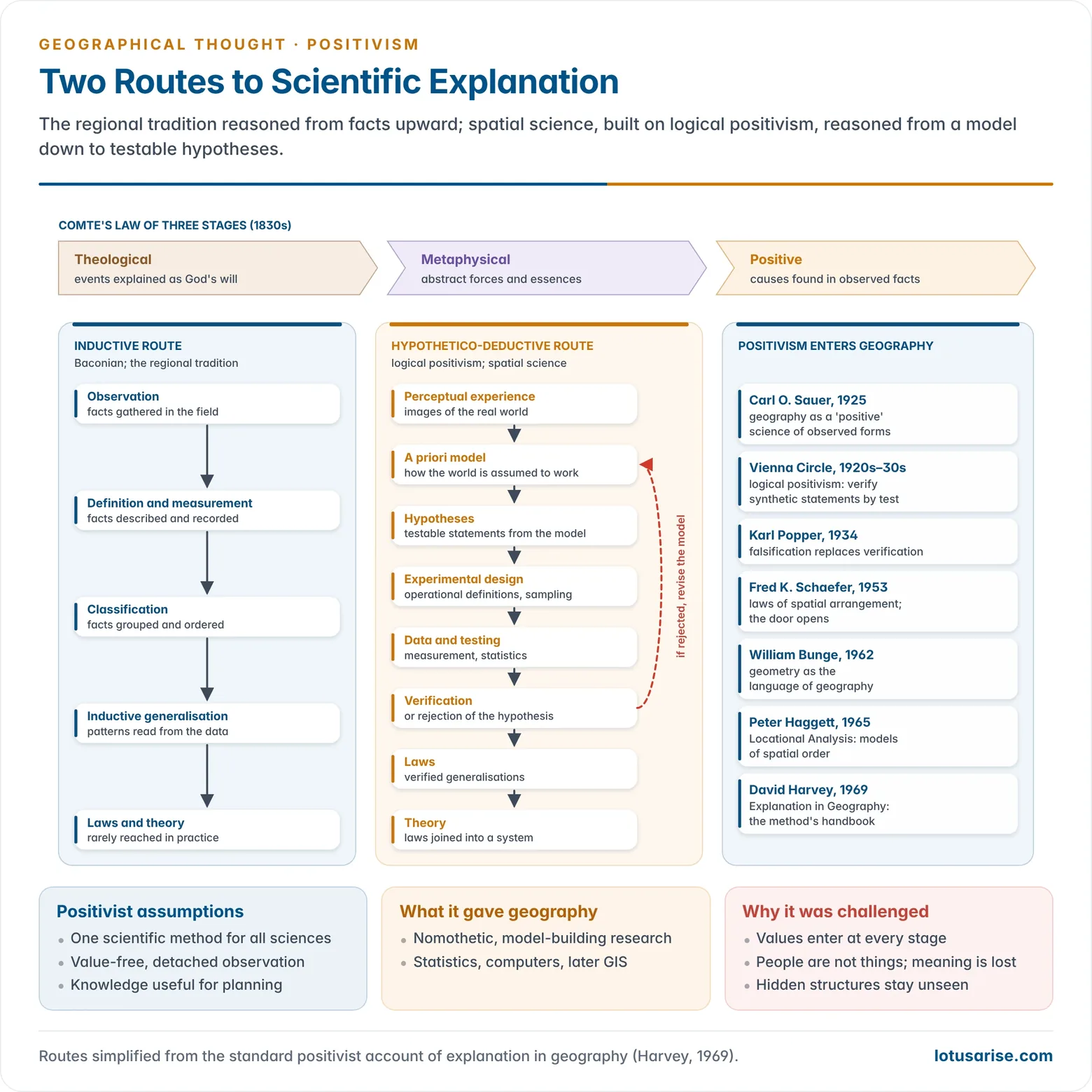
- Law of three stages: human thought passes from the theological (events explained as God’s will), through the metaphysical, to the positive stage, when causes are found in observed facts.
- He argued for a science of society (he coined the word sociologie) built on the same principles as the natural sciences.
- Comte’s precepts:
- Direct experience: knowledge rests on observation of reality.
- La certitude: there is a single scientific method for all sciences. They differ in what they study, not how.
- Le précis: the goal is testable theory, so value judgements are excluded.
- L’utile: knowledge must be useful, a tool for social engineering.
- Le relatif: knowledge is unfinished and advances by unifying theories.
Logical Positivism
- In the 1920s and 1930s the Vienna Circle (Moritz Schlick, Rudolf Carnap and others) restated positivism as logical positivism, or logical empiricism.
- It separated analytic statements, true by definition (logic, mathematics), from synthetic statements, whose truth must be verified empirically by testing hypotheses.
- This gave deductive reasoning full scientific standing. It was the version that later entered geography.
- Karl Popper replaced verification with falsification: a scientific hypothesis is one that could be shown false, and it stands only until it is.
- Three doctrines underlie the positivist idea of science:
- Scientism: its method is the only true route to knowledge.
- Scientific politics: science can solve social problems through planning and social engineering.
- Value-freedom: scientific judgements are objective and independent of moral or political commitments.
- Applied to society, the doctrine of naturalism assumed that human decisions have identifiable causes, follow behavioural laws, can be observed objectively by a detached observer, and can be steered by changing conditions.
Positivism in Geography
- Carl O. Sauer’s “The Morphology of Landscape” (1925) already spoke of geography as a “positive science” of observed forms. Hartshorne, however, avoided causal laws, which seemed too close to discredited determinism.
- Schaefer’s 1953 paper opened the door to logical positivism. Derek Gregory (1978) remarked that it entered the discipline slowly, “through several side entrances” rather than by the main steps.
- Harvey’s Explanation in Geography (1969) became the methodological handbook of the new geography. It set out the hypothetico-deductive route:
- perceptual experience and images of the real world;
- an a priori model of how the world works;
- hypotheses derived from the model;
- experimental design and data collection;
- verification or rejection, giving laws and then theory.
- The older inductive route (Ritter, the regionalists) went the other way, from facts to classification to generalisation.
Impact of Positivism on the Paradigm Shift
- Gains:
- It moved geography from idiographic to nomothetic work, and from description to explanation and prediction.
- It produced rigorous models and theory: central places, diffusion, gravity and interaction models, systems analysis.
- It built bridges to economics, sociology and planning, and it brought computers and statistics into the discipline. Today’s GIS and spatial data science descend directly from it.
- It shifted the focus from place and areal differentiation to space and spatial interaction, widening what counted as geography.
- Costs:
- Space was reduced to an isotropic plane, an absolute, pre-social surface. Spatial analysis was sometimes reduced to “spatial fetishism”.
- People became rational economic men. Values, perception and history dropped out of explanation.
- The physical side of geography drifted apart from the human side.
- The criticism of quantification that followed set off the next round of shifts.
Criticism of Positivism
- Value-free research is impossible. Values enter when the topic is chosen, when hypotheses are framed and when results are interpreted, and findings in turn shape policy.
- People are not things. Humans have intentions, beliefs and imagination, which cannot be translated into the “thing language” of the natural sciences. Humanists said positivism could not handle meaning.
- Surface, not structure. Marxists and realists said it stays at the level of observed regularities and misses the hidden structures (class, capital) that produce them.
- Unity of science is unattained. Each social science still works with its own concepts and methods.
- It closes off alternatives. By treating the present order as the object of universal laws, it leaves no room for imagining a different society.
Contemporary Paradigms and a Plural Discipline
Contemporary Paradigms
- After 1945 three broad frameworks dominated human geography: logical positivism, humanism and historical materialism.
- Positivism offered rigour but could not deal with meaning. Humanism gave meaning but lacked structure. Historical materialism gave structure but seemed to make people puppets of it.
- From the mid-1980s the rival frameworks moved toward rapprochement and convergence. Remaking Human Geography (Audrey Kobayashi and Suzanne Mackenzie, eds, 1989) marked the mood.
- Structuration theory (Anthony Giddens, The Constitution of Society, 1984) joined human agency and social structure. Critical realism (Andrew Sayer) linked deep causes to concrete, place-specific outcomes.
- The result is a geography more contextual, alert to regional, cultural and historical detail, with theory “closer to the ground”.
- Present-day frameworks include:
- Cultural turn and spatial turn: culture is studied as meaning and power, and other social sciences now theorise space themselves.
- Critical geographies: Marxist, feminist, postcolonial and anti-racist work united by a concern with how inequality is spatialised.
- Relational and non-representational thinking: places are made through flows and connections, and through practice, emotion and the body (Nigel Thrift, Non-Representational Theory, 2008).
- GIScience and big data: Michael Goodchild’s “Geographical information science” (1992) renewed quantitative work through remote sensing, GIS and machine learning.
- Political ecology and critical physical geography: environmental change is studied together with power (Rebecca Lave and colleagues, 2014).
- The Anthropocene: Paul Crutzen and Eugene Stoermer (2000) named an age of human-made planetary change. The geological bodies rejected it as a formal epoch in March 2024, but it remains a powerful framing for climate and earth-system geography.
| Framework | View of space | Main question | Typical method |
|---|---|---|---|
| Spatial science / GIScience | Absolute, measurable | Where and how much? | Models, GIS, statistics |
| Humanistic / cultural | Lived, meaningful | What does place mean? | Interpretation, ethnography |
| Political economy / critical | Socially produced, unequal | Who gains and who loses? | Structural and historical analysis |
| Feminist / postcolonial | Situated, plural | Whose knowledge and whose space? | Qualitative, participatory |
| Political ecology / Anthropocene | Socio-natural | How do power and nature interact? | Mixed methods |
A Multi-Paradigmatic Discipline
- Geography never had a single paradigm for long. Several frameworks now coexist, sometimes inside one department or one research team.
- A flood study may combine hydrological models (spatial science), household perception surveys (behavioural), an analysis of who is displaced (political economy) and gendered vulnerability (feminist).
- Some see this as fragmentation and loss of a core identity. Others see healthy pluralism suited to a subject that bridges natural and social sciences.
- The regional and systematic, idiographic and nomothetic, humanistic and Marxist approaches, once treated as opposed dualisms, are now widely seen as complementary.
Eurocentricity and Its Recent Challenge
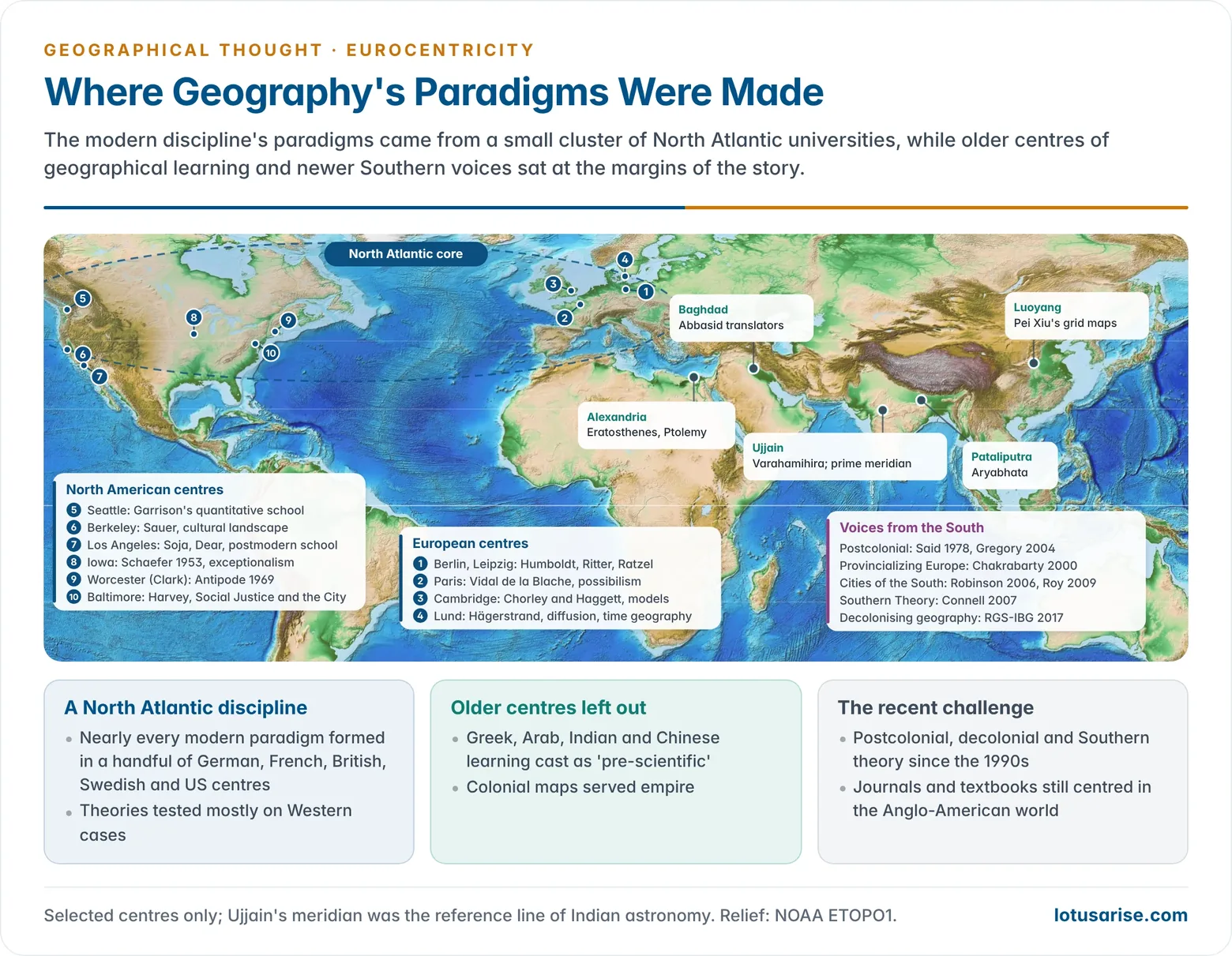
- Geography as a “European science”: David Stoddart (On Geography and Its History, 1986) dated the modern discipline to 1769, when James Cook entered the Pacific with trained scientific observers.
- In that view, modern geography’s attitudes and methods (observation, classification, comparison) were born in Europe, and other traditions were derivative.
- Imperial roots: university geography grew after 1870 alongside empire. Geographical knowledge helped European powers map, classify and govern colonised lands. Determinism ranked climates and peoples in ways that justified colonial rule.
- Silences: the standard story begins with the Greeks and jumps to Humboldt. It underplays Arab scholarship, Indian astronomy and cosmography and Chinese cartography, and almost every major theory was tested on North Atlantic cases.
- The challenge, mostly since the 1990s:
- Postcolonial geography: Edward Said’s Orientalism (1978) and Derek Gregory’s The Colonial Present (2004) showed how geographical imaginations served power. James Blaut’s The Colonizer’s Model of the World (1993) attacked Eurocentric diffusionism, the idea that progress spreads outward from Europe.
- Decolonial geography: Sarah Radcliffe’s 2017 Royal Geographical Society chair’s theme, “Decolonising geographical knowledges”, put the question at the centre of the discipline. Critics answered at once that a largely white academy could easily reproduce the coloniality it criticised.
- Southern theory: Raewyn Connell’s Southern Theory (2007), Jennifer Robinson’s Ordinary Cities (2006) and Ananya Roy’s call for “new geographies of theory” (2009) argue that theory should also be built from the cities and societies of the global South.
- Indian perspectives: Dipesh Chakrabarty’s Provincializing Europe (2000) argued that European categories must be treated as one tradition among many. Indian geography’s own long record, from the Surya Siddhanta and Aryabhata to the regional and planning work of independent India, enters this wider history.
- The challenge is real but recent and partial. Most journals, citation networks and textbooks remain centred in the Anglo-American world. This is the sense in which geography is a contested, multi-paradigmatic discipline with a Eurocentric core.
Previous Year Questions
1999Describe the sequence of major paradigm shifts in geographic thought during the twentieth century.2011Discuss the impact of positivism in paradigm shift in Geography.2017Discuss the contemporary paradigms of Geography.2018“Geography is a contested and multi paradigmatic discipline with a strong eurocentricity that has only recently been challenged.” Comment.