The early administrative structure; From diarchy to direct control;
The Regulating Act (1773); The Pitt’s India Act (1784); The Charter Act (1833);
The voice of free trade and the changing character of British colonial rule;
The English utilitarian and India.
Early Structure of the British Raj covers how the Company governed once it had conquered — the Acts, the administration and the ideas behind them. UPSC has set 18 questions on it between 1986 and 2026, appearing in four of the last ten papers. It is a moderate unit, but one of the most predictable in the paper.
Every question the Commission has asked on this topic is listed below, newest first, with a written model answer linked against each one.
| Questions asked (1986–2026) | 18 |
| Appeared in | 4 of the last 10 papers |
| Paper | Paper II, Section A (Modern India) |
| Usual mark value | 10, 15 or 20 marks |
| Model answers available | 17 of 18 |
PYQs: Early Structure of the British Raj [1985-2026]

| Year | Question | Answer |
|---|---|---|
| 2026 | Why did the British Crown assume direct control over the Indian Government in 1858? Mention the new administrative arrangements. | |
| 2024 | The values of utilitarianism prompted the Company administration to attempt reform of Indian society. | View answer |
| 2022 | Can you explain how, after acquiring Diwani, the government of the East India Company functioned like 'an Indian ruler'? | View answer |
| 2021 | How did the English utilitarian thinking impact India in the British era? | View answer |
| 2016 | Peace hath her victories no less renowned than war." Examine this statement with reference to Lord William Bentinck. | View answer |
| 2016 | How far is it correct to say that if Clive was the founder of the British Empire in India, Warren Hastings was its administrative organiser? | View answer |
| 2016 | The need to impose greater parliamentary control over the Company’s affairs increased during the decades (1773-1853) after Plassey”. Elucidate. | View answer |
| 2015 | Critically examine: The Regulating Act (1773), the Pitt’s India Act (1784) and eventually the Charter Act of 1833 left the East India Company as a mere shadow of its earlier political and economic power in India. | View answer |
| 2015 | James Mill, the apostle of utilitarian philosophy, proposed a revolution of Indian society through the‘weapon of law’ solely. But in actual policy framing, other influences and considerations weighed much more than the colonial State.” Elucidate. | View answer |
| 2014 | The Dual System of Government was a complete failure from the outset. In the first place, the abuse of the private trade reached a greater height than ever. In the second place, the demands of the Company for the increase led to gross oppression of the peasantry.” Examine. | View answer |
| 2011 | The Charter Act of 1833 rung down the curtain on the Company’s trade and introduced a new concept of government in India.” Substantiate. | View answer |
| 2008 | Sprung from paternalism, the English Utilitarian philosophy as introduced in India rejected its human warmth between rulers and the ruled”. Comment. | View answer |
| 2004 | ‘The object of the Act (Regulating) was good, but system that it established was imperfect.’ Comment. | View answer |
| 1999 | The British Indian State experienced the wind of change with the arrival of Lord William Bentinck. Comment. (1999 ) | View answer |
| 1993 | What kind of administrative change were introduced in India under the East India Company? | View answer |
| 1992 | Assess the impact of the utilitarian ideas in moulding the British attitude towards India. How did the utilitarian try to solve the problem of land revenue? | View answer |
| 1987 | 'The national democratic awakening of the Indian people found expression of white racism.’ Comment in about 200 words. | View answer |
| 1986 | Discuss the basic features of the judicial administration under the East India Company. Did the British introduce the modem concept of the rule of law in India? | View answer |
What UPSC keeps asking about the Early Structure of the Raj
Eighteen questions fall into three threads. Two of them have been asked in almost the same words for thirty years.
1. Utilitarianism and the ideology of reform (1992, 2008, 2015, 2021, 2024)
- The most consistently asked idea in the unit, and the most recent.
- James Mill’s proposed revolution in Indian society (2015), utilitarianism sprung from paternalism (2008), its impact on British attitudes and on India (1992, 2021), and its role in prompting reform (2024).
- Eric Stokes’s The English Utilitarians and India is the historiography. Distinguish utilitarian, evangelical and Orientalist strands rather than lumping them together as “British policy”.
2. The Acts and parliamentary control (2004, 2011, 2015, 2016, 2026)
- The Regulating Act (2004), the Regulating and Pitt’s Acts together (2015), growing parliamentary control (2016), the Charter Act of 1833 (2011), and the Crown’s assumption of control in 1858 (2026).
- Prepare a single sequence from 1773 to 1858 with, for each Act, what problem it answered and what problem it created.
3. Administration from Diwani to Bentinck (1986, 1987, 1993, 1999, 2014, 2016, 2022)
- The Dual System (2014), government after the Diwani (2022), judicial administration (1986), the winds of change under Bentinck (1999).
- 2016 asked whether Clive founded the empire and Warren Hastings made it viable — a comparison worth preparing as a single answer.
The model answers to this unit, in one place
Knowing the questions is half the work. The other half is seeing what a full-mark answer to each one looks like — not a hint or a bullet outline, but a complete answer at the mark and the word limit, with the historians named inside the argument.
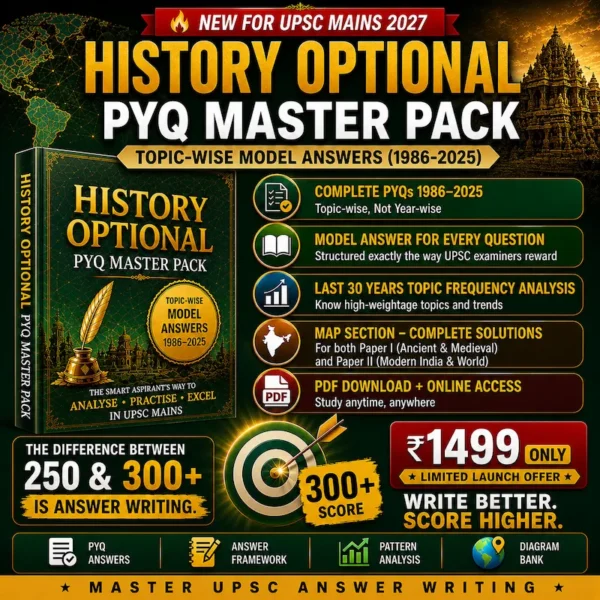
The History Optional PYQ Master Pack carries the same for every question the Commission has set since 1985, across the whole syllabus.
- PYQs 1985–2025, arranged topic-wise — revise a theme and see every way it has been asked
- Model answers with historiography — the debate cited where it belongs, not bolted on
- Map sections solved — the full 50-mark section, every year
- PDF plus online access — any device, permanently, no subscription
₹1,499 (regular ₹2,500). One-time payment, instant access.
How to use this topic list
Reading a question list feels like preparation and is not. Three sittings turn it into marks.
Sitting 1 — sort before you read (30 minutes)
- Copy the questions above into the threads identified in the previous section.
- Note which thread has gone longest without being asked — that is your priority, not the one you find most interesting.
Sitting 2 — write three answers cold (45 minutes)
- Pick the most recent question from three different threads.
- Seven minutes for a 10-marker, fifteen for a 20-marker. Stop when the time is up, even mid-sentence.
- Mark every place you wanted a historian’s name and could not produce one.
Sitting 3 — compare, then rewrite (45 minutes)
- Put your script beside the model answer for the same question.
- Compare structure first: opening claim, evidence, counter-view, judgement.
- Rewrite your weakest answer using that structure and no new content. Most candidates gain four to six marks from structure alone.
Two ways to prepare this optional
Two routes, depending on what is actually missing.
| PYQ Master Pack | Mains Master Kit 2027 | |
| Best when | Your notes are done; answer-writing is the gap | You are still building the subject |
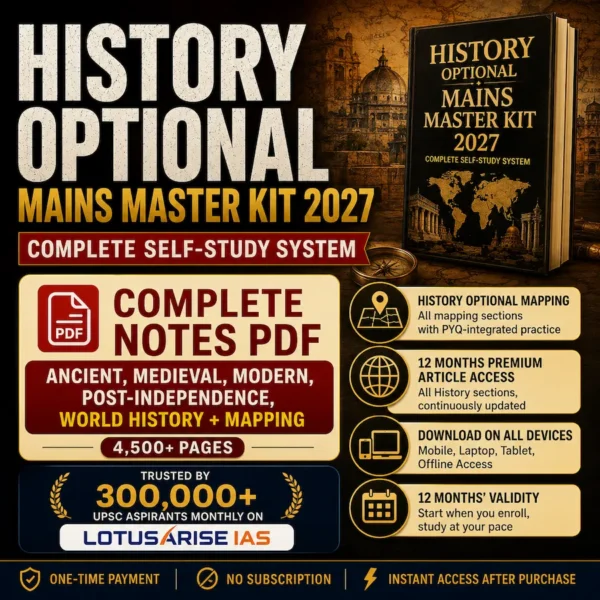
| What you get | Model answers to every question since 1985, topic-wise, map sections included | 4,500+ pages of notes, full mapping coverage, 12 months of article access |
| Price | ₹1,499 (reg. ₹2,500) | ₹1,770 (reg. ₹5,000) |
Frequently asked questions
Related topics
Administrative questions often reach into:
- British Expansion in India
- Economic Impact of British Colonial Rule
- Social and Cultural Developments
- Indian Response to British Rule
- All topics — History Optional PYQs, topic-wise
Prefer to work year by year?
The complete papers, with both papers in full, unit-wise analysis and the official PDFs:
- History Optional Question Paper 2026
- History Optional Question Paper 2025
- History Optional Question Paper 2024
- History Optional Question Paper 2023
- History Optional Question Paper 2022
- History Optional Question Paper 2021
- History Optional Question Paper 2020
- UPSC History Optional Map Solutions (2013–2025)