Major administrative policies of Jahangir, Shahjahan and Aurangzeb;
The Empire and the Zamindars;
Religious policies of Jahangir, Shahjahan and Aurangzeb;
Nature of the Mughal State;
Late Seventeenth century crisis and the revolts;
The Ahom Kingdom;
Shivajl and the early Maratha Kingdom.
The Mughal Empire in the Seventeenth Century covers Jahangir to Aurangzeb, the jagirdari crisis and the rise of the Marathas. UPSC has set 33 questions on it between 1985 and 2026, and it has appeared in nine of the last ten papers. It is the unit where the examiner tests whether you can explain Mughal decline without reaching for Aurangzeb’s personality.
Every question the Commission has asked on this topic is listed below, newest first, with a written model answer linked against each one.
| Questions asked (1985–2026) | 33 |
| Appeared in | 9 of the last 10 papers |
| Paper | Paper I, Section B (Medieval India) |
| Usual mark value | 10, 15 or 20 marks |
| Model answers available | 31 of 33 |
PYQs: Mughal Empire in the Seventeenth Century [1985-2026]

| Year | Question | Answer |
|---|---|---|
| 2025 | Aurangzeb's religious policy was a reflection of the changed political realities of the Mughal Empire." Elucidate. | View answer |
| 2024 | Examine the causes and consequences of peasant uprisings during the reign of Aurangzeb. | View answer |
| 2023 | Discuss the role of Nur Jahan in the Mughal court politics during the reign of Jahangir. | View answer |
| 2023 | Discuss the nature of the Mughal State under Akbar. | View answer |
| 2022 | Aurangzeb’s Deccan policy was a major factor in Mughal decline. Discuss. | View answer |
| 2021 | The late seventeenth century Mughal India is considered to be a period of Jagirdari crisis. Discuss. | View answer |
| 2018 | Discuss the working of Zamindari System under the Mughal rulers. Also describe the role played by the Zamindars in the agrarian economy of Mughal India. | View answer |
| 2016 | Identify the broad contours of the Mughal foreign policy and their impact on the Mughal empire. | View answer |
| 2014 | How was Iqta system of the Sultans different from the Jagir system under the Mughals? | View answer |
| 2009 | The major causes of revolts against the Mughal Empire during the latter half of the 17th century were economic, rather than religious." Discuss. | View answer |
| 2007 | Akbar built the Mughal Empire by enlisting the support of the Rajputs, Aurangzeb destroyed it by alienating the Rajputs.” Discuss critically. | View answer |
| 2006 | Write brief essay on Dara Shikoh. | View answer |
| 2004 | In what ways were Aurangzeb's Rajput and religious policies different from those of his predecessors? What were the consequences of the changes made by him? | View answer |
| 2003 | ‘Akbar built the Mughal Empire by enlisting the support of the Rajputs, Aurangzeb destroyed it by alienating the Rajputs.’ Do you agree? | View answer |
| 2000 | Describe the Rajput policy of the Mughal emperors. Do you agree with the view that the reversal of Akbar's Rajput policy by Aurangzeb was responsible for the disintegration of the Mughal empire? | View answer |
| 1999 | Write brief essay – Spanish ulcer ruined Napolean Bonaparte, the Deccan ulcer ruined Aurangzeb. | View answer |
| 1998 | Write brief essay on Nurjahan. | View answer |
| 1995 | Changes in the composition of nobility from Akbar to Aurangzeb. Comment. | View answer |
| 1994 | Aurangzeb is a much maligned monarch.” Argue the case for and against the proposition. | View answer |
| 1991 | What were the major features of the administrative system of the Mughal State? To what extent did other Indian powers model their administration on this system in the late medieval period? | View answer |
| 1985 | Analyse the religious policy of the Mughal emperors from Akbar to Aurangzeb. How did it affect the stability of the Mughal empire? | View answer |
The Ahom Kingdom
| Year | Question | Answer |
|---|---|---|
| 2014 | Give a brief account of resistance offered by Ahom State against the Mughal rule. | View answer |
| 2008 | Write short essay on The Ahom Kingdom in 200 words. | View answer |
Shivaji and the early Maratha Kingdom
| Year | Question | Answer |
|---|---|---|
| 2026 | Trace the formulation of the Mughal imperial authority from Akbar to Aurangzeb. Focus on the influence of Persian ideas of kingship in the construction of Mughal royalty. | |
| 2026 | Trace the trajectory of Maratha polity from Shivaji to Peshwa Balaji Baji Rao. What was the impact of the Third Battle of Panipat (1761) on the Maratha State? Analyze. | |
| 2020 | Examine the sources of the history of Chhatrapati Shivaji with special reference to Shivabharat and Sabhasad Bakhar. (in 150 words) | View answer |
| 2019 | Shivaji was not merely a military conqueror but also was an enlighened ruler. Discuss. | View answer |
| 2012 | Give social background to the rise of the Maratha movement during the seventeenth century. | View answer |
| 2010 | How did Shivaji organise his administration and finances to consolidate his power? | View answer |
| 1999 | Examine circumstances leading to rise of Shivaji. Throw light on his legacy. | View answer |
| 1996 | Shivaji’s rise to power cannot be treated as an isolated phenomenon in Maratha history. It was as much the result of his personal daring and heroism as of the peculiar geographical situation of the Deccan country and the unifying religious influences that were animating the people with new hopes and aspirations in the 15th and 16th centuries. Explain. | View answer |
| 1992 | Shivaji was a great organizer and builder of civil institutions, examine this statement in the light of the difficulties of administration and the extent of success achieved by him. | View answer |
| 1985 | Write short answer of not more than 200 words: Was Shivaji a nationalist leader? | View answer |
What UPSC keeps asking about the Seventeenth-Century Mughal Empire
Thirty-three questions sort into five threads. The first two are really one question asked from different sides: why did the empire come apart?
1. Aurangzeb — religious policy, Rajputs and the Deccan (1985, 1994, 1999, 2000, 2003, 2004, 2007, 2022, 2025)
- The largest thread. The old form pitted Akbar’s Rajput alliance against Aurangzeb’s alienation of it (2003, 2007); the newer form reads his religious policy as a response to changed political realities (2025).
- The Deccan ulcer (1999) returned in 2022 as a major factor in decline.
- Aurangzeb as “much maligned” (1994) is the question to prepare for: Satish Chandra and Athar Ali on political necessity against the older communal reading.
2. Jagirdari crisis, nobility and revolt (1995, 2009, 2014, 2018, 2021, 2024)
- The structural explanation of decline. 2021 asked directly about the jagirdari crisis of the late seventeenth century.
- Changes in the nobility from Akbar to Aurangzeb (1995), zamindars (2018), peasant uprisings (2024), revolts against the empire (2009).
- Satish Chandra’s jagirdari crisis, Irfan Habib’s agrarian crisis and Athar Ali’s nobility studies form the core. Muzaffar Alam and Chetan Singh on regional revisions give you the counter-view.
3. The Mughal state and imperial authority (1991, 2016, 2023, 2026)
- The nature of the Mughal state under Akbar (2023), administrative features (1991), foreign policy (2016).
- 2026 asked you to trace imperial authority from Akbar to Aurangzeb — the long-arc framing now appearing across Mughal units.
4. Shivaji and the Marathas (1985, 1992, 1996, 1999, 2010, 2012, 2019, 2020, 2026)
- Nine questions, and asked in three of the last eight papers.
- Shivaji as administrator and builder of institutions (1992, 2010, 2019), the social background of the Maratha movement (2012), the sources (2020), and whether he was a nationalist (1985).
- 2026 traced Maratha polity from Shivaji to Balaji Baji Rao — prepare the Peshwa transition, not only Shivaji.
5. The court and the frontiers (1998, 2006, 2008, 2014, 2023)
- Nur Jahan (1998, 2023) and Dara Shikoh (2006) — both prepared best as short answers.
- The Ahom resistance (2008, 2014) is the frontier question most candidates skip.
The model answers to this unit, in one place
Knowing the questions is half the work. The other half is seeing what a full-mark answer to each one looks like — not a hint or a bullet outline, but a complete answer at the mark and the word limit, with the historians named inside the argument.
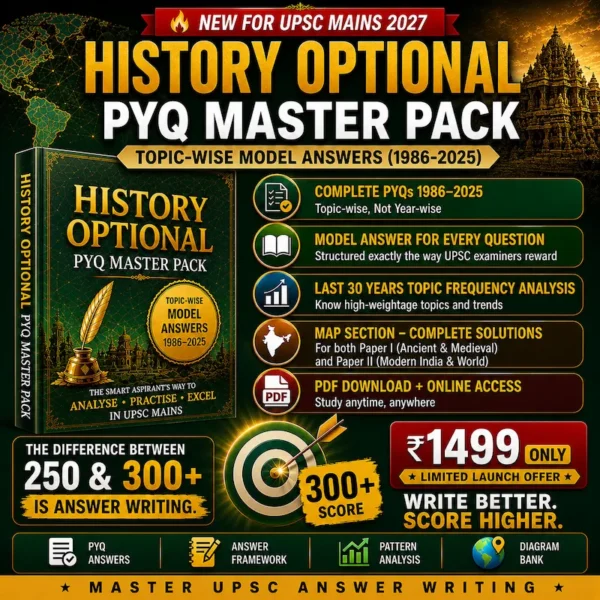
The History Optional PYQ Master Pack carries the same for every question the Commission has set since 1985, across the whole syllabus.
- PYQs 1985–2025, arranged topic-wise — revise a theme and see every way it has been asked
- Model answers with historiography — the debate cited where it belongs, not bolted on
- Map sections solved — the full 50-mark section, every year
- PDF plus online access — any device, permanently, no subscription
₹1,499 (regular ₹2,500). One-time payment, instant access.
How to use this topic list
Reading a question list feels like preparation and is not. Three sittings turn it into marks.
Sitting 1 — sort before you read (30 minutes)
- Copy the questions above into the threads identified in the previous section.
- Note which thread has gone longest without being asked — that is your priority, not the one you find most interesting.
Sitting 2 — write three answers cold (45 minutes)
- Pick the most recent question from three different threads.
- Seven minutes for a 10-marker, fifteen for a 20-marker. Stop when the time is up, even mid-sentence.
- Mark every place you wanted a historian’s name and could not produce one.
Sitting 3 — compare, then rewrite (45 minutes)
- Put your script beside the model answer for the same question.
- Compare structure first: opening claim, evidence, counter-view, judgement.
- Rewrite your weakest answer using that structure and no new content. Most candidates gain four to six marks from structure alone.
Two ways to prepare this optional
Two routes, depending on what is actually missing.
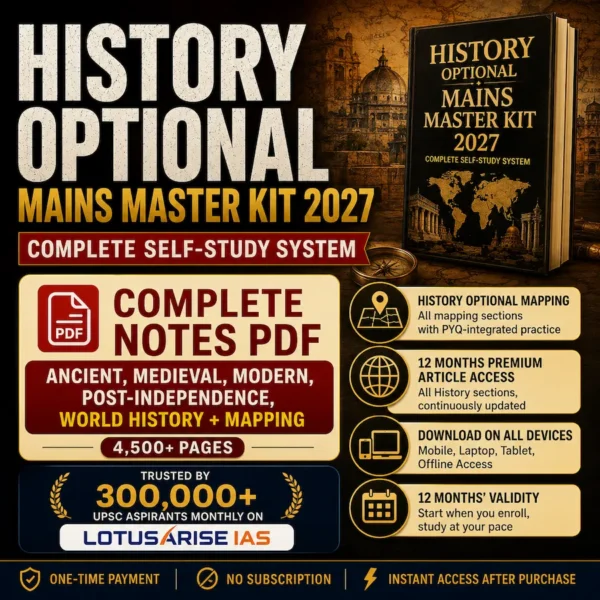
| PYQ Master Pack | Mains Master Kit 2027 | |
| Best when | Your notes are done; answer-writing is the gap | You are still building the subject |
| What you get | Model answers to every question since 1985, topic-wise, map sections included | 4,500+ pages of notes, full mapping coverage, 12 months of article access |
| Price | ₹1,499 (reg. ₹2,500) | ₹1,770 (reg. ₹5,000) |
Frequently asked questions
Related topics
This unit borders several Mughal and Maratha topics:
- Akbar
- Economy and Society in the 16th and 17th Centuries
- Culture during the Mughal Empire
- The Eighteenth Century
- All topics — History Optional PYQs, topic-wise
Prefer to work year by year?
The complete papers, with both papers in full, unit-wise analysis and the official PDFs:
- History Optional Question Paper 2026
- History Optional Question Paper 2025
- History Optional Question Paper 2024
- History Optional Question Paper 2023
- History Optional Question Paper 2022
- History Optional Question Paper 2021
- History Optional Question Paper 2020
- UPSC History Optional Map Solutions (2013–2025)