

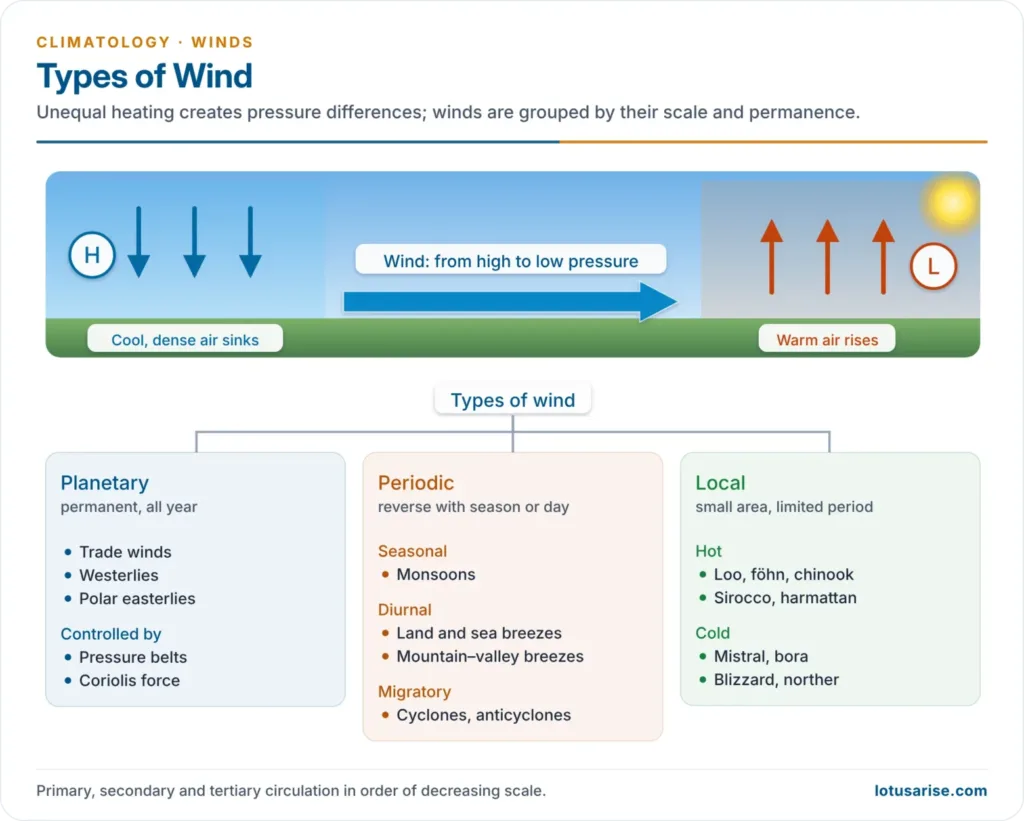
- Wind is the horizontal movement of air, caused by differences in air pressure within the atmosphere. Air moves from high pressure to low pressure.
- Pressure differences arise from unequal heating: between the equator and the poles, between land and sea, between day and night, and between slopes and valleys.
- Winds carry heat and moisture from one region to another and so control temperature and rainfall over the globe.
- By scale and permanence, winds are planetary (permanent), periodic (seasonal and diurnal) and local.
Wind: Causes, Direction and Measurement
Causes of Wind
- The basic cause is uneven heating, which creates pressure differences:
- between the equator and the poles: the planetary winds
- between land and sea: monsoons and land and sea breezes
- between slopes and valleys: mountain and valley breezes
- The speed depends on the pressure gradient; the direction is modified by the Coriolis force, friction and the curvature of the path. In the northern hemisphere winds turn right, so they blow anticlockwise into lows and clockwise out of highs.
Direction and Measurement
- A wind is named from the direction it blows from: a westerly blows from the west to the east. The side facing the wind is windward; the sheltered side is leeward.
- Instruments:
- Wind vane: direction
- Anemometer (cup or propeller type): speed; the anemograph records it continuously
- Pilot balloons, radiosondes and Doppler weather radar: upper winds
- Satellite scatterometers: winds over the oceans, such as OSCAT-3 on India’s Oceansat-3 (EOS-06), launched in 2022
- Beaufort scale (Francis Beaufort, 1805): estimates wind force from its visible effects, on a scale of 0 to 12.
| Beaufort number | Description | Speed (knots) | Observable effect |
|---|---|---|---|
| 0 | Calm | Under 1 | Smoke rises vertically |
| 4 | Moderate breeze | 11–16 | Dust and loose paper raised |
| 6 | Strong breeze | 22–27 | Large branches move; umbrellas hard to use |
| 8 | Gale | 34–40 | Twigs break off trees |
| 10 | Storm | 48–55 | Trees uprooted |
| 12 | Hurricane force | 64 and above | Widespread devastation |
- Veering and backing: a wind that shifts clockwise (say, from south-west to north-west) veers; one that shifts anticlockwise backs. Veering winds after a temperate cyclone passes signal clearing weather; backing winds bring continued bad weather.
Classification of Winds
| Category | Scale | Examples | Control |
|---|---|---|---|
| Primary (planetary, permanent) | Global (macroscale) | Trade winds, westerlies, polar easterlies | Pressure belts |
| Secondary (periodic) | Continental to regional (synoptic) | Monsoons; cyclones, anticyclones, air masses | Seasonal heating, migrating pressure systems |
| Diurnal periodic | Local | Land and sea breezes, mountain and valley breezes | Day–night heating |
| Tertiary (local) | Local (meso- and microscale) | Loo, föhn, chinook, mistral, sirocco, bora | Relief, local heating, passing depressions |
Planetary (Permanent) Winds
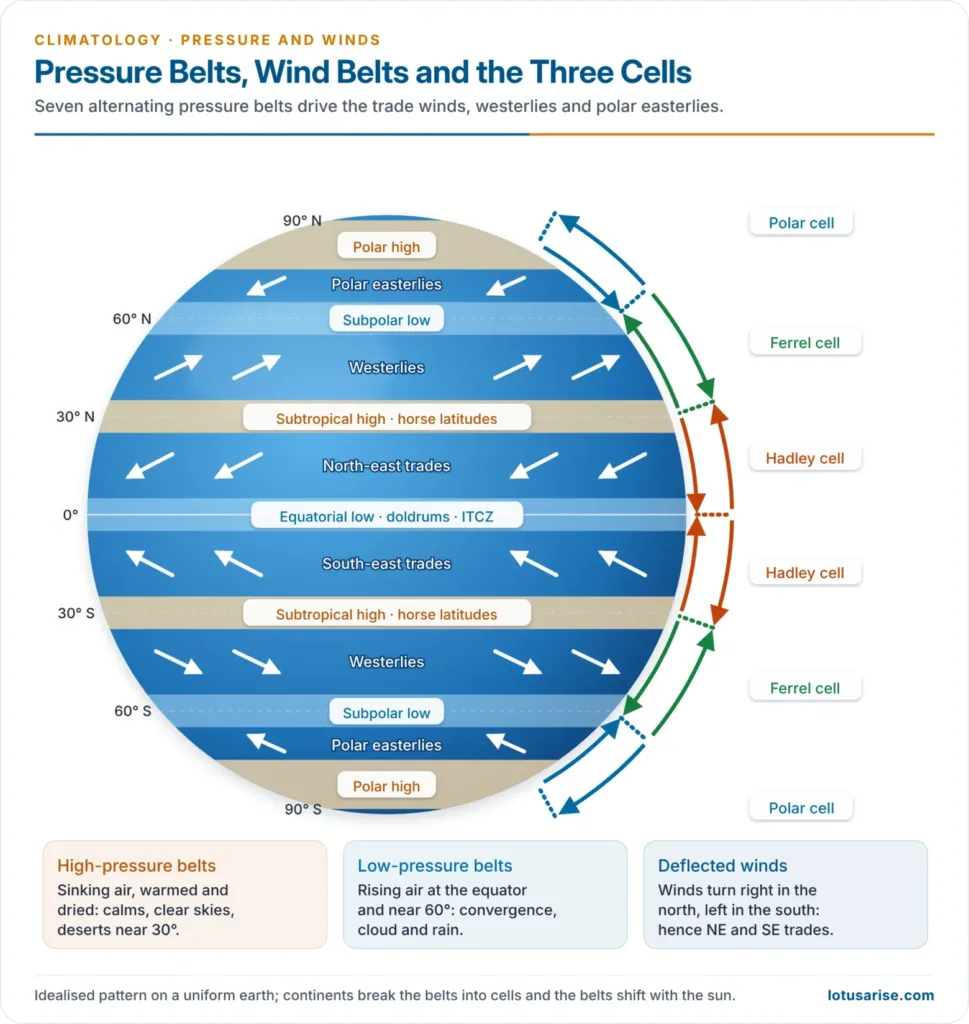
- Planetary winds blow throughout the year in the same general direction between the pressure belts. They form the primary circulation, which sets the framework for all other winds.
- On a rotating earth they are deflected by the Coriolis force, so they blow east–west rather than north–south.
Trade Winds
- Direction: from the subtropical highs towards the equatorial low, between about 5° and 30° N and S.
- Deflected by Ferrel’s law, they blow as the north-east trades in the northern hemisphere and the south-east trades in the southern.
- Features:
- They are the steadiest winds on earth, constant in direction and speed; sailing ships used them as dependable routes for trade.
- At their source (the eastern sides of the subtropical highs, over cool currents) they are descending, dry and stable, capped by the trade-wind inversion; this keeps the west-coast deserts dry.
- Moving equatorward over warm oceans they become warm and humid. On the eastern coasts of continents (eastern Brazil, Madagascar, Central America) they bring heavy rain.
- The trades of the two hemispheres converge at the ITCZ, where the air rises and gives heavy convectional rainfall.
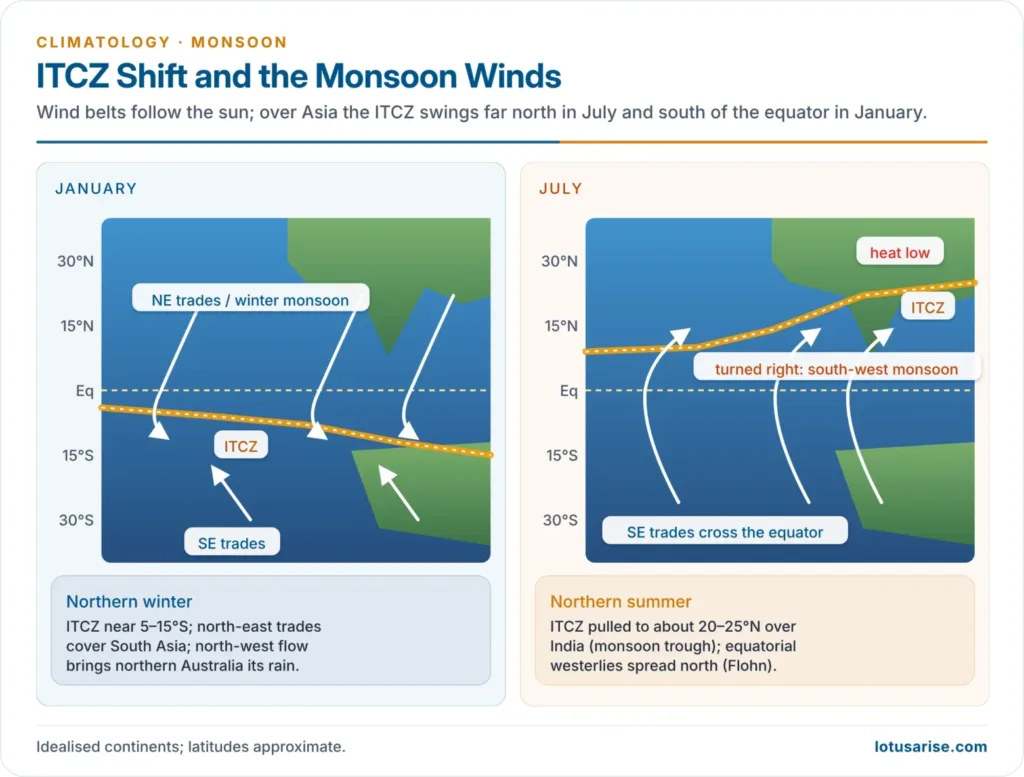
- Where the ITCZ moves far north in summer, the south-east trades cross the equator and turn right as south-westerly winds: these are the south-west monsoon of India.
Westerlies
- Direction: from the subtropical highs (30°–35°) towards the subpolar lows (60°–65°); south-westerly in the northern hemisphere, north-westerly in the southern.
- Features:
- They are variable in direction and strength, because temperate cyclones and anticyclones travel eastward within them and polar air invades from time to time.
- Their poleward boundary fluctuates, giving spells of wet and dry weather.
- They bring rain throughout the year to the western margins of continents in middle latitudes: north-west Europe, British Columbia, southern Chile.
- In the northern hemisphere, large land masses and mountains make them irregular, and they are stronger in winter than in summer.
- In the southern hemisphere, an almost unbroken ocean lets them blow strong and persistent, strongest between 40° and 60° S: the Roaring Forties, Furious Fifties and Shrieking Sixties of sailors. India’s supply voyages to its Antarctic stations, Maitri and Bharati, cross this stormy belt.
- Indian example: in winter the westerlies and the subtropical jet shift south, steering western disturbances that bring rain to the rabi wheat of the north-west plains and snow to the Himalaya.
Polar Easterlies
- Direction: from the polar highs to the subpolar lows; north-easterly in the northern hemisphere, south-easterly in the southern.
- Features:
- They are cold and dry.
- In the Arctic they are irregular, largely controlled by passing disturbances; they are more regular off Antarctica, blowing out from the high over the ice plateau.
- Where they meet the warmer westerlies along the polar front, the contrast breeds temperate cyclones.
| Feature | Trade winds | Westerlies | Polar easterlies |
|---|---|---|---|
| Belt | 5°–30° | 30°–60° | 60°–90° |
| From → to | Subtropical high → equatorial low | Subtropical high → subpolar low | Polar high → subpolar low |
| Direction (N / S hemisphere) | NE / SE | SW / NW | NE / SE |
| Nature | Steady, warm; rain on eastern coasts | Variable, stormy; rain on western coasts | Cold, dry, irregular |
Periodic Winds
- Periodic (secondary) winds change direction with the season or the time of day, because the pressure pattern that drives them reverses.
- Migrating cyclones and anticyclones and air masses also form part of the secondary circulation.
Monsoons
- Monsoons are winds that reverse their direction seasonally, blowing from sea to land in summer and from land to sea in winter. They are the largest seasonal modification of the planetary winds.
- Classical view: Edmond Halley (1686) explained them as land and sea breezes on a giant scale, a convectional circulation driven by the seasonal heating contrast between Asia and the Indian Ocean.
- Modern view: the monsoon is a seasonal shift of the planetary winds and the ITCZ, controlled also by the jet streams, the Tibetan Plateau and ocean conditions such as El Niño and the Indian Ocean Dipole.
- Summer (south-west) monsoon:
- With the northward march of the sun, an intense low forms over north-west India and Pakistan, and the ITCZ shifts north.
- The south-east trades cross the equator, are deflected right by the Coriolis force, and reach India as the south-west monsoon, saturated with moisture from a long sea track.
- They bring heavy rain to the Western Ghats, north-east India and the Indo-Gangetic plain.
- Winter (north-east) monsoon:
- A high develops over north-west India (and the Siberian High beyond the Himalaya); dry north-east winds blow out towards the sea.
- After crossing the Bay of Bengal, they bring October–December rain to the Tamil Nadu coast.
- Elsewhere: monsoon winds affect South and South-East Asia, northern Australia, East Asia and West Africa. In China and Japan, the winter monsoon is stronger than the summer monsoon.
- Recent example: in 2026 the monsoon reached Kerala on 4 June, three days late, and ended 12.6% deficient, the weakest since 2015, under a strengthening El Niño. The mechanism is detailed in the Indian monsoon.
Land and Sea Breezes
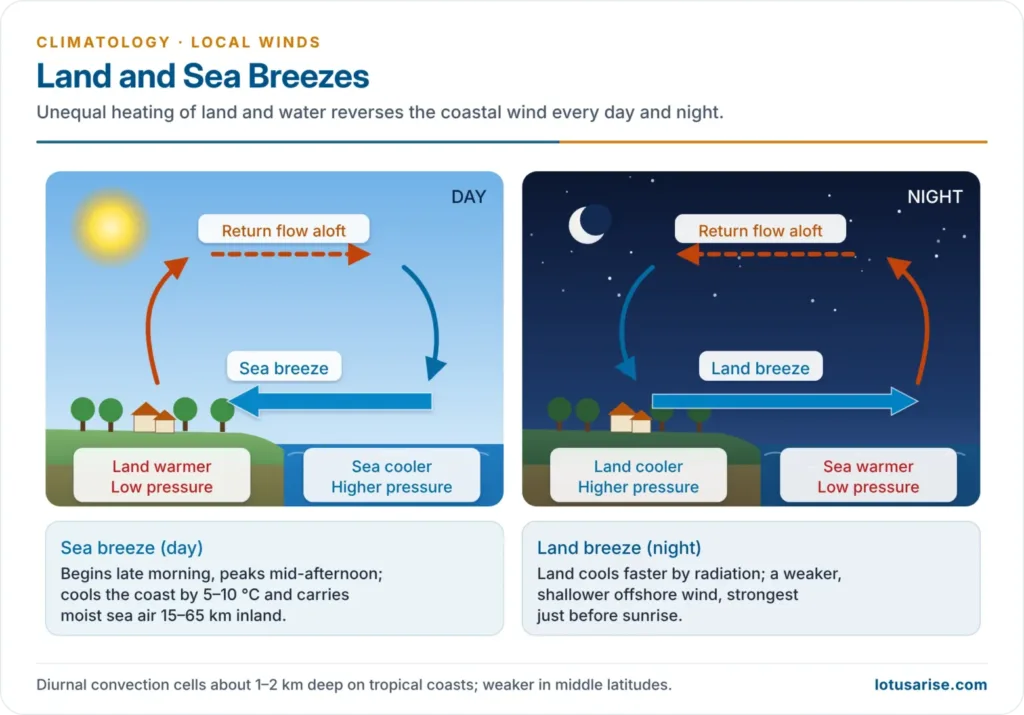
- Diurnal winds of coasts, caused by the unequal heating of land and water:
- Sea breeze (day): land heats faster, so pressure falls over it; cool air blows from sea to land.
- Land breeze (night): land cools faster, so pressure is higher over it; air blows from land to sea.
- The sea breeze is the stronger of the two; it moderates coastal temperatures, as on the coasts of Chennai and Mumbai.
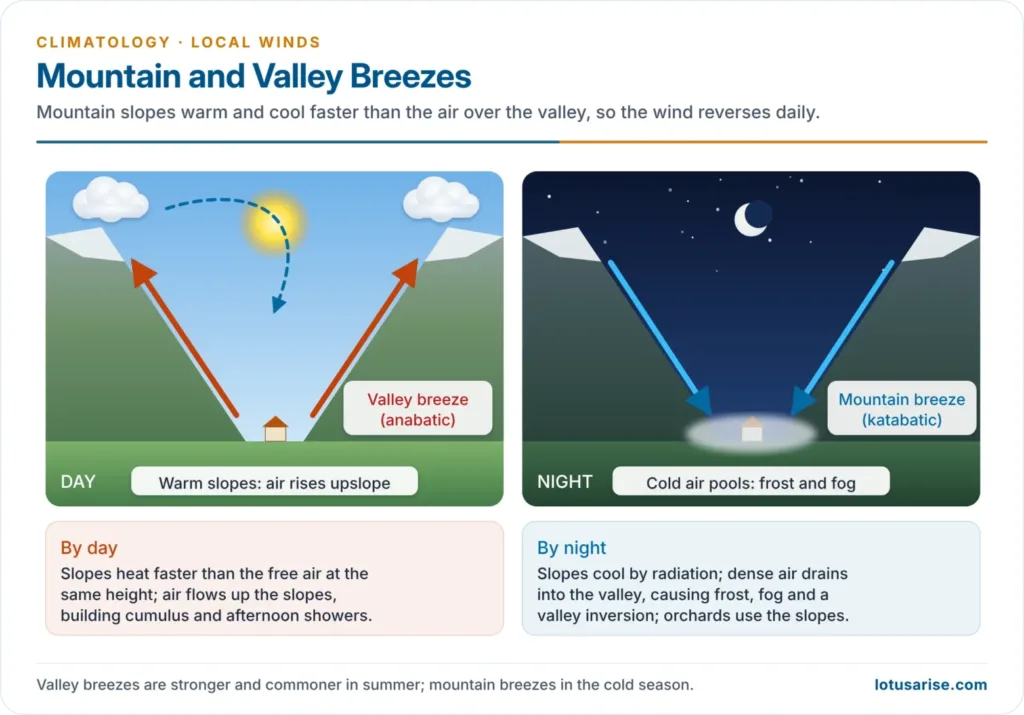
Mountain and Valley Breezes
- Valley breeze (day): sun-warmed slopes heat the air in contact with them, and air flows up the slopes from the valley. It is also called an anabatic wind.
- Mountain breeze (night): slopes cool by radiation, and dense, cold air drains down into the valley. It is also called a katabatic wind.
- Cold air draining off high plateaus and ice fields forms strong katabatic winds, as off Greenland and Antarctica.
- It collects in valley bottoms, causing frost and fog and a valley inversion.
Local Winds
- Local (tertiary) winds blow over a small area for a limited period of the day or year, in the lowest layers of the troposphere. They arise from local differences of temperature and pressure, relief, or the pull of a passing depression.
- They are grouped as hot and cold winds; some are beneficial, others harmful.
| Wind | Region | Nature | Effect |
|---|---|---|---|
| Loo | North-west India and Pakistan plains | Hot, dry westerly; May–June afternoons, 45–50 °C | Heatstroke |
| Föhn | Lee (north) side of the Alps | Warm, dry, descending | Melts snow, aids grazing and grape ripening |
| Chinook | East of the Rockies (USA, Canada) | Warm, dry, descending; “snow eater” | Clears snow from winter pastures |
| Santa Ana | Southern California | Hot, dry, offshore | Spreads wildfires |
| Sirocco | Sahara to southern Europe | Hot, dusty; humid after crossing the sea | Dust, crop damage |
| Harmattan | Sahara to the Guinea coast | Dry, dusty north-east wind; winter | Relief from humid heat |
| Brickfielder | South-eastern Australia | Hot, dry, dusty northerly | Heat and dust |
| Mistral | Rhône valley to the Gulf of Lion, France | Cold, dry, strong northerly | Damages crops; fans fires |
| Bora | Eastern Adriatic coast | Cold, dry, gusty north-easterly | Very cold, violent gusts |
| Levanter | Strait of Gibraltar | Humid easterly | Cloud and fog |
| Shamal | Iraq and the Persian Gulf | Strong north-westerly | Sandstorms |
| Elephanta | Malabar coast | Strong southerly to south-easterly; September–October | Marks the end of the south-west monsoon |
Previous Year Questions
- No direct PYQ has been asked on this sub-topic yet.





Informative
lucid and concise.
Respected,
What are your source of information? Any ways we are so thankful to you.
-Aspirant
Thank you so much sir 🙏
Mistral flows through the valley of rhone river not rhine please make it correct thanks
Thank You.
Great effort sir, God bless you
Good sir…
Vey helpful for me and I hope for all the aspirants
thank you so much
How can I download this odf
https://store.lotusarise.com/shop/
Can we have types of monsoon
Thankyou 🪷 arise
It’s very helpful 🙂