

- Liberalisation, privatisation and globalisation (LPG) are the three linked strands of the economic reforms of 1991, which moved India from a licence-bound, public-sector-led economy towards a market-led one open to the world.
- The turning point came on 24 July 1991, weeks after a balance of payments emergency, when the New Industrial Policy was tabled in Parliament and Finance Minister Manmohan Singh presented the Budget, in the P. V. Narasimha Rao government.
- Their geography is uneven. Investment, exports and jobs gathered in a few already advanced States and metropolitan regions, so the reforms feed directly into India’s regional disparities.
Liberalisation
- Liberalisation means freeing the economy from direct or physical controls imposed by the government, so that market forces guide investment and output.
- For industry, it means removing the bureaucratic hurdles that decided who could produce what, how much and where, and preparing firms to meet market competition.
The Economy Before 1991
- India began its First Five Year Plan on 1 April 1951 and, from the mid-1950s, aimed at a socialistic pattern of society.
- From the First to the Sixth Plan, the public sector held the primary role in growth and development.
- Examples: BHEL in the 1960s and NTPC in the 1970s.
- The private sector played a secondary role, within tight rules.
- Industry and trade faced production quotas and permits for export and import.
- The aim was to protect domestic industry from international competition and to curb private monopolies.
- Results, as the reformers read them: licences, permits and quotas worked at first, but the end result disappointed.
- Public enterprises came to be criticised for corruption and inefficiency.
- Private firms, in the absence of competition, did little to diversify or modernise.
- Policy line behind 1991: the Industrial Policy Resolutions of 1948 and 1956 set up a mixed economy, with 17 industries reserved for the state in Schedule A of 1956. The statements of 1977 and 1980 shifted attention to small industry and to public sector management, all stages in the evolution of industries.
- First loosening: the Sixth Plan (1980–85) already felt that firms had to become efficient, modern and able to compete abroad, and it began some liberalisation. High-cost, low-quality production had become the pattern of the first three decades of planning.
The Crisis of 1990–91
- The cumulative effect was stagnation, and by June 1991 India faced an unprecedented economic crisis.
- Reserves were barely enough to pay for two weeks’ imports, with estimates of cover falling to about 10 days.
- New loans were not available on normal terms.
- In July 1991, the Reserve Bank of India (RBI) pledged 46.91 tonnes of gold with the Bank of England and the Bank of Japan to raise about US$ 400 million.
| Indicator | Earlier | 1990–91 | Official later count |
|---|---|---|---|
| Fiscal deficit (% of GDP) | 5.4 (1981–82) | 8.4 | Later series: about 7.8 |
| Current account deficit (₹ crore) | 2,214 (1980–81) | 17,367 | About 3% of GDP |
| Foreign loans (% of GDP) | 12 (1980–81) | 23 | External debt 28.7% at end-March 1991 |
| Debt service | 15% of exports (1980–81) | 30% of exports | 35.3% of current receipts |
| Forex reserves (₹ crore) | 8,151 (1986–87); 6,252 (1989–90) | 11,416, end-March 1991 | Only ₹4,388 crore of it was foreign currency |
- Fiscal deficit: government spending had run far ahead of revenue through the 1980s.
- Balance of payments: the heavier burden of foreign debt service drained reserves and caused a crisis of confidence in the international foreign exchange market.
- External debt stood at US$ 83.8 billion at end-March 1991.
- Short-term debt alone was 3.8 times the foreign currency assets.
- Gulf crisis: the Iraq war of 1990–91 pushed up oil prices and hit the remittances India received from Gulf countries, deepening the crisis.
- Foreign exchange reserves: counting gold and special drawing rights, reserves were US$ 5.83 billion at end-March 1991, but foreign currency assets were only US$ 2.24 billion, and they fell further in the next months.
Why India Waited Till 1991
- After Independence, India put barriers on foreign trade and investment to protect its producers from foreign competition. Imports, it was felt, would have stopped new industries from coming up.
- Strict restrictions applied, except on essentials such as petroleum products, capital goods and fertilisers. Developed countries had offered similar protection in their own early stages of development.
- The 1980s up to 1991:
- The mixed economy framework came to be seen as having produced a mass of rules and laws, the permit-licence raj.
- Revenue fell short of spending, as taxation could not raise enough at home while much spending went to the social sector and defence. Money borrowed abroad went to meet government consumption.
- Public enterprises grew from just 5 in 1951 to 246 in March 1991. Their first 15 years were encouraging, but most later showed losses and became a liability.
- India approached the International Bank for Reconstruction and Development (IBRD) and the International Monetary Fund (IMF). In return for loans, they wanted India to open up the economy, free the private sector and reduce the government’s role.
Globalisation and Liberalisation
- Removing barriers to trade is liberalisation, and the removal of those barriers results in globalisation.
- Some measures came in 1990, in industrial licensing, export-import policy, technology upgradation, fiscal policy and foreign investment, but they were not sufficient, and the New Economic Policy of 1991 began comprehensive reform.
The New Industrial Policy, 1991
- Aims:
- Release industry from needless bureaucratic control.
- Integrate India with the world economy.
- Remove limits on direct foreign investment, and free domestic entrepreneurs from the Monopolies and Restrictive Trade Practices (MRTP) Act.
- Shed the load of loss-making or low-return public enterprises.
| Head | What changed in 1991 |
|---|---|
| Industrial licensing | Abolished except for a short list of security, strategic, social, hazardous, environmental and elite-consumption items |
| Location | No central approval outside cities of over one million people. Within them, polluting units had to sit 25 km beyond the periphery, except in designated industrial areas |
| Foreign investment | Automatic approval up to 51% foreign equity in high-priority industries |
| Foreign technology | Automatic approval of technology agreements in priority industries; no permission needed to hire foreign technicians |
| Public sector | Priority narrowed to essential goods and services, oil and minerals, technology where private investment was lacking, and strategic products such as defence equipment |
| MRTP Act | No prior approval for expansion, mergers or new units; the focus moved to curbing unfair and restrictive trade practices |
- The 1991 policy kept compulsory licensing for 18 industries, among them coal and lignite, petroleum products, sugar, motor cars, paper, drugs and white goods. The list later shrank to five.
- Later law: the Foreign Exchange Management Act replaced the Foreign Exchange Regulation Act from 1 June 2000, and the Competition Act (2002) superseded the MRTP framework.
- Private role in infrastructure: industrialists were invited into roads, power, communication and petroleum, leaving governments more room for social and economic programmes.
- Early path: the first years after the reforms saw low growth and even stagnation in major industries. Annual industrial growth then recovered to 12% in 1995–96.
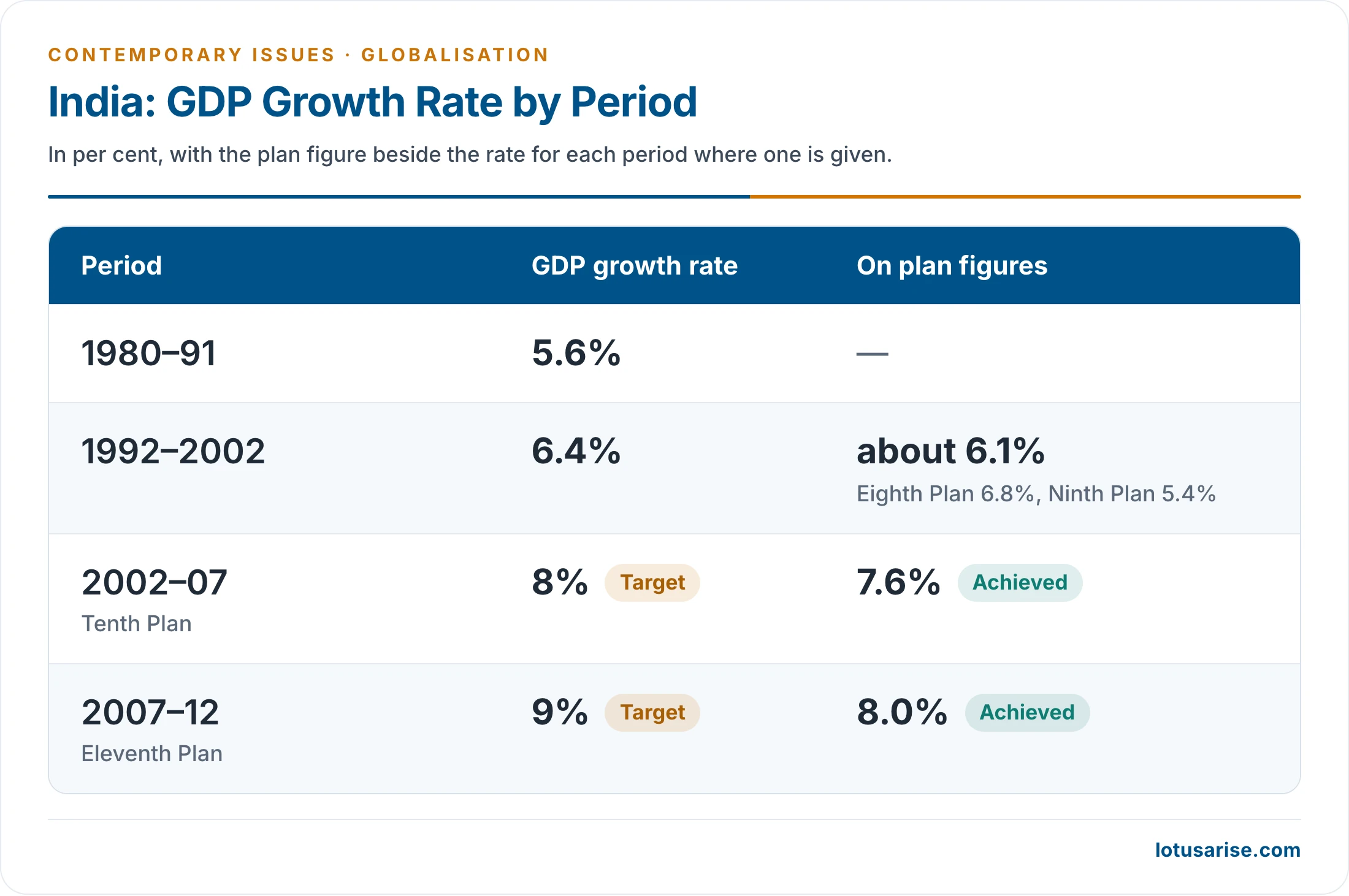
- The Eighth Plan (1992–97) was drawn up against worsening inflation and balance of payments. It aimed at 5.6% annual growth and achieved 6.8%.
Features of Liberalisation
Industrial Sector
| Feature | Till 1991 | Since 1991 |
|---|---|---|
| Licensing | Government permission to start or close a firm | Removed except for five industries: alcoholic drinks, cigars and cigarettes, electronic aerospace and defence equipment, industrial explosives, hazardous chemicals |
| Output | Permission needed for the quantity produced | Firms decide |
| Public sector reservation | Private sector barred from many industries; 17 reserved | Cut to 8 in 1991, and by 2010–11 to two: atomic energy and railway operations |
| Small industry | Some goods only from small-scale units | Many items de-reserved; market forces allocate resources in place of government directives |
| Prices | Government controlled prices and distributed selected products, which led to corruption | In many industries the market sets prices |
- Atomic energy: the SHANTI Act (December 2025) replaced the Atomic Energy Act, 1962 and opened civil nuclear power to licensed private firms and joint ventures, while the state keeps control of strategic assets.
Financial Sector
- The RBI’s role shifted from “a regulator” to “a facilitator” of the financial sector.
- Private banks, domestic and international, were established under the RBI’s guidelines of January 1993. Examples: ICICI Bank and HDFC Bank (1994), and later Kotak Mahindra.
- Foreign investment limits rose gradually in various sectors, for both direct and portfolio investment.
- Insurance: the limit reached 100% in February 2026, through the automatic route, after the Sabka Bima Sabki Raksha Act, 2025.
- Banks were allowed to raise resources in India and abroad.
- Reforms reached insurance, money and capital markets.
- New institutions and regulators arose to suit these realities:
| Body | Role | Date |
|---|---|---|
| SEBI | Securities regulator | Set up 1988; statutory from 1992 |
| NSE | National stock exchange | Recognised 1993 |
| BSE | Older stock exchange, now under SEBI | Founded 1875 |
| IRDA (now IRDAI) | Insurance regulator | 1999 |
| PFRDA | Pension regulator | 2003; statutory from 2014 |
Tax Reforms
- Taxes on individual income have been reduced continuously since 1991.
- High income tax rates were thought to encourage evasion, so moderate rates of income and corporate tax were brought in.
- Many procedures have been simplified.
- Indirect taxes: the Goods and Services Tax (GST) began on 1 July 2017.
- From 22 September 2025, GST moved to two main slabs of 5% and 18%, with a special 40% rate on a few items.
- The Income-tax Act, 2025 replaces the Act of 1961.
Foreign Exchange Reforms
- The rupee was devalued in two steps, on 1 and 3 July 1991, by about 18% against the US dollar in all.
- The aim was to raise exports and rebuild reserves, and it increased the supply of foreign exchange.
- Exchange rate steps: a dual rate came in March 1992 and a unified market rate in March 1993. The rupee became convertible on current account in August 1994.
- Demand and supply now set the rate, and the RBI steps in only to calm the market, a managed float.
Trade and Investment Policy
- Quantitative restrictions on imports were eased gradually.
- Import licensing was abolished, except for hazardous and environmentally sensitive industries.
- Restrictions on manufactured consumer goods and agricultural products were fully removed from April 2001.
- Export duties were removed, to make Indian goods more competitive abroad.
- Foreign direct and portfolio investment were liberalised gradually.
- Press Note 3 of 2020 placed investment from countries sharing a land border under the government route, and a 2026 revision eased it for small non-controlling stakes.
- Exports: ₹32,553 crore in 1990–91; goods exports were US$ 441.78 billion in 2025–26.
- Trade agreements under the foreign trade policy have widened fast: the UAE (2022), the European Free Trade Association (2025), and Oman, the United Kingdom and New Zealand (2026).
Disinvestment
- Disinvestment and privatisation both sell government shares in public enterprises. Privatisation transfers 51% or more of the equity, and control, to private players; disinvestment sells only part of the equity, so that ownership and management stay with the government.
- Current position: the New Public Sector Enterprise Policy (February 2021) keeps a bare minimum government presence in four strategic sectors and looks to privatise or close the rest, which sets the frame for disinvestment and privatisation today.
Privatisation
- Privatisation is the transfer of ownership, management and control of public sector enterprises to the private sector. It takes two forms:
- Withdrawal of government ownership and management, by giving up majority control of public companies.
- Outright sale of public companies.
- Most profitable undertakings were formed in the 1950s and 1960s, when self-reliance was central to public policy. They were meant to provide infrastructure and direct employment.
- The government later gave them more managerial and operational autonomy through the Navratna and Miniratna categories.
- Pace of sale: critics of the 1991 policy count slow privatisation among its failures. Others reply that a reformed public sector has become profitable and strategically useful.
- The landmark sales came late: Air India to the Tata group (transfer completed 27 January 2022), and a 60.72% stake in IDBI Bank, approved on 14 October 2026.
Globalisation
- Globalisation is the growing interdependence of the world’s economies.
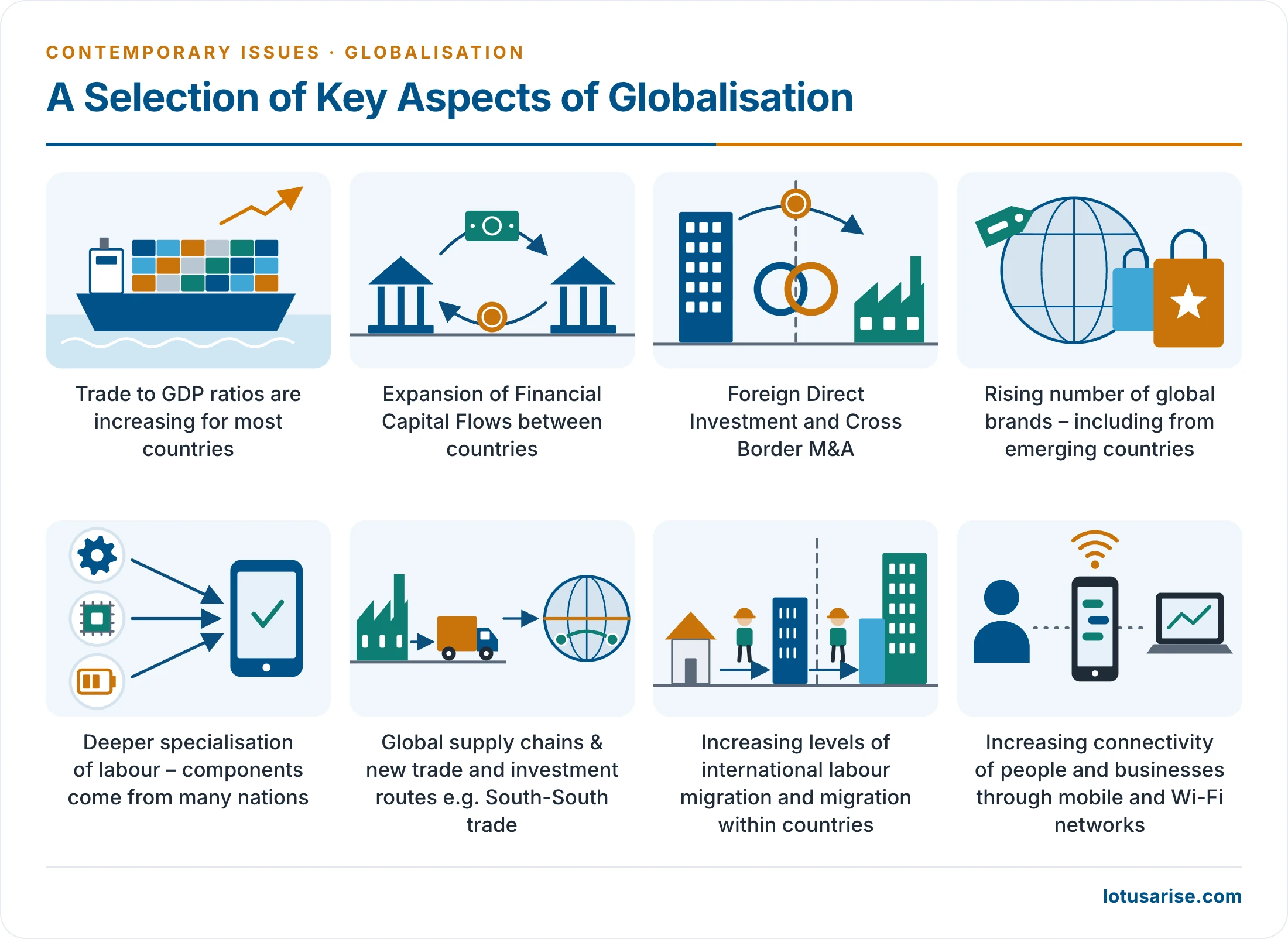
- Economic globalisation aligns regional economies with the global economy through trade, foreign direct investment (FDI), capital flows, technology and wide-scale migration.
- It is the outcome of liberalisation and privatisation: only after 1991 did the Indian economy taste free trade in a real sense.
- Commercial activities move to places where they are cheaper, so production is spread across countries.
- The web of a product: research and development may sit in the USA, component making in China, accessories in Thailand, assembly in Poland and call centres in India.
- Apple shows how such webs shift. By a 2026 industry estimate, China assembled about 74% of iPhones in 2025 and India about 23%, against 14% in 2024.
Outsourcing: An Offshoot of Globalisation
- Outsourcing occurs when a company retains another business, usually in a country with lower labour costs, for regular back-end work such as business process outsourcing (BPO) and knowledge process outsourcing (KPO). It has intensified with information and communication technologies (ICT).
- Low wages and English-speaking skilled manpower made India a global outsourcing destination after the reforms.
- The software industry grew about 52% a year between 1991 and 1996, drawing on a large pool of technical skill.
- In 2025–26, the technology sector earned about US$ 315 billion, of which about US$ 246 billion came from exports.
Advantages of Globalisation
- Firms and consumers: more competition raised the productivity of domestic industry, though only partly; quality improved, prices fell and choice widened; and foreign capital brought updated technology.
- Local suppliers: firms supplying raw materials to big industries gained, and some Indian firms grew from local to global, into big multinationals.
- Foreign investment: FDI and foreign portfolio investment (FPI) together came to just US$ 100 million in 1990–91. In 2025–26, total FDI inflow was US$ 94.52 billion, but net FDI only US$ 7.7 billion after repatriation and outward investment.
- Foreign exchange reserves: from foreign currency assets of US$ 2.24 billion at end-March 1991, reserves reached a record US$ 785.7 billion on 4 September 2026 and stood at US$ 721.0 billion on 16 October 2026.
- Industrial revival: foreign investment and technology revived old units and created new ones.
- The slump of 1991 had eased by 1994, when automobiles, consumer electronics, textiles, petrochemicals and software grew at about 20%.
- India also took the global recession of 2008 relatively well, though industrial growth fell to 2.5% in 2008–09.
- Infrastructure: heavy investment flowed into transport and electricity, both weak before the reforms.
- GDP growth: growth before 1980 was known as the Hindu rate of growth, a term of the economist Raj Krishna for a rate of about 3–3.5%. It rose after liberalisation:
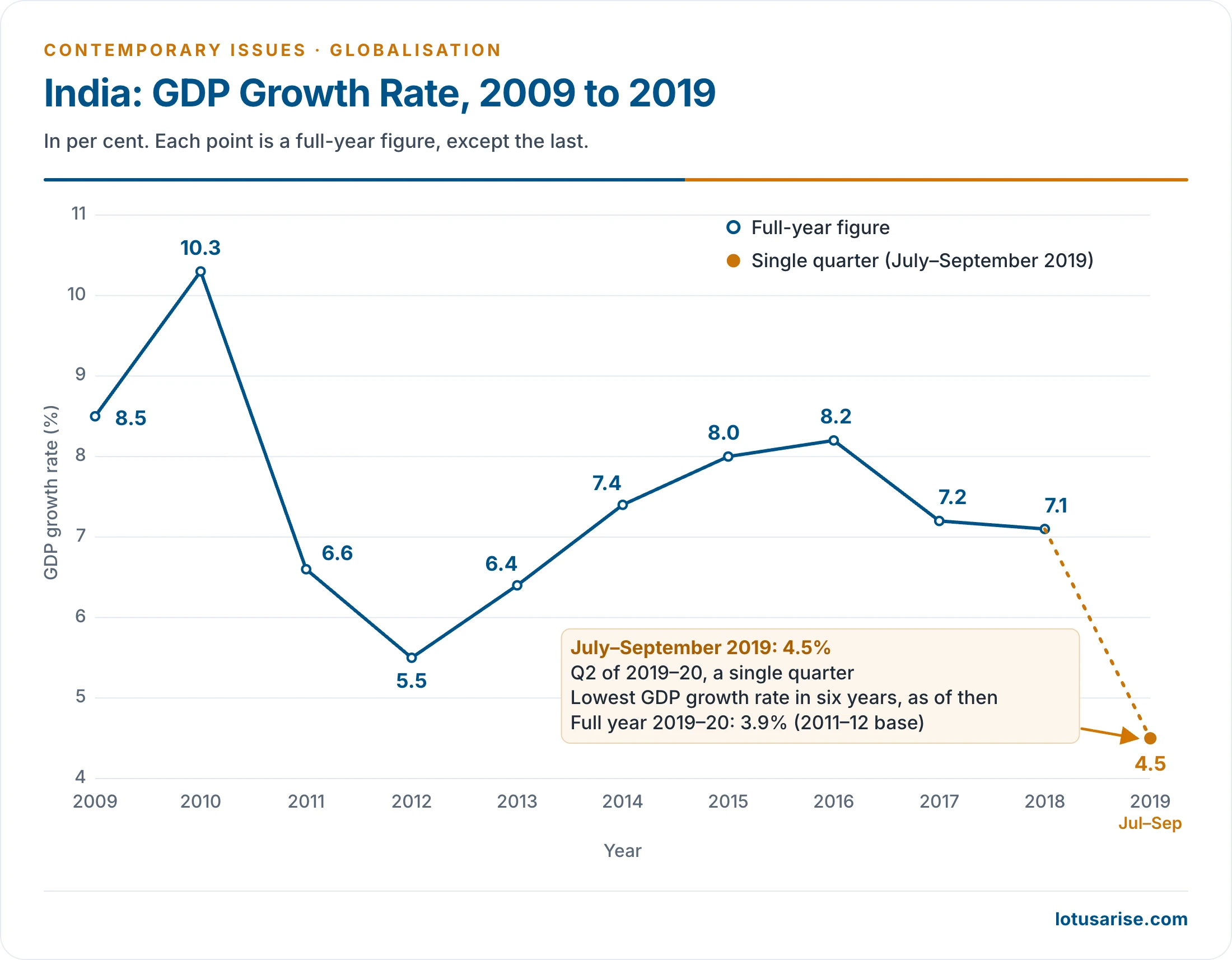
- Growth since 2012 has swung around the Covid-19 shock:
| Period | Growth (%) | Basis |
|---|---|---|
| Twelfth Plan, 2012–17 | about 7.1 | Plan average |
| 2019–20 | 3.9 | 2011–12 base |
| 2020–21 | −5.8 | 2011–12 base; Covid-19 year |
| 2021–22 | 9.7 | 2011–12 base |
| 2022–23 | 7.6 | 2011–12 base, final |
| 2023–24 | 9.2 | 2011–12 base, first revised |
| 2024–25 | 7.1 (6.5 on the 2011–12 base) | 2022–23 base |
| 2025–26 | 7.7 | 2022–23 base, provisional (June 2026) |
- Services: most GDP growth has come from the service sector, whose share rose from 37.0% of GDP in 1990 to 49.3% in 2025 (World Bank).
- Going abroad: Indian companies have left footprints overseas.
- Tata group: Tetley (2000), NatSteel (2004–05) and Corus (2007).
- VSNL, later Tata Communications: Tyco Global Network and Teleglobe (2005–06).
Disadvantages of Globalisation
- Rural–urban gap: critics hold that reform widened the gap between rural and urban India, with joblessness and the growth of slums, while well-off urban groups gained most.
- Competition: some small producers could not survive against foreign firms.
- Units making batteries, plastic toys and tyres and other micro, small and medium enterprises (MSMEs) shut down, causing job losses. Toys are the classic case.
- Cottage and small-scale industries, the livelihood of millions of village artisans, lacked the finance and technology of big firms.
- Job quality: more employment is flexible or temporary, because of competition and uncertainty.
- Sectoral imbalance: manufacturing as a whole suffered while services benefited. Manufacturing was 16.6% of GDP in 1990 and 13.5% in 2025.
- Foreign subsidies: domestic industries also suffered from subsidies other countries gave their own firms.
- Structural bottlenecks: slow and costly land acquisition, rigid labour laws, a shortage of skilled workers and low spending on research held back manufacturing. Assembly industries such as electronics and solar panels still depend on imported Chinese components.
- Jobless growth: reform-led growth has not created employment in step with output.
- Labour-saving technology came along with heavy investment.
- Agriculture still held about 46% of workers in 2023–24 (Periodic Labour Force Survey), far above its share of output.
- The four Labour Codes took effect on 21 November 2025. Supporters call them a simplification, and unions oppose them as weakening worker protection.
- Agriculture: critics call the fall in public investment in irrigation, power, roads, market links and research the biggest drawback of the reform period.
- Liberalisation favoured industry, they add, over a sector then supporting more than 55% of the people.
- Power tariffs: reform in the power sector brought a steep rise in tariffs, which hit some groups hard. Suicides among the powerloom weavers of Sircilla (now in Telangana) in the early 2000s are linked to it, alongside debt and weak markets.
- Farmers: small and marginal farmers were affected adversely, with rising suicides among cotton farmers of the Deccan; the National Crime Records Bureau recorded 10,786 suicides in the farm sector in 2023, led by Maharashtra and Karnataka.
- Imports: products that were not world class lost demand to cheaper imports.
- Narrow investment: only a few sectors attracted investment, and infrastructure stayed inadequate across the country.
- Foreign money favoured white goods over wage goods, and could not always be absorbed productively.
- Portfolio money, easily withdrawn, has often been preferred to direct investment. Net portfolio outflow was about US$ 16.5 billion in 2025–26.
- Protectionism abroad: policies of developed countries have denied a level playing field and cut the export income of developing countries such as India, as with US tariffs of up to 50% from August 2025, cut to 18% under a February 2026 framework.
- Welfare spending: critics argue that lower tariffs and pressure from multilateral lenders cut development and welfare expenditure.
- Other criticisms:
- Inflation has at times reached double digits, and the gap between rich and poor has widened.
- Some critics fear that foreign firms could gain too much power over economic and political choices, while others credit multinational companies with capital, technology and exports.
Regional Effects of the Reforms
- Investors, Indian and foreign, chose regions that were already industrially advanced, widening the older regional imbalance.
| Theme | Early reform years | Latest position |
|---|---|---|
| Investment | 1994: Maharashtra led with ₹3,744.71 crore, then West Bengal with ₹2,844 crore | 2025–26: Maharashtra led FDI with about US$ 18.4 billion, then Karnataka |
| Who gained | Maharashtra, Gujarat, Rajasthan, West Bengal, Andhra Pradesh, Tamil Nadu, Karnataka | Mainly western and southern States and the National Capital Region |
| Who lagged | Bihar, Uttar Pradesh, Odisha, Himachal Pradesh, Uttarakhand, Jammu and Kashmir, Meghalaya, Mizoram, Tripura, Nagaland | Bihar, the north-eastern States and others |
| Income gap | Top-to-bottom ratio of per capita income among 20 major States: 4.9 (2011–12) | 5.6 (2023–24) |
- Infrastructure: of 33 electricity projects sanctioned in 1994, Odisha received 6 and Karnataka 5, while Madhya Pradesh, Uttar Pradesh, Bihar, Mizoram, Nagaland and Delhi received none.
- Enclaves: export zones, from Asia’s first at Kandla (1965) to the special economic zones of the Act of 2005, cluster strongly. Special economic zones numbered 277 operational on 31 March 2026.
- Skills and cities: the technology boom lifted a few metropolitan regions, mostly southern and western, along with the National Capital Region.





Really very helpful. Thanks for all ur efforts.
Thank a lot Sir
Extremely helpful, Thanks!
Substantial sale and Privatisation both terms are same??
Substantial sale means transferring of assets not less than 25% and rest you know
THANKSSS IT WAS OF GREAT HELP