- The chemical industry turns raw materials such as oil, natural gas, water and minerals into thousands of products, using chemical processes, reactions and refining. It is central to the modern world economy.
- In India it ranks among the most vital parts of the economy. It started late, changed greatly over three to four decades, and moved faster once industrial policy was liberalised in 1991.
- It is studied under two heads: the heavy inorganic and the heavy organic chemical industry, with allied branches such as pesticides, dyestuffs, soaps and detergents.
Scale and Structure
Position in the Economy
- It has long been counted fourth among groups of industries, behind textiles, iron and steel, and engineering.
- Its growth has run above the average for Indian industry. Older accounts give about 10% a year over a decade.
- Rank: third largest producer in Asia and sixth in the world (NITI Aayog, July 2025).
- On chemical sales alone, the European Chemical Industry Council placed India seventh in the world and fourth in Asia for 2022, at €115 billion.
- Global share: a projection of the mid-2010s saw India’s share doubling to 6% by 2021. Its share of global chemical value chains was about 3.5% in 2023.
- NITI Aayog now proposes 5–6% by 2030 and 10–12% by 2040.
- Size: the sector was put at US$147 billion in 2015, with US$226 billion projected for 2020.
- India remains a net importer, and the gap has widened:
| Year | Imports (US$ billion) | Exports (US$ billion) | Deficit (US$ billion) |
|---|---|---|---|
| 2015 | 19 | 12.7 | 6.3 |
| 2023 | about 75 | about 44 | about 31 |
What the Industry Makes
- Its products go either into the manufacture of other materials or directly to consumers:
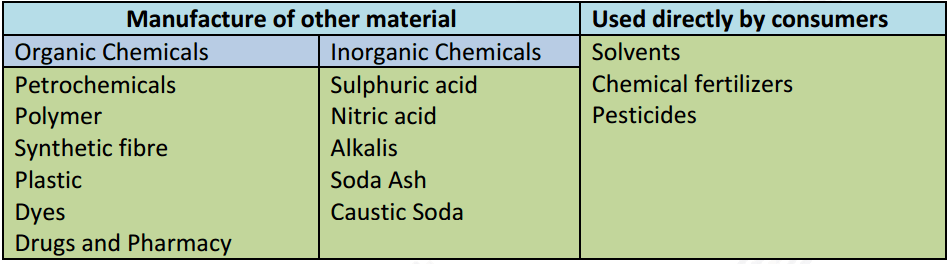
- Chemical fertilizers and drugs and pharmaceuticals have grown into major industries of their own.
- Official output for large and medium units in 2023-24 (thousand tonnes):
| Group | Capacity | Production | Imports | Exports |
|---|---|---|---|---|
| Alkali chemicals | 11,260 | 9,234 | 1,263 | 893 |
| Inorganic chemicals | 1,650 | 1,137 | 942 | 417 |
| Organic chemicals | 3,076 | 1,980 | 5,018 | 301 |
| Pesticides (technical) | 444 | 280 | 62 | 539 |
| Dyes and pigments | 590 | 345 | 50 | 493 |
| Total major chemicals | 17,021 | 12,976 | 7,334 | 2,642 |
- Alkalis dominate output at about 71%, while organic chemicals carry the import bill.
Heavy Inorganic Chemical Industry
Sulphuric Acid
- Uses: it goes into fertilizers, paints, plastics, dyestuffs and synthetic fibres. Metallurgy, oil refining and leather tanning also need it.
- Raw material: sulphur, scarce in India. About 90% has been imported.
- Domestic sulphur now comes as a by-product of refineries and fertilizer plants, and metal smelters yield the acid itself.
- Over 100 units make it.
- About 80% of output comes from Keralam (Kerala), Tamil Nadu, Maharashtra, Gujarat, Madhya Pradesh, Chhattisgarh and West Bengal.
- Jharkhand, Andhra Pradesh, Telangana, Uttar Pradesh, Delhi, Karnataka, Assam, Punjab, Rajasthan and Odisha supply the rest.
- Centres: Mumbai, Trombay, Chennai, Kalyan, Jamshedpur, Delhi, Kolkata, Burnpur, Udaipur, Alwaye, Debari and Khetri.
Nitric Acid
- Its making and use are tied to fertilizer plants and explosives.
- Trombay is the main producer. The unit began under the Fertilizer Corporation of India and passed to Rashtriya Chemicals and Fertilizers in the 1978 reorganisation.
Alkalis
- The main products are soda ash, caustic soda, calcium carbide and liquid chlorine. Demand keeps rising with the industries that use them.
- Raw materials are heavy and weight-losing: common salt, limestone and coal. The finished product weighs far less than its inputs.
- It also needs cheap electricity in abundance.
- So plants locate close to raw material, power and market.
Soda Ash
- Uses: glass, paper, soaps and detergents.
- Raw materials: sodium chloride and limestone, both plentiful in Gujarat.
- Main centres: Okha, Mithapur and Dhrangadhra. Sutrapada, Varanasi, Nangal and Tuticorin are smaller centres.
- The foundation stone of India’s first soda ash factory was laid at Dhrangadhra in 1925.
- Tata Chemicals took over the Mithapur works in 1939.
- Output rose steadily (thousand tonnes):
| Year | 1950-51 | 2000-01 | 2011-12 | 2023-24 |
|---|---|---|---|---|
| Soda ash | 46 | 1,631 | 2,427 | 2,976 |
- Capacity stood at 3,714 thousand tonnes in 2023-24, and imports came from Turkey, the USA, Russia, Kenya and the UAE.
Caustic Soda
- First plant: Mettur, 1936, making just five tonnes a day.
- Users: soaps, detergents, textiles and alumina.
- By-product: chlorine, which goes to water treatment plants and to the paper, soap, detergent and textile industries.
- Raw material: common salt, plentiful in India.
- Power is the deciding input. It has made up more than two-thirds of production cost.
- New mercury-cell plants have been barred since 1991. The shift to membrane cells saves about 24% of energy on a net basis.
- Older growth ran near 6% a year, against about 2% worldwide. Output reached 3,618 thousand tonnes in 2023-24, from a capacity of 4,304.
- Centres: Porbandar, Mithapur, Thane, Kalyan and Titagarh.
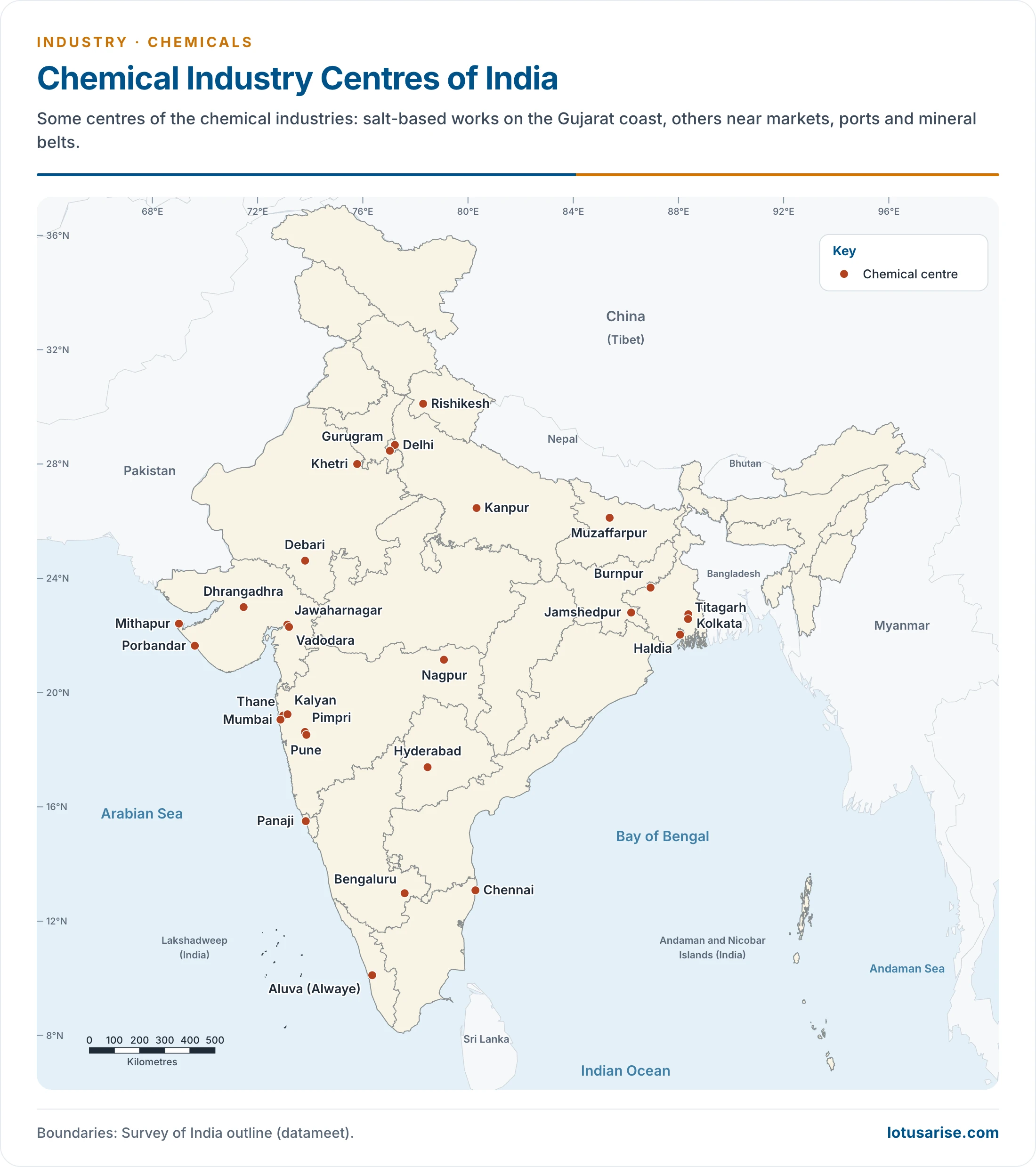
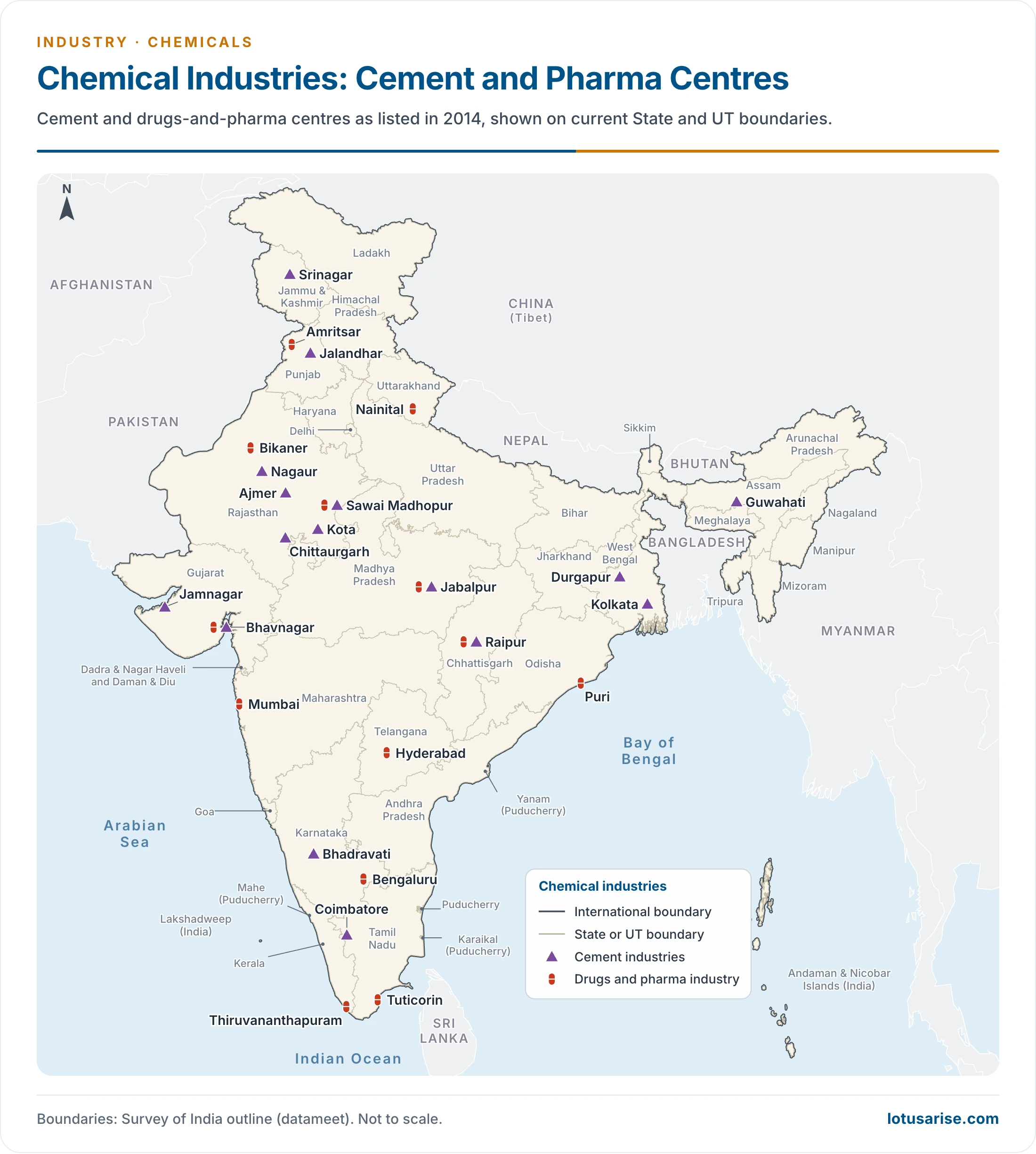
- The second map marks cement and drugs-and-pharma centres.
Heavy Organic Chemical Industry
Petrochemicals
- Petrochemicals are chemicals and compounds derived from petroleum resources. The main feedstock and fuel are natural gas and naphtha.
- Their rise followed demand for organic chemicals outrunning older routes through alcohol, calcium carbide and coal, just as petroleum refining expanded.
- Uses: synthetic fibres, synthetic rubber, plastics, dyestuffs, insecticides, drugs and pharmaceuticals.
- The products now reach clothing, housing, furniture, vehicles, toys, farming, irrigation, packaging and medical appliances.
- Geography:
- Mumbai has been the classical hub.
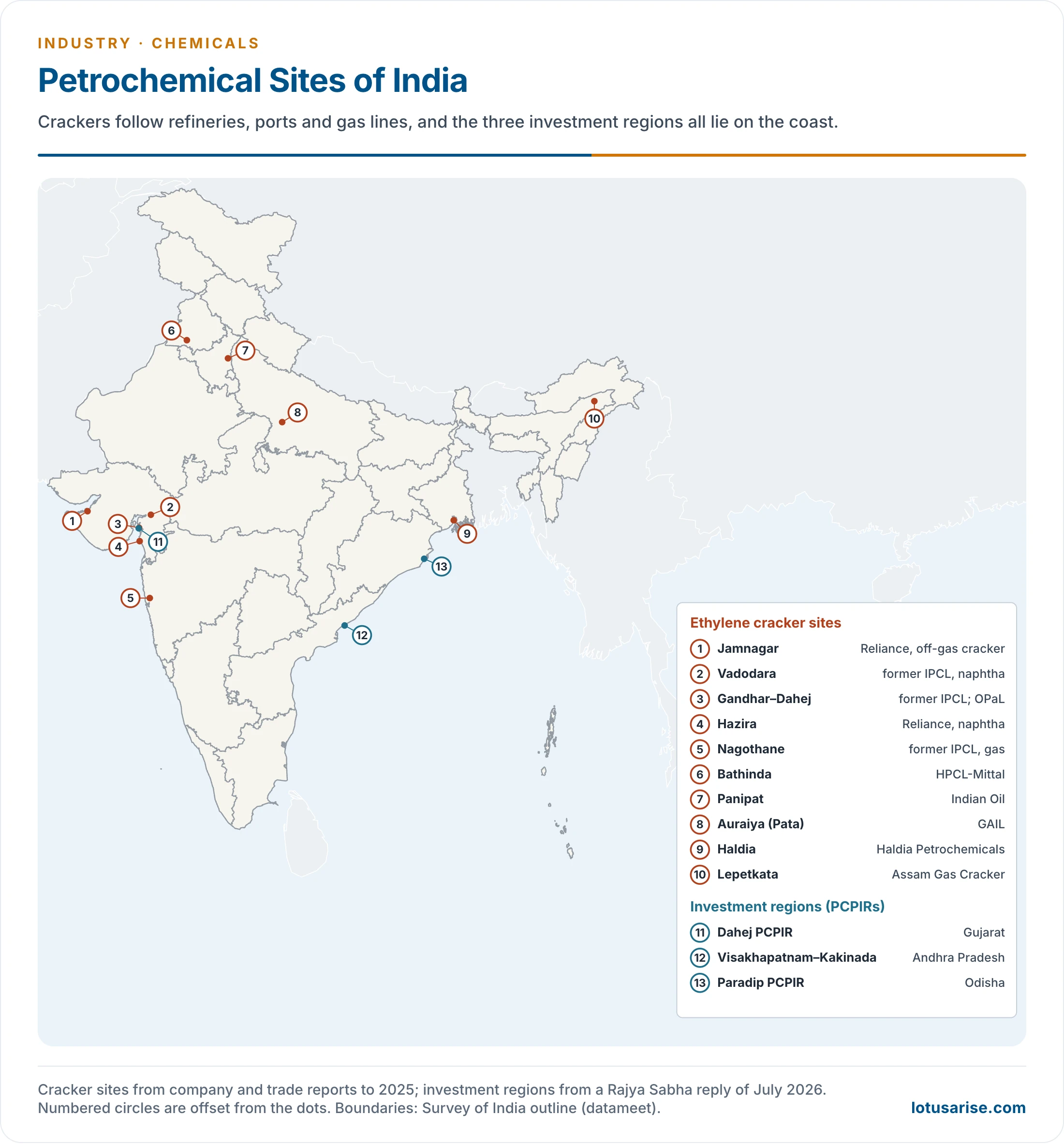
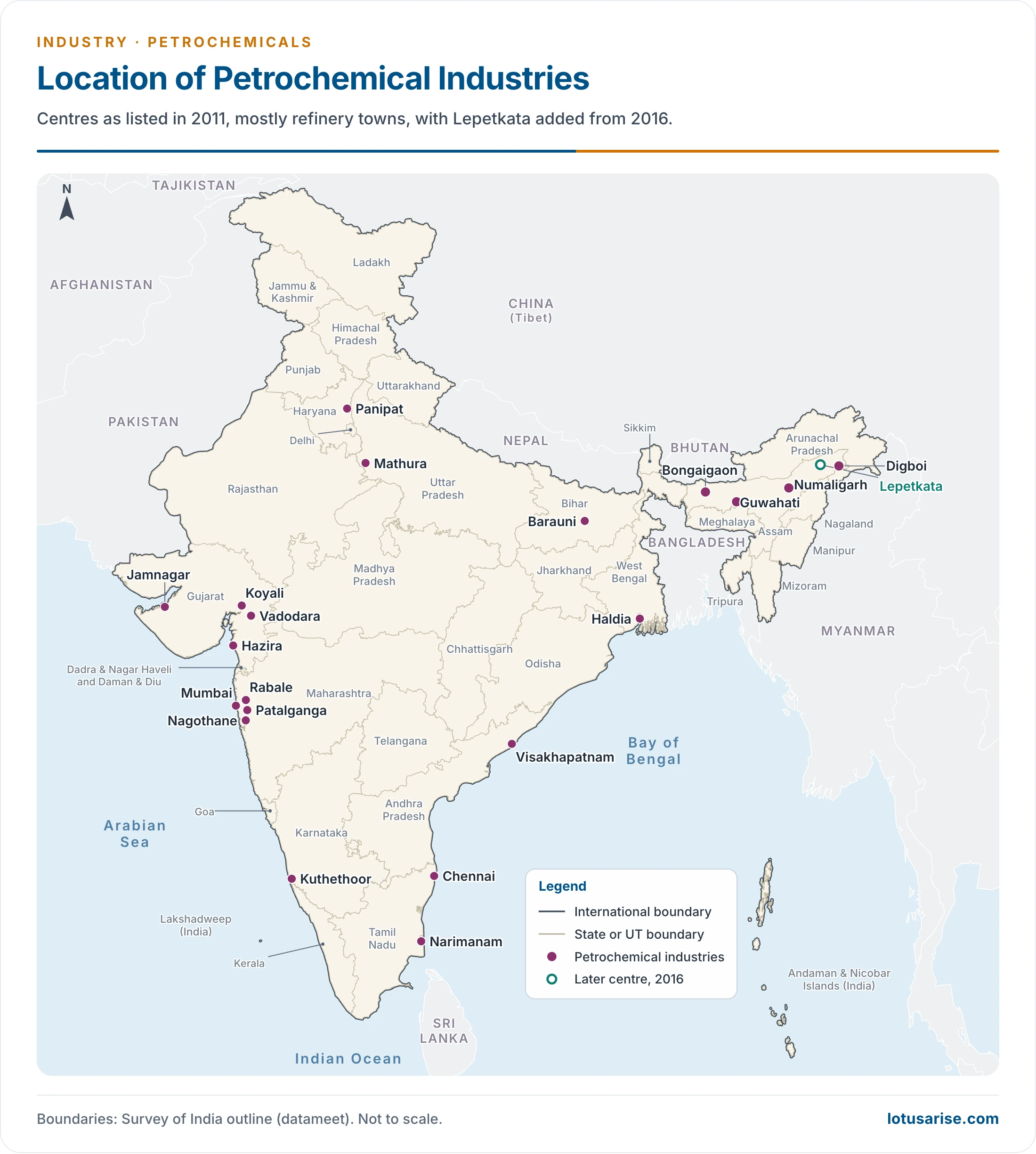
- Cracker sites in the classical list: Auraiya (Uttar Pradesh), Jamnagar, Gandhar, Hazira (Gujarat), Nagothane, Ratnagiri (Maharashtra), Haldia (West Bengal) and Visakhapatnam (Andhra Pradesh).
- The Ratnagiri refinery-cum-petrochemical complex, shifted from Nanar to Barsu after local protest, remains a proposal.
- The weight has moved to Gujarat, with 33.36% of chemical output, against 15.65% for Maharashtra (Annual Survey of Industries, 2022-23).
- New plants have reached Bathinda, Panipat and Lepetkata (Dibrugarh, Assam), where the Assam Gas Cracker was dedicated in February 2016.
- Petroleum, Chemicals and Petrochemicals Investment Regions (PCPIRs):
- Three operate: Dahej (Gujarat), Visakhapatnam–Kakinada (Andhra Pradesh) and Paradip (Odisha).
- They had drawn Rs 3,49,192 crore by July 2026, up from Rs 1,40,537 crore in March 2014.
- Dahej alone holds Rs 1,37,163 crore, 2,079 units and 2,45,140 jobs.
- Institutions:
- Indian Petrochemicals Corporation Limited (IPCL), a public undertaking, made polymers, chemicals, fibres and fibre intermediates at Vadodara, Gandhar and Nagothane. It merged into Reliance Industries in September 2007.
- Petrofils Cooperative Limited, owned jointly by the Centre and weavers’ societies, made polyester and nylon filament yarn at Vadodara and Naldhari.
- CIPET, founded at Chennai as the institute for plastics engineering and technology, trains staff and gives technical services to the trade. Renamed the Central Institute of Petrochemicals Engineering and Technology, it has 45 centres on the ministry’s count.
- The group divides into four subgroups: polymers, synthetic fibres, elastomers and surfactant intermediates. Official series add performance plastics (thousand tonnes):
| Group | 2006-07 | 2011-12 | 2023-24 |
|---|---|---|---|
| Synthetic fibres | 2,251 | 2,697 | 3,853 |
| Polymers | 5,183 | 6,211 | 12,548 |
| Elastomers (synthetic rubber) | 95 | 88 | 395 |
| Synthetic detergent intermediates | 556 | 623 | 808 |
| Performance plastics | 132 | 183 | 1,425 |
| Total | 8,517 | 9,802 | 19,028 |
- The 2023-24 column comes from a later official series, so read the jump as indicative. The 2006-07 entries add to 8,217, while the official table prints the total as 8,517, so one of those entries may carry a misprint.
Polymers and Plastics
- Polymers are built from ethylene and propylene, which come out of crude oil refining. They feed the plastics industry as its basic raw material.
- Polyethylene is the common thermoplastic.
- Processors take plastic as powder, pellets, resin or sheets, and shape it into finished goods.
- History:
- Attempts in the late 1950s and early 1960s used other organic chemicals.
- National Organic Chemical Industries Limited (NOCIL), founded by the Mafatlal Group in 1961, began the first naphtha-based unit at Mumbai. Other companies followed.
- Producers: Mumbai, Barauni, Mettur, Pimpri and Rishra.
- Plastic raw materials or goods also come from Delhi, Kolkata, Chennai, Bengaluru, Vadodara, Vapi, Kanpur, Amritsar, Coimbatore, Bongaigaon and Durgapur.
- Output:
- Polymer growth was about 7.8% in 2003-04.
- Between 2006-07 and 2011-12, output climbed 19.8%, as the table shows.
- Trade:
- India once counted as a major polymer exporter. Exports peaked at 1,934 thousand tonnes in 2018-19.
- In 2023-24, imports of 5,313 far exceeded exports of 705, so India is now a net importer.
- The processing industry, in older estimates:
- About 20,000 units, nearly three-fourths of them small, taking 20–25% of polymers.
- Rs 15,000 crore invested, a Rs 25,000 crore turnover, capacity of 6–7 million tonnes and growth of about 15% a year.
- Three million people employed directly.
- It handled about 3.6 million tonnes of virgin polymer and 1.4 million tonnes of recycled material.
- Uses and exports:
- Packaging, building, pipes, fittings, electrical accessories, consumer goods, housewares, toys and furniture.
- Called a sunrise industry for its versatility, and given thrust-industry status.
- Buyers have included Kuwait, Saudi Arabia, Egypt, Kenya, Nigeria, Iraq, Syria, the UK, Thailand and Sri Lanka.
- Problems and prospects:
- Older per capita use was only 3.6 kg against a world average of 21.5 kg, which signals room to grow.
- Plastic does not biodegrade, so solid waste is the main cost. India banned identified single-use plastic items from 1 July 2022.
- Recycling eases waste and raw-material pressure and gives work, much of it to ragpickers.
Synthetic Fibres
- They are prized for strength, durability, dyeability, workability, washability and resistance to wrinkles and shrinkage.
- Nylon made a start just after World War II. Real progress came in the 1960s, once refineries supplied feedstock.
- Centres:
- Nylon and polyester filament yarn: Kota, Pimpri, Mumbai, Modinagar, Pune, Ujjain, Nagpur and Udhana.
- Acrylic staple fibre: Kota and Vadodara.
- Polyester staple fibre: Thane, Ghaziabad, Manali, Kota and Vadodara.
- In 2023-24, polyester filament yarn led at 2,508 thousand tonnes, followed by polyester staple fibre at 1,025 and acrylic fibre at 76.
Elastomers
- Elastomers are polymers with both viscosity and elasticity, a property called visco-elasticity.
- Weak forces hold their molecules together, so they generally have a low Young’s modulus and high failure strain.
- They regain their original shape and size after being stretched a long way.
- Examples: natural rubber, polyurethanes and neoprene.
- Indian output centres on styrene butadiene rubber and polybutadiene rubber.
- Output moved from 95 thousand tonnes in 2006-07 to 105 in 2009-10 and 88 in 2011-12, with one plant idle and capacity use of 55–60%.
- In 2023-24 production was 395 thousand tonnes against imports of 724, so rubber remains import-dependent.
Surfactant Intermediates
- A surfactant, or surface-active agent, is a substance such as a detergent that lowers a liquid’s surface tension, improving spreading and wetting.
- In textile dyeing, surfactants help dye penetrate the fabric evenly. They also disperse aqueous suspensions of insoluble dyes and perfumes.
- The main intermediates for detergents are linear alkyl benzene and ethylene oxide, at 479 and 329 thousand tonnes in 2023-24.
Allied Chemical Industries
Pesticides
- They serve agriculture and public health, as insecticides, fungicides and rodenticides.
- Older count: over 125 units of technical grade and over 500 of formulations, with capacity of 1.25 lakh tonnes and output of 85,800 tonnes.
- Hindustan Insecticides Limited, now HIL (India) Limited, is the public sector maker, with units listed at Udyogamandal, Rasayani and Delhi. Its subsidiary, Southern Pesticides Corporation, has a factory at Kovur.
- Its classical products were BHC, DDT, Malathion and Endosulfan. The Supreme Court stopped endosulfan’s production and sale in May 2011.
- India has moved from importing to exporting. In 2023-24, exports of 539 thousand tonnes dwarfed imports of 62.
Dyestuffs
- Synthetic dyes spread after World War II, when imports almost stopped. Natural and vegetable colours are far older.
- Early units:
- Associated Research Laboratories near Pune (1941).
- Atul Products near Bulsar (1947, producing from 1952).
- Amar Dyechem and Indian Dyestuff Industries (1954).
- Foreign collaborations followed, including Sandoz (India) at Kolshet (1961).
- Older structure: over 95% of demand met at home, with 50 organised units making 65% and over 1,000 small units making 35%.
- Maharashtra and Gujarat together make over 90%.
- Advantages: textile and leather demand, feedstock, chemical engineering skills, skilled labour, entrepreneurship and low overheads.
- The official 2023-24 series covers large and medium units only, at 345 thousand tonnes.
Soaps and Detergents
- Soap making grew after World War I, and detergents came later.
- Older figures: 88 organised soap units (capacity 7,05,963 tonnes) and 33 detergent units (6,05,000 tonnes), in a market of Rs 6,716 crore.
- The rural market has been livelier than the urban.
Location and Current Issues
- Three location logics recur:
- Raw material and power for alkalis, as on the salt and limestone coast of Saurashtra.
- Refinery and port for petrochemicals, as at Jamnagar, Dahej, Hazira and Haldia.
- Market and skills for dyes, plastics and formulations, as around Mumbai and Ahmedabad–Vadodara.
- Policy: most products are de-licensed, and 100% foreign direct investment is automatic, except for certain hazardous chemicals such as hydrocyanic acid, phosgene and isocyanates.
- Problems:
- Feedstock and import dependence, sharpest in organics, with imports of 5,018 against exports of 301 thousand tonnes in 2023-24.
- Idle capacity: utilisation was 76.2% in major chemicals, and only 64.3% in organics.
- Hazard and pollution: the Bhopal gas disaster of December 1984 remains the defining industrial accident, and industrial complexes such as Vapi and Ankleshwar carry heavy effluent loads.
Previous Year Questions
- No direct PYQ has been asked on this sub-topic yet.