

- Indian society is very old, complex and plural. Over a long history, groups from many parts of the world entered India with their own social, cultural and physical traits, and were joined to the peoples already there.
- Plurality and multiplicity characterise Indian society. It has accommodated and assimilated outside elements into a growing culture.
- It has never been a “melting pot” in which differences dissolve into one uniform identity.
- It is better described as a “salad bowl”: elements keep their identity, yet together form a distinct whole. In this sense India is a unity in diversity, guided by tolerance and mutual respect.
- Over time Indian society built up:
- the varna system and caste hierarchies;
- religious diversity and pluralism;
- distinctive gender roles and family structures;
- an economic organisation and occupational pattern tied to land and caste.
- Its evolution was shaped by reform and devotional movements (Buddhist, Jain, Bhakti, Sufi and modern reformers), colonial intervention, constitutional values of equality and justice, and now globalisation and technology.
- The result is a “continuity with change” society: traditional norms persist while efforts continue towards social justice, inclusion and modernisation. Its regional expression is the mosaic of cultural regions of India.
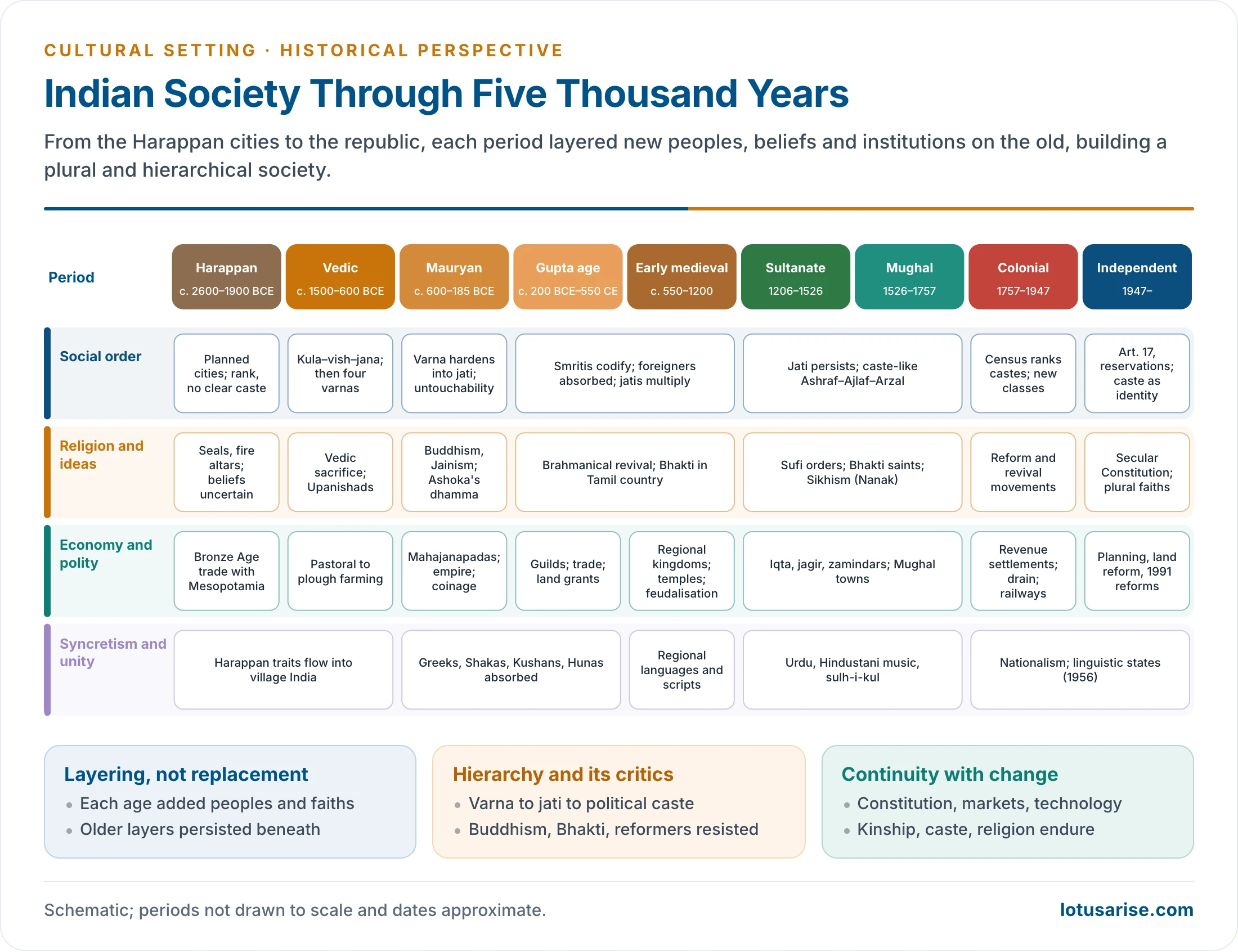
Genesis of Diversity and Bases of Unity

Sources of Diversity
- Physiography: the Himalaya, the Indo-Gangetic plain, the desert, the Deccan plateau, the coasts and the islands support very different ways of life, from pastoral nomadism to wet-rice farming.
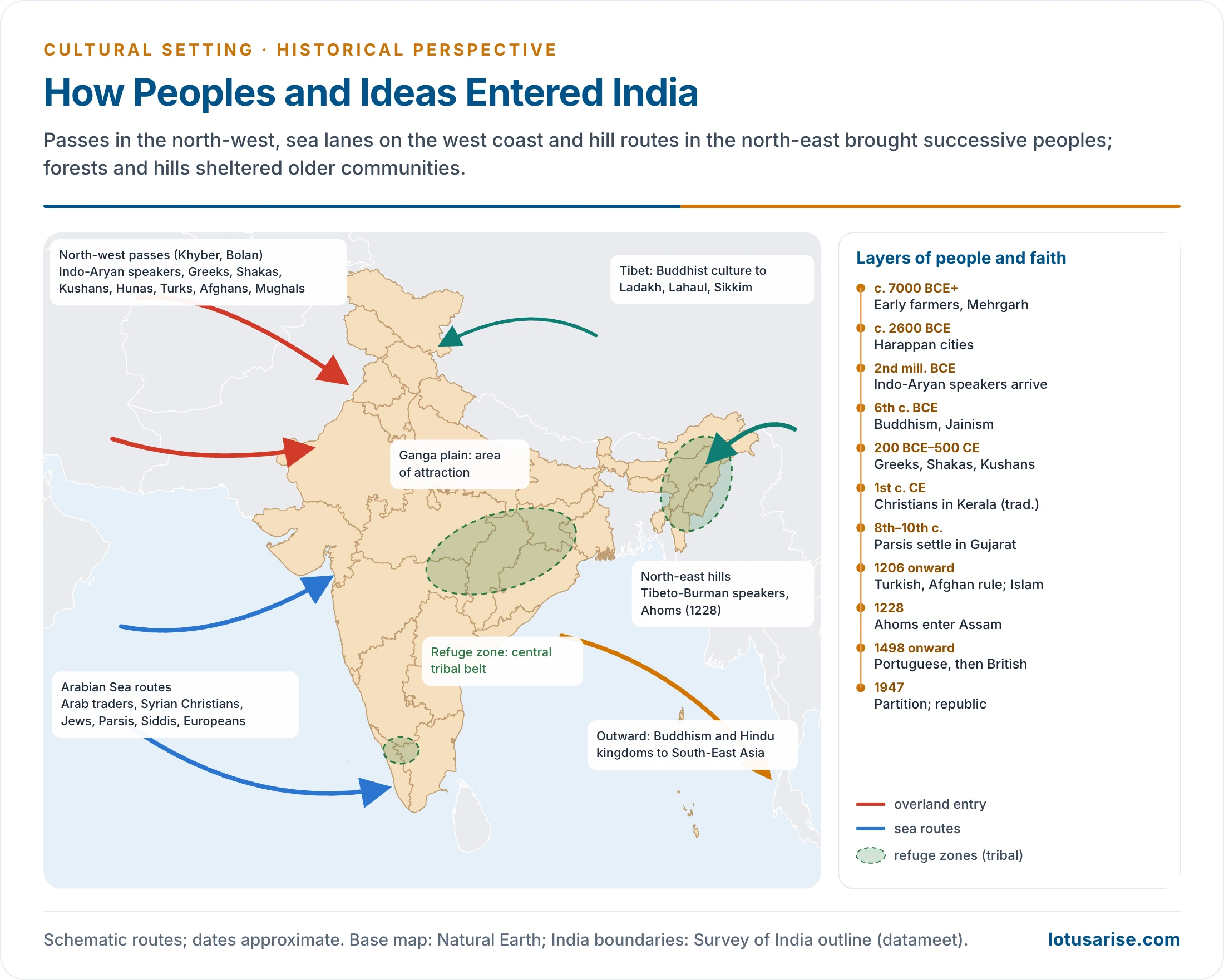
- Successive arrivals: India lies open to Central and West Asia through the north-western passes, to the Arabian Sea and the Bay of Bengal by sea, and to South-East Asia and Tibet through the north-eastern hills. Each route brought new peoples, languages and faiths over five thousand years.
- Refuge zones: forests and hills of central India and the North-East sheltered older communities. They became today’s tribal areas with distinct languages and customs.
- Maritime contacts: the coasts received traders and refugees who kept their identity: Jews of Kochi, Syrian Christians and Arab-descended Mappilas in Keralam (Kerala), Parsis in Gujarat, and Siddis of African descent in Gujarat and Karnataka.
- Birthplace of religions: Hinduism, Buddhism, Jainism and Sikhism arose here. Islam, Christianity, Judaism and Zoroastrianism found long-established homes here.
- Regional states: long periods of rule by regional kingdoms fostered regional languages, literatures, scripts and temple styles.
- Colonial and modern change added new classes, new religious and caste categories, and new regional identities.
- The result shows on the ground in differing settlement patterns, land tenure, farming practice, kinship, marriage rites and inheritance.
Bases of Unity
- Geographical unity: the mountain and ocean frame of the subcontinent and the common monsoon rhythm of the farming year.
- Sacred geography: pilgrimage circuits, sacred rivers and a shared stock of epics (the Ramayana and the Mahabharata are retold in every major language) link distant regions. Sikhs, Jains and Buddhists also hold India sacred, and Muslims and Christians have major pilgrim centres here.
- Political unification at intervals, under the Mauryas, the Guptas, the Delhi Sultanate, the Mughals and the British, and finally the Constitution of 1950.
- Ashoka, Samudragupta and Akbar brought large parts under one rule, but only British rule made India a single political entity for the first time.
- One constitution, one body of civil and criminal law and a secular state now give substance to the idea of one nation.
- Economic interdependence of regions through trade, pilgrimage and migration.
- Shared institutions: the village community, the joint family and the jati, found in different forms across regions and faiths.
Caste and the Village Order
- Caste across faiths: caste is not confined to Hindus. Muslims, Christians, Sikhs, Jews, Buddhists and Jains in India also show caste groupings, which gives diverse communities a common social idiom.
- Main features: hierarchy; endogamy and hypergamy; occupational association; distinctions in custom, dress and speech; pollution; ritual and other privileges and disabilities; caste organisation; and caste mobility.
- Numbers and spread: India has more than 3,000 castes, and most are regional:
- Upper: Saryuparin Brahmins of Awadh, Namboodiris of Keralam, Chitpavans of Maharashtra, Iyengars of Tamil Nadu.
- Middle, cultivating: Jats of Haryana and Punjab, Bhumihars of Bihar, Reddys of Andhra Pradesh, Vellalas of the Tamil country.
- Lower: Chamars of Uttar Pradesh, Mahars of Maharashtra, Malas of Andhra Pradesh, Adi-Dravidas of Tamil Nadu.
- Varna on the map:
- Brahmins are the most widely spread, since every region needs ritual specialists, and land grants made many of them landowners.
- Warrior castes often give villages their name: Rajput villages in Rajasthan, Jat villages in Haryana and Uttar Pradesh, Nair villages in Keralam.
- Vaishyas farm and trade; Shudras, mainly cultivators and artisans, form the bulk of the population.
- Jajmani system: the classic tie between castes in a largely subsistence village.
- Service and artisan castes (priest, barber, washerman, carpenter, blacksmith, leather worker) serve patron families for a yearly share of grain at harvest, with extra payments at birth, marriage and death.
- Regional names: jajmani in the north, mirasi in the Tamil country, bara balute in Maharashtra, adade in Karnataka.
- The tie between jajman and kamin is unequal. The right to serve is hereditary and can be transferred, sold, mortgaged or divided.
- These vertical ties bound castes together locally. Their weakening has strengthened horizontal caste ties over wide areas, the root of much modern caste politics.
- Wider patron–client ties (landowner and tenant, creditor and debtor) still shape rural life and voting.
- Village as a unit: a headman, usually of the dominant caste; an accountant (a Brahmin in the south); a watchman and messengers; a water regulator in irrigated tracts; and a village council for order, disputes, festivals and works such as roads and tanks.
- Forces of change: city life loosens rules on contact and interdining, while roads, the money economy and machine goods are eroding self-sufficiency, crafts and jajmani in the villages.
Ancient Foundations
Harappan Society (c. 2600–1900 BCE)
- The Harappan (Indus Valley) civilisation was India’s first urban society. Its mature phase lasted from about 2600 to 1900 BCE, at sites such as Harappa, Mohenjo-daro, Dholavira, Kalibangan, Lothal and Rakhigarhi.
- Social features:
- Planned cities with grid streets, drains, granaries and standard bricks, showing strong civic organisation.
- Craft specialisation (beads, seals, metal, pottery) and long-distance trade with Mesopotamia.
- Standard weights and measures and a script that is still undeciphered.
- Differences in house size and the citadel–lower town plan suggest social ranking. There is no clear evidence of caste.
- The cities declined after about 1900 BCE through changing rivers, climate and trade. Their people dispersed into village farming cultures, and many traits survived, such as weights, crafts and perhaps religious symbols.
- Geography: the civilisation spread over Sindh, Punjab, Haryana, northern Rajasthan and Gujarat, the largest of the Bronze Age urban cultures. After its decline, chalcolithic village cultures such as Ahar–Banas (Rajasthan), Malwa and Jorwe (Maharashtra) carried farming into the interior.
- Ancient DNA from Rakhigarhi (2019) showed that Harappans descended from ancient Iranian-related hunter-gatherers and South Asian hunter-gatherers, with no steppe-pastoralist ancestry. Most present-day South Asians are mixtures of the Harappan-related population with later steppe-related and south Indian hunter-gatherer ancestry.
- Genetic studies date the mixing of these groups to roughly 4,000–2,000 years ago, after which endogamy sharply reduced mixing. This is a biological trace of the jati system, not evidence that caste is “racial”.
Early Vedic Society (c. 1500–1000 BCE)
- Economic base: the early Vedic people, the Indo-Aryan-speaking groups of the Rig Veda in the Sapta Sindhu (Punjab) region, were migratory and mainly pastoral, skilled in cattle-rearing and warfare.
- Cattle were the main wealth: gavishti, “search for cows”, was a word for war. Farming was secondary.
- Lineage society:
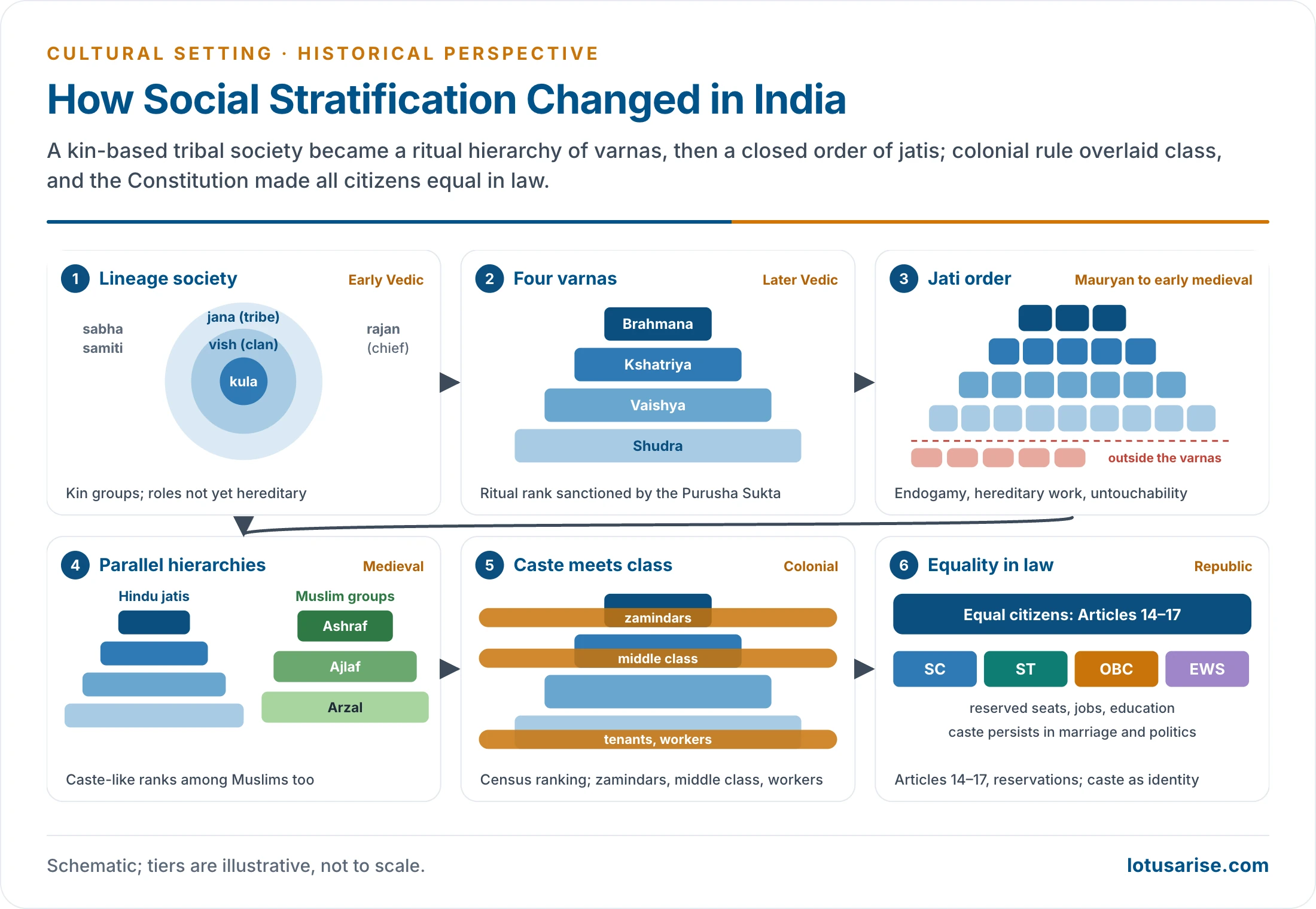
- Society was organised by kinship: families (kula) → clans (vish) → tribes (jana), linked by common descent.
- Each clan was a fairly autonomous socio-political unit. This was a segmentary tribal society with little rigid hierarchy and strong collective identity.
- Relatively egalitarian and flexible:
- Social distinctions were functional, not hereditary. There were no rigid caste divisions at first.
- The rajan was a tribal chief, not an autocratic king. Assemblies such as the sabha (council of elders) and samiti (general assembly) shared in decisions.
- Religion: worship of natural forces, such as Agni (fire), Indra (rain and war) and Varuna (cosmic order), through sacrificial rituals (yajna).
- Interaction with other peoples:
- The texts describe conflict with the dasas and dasyus, possibly descendants of Harappan or other local populations. Some of them were subjugated and used as servile groups.
- The Panis appear as wealthy cattle-owners and traders, portrayed negatively in the Rig Veda. They were non-Aryan groups, possibly of Proto-Australoid or other local stock.
- The texts use colour (varna) imagery to contrast groups. Colonial-era scholars read this racially, a reading modern historians and geneticists reject. The emerging distinction was mainly one of culture, ritual and occupation.
- Proto-stratification: contact between dominant pastoral groups and others led to social differentiation and early forms of the varna distinction.
- Geography: the Rig Veda’s world is the land of the seven rivers (Indus and the Punjab rivers with the Sarasvati). Later texts move east to the Kuru–Panchala country of the Ganga–Yamuna doab and then to Videha and Magadha, tracing the spread of settlement down the Ganga plain.
Later Vedic Society (c. 1000–600 BCE)
- Economic change:
- Expansion into the Ganga plain, helped later by iron tools, brought a shift to settled agriculture and land ownership.
- Surplus production and the idea of private property emerged.
- Complex, hierarchical society: division of labour and occupational specialisation grew, and the egalitarian tribal order declined.
- The four-fold varna system became clearly defined:
- Brahmana (priests): custodians of ritual and sacred knowledge, with the highest prestige.
- Kshatriya (rajanya, warriors): political authority and governance.
- Vaishya: agriculture, cattle-rearing and trade.
- Shudra: manual labour and service; some accounts call them peasants.
- Ideological sanction: the Purusha Sukta of the Rig Veda pictured society as born from the cosmic being (Purusha), with each varna in its place. Hierarchy acquired religious sanction and became a sacred order.
- Earlier hymns name only three groups: Brahma, Kshatra and Vish. The four-fold list became the chaturvarna of later texts.
- The Bhagavad Gita later defended the order through the ideas of guna, karma and dharma.
- Social disabilities:
- Shudras were denied access to the sacred texts (Vedas) and their recitation and to religious rituals, and were marginalised in social and economic life.
- Free choice of occupation survived only among the upper strata. Occupational mobility narrowed, and birth began to replace merit as the basis of status.
- The hierarchy consolidated further in the Epic period.
- Codification: rules of purity and pollution, ritual rank and conduct began to be formalised. These were developed later in the Dharmasutras and Smritis.
- Women: their status declined. Their role in ritual and education shrank, patriarchal norms strengthened and property rights and autonomy were restricted.
- Family and life course:
- The ashrama scheme divided an ideal life into four stages: student, householder, retreat and renunciation.
- Gotra exogamy (marriage outside the clan) and the samskaras (life-cycle rites) took shape.
- These gave the household and kinship the central place they still hold.
Post-Vedic and Mauryan Society (c. 600–185 BCE)
- From lineage to state:
- Clans and lineages became organised republics (gana-sanghas) and monarchies (rajyas) among the sixteen mahajanapadas.
- Authority moved from tribal assemblies to centralised, hereditary kingship, mostly of Kshatriyas, though some republics kept collective rule.
- Second urbanisation in the middle Ganga plain brought cities, coinage and trade.
- Mauryan Empire (c. 322–185 BCE):
- It created administrative centralisation, extended territorial control and integrated diverse regions into one political framework.
- The state regulated social and economic life more actively.
- Ashoka’s dhamma promoted ethical conduct, tolerance, respect for all sects and the restraint of animal sacrifice.
- Megasthenes, the Greek envoy at Pataliputra, described Indian society as divided into seven endogamous occupational groups: a foreigner’s view of hereditary occupations already in place.
- Kautilya’s Arthashastra treats varna duties as matters of state law and policy.
- Buddhism and Jainism as social protest:
- Gautama Buddha and Mahavira (6th–5th centuries BCE) challenged elaborate ritual, sacrifice, priestly dominance and birth-based status. Some scholars read their social side as a Kshatriya challenge to Brahmin supremacy.
- They stressed moral conduct over birth, non-violence (ahimsa) and simple living.
- The sangha offered alternative social spaces open to all. Caste norms weakened to some extent, and social mobility and inclusiveness were encouraged.
- Assimilation: interaction with forest peoples and incoming groups produced cultural syncretism, new identities and sub-groups, regional variation and occupational diversification.
- Rigidification of caste:
- Birth replaced occupation as the basis of status, and movement between varnas declined.
- A fifth group outside the varnas emerged, the “untouchables”. It probably included forest communities and groups in occupations deemed ritually polluting.
- Purity and pollution became central. They justified social distance, restrictions on physical contact, and exclusion from public spaces, water sources and temples.
- The Chinese pilgrim Faxian (c. 400 CE) noted that chandalas lived outside towns and had to announce their approach, showing how far untouchability had spread by Gupta times.
- The open varna order hardened into jati: membership by birth, endogamy, hereditary occupation and strict ritual codes. A functional classification became rigid stratification.
Sangam Society of the South (c. 300 BCE – 300 CE)
- In Tamilakam, the Sangam poems describe a society organised by landscape. The five tinai (eco-zones) each had its own livelihood, deity and way of life:
- Kurinji: hills, with hunting and gathering.
- Mullai: forest and pasture, with herding.
- Marutam: river valleys, with wet-rice farming.
- Neytal: the coast, with fishing and salt-making.
- Palai: dry wasteland, with raiding.
- This is an early ecological view of society: culture matched to environment.
- The Chera, Chola and Pandya kingdoms traded with Rome through ports such as Muziris and Arikamedu.
- Varna was weak at first. Society was ranked more by occupation and clan, and Brahmanical influence grew gradually.
Post-Mauryan, Gupta and Post-Gupta Society (c. 200 BCE – 1200 CE)
- New peoples:
- The centuries after the Mauryas (c. 200 BCE – 300 CE) joined political instability with cultural dynamism. Indo-Greeks, Shakas, Parthians, Kushans and later Hunas entered from the north-west.
- These groups were absorbed into the caste order, often as Kshatriyas, and helped multiply sub-castes (jatis) reflecting regional, occupational and ethnic diversity.
- Buddhism and Jainism lost ground in many regions, and Brahmanical traditions revived and consolidated.
- Economy:
- Guilds (shrenis) flourished in towns. They regulated production, prices and wages, gave social security and identity to artisans and traders, and acted as semi-autonomous bodies.
- Powerful merchant groups and Indian Ocean trade linked India to Rome and South-East Asia. Peasant castes formed the rural base.
- Guilds tightened the link between occupation and caste, making professions more hereditary.
- Classical age (Gupta, c. 320–550 CE):
- A cultural flowering in Sanskrit literature, temple art and architecture, philosophy, mathematics and astronomy, including the decimal place-value system.
- Hindu traditions became the dominant cultural force.
- Codification:
- The Smritis, especially the Manusmriti and later texts, formalised duties by caste and stage of life (varnashrama dharma) and strengthened Brahmanical authority. The position of Shudras also became more settled, though still at the lower end, and the hierarchy as a whole grew more rigid.
- They legitimised caste hierarchy, regulated family, marriage and property, and reduced social mobility.
- Agrarian expansion and land grants:
- Land revenue rose in the Gupta period, a sign of agricultural growth, and investment in crafts and commerce widened.
- Land grants (agraharas, brahmadeyas) to Brahmins, temples and officials carried farming into new regions and forests.
- Forest and tribal peoples were drawn in as new peasant jatis, and rural division of labour multiplied local sub-castes.
- Land grants and expanding administration created demand for scribes and record-keepers, and the Kayasthas emerged as a distinct caste.
- Regionalisation and feudalisation (post-Gupta):
- Central authority declined, and regional kingdoms rose, notably in the south (Pallavas, Chalukyas, Cholas).
- Regional languages, scripts, temple styles and cults developed.
- Land grants created local power structures, made peasants dependent on landed elites, and fragmented political authority.
- Historians debate how far this amounted to “Indian feudalism”. Some stress decline of towns and dependent peasants; others stress expanding agrarian settlement, temple towns and regional integration.
- Temples became major landowners, employers and bankers, the centres of regional society.
- New ruling lineages, such as the Rajput clans, rose from varied origins and were given Kshatriya status through genealogy and ritual.
- Bhakti began in Tamil country with the Alvars and Nayanars (6th–9th centuries), devotional poet-saints who included women and lower castes.
- Pluralism with fragmentation: customs, religious practice and local power varied from region to region, and many political centres competed. Diversity grew, but political unity weakened.
- The period was a transition from ancient centralised empires to medieval regional polities, and prepared the ground for new political formations, including the later Turkish sultanates.
Medieval Society (c. 1200–1750)
The Indo-Islamic Encounter
- The Delhi Sultanate (from 1206) and the Mughal Empire (from 1526) brought sustained contact between two distinct civilisational traditions, Hindu and Islamic.
- Hindu social order rested on the varna–jati hierarchy by birth, legitimised by karma and dharma: a ritually graded society.
- Islamic social philosophy emphasised the equality of believers in the umma and rejected hereditary hierarchy in principle.
- In practice neither replaced the other. Accommodation, adaptation and synthesis shaped society.
- Caste-like structures among Muslims:
- Islam did not recognise caste in theory, but Muslim society in India developed endogamous, hierarchical groups under the influence of the surrounding social order, the needs of a complex agrarian economy and converts who kept their old occupational identities.
- Ashraf: groups claiming foreign or noble descent: Sayyids (descent from the Prophet), Shaikhs, Pathans and Mughals, of Turko-Afghan and Persian origin, with warrior migrants from Central Asia forming the ruling elite. They held political power and prestige.
- Ajlaf: local converts in artisan, trading and service occupations.
- Arzal: groups in occupations considered lowest, mirroring untouchability.
- Social institutions were shaped more by lived realities than by doctrine.
- Al-Biruni (Kitab al-Hind, c. 1030) described the four varnas, the groups outside them and the rules of purity. His account shows that caste was firmly established when Turkish rule began.
- Agrarian order:
- Iqta (Sultanate) and jagir (Mughal) revenue assignments created new landed elites.
- Zamindars and local chiefs became intermediaries, and land control became a key source of status.
- The order strengthened caste divisions by tying land rights to rank, while state service and patronage opened mobility to some groups.
- Regional kingdoms flourished alongside the sultanates: Vijayanagara (from 1336) in the south, the Bahmani and Deccan sultanates, the Ahom kingdom of Assam (from 1228) and the Rajput states.
- Towns and trade grew under the Mughals. Agra, Delhi, Lahore, Surat and Dhaka were great centres of crafts and commerce, and Indian textiles were traded worldwide.
- Conversion to Islam was greatest in the agrarian frontier of east Bengal, the Kashmir valley and western Punjab. Historians explain it mainly through gradual processes around Sufi shrines and the extension of farming into forest and delta lands.
- Changes within the Hindu caste system:
- Jatis multiplied with new occupations, and caste identities became more regional.
- Boundaries loosened in urban and administrative settings. Some lower-caste and peasant groups gained military or administrative posts and land, and later claimed higher status.
- This was “mobility within hierarchy”, not abolition of hierarchy.
- Continuity and change:
- Continuity: caste hierarchy among Hindus, ritual restrictions, occupational specialisation.
- Change: caste-like structures among Muslims, new mobility channels, more complex and diversified groups, and new layers of identity (religion, ethnicity, occupation).
- The result was a layered transformation, not a rupture.
Bhakti, Sufi and the Composite Culture
- Bhakti spread from the south to the north between the 12th and 17th centuries. It preached devotion to a personal god open to all, often in regional languages, and questioned caste and ritual.
- Ramanuja (Vaishnava philosophy), Basavanna and the Lingayats (Karnataka, 12th century), Namdev and Tukaram (Maharashtra), Kabir and Ravidas (Varanasi), Mirabai (Rajasthan), Tulsidas (Awadh), Chaitanya (Bengal) and Shankardev (Assam).
- Sufism brought Islamic mysticism through orders such as the Chishti (Moinuddin Chishti at Ajmer, Nizamuddin Auliya at Delhi), Suhrawardi and Qadiri. The khanqah and dargah drew people of all faiths.
- Guru Nanak (1469–1539) founded Sikhism in Punjab. It stressed one God, equality, the langar (community kitchen) and honest labour.
- Syncretism and composite culture:
- Languages: Urdu and Hindustani.
- Arts: Hindustani music, Indo-Islamic architecture and Mughal painting.
- Shared practice: veneration at the same shrines.
- State policy: Akbar’s sulh-i-kul (peace with all).
- These movements softened hierarchy without dissolving it. Bhakti saints came from all castes, yet Kabir’s followers (Kabirpanthis) became a caste themselves, and caste outlived conversion to Islam and Christianity. They gave Indian society its pluralist ethos and its regional literatures.
- Women: among elites of all faiths, seclusion (purdah) and early marriage restricted women. Women saints such as Akka Mahadevi and Mirabai defied convention through devotion.
Colonial Society (c. 1757–1947)
Structural Transformation
- British rule brought deep change in the social, economic, political and ideological framework, from a community-based order to a colonial-modern one.
- It disrupted the largely self-sufficient village economy and its social system, which had joined farming, crafts and service relations.
- It introduced Western ideas of equality, liberalism, humanism, secularism and rationality, which challenged hierarchy and stimulated intellectual awakening.
- The land revenue settlements were the most profound structural change. They replaced customary collective rights with individual ownership and fixed revenue in cash.
| Settlement | Year and area | Proprietor | Social effect |
|---|---|---|---|
| Permanent (Zamindari) | 1793; Bengal, Bihar, Odisha, Varanasi region | Zamindar, revenue fixed forever | A landed class loyal to the British; absentee landlordism, rack-renting of tenants |
| Ryotwari | From 1820; Madras and Bombay presidencies, Assam | Cultivator (ryot), direct with the state | High, periodically revised demand; indebtedness |
| Mahalwari | From 1822, revised 1833; north-west provinces, Punjab, parts of central India | Village community (mahal) or headmen | Village elites gained; joint liability |
- Consequences:
- Commercialisation of agriculture, rural indebtedness, land alienation and recurrent famine.
- The breakdown of traditional agrarian relations and village self-sufficiency.
- The decline of crafts and cottage industries under machine-made imports (de-industrialisation), weakening of customary rights and community management of resources, and growing dependence on the market and money.
- Social cohesion eroded, and more individualistic, competitive relations emerged.
- Economic drain and famine: Dadabhai Naoroji described the “drain of wealth” to Britain. Major famines, as in 1876–78 and Bengal in 1943, killed millions.
- Railways (from 1853), plantations and mines reorganised space. Tea gardens in Assam, coal in Chotanagpur and jute mills on the Hugli drew migrant labour. Indentured workers went to Mauritius, Fiji, the Caribbean and Natal.
- Forest and tribal areas:
- The forest laws of 1865 and 1878 restricted customary rights.
- Moneylenders and outsiders entered tribal lands.
- Revolts followed, such as the Santhal hul (1855–56) and Birsa Munda’s ulgulan (1899–1900).
- New social classes: zamindars; tenants and landless labourers; an urban middle class of professionals, officials and educated elites; and industrial workers and capitalists.
- This gave stratification beyond caste, rising class consciousness and political mobilisation, and growing interaction of caste and class.
- Classification and identity: the census (from 1871–72) recorded and ranked castes and religions. This hardened categories that had been more fluid, and fed caste associations and communal politics.
- Herbert Risley’s 1901 census ranked castes by “social precedence”. Castes petitioned for higher places, and caste associations multiplied.
- The Poona Pact (1932) secured reserved seats for the depressed classes, and the Government of India Act, 1935 introduced the term Scheduled Castes.
- Modern institutions: English education, codified law, the press, the railways and a modern bureaucracy spread a rational and scientific outlook, encouraged critical questioning of tradition and nurtured nationalism.
- They also created a Western-educated elite distant from the masses and some cultural alienation.
Reform and Revival
- Western ideas were absorbed first by an educated class, mostly upper-caste and urban. They led reform movements against sati, child marriage, the ban on widow remarriage, caste discrimination and gender inequality, and revivalist movements that reinterpreted indigenous tradition.
| Movement | Founder and year | Main concerns |
|---|---|---|
| Brahmo Samaj | Raja Ram Mohan Roy, 1828 | Monotheism; against sati and idolatry |
| Prarthana Samaj | Atmaram Pandurang (with M. G. Ranade), 1867 | Social reform in Maharashtra |
| Satyashodhak Samaj | Jyotirao Phule, 1873 | Rights of lower castes and women |
| Arya Samaj | Swami Dayanand Saraswati, 1875 | Vedic revival; against caste by birth |
| Ramakrishna Mission | Swami Vivekananda, 1897 | Service to all; easing of caste barriers |
| Aligarh Movement | Sir Syed Ahmad Khan; college 1875 | Modern education for Muslims |
| SNDP Yogam | Sree Narayana Guru, 1903 | Dignity of the Ezhavas in Kerala |
| Self-Respect Movement | E. V. Ramasamy (Periyar), 1925 | Against caste and Brahmanical dominance |
- Laws: abolition of sati (1829), the Hindu Widows’ Remarriage Act (1856), the Age of Consent Act (1891) and the Child Marriage Restraint (Sarda) Act (1929).
- B. R. Ambedkar led the movement for the rights of the depressed classes, including the Mahad satyagraha (1927) for access to public water.
- Nationalism and social reform became intertwined:
- The Vaikom satyagraha (1924–25) in Travancore demanded that lower castes be allowed to use the roads around a temple.
- Mahatma Gandhi campaigned against untouchability and for temple entry.
- The national movement drew peasants, workers, women and lower castes into politics. The Constituent Assembly (1946–49) later turned these demands into rights.
- Limits:
- Colonial reform was partial, selective and uneven, and overall social and economic decline continued.
- Policy served “home interests”, the economic and political priorities of Britain, and relied on petty European officials and Indian intermediaries with little sensitivity to Indian realities.
- Rulers feared social resistance and avoided disturbing an order that kept administration stable.
- Overall: colonialism destroyed traditional institutions (village economy, caste-based crafts), created new ones (modern state, education, law), produced new classes and identities, and spread modern ideas while traditional hierarchies persisted. Society moved from a static, hierarchical order towards a dynamic but unequal one.
Tribal Societies through Time
- Tribal communities lived in a long “tribe–caste continuum” with the plains states.
- Some built kingdoms, such as the Gond states of Garha-Mandla and Chanda and the Ahom state of Assam.
- Others were drawn into caste society as peasant jatis through land grants, Sanskritisation and the spread of farming.
- Colonial rule brought forest reservation, moneylenders and land loss, and set tribal tracts apart as Scheduled Districts (1874) and excluded and partially excluded areas (1935).
- After 1947 the Fifth and Sixth Schedules carried this separate treatment into the Constitution, with protection of land and self-governing councils in the North-East. Land alienation, displacement and weak self-rule remain the main problems of tribal areas.
Independent India
- Partition (1947) displaced more than 1.4 crore people across the new borders. It reshaped the religious and linguistic map of Punjab and Bengal and the social life of cities such as Delhi.
- The reorganisation of states on linguistic lines (1956) turned cultural regions into political units.
Constitutional Vision and Social Justice
- The Preamble declares India a sovereign, socialist, secular, democratic republic. “Socialist” and “secular” were added by the 42nd Amendment (1976).
- It promises justice (social, economic and political), liberty (of thought, expression, belief, faith and worship), equality (of status and opportunity) and fraternity (dignity of the individual and unity of the nation).
- State-led social justice:
- Abolition of untouchability (Article 17) made it a punishable offence. Article 15 bars discrimination by religion, race, caste, sex or place of birth.
- Reservation (protective discrimination) in government jobs, education and legislatures for Scheduled Castes and Scheduled Tribes, extended to Other Backward Classes in central jobs after the Mandal Commission report was implemented (1990, upheld in Indra Sawhney, 1992). The Economically Weaker Sections quota followed in 2019.
- Religious freedom and minority rights (Articles 25–30) protect the cultural and educational autonomy of minorities.
- Article 46 directs the state to promote the educational and economic interests of weaker sections. The SC and ST (Prevention of Atrocities) Act, 1989 protects them against caste violence.
- Together these measures laid the base of a welfare-oriented, justice-driven state, in a phase of state-led social engineering.
- Scheduled Castes formed 16.6% and Scheduled Tribes 8.6% of India’s population in 2011. Their distribution follows the old agrarian plains and the tribal refuge zones respectively.
- Planned development: Five-Year Plans under the goal of a “socialistic pattern of society” (1955) aimed to reduce poverty and inequality, balance regional development, build infrastructure and industry and raise living standards. The mood was one of idealism and optimism, with growth and social justice meant to go together.
- Agrarian reform:
- Zamindari abolition (from the early 1950s) removed intermediaries and was meant to empower the actual tillers.
- Land ceiling laws sought to redistribute surplus land.
- Outcomes were limited: dominant landed castes kept control through loopholes and benami holdings.
- Community Development Programme (1952) sought rural modernisation, farm productivity, education and health through people’s participation. Bureaucracy, weak participation and elite dominance limited it. Panchayati Raj gained constitutional status in 1992 (73rd Amendment), with seats reserved for women, SCs and STs.
- Women’s status:
- The Hindu Code Bills (1955–56) gave women rights to divorce and inheritance.
- Reserved seats in panchayats (1992) brought many women into local office.
- The Constitution (106th Amendment) Act, 2023 provides for one-third reservation for women in the Lok Sabha and the state assemblies.
- Green Revolution (from the mid-1960s): prosperity in Punjab, Haryana and western Uttar Pradesh strengthened dominant peasant castes and widened regional disparities.
- Continuity amid change:
- Legal equality coexisted with social inequality. Caste still shaped access to land, jobs and power, and benefits were unevenly distributed.
- Yet democracy widened participation and brought the gradual rise of marginalised groups. Identity began to shift towards citizenship, though embedded hierarchies adapted and persisted.
Contemporary Society (since the 1980s)
- Liberalisation: a shift from state-led planning to a market economy, culminating in the economic reforms of 1991.
- Markets opened to global capital and trade, state control eased, and the private and service sectors grew.
- Growth accelerated, the middle class and consumption expanded, and India integrated with the world economy.
- Technology and connectivity:
- Radio, television, satellite broadcasting, transport networks, computers and computer networks, fax, mobile phones and the internet created a “global village” effect.
- India now has one of the largest digital public infrastructures, built on Aadhaar and UPI.
- Ideas, lifestyles, aspirations and values have changed.
- Tradition persists alongside modernity: consumer lifestyles and individualism coexist with caste, religion and kinship, and global culture with local tradition.
- Caste transformed, not ended:
- Purity–pollution and caste-based occupations have declined.
- Caste survives in endogamy and kinship networks, in social identity, and as a basis of political mobilisation.
- M. N. Srinivas’s concepts of the dominant caste, Sanskritisation and Westernisation describe how caste groups pursue status and power.
- Caste has moved from a ritual hierarchy to a socio-political identity.
- Since the 1990s, parties rooted in backward-caste and Dalit mobilisation have reshaped politics, especially in the Hindi belt. Caste has become an instrument of democratic assertion as well as of division.
- Persistent problems:
- Poverty, absolute and relative, and inequality: multidimensional poverty fell from 29.17% (2013–14) to 11.28% (2022–23), with about 24.82 crore people leaving it (NITI Aayog, 2024). Deprivation remains concentrated in some states and social groups.
- Population pressure: India became the most populous country in 2023, although fertility is now below replacement (TFR 1.9, SRS 2024). Growth still presses on resources, jobs, infrastructure and human development. Poverty, through poor education and health care, and high fertility once fed a vicious circle that is now weakening.
- Urban problems: slums, unemployment and underemployment of the young, crime, juvenile delinquency and dowry-related and gender-based violence. Housing shortages and migration pressure feed the slums; these are the social costs of rapid, unplanned urban growth.
- Divides: liberalisation widened opportunity but also inequality, and technology brought a digital divide.
- Mobility and urbanisation: about 31% of Indians lived in towns at the 2011 Census, and internal migration loosens village and caste ties. Migrants and the young form new urban identities based on occupation, education and consumption.
- Ageing and the family: falling fertility and longer lives shrink households, and joint families give way to nuclear households, especially in cities.
- The social structure is fluid in economic terms but stable in cultural and identity terms.
Conclusion
- Indian society has been built in layers. Each period added peoples, beliefs and institutions without wiping out the earlier ones.
- Hierarchy and pluralism have both been constant. Caste, religion and region persist even as globalisation, technology and constitutional democracy transform them.
- Indian society today is modern in aspiration and economy yet rooted in tradition: complex, hybrid and resilient, a lasting case of unity in diversity.
Previous Year Questions
1996Elucidate the genesis of ethnic and cultural diversities in India.1999Discuss the genesis of ethnic and racial diversities in India.





I wonder why this article was without comments. It’s a good one