

- Development thinking long stressed physical capital (tools, infrastructure) and human capital (education, skills). Relationships, networks and trust also raise individual and collective efficiency: this is social capital, a non-material resource embedded in social relations that eases cooperation, coordination and collective action.
- A population becomes social capital when its people are capable, connected and oriented to common goals; numbers alone are not an asset.
Social Capital

Evolution of the Concept
- L. J. Hanifan (1916) used the term first: writing about rural schools in West Virginia, he showed that community participation and goodwill improved schools and community life.
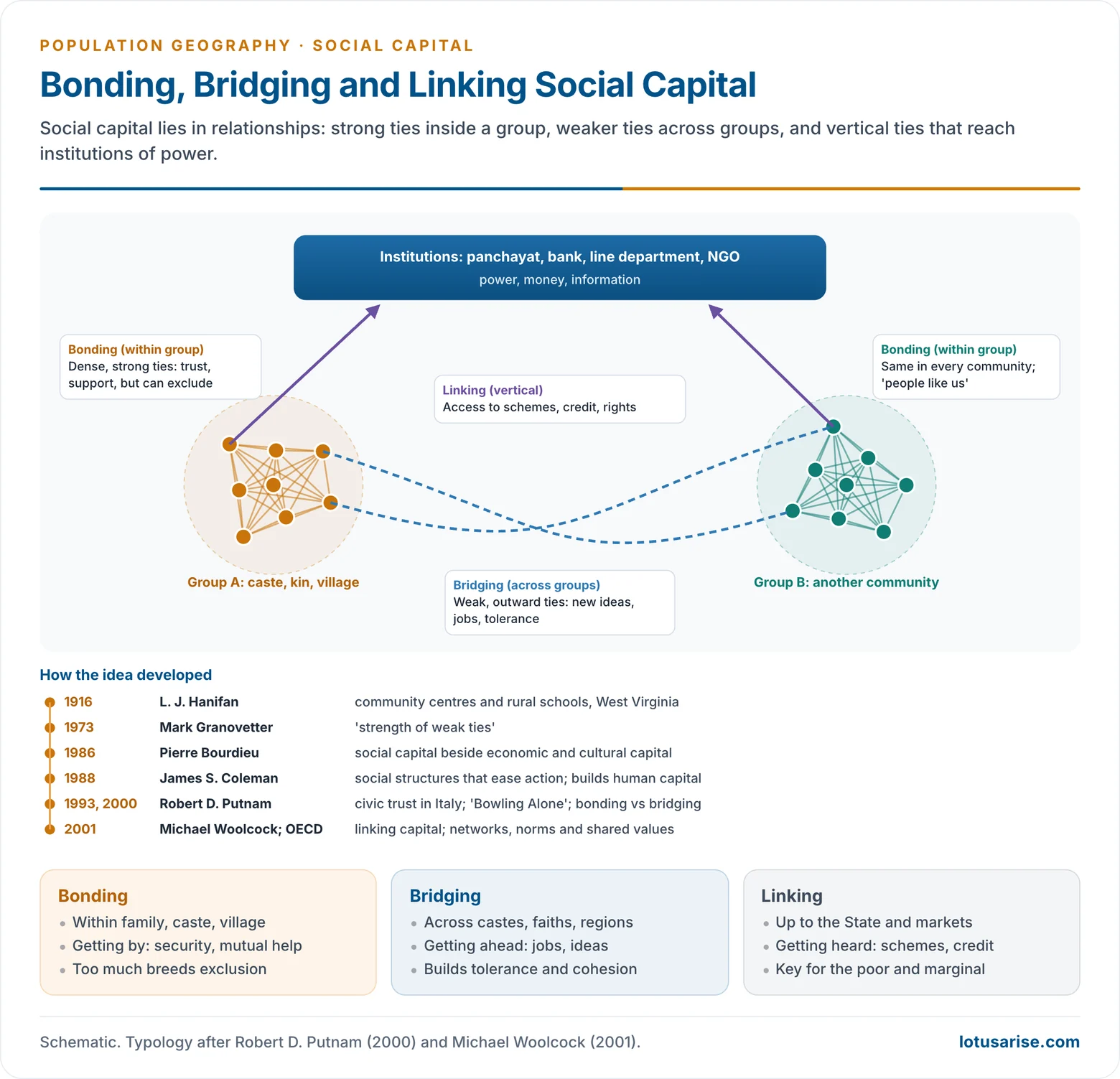
- Mark Granovetter (1973) showed the “strength of weak ties“: acquaintances bring new information and jobs that close friends cannot.
- Pierre Bourdieu (1986) set social capital beside economic and cultural capital.
- It is the sum of the actual or potential resources a person gains from a durable network of mutual acquaintance and recognition.
- Networks are therefore sources of power and advantage that help the privileged reproduce their position.
- James S. Coleman (1988, 1990) defined it by its function, as aspects of social structure that make certain actions possible, and showed how family and community ties help children build human capital.
- Robert D. Putnam made the idea famous, defining it as the networks, norms of reciprocity and trustworthiness that arise from social connections and sustain democracy.
- Making Democracy Work (1993) compared the 20 regional governments set up in Italy in 1970: the north and centre (Emilia-Romagna), rich in choral societies, clubs and cooperatives, governed far better than the south (Calabria), where patron–client ties dominated.
- He traced the gap to centuries-old civic traditions: social capital is path-dependent and place-bound.
- Bowling Alone (2000) traced declining civic engagement in the United States.
- Francis Fukuyama (1995) linked prosperity to trust: high-trust societies (Germany, Japan) built large private firms easily, while low-trust, family-based societies stayed with small family businesses.
- The World Bank launched a Social Capital Initiative (1996), and the OECD (2001) defines social capital as networks together with shared norms, values and understandings that ease cooperation within or among groups.
Conceptual Understanding
- Social capital is a resource in relationships, not in individuals. It reduces transaction costs (people who trust each other need fewer contracts and checks) and uncertainty, spreads information and enables collective action.
- It is intangible, context-specific and culturally embedded.
- Norman Uphoff (2000) separates two components:
- Structural: networks, associations, rules and procedures, which are visible.
- Cognitive: trust, norms, values and attitudes, which are in people’s minds.
Types of Social Capital
- Bonding social capital: strong ties within homogeneous groups (family, close friends, caste, ethnic or religious community), based on shared identity (“people like us”). It gives emotional support and social security, but if inward-looking breeds exclusion and groupism.
- Bridging social capital: weaker ties across groups (colleagues, acquaintances, inter-community links), which spread ideas and opportunities and promote social mobility and tolerance.
- Linking social capital (a term associated with Michael Woolcock, 2001): vertical ties to institutions of power (government offices, banks, NGOs, elected bodies), giving access to resources, schemes and institutional support; it matters most for the poor.
| Type | Ties | Function | Indian example |
|---|---|---|---|
| Bonding | Strong, within a group | Getting by | Joint family, caste panchayat, migrant kin networks |
| Bridging | Weak, across groups | Getting ahead | Trade unions, cooperatives, mixed urban neighbourhoods |
| Linking | Vertical, to institutions | Getting heard | SHG federations linked to banks, gram sabhas |
Determinants of Social Capital
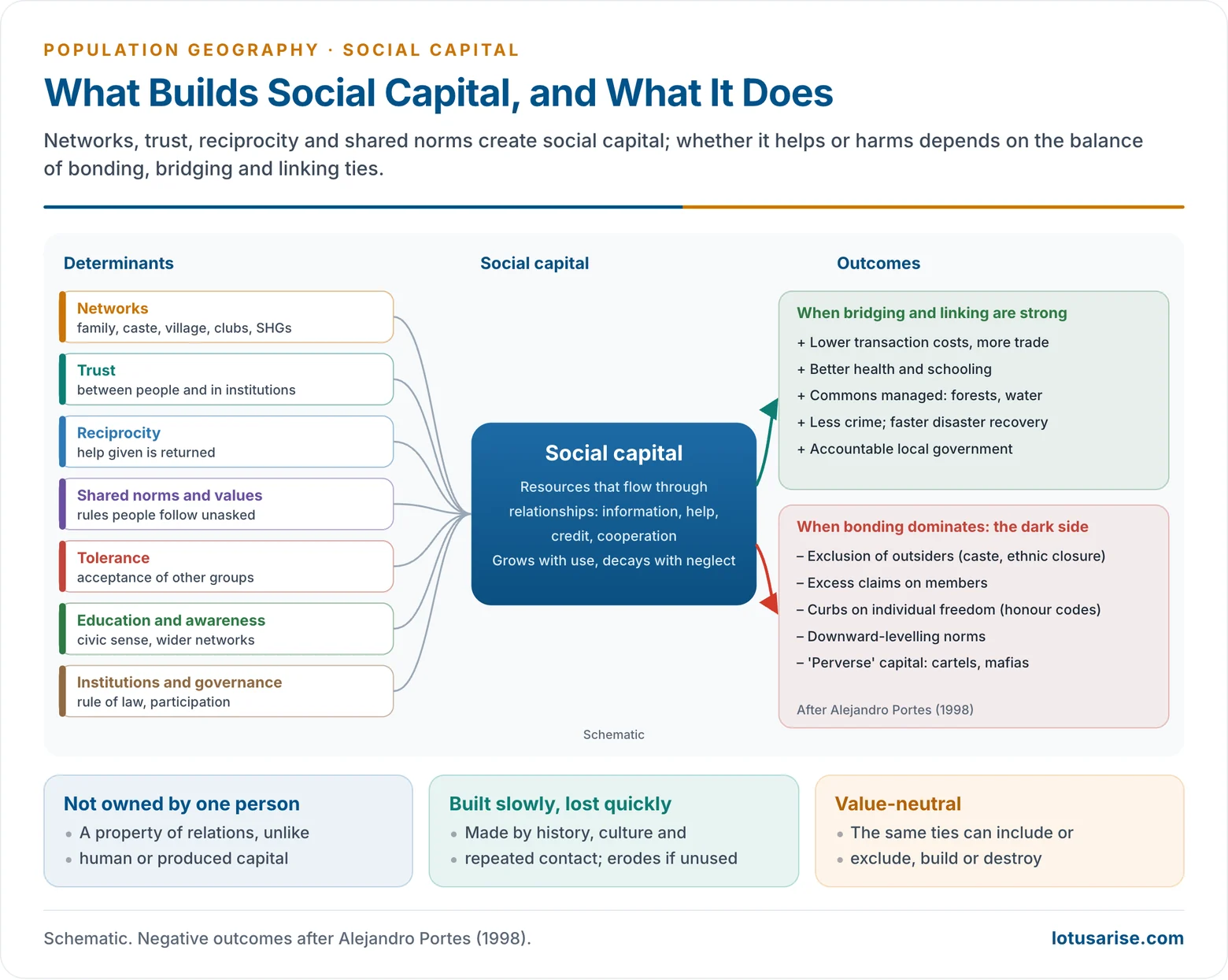
- Social capital rests on formal institutions (schools, governance, organisations) and informal relations (family, community, custom).
- Social networks, the base: ties of family, community, profession and institutions carry information, opportunities and support; dense, well-connected networks give stronger collective capacity.
- Trust, the central determinant: interpersonal trust between people and institutional trust in government, courts and organisations. Low-trust societies suffer corruption, inefficiency and fragmentation.
- Reciprocity, the norm that help given is returned, as in shared labour at harvest.
- Shared norms and values, which ease cooperation and give a sense of belonging, and tolerance of other cultures, religions and ethnic groups, the basis of bridging capital.
- Education: educated people join more associations, build more diverse networks and trust institutions more.
- Institutions and governance: the rule of law, transparency and participation build trust between society and the state.
Measuring Social Capital
- Trust surveys: the share of people who say “most people can be trusted” (World Values Survey).
- Associational density (membership of clubs, unions, cooperatives and voluntary bodies), Putnam’s main measure, and civic participation (voting, attendance at village or ward meetings).
- Network analysis: the number, strength and range of a person’s ties.
- In India, the India Human Development Survey asks households about membership of organisations, social networks and confidence in institutions.
- Measurement is difficult because social capital is relational and partly invisible.
Population, Community and Society
- Classical sociology linked population size and density to social bonds. Ferdinand Tönnies (1887) contrasted Gemeinschaft (close, kin-based ties of the village) with Gesellschaft (impersonal, contractual ties of the city); for Émile Durkheim (1893), rising density deepens the division of labour, so mechanical solidarity (likeness) gives way to organic solidarity (interdependence).
- Small dense communities are therefore rich in bonding capital, while large urban populations depend on bridging and linking capital and on institutions.
Four Views of Social Capital and Development
- Woolcock and Deepa Narayan (2000) grouped the literature into four views: communitarian (local associations; more is always better), networks (the balance of bonding and bridging ties decides outcomes), institutional (social capital is a product of the political, legal and institutional environment) and synergy (the best results come from cooperation between state and society).
- The synergy view fits India’s experience with SHGs, Joint Forest Management and panchayats.
Spatial Dimensions of Social Capital
- Social capital is unevenly distributed across space, which makes it a geographical variable.
- Between countries: surveys show high generalised trust in the Nordic countries, the Netherlands and parts of East Asia, and low trust in much of Latin America and Sub-Saharan Africa; high-trust countries tend to have lower corruption and stronger welfare states.
- Between regions: Putnam’s civic north and clientelist south of Italy; in India, the strong cooperative and panchayat traditions of Kerala, Gujarat and Maharashtra.
- Rural and urban: villages have dense bonding ties; cities have many weak, bridging ties but more anonymity, and gated colonies, slums and ethnic enclaves segregated by caste, religion or class limit bridging capital.
- Across borders: migrant networks drive chain migration (Kerala to the Gulf, Punjab’s Doaba to Canada and the UK, Gujarat to East Africa and the USA), lowering its costs and risks and channelling remittances home.
Critique of the Concept
- Vague and stretched: used for everything from family ties to national trust, so it can explain too much.
- Circular reasoning: successful communities are said to have social capital because they succeed.
- The “capital” metaphor: Kenneth Arrow and Robert Solow (1999) argued it lacks the features of capital, such as deliberate investment and measurable returns.
- Neglect of power: Putnam’s version underplays class, caste, gender and the state, which Bourdieu’s version puts at the centre.
- Hard to measure: surveys capture only traces of the relations themselves.
- Even so, the idea draws attention to the social and institutional conditions of development.
Negative Social Capital and Other Forms of Capital
The Dark Side of Social Capital
- Social capital is value-neutral: the same ties can include or exclude, build or destroy.
- Alejandro Portes (1998) listed four negative effects: exclusion of outsiders, excess claims on group members, restrictions on individual freedom, and downward-levelling norms.
- Exclusionary structures: strong bonding within caste, religion, ethnicity or kinship shuts outsiders out, and groups with weak bridging ties may stay isolated as “permanent outsiders”. In India, caste networks support members but restrict occupational mobility and inter-caste contact, and feed casteism, communalism and regionalism.
- Reinforced inequality: powerful groups use networks to monopolise opportunities, while marginal groups lack linking capital, so poverty passes down the generations.
- Perverse social capital: drug cartels, terrorist groups and organised crime run on dense networks, high internal trust and deviant norms.
- Resistance to change: tight networks enforce conservative norms, such as patriarchal limits on women’s mobility and schooling and khap panchayat pressure against inter-caste or same-gotra marriage.
Other Forms of Capital
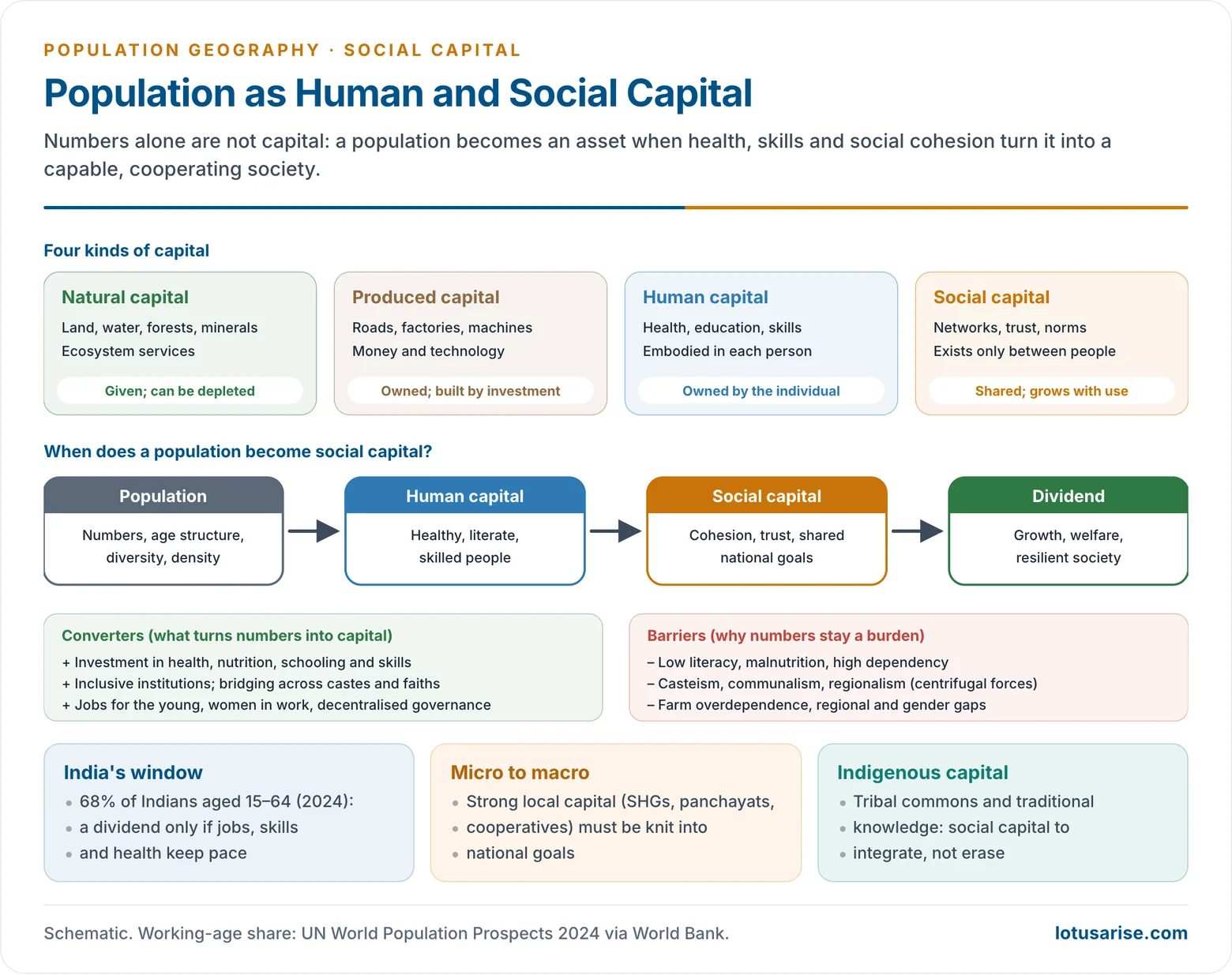
- Natural capital: land, water, minerals, forests and ecosystem services (oxygen, climate regulation, soil fertility), the ecological base of life.
- Produced (economic) capital: infrastructure, industries, transport, machines, finance and technology, which drive economic growth.
- Human capital: education, skills and health, which raise productivity and underpin the demographic dividend.
- Social capital: relationships, trust, norms and institutional links, which decide the efficiency of collective action, governance and social cohesion.
- Cultural capital (Bourdieu’s third form): knowledge, tastes, manners and educational credentials passed down in families. It converts into economic and social capital, which is why advantage tends to reproduce itself across generations.
How Social Capital Differs
- Natural, produced and human capital can belong to individuals or firms; social capital exists only between people.
- It is built indirectly, over time, through history, culture and repeated interaction, and it grows with use and decays with disuse. Built slowly, it can be destroyed quickly, for example by a riot or a breach of trust.
Population as Social Capital
When Does a Population Become Social Capital?
- Population is not automatically social capital. It becomes one when it shows cohesion, capability and a collective orientation to common goals.
- At the national scale this depends on:
- Size and density, which set the pressure on resources and the scope for interaction.
- Diversity (ethnic, linguistic, religious), which enriches society but can also fragment it.
- Demographic attributes: literacy, age structure, occupational structure and gender balance.
- Social cohesion and national integration, which bind diverse groups into one developmental project.
- Large and diverse populations find this harder:
- Centrifugal forces (regionalism, caste divisions, communalism, linguistic loyalties) can override national interest.
- Imbalances (low literacy, over-dependence on agriculture, high dependency, gender inequality, regional disparities) leave many “micro social capitals” pulling in different directions.
- Population becomes social capital through the macro-integration of micro social capitals: local networks and traditions, including the strong internal social capital of indigenous communities, harmonised by national policies towards inclusive goals without eroding identity.
- Indian contrast: Kerala and Tamil Nadu turned early investment in schooling, health and social reform movements into a skilled, mobile and organised population. Bihar and Uttar Pradesh, with far more people but weaker human capital and deeper social divisions, have converted less of that number into capability.
Human Capital and the Demographic Dividend in India
- India has the world’s largest population and a large working-age share: about 68% of Indians were aged 15–64 in 2024, and the dependency ratio had fallen to about 47 (UN WPP 2024, via the World Bank).
- The age composition sets the size and timing of the demographic window, but the demographic dividend pays only if the extra workers are healthy, skilled and employed and society is cohesive enough to use them.
- Implications for India’s economy and society:
- Used well, a larger workforce, higher savings and a bigger domestic market raise growth, as they did in East Asia.
- Left idle, the same bulge brings youth unemployment, informal work, pressure on cities and social unrest.
- The window is time-bound and regionally uneven: fertility is below replacement and the median age is rising, so the southern States are already ageing while Bihar and Uttar Pradesh stay young.
- The gaps are in human capital:
- The World Bank’s Human Capital Index (2020) put India at 0.49: a child born today would be only about half as productive as a child with full education and health.
- Female labour force participation was 40.0% (PLFS 2025), against 79.1% for men, and 25.0% of people aged 15–29 were not in employment, education or training.
- They are also in social capital: low trust across castes and communities, weak linking ties between the poor and institutions, and gender norms that keep women out of public life.
- Turning numbers into a dividend needs:
- Health and nutrition from early childhood, so that workers are productive.
- Quality schooling and skills (the Skill India Mission and PMKVY, from 2015) matched to jobs.
- Jobs in manufacturing and services that can absorb young workers leaving agriculture.
- Women’s work: raising female participation is the largest untapped source of growth.
- Social cohesion, so that regional, caste and religious divisions do not waste the window.
Advantages of Population as Social Capital
- Health:
- Trust and networks spread health information and ease access to care, and collective action builds sanitation and primary health facilities; low-trust communities respond poorly and tend to have higher mortality.
- India’s ASHA workers and village health committees link households to the health system.
- Fertility: the small family norm, contraception and later marriage spread through networks as women copy neighbours, relatives and self-help group members. This social diffusion helps explain why fertility often falls region by region.
- Disaster resilience:
- Communities with strong ties recover faster, as Daniel Aldrich found in Kobe (1995) and in Tamil Nadu’s coastal villages after the 2004 tsunami.
- In the Kerala floods of 2018, fishing communities used their boats and networks to rescue thousands of people.
- Social order and education: neighbourhood ties allow informal surveillance, and school management committees and parent networks raise enrolment, retention and quality.
- Environment and sanitation: communities manage forests, water and land collectively, as in the Van Panchayats of Uttarakhand (from 1931), Joint Forest Management (from 1990), the Chipko movement (1973) and watershed work at Ralegan Siddhi and Hiware Bazar in Maharashtra; state–civil society synergy drove the community-led phase of Swachh Bharat.
- Economic development: trust lowers transaction costs and supports entrepreneurship, trade networks and the adoption of new technologies, as in cooperative dairying (Amul), the trading networks of the Marwaris, Gujaratis and Chettiars, and diaspora networks.
- Governance: dense civic networks make governments more responsive and accountable, as with participatory budgeting in Porto Alegre, Brazil (from 1989) and Kerala’s People’s Plan Campaign (1996), which devolved a large share of plan funds to panchayats.
Social Capital in India
- Traditional bonding capital is strong: joint families, caste and kin networks, village institutions. It provides security but also hierarchy and exclusion.
- Bridging and linking capital have grown through democratic institutions: Panchayati Raj after the 73rd Amendment (1992), with reserved seats for women, SCs and STs, and cooperatives, trade unions and civil-society movements.
- Self-help groups are India’s largest experiment in building social capital among the poor:
- Under DAY-NRLM (from 2011), about 10.05 crore women are organised in 90.9 lakh SHGs (2025).
- SHGs combine bonding (savings and mutual trust), bridging (village and cluster federations) and linking (bank credit and government schemes). Kudumbashree in Kerala (from 1998) is the best-known State model.
- Other Indian examples:
- SEWA (Self Employed Women’s Association, founded by Ela Bhatt in 1972) organised informal women workers into a union and cooperatives.
- Pani Panchayat (from 1974, Purandar taluka, Maharashtra), begun by Vilasrao Salunke, shared groundwater equitably among farmers, including the landless.
- Social audits of MGNREGA works, pioneered in Andhra Pradesh and Rajasthan, use village gatherings to check public spending.
- Bridging capital and peace: Ashutosh Varshney (2002) found that inter-communal civic associations (business bodies, trade unions, professional groups, shared festivals) kept the peace in Indian cities: Calicut, with strong cross-community associations, stayed calm in crises that turned Aligarh, with segregated networks, violent.
- Threats in India: communal and caste polarisation, distrust of institutions, urban anonymity, and the exclusion of Dalits, Adivasis and women from networks of power.
Threats to Social Capital
- Declining civic engagement: in many democracies participation in associations, voluntary bodies and politics has fallen. Putnam blamed pressures of time and money, suburban sprawl and long commutes, electronic entertainment and, above all, generational change; the result is weaker democracy and accountability.
- Changing family structures: nuclear families and single-person households reduce intergenerational contact and informal support.
- Technology: television and digital media privatise leisure, and online networks are wide but often shallow.
- Individualism and consumerism weaken community-oriented behaviour and shared norms.
- Inequality and identity conflicts: segregated societies deny the poor bridging and linking ties, and assertive ethnic, religious and regional identities, with bonding but no bridging, produce polarisation.
- Displacement and migration: dams, mines, conflict and distress migration break up communities; migrants arrive in cities without networks and depend on contractors and middlemen.
- Erosion of the commons: privatisation of village commons, forests and water weakens the shared resources around which collective action was organised.
Strengthening Social Capital
- For India the priority is inclusive bridging and linking capital:
- Participatory institutions: gram sabhas, ward committees, SHG federations, cooperatives.
- Trust in institutions through transparent, accountable service delivery.
- Shared public spaces, schools and workplaces that mix castes, religions and regions.
- Modernisation must be balanced with the cohesion and diversity of traditional communities.
- Besides growth, sustainable development needs a society able to rebuild trust, strengthen networks and act together.





Great work
thank u so much … helpful content and to the point info
Crisp and to the point explained