The Geography Optional Question Paper 2017 was set for UPSC Civil Services Mains 2017. Paper I and Paper II carry 250 marks each, three hours each, 500 marks together. Both papers are reproduced below exactly as UPSC asked them, followed by a unit-wise breakdown of what the paper tested, what the 2017 pattern tells you about how the Commission frames questions, and how to work through these questions instead of only reading them.
| Examination | UPSC Civil Services Mains 2017 — Geography Optional |
| Papers | Paper I (Physical & Human Geography) and Paper II (Geography of India) |
| Marks | 250 per paper — 500 total |
| Duration | 3 hours per paper |
| Structure | Section A and Section B, four questions each. Q1 and Q5 are compulsory; one question from the remaining three in each section. |
| Language | English and Hindi |
Every question on this page, already answered
Reading a past paper tells you what UPSC asked. It does not tell you what a 300-plus answer to it looks like — and that is the part that decides your marks. The Geography Optional 300+ Score Pack carries a written model answer for every question the Commission has set since 2013, including every question on this 2017 paper.
- 820 solved PYQ model answers (2013–2026) — topic-wise across all 20 units, Paper I and Paper II
- 20 PYQ pattern & strategy reports — one per unit: what repeats, what is due, what UPSC rewards
- Diagrams and maps drawn inside the answers, at the exact point where you would draw them in the exam hall
- 500 days of access from your enrolment date — covered right through Mains 2027
₹1,770 (regular ₹2,500) — about ₹2.16 per model answer. One-time payment, no subscription.
Geography Optional Question Paper-1 (2017)

Paper I covers Physical Geography in Section A — Geomorphology, Climatology, Oceanography, Biogeography and Environmental Geography — and Human Geography in Section B, including Perspectives, Economic Geography, Population and Settlement Geography, Regional Planning, and Models, Theories and Laws. Q1 and Q5 are compulsory.
Paper I — Section A
Q1. Answer the following questions in about 150 words each (10 × 5 = 50)
- (a) Write a note on pseudo-volcanic features.
- (b) Distinguish between low energy coasts and coral coasts.
- (c) Discuss the impacts of ocean currents on air mass behaviour.
- (d) Describe the characteristics of biological deserts.
- (e) Explain the concept of micro carbon sink and its relevance.
Q2. (20 + 15 + 15 = 50)
- (a) Discuss the forces which govern the air movement on the Earth’s surface. (20)
- (b) “The knowledge of slope analysis has limited field application in slope management.” Explain. (15)
- (c) Describe the configuration of the Pacific Ocean floor. (15)
Q3. (20 + 15 + 15 = 50)
- (a) “Climate change is a reality.” Explain with suitable examples. (20)
- (b) Distinguish between the characteristics of Chernozem and Sierozem soils. (15)
- (c) Give a classification of plants based on the amount of water requirement. (15)
Q4. (20 + 15 + 15 = 50)
- (a) Discuss the concept of the periglacial cycle as propounded by Peltier. (20)
- (b) “Climate, slope gradient and rock structure influence the avulsion of channels.” Explain. (15)
- (c) Discuss the Perception, Attitude, Value and Emotion (PAVE) theory of environmental management. (15)
Paper I — Section B
Q5. Answer the following questions in about 150 words each (10 × 5 = 50)
- (a) Explain the concept of time-geography.
- (b) “Whittlesey’s agricultural regions are relevant even today.” Discuss.
- (c) Write an explanatory note on geographical systems.
- (d) “The traditional cultural identities are at loss with the growth of global connectivity.” Explain.
- (e) Give an account of sustainable development and its components.
Q6. (20 + 15 + 15 = 50)
- (a) Discuss the contemporary paradigms of Geography. (20)
- (b) “The intensity of the energy crisis varies regionally.” Explain. (15)
- (c) Examine the causes and consequences of forced migration of population in the present context. (15)
Q7. (20 + 15 + 15 = 50)
- (a) Discuss the applicability of Christaller’s Central Place Theory. (20)
- (b) “There are considerable demographic similarities between West European nations and Japan.” Explain. (15)
- (c) Define quality of life and explain its parameters with adequate examples. (15)
Q8. (20 + 15 + 15 = 50)
- (a) “The Heartland Theory is gaining importance once again.” Comment. (20)
- (b) Examine the role of small towns in the regional development process. (15)
- (c) Explain the concept of social capital in relation to India. (15)
Could you actually write these answers — in 20 minutes each?
That is the honest test of a past paper, and it is where Paper I marks are lost. Not in knowing plate tectonics or the tricellular circulation, but in structuring the answer, placing the right labelled diagram at the right point, and finishing inside the time available. The 300+ Score Pack gives you the written form of each of these 2017 answers, so you are studying a structure instead of inventing one under pressure.
Paper II is reproduced below. Before you scroll on, mark the three questions above you could not attempt today — those are the ones to read the model answers for first.
Geography Optional Question Paper-2 (2017)
Paper II is the Geography of India paper. Section A covers the physical setting, resources, agriculture and industry; Section B covers transport and trade, cultural setting, settlements, regional development and contemporary issues. Q1(a) is the compulsory map question, worth 20 marks on its own.
Paper II — Section A
Q1(a). On the outline map of India provided to you, mark the location of all of the following. Write in your QCA Booklet the significance of these locations, whether physical / commercial / economic / ecological / environmental / cultural, in not more than 30 words for each entry (2 × 10 = 20)
- Thumba
- Nayachar Island
- Doddabetta
- Devasthal
- Pangong Lake
- Hampi
- Havelock Island
- Luni River
- Daringbadi
- Dudhsagar Waterfalls
Q1(b) to Q1(d). Answer in about 150 words each (10 × 3 = 30)
- (b) Give a reasoned account of the unusual pattern of distribution of monsoonal rainfall in India in 2017.
- (c) Explain the inter-State issues involved in implementation of the Satluj-Yamuna Link Canal Project.
- (d) Small towns in India have problems and prospects of their own. Elaborate.
Q2. (20 + 15 + 15 = 50)
- (a) Discuss the freshwater crisis in India and prepare a blueprint for its sustainable management. (20)
- (b) Identify the Naxal-affected areas in India and discuss their socio-economic problems. (15)
- (c) Critically examine the feasibility of development of a comprehensive network of airways in India. (15)
Q3. (20 + 15 + 15 = 50)
- (a) “An effective three-tier Panchayat Raj System will strengthen the bottom-up approach to multi-level planning in India.” Explain. (20)
- (b) “Linguistic diversity is an asset as well as a challenge in India.” Explain the statement focusing on the distribution of languages and the major steps taken to address the related issues. (15)
- (c) How may tourism in hilly areas of India be developed as an important source of economy? (15)
Q4. (20 + 15 + 15 = 50)
- (a) Mention various methods of functional classification of towns in India and explain the method applied by Asok Mitra.
- (b) Farmers’ suicide is one of the major agrarian problems in India. Bring out its causes and suggest remedial measures with special reference to Maharashtra, Andhra Pradesh and Punjab.
- (c) Land reform is a key to modern agriculture in India. Describe various measures taken in this direction after Independence.
Paper II — Section B
Q5. Answer the following questions in about 150 words each (10 × 5 = 50)
- (a) Explain the role of the ‘Hill Transport Subsidy Scheme’ in reducing regional imbalances in areas identified by the Government of India.
- (b) Bring out the geopolitical implications of the Doklam dispute in the context of Indo-China relations.
- (c) Bring out the significance of the Indian Regional Navigation Satellite System (IRNSS).
- (d) Mini steel plants can act as an instrument of decentralisation of the iron and steel industry in India. Explain.
- (e) Goods and Services Tax (GST) has a differential impact on developed and backward States of the country. How and why?
Q6. (20 + 15 + 15 = 50)
- (a) Interlinking of rivers may serve as a major source of assured irrigation and all-weather inland navigation in India. Comment on its feasibility taking into account physical, economic and ecological implications. (20)
- (b) Religious minorities are largely concentrated in border States of India. Discuss its causes and consequences. (15)
- (c) What do you understand by soil pollution? Delineate the areas vulnerable to it in India and suggest remedial measures. (15)
Q7. (20 + 15 + 15 = 50)
- (a) Integrated development of road and rail networks in a complementary framework is a prerequisite for regional development. Explain with reference to the North-Eastern Region of India. (20)
- (b) Describe the salient features of the Sagar Mala Project and highlight its role in port-led development of coastal regions in India. (15)
- (c) Justify the inclusion of Meghalaya in Peninsular India and discuss its vegetation and soil types. (15)
Q8. (20 + 15 + 15 = 50)
- (a) Name the major industrial regions of India indicating the bases of their identification. Highlight their basic problems. (20)
- (b) Drainage pattern in Peninsular India is a result of its geological structure and topography. Elaborate. (15)
- (c) Why has solar energy in India not been developed to the desired level in spite of its high potential? (15)
What the 2017 Geography Optional paper actually tested
Twenty-seven questions per paper look like a lot until you map them onto the syllabus. Then the shape of the paper becomes obvious — and so does the reason most aspirants leave marks on the table in the same three or four units every year.
Paper I — unit-wise spread (2017)
| Syllabus unit | Questions | Count |
| Geomorphology | Q1(a), Q2(b), Q4(a), Q4(b) | 4 |
| Climatology | Q2(a), Q3(a) | 2 |
| Oceanography | Q1(b), Q1(c), Q2(c) | 3 |
| Biogeography and soils | Q1(d), Q3(b), Q3(c) | 3 |
| Environmental Geography | Q1(e), Q4(c) | 2 |
| Perspectives in Human Geography | Q5(a), Q5(c), Q5(d), Q6(a), Q8(c) | 5 |
| Economic Geography | Q5(e), Q6(b) | 2 |
| Population and Settlement Geography | Q6(c), Q7(b), Q7(c) | 3 |
| Regional Planning | Q8(b) | 1 |
| Models, Theories and Laws | Q5(b), Q7(a), Q8(a) | 3 |
Paper II — unit-wise spread (2017)
| Syllabus area | Questions | Count |
| Map question | Q1(a) | 1 (20 marks) |
| Physical setting, drainage and climate | Q1(b), Q7(c), Q8(b) | 3 |
| Resources, water and environment | Q1(c), Q2(a), Q6(a), Q6(c), Q8(c) | 5 |
| Agriculture | Q4(b), Q4(c) | 2 |
| Industry | Q5(d), Q8(a) | 2 |
| Transport and communication | Q2(c), Q5(c), Q7(a), Q7(b) | 4 |
| Settlements | Q1(d), Q4(a) | 2 |
| Cultural setting and political aspects | Q3(b), Q5(b), Q6(b) | 3 |
| Regional development and contemporary issues | Q2(b), Q3(a), Q3(c), Q5(a), Q5(e) | 5 |
Five things the 2017 paper tells you about UPSC’s pattern
- Water dominated Paper II. The freshwater crisis, the Satluj-Yamuna Link Canal, interlinking of rivers, soil pollution and solar energy gave resources and environment five of the twenty-seven slots. The Satluj-Yamuna question is the model here: a physical resource asked as an inter-State political problem.
- Paper I asked for named models in Section A too. Peltier’s periglacial cycle, the PAVE theory, Whittlesey, Christaller, the Heartland Theory. The physical paper is not a purely descriptive paper; it expects you to attach a name and a date to a process.
- Geomorphology was the largest Section A unit, and two questions were about slope and channel behaviour. Slope analysis in field management, and the influence of climate, gradient and rock structure on channel avulsion. Both reward a labelled sketch far more than a paragraph.
- The Commission sets questions on things that happened months earlier. The 2017 monsoon’s unusual distribution, the Doklam standoff and the rollout of GST all appeared in the same paper. Paper II is a current-affairs paper with a syllabus attached.
- Small towns appeared twice, in both papers. As the role of small towns in regional development in Paper I, and as the problems and prospects of small towns in India in Paper II. When a theme crosses both papers in one year, it is worth preparing as a single connected answer bank rather than twice.
How to use this paper (rather than just read it)
- Write Q1 and Q5 first, under a clock. Ten questions, 150 words each, 100 marks. Give yourself 90 minutes for the ten and see how many you can finish. This single exercise tells you more about your readiness than a week of reading.
- Mark every question you could not start. Not the ones you answered badly — the ones where you had nothing. Those are syllabus gaps, and they are far cheaper to fix than weak answers.
- Attach a name to every process you revise. Peltier, Whittlesey, Christaller, Mackinder, Asok Mitra all appeared in this one year. Naming the theorist in the first line of an answer is the cheapest credibility you can buy in the exam hall.
- Draw the diagram before you write the answer. In the 2017 Paper I, Q2(b), Q2(c), Q4(a), Q4(b) and Q7(a) are diagram-first answers. If you cannot sketch it in ninety seconds, you will not use it under time pressure.
- Compare your answer against a model answer, not against the syllabus. The gap you need to close is a writing gap. Reading more notes does not close it; seeing the finished shape of a 300-plus answer does.
Two ways to prepare for the papers above
Past papers are the syllabus UPSC actually examines. What you do next with them decides the marks. Two LotusArise systems are built for the two different gaps aspirants have at this stage.
| 300+ Score Pack | Mains Master Kit 2027 | |
| Best for | You already have notes and your gap is answer writing | You are starting Geography Optional and want one complete system |
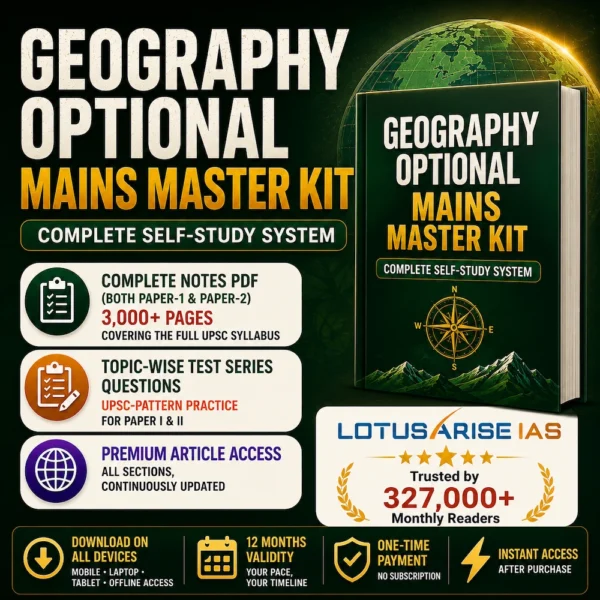
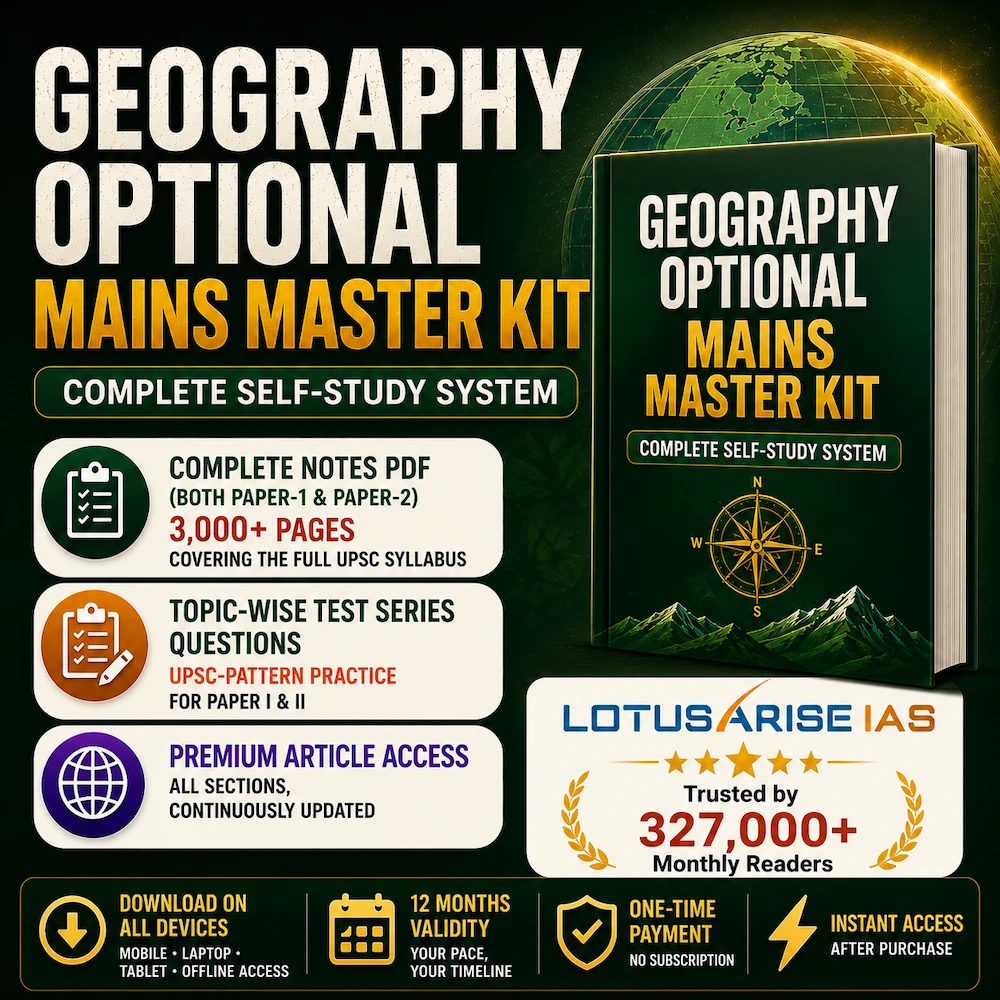
| Core content | 820 solved PYQ model answers (2013–2026), topic-wise across all 20 units | Complete Notes PDF for Paper I & II — 3,000+ pages covering the full syllabus |
| Also inside | 20 unit-wise PYQ pattern & strategy reports; diagrams and maps inside the answers | Topic-wise test series questions for both papers; 12 months premium article access; 500+ mapped locations |
| Access | 500 days from enrolment | 12 months, all devices, offline |
| Price | ₹1,770 (regular ₹2,500) | ₹1,770 (regular ₹5,000) |
Both are one-time payments with instant access and no subscription. If you are unsure, start with the 300+ Score Pack — answer writing is the constraint for most aspirants who have already read the syllabus once.
Geography Optional Question Paper 2017 — FAQs
Geography Optional question papers — other years
- UPSC Geography Optional Question Paper 2013
- UPSC Geography Optional Question Paper 2014
- UPSC Geography Optional Question Paper 2015
- UPSC Geography Optional Question Paper 2016
- UPSC Geography Optional Question Paper 2018
- UPSC Geography Optional Question Paper 2019
- UPSC Geography Optional Question Paper 2020
- UPSC Geography Optional Question Paper 2021
- UPSC Geography Optional Question Paper 2022
- UPSC Geography Optional Question Paper 2023
- UPSC Geography Optional Question Paper 2024
- UPSC Geography Optional Question Paper 2025
- UPSC Geography Optional Question Paper 2026
- Geography Optional question papers — topic-wise PYQ hub
- Geography Optional 300+ Score Pack — solved PYQ model answers (2013–2026)