The Geography Optional Question Paper 2020 was set for UPSC Civil Services Mains 2020. Paper I and Paper II carry 250 marks each, three hours each, 500 marks together — roughly a fifth of your entire Mains total. Both papers are reproduced below exactly as UPSC asked them, followed by a unit-wise breakdown of what the paper actually tested, what the 2020 pattern tells you about how the Commission frames questions, and how to work through these questions instead of only reading them.
| Examination | UPSC Civil Services Mains 2020 — Geography Optional |
| Papers | Paper I (Physical & Human Geography) and Paper II (Geography of India) |
| Marks | 250 per paper — 500 total |
| Duration | 3 hours per paper |
| Structure | Section A and Section B, four questions each. Q1 and Q5 are compulsory; one question from the remaining three in each section. |
| Language | English and Hindi |
Download the 2020 Geography Optional question papers

Every question on this page, already answered
Reading a past paper tells you what UPSC asked. It does not tell you what a 300-plus answer to it looks like — and that is the part that decides your marks. The Geography Optional 300+ Score Pack carries a written model answer for every question the Commission has set since 2013, including all 40 questions on this 2020 paper.
- 820 solved PYQ model answers (2013–2026) — topic-wise across all 20 units, Paper I and Paper II
- 20 PYQ pattern & strategy reports — one per unit: what repeats, what is due, what UPSC rewards
- Diagrams and maps drawn inside the answers, at the exact point where you would draw them in the exam hall
- 500 days of access from your enrolment date — covered right through Mains 2027
₹1,770 (regular ₹2,500) — about ₹2.16 per model answer. One-time payment, no subscription.
Geography Optional Question Paper-1 (2020)
Paper I covers Physical Geography in Section A (Geomorphology, Climatology, Oceanography, Biogeography and Environmental Geography) and Human Geography in Section B (Perspectives, Economic, Population and Settlement Geography, Regional Planning, and Models & Theories). Q1 and Q5 are compulsory.
Paper I — Section A
Q1. Answer the following in about 150 words each (10 × 5 = 50)
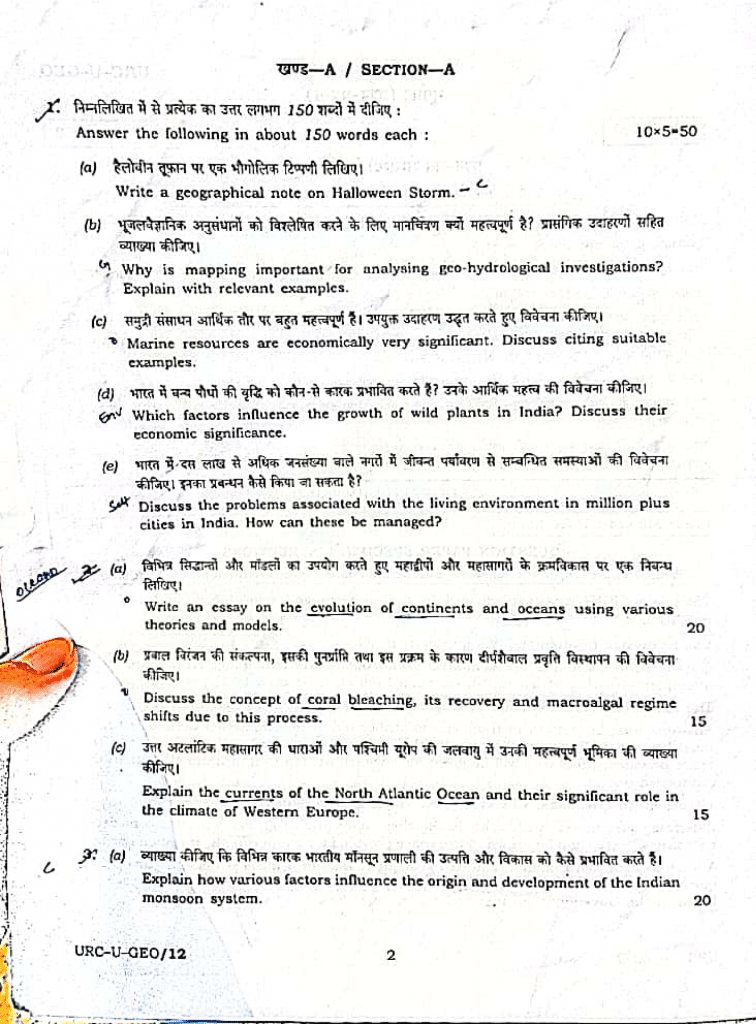
- (a) Write a geographical note on Halloween storm.
- (b) Why is mapping important for analyzing geo-hydrological investigations? Explain with relevant examples.
- (c) Marine resources are economically very significant. Discuss citing suitable examples.
- (d) Which factors influence the growth of wild plants in India? Discuss their economic significance.
- (e) Discuss the problems associated with the living environment in million-plus cities in India. How can these be managed?
Q2. (20 + 15 + 15 = 50)
- (a) Write an essay on the evolution of continents and oceans using various theories and models.
- (b) Discuss the concept of coral bleaching, its recovery and microalgal regime shifts due to this process.
- (c) Explain the currents of the North Atlantic ocean and their significant role in the climate of western Europe.
Q3. (20 + 15 + 15 = 50)
- (a) Explain how various factors influence the origin and development of the Indian monsoon system.
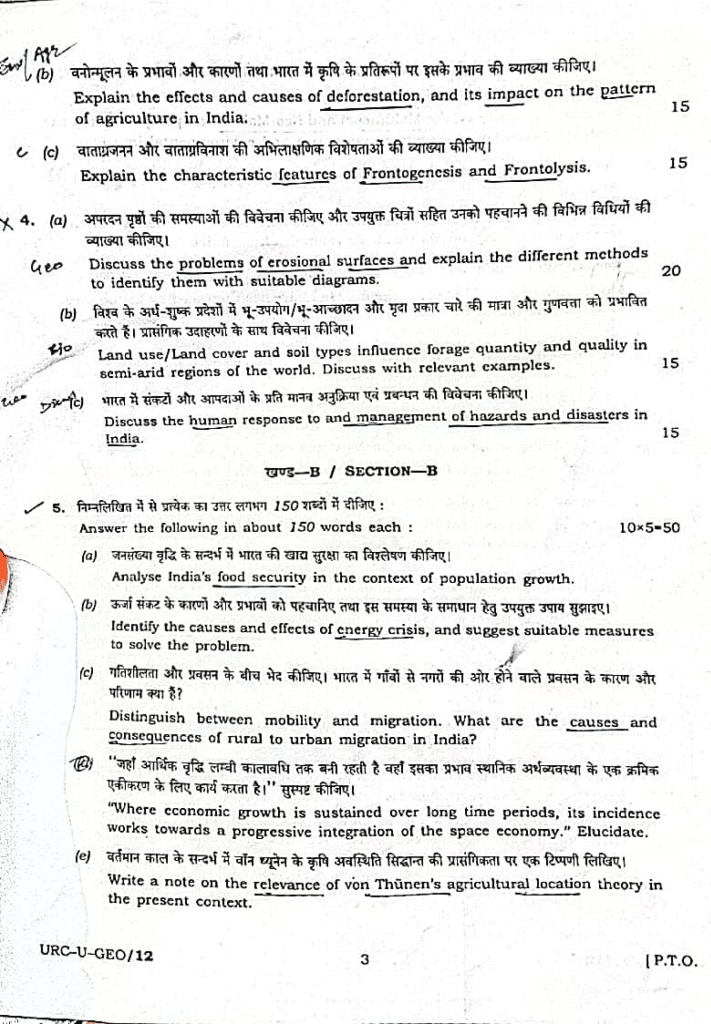
- (b) Explain the effects and causes of deforestation and its impact on the pattern of agriculture in India.
- (c) Explain the characteristic features of frontogenesis and frontolysis.
Q4. (20 + 15 + 15 = 50)
- (a) Discuss the problems of erosional surfaces and explain the different methods to identify them with suitable diagrams.
- (b) Land use / land cover and soil types influence forage quantity and quality in semi-arid regions of the world. Discuss with relevant examples.
- (c) Discuss the human response to and management of hazards and disasters in India.
Paper I — Section B
Q5. Answer the following in about 150 words each (10 × 5 = 50)
- (a) Analyse India’s food security in the context of population growth.
- (b) Identify the causes and effects of energy crisis, and suggest suitable measures to solve the problem.
- (c) Distinguish between mobility and migration. What are the causes and consequences of rural to urban migration in India?
- (d) “Where economic growth is sustained over long time periods, its incidence works towards a progressive integration of the space economy.” Elucidate.
- (e) Write a note on the relevance of Von Thunen’s agricultural location theory in the present context.
Q6. (20 + 15 + 15 = 50)
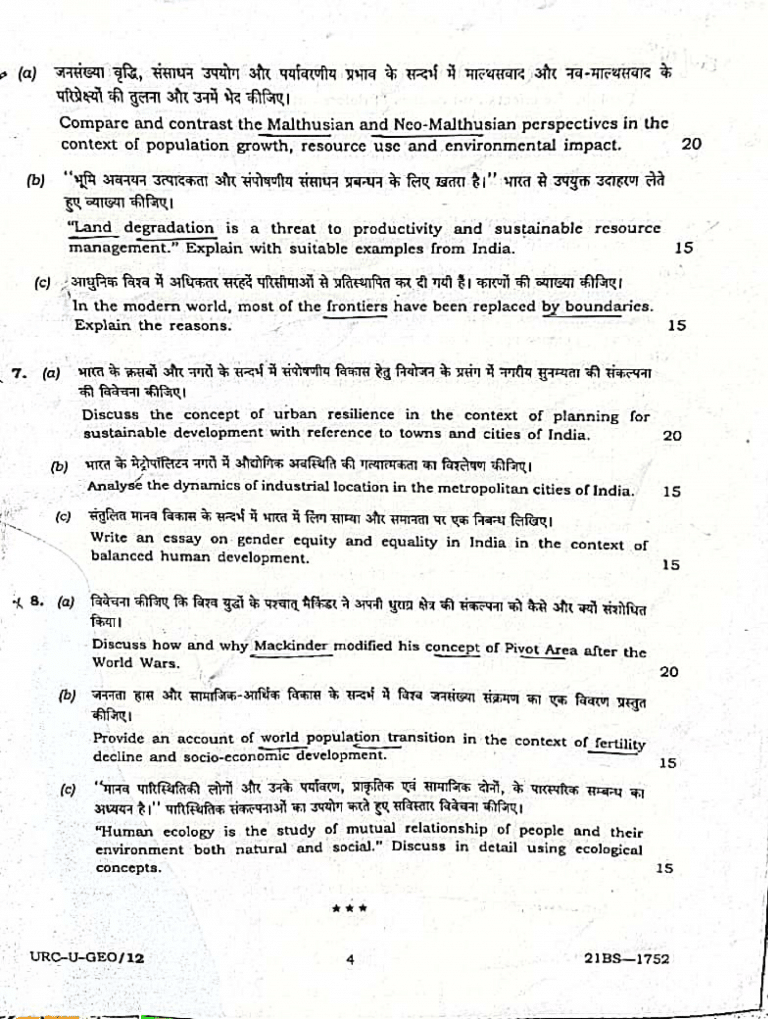
- (a) Compare and contrast the Malthusian and Neo-Malthusian perspectives in the context of population growth, resource use, and environmental impact.
- (b) “Land degradation is a threat to productivity and sustainable resource management.” Explain with suitable examples from India.
- (c) In the modern world, most of the frontiers have been replaced by boundaries. Explain the reasons.
Q7. (20 + 15 + 15 = 50)
- (a) Discuss the concept of urban resilience in the context of planning for sustainable development with reference to towns and cities of India.
- (b) Analyse the dynamics of industrial location in the metropolitan cities of India.
- (c) Write an essay on gender equity and equality in India in the context of balanced human development.
Q8. (20 + 15 + 15 = 50)
- (a) Discuss how and why Mackinder modified his concept of Pivot Area after the World Wars.
- (b) Provide an account of world population transition in the context of fertility decline and socio-economic development.
- (c) “Human ecology is the study of the mutual relationship of people and their environment, both natural and social.” Discuss in detail using ecological concepts.
Could you actually write these answers — in 20 minutes each?
That is the honest test of a past paper, and it is where Paper I marks are lost. Not in knowing plate tectonics or the tricellular circulation, but in structuring the answer, placing the right labelled diagram at the right point, and finishing inside the time available. The 300+ Score Pack gives you the written form of each of these 2020 answers, so you are studying a structure instead of inventing one under pressure.
Paper II is reproduced below. Before you scroll on, mark the three questions above you could not attempt today — those are the ones to read the model answers for first.
Geography Optional Question Paper-2 (2020)
Paper II is the Geography of India paper. Section A covers the physical setting, resources, agriculture and industry; Section B covers transport and trade, cultural setting, settlements, regional development and contemporary issues. Q1(a) is the compulsory map question, worth 20 marks on its own.
Paper II — Section A
Q1(a). On the outline map of India provided to you, mark the location of all of the following. Write in your QCA Booklet the significance of these locations, whether physical / commercial / economic / ecological / environmental / cultural, in not more than 30 words for each entry (2 × 10 = 20)
- Vadhawan
- Salkhan
- Coorg
- Mhow
- Umroi
- Thoothukudi
- Bargarh
- Atal Tunnel
- Gurushikhar
- Bum La
Q1(b) to Q1(d). Answer in about 150 words each (10 × 3 = 30)
- (b) Climate change has unsettled the rhythm of seasons. Comment with examples and empirical evidence.
- (c) Discuss the methods of crop residue management in rural India to reduce pollution.
- (d) Has the regional aspiration of the people of Jammu and Kashmir been addressed through re-organisation of the state? Make an assessment.
Q2. (20 + 15 + 15 = 50)
- (a) Identifying areas covered under the Tribal Sub-Plan, discuss the programmes initiated to address their problems.
- (b) Soil types in India, classified on the basis of colour, possess specific chemical and mineral characteristics. Discuss.
- (c) The pharmaceutical industry in India depends on the import of raw material. Evaluate this statement in view of the Indo-Chinese relationship.
Q3. (20 + 15 + 15 = 50)
- (a) India has opened up its space to private sectors for satellite-based activities. Critically examine its implications, indicating the major security concerns.
- (b) Identify the oilseed-producing areas in India and discuss the measures to promote the edible oil industry.
- (c) Give a reasoned geographical account of changing rural folk houses in India.
Q4. (20 + 15 + 15 = 50)
- (a) Border area development is an important national priority. What are the resilient steps needed for peaceful borders?
- (b) Stunting and wasting among children are major consequences of food insecurity. Discuss the various schemes of the Government of India to address these problems and their achievements.
- (c) The Essential Commodities (Amendment) Bill, 2020 aims to deregulate the production, supply and distribution of farm produce. Critically examine its spatial consequences.
Paper II — Section B
Q5. Answer the following questions in about 150 words each (10 × 5 = 50)
- (a) The success of Panchayati Raj depends upon meaningful participation of people at the grassroots level. Examine.
- (b) Elucidate the benefits of the neem-coated urea scheme for Indian agriculture.
- (c) Canal irrigation has led to monocropping in India. Explain with suitable examples.
- (d) The pattern of growing ecological footprints is uneven in nature. Analyse with reference to land resources in India.
- (e) Identify the challenges faced by generative and parasitic towns in India and their possible remedies.
Q6. (20 + 15 + 15 = 50)
- (a) The digital divide in India needs quick redressal to reduce regional disparity in development. Elaborate with suitable examples.
- (b) Avalanche is a major hazard in the Himalayas. What are its causes and mitigation measures?
- (c) The process of demographic transition is not uniform in India. Examine this statement in the context of demographic transition theory.
Q7. (20 + 15 + 15 = 50)
- (a) Demarcating the seismic zones of India, suggest suitable interventions required in the most sensitive seismic zones for sustainable human settlements.
- (b) What are the characteristics of Blue Flag certified beaches? Discuss their significance for beach tourism in India.
- (c) Urban sprawl around planned cities evolves, leading to the emergence of squatter settlements. Discuss the advantages and disadvantages of such outgrowth.
Q8. (20 + 15 + 15 = 50)
- (a) Analyse the changing nature of workforce composition vis-à-vis the rural-urban divide in India.
- (b) Describe the economic, maritime and strategic interests of India in the South China Sea.
- (c) What kind of skill promotion programmes have been initiated for job-deficient regions in India? Explain.
Geography Optional 2020 question paper — original pages
What the 2020 Geography Optional paper actually tested
Twenty-seven questions per paper look like a lot until you map them onto the syllabus. Then the shape of the paper becomes obvious — and so does the reason most aspirants leave marks on the table in the same three or four units every year.
Paper I — unit-wise spread (2020)
| Syllabus unit | Questions | Count |
| Geomorphology | Q1(b), Q2(a), Q4(a) | 3 |
| Climatology | Q1(a), Q3(a), Q3(c) | 3 |
| Oceanography | Q1(c), Q2(b), Q2(c) | 3 |
| Biogeography and soils | Q1(d), Q3(b), Q4(b) | 3 |
| Environmental Geography | Q1(e), Q4(c) | 2 |
| Perspectives in Human Geography | Q6(c), Q7(c), Q8(c) | 3 |
| Economic Geography | Q5(b), Q6(b), Q7(b) | 3 |
| Population and Settlement Geography | Q5(a), Q5(c), Q7(a), Q8(b) | 4 |
| Regional Planning | Q5(d) | 1 |
| Models, Theories and Laws | Q5(e), Q6(a), Q8(a) | 3 |
Paper II — unit-wise spread (2020)
| Syllabus area | Questions | Count |
| Map question | Q1(a) | 1 (20 marks) |
| Physical setting, soils and climate | Q1(b), Q2(b), Q6(b), Q7(a) | 4 |
| Agriculture and food security | Q1(c), Q3(b), Q4(b), Q4(c), Q5(b), Q5(c) | 6 |
| Industry, resources and technology | Q2(c), Q3(a), Q6(a) | 3 |
| Settlements and urbanisation | Q3(c), Q5(e), Q7(c) | 3 |
| Population, tribal and workforce | Q2(a), Q6(c), Q8(a), Q8(c) | 4 |
| Political aspects and geopolitics | Q1(d), Q4(a), Q5(a), Q8(b) | 4 |
| Environment, hazards and tourism | Q5(d), Q7(b) | 2 |
Five things the 2020 paper tells you about UPSC’s pattern
- The compulsory question decides the paper. Q1 and Q5 are compulsory and carry 100 of the 250 marks between them. In 2020 they opened on narrow, named entry points — Halloween storm, frontogenesis and frontolysis, generative and parasitic towns — where you either hold the definition or you do not. There is no way to write around a term you have never met.
- Physical questions arrive wrapped in an applied demand. Erosional surfaces came with “different methods to identify them with suitable diagrams”. Marine resources came with economic significance. Coral bleaching came with recovery and microalgal regime shifts. Describing the process is half an answer; the marks sit in the second clause.
- Section B was unusually thinker-heavy. Von Thunen, Malthus and the Neo-Malthusians, Mackinder’s Pivot Area, human ecology — four separate blocks on named models and their critiques. Aspirants who treat Models and Theories as a revision afterthought lose these outright.
- Paper II 2020 leaned hard on the previous twelve months. The Jammu and Kashmir reorganisation, the Essential Commodities (Amendment) Bill 2020, the opening of the space sector to private players, Blue Flag certification and neem-coated urea were all recent at the time of the exam. Geography Paper II is a current-affairs paper wearing a syllabus.
- The map question rewarded the newsworthy, not the textbook. Vadhawan, Atal Tunnel, Umroi and Bum La were in the news before they were on the map. Learning fifty physical features will not cover this; tracking places that appear in the year’s reporting will.
How to use this paper (rather than just read it)
- Write Q1 and Q5 first, under a clock. Ten questions, 150 words each, 100 marks. Give yourself 90 minutes for the ten and see how many you can finish. This single exercise tells you more about your readiness than a week of reading.
- Mark every question you could not start. Not the ones you answered badly — the ones where you had nothing. Those are syllabus gaps, and they are far cheaper to fix than weak answers.
- Map the gaps onto units, not topics. If three of your blanks sit in Oceanography, the problem is the unit, not the three questions. Fix it at unit level.
- Draw the diagram before you write the answer. For the 2020 paper, at least Q2(a), Q2(c), Q4(a) and Q3(c) in Paper I are diagram-first answers. If you cannot sketch it in ninety seconds, you will not use it in the hall.
- Compare your answer against a model, not against the syllabus. The gap you need to close is a writing gap. Reading more notes does not close it; seeing the finished shape of a 300-plus answer does.
Two ways to prepare for the papers above
Past papers are the syllabus UPSC actually examines. What you do next with them decides the marks. Two LotusArise systems are built for the two different gaps aspirants have at this stage.
| 300+ Score Pack | Mains Master Kit 2027 | |
| Best for | You already have notes and your gap is answer writing | You are starting Geography Optional and want one complete system |
| Core content | 820 solved PYQ model answers (2013–2026), topic-wise across all 20 units | Complete Notes PDF for Paper I & II — 3,000+ pages covering the full syllabus |
| Also inside | 20 unit-wise PYQ pattern & strategy reports; diagrams and maps inside the answers | Topic-wise test series questions for both papers; 12 months premium article access; 500+ mapped locations |
| Access | 500 days from enrolment | 12 months, all devices, offline |
| Price | ₹1,770 (regular ₹2,500) | ₹1,770 (regular ₹5,000) |
Both are one-time payments with instant access and no subscription. If you are unsure, start with the 300+ Score Pack — answer writing is the constraint for most aspirants who have already read the syllabus once.
Geography Optional Question Paper 2020 — FAQs
Geography Optional question papers — other years
- UPSC Geography Optional Question Paper 2013
- UPSC Geography Optional Question Paper 2014
- UPSC Geography Optional Question Paper 2015
- UPSC Geography Optional Question Paper 2016
- UPSC Geography Optional Question Paper 2017
- UPSC Geography Optional Question Paper 2018
- UPSC Geography Optional Question Paper 2019
- UPSC Geography Optional Question Paper 2021
- UPSC Geography Optional Question Paper 2022
- UPSC Geography Optional Question Paper 2023
- UPSC Geography Optional Question Paper 2024
- UPSC Geography Optional Question Paper 2025
- UPSC Geography Optional Question Paper 2026
- Geography Optional question papers — topic-wise PYQ hub
- Geography Optional 300+ Score Pack — solved PYQ model answers (2013–2026)