

- State reorganization is the redrawing of India’s internal political map. Its central event is the work of the States Reorganisation Commission (SRC), also called the Fazl Ali Commission, set up in December 1953.
- Its report of 30 September 1955 led to the States Reorganisation Act, 1956, which gave India 14 States and 6 Union Territories from 1 November 1956.
- Change has continued since then. In October 2026 the Union has 28 States and 8 Union Territories.
Why Reorganisation Was Needed
Cultural Landscape as a Basis
- Alfred Hettner (1859–1941), the German regional geographer, took race, language, customs and religion as the elements that give an area its cultural landscape.
- His own term for regional study was Länderkunde. The related Landschaftskunde, or landscape study, was developed by Siegfried Passarge.
- Indian planners used this idea after independence. The Fazl Ali Commission treated the cultural landscape, language above all, as a basis for reorganising States.
- Andhra, formed in 1953, was the first State of independent India made on a linguistic basis. It became Andhra Pradesh in 1956.
Two Needs After Independence
- A new administrative set-up was required for a vast country that combined British provinces and princely states.
- A legacy of regional government could not simply be abandoned.
- The task was hard because of India’s physical, social, economic, cultural, political and administrative diversity.
The Four Categories of 1950
- India first adopted a form of interim federalism, a temporary arrangement that sorted its units into four categories.
| Part | Character | Units | Governed by |
|---|---|---|---|
| A (9) | Former governors’ provinces of British India | Assam, Bihar, Bombay, Madhya Pradesh, Madras, Orissa, Punjab, United Provinces (Uttar Pradesh), West Bengal | Governor |
| B (8) | Former princely states or their unions, with legislatures | Hyderabad, Jammu and Kashmir, Madhya Bharat, Mysore, Patiala and East Punjab States Union (PEPSU), Rajasthan, Saurashtra, Travancore-Cochin | Rajpramukh |
| C (10) | Medium-sized princely states and chief commissioners’ provinces | Ajmer, Bhopal, Bilaspur, Coorg, Delhi, Himachal Pradesh, Kutch, Manipur, Tripura, Vindhya Pradesh | Chief commissioner or lieutenant governor |
| D (1) | Territory | Andaman and Nicobar Islands | The Centre |
- Cooch Behar, another medium-sized princely state, merged with India on 28 August 1949 and joined West Bengal in January 1950.
- This arrangement lacked economic viability and a lasting administrative machinery. Smooth federal working called for a fresh map.
- The Constitution leans towards federalism, and it calls the units States, the word also used in the American federal system. Article 1 describes India as a Union of States.
The Linguistic Question Before 1953
Early Opposition
- Dhar Commission (1948): the Linguistic Provinces Commission under S. K. Dhar was set up in June 1948 and signed its report on 10 December 1948.
- It concluded that drawing the map along linguistic lines would put the unity of newly independent India at risk.
- JVP Committee (1949): a Congress panel of Jawaharlal Nehru, Vallabhbhai Patel and Pattabhi Sitaramayya, formed in December 1948, reported in April 1949.
- It warned that the language issue could overshadow administrative, financial and economic problems.
- The political geographer Moody held that linguistic unity leads to linguistic regionalism and in the end to the formation of a state.
- All three positions stood against linguistic States.
Pressure from Below
- Public demand for linguistic States was strong, particularly in South India. Its supporters argued that without them, Hindi could be imposed, and agitations spread in many parts.
- Telugu-speaking areas saw violence over the issue, and at a conference in Vijayawada the Communist Party of India (CPI) resolved in favour of linguistic States.
- Potti Sriramulu died on 15 December 1952 after a fast for a Telugu State, and Nehru announced the State within days.
- Andhra State came into being on 1 October 1953, under the Andhra State Act, 1953. It brought together 11 Telugu-speaking districts of Madras, with Kurnool as capital.
- Telangana joined it in 1956.
The Fazl Ali Commission
Formation
- Andhra’s creation set off similar demands in other regions. Under this pressure the Government of India appointed a commission to examine the whole question of a linguistic basis.
- Justice Fazl Ali chaired it, with K. M. Panikkar and H. N. Kunzru as members.
- It was formed in December 1953, reported on 30 September 1955, and its report was tabled in the Lok Sabha on 14 December 1955.
- Field work: the members travelled 98,420 km across the country and interviewed over 9,000 persons of different strata and regions.
Language as Data
- The Commission took the 1951 Census as its reference line for the distribution of languages.
- It found 744 languages and dialects, while 97% of the population was familiar with only 14 languages.
- The Eighth Schedule began with those 14 languages and now lists 22. In Census 2011, about 96.7% of people gave a scheduled language as their mother tongue.
- Bilingual and multilingual societies exist in India, but the 14 languages show areal continuity in their distribution, as Tamil, Telugu and Malayalam do.
- Areal continuity was the essential test for drawing a State: all Tamil speakers, for example, should fall in one State.
- This emerged as the most favourable political and social factor for reorganisation.
Findings and Arguments
- The Commission rejected “one language, one State”, since India had too many languages. It called reorganisation by the “single test of either language or culture” neither possible nor desirable.
- It weighed four factors:
- Unity and security of India.
- Linguistic and cultural homogeneity.
- Financial, economic and administrative considerations.
- Planning and the welfare of the people.
- It still strongly supported linguistic States, for these reasons:
- Precedent: provinces on linguistic lines had worked under British rule, so federal India had nothing to fear.
- Viability: only 14 languages were dominant, each with geographical continuity over a vast area. States built on them would reduce linguistic tension.
- Efficiency: administration would improve.
- Public feeling: its tours showed a general preference for linguistic States, an emotion that could not be ignored.
From Report to Act
- The stages changed the numbers:
- The report: 16 States and 3 territories (Andaman and Nicobar, Delhi, Manipur).
- The government’s first plan: 15 States and 7 territories.
- The Act: 14 States and 6 Union Territories. It was enacted on 31 August 1956 and took effect on 1 November 1956.
- The Constitution (Seventh Amendment) Act, 1956 took effect the same day and ended the Parts A, B, C and D.
- The recommendations were accepted with some modifications. Three departures left lasting demands:
- Vidarbha: a separate State was recommended, but its Marathi-speaking districts went to Bombay.
- Telangana: a separate State was recommended, with possible union with Andhra after the 1961 elections. It was merged in 1956.
- Bombay: kept as one large bilingual State.
| State (1956) | Made from |
|---|---|
| Andhra Pradesh | Andhra State and the Telugu-speaking areas of Hyderabad |
| Bombay | Bombay, Saurashtra, Kutch, Marathi-speaking districts of Madhya Pradesh and Hyderabad |
| Kerala (Keralam since 2026) | Travancore-Cochin, Malabar district and the Kasaragod taluk |
| Madhya Pradesh | Madhya Bharat, Vindhya Pradesh, Bhopal and the Hindi-speaking part of the old Madhya Pradesh |
| Madras | Madras without Malabar, with Kanyakumari and Sengottai added |
| Mysore | Mysore, Coorg and Kannada-speaking areas of Madras, Bombay and Hyderabad |
| Punjab | Punjab and PEPSU |
| Rajasthan | Rajasthan, Ajmer and parts of Bombay and Madhya Bharat |
| West Bengal | West Bengal, with Purulia and Islampur from Bihar |
| Bihar | Bihar without those areas |
| Assam, Jammu and Kashmir, Orissa, Uttar Pradesh | No boundary change |
- Union Territories (1956): Andaman and Nicobar Islands, Delhi, Himachal Pradesh, Laccadive, Minicoy and Amindivi Islands, Manipur and Tripura.
- Zonal Councils: Part III of the Act created five advisory councils (Northern, Central, Eastern, Western and Southern), all chaired by the Union Home Minister, to settle inter-State friction by discussion.
- This map rested on the principle of linguistic States, but it did not end the matter. Linguistic resentment continued in many parts of the country and at times turned violent.
How the Map Changed After 1956
From Bombay to Punjab (1960–1966)
- Bombay: continued pressure divided it into Maharashtra and Gujarat on 1 May 1960.
- Former colonies: these completed territorial integration.
- Dadra and Nagar Haveli became part of the Union through the Tenth Amendment (1961).
- Goa, Daman and Diu were liberated from Portugal on 19 December 1961 and made a Union Territory.
- Pondicherry followed through the Fourteenth Amendment (1962).
- Nagaland: people of the Naga areas resisted remaining within Assam and demanded their own State, while divisive forces gained ground in the North-East. The Naga Hills Tuensang Area became Nagaland on 1 December 1963, taking the total to 16 States.
- Punjab (1 November 1966): the old State was divided into four administrative units, mainly by language and dialect, after the Shah Commission on boundaries.
- Punjab for Punjabi speakers and Haryana for Hindi speakers.
- Chandigarh, claimed by both, became a Union Territory and their shared capital.
- Hill areas including Kangra and Kullu went to Himachal Pradesh, then a Union Territory.
- Himachal Pradesh became a State on 25 January 1971. Until then, the Commission’s scheme drew steady criticism.
- Renaming: after the 1967 elections brought regional parties to power, a wave of name changes began.
- Madras became Tamil Nadu (14 January 1969).
- Mysore became Karnataka (1 November 1973).
- Later: Uttaranchal to Uttarakhand (1 January 2007), Orissa to Odisha (2011), and Kerala to Keralam (25 August 2026).
New Variables After 1970
- Culture, ethnicity and backwardness became the new grounds of demand in the 1970s.
- Smaller States such as Punjab and Haryana grew quickly. Punjab had been drawn on a linguistic basis, but its economic growth drew attention to what a smaller unit could do.
- Demand for statehood rose particularly in North-East India.
The North-East (1972–1987)
- Meghalaya first became an autonomous State within Assam on 2 April 1970, under the Twenty-second Amendment and the Assam Reorganisation (Meghalaya) Act, 1969.
- The North-Eastern Areas (Reorganisation) Act, 1971, in force from 21 January 1972, gave the region 5 States and 2 Union Territories:
- Assam and Nagaland already existed.
- Meghalaya became a full State, as the culture of its Garo, Khasi and Jaintia people differed from Assamese culture.
- Manipur and Tripura moved up from Union Territories, taking the total to 21 States.
- Mizoram and Arunachal Pradesh became Union Territories. Arunachal had been the North-East Frontier Agency (NEFA).
- Sikkim: a protectorate of India, it became an Associate State in 1974, under the Thirty-fifth Amendment. After a referendum on 14 April 1975 it became the 22nd State on 16 May 1975, under the Thirty-sixth Amendment.
- It was then the smallest State (7,096 sq km), and its geostrategic position weighed in the decision. Goa (3,702 sq km) has held that place since 1987.
- Mizoram and Arunachal Pradesh became States on 20 February 1987, because of local demand and their geostrategic importance.
- Goa became a State on 30 May 1987, on the basis of culture. Daman and Diu stayed together as a Union Territory.
Backwardness and Identity (2000)
- Three new States came in November 2000, on the basis of the backwardness of these regions, and of tribal and hill identity:
- Chhattisgarh from Madhya Pradesh, 1 November, the 26th State, under the Madhya Pradesh Reorganisation Act, 2000.
- Uttaranchal (now Uttarakhand) from Uttar Pradesh, 9 November, the 27th, under the Uttar Pradesh Reorganisation Act, 2000.
- Jharkhand from Bihar, 15 November, the 28th, under the Bihar Reorganisation Act, 2000.
- All three Acts are ordinary laws under Article 3.
- In the tribal tracts, local tribes were becoming a minority through continued in-migration and feared losing their place.
- Demands based on language alone have largely passed, which is often credited to the Commission’s balance of language with national unity. Later demands rest more on development and ethnicity, though language still plays a part in some.
Telangana (2014)
- Telangana lay in the princely state of Hyderabad, and its demand for separate status dates from 1947. It was merged into Andhra Pradesh in 1956 because of the shared Telugu language.
- Key steps:
- Gentlemen’s Agreement (20 February 1956) between leaders of the two regions.
- Agitation of 1969, led by students.
- Srikrishna Committee, formed in February 2010, reported on 30 December 2010.
- Andhra Pradesh Reorganisation Act, 2014, in force from 2 June 2014, made it the 29th State. The Union then had 29 States and 7 Union Territories, up from 28 and 7.
- Hyderabad served as a common capital until 2 June 2024. An amendment passed in April 2026 named Amaravati as the capital of Andhra Pradesh.
Jammu and Kashmir and Ladakh (2019)
- Article 370: following a resolution of Parliament, the President’s orders of 5 and 6 August 2019 ended the special status given by this Article, and the President gave assent to the Jammu and Kashmir Reorganisation Act, 2019.
- The former State was reorganised on 31 October 2019 into two Union Territories: Jammu and Kashmir, with a legislature, and Ladakh, without one.
- Ladakh was formed from two districts, Kargil and Leh. An order of 2 November 2019 defines Leh to include Gilgit, Gilgit Wazarat, Chilas, the Tribal Territory and “Leh and Ladakh” apart from Kargil. These include areas under Pakistan’s illegal occupation.
- All the rest of the former State falls in the Union Territory of Jammu and Kashmir, including the area there under Pakistan’s illegal occupation.
- Five new districts were notified on 27 April 2026: Nubra, Sham and Changthang from Leh, and Zanskar and Drass from Kargil. Ladakh now has seven.
- Supreme Court: on 11 December 2023 it upheld the ending of Article 370 and recorded the Centre’s assurance that statehood would return, asking for this “at the earliest”.
- Position in September 2026: Jammu and Kashmir remains a Union Territory. The Union Home Minister has said statehood will return at an “appropriate time”.
- The count: the Union moved to 28 States and 9 Union Territories. On 26 January 2020, Dadra and Nagar Haveli and Daman and Diu merged into one Union Territory, giving today’s 28 and 8.
The Legal Route
- Article 3 lets Parliament form a new State, change boundaries or change a name by ordinary law.
- A bill needs the President’s recommendation.
- If it affects a State, the President refers it to that State’s legislature for its views, which do not bind Parliament.
- The Eighteenth Amendment (1966) made clear that the power extends to Union Territories.
- Article 4 provides that such a law is not an amendment under Article 368. Most States formed since 1956 came this way, and a constitutional amendment was needed only for added provisions.
New States Added Since 1950
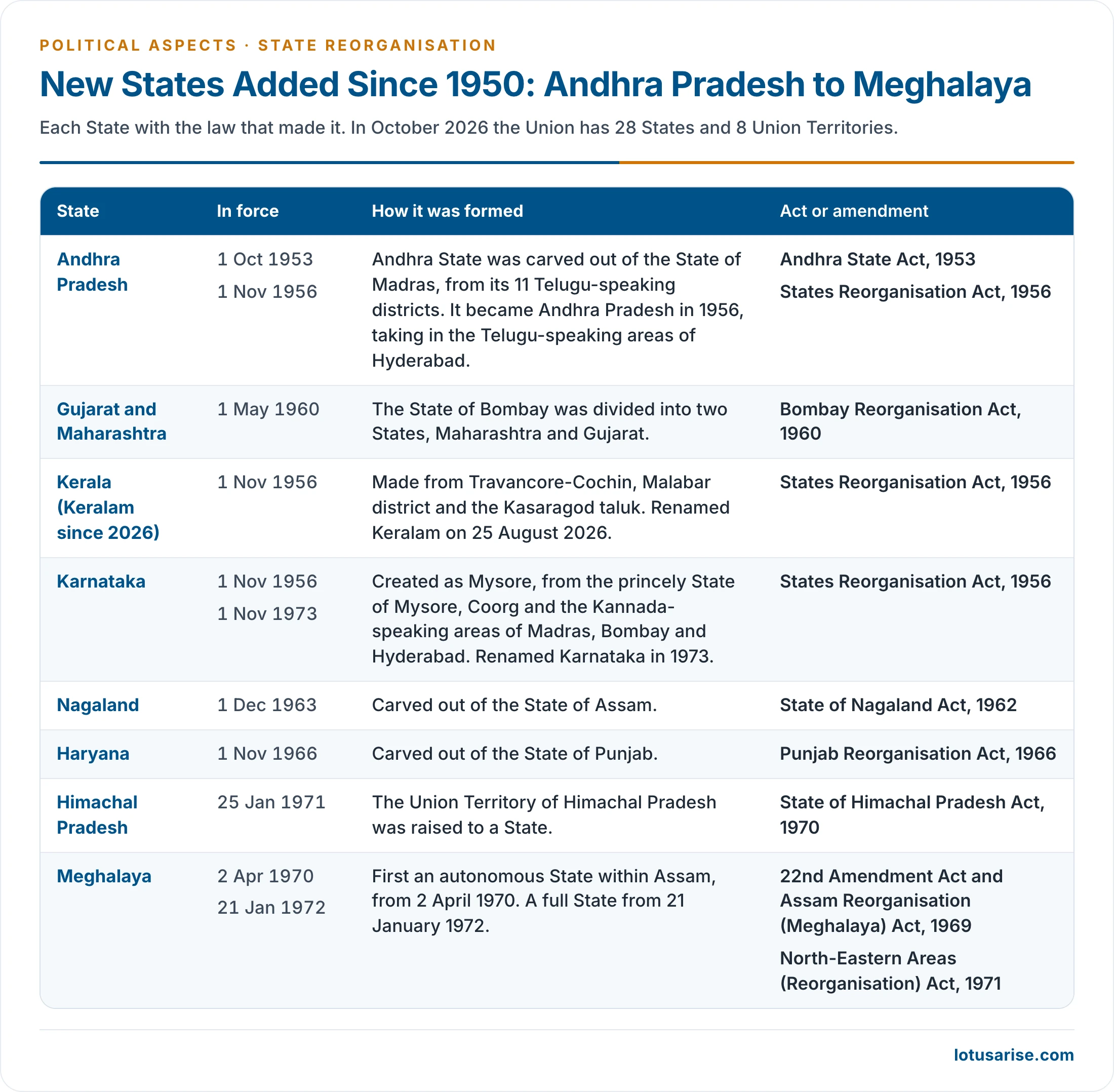
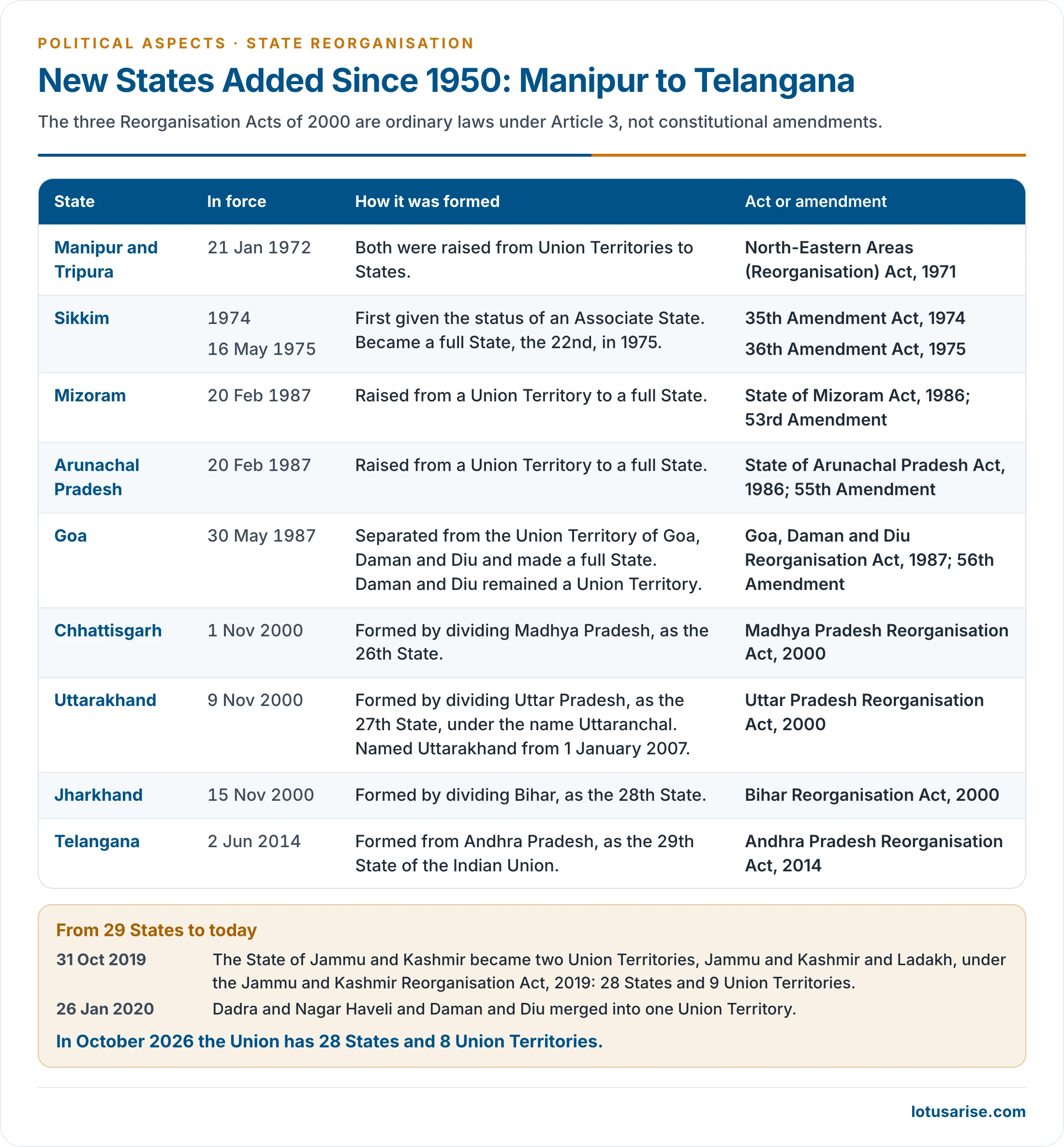
| Date in force | Change | Law | States | UTs |
|---|---|---|---|---|
| 1 Nov 1956 | Reorganisation | States Reorganisation Act, 1956; 7th Amendment | 14 | 6 |
| 1 May 1960 | Maharashtra, Gujarat | Bombay Reorganisation Act, 1960 | 15 | 6 |
| 1961–62 | Dadra and Nagar Haveli; Goa, Daman and Diu; Pondicherry | 10th, 12th and 14th Amendments | 15 | 9 |
| 1 Dec 1963 | Nagaland | State of Nagaland Act, 1962 | 16 | 9 |
| 1 Nov 1966 | Haryana; Chandigarh | Punjab Reorganisation Act, 1966 | 17 | 10 |
| 25 Jan 1971 | Himachal Pradesh | State of Himachal Pradesh Act, 1970 | 18 | 9 |
| 21 Jan 1972 | Meghalaya, Manipur, Tripura; Mizoram and Arunachal as UTs | North-Eastern Areas (Reorganisation) Act, 1971 | 21 | 9 |
| 16 May 1975 | Sikkim | 36th Amendment | 22 | 9 |
| 20 Feb 1987 | Mizoram, Arunachal Pradesh | State of Mizoram Act and State of Arunachal Pradesh Act, 1986; 53rd and 55th Amendments | 24 | 7 |
| 30 May 1987 | Goa | Goa, Daman and Diu Reorganisation Act, 1987; 56th Amendment | 25 | 7 |
| Nov 2000 | Chhattisgarh, Uttarakhand, Jharkhand | Three Reorganisation Acts, 2000 | 28 | 7 |
| 2 Jun 2014 | Telangana | Andhra Pradesh Reorganisation Act, 2014 | 29 | 7 |
| 31 Oct 2019 | Jammu and Kashmir; Ladakh | Jammu and Kashmir Reorganisation Act, 2019 | 28 | 9 |
| 26 Jan 2020 | Merger of two UTs | Dadra and Nagar Haveli and Daman and Diu (Merger of Union Territories) Act, 2019 | 28 | 8 |
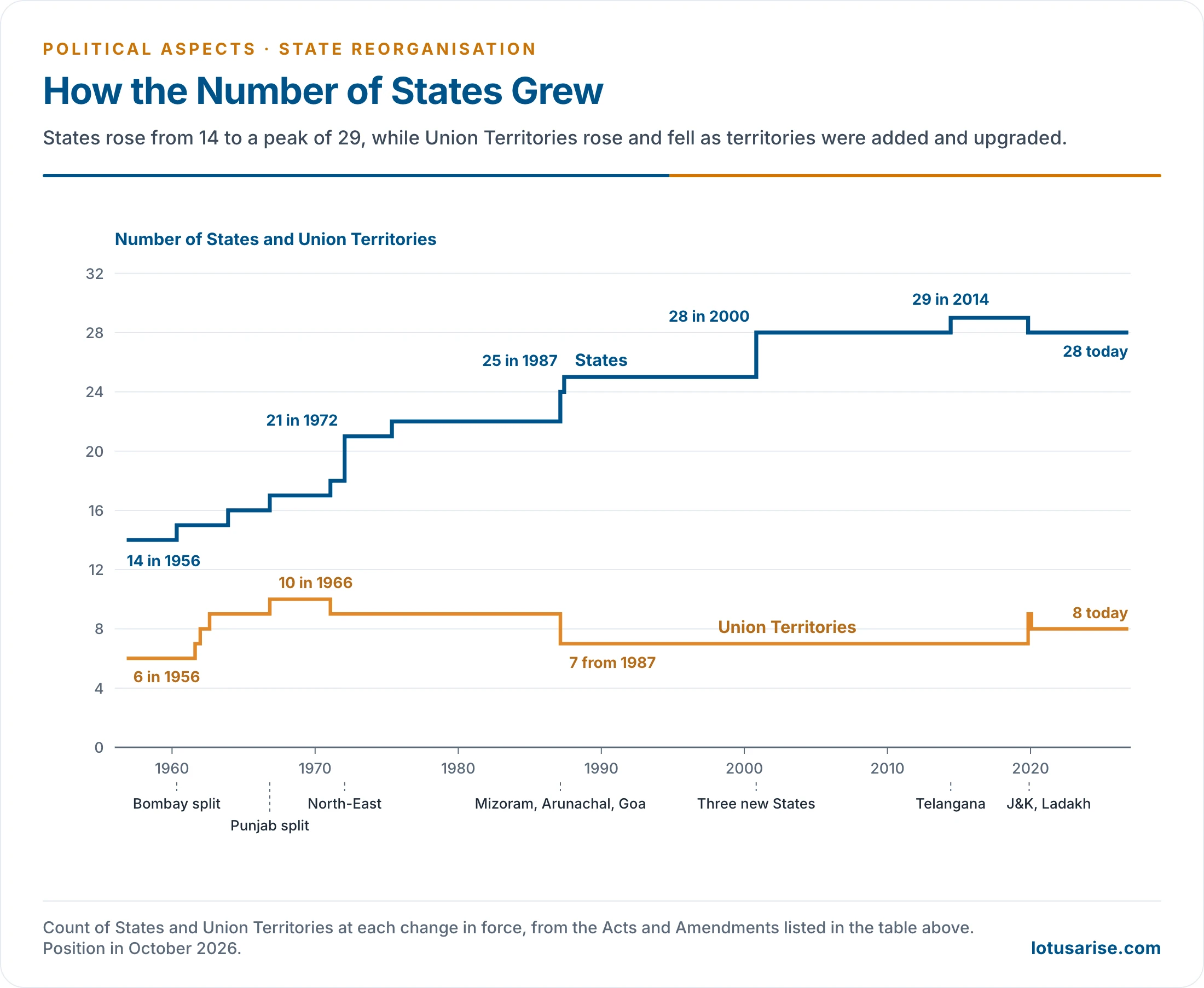
- These changes show the pull of regional identity within a federal Union, a theme taken further in regional consciousness and national integration and in the geographical basis of Indian federalism.
- The same diversity of speech is mapped in India’s linguistic regions, and the current list of units sits against India’s extent and frontiers.
Previous Year Questions
2022Discuss the emergence of linguistic regions and states in India.2020Has the regional aspiration of the people of Jammu and Kashmir been addressed through re-organisation of the state? Make an assessment.2008Critically examine the bases of state reorganisation in India since independence.1997Explain the basis and consequences of the establishment and implementation of recommendations of the State Re-organisation Commission in India since 1950s.1990Critically examine the political consequences of the regionalisation of our country on the basis of language.




 History Optional PYQ Master Pack: Topic-wise Model Answers (1985–2025) by LotusArise IAS
 History Optional Mains Master Kit 2027 Complete Self-Study System — Notes, Mapping & Premium Articles by LotusArise IAS
Nice 👍