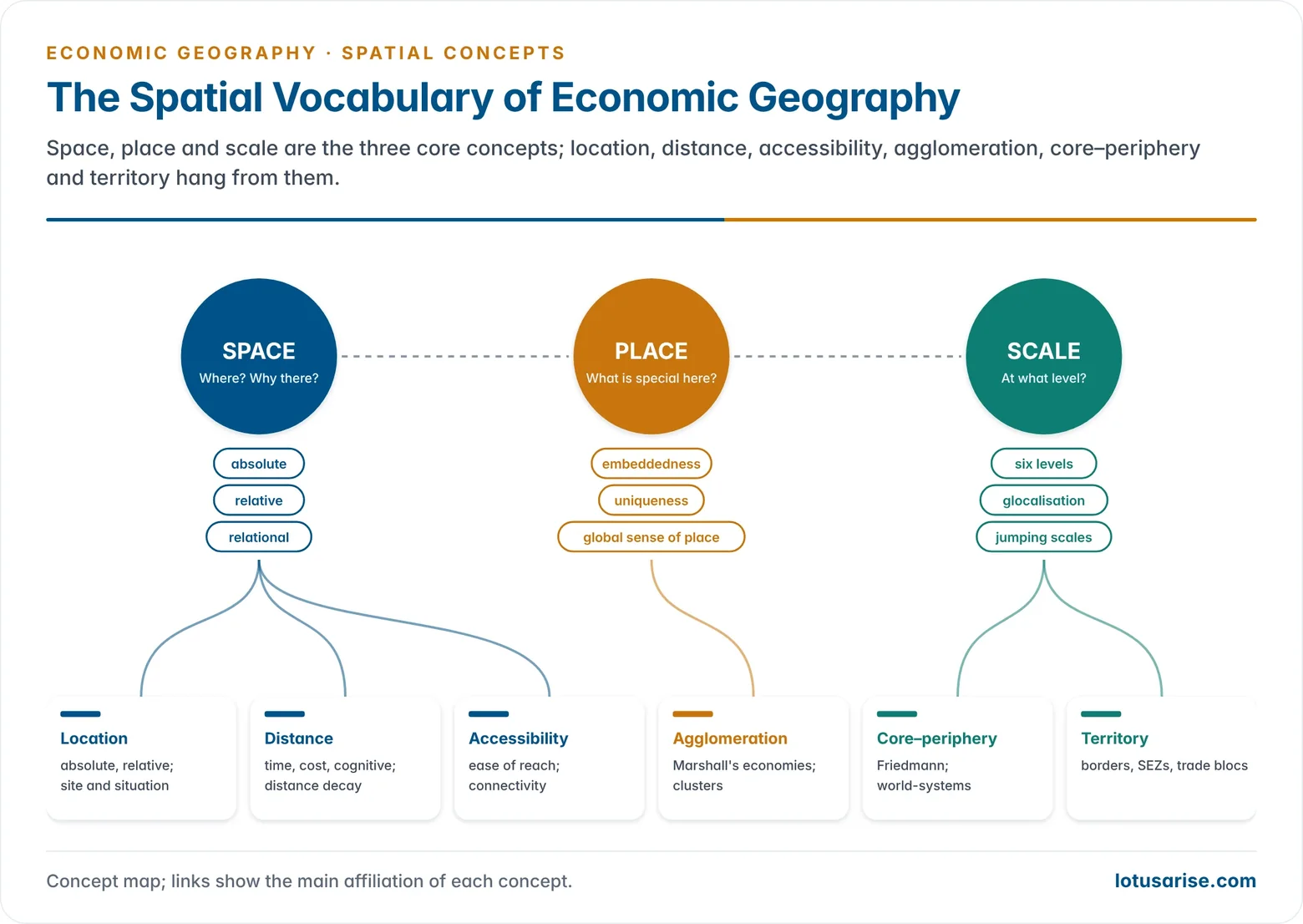
- Space, place and scale are the core concepts of economic geography. They are the common vocabulary through which geographers describe and explain economic life.
- They are supported by related concepts: location, distance, accessibility, agglomeration, core–periphery and territory.
- Together these turn the question “what does the economy do?” into “where, why there, at what scale, and with what effects on places?”
- These concepts are not neutral descriptions. Each has rival meanings, and how they are used shapes how problems are seen.
Space

Meaning
- Space refers to the physical distance between locations and the area covered by geographical phenomena.
- It lets us ask the two founding questions of economic geography: where is an economic process happening, and why there?
Three Views of Space
- Geographers do not agree on what space is. David Harvey (1973) distinguished three views, and each supports a different kind of economic geography.
| View | Meaning | Economic-geography use | Example |
|---|---|---|---|
| Absolute | A fixed container measured in coordinates and kilometres | Mapping where activities are; area and distance | A factory at a given latitude and longitude |
| Relative | Space measured by time, cost or effort of movement | Transport cost, accessibility, market areas | Pune is “closer” to Mumbai by expressway than a nearer hill village |
| Relational | Space produced by relations and flows between actors | Networks, value chains, power | Bengaluru tied to Silicon Valley through firms and engineers |
- Spatial science of the 1950s–60s worked mainly with absolute and relative space. Political-economy and relational approaches stress space as socially produced.
Four Elements of Space
- Territoriality and form: the bounded shape of political and economic units, such as the territory of a state, a special economic zone or a municipal limit.
- Location: the position of a country, city or firm, absolute and relative.
- Flows across space: trade, capital, migration, information and remittances linking places.
- Uneven space: uneven development is not an accident but a built-in feature of capitalism, as capital moves to places of higher return and leaves others behind.
Place
Meaning
- Place captures the specificity or uniqueness of particular locations carved out of wider space.
- It is space given meaning by people, institutions, history and culture.
- It lets geographers study the richness and complexity of places.
- Economic processes are embedded in their environmental, social, cultural, institutional and political contexts.
Embeddedness
- Embeddedness (Mark Granovetter, 1985) means that economic action takes place within networks of social relations, not in an abstract market.
- The idea works both ways:
- Local contexts shape economic activity.
- Economic activity in turn reshapes those contexts.
- Because values, norms and institutions differ, economies are organised differently from place to place. Business practice in the City of London differs from that in Port of Spain (Trinidad).
- Western (occidental) assumptions about firms, contracts or consumption may be inappropriate or alien elsewhere.
- Indian examples of embedded place economies:
- Surat’s diamond-cutting cluster: built on community and kinship networks of trust and credit.
- Tiruppur’s knitwear cluster: grew from local entrepreneurs and family firms into a major garment-export centre.
- Moradabad’s brassware: artisan skills passed down through generations.
Global Sense of Place
- Doreen Massey (1991) argued for a “global sense of place”. Places are not closed and fixed but are meeting points of wider flows.
- A call-centre suburb of Gurugram is local and global at once.
- Limitation: “place” remains a somewhat vague concept. It can refer to anything from a village street to a global city.
Scale
Meaning
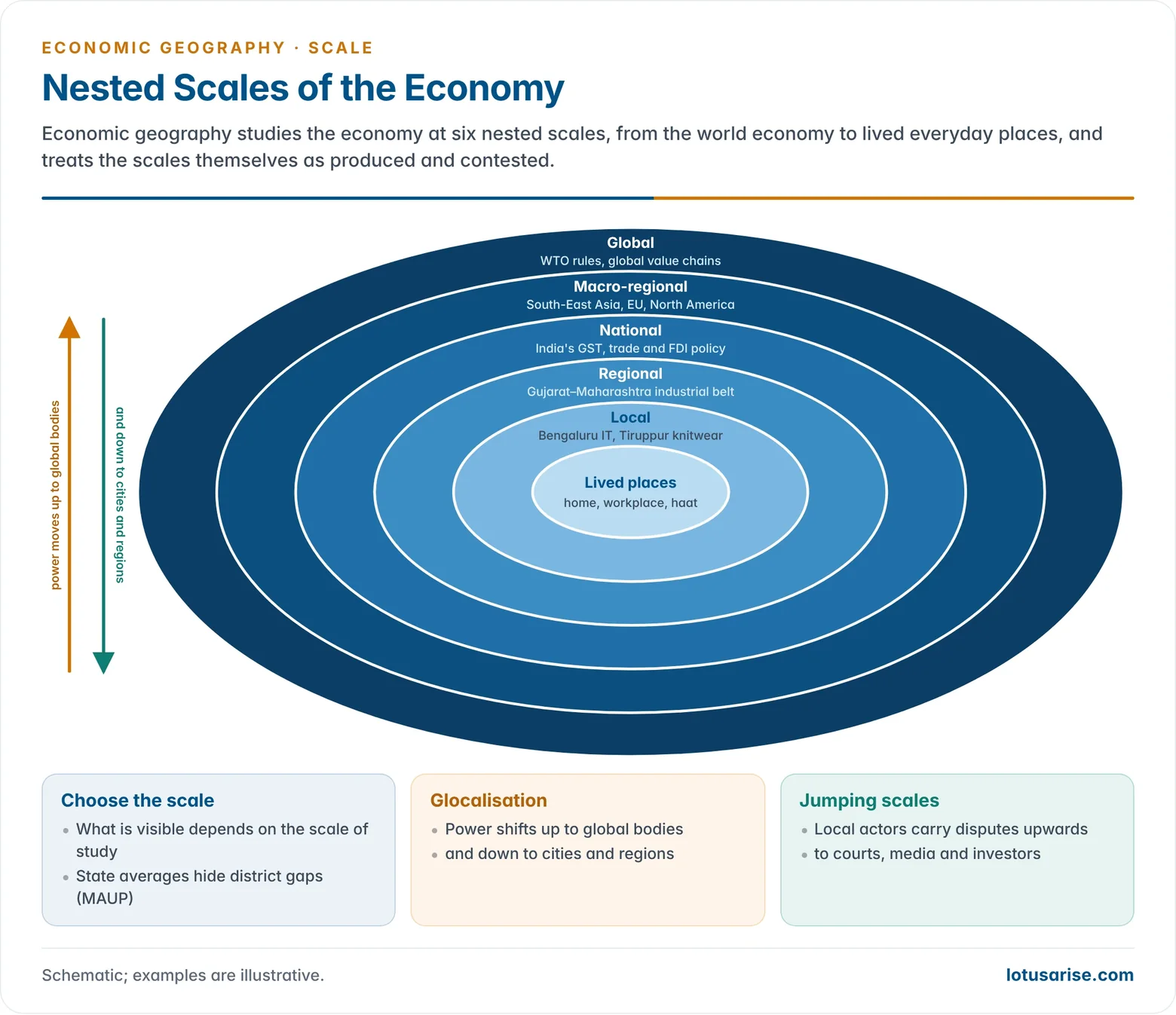
- Scale organises places into levels for analysis. The scale chosen changes what is seen and how it is explained.
Levels of Scale
| Scale | Unit | Example |
|---|---|---|
| Global | The world economy as a whole | World trade, global value chains |
| Macro-regional | Groups of countries | South-East Asia, the European Union, North America |
| National | Countries | India, the USA, Japan, France |
| Regional | Sub-national regions | California, South-East England, the Gujarat–Maharashtra industrial belt |
| Local | Cities, districts, clusters | Silicon Valley, Manhattan, the City of London, Bengaluru |
| Lived places | Places of everyday experience | Workplace, home, neighbourhood market |
Problems of Scale
- Classifying scale is not always easy:
- Terms like “local” and “regional” are used loosely.
- In Hong Kong, Singapore or Trinidad, the national, regional and local scales may coincide or blur.
- When reading economic geography, it is important to check how each author defines scale.
- Modifiable areal unit problem (MAUP): results change with the size and boundaries of the units used. A state average can hide sharp district-level poverty.
- Ecological fallacy: inferences drawn about individuals from aggregate data can mislead.
Scale as a Process
- Scale is not a fixed ladder; it is produced and contested.
- Glocalisation (Erik Swyngedouw, 1997) describes the simultaneous shift of power upwards to global institutions and downwards to cities and regions, away from the nation-state.
- Jumping scales (Neil Smith, 1992): local actors carry a struggle to a higher scale. A village fighting a mine may appeal to national courts or to global investors.
- Indian examples:
- The GST Council redistributed tax powers between scales.
- Trade policy is negotiated at the WTO but felt in local markets.
- City-level governance tools such as Smart City SPVs operate alongside state and national bodies.
Related Spatial Concepts
Location
- Absolute location:
- A position fixed by coordinates or address. Example: Jamshedpur at about 22.8° N, 86.2° E.
- Relative location:
- Position in relation to other places, resources and routes. It changes as transport and markets change.
- Site and situation:
- Site is the local physical setting: relief, water, soil, the harbour.
- Situation is the position within the wider network of places.
- Mumbai has a modest island site but an outstanding situation as the gateway to western India.
Distance
- Distance takes several forms:
- Absolute (physical): measured in kilometres.
- Time distance: hours needed to travel.
- Cost distance: money spent on travel or freight.
- Cognitive distance: how far a place is perceived to be.
- Friction of distance:
- Movement has a cost, so interaction falls as distance rises. This is distance decay, the basis of the gravity model.
- Ullman’s conditions for spatial interaction build on this idea.
- Time-space convergence (Donald Janelle, 1968):
- Places come “closer” in travel time as transport improves.
- Delhi–Mumbai rail time has fallen from days in the steam era to around 16 hours today, and the Delhi–Mumbai Expressway and Dedicated Freight Corridors cut freight time further.
- Time-space compression (David Harvey, 1989): capitalism’s drive to speed up turnover shrinks the felt world through containers, jets, the internet and digital payments.
Accessibility and Connectivity
- Accessibility:
- The ease of reaching a place from others. It depends on distance, routes and transport cost.
- It raises land values and attracts activity, as with metro stations and expressway interchanges.
- Connectivity:
- The degree to which places are linked in a network.
- It is measured with graph indices such as the beta index (links ÷ nodes).
- Greater connectivity means more alternative routes and stronger integration.
Agglomeration and Clusters
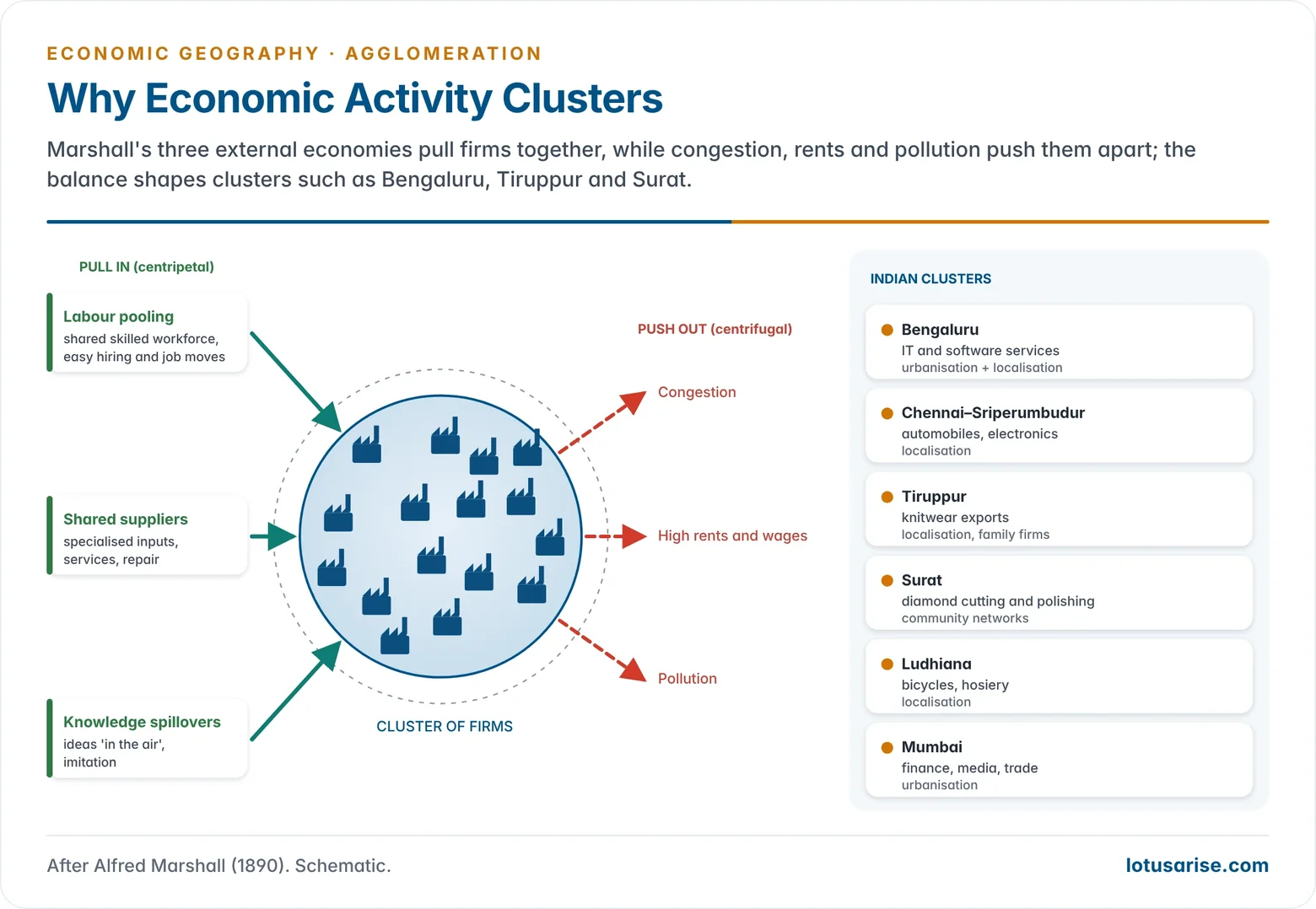
- Agglomeration is the concentration of economic activity in a few places.
- Agglomeration economies:
- Alfred Marshall (1890) identified three sources:
- a pooled labour market,
- shared specialised inputs and suppliers,
- knowledge spillovers (“the mysteries of the trade become no mysteries, but are as it were in the air”).
- Localisation economies: benefits from many firms in the same industry, such as the automobile cluster around Chennai.
- Urbanisation economies: benefits from the size and diversity of a city as a whole, as in Mumbai and Delhi NCR.
- Alfred Marshall (1890) identified three sources:
- Clusters (Michael Porter, 1990): geographic concentrations of interconnected firms, suppliers and institutions. Examples are Silicon Valley, Bengaluru IT and Ludhiana bicycles.
- Diseconomies: congestion, high rents and pollution eventually push activity outwards. These centripetal and centrifugal forces lie at the heart of the New Economic Geography.
Core and Periphery
- The core is a dominant, innovative, high-income area. The periphery depends on it and supplies labour, raw materials and markets.
- John Friedmann’s (1966) core–periphery model and Immanuel Wallerstein’s world-systems theory (core, semi-periphery, periphery) apply the idea from regional to global scale.
- India:
- The western and southern industrial core (Maharashtra, Gujarat, Tamil Nadu, Karnataka) contrasts with the eastern and central periphery.
- Even within cities, prosperous enclaves sit beside informal settlements.
Territory and Borders
- Territory is space controlled by a political authority. Borders regulate flows of goods, money and people.
- Special economic zones, free-trade agreements and customs unions reshape economic space by changing the rules at borders.
- GIFT City in Gujarat applies special rules to international finance within India.
Space, Place and Scale as Representations
- These concepts are not neutral descriptions of the world. They are also representations: ways of framing reality.
- How academics, the media and politicians use them shapes how we perceive the world and its problems.
- Calling a problem “global” can hide its local causes.
- Labelling a region “backward” can shape how investors and governments treat it.
- The same words carry different meanings in different traditions. Some geographers mean absolute space, others relative or relational space. Reading economic geography therefore needs attention to how each concept is defined.
Previous Year Questions
- No direct PYQ has been asked on this sub-topic yet.