

Humanism; Secularism; Multi-culturalism.
Official Syllabus: Paper II, Section A, Unit 6
Secularism is the principle that the state should not be tied to any religion and that every person should be free to believe, practise or reject any religion while remaining an equal citizen. It was born in Europe from bitter experience — a century of wars of religion — and took shape in Locke’s plea for toleration, Jefferson’s “wall of separation between Church and State” and France’s laïcité. But secularism is often misunderstood: it is not the same as atheism, it does not always mean complete separation of religion and state, and it is not the same thing as religious pluralism, though the two are closely linked. This article explains the meaning of secularism and secularisation, its origins, the Western models (American and French) and other state–religion arrangements, and then examines four questions: Is secularism atheism? Must religion and state be completely separated? Is secularism necessarily related to religious pluralism? What is the status of theocracy in a modern secular state? The Indian model and the Indian debate follow in Articles 5 and 6.
In simple words
In a cricket match the umpire is not on either team. He may personally support India or Australia, but on the field he must apply the same rules to both, protect both teams’ right to play, and never put on one team’s jersey. A secular state is like that umpire: it does not wear the jersey of any religion, applies the same law to all believers and non-believers, and protects everyone’s right to play the game of faith — or not to play it.
Context & Problem
Meaning of Secularism
- Etymology. From the Latin saeculum — “an age”, “this world”, as opposed to the eternal or the sacred. “Secular” originally meant worldly (a “secular” priest worked in the world, not in a monastery).
- The word “secularism” was coined by the English free-thinker George Jacob Holyoake in 1851 for a system of ethics concerned with this-worldly human welfare, based on reason and experience, that neither affirms nor denies religion. Holyoake deliberately distinguished secularism from atheism — a point we shall return to.
- Core meaning (political).
- Separation of religion and politics — the state’s authority does not come from religion, and religious bodies do not control the state.
- Religious freedom for each individual — to believe, worship, propagate, change or give up religion.
- Equal citizenship — rights and duties do not depend on one’s faith.
- Not identical to atheism — secularism only restrains religion in the public (state) aspects of life; it does not attack religion in private or social life.
A Classic Definition — Three Relationships
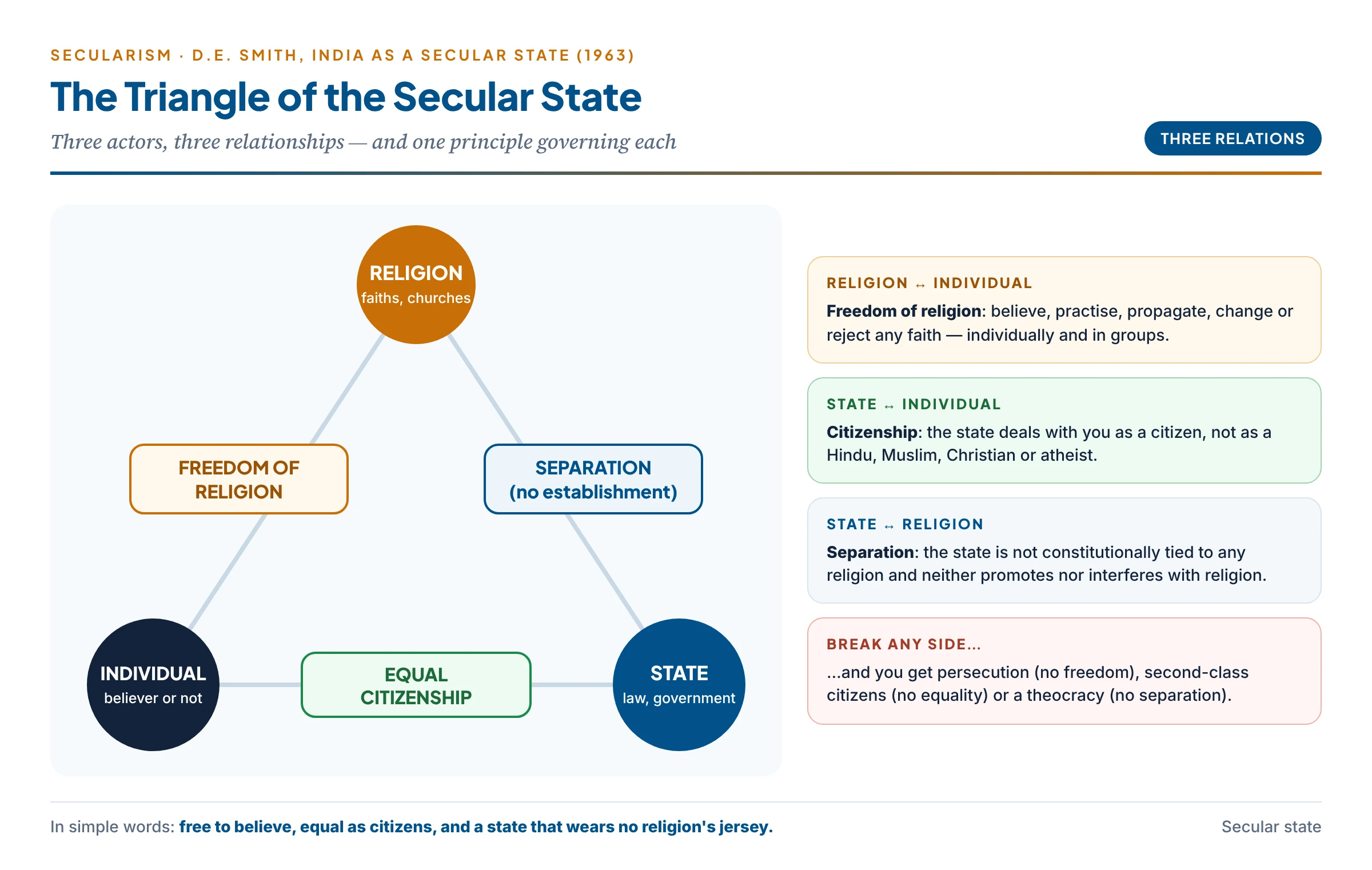
The American scholar Donald Eugene Smith (India as a Secular State, 1963) defined the secular state as one which guarantees individual and corporate freedom of religion, deals with the individual as a citizen irrespective of his religion, is not constitutionally connected to a particular religion, and does not seek either to promote or to interfere with religion. He showed that this involves three relationships:
| Relationship | Principle | In plain words |
|---|---|---|
| Religion ↔ individual | Freedom of religion | You may believe and practise any faith, or none |
| State ↔ individual | Citizenship | The state treats you as a citizen, not as a Hindu, Muslim or Christian |
| State ↔ religion | Separation | The state neither establishes a religion nor is controlled by one |
Secularisation, Secularism and the Secular State
| Term | What it is | Example |
|---|---|---|
| Secularisation | A social process — the decline of religion’s authority over law, education, science, art and daily life | Weber’s “disenchantment of the world”; church attendance falling in Europe |
| Secularism | A normative political doctrine — how the state ought to relate to religion | “The state shall have no official religion” |
| Secular state | An institutional arrangement that puts secularism into practice | Constitutions of the USA, France, India |
- The secularisation thesis (that modernity would make religion fade away) has been widely questioned: religion has revived in much of the world, and the sociologist Peter Berger, once its champion, later withdrew it.
- Charles Taylor (A Secular Age, 2007) distinguished three senses of “secular”: (1) public spaces emptied of God; (2) decline of belief and practice; (3) a new condition of belief, in which faith is one option among others, no longer taken for granted. Modern societies are “secular” mainly in the third sense.
Common confusion
Does a secular state mean a secularised (non-religious) society? No. Secularisation describes what happens in society; secularism describes how the state behaves. The USA has a secular constitution but a very religious society; Britain has an established church but a largely secularised society; India has a secular state and a deeply religious society. A secular state does not require citizens to become less religious — it requires the state to be fair to all.
Two Aspects of the Western Notion
- Negative sense — neutrality. The state stands neutral towards all religions: no establishment, no favouritism, no interference.
- Positive sense — scientific temper and secular morality. Public life should be guided by reason, evidence and a morality based on human welfare, not on revelation.
Core Doctrine
Origins of Western Secularism
1. The Reformation and the wars of religion.
- Luther’s challenge (1517) split Western Christianity. For over a century Catholics and Protestants fought each other — the French Wars of Religion, the Thirty Years’ War (1618–48), which killed perhaps a third of the population in parts of Germany.
- The Peace of Augsburg (1555) and the Peace of Westphalia (1648) settled conflict on the principle cuius regio, eius religio — “whose realm, his religion”: the ruler decides the religion of the territory. This ended war between states but not persecution within them.
- The lesson Europe drew: when the state takes sides in religion, there is no peace.
2. John Locke — toleration and the separation of church and commonwealth. In A Letter Concerning Toleration (1689), Locke argued:
- Different jobs. The commonwealth exists only to secure civil interests — life, liberty, health and property. The church is a voluntary society for the salvation of souls. The two must be kept apart.
- Belief cannot be forced. True religion consists in inward persuasion of the mind; force can produce only outward conformity and hypocrisy, never genuine faith. So persecution is useless as well as wrong.
- The magistrate has no authority over souls; a church has no right to use the sword.
- Toleration of all peaceful worship.
- Limits of Locke’s toleration: he excluded atheists (whose oaths, he thought, could not be trusted) and Catholics (whose loyalty to a foreign power — the Pope — he distrusted). Modern secularism goes further than Locke.
“The care of souls is not committed to the civil magistrate.” — John Locke
In simple words
A teacher can make a student sit in the prayer assembly, but cannot make him believe the prayer. Force reaches the body, never the mind. That is Locke’s simplest argument for toleration: since faith that is forced is not faith at all, the state gains nothing by forcing it — except hypocrisy and hatred.
3. The Enlightenment. Spinoza, Bayle and Voltaire attacked priestcraft and the Church’s political power; the struggle against papal and ecclesiastical authority made the freedom of conscience and the authority of reason central political ideals (see Article 1).
4. The American founding.
- The First Amendment (1791): “Congress shall make no law respecting an establishment of religion, or prohibiting the free exercise thereof” — two clauses: non-establishment and free exercise.
- Thomas Jefferson, in his letter to the Danbury Baptists (1802), described it as building “a wall of separation between Church and State“.
- The experience of religious oppression in Europe that drove many immigrants to America shaped this phrasing: religious rights were meant to guarantee individual freedom of worship, and many churches wanted separation to protect religion from the state.
5. The French Revolution and laïcité.
- Before 1789 the Catholic clergy were the First Estate, profoundly shaping French politics, owning vast lands and controlling education. After the Revolution it was felt essential to curtail the Church’s power.
- The Law of Separation of the Churches and the State (1905): “The Republic does not recognise, pay or subsidise any religion.” Article 1 of the 1958 Constitution: France is “an indivisible, secular (laïque), democratic and social Republic”.
The Principles of the Western (“Wall of Separation”) Model
- Mutual exclusion — religion cannot interfere in the affairs of the state, and the state cannot interfere in the affairs of religion.
- Strict neutrality / non-sponsorship — the state gives no financial aid, patronage or legal recognition to any religion.
- Privatisation of religion — religion belongs to the private sphere of individual conscience; in public institutions (parliament, courts, state schools) religious symbols and language are kept out (most strictly in French laïcité).
- Individual-centred — rights belong to individuals; religious communities as such have no special rights.
The American and French Models Compared
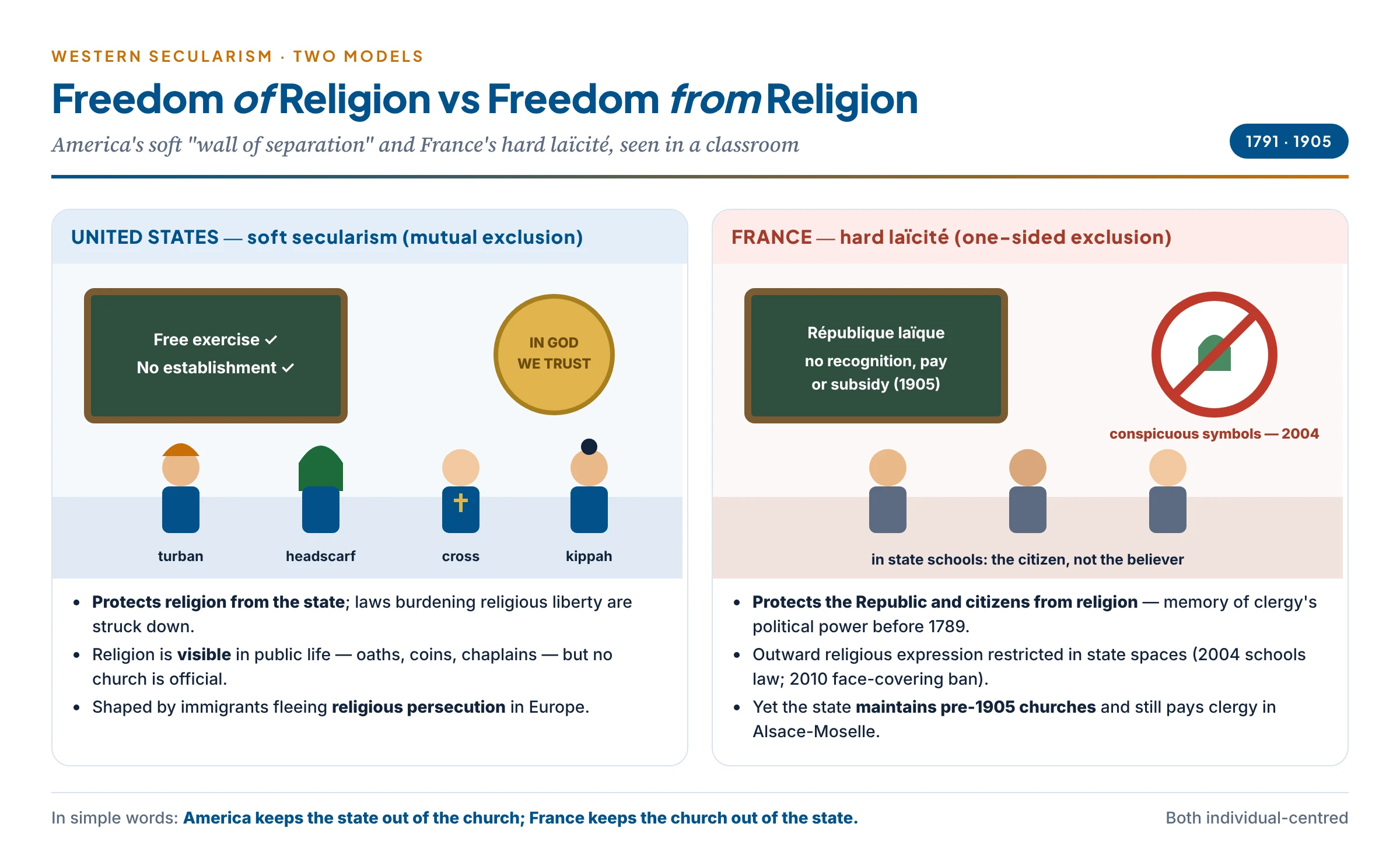
| Point | United States | France (laïcité) |
|---|---|---|
| Basic idea | The sphere of politics is separate from the sphere of religion | Total separation between state and religion |
| Freedom emphasised | Freedom of religion — protect religion from the state | Freedom from religion — protect the state and citizens from religion |
| Character | “Soft” secularism — the state keeps an arm’s-length distance; laws limiting religious liberty are unconstitutional | “Hard” or militant secularism — outward expression of religion is restricted in public institutions |
| Religion in public | Visible and welcome: “In God We Trust” on currency, presidential oaths on the Bible, chaplains in Congress | Kept out of state spaces: 2004 law banning conspicuous religious symbols in state schools, 2010 ban on face coverings in public (the “burqa ban”), 2023 ban on the abaya in schools |
| Historical driver | Immigrants’ experience of religious oppression in Europe | The clergy’s domination of politics before the Revolution |
| Who is protected | Mainly religion, from the state | Mainly the Republic and individuals, from religion |
| Typical criticism | Religion has large informal influence on politics (the religious right) | Burden falls on minorities (Muslim women); “neutrality” masks a Catholic past |
Common confusion
Does French laïcité mean the state never touches religion? Not quite. Under the 1905 law the state owns and maintains the churches built before 1905 and lets them be used for worship free of charge; in Alsace-Moselle (German territory in 1905) the older Concordat still applies and the state pays clergy of recognised religions. The state also regulates religious associations. For this reason the Indian political philosopher Rajeev Bhargava calls the French model “one-sided exclusion”: religion is excluded from the state, but the state can intervene in religion. The American model is closer to “mutual exclusion”.
Other State–Religion Arrangements
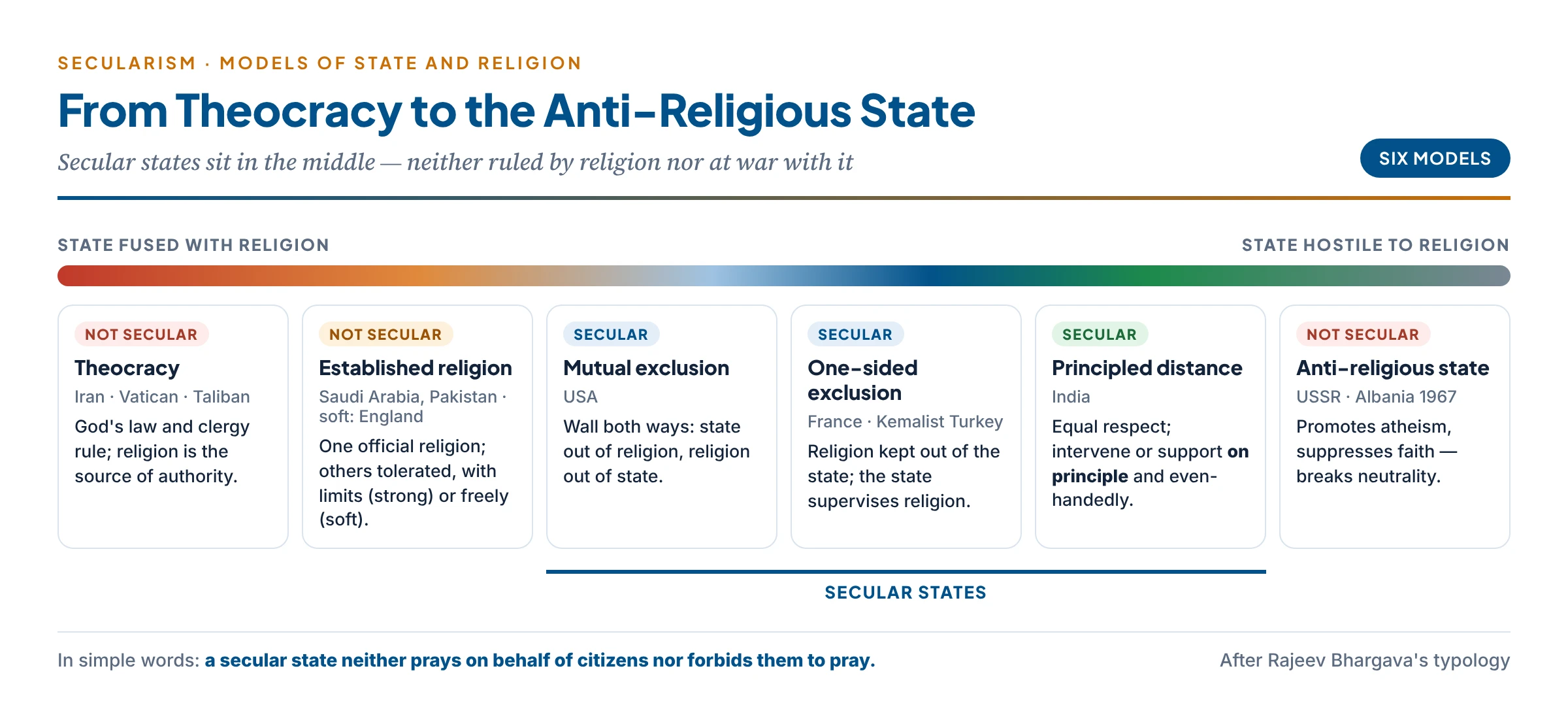
| Model | Example | How the state relates to religion |
|---|---|---|
| Theocracy | Iran (since 1979), Vatican City; Afghanistan under the Taliban | Religious law and clergy rule; religion is the source of political authority |
| Established religion — strong | Saudi Arabia, Pakistan (“Islamic Republic”) | One religion is official; others tolerated with limits |
| Established religion — soft | England (Church of England), Denmark, Norway (till 2012) | Official church, but in practice liberal and tolerant |
| Mutual exclusion | USA | Wall of separation both ways |
| One-sided exclusion / control | France; Kemalist Turkey (state controls religion through a Directorate of Religious Affairs) | Religion kept out of the state; state supervises religion |
| Principled distance | India | Equal respect; the state may intervene or support, on principle (Article 5) |
| Anti-religious state | Soviet Union, Communist China, Albania (1967 “first atheist state”) | State promotes atheism and suppresses religion — not truly secular, since it is not neutral |
Secularism in Modern Political Philosophy
- Rawls — public reason. In a society of many “reasonable comprehensive doctrines”, laws must be justified by reasons all citizens can share, not by any one religion’s doctrine.
- Habermas — the “post-secular” society. Religious citizens may speak in their own language in public debate, but their arguments must be translated into generally accessible reasons before they become law.
- Maclure and Charles Taylor (Secularism and Freedom of Conscience, 2011): secularism has two ends — equal respect for all citizens and freedom of conscience — and two means — separation of church and state and state neutrality. The means should serve the ends; when rigid separation harms equal respect or freedom (for example, by burdening a minority), the ends must prevail.
Critical Evaluation
Is Secularism Analogous to Atheism? (with the Indian context)
Why the two are confused:
- Both reject the idea that religion should govern public life.
- Many famous secularists were atheists (Holyoake’s associate Bradlaugh, Russell, Periyar).
- Some states that called themselves “secular” — the Soviet Union, communist China — actually promoted atheism.
- In India, critics like Ashis Nandy and T.N. Madan suspect that “secularism” is a cover for irreligion imposed by a Westernised elite (Article 6).
Why they are different:
| Point | Secularism | Atheism |
|---|---|---|
| Kind of idea | A political principle about the state | A metaphysical belief about God |
| Question it answers | “How should the state treat religions?” | “Does God exist?” |
| Answer | Impartially; no establishment; freedom for all | No |
| Who can hold it | Believers and non-believers alike | Only non-believers |
| Attitude to religion | Neutral or respectful | Usually critical |
| A state based on it | Protects religion and irreligion | Anti-religious state — violates neutrality |
- Holyoake himself insisted that secularism “is not an argument against Christianity, it is one independent of it”.
- A secular state protects atheists too — freedom of conscience includes the freedom not to believe. But it equally protects believers. A state that persecutes religion (Soviet “militant atheism”) is as non-secular as a theocracy.
In simple words
Picture a library that keeps books on every religion and on atheism, and lets everyone read what they like. The librarian may be a devout believer or a convinced atheist — what makes the library “secular” is that it favours no shelf. Atheism is a choice about which book to believe; secularism is a rule about how the library must treat every book.
The Indian context:
- Radhakrishnan: “When India is said to be a secular state, it does not mean that we reject the reality of an unseen spirit or the relevance of religion to life, or that we exalt irreligion.” Secularism in India stands not for irreligion but for deep religious understanding — impartial respect for all faiths.
- Nehru defined it as freedom of religion and conscience, including freedom for those who may have no religion.
- The Constitution guarantees freedom of conscience and the right to profess, practise and propagate religion (Article 25) — protecting believers and atheists (India’s atheist movement — Gora’s Atheist Centre in Andhra Pradesh, Periyar’s rationalism — has worked freely under it).
- The Supreme Court (S.R. Bommai, 1994): secularism is a basic feature of the Constitution; it means equal treatment of all religions, not hostility to religion.
- Conclusion: secularism is not analogous to atheism. In India it is even less so than in the West: Indian secularism rests on equal respect for all religions (sarva dharma samabhāva), a spiritual as much as a political idea.
Does Secularism Require Complete Separation of Religion and State?
The case for complete separation:
- Prevents domination — if religion controls the state, minorities and dissenters are oppressed; if the state controls religion, faith is corrupted.
- Protects religion itself — Roger Williams and the Baptists wanted a wall to keep the “garden” of the church safe from the “wilderness” of the world.
- Equal citizenship — only a state with no religious ties can treat all citizens as equals.
- Clarity — a clear rule (“no state money for any religion”) is easier to apply fairly than case-by-case judgement.
The case against:
- Complete separation is impossible in practice. Every state must regulate religion where it touches public order, health, education, marriage, property and charity; even the USA gives tax exemptions to churches and France maintains old churches.
- It can be unequal. A rigid wall may leave intra-religious oppression untouched (caste, gender discrimination) and may burden minorities whose practices are more public (headscarves, turbans).
- Deep diversity needs engagement. In multi-religious, community-based societies like India, the state must sometimes intervene (to abolish untouchability, reform personal laws) and sometimes support (minority educational institutions). Strict separation would forbid both.
- Neutrality can be a disguise. “Neutral” arrangements often reflect the majority’s history — the Sunday holiday, Christmas as a public holiday in Christian-majority countries.
In simple words
A hospital must be clean, but that does not mean the doctor never touches the patient — it means he touches only with clean hands, for the patient’s good. Likewise, a secular state need not keep zero contact with religion; it must touch religion only with clean hands — on principle, for equality and liberty, and equally for every faith.
Balanced conclusion. What secularism requires is not separation as an end in itself but its ends: no establishment, equal liberty of conscience and equal citizenship. Separation and neutrality are means. A state may keep a principled distance — neither fused with religion nor wholly cut off — engaging with religion only on principle (equality, liberty, dignity) and evenhandedly across communities. This is the logic of the Indian model (Article 5).
Is Secularism Necessarily Related to Religious Pluralism?
Meanings first:
- Religious pluralism (as a fact) — the presence of many religions in one society.
- Religious pluralism (as a theory) — the view, associated with John Hick and Ramakrishna (“as many faiths, so many paths”), that many religions are valid paths to the same ultimate reality.
- Religious pluralism (as a political ideal) — a society should welcome and respect the coexistence of many faiths.
The close historical link:
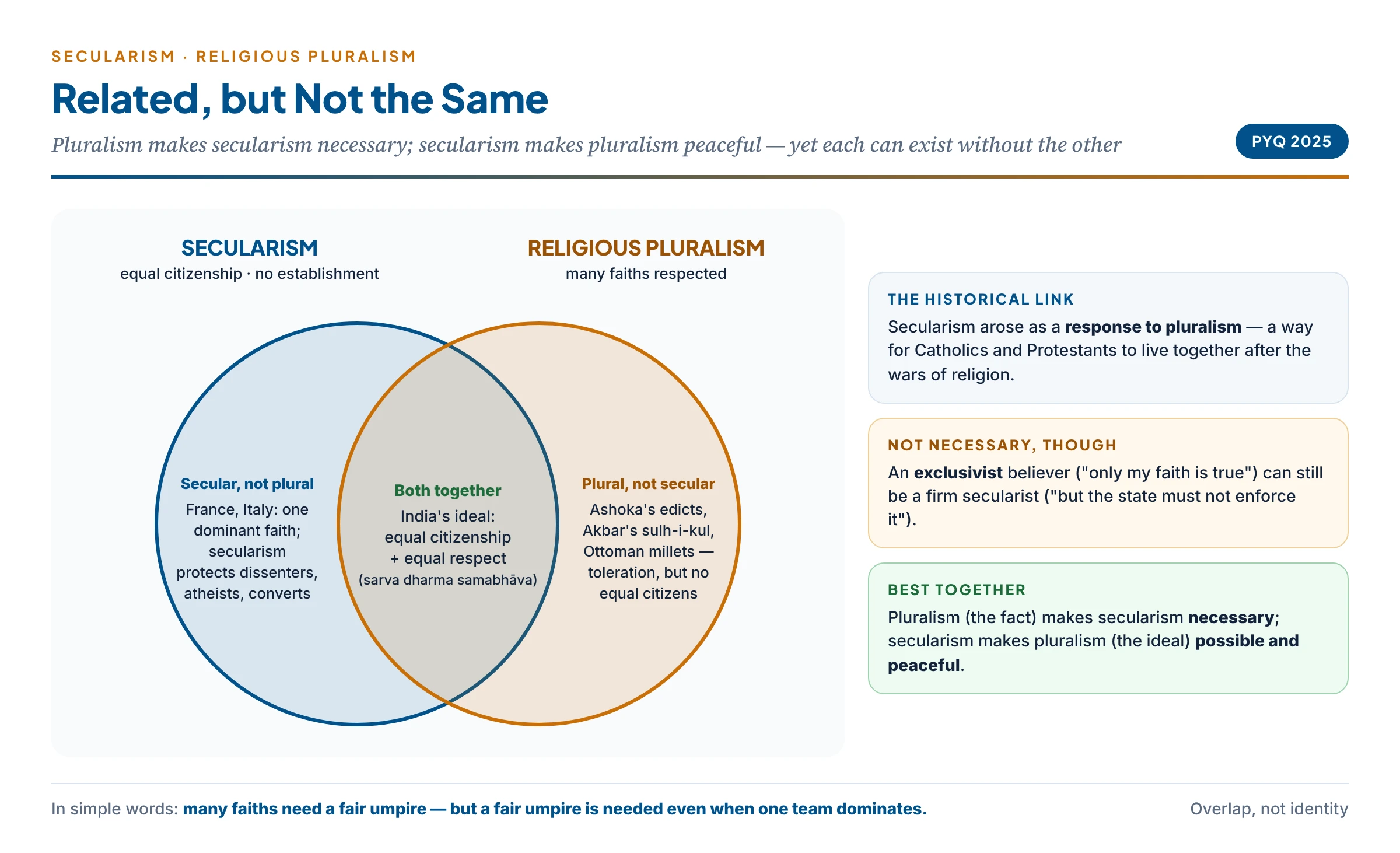
- Secularism arose as a response to pluralism — Europe needed a way for Catholics and Protestants to live together after the wars of religion.
- In pluralist societies it is the most reliable framework for coexistence: no faith rules, all are protected.
- Indian secularism in particular is a pluralist secularism — it rests on equal respect for many religions (sarva dharma samabhāva, Gandhi).
But the link is not necessary:
- Secularism without pluralism. A society with one dominant religion can still need secularism — to protect dissenters, sects, atheists and converts, and to stop clergy from controlling the state. France and Italy were overwhelmingly Catholic when they separated church and state; the struggle was between the Church and the citizens, not between religions.
- Pluralism without secularism. Many societies tolerated many religions under a religious state: Ashoka’s edicts asked people to honour other sects (“one who honours his own sect and condemns others injures his own sect”); Akbar’s policy of sulh-i-kul (peace with all); the Ottoman millet system gave religious communities self-government under an Islamic empire. These were pluralist but not secular — there was no equal citizenship.
- Secularism does not require the theory of pluralism. A person can be an exclusivist believer (“only my faith is true”) and still a firm secularist (“but the state must not enforce any faith”) — many of Jefferson’s Baptist allies were exactly that.
Conclusion. Secularism and religious pluralism are closely related but not identical. Pluralism (the fact) makes secularism necessary; secularism makes pluralism (the ideal) possible and peaceful. But secularism also protects freedom within one religion, and pluralism can exist without secular equality. The strongest form — as in India’s constitutional ideal — joins the two: equal citizenship plus equal respect.
The Status of Theocracy in the Modern Secular State
- Meaning. Theocracy (Greek theos, god + kratos, rule) is government in the name of God, usually by a priestly class or according to religious law. Modern examples: Iran (rule of the Islamic jurist, velāyat-e faqīh, since 1979), Vatican City, Afghanistan under the Taliban; some states combine monarchy and religious establishment (Saudi Arabia).
- Incompatible in principle. A modern secular democratic state rests on:
- popular sovereignty — authority comes from the people, not God or clergy;
- equal citizenship — rights cannot depend on faith;
- fundamental rights — including freedom to dissent, convert or reject religion;
- rational public justification — laws must be defensible by reasons all can share.
Theocracy denies all four, so within a secular state it has no legitimate place as a form of government.
- Residues and grey zones. Theocratic elements survive in many otherwise secular systems:
- Established churches — the British monarch is Supreme Governor of the Church of England, and 26 bishops sit in the House of Lords.
- Blasphemy and apostasy laws in some states.
- Religious personal laws governing marriage and inheritance (India, Israel, many Muslim-majority states).
- Religious courts or arbitration councils (debates over sharia councils in Britain).
- Resurgence. Religious nationalism and “theo-democratic” movements in many countries seek to give the majority religion a privileged place in the state — a pressure on secular constitutions (Article 6).
- Conclusion. In the modern secular state, theocracy is constitutionally excluded as a form of rule, but survives as symbolic establishment, personal-law pluralism and political pressure. The secular state’s task is to keep these residues subordinate to equal citizenship and fundamental rights.
Criticisms of the Western Model
- Blind to community identities — it sees only individuals, but in many societies religion is a communal identity; ignoring groups can leave minorities unprotected.
- Neutrality may hurt minorities. If secularism is defined as neutrality towards all religious communities, then in a competitive setting the interests of minorities are bound to suffer, because the majority has more votes, money and institutions.
- Privatisation is culturally specific. It assumes religion is a private belief (a Protestant idea); for many faiths religion is a public way of life (dress, food, festivals, law).
- Hostility. Hard secularism can be perceived as hostile to religious expression (France’s bans).
- Christian in disguise. The anthropologist Talal Asad argues that Western secularism carries the marks of its Christian (Protestant) origins — its idea of what counts as “religion” is not neutral.
- Cannot reform. A strict wall forbids the state from reforming unjust religious practices — something India needed to abolish untouchability.
What a multicultural secular democracy should aim at (the answer to criticisms 1–2 and 6):
- Removal of injustice to any individual or section emanating from the culture of that community — for example, banning instant triple talaq.
- Protection of minority communities from the onslaught of the powerful majority — for example, setting up a Minorities Commission.
Critics and Defenders
Criticism — Critics
- Communitarians and Indian critics (Nandy, Madan): secularism is an alien, elite doctrine that privatises what cannot be privatised.
- Talal Asad: Western secularism is Christianity’s child, not a neutral framework.
- Multiculturalists: neutrality ignores group identities and burdens minorities (headscarf bans).
- Religious conservatives: secularism drives faith from public life and weakens moral foundations.
- Feminists: strict non-interference shields patriarchal religious practices.
- Bhargava: both mutual and one-sided exclusion fail in deeply diverse societies.
Defence — Defenders and strengths
- Locke: belief cannot be coerced; a state that tries only produces hypocrisy and war.
- Jefferson and the Baptists: separation protects religion from corruption by power.
- Rawls and Habermas: public reason allows believers and unbelievers to live as equals.
- Maclure and Taylor: keep the ends (equal respect, freedom of conscience) and adapt the means.
- History: secular constitutions ended wars of religion and made religious freedom possible.
- Indian secularists: secularism can be reformed (principled distance), not abandoned.
Cross-Tradition Comparison
Western and Indian Approaches at a Glance
| Point | Western (US/French) | Indian |
|---|---|---|
| Origin | Wars of religion; Church–state conflict | Deep religious diversity; anti-colonial unity; caste reform |
| Basic principle | Separation / exclusion | Equal respect + principled distance |
| State and reform | State may not reform religion (US) | State may reform religion (untouchability, personal laws) |
| State and support | No aid to religion | Even-handed aid (minority institutions) |
| Unit of rights | Individual | Individual and community |
| Religion in public | US: visible but unofficial; France: restricted | Visible and plural |
| Neutrality means | Indifference / distance | Impartiality / harmony (Radhakrishnan) |
Indian Connect — Indian Connect — older Indian roots of secular toleration
- Ashoka’s Rock Edict XII: “One who honours his own sect and condemns the sects of others injures his own sect”; he supported Brahmins, Śramaṇas and Ājīvikas alike.
- Akbar’s sulh-i-kul (peace with all), the debates of the Ibādat Khāna, and the abolition of the jizya tax on non-Muslims (1564).
- The Ṛgvedic line “Truth is one; the wise call it by many names” (ekaṃ sad viprā bahudhā vadanti) and Jaina anekāntavāda (many-sidedness of truth) gave Indian thought a pluralist temper.
- These are traditions of toleration under religious rulers, not secularism in the modern sense of equal citizenship — but they explain why Indian secularism took the form of equal respect rather than a wall (Article 5).
Synthesis (Siddhānta)
- What secularism is. A political principle: no establishment of religion, freedom of conscience for all, and equal citizenship irrespective of faith — expressed in D.E. Smith’s three relationships.
- What it is not. It is not atheism (a belief about God), not secularisation (a social process), and not necessarily complete separation (one means among others).
- The Western models — American mutual exclusion and French one-sided exclusion — were answers to Europe’s wars of religion and Church power; they protect individual freedom well but can be blind to community identities and burdensome to minorities.
- Pluralism and secularism are closely linked — pluralism makes secularism necessary, secularism makes pluralism peaceful — but not identical.
- Theocracy has no legitimate place as a form of government in a secular state, though its residues must be kept subordinate to rights.
- The deeper lesson: secularism must be judged by its ends — equal respect and freedom of conscience — and its means adapted to each society. This prepares the ground for India’s distinctive model of principled distance.
- Contemporary relevance.
- Headscarf, turban and hijab controversies across Europe and in India test whether neutrality means exclusion or equal accommodation.
- Religious nationalism in many democracies challenges the idea of a state that wears no religion’s jersey.
- Rawlsian public reason shapes debates on abortion, euthanasia and same-sex marriage, where religious and secular arguments meet.
“Believing with you that religion is a matter which lies solely between man and his God… I contemplate with sovereign reverence that act of the whole American people which declared that their legislature should make no law respecting an establishment of religion, or prohibiting the free exercise thereof, thus building a wall of separation between Church and State.” — Thomas Jefferson, 1802
Previous Year Questions
- 2025Is the idea of secularism necessarily related to the idea of religious pluralism? Discuss.
- 2020Do you think that secularism requires complete separation of religion and ‘state’? Discuss.
- 2019Discuss the status of theocracy in the modern secular state.
- 2009Is secularism analogous to atheism? Examine in Indian context.