

Humanism; Secularism; Multi-culturalism.
Official Syllabus: Paper II, Section A, Unit 6
Humanism is the outlook that puts human beings — their reason, freedom, dignity and welfare — at the centre of thought and action. Instead of asking first “What does God command?” or “What does tradition say?”, the humanist asks “What is good for human beings, and how can human beings find it out for themselves?” The idea is very old — it begins with the Greek sophist Protagoras — but it took its modern shape in the Renaissance, was given its philosophical foundation by the Enlightenment and Kant, and then branched into many kinds: scientific, Christian, existentialist, Marxist, radical, integral and ecological humanism. This article explains what humanism means, its central tenets, its Greek and Renaissance roots, how the Enlightenment paved the way for modern humanism, the main kinds of humanism (including whether “Christian humanism” is a contradiction in terms), and its critics. Marxist humanism and M.N. Roy’s radical humanism are taken up in Article 2; Indian humanism and the question “Can humanism replace religion?” in Article 3.
In simple words
Think of two ways of deciding whether a village should build a hospital or a new temple gate. One way asks the priest what the scriptures command. The other asks: “What will reduce suffering and help people live fuller lives?” — and tries to answer with evidence, discussion and reason. The second way of thinking, which judges every plan, law and custom by its effect on human well-being, is the heart of humanism.
Context & Problem
What Problem Does Humanism Answer?
- The problem of authority. For centuries in Europe, truth and morality were thought to come from outside human beings — from revelation, the Church, scripture and inherited custom. Human beings were seen as fallen, sinful and dependent. Humanism asks: can human beings, by their own reason and experience, know what is true and decide what is right?
- The problem of value. If the world is not arranged around a divine plan, where do values come from? The humanist answer: from human experience and human needs.
- The problem of dignity. What gives a person worth — birth, caste, faith, wealth? Humanism replies: being human is enough. Every person has worth simply as a person.
Meaning and Definitions
- Literal sense. From the Latin humanitas (human nature, culture, refinement). In the Renaissance, a “humanist” (umanista) was a teacher of the studia humanitatis — grammar, rhetoric, poetry, history and moral philosophy, studied through Greek and Latin classics.
- Philosophical sense. A human-centred philosophy that evaluates everything in the light of human existence. It:
- emphasises the centrality of man and usually rejects the supernatural;
- assigns human beings a special position in the scheme of things;
- is not one school or a fixed set of doctrines but a general perspective from which the world is viewed;
- affirms the intrinsic value, dignity, rational agency and freedom of human beings, and makes human flourishing the test of truth and morality.
- A modern dictionary definition: a philosophical approach based on the assumption that mankind is the most important thing that exists, and that there can be no knowledge of a supernatural world, if any such world exists.
The Three Foundations of (Modern) Humanism
Modern, secular humanism rests on three philosophical commitments:
| Area | Humanist position | In plain words |
|---|---|---|
| Epistemology (theory of knowledge) | Positivist / empirical — knowledge comes from experience, observation and reason, not revelation | “Show me the evidence.” |
| Metaphysics (theory of reality) | Naturalist / materialist — reality is the natural world; no supernatural realm is needed to explain it | “Nature is all there is that we can know.” |
| Ethics (theory of value) | Secular ethics — morality rests on human needs and reason; religion is not the source (locus) of morality | “Be good for goodness’ sake, not out of fear of hell.” |
The Five Central Tenets
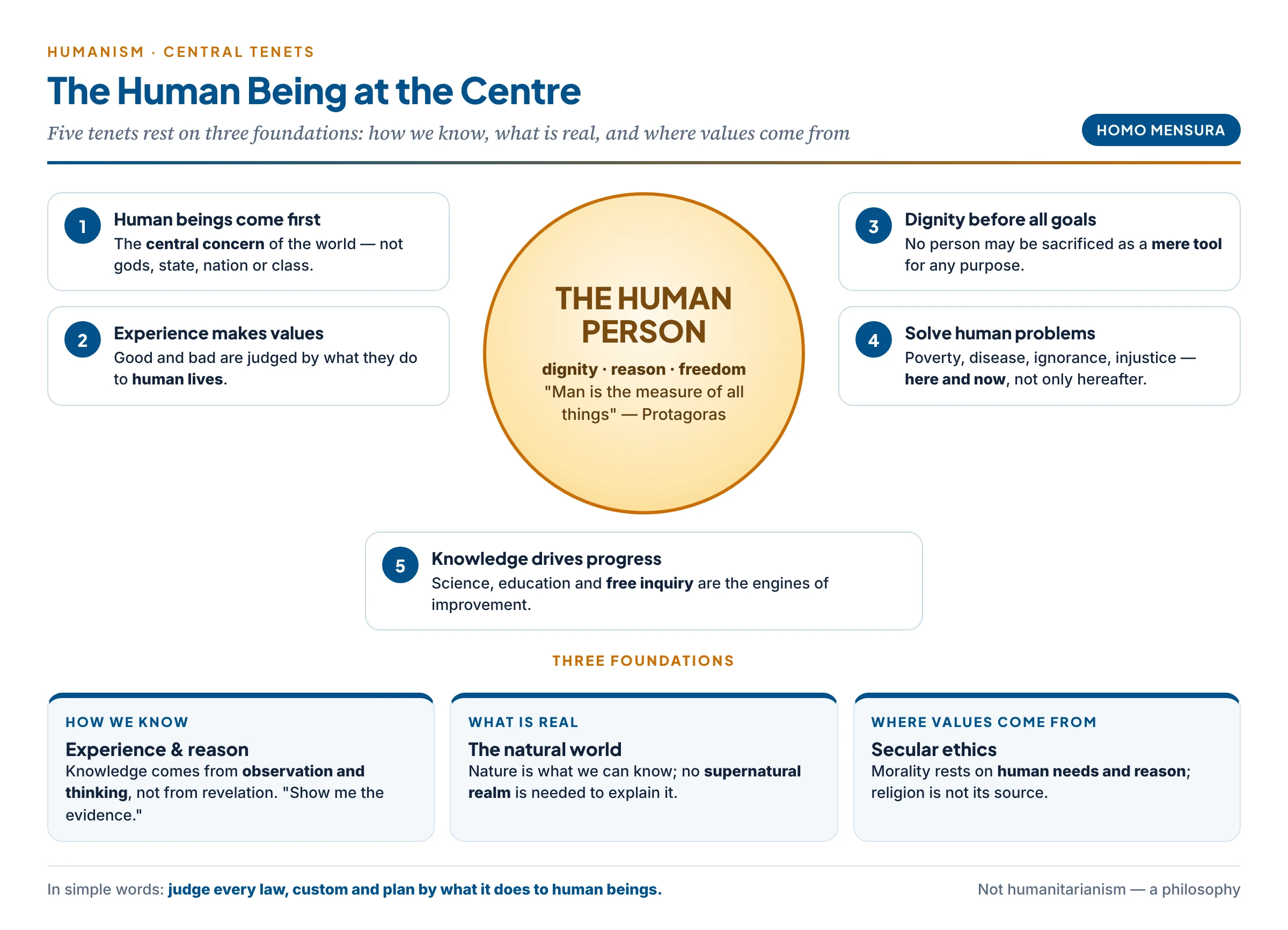
- Human beings are the central concern of the world — not gods, the state, the nation or a class.
- Human experience is the source of all values — good and bad are judged by what they do to human lives.
- Human dignity and welfare take precedence over all other goals — no person may be sacrificed as a mere tool.
- Society should focus on solving human problems — poverty, disease, ignorance, injustice — here and now, rather than on other-worldly salvation.
- Human knowledge is the key to social progress — science, education and free inquiry are the engines of improvement.
Alongside these, most humanists add freedom and autonomy (each person should think and choose for himself), reason and free inquiry, democracy and human rights, tolerance, and a cosmopolitan sense of one shared humanity.
Common confusion
Is humanism the same as humanitarianism? No. Humanitarianism means welfare activity for human beings — relief work, charity, feeding the hungry. A deeply religious person can be a great humanitarian. Humanism is a philosophy: a view about where knowledge and value come from (human reason and experience) and what matters most (human dignity and flourishing). Humanism usually leads to humanitarian action, but the two are not identical. Mother Teresa was a humanitarian; Bertrand Russell was a humanist.
Core Doctrine
Greek Humanism — The Beginning
- Protagoras (5th century BCE), the sophist, made the founding statement of humanism: “Man is the measure of all things” (homo mensura) — “of the things that are, that they are, and of the things that are not, that they are not.”
- Meaning: there is no truth or value standing completely outside human judgement; things are as they appear to human beings.
- Epistemology: the Greek humanists, though not systematic, accepted a positivist epistemology — perception was treated as the valid source of knowledge.
- Socrates turned philosophy from speculation about the heavens to the question “How should a human being live?” — “the unexamined life is not worth living.” Cicero said Socrates “called philosophy down from the heavens”.
- Greek tragedy and art celebrated human greatness and suffering: Sophocles wrote, “Wonders are many, and none is more wonderful than man.”
- Terence, the Roman playwright, gave humanism its motto: “I am human; nothing human is alien to me.”
- Limits: Greek humanism was not a full theory — it coexisted with belief in gods and fate, and with slavery and the exclusion of women and “barbarians” from full humanity.
Indian Connect — Indian Connect — an early Indian “man-centred” strand
- The Cārvāka (Lokāyata) school, like the Greek humanists, accepted perception (pratyakṣa) as the only valid source of knowledge, rejected the supernatural and the authority of the Vedas, and made this-worldly happiness the goal of life.
- The Buddha asked people to test even his teaching by their own experience, and told his disciples, “Be lamps unto yourselves.”
- The medieval Bengali poet Chandidas sang: “Listen, O brother man — the truth of man is above all truths; there is nothing above it.” This line is often quoted as the motto of Indian humanism.
Renaissance Humanism — The Rebirth of Man
The Renaissance (14th–16th centuries, beginning in Italy, especially Florence and Rome) means “rebirth” — the rebirth of classical learning and of confidence in human powers.
What the Renaissance humanists did:
- Studied “humane letters”. Humanism at first meant devotion to humane letters — a preference for the pagan Latin authors (Cicero, Seneca, Virgil) over medieval Christian Latin, and an ambition to read the Greek authorities in the original rather than in translation.
- Moral philosophy over metaphysics. They were keenly interested in human affairs — politics, institutions, art, manners, human freedom and dignity — more than in abstract scholastic metaphysics.
- Freed philosophy from the clergy. They turned philosophy into a fitting study for laypersons, translated Greek and Roman masterpieces into the vernacular (the people’s language) and wrote in it themselves. Even several popes were humanists — notably Nicholas V (1447–55), whose collection of some 1,200 Greek and Latin manuscripts founded the Vatican Library.
- Recovered Greek learning. Contact with Byzantine scholars at the Council of Florence (1439) and the arrival of refugee scholars with precious manuscripts after the fall of Constantinople to the Turks (1453) spread Greek learning in the West.
- Used critical scholarship. Lorenzo Valla used the study of language to prove (1441) that the Donation of Constantine — a document on which the popes had based their claim to temporal power — was a forgery. Reason and evidence were turned even on Church authority.
The main Renaissance humanists:
| Humanist | Work | Humanist idea |
|---|---|---|
| Petrarch (1304–1374) | Poems, letters | “Father” of Italian humanism; contempt for the “barbaric, pedantic, arid” disputations of the scholastics; preferred Plato to the scholastic Aristotle; motto: “Platonic wisdom, Christian dogma, Ciceronian eloquence” |
| Pico della Mirandola (1463–1494) | Oration on the Dignity of Man (1486) | Man has no fixed nature — he can shape himself by free choice |
| Erasmus (1466–1536) | In Praise of Folly | Satirised over-intellectual scholastics and corrupt clergy; called for a simpler, happier, ethical Christianity — the “prince of the humanists” |
| Thomas More (1478–1535) | Utopia | Combined Platonic, Epicurean and Christian ideas in a picture of an ideal, rational, tolerant society |
| Montaigne (1533–1592) | Essays | Witty scepticism; the self as a subject of study — “Each man bears the entire form of the human condition” |
| Machiavelli (1469–1527) | The Prince | Called a humanist for studying politics as it actually is — human power, not divine order |
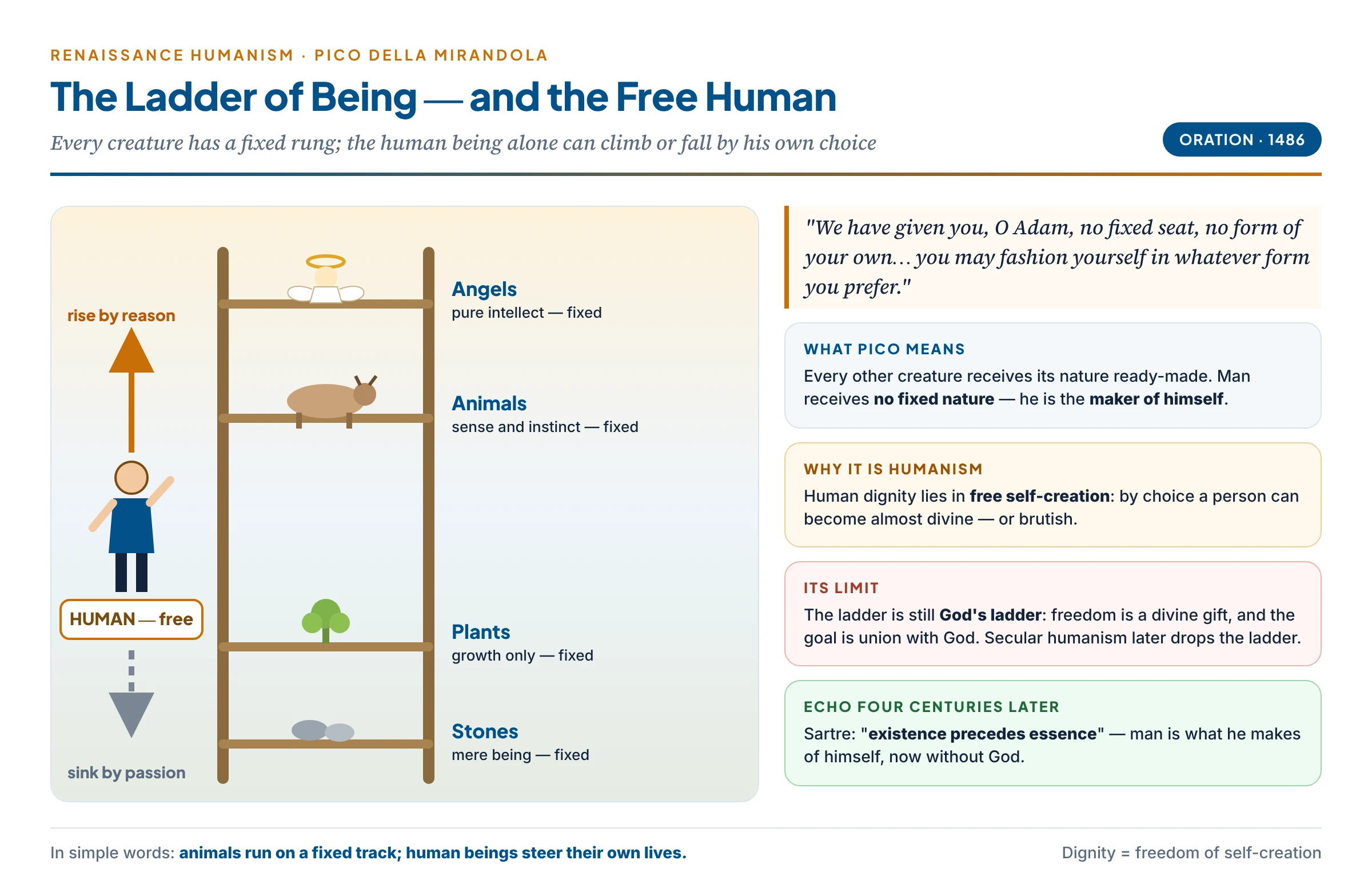
Pico’s Oration — the manifesto of human dignity. In Pico’s story, God created all creatures with fixed natures — stones, plants, animals and angels each have their place. To Adam alone he says: “We have given you, O Adam, no fixed seat, no form of your own… you may fashion yourself in whatever form you prefer. You can sink to the lower forms of life, which are brutish; you can rise, by your soul’s judgement, to the higher forms, which are divine.” Human dignity lies in this freedom of self-creation.
In simple words
A train runs only on its fixed track; a car can be driven anywhere the driver chooses. For Pico, animals are like trains — their nature fixes their path. Human beings are like cars: no track is laid for us, and we steer our own lives. That freedom is both our dignity and our responsibility.
Features and limits of Renaissance humanism:
- It emphasised the centrality of human beings and a broadly empirical approach to knowledge.
- But it accepted the existence of God. Man was seen as superior in the material world because God had given him a special status, and other creatures were thought to have been created for human use and enjoyment.
- It remained book-centred: arguments rested on the authority of ancient authors (was Plato or Aristotle the truer guide?) rather than on reason and experiment. Only at the end of the Renaissance did thinkers begin to challenge all authorities, including the classics — and with that the modern world began.
Criticism of Renaissance humanism (from the standpoint of secular humanism):
- Self-contradictory — if God exists and is supreme, human beings become secondary; a God-centred humanism is only half a humanism.
- Dependence — human beings remain dependent on God for liberation (salvation).
- Religious morality replaces secular morality — right and wrong are still decided by divine command.
- Fate over reason — divine providence and fate become more important than rationality and experience.
- Other-worldliness — human welfare becomes secondary when the next world matters more than this one.
The Scientific Revolution, Deism and the Enlightenment — How Modern Humanism Was Born
Renaissance humanism revived confidence in man; the Scientific Revolution (16th–17th centuries) and the Enlightenment (17th–18th centuries) gave that confidence a method and a programme.
1. The Scientific Revolution. Copernicus, Galileo, Kepler and Newton showed that nature runs by regular laws that human reason can discover. Francis Bacon proclaimed that “knowledge is power” — science could be used for “the relief of man’s estate”. Descartes began philosophy from the thinking self (cogito).
2. Deism. The deists (Toland, Tindal, Voltaire, many American founders) accepted a Creator but rejected miracles, revelation and priestly authority. By making the “natural light of reason” the final court of appeal in matters of God and morality, deism purified religion of superstition and made a truce with science — and in due course paved the way for rationalism, scientism, the Enlightenment and humanism. The truce, critics later said, was “with science at the cost of religion”.
3. The Enlightenment. Kant defined it in 1784: “Enlightenment is man’s emergence from his self-incurred immaturity… Sapere aude! Have courage to use your own understanding!” Its main ideas, each of which became a tenet of humanism:
| Enlightenment idea | Thinkers | What it gave to humanism |
|---|---|---|
| Reason as the final authority | Descartes, Spinoza, Kant | Truth is found by human reason, not accepted on authority |
| Science and experiment | Bacon, Newton, Locke | Empirical (positivist) epistemology; knowledge as the key to progress |
| Autonomy of the individual | Kant, Rousseau | Each person is a self-legislating moral agent with dignity |
| Natural and human rights | Locke, Paine; Declarations of 1776 and 1789 | Dignity becomes enforceable rights — life, liberty, equality |
| Religious toleration and secularism | Locke, Voltaire, Spinoza | Religion becomes private; ethics and politics become secular |
| Idea of progress | Condorcet, Turgot | History is the story of human improvement through knowledge |
| Critique of tradition and privilege | Voltaire, Diderot’s Encyclopédie | Attack on superstition, priestcraft, hereditary privilege |
| Cosmopolitanism | Kant (Perpetual Peace) | One humanity; peace and world citizenship |
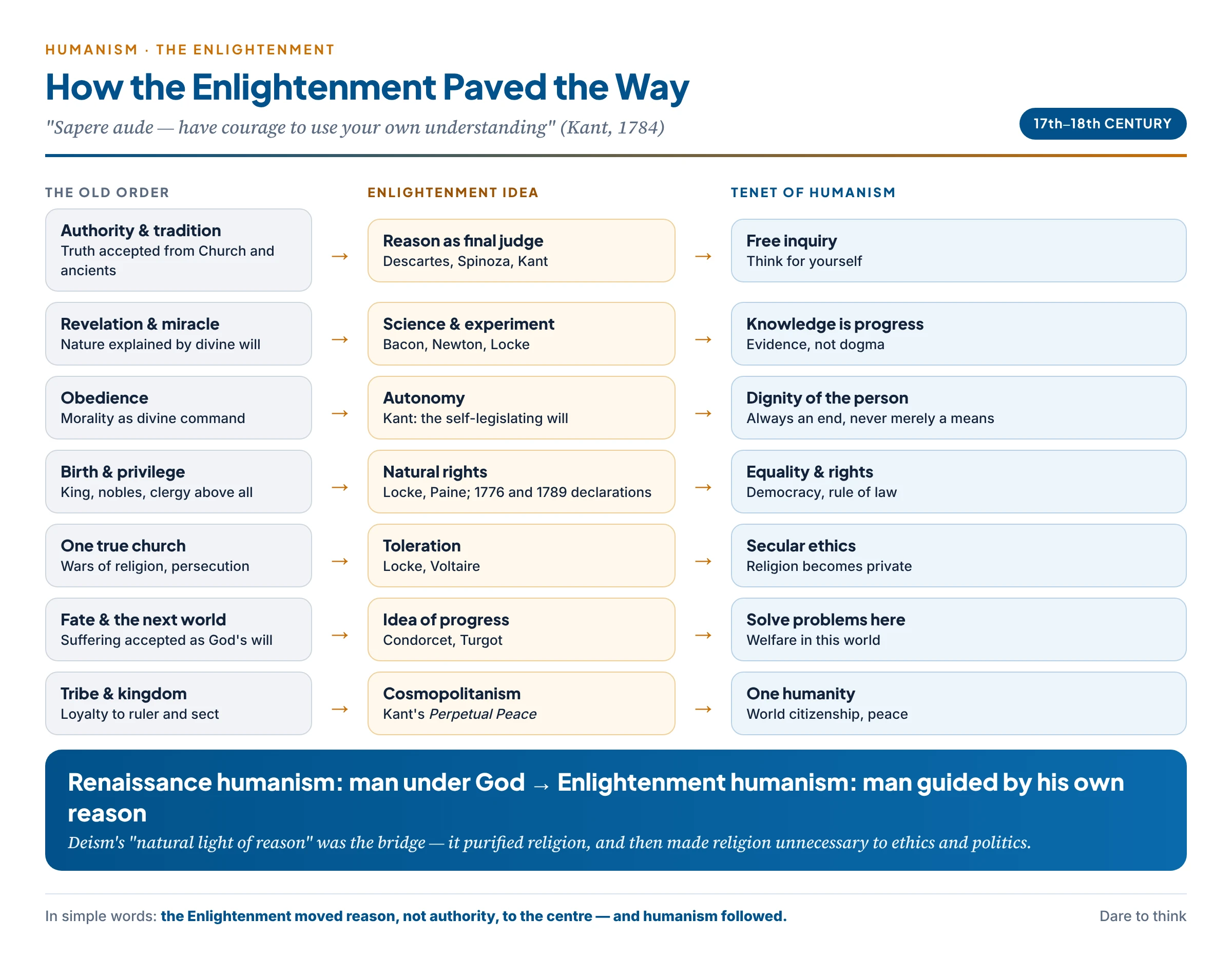
In short: the Enlightenment removed God and the Church from the centre of knowledge, ethics and politics and put human reason there. Renaissance humanism was still God-centred humanism; after the Enlightenment, humanism became secular, scientific and political.
In simple words
Imagine a student who has always copied answers from a senior’s notebook. One day a teacher says, “Work it out yourself — you can.” At first it is frightening; soon the student finds he can solve problems no notebook contained. The Enlightenment was that teacher for Europe: “Dare to think for yourself.” Humanism is the confidence that followed.
Immanuel Kant — The Philosophical Foundation of Humanism
Kant is often said to have laid the philosophical foundation of modern humanism, because he grounded morality in human reason itself.
- Moral and political philosophy linked. Kant interlinked ethics and politics, using the concept of moral freedom to arrive at standards of political behaviour.
- Moral freedom = true freedom. A person is free not when he follows desire but when he acts from a will informed by his own sense of duty — when he obeys a law his own reason gives. Hence moral freedom coincides with true freedom (autonomy).
- Sovereignty of the moral law. Man’s practical reason is guided by the moral law, and that law should be the foundation even of metaphysics (Kant made practical reason supreme over speculative reason).
- The categorical imperative commands what ought to be done irrespective of conditions — not “if you want X, do Y”, but “do this, because it is right”.
- The Formula of Humanity: “Act in such a way that you treat humanity, whether in your own person or in the person of any other, never merely as a means to an end, but always at the same time as an end.”
- Dignity (Würde). “In the kingdom of ends everything has either a price or a dignity.” Things have a price and can be exchanged; a person has dignity, which has no price and cannot be traded.
- Contracts and politics. The objective of any contract should be the mutual benefit of the contracting parties; no one may be used merely as a tool. Kant wanted politics to serve moral ends through the instrument of law. If politics were shaped by morality, it would promote public legal justice, forbid wars, insist on perpetual peace (Perpetual Peace, 1795) and protect the rights of man.
In simple words
A shopkeeper may employ a worker — that is using him as a means. But if the shopkeeper locks him in, cheats his wages or treats him as a machine, he is using him merely as a means. Kant’s rule allows us to cooperate and benefit from each other, but never to forget that the other person is a person, with aims and dignity of his own.
Scientific (Secular) Humanism
- Origin. It owes its origin to the Scientific Revolution and the Enlightenment; the close connection between science and human progress was fully established in the Enlightenment.
- Content. It embraces human reason, secular ethics and philosophical naturalism, while rejecting religious dogma, the supernatural and superstition as the basis of morality and decision-making.
- Humanistic naturalism (a 20th-century American form): profound respect for modern science; the universe is “self-existing and not created”; all ideas of a supernatural Being and of cosmic “support” are abandoned; emphasis on social studies and on human interests and aspirations. It has much in common with Auguste Comte’s “Religion of Humanity” (19th century), William James’s pragmatism and John Dewey’s instrumentalism.
- Public declarations. The Humanist Manifesto (1933, revised 1973 and 2003) and the Amsterdam Declaration of the International Humanist and Ethical Union (1952; renewed 2002 and 2022) set out its creed: ethics based on human values, reason and science, democracy and human rights, and “a joyful life” without supernatural belief. (M.N. Roy was one of the first vice-presidents of that Union — Article 2.)
- Graham Wallas (Human Nature in Politics, 1908) warned against both intellectualism (the false belief that people act only by cold calculation) and anti-intellectualism (contempt for reason) as inimical to humanity — a scientific humanism must study human beings as they really are, emotions included.
- Nehru gave scientific humanism its Indian voice: the power gained through the advancement of science should be directed to the service of humanity, not to private profit and the exploitation of others. “It is science alone that can solve the problems of hunger and poverty, of insanitation and illiteracy, of superstition and deadening custom.”
- The dark side. The same scientific and industrial progress led to the dismal condition of workers in the Industrial Revolution — long hours, child labour, slums. This exposed the gap between humanism’s promise and capitalism’s practice and provoked socialist and Marxist humanism (Article 2).
Existentialist Humanism — Sartre
- In his lecture Existentialism Is a Humanism (delivered 1945, published 1946), Jean-Paul Sartre argued: “existence precedes essence.” A paper-knife is made for a purpose decided beforehand; a human being has no pre-existing blueprint, divine or natural. “Man is nothing else but what he makes of himself.“
- Because there is no God to give us a fixed nature or ready-made values, man is “condemned to be free” — and therefore fully responsible, not only for himself but, in choosing, for the image of humanity he creates.
- Why Sartre called it humanism: it places man at the centre as the sole creator of values, and makes human freedom and responsibility the foundation of ethics.
- But Sartre rejected “humanism” in another sense — the self-congratulatory cult of “Humanity” that worships man as a finished, admirable product (he mocked it in Nausea). Existentialist humanism is a humanism of freedom and responsibility, not of human self-worship.
Christian Humanism — Is It a Contradiction in Terms?
What it is. Christian humanism holds that human dignity, reason and freedom are gifts of God and are fulfilled, not crushed, by faith. Its sources:
- Imago Dei — man is created “in the image of God”; hence every person has dignity.
- The Incarnation — God became man in Christ; nothing could honour human nature more.
- Aquinas — “grace does not destroy nature but perfects it”; reason and faith work together.
- Renaissance Christian humanists — Erasmus, Thomas More, John Colet: return to the sources (the Gospels and the Church Fathers), education, ethics, peace, reform of a corrupt Church.
- Jacques Maritain, Integral Humanism (1936): he distinguished “anthropocentric humanism” (man as the measure of all things, which he thought ends in tragedy) from “theocentric” or integral humanism, which recognises God as the centre of man and so gives man his full dignity. Catholic social teaching later spoke of “integral human development”.
The case that it is a contradiction in terms:
- Humanism (in the strict sense) is man-centred; Christianity is God-centred. If God is the centre, man is not.
- Self-sufficiency vs grace. Humanism trusts human reason to find truth and goodness; Christianity teaches original sin and that man is saved only by grace, not by his own efforts.
- This world vs the next. Humanism seeks happiness here; Christianity looks to eternal salvation.
- Morality by reason vs morality by command. Secular humanism grounds ethics in human needs; Christianity grounds it in God’s will.
- Historical critics. Feuerbach said “theology is anthropology” — God is only human nature projected outward, so the truly humanist step is to take back what we gave to God. Nietzsche and Sartre argued that only the “death of God” makes man free. From the other side, the Protestant theologian Karl Barth insisted that God is “wholly other” and that human-centred religion is idolatry.
The case that it is not:
- It depends on the definition. If humanism means “rejecting the supernatural“, Christian humanism is a contradiction. If it means “affirming human dignity, reason, freedom and welfare“, it is not — and that broader meaning was the original Renaissance meaning, whose founders were Christians.
- The best grounding for dignity. Christian humanists argue that dignity is secure only if it has a source above human opinion; otherwise majorities or states can deny it.
- Historical record. Christian humanism inspired universities, hospitals, the abolition of the slave trade (Wilberforce), the civil rights movement (Martin Luther King Jr.) and liberation theology’s “preferential option for the poor”.
Balanced view: “Christian humanism” is a contradiction only for strict secular humanism. As a humanism of dignity and service grounded in God, it is coherent — but it is a different humanism, which affirms man under God rather than man in place of God.
Common confusion
Is Maritain’s “Integral Humanism” the same as Deendayal Upadhyaya’s “Integral Humanism”? No — they share a name only. Maritain’s Integral Humanism (1936) is a Catholic philosophy: man is fulfilled in relation to the Christian God. Deendayal Upadhyaya’s Integral Humanism (Ekātma Mānava-darśana, 1965) is an Indian philosophy built on the puruṣārthas, dharma and the idea of a nation’s soul (chiti) — discussed in Article 3. Both, however, criticise a humanism that sees man as only a material, economic being.
Ecological Humanism
Modern humanism was accused of making man the master and owner of nature. Ecological humanism corrects this. It is used particularly in two contexts:
1. The relation between human beings and nature.
- Knowledge about nature should be used to improve the quality of human life without damaging the inherent quality of nature.
- Human welfare depends on healthy ecosystems; destroying nature is finally self-destruction.
2. The relation between rich and poor nations.
- It seeks a balanced development strategy for the whole of human civilisation and upholds social justice for the poor of the world — because they are human.
- It responds to the stiff attitude of rich nations towards poor nations over sharing the world’s limited resources. Two perspectives compete:
| Perspective | Garrett Hardin — “tragedy of the commons” and “lifeboat ethics” | “Developed nations owe the poorer nations” |
|---|---|---|
| Diagnosis | The human predicament is growing scarcity | The plight of Third World nations is the result of imperialism and neo-imperialism |
| Responsibility | The poor and oppressed nations are solely responsible for their present plight | The rich are responsible — their wealth was built partly on colonial extraction |
| On aid | Aid or soft loans to poor countries will cause a tragedy of the commons — more people, more pressure, collapse | Foreign aid is repayment of debts owed to the descendants of their ancestors’ victims |
| Policy | Urgent population control in Third World countries; rich nations should not let everyone into the “lifeboat” | Fair trade, technology transfer, climate finance, common but differentiated responsibilities |
Key terms:
- Human predicament — the situation human beings will face when the earth can no longer support the number of people living on it at their standard of living; the resources necessary to sustain life will be gone.
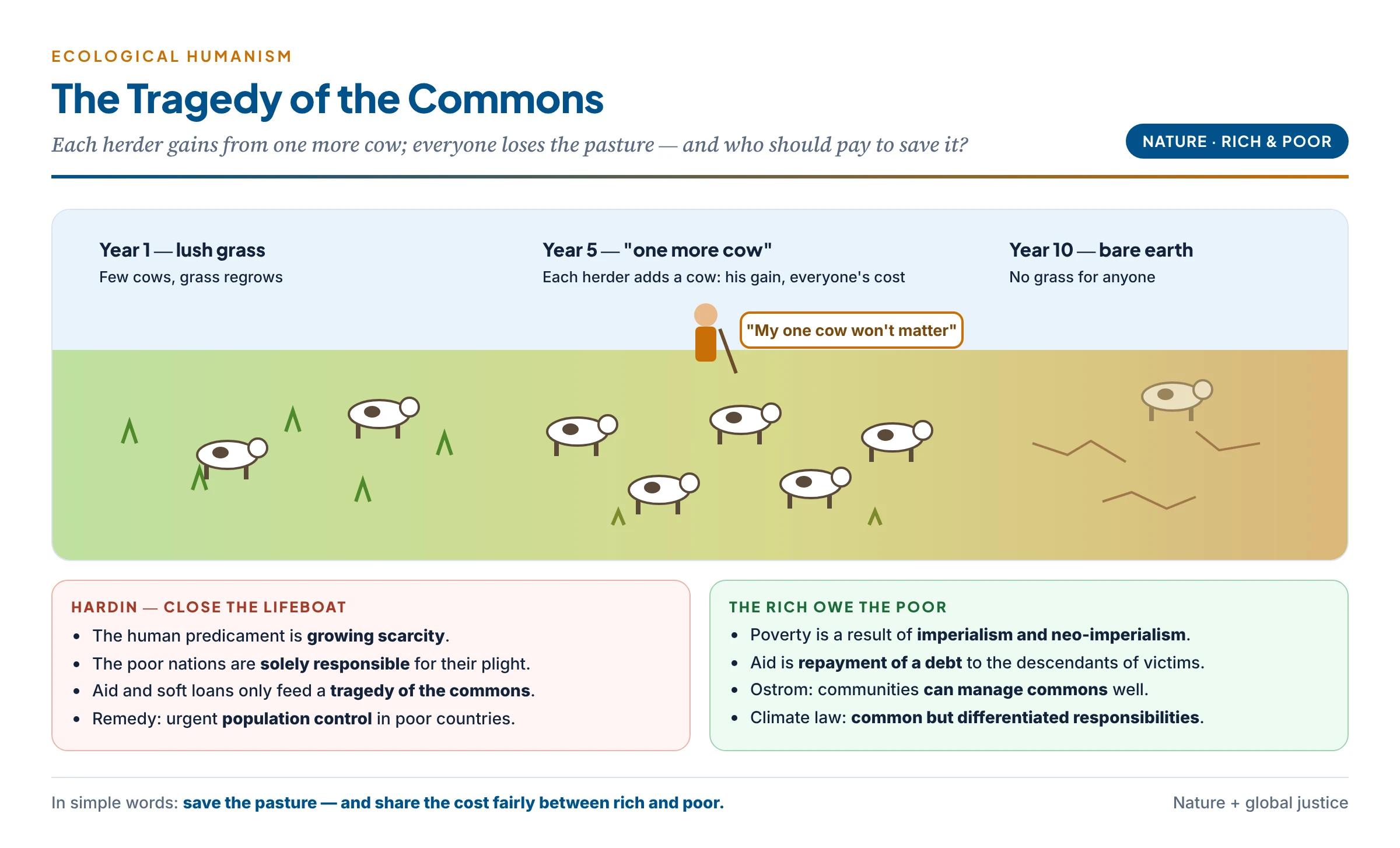
- Tragedy of the commons — a problem that occurs when individuals exploit a shared resource so far that demand overwhelms supply and the resource becomes unavailable to some or all.
In simple words
A village has one common pond. Each family thinks, “One more bucket for my fields won’t matter.” Every family thinks the same — and by summer the pond is dry for everyone. That is the tragedy of the commons. Ecological humanism asks two questions: how do we save the pond (nature), and is it fair that the richest families, who drew the most water for years, now tell the poor ones to stop (justice between rich and poor)?
Replies to Hardin:
- Elinor Ostrom (Nobel Prize 2009) showed from field studies that communities across the world — including Indian villages — can and do manage commons well through local rules, monitoring and cooperation; tragedy is not inevitable.
- Peter Singer (“Famine, Affluence and Morality”, 1972): if we can prevent something very bad without sacrificing anything of comparable moral importance, we ought to — distance does not cancel duty.
- Climate justice: the Rio principle of “common but differentiated responsibilities” (1992), carried into the Paris Agreement (2015), is ecological humanism in international law — all must act, but those who caused more harm and have more capacity must do more.
Indian Connect — Indian Connect — ecology and the human good
- India’s sacred groves (devrāi, orans), Van Panchayats of Uttarakhand and the Chipko movement (1973) are living examples of communities guarding the commons — Ostrom’s point in Indian form.
- Gandhi’s insistence that the earth has enough for everyone’s need but not for everyone’s greed, and his idea of a simple, decentralised economy, is an ecological humanism decades before the term.
- India’s climate diplomacy (equity, climate finance, “LiFE — Lifestyle for Environment”) restates the second perspective: the poor must not pay for the rich nations’ historic emissions.
The Kinds of Humanism at a Glance
| Kind | Main thinkers | Centre of the view | Attitude to God |
|---|---|---|---|
| Classical (Greek) | Protagoras, Socrates | Man the measure; the examined life | Coexists with gods |
| Renaissance | Petrarch, Pico, Erasmus, More | Human dignity, free self-creation, classical learning | Accepts God |
| Christian | Erasmus, Aquinas, Maritain | Dignity as image of God | God-centred |
| Scientific / secular | Bacon, Comte, Dewey, Russell, Manifestos | Reason, science, naturalism, secular ethics | Rejects the supernatural |
| Kantian / liberal | Kant, Mill | Autonomy, dignity, rights | Religion private |
| Marxist / socialist | Young Marx, Fromm | End of alienation; free, creative species-being | Atheist |
| Existentialist | Sartre | Freedom and self-made essence | Atheist (Sartre) |
| Radical (new) | M.N. Roy | Sovereign, rational, moral individual | Atheist, materialist |
| Spiritual (Indian) | Vivekananda, Tagore, Gandhi | Divinity of man; service of man as worship | God within man |
| Integral | Deendayal Upadhyaya | Body–mind–intellect–soul; puruṣārthas | Dharma-centred |
| Ecological | Contemporary | Humanity within nature; global justice | Varies |
Critical Evaluation
Strengths of Humanism
- Dignity of every person — the moral basis of human rights, democracy and the abolition of slavery, untouchability and caste privilege.
- Freedom of thought — free inquiry, science, education and the rejection of superstition.
- This-worldly concern — attention to poverty, health and justice now.
- Tolerance — no single revealed truth may be imposed on all.
- Universalism — one humanity beyond race, caste, creed and nation.
Critiques of Humanism
- The religious critique. Without God, can human dignity be secured? If man is only a product of nature, why is he more valuable than an animal or a machine? Humanism may borrow its belief in dignity from the religious tradition it rejects.
- The critique of over-optimism. Humanism assumes human beings are rational and good. The World Wars, the Holocaust, Hiroshima and genocides were committed by educated, scientific societies. Reason and science can serve cruelty as easily as kindness.
- The anti-humanist critique.
- Heidegger (“Letter on Humanism”, 1947): traditional humanism treats man as the “rational animal” and master of beings, and so forgets the deeper question of Being; it leads to a technological domination of the earth.
- Foucault: “man” in the humanist sense is a recent invention of modern knowledge and may be “erased, like a face drawn in sand at the edge of the sea.”
- Althusser: “humanism” in Marxism is ideology; history is moved by structures, not by free human subjects.
- The ecological critique. Humanism is anthropocentric — by making man the measure of all things, it treated nature as a mere resource and contributed to the environmental crisis. (Ecological humanism is the reply.)
- The postcolonial and feminist critique. The “universal man” of Enlightenment humanism was in practice European, male, propertied and white; colonised peoples, women and slaves were excluded. Humanism must be made truly universal.
- The relativist critique. If “man is the measure”, whose judgement counts? Protagoras’s dictum can collapse into “whatever seems true to me is true for me”.
Critics and Defenders
Criticism — Critics
- Religious thinkers: dignity needs a source above human opinion; humanism lives on borrowed capital.
- Barth and conservative theologians: man-centred religion is idolatry.
- Heidegger, Foucault, Althusser: “man” is a metaphysical or historical construction; humanism hides domination.
- Ecologists: anthropocentrism licensed the exploitation of nature.
- Feminists and postcolonial thinkers: the “universal man” excluded women and the colonised.
- Hardin: in a world of scarcity, universal compassion can destroy the commons.
Defence — Defenders and strengths
- Kant: dignity rests on rational autonomy, which every person has — no external source is needed.
- Sartre: precisely because there is no God, man is fully responsible; humanism is a philosophy of responsibility, not complacency.
- Christian humanists: dignity and faith need not conflict — grace perfects nature.
- Ecological humanists: human welfare itself requires care for nature; anthropocentrism can be enlightened.
- Ostrom and Singer: commons can be governed and the poor can be helped; tragedy is not destiny.
- Human rights movements: the critique of exclusion is made in humanism’s own name — it extends humanism rather than refutes it.
Cross-Tradition Comparison
Western and Indian Humanism
| Point | Western (secular) humanism | Indian (spiritual) humanism |
|---|---|---|
| Basis of dignity | Reason and autonomy (Kant), or simply being human | The divine in man (ātman, Brahman) — Vivekananda, Tagore, Gandhi |
| Attitude to religion | Critical; often atheist or agnostic | Religion reinterpreted as service of man |
| Knowledge | Science and experience | Science plus intuition and spiritual experience |
| Freedom | Political and intellectual freedom of the individual | Freedom as self-realisation (mukti) and social freedom together |
| Society | Individual rights, democracy | Duties, harmony, sarvodaya |
| Nature | Often master of nature (until ecological humanism) | Kinship with nature; “the whole world is one family” (vasudhaiva kuṭumbakam) |
Indian Connect — Indian Connect — the takeaway
- Indian thought rarely separated humanism from spirituality: “service of man is the worship of God” (Ramakrishna, Vivekananda). Western secular humanism and Indian spiritual humanism agree on the dignity of every person and the duty to remove suffering; they differ on where that dignity comes from.
- India also had a strong rationalist strand — the Cārvāka, early Buddhism, and in modern times M.N. Roy, Periyar and Ambedkar — which comes close to Western secular humanism.
- Article 3 develops Vivekananda, Tagore, Gandhi and Deendayal Upadhyaya in full.
Protagoras, Pico, Kant and Sartre
| Thinker | Key line | What makes man special | Limit |
|---|---|---|---|
| Protagoras | “Man is the measure of all things” | Human judgement decides what is | Risks relativism |
| Pico | “We have given you no fixed seat” | Free self-creation within God’s order | Still God-centred |
| Kant | “Treat humanity… always as an end” | Rational autonomy and dignity | Formal; excludes non-rational beings |
| Sartre | “Existence precedes essence” | Freedom with no given essence | Freedom without fixed values may seem arbitrary |
Synthesis (Siddhānta)
- What humanism is. A human-centred outlook that rests on reason and experience (epistemology), nature (metaphysics) and human welfare (ethics), and makes human dignity, freedom and flourishing the measure of all institutions.
- How it grew. From Protagoras’s “man the measure”, through the Renaissance rebirth of human dignity (still under God), to the Enlightenment, which made reason, science, autonomy, rights, toleration and progress the foundations of a secular humanism — given philosophical form by Kant’s principle of treating humanity always as an end.
- Its many kinds — Christian, scientific, existentialist, Marxist, radical, spiritual, integral, ecological — agree on the worth of the human person and differ on its source (God, reason, nature, society) and its scope (individual, class, nation, humanity, nature).
- Its lesson after the twentieth century. Reason without compassion produced the death camps; humanism must therefore be humble — aware of human evil, open to the excluded, and responsible to nature and to future generations.
- Contemporary relevance.
- Human rights and constitutionalism — the Universal Declaration (1948) opens with “the inherent dignity… of all members of the human family”; India’s Preamble promises “the dignity of the individual” and Article 51A(h) asks citizens to develop “the scientific temper, humanism and the spirit of inquiry and reform”.
- Bioethics and technology — AI, genetic engineering and surveillance raise again Kant’s question: are persons being treated as ends or as data?
- Climate change — ecological humanism’s two questions (saving nature, justice between rich and poor) are the two halves of every climate negotiation.
“Nothing human is alien to me.” — Terence
Previous Year Questions
- 2024Delineate the central tenets of Humanism. How does advent of enlightenment in Europe pave the way for Humanism? Discuss.
- 2022Discuss the role of enlightenment movement in the rise of humanism.
- 2006Critically examine “Christian humanism is a contradiction in terms.”
- 2005What is humanism? What are its different kinds? In what way, if any, is M.N. Roy’s radical humanism different from Marxism? Discuss.
- 1999Explain humanism and discuss the essential features of radical humanism.