

Humanism; Secularism; Multi-culturalism.
Official Syllabus: Paper II, Section A, Unit 6
The Industrial Revolution showed that the Enlightenment’s promise of human dignity could sit side by side with child labour, slums and fourteen-hour working days. Socialist and Marxist humanism grew from this shock: the young Karl Marx argued that capitalism dehumanises the worker — it alienates him from his work, from other people and from his own human nature — and that only communism would restore “the human essence”. A century later the Indian revolutionary Manabendra Nath Roy (1887–1954), once a leading communist himself, turned against Marxism in the name of humanism. His Radical Humanism (or New Humanism) put the free, rational, moral individual — not the class, the nation or the party — at the centre, and proposed a partyless, decentralised democracy of People’s Committees. This article explains early socialist and Marxist humanism, the difference between liberal and Marxist humanism, Roy’s intellectual journey, his critique of Marxism and of Gandhism, the principles of Radical Humanism and the 22 Theses, and an evaluation.
In simple words
Imagine a tailor who once stitched whole shirts, chose the cloth, met his customers and felt proud of his work. Now he works in a garment factory, sewing only collars all day, for a wage, on a machine he does not own, for buyers he never sees. He has a job — but he no longer recognises himself in what he makes. Marx called this alienation. M.N. Roy agreed that the worker is crushed, but asked a further question: will replacing the factory owner with an all-powerful party make the tailor free? His answer was no — only a free, thinking individual can be free.
Context & Problem
Why Socialist Humanism Arose
- The gap between promise and reality. The Enlightenment proclaimed liberty and equality; the factory system delivered exploitation, poverty and the misery of workers.
- The humanist charge against capitalism. Capitalism treats the worker as a commodity and a means — exactly what Kant’s humanism forbade.
- Two answers emerged:
- Reform within capitalism — the liberal and social-democratic path.
- Transformation of society — the socialist and Marxist path.
Early (Utopian) Socialist Humanism
- Charles Fourier (1772–1837) sought to ameliorate social conditions by an appeal to the humanist cause — by persuading capitalists rather than fighting them. He proposed a new social order through cooperative effort: self-sufficient communities (phalanstères) where work would be varied and attractive.
- Since this order was fully informed by the spirit of humanism, it was to have no scope for exploitation.
- Robert Owen (New Lanark mills, cooperatives) and Saint-Simon (a society organised by scientists and producers for the poorest class) belong to the same family.
- Marx and Engels called them “utopian” — good intentions without a theory of how history actually changes.
Core Doctrine
Marxist Humanism — The Young Marx
- The humanist Marx. Humanist thought is associated chiefly with the young Marx, especially the Economic and Philosophical Manuscripts of 1844 (published only in 1932). He severely criticised the capitalist system for its dehumanising effect.
- From Feuerbach. Feuerbach had said that “theology is anthropology” — God is human nature projected outward. Marx agreed, but added that the real alienation is not only religious but economic: man is estranged in his daily labour.
- The radical root. “To be radical is to grasp things by the root. But for man the root is man himself.” (Roy later used the same idea for his “radical” humanism.)
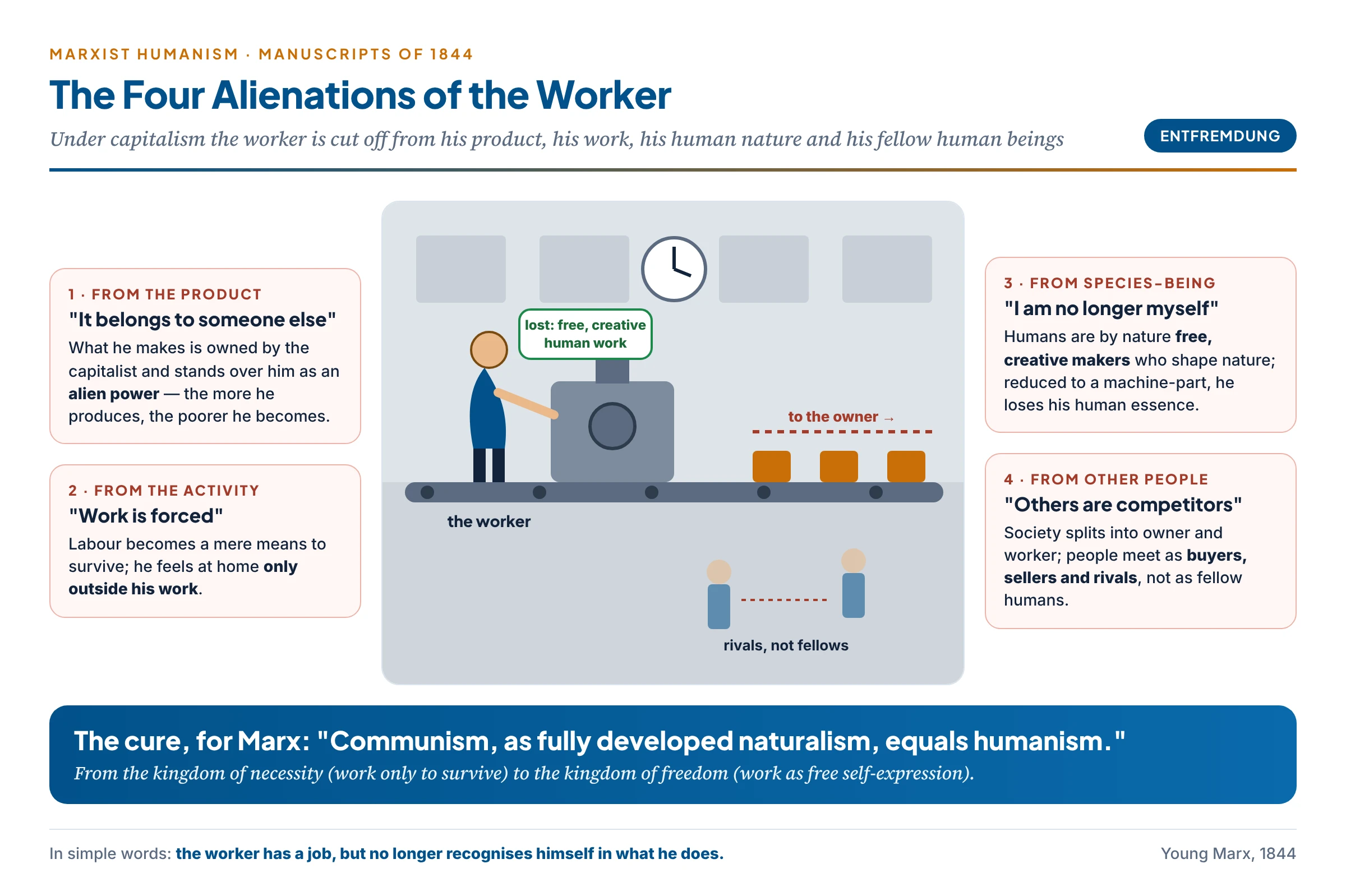
Alienation (Entfremdung) — the four forms. Under capitalism the worker is alienated:
- From the product of his labour — what he makes belongs to another and even stands over him as an alien power (the more he produces, the poorer he becomes).
- From the activity of labour — work becomes forced, joyless, a mere means to survive; “he feels himself at home only outside his work”.
- From his species-being (human nature) — human beings are by nature free, conscious, creative producers who shape nature; when labour is degraded into mere survival, man loses what makes him human and his relation to nature becomes merely one of use.
- From other human beings — society splits into owner and worker, buyer and seller; people meet as competitors, not as fellow humans.
Common confusion
Are Marx’s four alienations “from product, from nature, from others and from oneself”? That is how many notes put it, and it is close but not exact. In the 1844 Manuscripts the four are: alienation from the product, from the activity of labour (the work process), from species-being (one’s human nature — creative, free activity on nature), and from other men. “Nature” enters through the third: man’s species-life is his free, creative shaping of nature, which capitalism turns into a mere means of survival. “From oneself” is another way of naming alienation from one’s own activity and human essence.
Communism as humanism.
- Marx wrote: “Communism, as fully developed naturalism, equals humanism, and as fully developed humanism equals naturalism.” — that is, communism reconciles man with nature and with other men.
- Necessity and freedom. Capitalism is the kingdom of necessity (people work only to survive, under compulsion); communism is the kingdom of freedom (people develop their powers for their own sake). The socialist revolution would be humanity’s “leap from the kingdom of necessity to the kingdom of freedom” (Engels’s phrase, drawn from Marx).
- “From each according to his ability, to each according to his needs.” In the higher stage of communism, work becomes “life’s prime want”, and the free development of each is the condition for the free development of all.
In simple words
In a cricket academy run purely for profit, young players are drilled only to win contracts; the joy of the game disappears. In a neighbourhood team, children play because they love it and get better together. Marx’s communism wants all human work to become like the neighbourhood game — free, creative, shared — instead of the profit academy.
Socialist Humanism in the Twentieth Century
- Rediscovery of the 1844 Manuscripts (1932) led many to read Marx as a humanist rather than an economic determinist: Erich Fromm (Marx’s Concept of Man, 1961; he edited the symposium Socialist Humanism, 1965), Georg Lukács, Antonio Gramsci, the Frankfurt School, the Yugoslav Praxis philosophers.
- “Socialism with a human face” — the slogan of the Prague Spring (1968) — was a protest of socialist humanism against Stalinist bureaucracy.
- Indian socialist humanism: Nehru’s democratic socialism, Ram Manohar Lohia and Jayaprakash Narayan, who later took the idea of People’s Committees from Roy.
- The anti-humanist reply: Louis Althusser argued that the mature Marx (of Capital) made an “epistemological break” with the humanism of his youth; history is driven by structures, not by human subjects, and “humanism” is ideology.
Critical notes on socialist humanism:
- Strength: it restores the moral core of socialism — the aim is free human beings, not merely nationalised factories.
- Weakness: it can be utopian (Fourier) or, in Marxist form, betrayed in practice — states built in its name crushed the individual. Roy’s whole philosophy is a reflection on this betrayal.
Liberal Humanism and Marxist Humanism Distinguished
| Point | Liberal humanism | Marxist humanism |
|---|---|---|
| Thinkers | Locke, Kant, Mill, Rawls | Young Marx, Fromm, Lukács, Gramsci |
| Human nature | Fixed, rational, self-owning individual | Social and historical — “the ensemble of social relations” |
| Unit of analysis | The individual | Social classes and relations of production |
| Meaning of freedom | Negative: freedom from interference; civil and political rights | Positive: freedom from alienation and exploitation; self-realisation through creative labour |
| Property | Private property is a right and a guarantee of freedom | Private ownership of the means of production is the root of alienation |
| Equality | Formal — equality before law, equal opportunity | Substantive — economic equality, end of classes |
| State | Neutral protector of rights | Instrument of the ruling class; will wither away |
| Method of change | Gradual reform, rights, education, markets | Class struggle and revolution |
| Human emancipation | Political emancipation | Human emancipation — political plus economic and social |
| Main danger | Ignoring economic unfreedom of the poor | Sacrificing the individual to the collective (Stalinism) |
In simple words
A liberal says to a hungry man, “You are free — no one stops you from buying bread.” A Marxist replies, “Freedom without money for bread is a joke.” A Roy-style radical humanist adds, “And freedom where the party decides what bread you may eat is no freedom either.” The three humanisms differ on where unfreedom comes from.
M.N. Roy — The Ideational Journey
Life in brief:
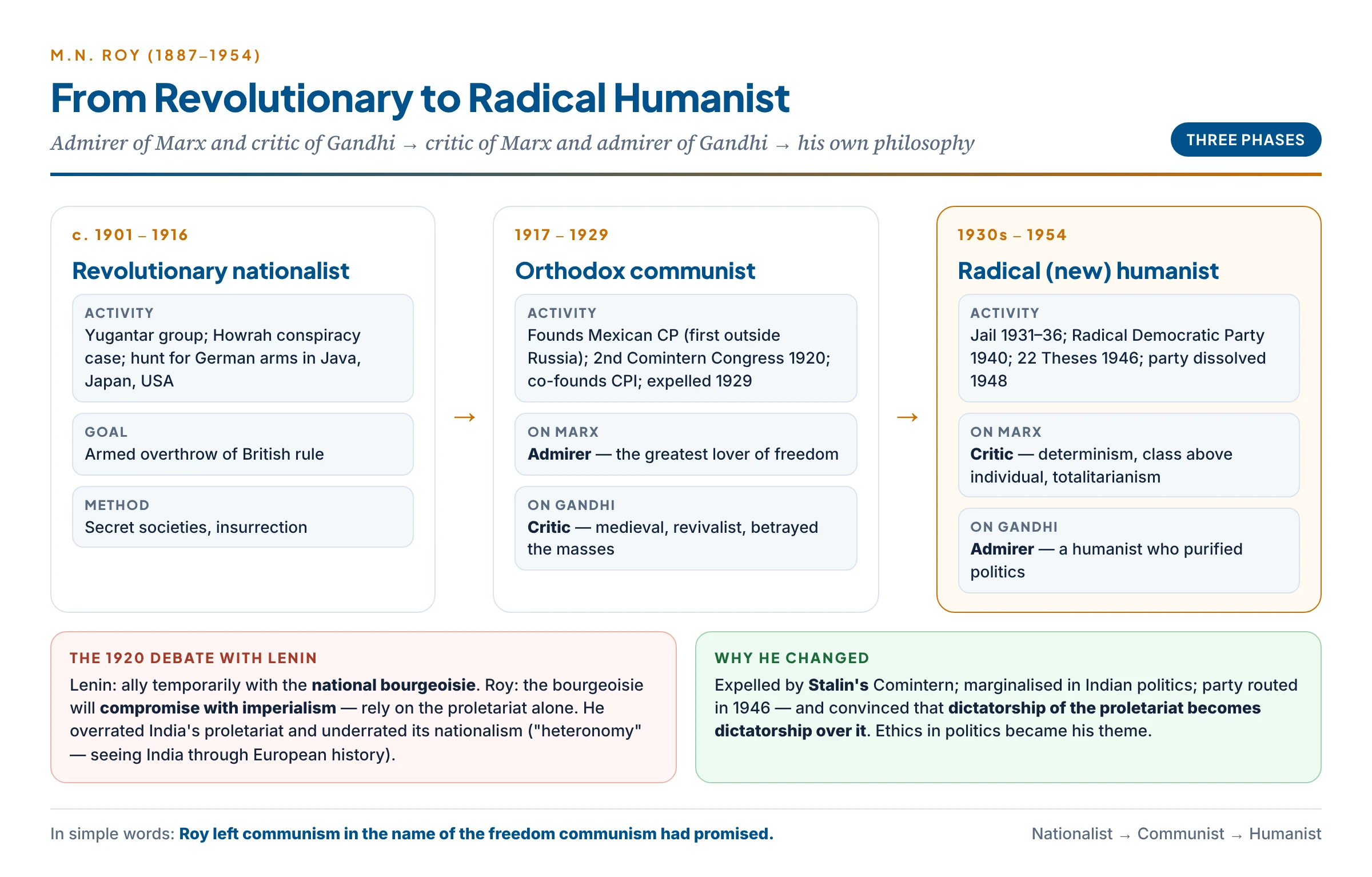
- Born Narendranath Bhattacharya (21 March 1887) in Bengal; joined underground revolutionary work as a boy; member of the Yugantar group under Jatin Mukherjee; tried in the Howrah conspiracy case.
- 1915–16: went to Java and Japan seeking German arms for an insurrection; reached San Francisco, then Mexico, where he became a socialist and converted the Mexican Socialist Party into the Communist Party of Mexico — the first communist party outside Soviet Russia.
- 1920: invited by Lenin to the Second Congress of the Communist International (Comintern) in Moscow; co-founded the Communist Party of India (Tashkent, 1920); rose to the Comintern’s highest bodies.
- 1929: expelled from the Comintern under Stalin for criticising its policies.
- 1930–36: returned secretly to India; arrested in 1931 (he had been accused No. 1 in the Kanpur conspiracy case of 1924); imprisoned till 1936.
- 1940: left the Congress over the Second World War (Roy saw it as an anti-fascist war to be supported) and founded the Radical Democratic Party.
- 1946: the party’s Bombay conference adopted the 22 Theses — “Principles of Radical Democracy”; New Humanism: A Manifesto followed in 1947.
- 1948: the party dissolved itself and became the Radical Humanist Movement; Roy concluded that party politics is incompatible with real democracy.
- 1952: one of the first vice-presidents of the International Humanist and Ethical Union (Amsterdam). Major work: Reason, Romanticism and Revolution. Died 1954 in Dehradun.
The three phases of his thought:
- Revolutionary nationalist — armed struggle against British rule.
- Orthodox Marxist — an admirer of Marx and a critic of Gandhi.
- Radical humanist — a critic of Marx and an admirer of Gandhi, who finally built his own philosophy.
The Lenin–Roy Debate on the Colonial Question (1920)
- Lenin’s theory of imperialism: capitalism has become a world system; revolution in the advanced countries is a remote possibility because capitalism is well entrenched there; the chain will break at its weakest link — the colonies.
- Roy agreed that the world revolution against capitalism would start from the colonies.
- But they differed on strategy:
| Issue | Lenin | Roy |
|---|---|---|
| Support to national movements | Communists should support the colonial freedom struggles led by the national bourgeoisie | Communists should not support the bourgeois-led struggle |
| Alliance | A temporary alliance with the national bourgeoisie, keeping communist identity distinct | No alliance — the bourgeoisie will compromise with the imperialists in the end and betray real freedom (as the German bourgeoisie had betrayed the 1848 revolution) |
| Agent of revolution | Workers and peasants together with anti-imperialist bourgeois forces | The narrow proletariat class alone, with mass organisations of workers and peasants |
- Outcome. At Lenin’s suggestion both sets of theses were adopted; Roy’s position was accepted at first, but later he was expelled and, paradoxically, blamed as a “right-wing” intellectual.
- Where Roy went wrong. He overestimated the strength of the Indian proletariat and underestimated the nationalism of the Indian bourgeoisie; his judgement about the Congress proved wrong. He blamed Abani Mukherji for supplying incomplete statistics that misled him about the proletariat’s strength.
- Kaviraj’s criticism. The political scientist Sudipta Kaviraj says Roy committed the fault of “heteronomy” — seeing Indian events through the eyes of European history (expecting the Indian bourgeoisie to behave like the German).
Roy’s Critique of Marxism
Roy never stopped admiring Marx. He called him the greatest lover of freedom and humanity, and maintained that he was revising, not rejecting, Marxism — saving it from crude economic determinism and bringing out its humanist core. (His views are found in books such as Scientific Politics and Beyond Communism.) The basic defect, he said, is that Marxism neglects human freedom. His specific objections:
1. On dialectical materialism
- Dialectics is a method of argument — a movement of ideas. Marx arbitrarily applied it to the material world. A “dialectic of matter” is really idealism in disguise: if history moves by thesis–antithesis–synthesis, it moves by a logical scheme, not by matter.
- The materialist interpretation of history is inadequate.
2. On economic determinism
- Marx reduced ideas to a “superstructure” on the economic base and gave a minimum role to mental activity in shaping history.
- But the means of production are themselves creations of the human mind. How can they determine human consciousness? Man, the creator of machines, is greater than the machines.
- Ideas have a physiological origin (they arise in the brain from awareness of the environment), but once formed they become an objective reality with their own laws and influence history independently. Cultural patterns and ethical values are not mere reflections of economic relations.
- Materialism is not only economic: there are other material factors, such as power and physiological (biological) factors; Marx neglected anthropology in explaining history.
3. On class struggle
- History is not simply class struggle; it is also a product of class cohesion and cooperation.
- Marx neglected the creative role of man in making history.
- He ignored the middle class — Marx predicted it would disappear, but the middle class has grown, especially in India. Marx and Engels themselves came from the middle class.
4. On the proletariat as the bearer of socialism
- The intellectual and cultural backwardness of the proletariat does not allow it a long-distance view; revolutions are heralded by iconoclastic ideas conceived by gifted individuals. Even Lenin had to give the role of leading the revolution to a “vanguard of the proletariat” — an elite, not the class itself.
5. On surplus value
- No economic system can survive without some surplus; extraction of surplus is not peculiar to capitalism, so it cannot by itself prove capitalism unjust.
6. On revolution and the state
- Social change should come through persuasion and education, not through violent class war.
- The “withering away of the state” is a myth: the state is the political organisation of society and cannot disappear even after classes are abolished.
- The dictatorship of the proletariat becomes, in practice, the dictatorship of a party over the proletariat — a totalitarian state ruled by bureaucracy (as Roy saw in Stalin’s Russia).
7. On ethics and the individual
- Marx neglected ethics; morality became “class morality”, which justifies any means.
- In Marx, human nature changes with the mode of production — so there is no stable basis for human dignity.
- In Hegel the individual is overshadowed by the state; in Marx the individual is overshadowed by the class.
- Marxism has become a cult of irrationalism, a secular faith responsible for totalitarianism. Its revolutions draw on romanticism — revolution occurs when collective emotion reaches a peak — rather than on reason.
What Roy credited Marx with:
- Ideas come from matter — all human knowledge arises from a physical substructure (a materialist starting point Roy kept).
- Action succeeds only if based on a well-thought-out plan — scientific politics.
- Marx’s moral passion for freedom — which Roy wanted to rescue from Marx’s own determinism.
In simple words
A mobile phone is made by engineers; the phone does not make the engineers. Roy’s point against economic determinism is the same: machines and factories are products of human minds, so it is odd to say that the machines decide what human minds think. Ideas start in human brains — and then change the world.
Evaluation of Roy’s critique. Roy’s criticism of Marxism is not in depth: it is limited mainly to dialectical and historical materialism. He did not engage with the technical core of Marx’s economics — the theory of accumulation of capital or the labour theory of surplus value. Some of his points (the middle class, the vanguard, totalitarianism) were sharp and prophetic; others (surplus “needed by every system”) miss Marx’s point, which concerns who controls the surplus.
Roy on Gandhi — From Critic to Admirer
First phase — the harsh critic (in India in Transition, India’s Problem and Its Solution, One Year of Non-Cooperation):
- Lenin saw Gandhi as a revolutionary inspirer and leader of the masses. Roy disagreed: Gandhi was a reactionary with a medieval outlook.
- Not a mass leader — far from leading the masses he betrayed them and discouraged mass action; there can be no revolution without a revolutionary ideology.
- Revivalist — Gandhi revived the cultural and religious traditions of the past; Gandhism was in crisis and would be swept aside by mass movements, since Indian society was in transition and new social forces were emerging.
- Non-cooperation was an ideology of the middle class with no revolutionary programme.
- Shortcomings of Gandhism:
- Non-violence ultimately supports violence — it is a mask that hides real exploitation and inhibits revolution; if non-violence is practised, capitalism will never go.
- Gandhi inhibits progress through his medievalism and cultural backwardness.
- His metaphysics of conscience is unfortunate for politics.
- The economics of the charkha is reactionary; he had no economic programme.
- Trusteeship tries to unite the exploiters with the exploited.
- Gandhi was a “weak and watery” nationalist, seeking interviews with the Viceroy.
Why Roy changed (from the 1930s):
- He was condemned by the Comintern under Stalin and lost faith in communism.
- His political influence in India was marginalised; his Radical Democratic Party failed to gain roots among the masses, as its defeat in the 1946 elections showed.
- He began to value ethics in politics — Gandhi’s central theme.
Second phase — the admirer. After Gandhi’s assassination, in “The Message of the Martyr” (1948), Roy wrote that:
- Gandhi was a humanist, with a cosmopolitan appeal.
- He aimed at the purification of politics and elevated politics above the vulgar scramble for power.
- He used mass action for political purposes and consolidated the Indian National Congress.
- He liberated national forces from government repression through non-violence.
- Revivalism is not the only element of Gandhism; its greater element is its moral humanism — the insistence that means must be as pure as ends.
Indian Connect — Indian Connect — Roy and Gandhi meet on ethics
- Roy began by calling Gandhi medieval and ended by calling him a humanist. The meeting point was morality in politics: Gandhi’s “means are ends in the making” and Roy’s “humanist politics is politics with ethics”.
- Both rejected party power politics — Gandhi wanted the Congress dissolved into a Lok Sevak Sangh (1948); Roy dissolved his own party into a movement (1948).
- Both wanted decentralised democracy — Gandhi’s village republics and Roy’s People’s Committees. Jayaprakash Narayan later combined the two in his idea of “partyless democracy”.
- They differed on foundations: Gandhi’s humanism was spiritual (God as Truth); Roy’s was materialist and scientific.
Radical Humanism — Meaning and Purpose
- Humanism is not humanitarianism. It is a very old philosophy, born in ancient Greece, whose essence is that man is at the centre and all social institutions are secondary to man.
- Sovereignty of man. Radical humanism is based on the sovereignty of man: the individual is more important than nation or class.
- It is “humanism” because it aims at preserving the integrity of the individual.
- It is “radical” because it penetrates through all abstractions — nation, class, race, God — to reach the root of society, the individual human being, and studies man in his originality.
- The objective of philosophy: to coordinate the philosophy of nature and the philosophy of social order in one monistic (unified) system — a single scientific world-view from physics to politics.
- The objective of radical humanism: to ensure the freedom of the individual. Mankind faces a moral crisis that requires the reassertion of humanist values. “The great issue of politics today is neither capitalism, communism nor fascism, but human freedom.”
- Why “new” humanism? Roy distinguished his scientific, integral, new humanism from old humanism, which was tied to religion; his was built on the results of modern science.
How it developed:
- Roy formed a League of Radical Congressmen within the Congress (1937 onwards) and started the weekly Independent India, later renamed The Radical Humanist.
- The Radical Democratic Party outlined the philosophy at its conference of December 1946 (the 22 Theses).
- Main claims of the Theses:
- Radical humanism is a reconstruction rather than a negation of Marxism.
- Society should be based on the real individual, not on abstractions like nation or class.
- Communism is no longer the road to freedom — communist parties have controlled every aspect of human life in the USSR, China and elsewhere.
- Germany showed the weakness of parliamentary democracy — it allowed fascism to come to power through elections.
- A different path to human freedom must be found, guided by a new philosophy.
- Decentralisation forms the basis of radical democracy.
Sources of influence on Roy:
| Source | What Roy took from it |
|---|---|
| Descartes | Reason comes from nature; the thinking individual |
| Hobbes | Scientific materialism |
| Bentham | Utilitarian ethics — human beings naturally seek to satisfy desires |
| Spinoza | A naturalistic ethics — freedom through understanding |
| Erasmus | Renaissance humanism |
| Thomas More | Utopian vision of a rational society |
| Condorcet and Turgot | Science emancipates man and widens the sphere of freedom; idea of progress |
| Secular law | The secularism of modern law |
| Marx | Materialism, the critique of capitalism, the passion for freedom |
The Three Pillars — Freedom, Reason and Morality
1. Freedom
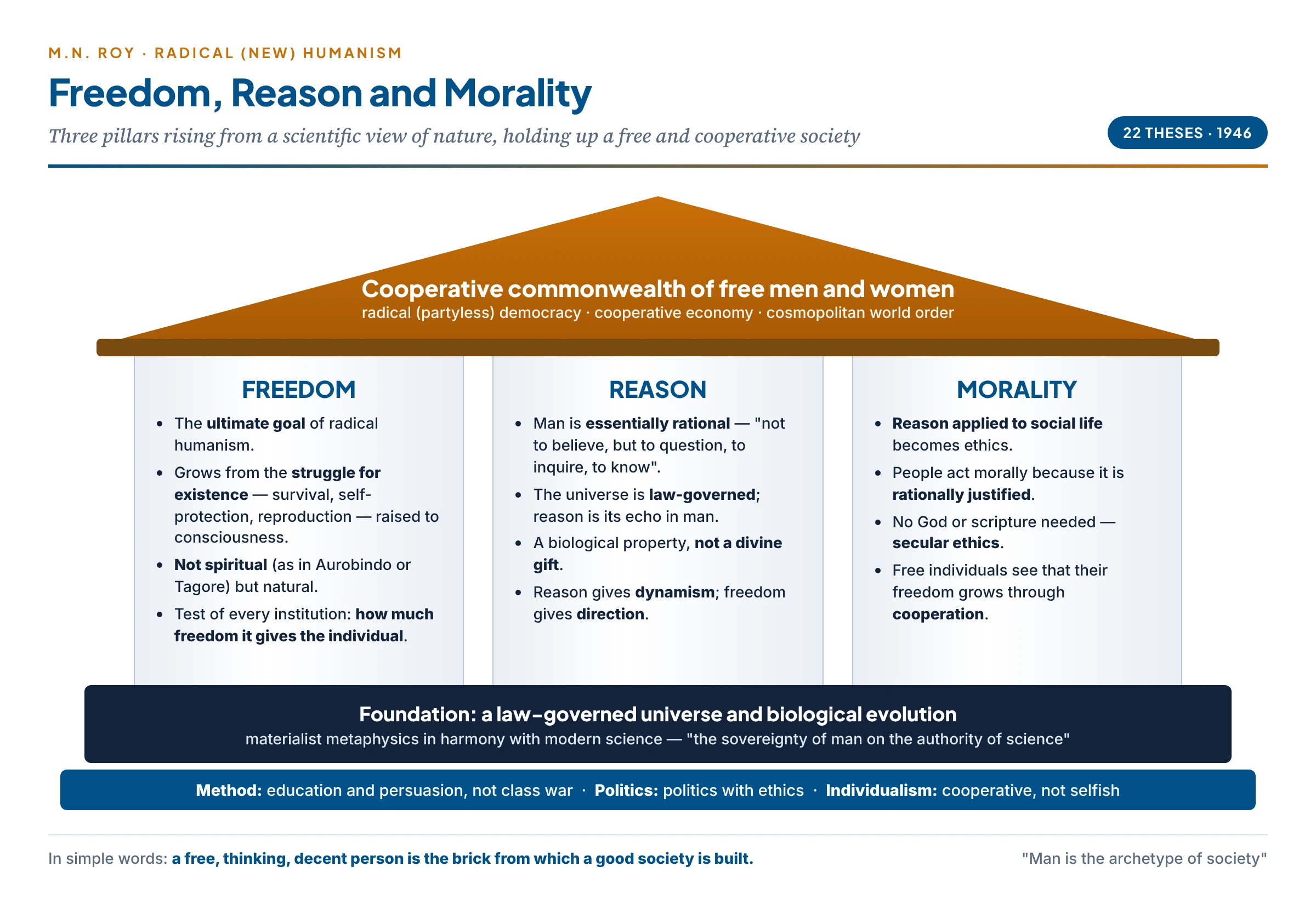
- Freedom of man is the ultimate objective of radical humanism.
- Freedom is biological in origin. It grows out of man’s struggle for existence — for self-survival, self-protection and reproduction. The quest for freedom is the continuation, on a higher level of consciousness, of the biological struggle for existence.
- Not spiritual. Freedom is materialistic, not spiritual as Aurobindo or Tagore believe; spiritualism reduces the scope of human action.
- Definition: freedom is “the progressive elimination of all factors — physical, social, psychological — which obstruct the unfolding of man’s rational, moral and creative potentialities”.
- The test of every social order: “The merit of any pattern of social organisation or political institution is to be judged by the actual measure of freedom it gives to the individual.”
2. Reason
- Man is essentially rational. “His nature is not to believe, but to question, to inquire and to know.”
- Reason comes from nature. The universe is a law-governed system; man, as part of it, is rational — reason is the human echo of the harmony of nature, a biological property, not a gift of God.
- Roy gave a materialistic metaphysics in harmony with the philosophy of nature, and proclaimed the sovereignty of man on the authority of modern science, which has dispelled all mystery about the essence of man.
3. Morality (Ethics)
- When reason is applied in social life, it becomes ethics. Ethics thus has a materialistic (natural) origin — and this materialism is not vulgar but natural.
- Morality is based on rationality: human beings act morally because they see that it is rationally justified — a rational person knows that his own freedom can flourish only through cooperation with others.
- No supernatural sanction is needed; religion is bound to be replaced by science as humanity outgrows its childhood.
- Freedom is fundamental to self-realisation, and a free person is a moral person.
Other Features of Radical Humanism
- Cosmopolitan. It is against both nationalism and (communist) internationalism; it aims at a cosmopolitan commonwealth of free men and women, a kind of world government.
- Cooperative individualism. Reason provides dynamism; freedom gives direction. Together they produce the cooperative spirit of mankind — Roy’s individualism is cooperative, not selfish. In his words, “Man is the archetype of society; cooperative social relationships contribute to develop individual potentialities. Development of the individual is the measure of the progress of society.”
- Decentralisation. The centralised state curtails freedom; decentralisation is necessary for freedom and is the essence of radical democracy.
- Economic democracy. Radical democracy requires economic democracy; without economic security, freedom loses its value. Roy proposed a cooperative economy — the means of production owned neither by capitalists nor by the state but by the workers’ cooperatives, and production for use, not profit (his People’s Plan, 1944, gave priority to agriculture and small industry).
- Education, not class war. Revolution will come not through class struggle but through education — “education of the citizen is a precondition for a successful reorganisation of society”. One cannot be a revolutionary without scientific knowledge.
- Humanist politics. Radical humanism is based on the idea of the moral man; humanist politics means politics with ethics.
Radical (Partyless) Democracy and People’s Committees
Roy’s critique of parliamentary democracy:
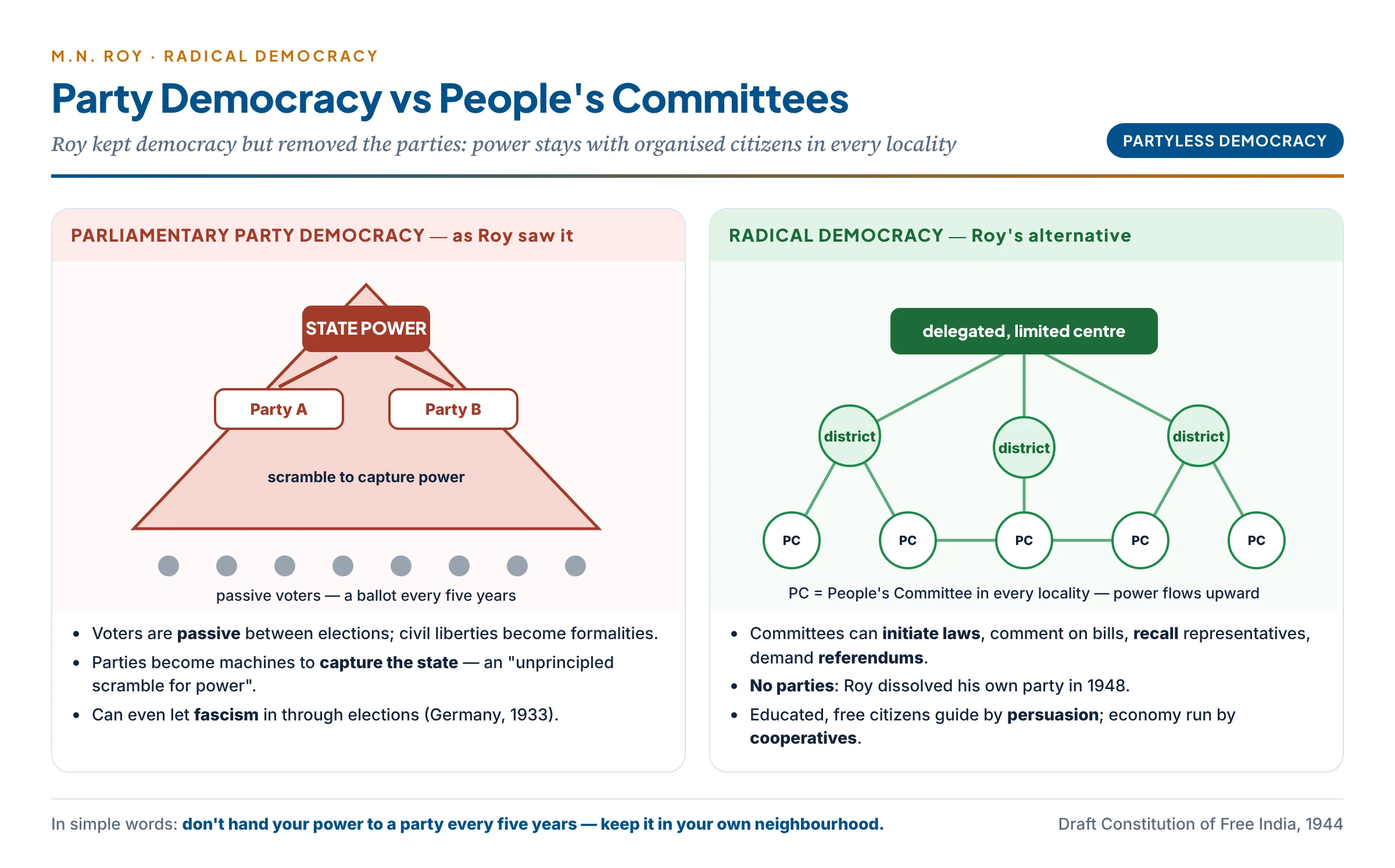
- Formal democracy gives citizens a vote every few years and then leaves them passive and powerless; civil liberties can become mere formalities.
- Political parties become machines for capturing state power; in a country with mass illiteracy, party politics becomes an “unprincipled scramble for power“.
- Parliamentary democracy can even open the door to fascism (Germany, 1933).
Roy’s alternative:
- People’s Committees in every locality — a countrywide network of primary, self-governing bodies of the people.
- Powers: to initiate legislation, express opinion on pending bills, recall representatives, and hold referendums on important national issues (Draft Constitution of Free India, 1944).
- Power from below: political power should reside in these primary organisations and should not be usurped by any party.
- No parties: in 1948 Roy dissolved his own party, holding that party politics is inconsistent with real democracy.
- Role of intellectuals: a body of free, rational, educated citizens (“spiritually free men”) would guide the people by persuasion, not command.
Common confusion
Did Roy reject democracy when he rejected parties? No. Roy rejected party democracy, not democracy. He wanted more democracy — direct, organised, continuous participation through People’s Committees, with recall and referendum — not rule by a few leaders or by one party. His target was the gap between “government for the people” and “government by the people”. Gandhi’s village republics and Jayaprakash Narayan’s partyless democracy belong to the same family.
The 22 Theses — Key Statements
- “Man is the archetype of society; cooperative social relationships contribute to develop individual potentialities. Development of the individual is the measure of the progress of society.”
- “The quest for freedom and search for truth constitute the basic urge of human progress.”
- “The purpose of all rational human endeavour, individual as well as collective, is the attainment of freedom in ever-increasing measure.”
- Ideas arise from a physiological process but then have an autonomous existence; cultural patterns and ethical values are not mere superstructures of economic relations.
- “Man is the maker of his world” — as a thinking being, and he can be so only as an individual.
- Education of the citizen is the precondition of a free social order.
- The goal: a cooperative commonwealth of free men.
Common confusion
Did Roy write, “Man is the arche of society, co-eval and co-terminous with it”? That wording circulates in some notes, but it is not Roy’s. The opening thesis of the Principles of Radical Democracy reads: “Man is the archetype of society; cooperative social relationships contribute to develop individual potentialities. Development of the individual is the measure of the progress of society.” The meaning is that society is made by and for individuals, and is to be judged by how far it frees them.
Critical Evaluation
Criticisms of Radical Humanism
- Nothing new. Critics say new humanism is a repetition of old humanist ideas — Protagoras, the Renaissance, the Enlightenment, liberalism and utilitarianism — with a scientific vocabulary.
- Materialism and consumerism. Its emphasis on materialism may ultimately encourage consumerism.
- Ecology. Emphasis on material progress and the conquest of nature may lead to environmental degradation.
- Over-optimism about reason. Roy assumed that human beings, once educated, will act rationally and morally; the twentieth century showed that educated people can be fanatical and cruel.
- Biological derivation of values is doubtful. From the fact that organisms struggle to survive, it does not follow that freedom ought to be valued — an “is” does not yield an “ought” (Hume’s point).
- Partyless democracy is impractical. In a large, diverse country parties aggregate interests and give voters choices; without them, power may pass to unaccountable local elites or to the best-organised group.
- Elitism. Roy’s reliance on “spiritually free” intellectuals to guide the masses resembles the vanguard he criticised in Lenin.
- Weak critique of Marx. As noted, he did not engage Marx’s economic theory.
- Political failure. His party never won mass support; his movement remained a small circle of intellectuals.
Strengths and Contribution
- Prophetic warning against totalitarianism — long before 1989, Roy saw that communism in power would crush the individual.
- Ethics in politics — he joined Gandhi in insisting that means must be moral.
- Rationalism and scientific temper in a society bound by superstition — a value later written into Article 51A(h) of the Constitution.
- Decentralisation — his People’s Committees anticipated Panchayati Raj, gram sabhas and participatory democracy.
- Cooperative economy — a third way between market capitalism and state socialism.
- Cosmopolitanism — beyond nationalism and class internationalism, towards one humanity.
Critics and Defenders
Criticism — Critics
- Orthodox Marxists: Roy is a renegade whose humanism is bourgeois individualism; he never answered Marx’s economics.
- Liberal democrats: partyless democracy is utopian; parties are indispensable in mass democracy.
- Spiritual humanists (Gandhi, Tagore, Aurobindo): a humanism without the spirit cannot explain dignity or inspire sacrifice.
- Philosophers: values cannot be derived from biology; reason alone does not make people moral.
- Ecologists: the materialist faith in mastery over nature is dangerous.
- Historians: Roy misjudged Indian nationalism and the Indian proletariat (“heteronomy”).
Defence — Defenders and strengths
- History vindicated his warning that the dictatorship of the proletariat would become the dictatorship of a party.
- Roy did not reject Marx — he rescued the humanist core of Marx from determinism, as Fromm and the Praxis school later did.
- Partyless democracy survives in Panchayati Raj, gram sabhas, recall and referendum debates, and citizen assemblies.
- Rational ethics is defensible: cooperation is in fact in the interest of free individuals.
- Education and scientific temper remain the surest routes to freedom in a society of caste and superstition.
- His moral turn brought him close to Gandhi: politics with ethics.
Cross-Tradition Comparison
Marx and Roy Compared
| Point | Marx | M.N. Roy |
|---|---|---|
| Starting point | Social class and relations of production | The individual human being |
| Role of ideas | Superstructure reflecting the economic base | Autonomous force; ideas move history |
| Motor of history | Class struggle | Quest for freedom and search for truth; class cohesion as well as struggle |
| Method of change | Revolution | Education and persuasion |
| State | Will wither away | Cannot wither away; must be decentralised |
| Ethics | Class morality | Rational, universal morality |
| Middle class | Will disappear | Grows; has a key role |
| Economy | Social ownership | Cooperative economy |
| Final goal | Classless society | Cooperative commonwealth of free individuals |
| Common ground | Materialism; critique of exploitation; freedom as the goal of history | the same |
Roy and the Indian Spiritual Humanists
| Point | Roy (radical humanism) | Vivekananda, Tagore, Aurobindo, Gandhi |
|---|---|---|
| Basis | Science, biology, materialism | Spirit — the divine in man |
| Freedom | Biological urge raised to consciousness | Spiritual self-realisation (mukti) and social freedom |
| Morality | Reason applied to social life | Rooted in religion as universal ethics |
| Politics | Partyless, decentralised radical democracy | Village republics (Gandhi), spiritual nationalism (Vivekananda), universal humanity (Tagore) |
| Shared ground | Dignity of the individual; ethics in politics; decentralisation; cosmopolitanism | the same |
Indian Connect — Indian Connect — the takeaway
- Roy stands in India’s rationalist line — with the Cārvāka, early Buddhism, and modern reformers like Periyar and Ambedkar — that refuses supernatural authority and puts reason and the individual first.
- His People’s Committees anticipate the 73rd and 74th Amendments (1992), which gave constitutional status to panchayats and gram sabhas; his cooperative economy has echoes in India’s dairy cooperatives (Amul) and self-help groups.
- His journey from Marx to humanism mirrors a wider Indian pattern: socialists like Lohia and JP also moved from Marxist economics towards decentralised, ethical, Gandhian democracy.
Synthesis (Siddhānta)
- The common root. Socialist humanism, Marxist humanism and Roy’s radical humanism all begin from the same humanist charge: modern society treats human beings as means. They differ on the cure.
- Marx’s insight and limit. Marx showed that freedom is not only political but economic — an alienated worker is not free. But by subordinating the individual to the class and morality to history, Marxism in power produced new chains.
- Roy’s correction. Roy kept Marx’s materialism and passion for freedom but restored the individual, reason and ethics to the centre, replaced revolution by education, the party-state by People’s Committees, and nationalised industry by cooperatives.
- Roy’s limit. His faith in reason was too optimistic, his partyless democracy too utopian, and his critique of Marx’s economics too thin.
- The balanced view. Liberal humanism protects rights; Marxist humanism exposes economic unfreedom; radical humanism insists on the individual and ethics against both market and party. A mature humanism needs all three insights: free individuals, economic security and moral, decentralised politics.
- Contemporary relevance.
- Gig economy and alienation — platform workers controlled by algorithms revive Marx’s question of alienated labour.
- Party politics and democratic deficit — defections, money power and criminalisation in politics renew Roy’s critique of party oligarchy.
- Participatory democracy — gram sabhas, social audits (MGNREGA), participatory budgeting and citizens’ assemblies apply Roy’s People’s Committees.
- Scientific temper — the fight against superstition and misinformation continues Roy’s rationalism.
“The purpose of all rational human endeavour, individual as well as collective, is attainment of freedom in ever-increasing measure.” — M.N. Roy
Previous Year Questions
- 2014How do we distinguish liberal humanism and Marxist humanism?
- 2012In what ways is humanism different from Marxism? Discuss.
- 2005What is humanism? What are its different kinds? In what way, if any, is M.N. Roy’s radical humanism different from Marxism? Discuss.
- 2002Evaluate M.N. Roy’s Humanism as a response to Marxism.
- 1999Explain humanism and discuss the essential features of radical humanism.
- 1998Write critical notes on Socialistic Humanism.