

Humanism; Secularism; Multi-culturalism.
Official Syllabus: Paper II, Section A, Unit 6
Indian secularism did not grow out of a war between Church and State. It grew out of a land of many religions living side by side for centuries, a freedom struggle that needed Hindu–Muslim unity, the trauma of Partition, and the urgent need to abolish untouchability and reform unjust customs. So it took a different shape from the Western “wall of separation”. In India, secularism is not a rejection of religion but an acceptance of all religions — sarva dharma samabhāva, equal respect for all faiths — combined with a state that may intervene to reform and support all communities even-handedly. This article explains the Indian notion of secularism and its two aspects, the views of its architects — Gandhi, Nehru, Ambedkar and Radhakrishnan — and of the earlier modernist Sir Syed Ahmad Khan, the constitutional scheme, and the main Supreme Court judgments up to 2026. The philosophical debate about Indian secularism — Bhargava’s “principled distance” and its critics — follows in Article 6.
In simple words
Think of a large Indian joint family where one member keeps Navratri fasts, another offers namāz, a daughter-in-law goes to church on Sunday and a cousin is an atheist. A wise head of the family does not forbid any of them, does not favour one, joins everyone’s festivals, and still steps in firmly if anyone is ill-treated in the name of custom. That is the Indian idea of secularism: equal respect for all, plus the duty to stop injustice.
Context & Problem
Why India Needed a Different Secularism
- Deep religious diversity. India is home to Hindus, Muslims, Christians, Sikhs, Buddhists, Jains, Parsis, Jews, tribal faiths and non-believers — and each religion itself is internally plural (sects, castes, regional traditions).
- Religion is public and communal. For most Indians religion is not only private belief but festival, food, dress, family law and community identity — it cannot simply be “privatised”.
- Old traditions of coexistence. Ashoka’s edicts of mutual respect among sects, Akbar’s sulh-i-kul (peace with all), the Bhakti and Sufi saints (Kabir, Nanak), and the Ṛgvedic “Truth is one; the wise call it by many names”.
- Colonial communalism. British policies — separate electorates (1909), the Communal Award (1932) — hardened religious identities into political blocs and ended in Partition (1947) and massacres.
- Injustice within religions. Untouchability, caste exclusion from temples, child marriage, unequal personal laws for women — a state that refused to touch religion could not remove these.
- Hence two tasks for Indian secularism: (1) protect every community and keep peace among them; (2) reform unjust practices within communities, especially the majority’s.
Meaning of Indian Secularism
Two aspects:
- Negative sense — similar to the Western notion: non-interference of religion in the public (state) aspects of life; no state religion; no discrimination on grounds of religion.
- Positive sense — goes beyond religious neutrality and helps every citizen to realise his religious freedom: the state not only grants religious freedom but also makes provisions for its fulfilment (support to educational institutions of all communities, management of pilgrimages, protection of minority culture).
Sarva dharma samabhāva — “equal respect (or equal feeling) for all religions”:
- There is only one ultimate reality, and different religions are the various paths leading to it.
- Every creature is a manifestation of the same reality; hence no religion is superior and no believer inferior.
- The state should treat all religions equally — with equal respect, equal protection and equal distance from domination.
Radhakrishnan’s formula: “Neutrality in the West becomes impartiality in India; the apathy of the West becomes harmony in the Indian context.” He wrote: “When India is said to be a secular state, it does not mean that we reject the reality of an unseen spirit or the relevance of religion to life, or that we exalt irreligion. It does not mean that secularism itself becomes a positive religion or that the state assumes divine prerogatives… We hold that no one religion should be given preferential status.”
Common confusion
Is the Indian word for “secular” dharma-nirapekṣa? It is popularly said so, but the official Hindi text of the Constitution uses panth-nirapekṣa — “neutral among sects or creeds” — not dharma-nirapekṣa (“indifferent to dharma”). The choice matters: in Indian thought dharma also means moral order and duty, and no state can be indifferent to morality. Indian secularism means the state favours no religious community (panth), not that it is indifferent to righteousness (dharma).
Indian and American Secularism Compared
| Point | Secularism in India | Secularism in the US |
|---|---|---|
| Basic stance | Neutrality plus a positive role towards religion | Non-interference in matters of religion |
| Reform | The state can introduce religious reforms (temple entry, abolition of untouchability, personal-law reform) | The state cannot take any action in religious matters |
| Minorities | The state protects minorities and their institutions (Articles 29–30) | Rights are individual; no special minority rights |
| Funding | Even-handed aid to educational institutions of all communities | No public funds for religious bodies |
| Policy on religion | The state can formulate policies on religious matters (pilgrimage, endowments, personal law) | No religious policy |
| Personal law | Separate religious personal laws (with a constitutional goal of a uniform civil code) | One civil law for all |
| Religion in public | Visible, plural, celebrated | Visible but officially separate |
Core Doctrine
Mahatma Gandhi — Secularism as Equal Respect, a Foundation of Democracy
1. Religion as ethics.
- For Gandhi, not only politics but every aspect of life must be guided by religion — “For me every, the tiniest, activity is governed by what I consider to be my religion.”
- But by “religion” he meant ethics — truth, non-violence, love — not sectarian dogma. “Those who say that religion has nothing to do with politics do not know what religion means.”
2. Two aspects of every religion.
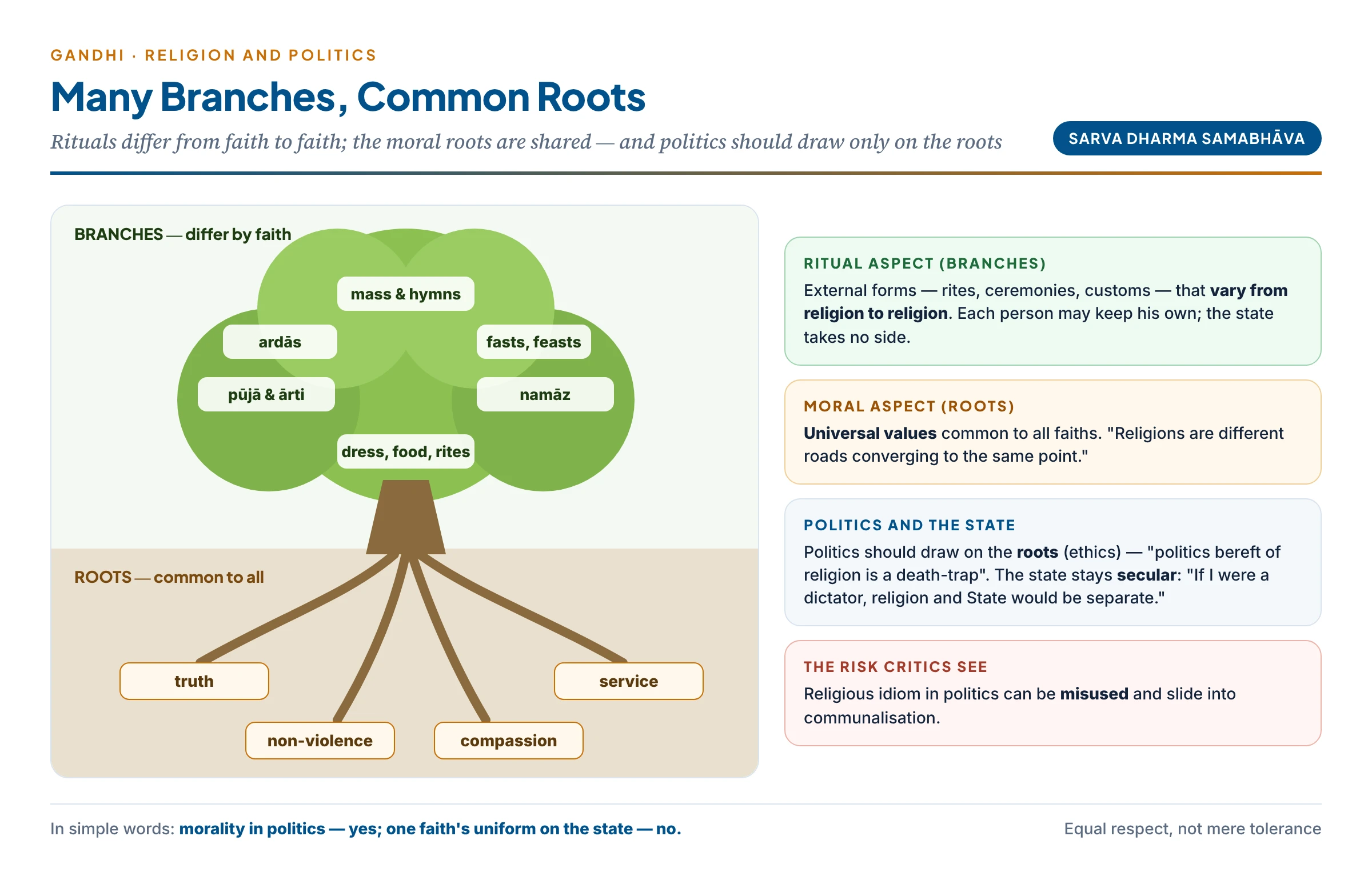
- The ritualistic (external) aspect — rites, ceremonies, customs, forms of worship; it varies from religion to religion.
- The universal moral principles — the internal values common to all religions (truth, compassion, non-violence, service).
- Religions primarily stand for a set of moral values common to all; religions are identical in their essence and differ only in their outer forms. “Religions are different roads converging to the same point.”
3. Sarva dharma samabhāva — all religions true and all imperfect.
- One of the vows of his ashram was equal respect for all religions: “All religions are true; all religions have some error in them; all religions are almost as dear to me as my own Hinduism.”
- He preferred equal respect to mere tolerance, because tolerance may imply a gratuitous assumption that the other’s faith is inferior.
4. Politics as lokanīti, not rājanīti.
- Politics should be service of the people (lokanīti), not a game of power (rājanīti). In his ideal of sarvodaya, lokanīti means the service of daridra-nārāyaṇa (God in the form of the poor).
- Hence there is no contradiction between religion and politics: religion (as ethics) provides vision to politics. “Politics bereft of religion is a death-trap, because it kills the soul.”
5. But the state must be secular.
- “If I were a dictator, religion and State would be separate. I swear by my religion. I will die for it. But it is my personal affair. The State has nothing to do with it. The State would look after your secular welfare, health, communications, foreign relations, currency and so on, but not your or my religion.” (1946)
- “The State should undoubtedly be secular. Everyone living in it should be entitled to profess his religion without let or hindrance, so long as the citizen obeyed the common law of the land.” It “could never promote denominational education out of public funds”. (1947)
- Teaching of fundamental ethics, common to all religions, is a function of the state; denominational religious education is the concern of religious associations alone.
6. Why secularism is a foundation of democracy (for Gandhi).
- Equal citizenship — “every man enjoys equality of status, whatever his religion”; democracy cannot rest on a hierarchy of faiths.
- Non-violence — democracy is the rule of persuasion, not force; communal violence destroys it.
- Moral politics — without ethics politics becomes a scramble for power; equal respect gives democracy a moral core.
- Unity — Hindu–Muslim unity was, for him, the precondition of swaraj; he died for it, on 30 January 1948.
- Freedom of conscience — a democrat must accept that others may reach truth by other paths.
7. Gandhi on the political misuse of religion.
- The political use of religion never serves either the state or religion:
- The state remains economically, socially and politically poor and backward.
- Religion gets polluted by constant riots in its name.
- Politically the country becomes unstable through separatist tendencies based on religion.
- Criticism: Gandhi’s view may be theoretically sound, but in practice the mixing of religious idiom with politics can be misused and can lead to the communalisation of politics (critics cite the Khilafat alliance of 1919–24 and the later use of religious symbols in mass politics).
In simple words
Gandhi’s distinction is like the difference between honesty and a uniform. He wanted politicians to be honest, truthful and kind — values every religion teaches (the roots). He did not want the state to wear any religion’s uniform — its rituals, symbols or priests (the branches). “Religion in politics” for Gandhi meant morality in politics, not one faith in the state.
Jawaharlal Nehru — Secular State and Scientific Temper
- Influenced by the Western notion. Nehru favoured a clearer separation of religion from politics; he saw organised religion as often tied to superstition and reaction.
- Broad sense of “dharma”. He preferred to use dharma in its broader ethical sense — duty and moral order — rather than as sectarian religion.
- Different goals. The goals of religion are other-worldly; the goals of politics are this-worldly — food, shelter, education, health.
- Scientific temper. A great supporter of the scientific temper, he believed that dogmatic religion discourages it; science alone could solve hunger, poverty and superstition.
- Definition. Secularism means “freedom of religion and conscience, including freedom for those who may have no religion“, with equal treatment of all and no state religion.
- Communalism the main enemy. He called communalism of the majority more dangerous than that of the minority, since it can pass itself off as nationalism; he insisted on protecting minorities after Partition.
- Reform. He pushed the Hindu Code Bills (1955–56) — monogamy, divorce, inheritance rights for daughters — through Parliament.
- Progress. He dwelt at length on the importance of a secular policy and secular outlook as the road to national progress.
B.R. Ambedkar — Secularism, Reform and Fraternity
- Meaning of a secular state. “It does not mean that we shall not take into consideration the religious sentiments of the people. All that a secular state means is that this Parliament shall not be competent to impose any particular religion upon the rest of the people.”
- Religion must not cover the whole of life. If personal law and every social practice are claimed as religion, the state can never reform society; religion must be limited to beliefs and rituals that are truly religious, so that social reform is possible.
- Constitutional design — as chairman of the Drafting Committee he shaped the guarantees of Articles 14–17 and 25–30: equality, prohibition of discrimination, abolition of untouchability (Article 17), freedom of conscience with the state’s power of reform (Article 25(2)), and minority rights.
- Hindu Code Bill — he resigned from Nehru’s cabinet in 1951 when it was stalled, seeing personal-law reform as the test of a secular, democratic state.
- Religion and democracy. Democracy is “primarily a mode of associated living“; it needs fraternity — a sense of common brotherhood — which, he held, is “another name for democracy“. A religion that sanctions caste cannot supply it; hence his turn to a rational, ethical Buddhism.
- The label “secular” was not written into the original Preamble; Ambedkar held that the Constitution’s provisions already made the state secular, and opposed fixing such policy labels in the text. The word “secular” was added by the 42nd Amendment (1976).
Gandhi and Ambedkar on the Foundations of Secular Democracy
| Point | Gandhi | Ambedkar |
|---|---|---|
| Role of religion in public life | Religion (as ethics) should guide politics | Religion must be confined so that the state can reform society |
| Attitude to existing religions | All religions true, all imperfect — equal respect (sarva dharma samabhāva) | Religions must be judged by liberty, equality and fraternity; Hinduism’s caste order fails the test |
| Caste | Reform Hinduism from within; untouchability a sin; varṇa reinterpreted | Annihilate caste; it is incompatible with democracy |
| Method | Change of heart, persuasion, constructive work | Law, constitutional morality, education, organisation, conversion |
| Foundation of democracy | Moral politics, non-violence, village self-rule | Fraternity, social and economic democracy, rule of law |
| State | Minimal; secular state, ethical society | Strong, reforming constitutional state |
| Minorities and depressed classes | Joint electorates (opposed separate electorates for “untouchables” — the fast of 1932) | Separate electorates or reserved seats for depressed classes (Poona Pact, 1932) |
| Common ground | No state religion; equal citizenship; freedom of conscience; rejection of untouchability; democracy needs a moral basis | the same |
Indian Connect — Indian Connect — two foundations, one Constitution
- Gandhi gave Indian secularism its spirit — equal respect, Hindu–Muslim unity, ethics in politics.
- Ambedkar gave it its structure — enforceable rights, a reforming state, constitutional morality.
- The Constitution combines both: Article 25 protects religion (Gandhi’s equal respect), and Articles 17 and 25(2) let the state reform it (Ambedkar’s social democracy).
Sir Syed Ahmad Khan — Modernist Reform and the Communal Question
Life and work (1817–1898).
- A Mughal-era noble who served the British judiciary; during 1857 he remained loyal and saved Europeans at Bijnor, but lost family members in the reprisals.
- Wrote Asbāb-e-Baghāwat-e-Hind (The Causes of the Indian Revolt, 1859), boldly telling the British that the revolt arose from their misgovernment and from the absence of Indians in the legislature.
- Founded the Scientific Society (1864), the journal Tahzīb-ul-Akhlāq and the Muhammadan Anglo-Oriental College at Aligarh (1875; later Aligarh Muslim University, 1920) to bring modern, scientific education to Muslims.
His religious thought — a rational Islam.
- The Qur’ān is the “Word of God” and nature is the “Work of God”; the two cannot contradict each other. Where they seem to, the interpretation of scripture must be revised in the light of reason and science.
- He rejected blind imitation (taqlīd), superstition and the belief that prayer changes the laws of nature; he called for independent reasoning (ijtihād).
- Orthodox ulema opposed him, some branding him a kāfir (unbeliever) and calling his followers nechari (“naturists”).
His political thought — from “two eyes” to “two nations”.
- Early composite nationalism. “India is like a beautiful bride blessed with two lustrous eyes — the Hindus and the Muslims. If they quarrel, the bride will look cross-eyed; if one destroys the other, she will be one-eyed.” At Gurdaspur (1884) he said that “Hindu” and “Muslim” are religious words, and that all who live in India are one nation.
- The turn. The Urdu–Hindi controversy (from 1867, when Hindus in Banaras demanded Hindi in Devanagari in place of Urdu in courts) convinced him that the communities’ interests were diverging.
- Opposition to the Congress. In speeches at Lucknow (1887) and Meerut (1888) he urged Muslims to stay away from the Indian National Congress: if the British left, could “two nations — the Mahomedans and the Hindus — sit on the same throne and remain equal in power? Most certainly not.” He feared that majority rule by elected councils would reduce the educationally and economically backward Muslims to a permanent minority.
- Interpretations. Some see him as the forerunner of the two-nation theory; others as a reformer and educationist whose politics was a cautious response to minority fear, and who never asked for a separate state.
Relevance to secularism.
- He shows the modernist path of reforming religion from within by reason — a parallel to Ram Mohan Roy and Vivekananda.
- He exposes the core problem Indian secularism had to solve: in a majoritarian democracy, a minority’s fear of permanent subordination. The constitutional answer was equal citizenship plus minority guarantees (Articles 29–30) — not separate electorates.
- His journey — from “two eyes of one bride” to “two nations” — warns that communal anxieties, if not answered by fairness, harden into separatism.
Common confusion
Was Sir Syed always a “separatist”? No. For most of his life he spoke of Hindus and Muslims as the “two eyes” of India, worked with Hindu colleagues, and his Aligarh college admitted Hindu students and had Hindu teachers and donors. His turn came late (1880s), over the Urdu–Hindi dispute and the Congress’s demand for elected councils, which he feared would mean permanent Muslim subordination. He sought British protection and education for Muslims, not a separate homeland — that demand came half a century later.
The Constitutional Scheme of Indian Secularism
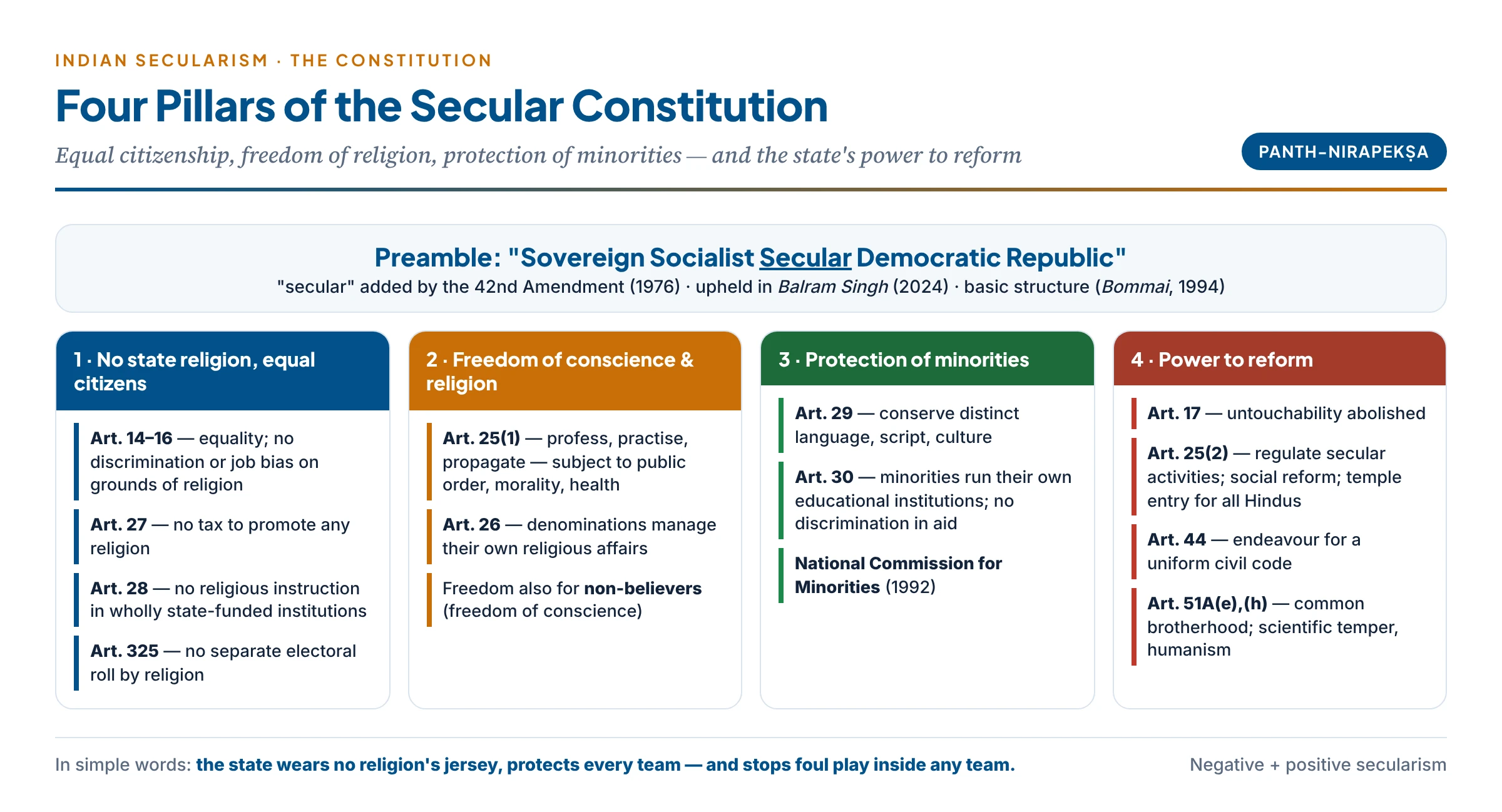
1. No state religion; equal citizenship
- Preamble: “Sovereign Socialist Secular Democratic Republic” (“secular” added by the 42nd Amendment, 1976). In Dr. Balram Singh v. Union of India (November 2024) the Supreme Court dismissed challenges to the words “socialist” and “secular”, holding them part of the Constitution’s basic character.
- Article 14 — equality before law; Article 15 — no discrimination on grounds of religion (among others); Article 16 — equality of opportunity in public employment; Article 325 — no separate electoral roll on grounds of religion.
- Article 27 — no person shall be compelled to pay taxes for the promotion of any particular religion.
- Article 28 — no religious instruction in institutions wholly maintained out of state funds.
2. Freedom of conscience and religion
- Article 25(1) — all persons are equally entitled to freedom of conscience and the right freely to profess, practise and propagate religion, subject to public order, morality and health and the other fundamental rights.
- Article 26 — every religious denomination may manage its own affairs in matters of religion, establish institutions, and own and administer property in accordance with law.
3. Protection of minorities
- Article 29 — any section of citizens with a distinct language, script or culture has the right to conserve it.
- Article 30 — all minorities, religious or linguistic, have the right to establish and administer educational institutions of their choice; the state shall not discriminate against them in giving aid.
- National Commission for Minorities (statutory since 1992).
4. The state’s power to reform
- Article 17 — untouchability is abolished and its practice in any form forbidden.
- Article 25(2) — the state may regulate economic, financial, political or secular activities associated with religious practice, and provide for social welfare and reform or the throwing open of Hindu religious institutions of a public character to all classes and sections of Hindus.
- Article 44 (Directive Principle) — the state shall endeavour to secure a uniform civil code for citizens throughout India.
- Article 51A(e) and (h) — the duty to promote harmony and the spirit of common brotherhood transcending religious divisions, and to develop the scientific temper, humanism and the spirit of inquiry and reform.
In simple words
A housing society’s rules say: everyone may decorate their own flat for any festival (freedom), no flat gets a bigger share of the common fund because of its religion (equality), the small Parsi and Christian families may run their own Sunday class (minority protection), and no one may bar the sweeper from the lift (reform). Put together, these four rules are the four pillars of India’s secular Constitution.
The Supreme Court and Secularism
| Case | Year | What it held |
|---|---|---|
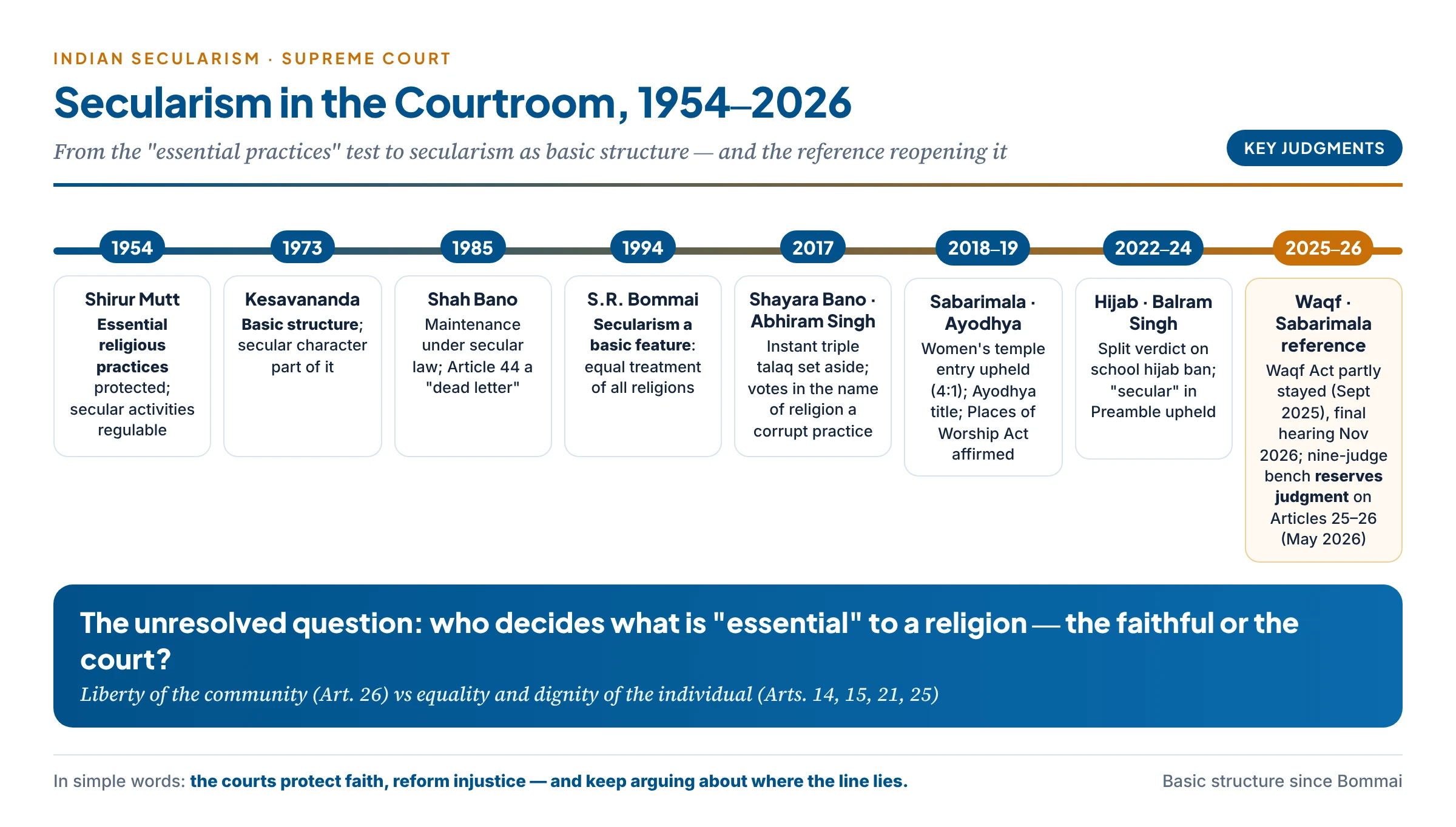
| Shirur Mutt | 1954 | “Essential religious practices”: religion includes rituals and practices integral to it, not just belief; the state can regulate secular activities |
| Durgah Committee, Ajmer | 1961 | Courts may exclude superstitious or non-essential practices from protection |
| Kesavananda Bharati | 1973 | Basic structure doctrine; the secular character of the Constitution is part of it |
| Shah Bano | 1985 | Maintenance for a divorced Muslim woman under secular criminal law; regretted that Article 44 was a “dead letter” (Parliament’s 1986 Act diluted it) |
| S.R. Bommai | 1994 | Secularism is a basic feature; it means equal treatment of all religions; a state government acting against secularism can be dismissed |
| Ismail Faruqui | 1994 | A mosque is not an essential part of Islamic practice for the purpose of acquisition |
| Sarla Mudgal | 1995 | Conversion to Islam to marry a second wife does not dissolve the first Hindu marriage; again urged a UCC |
| Aruna Roy | 2002 | Teaching about religions (value education) in schools is not religious instruction and is consistent with secularism |
| Abhiram Singh | 2017 | Seeking votes in the name of religion, caste or community is a corrupt practice under election law |
| Shayara Bano | 2017 | Instant triple talaq set aside (3:2); Parliament made it an offence in 2019 |
| Indian Young Lawyers Assn. (Sabarimala) | 2018 | Exclusion of women aged 10–50 from the temple held unconstitutional (4:1); review led to a reference on the scope of religious freedom |
| M. Siddiq (Ayodhya) | 2019 | Title to the disputed site decided by law of evidence; the Court affirmed the Places of Worship Act, 1991 as protecting the secular character of the state |
| Aishat Shifa (Hijab) | 2022 | Split verdict on the ban on headscarves in Karnataka schools; referred to a larger bench |
| Balram Singh | 2024 | Upheld “secular” and “socialist” in the Preamble |
| In re Waqf (Amendment) Act, 2025 | 2025–26 | Interim order (September 2025) refused to stay the whole Act but stayed some provisions and capped non-Muslim members on Waqf bodies; final hearing listed for November 2026 |
| Sabarimala reference (nine judges) | 2026 | Hearing on Articles 25–26 and the “essential religious practices” test concluded; judgment reserved (May 2026) |
Critical Evaluation
“Not a Rejection of Religion but Acceptance of All Religions” / “Fellowship of Religions”
What the statement means:
- Indian secularism is not anti-religious: it does not ask citizens or the state to turn away from religion.
- It means equal respect (sarva dharma samabhāva) and fellowship — friendly coexistence, mutual learning and shared festivals — among faiths.
- It also includes freedom for those with no religion (Nehru) — “acceptance of all religions” must not become compulsion to have one.
Why it fits India:
- Cultural roots — Ṛgvedic pluralism, Ashoka, Akbar, Bhakti and Sufi saints, Kabir’s “Ram and Rahim are one”.
- Social reality — religion is part of public life; a hostile secularism would be rejected.
- Constitutional design — Articles 25–30 protect and even assist religion; the state manages pilgrimages and endowments.
- Political wisdom — equal respect binds a diverse nation; Gandhi saw it as the basis of swaraj.
Problems with the formula:
- Accepting all religions is not accepting all practices. “Acceptance” cannot extend to untouchability, sati, instant triple talaq or the exclusion of women — the state must also reform (Ambedkar).
- Equal respect is hard to apply equally. The state reformed Hindu personal law but left other personal laws largely unreformed — critics call this asymmetry; others reply that reform of minority law must come with the community’s consent.
- Majoritarian slide. “Respect for all religions” can slide into public patronage of the majority’s rituals and symbols.
- Fellowship is an ideal, not a fact — communal riots (1984, 1992–93, 2002, 2020) show how fragile it is.
- Non-believers must not be pushed out by a “religious” secularism.
Balanced conclusion: the statement is true of Indian secularism’s spirit (equal respect and fellowship) but incomplete as a description of its structure, which also contains non-establishment, equal citizenship and the power of reform. Secularism in India stands not for irreligion but for deep religious understanding (Radhakrishnan) — and for equal rights under law.
In simple words
In a school assembly where students take turns to read from the Gītā, the Qur’ān, the Bible, the Guru Granth Sahib and the Constitution, no one’s faith is rejected and everyone learns about the others — that is “fellowship of religions”. But if one student is told he cannot sit with the others because of his caste, the principal must stop it at once — that is the reforming side of Indian secularism.
Criticisms of the Indian Model
- Vote-bank politics and appeasement — parties are accused of using minority protection for votes.
- Selective reform — Hindu law reformed, others not; the Uniform Civil Code long left unfulfilled.
- Majoritarian encroachment — state patronage of majority religious events and symbols; religious mobilisation in elections.
- Judges as theologians — the “essential religious practices” test makes courts decide what is essential to a religion (questioned in the 2026 Sabarimala reference hearing).
- Communal violence — the model has not prevented riots or the rise of religious nationalism.
- Conceptual vagueness — “equal respect”, “equal distance” and “principled distance” can justify almost any policy.
Strengths of the Indian Model
- Fits a deeply religious, plural society — no community is asked to give up its faith in public.
- Combines liberty and reform — the state can protect religion and also fight caste and gender injustice within it.
- Protects minorities with enforceable rights while keeping equal citizenship.
- Has endured — seventy-five years of a secular constitution in the world’s most religiously diverse democracy.
- Exportable — scholars now offer it as a model for other diverse societies (Article 6).
Critics and Defenders
Criticism — Critics
- Hindu nationalists: “pseudo-secularism” — appeasement of minorities and asymmetric reform.
- Liberal secularists: too much state involvement in religion; personal laws violate equal citizenship.
- Communitarian critics (Nandy, Madan): an elite, Westernised doctrine alien to Indian religiosity.
- Feminists: “respect for community” has protected patriarchal personal laws.
- Legal scholars: the essential-practices test makes judges arbiters of theology.
- Sir Syed’s minority fear, in modern form: majority rule can still leave minorities insecure.
Defence — Defenders and strengths
- Gandhi: equal respect is the only basis on which a plural nation can live in peace.
- Ambedkar: a reforming state is necessary in a society where religion sanctifies inequality.
- Radhakrishnan: Indian secularism is impartiality and harmony, not apathy or irreligion.
- The Supreme Court (Bommai, Balram Singh): secularism is part of the basic structure.
- Comparative scholars: India’s model handles deep diversity better than the Western wall (Bhargava, Article 6).
- Record: minority institutions, temple-entry and anti-untouchability laws, triple talaq reform — liberty and reform together.
Cross-Tradition Comparison
Architects of Indian Secularism
| Thinker | Key idea | Religion and state | Distinctive emphasis |
|---|---|---|---|
| Gandhi | Sarva dharma samabhāva; religion as ethics | State secular; politics moral | Equal respect, non-violence, Hindu–Muslim unity |
| Nehru | Secular state, scientific temper | Separation; no state religion; reform | Progress, anti-communalism, freedom for non-believers |
| Ambedkar | Constitutional morality, fraternity | State may not impose religion; must reform | Annihilation of caste, rights, personal-law reform |
| Radhakrishnan | Impartiality and harmony | No preferential status for any religion | Spiritual universalism; “not irreligion” |
| Sir Syed | Rational Islam; minority interests | Loyalty to a neutral (British) power | Education, reason, minority fear |
Indian Secularism and Western Thinkers
| Indian idea | Western parallel | Difference |
|---|---|---|
| Gandhi: all religions true, all imperfect | John Hick’s pluralism | Gandhi’s is practical ethics; Hick’s a theory of religious truth |
| Gandhi: denominational education not from public funds | Jefferson, First Amendment | Gandhi still wants ethics in politics |
| Ambedkar: secular state cannot impose religion but may reform | French one-sided exclusion | India reforms on principle and also supports all faiths |
| Nehru: freedom for those who have no religion | Locke (who excluded atheists) | Nehru’s toleration is wider than Locke’s |
| Radhakrishnan: impartiality, not apathy | Maclure and Taylor: equal respect as the end | Close agreement |
Synthesis (Siddhānta)
- Indian secularism has two aspects — a negative one (no state religion, no discrimination) and a positive one (helping citizens realise religious freedom) — united by sarva dharma samabhāva, equal respect for all religions.
- Gandhi gave it its ethical spirit: religion as morality, equal respect, a secular state and a moral politics; Nehru its modern, scientific and anti-communal edge; Ambedkar its constitutional structure and reforming power; Radhakrishnan its formula of impartiality and harmony; Sir Syed a reminder of the minority’s fear that secularism must answer.
- The Constitution combines freedom (Articles 25–26), equality (14–16, 27–28, 325), minority protection (29–30) and reform (17, 25(2), 44), and the Supreme Court has made secularism part of the basic structure while struggling with the “essential practices” test.
- “Not rejection but acceptance of all religions” captures its spirit; its structure adds equal citizenship and the duty to reform.
- Contemporary relevance.
- Uniform Civil Code — Uttarakhand’s code in force since 2025; Gujarat’s and Assam’s received the President’s assent in September 2026 (all exempt Scheduled Tribes) — reopening the balance between uniformity and pluralism (Article 6).
- Waqf (Amendment) Act, 2025 and the Sabarimala reference (judgment reserved in 2026) — the limits of state regulation of religious institutions and of judicial review of religious practice.
- Hijab, temple-entry and mosque-entry disputes — individual rights versus community autonomy.
- Election law — appeals to religion as a corrupt practice (Abhiram Singh) in an age of identity-based campaigning.
“We hold that no one religion should be given preferential status, or unique distinction… This view of religious impartiality, of comprehension and forbearance, has a prophetic role to play within the national and international life.” — S. Radhakrishnan
Previous Year Questions
- 2024Present an exposition of Gandhi’s views on secularism as one of the foundational Principles of democracy.
- 2023“Secularism is not a rejection of religion but acceptance of all religions.” Discuss.
- 2019Examine whether there is any difference between the views of Mahatma Gandhi and Dr. Babasaheb Ambedkar on the philosophical foundations of secular democracy.
- 2012“Secularism in Indian context is not a rejection of religion but fellowship of religions.” Discuss.
- 2009Is secularism analogous to atheism? Examine in Indian context.
- 2000Secularism in the Indian context.
- 1988“Secularism in India stands not for irreligion but for deep religious understanding“. Discuss this statement.