

Humanism; Secularism; Multi-culturalism.
Official Syllabus: Paper II, Section A, Unit 6
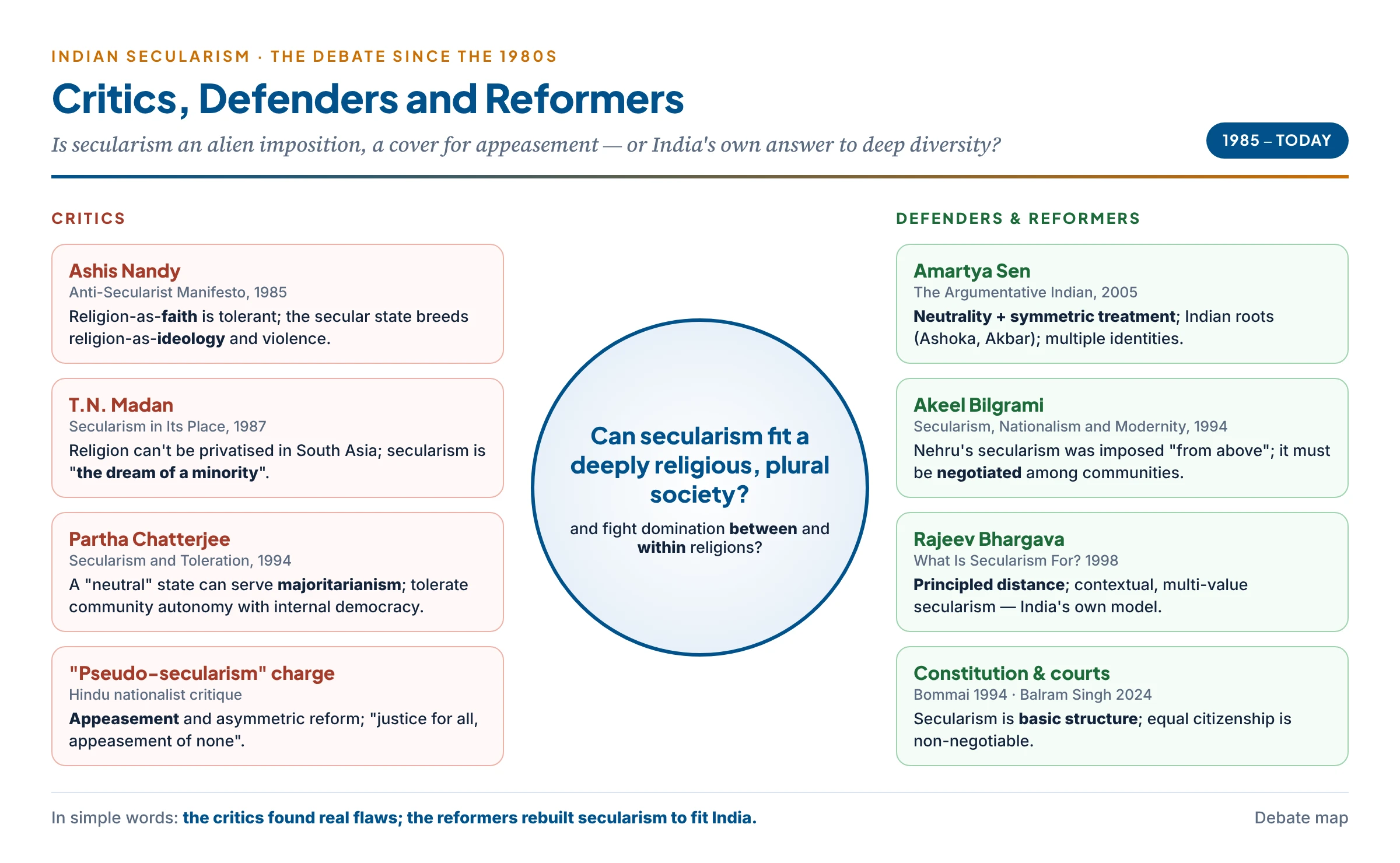
From the mid-1980s — the Shah Bano case (1985–86), the anti-Sikh violence of 1984, the Ayodhya movement and the demolition of the Babri Masjid (1992), and the riots that followed — Indian secularism entered a period of crisis and fierce debate. Some thinkers said secularism had failed because it was an alien Western idea imposed on a deeply religious people (Ashis Nandy, T.N. Madan, Partha Chatterjee); Hindu nationalists called it “pseudo-secularism”, a cover for minority appeasement; others defended it as India’s own achievement and the only basis for equal citizenship (Amartya Sen), or reformulated it — most influentially Rajeev Bhargava, with his idea of “principled distance” and “contextual secularism”, and Akeel Bilgrami, who argued that secularism must grow out of negotiation among communities. This article maps that debate, then examines whether equal respect for all religions is a viable and consistent policy, how religious nationalism threatens a secular society, the Uniform Civil Code debate up to the state codes of 2026, and whether secularism is a redundant Western ideal in multicultural India.
In simple words
Imagine a school principal in a class of forty children from many faiths. One teacher says, “Treat everyone exactly the same and never mention religion.” Another says, “Forget these modern rules — our grandparents lived together fine without them.” A third says, “Be fair, but sometimes being fair means treating children differently — giving one extra help, stopping another from bullying.” The Indian secularism debate is an argument among these three teachers.
Context & Problem
Why a Debate Arose
- The 1980s crisis. Communal riots, the Shah Bano reversal (the 1986 Act overturning a Supreme Court judgment under pressure from community leaders), the opening of the Ayodhya site, the Punjab crisis, and the rise of religious mobilisation in elections.
- Two charges from opposite sides.
- Anti-secularists / communitarians: secularism is a Western, elitist doctrine that does not fit Indian religiosity and has provoked the fundamentalism it fears.
- Hindu nationalists: Indian secularism is “pseudo-secular” — it reforms Hindu practices but appeases minorities.
- The defenders’ task: show that secularism is not Western in its Indian form, explain what it is for, and answer both charges.
The Main Positions at a Glance
| Thinker | Position | Key idea |
|---|---|---|
| Ashis Nandy | Anti-secularist | Recover tolerance from religion-as-faith; the secular state breeds religion-as-ideology and violence |
| T.N. Madan | Sceptic | Religion cannot be privatised in South Asia; secularism is “the dream of a minority“ |
| Partha Chatterjee | Critic | The secular state can coexist with majoritarianism; protect community autonomy with internal democracy |
| Hindu nationalist critique | “Pseudo-secularism” | Appeasement and asymmetric reform; “justice for all, appeasement of none” |
| Amartya Sen | Defender | Secularism means neutrality and symmetric treatment; it has deep Indian roots |
| Akeel Bilgrami | Reformer | Secularism should emerge from negotiation among communities, not be imposed “from above” |
| Rajeev Bhargava | Reformer and defender | Principled distance and contextual secularism — a distinct Indian model |
Core Doctrine
The Critics
1. Ashis Nandy — “An Anti-Secularist Manifesto” (1985), The Politics of Secularism and the Recovery of Religious Tolerance (1988)
- Religion as faith vs religion as ideology.
- Religion-as-faith: a way of life, plural, operationally flexible, open to borrowing — the religion of ordinary people, of saints and village shrines, which has rich internal resources for tolerance.
- Religion-as-ideology: religion as a marker of population, a political identity used to capture power — a modern phenomenon.
- Secularism is an alien, modern, state-centric ideology imposed by a Westernised elite on a deeply religious society.
- The secular state breeds the problem. By delegitimising faith in public life, state-enforced modernist secularism pushes believers towards religion-as-ideology and reactive fundamentalism; the worst communal violence is organised by “modern” political actors, not by traditional believers.
- Remedy: not more secularism but the recovery of religious tolerance from Indian traditions — Gandhi, Ashoka, Akbar, Kabir, the syncretic everyday life of villages.
2. T.N. Madan — “Secularism in Its Place” (1987)
- Secularism as a gift of Christianity. It arose from Protestant Europe’s separation of the sacred and the secular — a distinction foreign to South Asian religions.
- Religion is not a private preference. In South Asia, religion is the comprehensive ground of personal and social identity, not a “preference” chosen like an item in a shop; privatisation of religion is unviable and culturally unnatural.
- Famous verdict: secularism “is the dream of a minority which wants to shape the majority in its own image“; as a widely shared world-view it is impossible as a credo of life for most South Asians, impracticable as a basis for state action, and impotent as a remedy for fundamentalism.
- Remedy: take religion seriously; seek tolerance within the religious traditions rather than against them.
3. Partha Chatterjee — “Secularism and Toleration” (1994)
- The secular state is quite compatible with majoritarianism: a Hindu nationalist programme can present itself as “secular” (one law, no special treatment), using the language of state neutrality against minorities.
- Instead of a uniform state-imposed secularism, he proposed toleration of community autonomy — minorities may keep their own practices — on condition that communities become internally democratic and give public reasons for their practices before their own members.
4. The “pseudo-secularism” critique
- Indian secularism is charged with asymmetry: Hindu personal law was codified and Hindu temples are regulated by the state, while minority personal laws and institutions were left largely untouched.
- It is accused of vote-bank politics and minority appeasement (the 1986 Shah Bano Act is the standard example).
- Its slogan: “justice for all, appeasement of none” — sometimes called “positive secularism“.
- Reply by defenders: minority protections are constitutional rights (Articles 29–30), not favours; reform of minority law must come with the community’s participation; and the majority’s dominance is the real risk to equal citizenship.
In simple words
A doctor who refuses to examine any patient’s diet because “food is personal” (strict separation) may miss malnutrition. A doctor who forces one diet on everyone (uniformity) may make some patients ill. Nandy and Madan said India’s secular doctor was forcing a foreign diet; Hindu nationalists said he was examining only one patient’s plate. Bhargava’s answer: examine every plate, but by the same principle — health — even if the advice differs from patient to patient.
The Defenders and Reformers
1. Amartya Sen — “Secularism and Its Discontents” (The Argumentative Indian, 2005)
- What secularism requires. Two things: neutrality (the state keeps a distance from all religions) and symmetric treatment (if the state deals with religions at all, it must treat them equally). Secularism does not require personal atheism or hostility to religion.
- Indian roots. India has a long tradition of heterodoxy, argument and toleration — the Lokāyata sceptics, Buddhist and Jaina dissent, Ashoka’s edicts, Akbar’s policy of tolerance and his insistence on “the path of reason” — so secularism is not a Western import.
- Against the critics. Sen rejects the claim that India’s identity is “Hindu” and that secularism is anti-Hindu; he warns that the “solitarist” view of identity (a person is only his religion) feeds violence. People have multiple identities — language, profession, gender, region — and secularism protects the freedom to choose among them.
- Function. Secularism prevents majoritarian hegemony and protects the minorities’ equal citizenship.
2. Akeel Bilgrami — “Secularism, Nationalism and Modernity” (1994)
- Nehruvian secularism was “Archimedean” — it stood outside all communities and was imposed from above by an elite, without negotiation with the communities themselves.
- Hence it lacked roots and could be attacked as alien.
- Better path: a secularism that emerges from negotiation among communities, appealing to reasons that each community can accept from within its own values — a “substantive” secularism with internal justification. Bilgrami thus defends secularism while accepting part of the critics’ diagnosis.
3. Rajeev Bhargava — Principled Distance and Contextual Secularism Bhargava (What Is Secularism For?, 1998; The Promise of India’s Secular Democracy, 2010) offers the most influential reconstruction.
(a) The problem with Western models. Both American mutual exclusion and French one-sided exclusion are designed for single-value, individual-centred societies; they cannot handle deep religious diversity, community identities and injustice within religions.
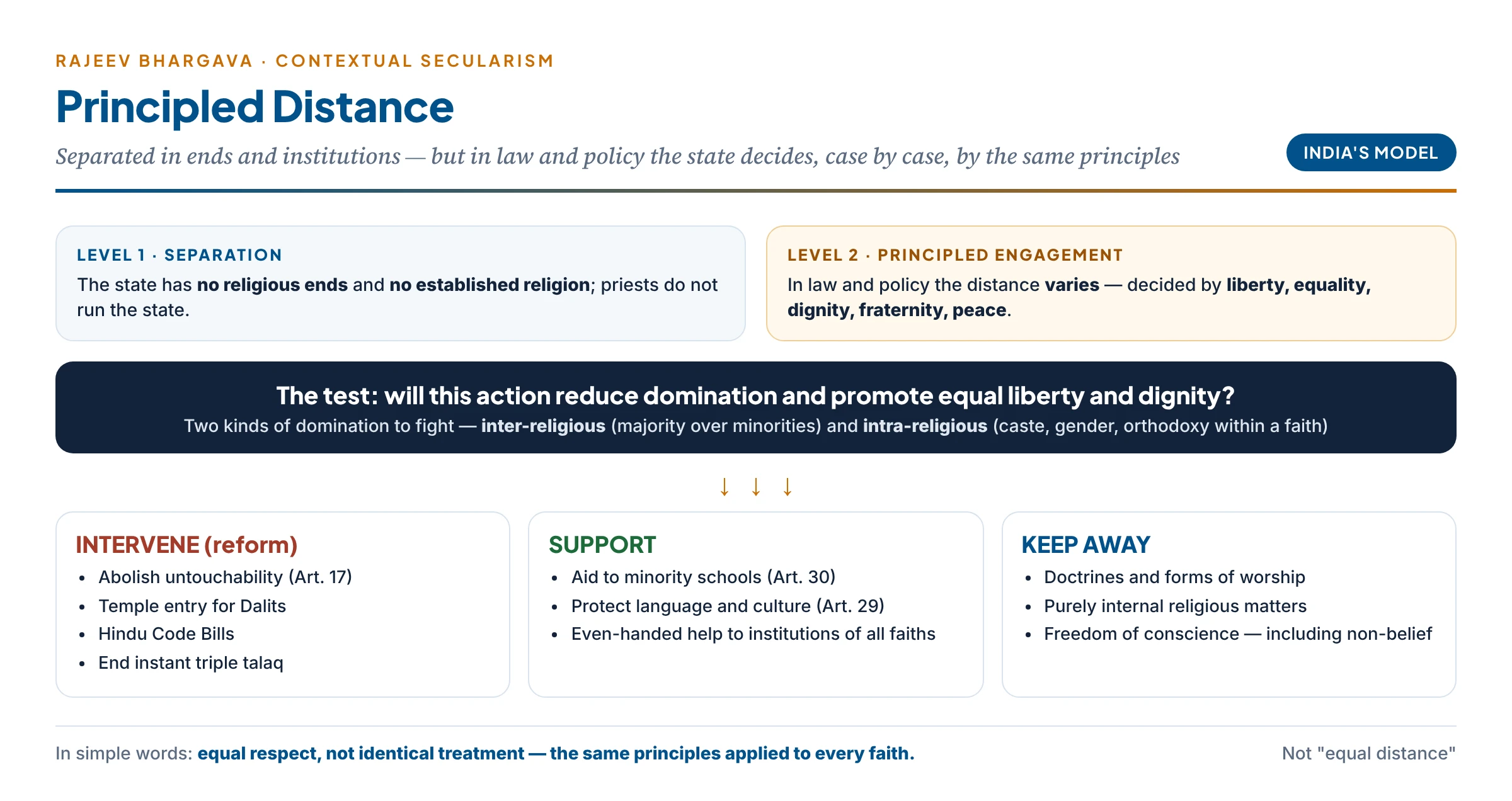
(b) What secularism is for — against two kinds of domination.
- Inter-religious domination — one religious community dominating others (majority over minorities).
- Intra-religious domination — dominant groups within a religion oppressing others (upper castes over Dalits, men over women, orthodoxy over dissenters).
Indian secularism is distinctive because it fights both.
(c) Principled distance.
- The state is separated from religion at the level of ends (it has no religious goals) and institutions (no established church, no priestly control).
- But at the level of law and policy, it neither keeps a fixed distance nor stays permanently aloof. Whether it intervenes, supports or abstains is decided by principle: does the action promote liberty, equality, dignity and fraternity, and reduce domination?
- Differential treatment can be equal treatment. The state may treat religions differently in order to treat them as equals — opening Hindu temples to Dalits (intervention in one religion), funding minority schools (support), leaving some practices alone (abstention).
- Examples: abolition of untouchability, temple-entry laws, Hindu Code Bills, banning instant triple talaq (intervention); aid to minority educational institutions, Article 30 (support); not regulating doctrines and rites (abstention).
(d) Contextual, multi-value secularism.
- Indian secularism balances many values — liberty, equality between and within communities, fraternity, peace, toleration and minority rights — rather than one.
- It is contextual: no a-priori rule decides every case; the state must engage in ethically sensitive, context-sensitive moral reasoning — “an ethically sensitive negotiation” among values. Bhargava calls this a “contextual secularism”, a model with lessons for other diverse societies.
(e) Criticisms of principled distance.
- Vague and discretionary — “principle” can be stretched to justify selective intervention.
- Gives the state great power over religion, which a majoritarian government may misuse.
- Depends on good faith of those who apply it.
- Bhargava’s reply: every model needs judgement; the alternative — rigid rules — fails in deep diversity; the safeguard is constitutional values and courts, applied even-handedly.
Common confusion
Does “principled distance” mean “equal distance from all religions”? No. “Equal distance” suggests a fixed, identical gap — treat every religion exactly alike. Principled distance means the distance varies: the state may come close to one religion (to reform caste exclusion in Hindu temples), support another (aid to a minority college), and stay away from a third practice — so long as each choice is guided by the same principles of liberty, equality and dignity. Equal respect, not identical treatment.
Critical Evaluation
Does Equal Respect for All Religions Provide a Viable and Consistent State Policy?
Why it is viable:
- Historical fit — it continues Indian traditions of coexistence (Ashoka, Akbar, Bhakti–Sufi), so it commands wide support.
- Constitutional backing — Articles 25–30 give it legal form; courts have enforced it (Bommai).
- Social peace — in a society where religion is public, a state seen as respecting all faiths can command loyalty from all.
- It has survived more than seven decades of strain.
Why it may be inconsistent:
- Respect for all doctrines? Religions make conflicting claims; a state cannot coherently “respect” all of them as true.
- Respect for all practices? Equal respect cannot extend to caste exclusion, sati or instant triple talaq — so the state must discriminate between practices, and the policy is no longer simply “equal respect”.
- Applied unequally. Reform of Hindu law but not others; state management of Hindu temples but not mosques and churches — critics from all sides see inconsistency.
- Competitive patronage. “Respect for all” can become equal patronage — state funds and ministers at every religious event — which blurs the line between state and religion. (The Haj subsidy was phased out by 2018 following a Supreme Court direction of 2012; state support for other pilgrimages continues to be debated.)
- Non-believers are left out of a policy framed only around religions.
How it can be made consistent:
- Understand equal respect as equal respect for citizens (Dworkin’s “equal concern and respect”), not equal endorsement of every religion or practice.
- Join it to principled distance: respect, support or reform — always by the same principles applied to every community.
- Include freedom of conscience for non-believers.
- Reform with communities, through representative and internal processes (Chatterjee, Bilgrami), not merely for them.
Conclusion: as a sentiment, equal respect is viable; as a sole policy, it is inconsistent. Joined to equal citizenship and principled reform, it becomes a viable and consistent framework.
How Is Religious Nationalism a Threat to a Secular Society?
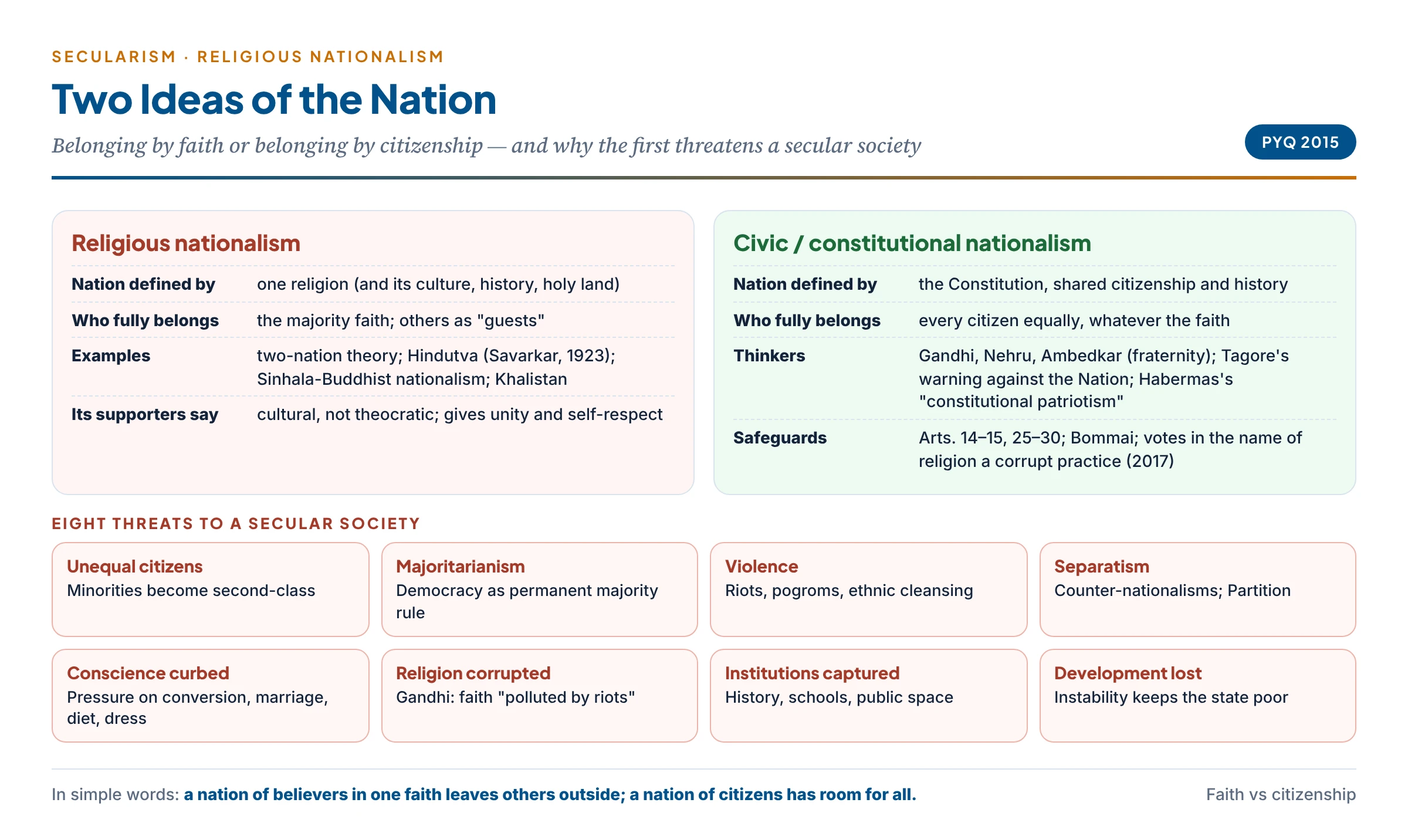
Meaning. Religious nationalism identifies the nation with one religion — the nation’s culture, history, law and loyalty are defined by the majority faith; citizens of other faiths belong, at best, as guests.
- Examples: the two-nation theory (Muslim League, Lahore Resolution 1940) and the creation of Pakistan; the Hindutva ideology formulated by V.D. Savarkar (Essentials of Hindutva, 1923), defining a Hindu as one for whom India is both fatherland (pitṛbhū) and holy land (puṇyabhū); Khalistan separatism; Sinhala-Buddhist nationalism in Sri Lanka (the “Sinhala Only” Act of 1956 and the civil war); the persecution of the Rohingya in Myanmar; religious-nationalist movements in many democracies.
Why it threatens a secular society:
- Unequal citizenship — minorities become second-class citizens, against Articles 14–15.
- Majoritarianism — democracy is reduced to the rule of a permanent religious majority; the minority’s fear (Sir Syed’s fear, Article 5) becomes reality.
- Violence — riots, pogroms, ethnic cleansing; religious nationalism has been a major source of mass violence in South Asia (Partition, 1984, 1992–93, 2002).
- Separatism — it provokes counter-nationalisms and division (Partition itself).
- Erosion of freedom of conscience — pressure on conversion, inter-faith marriage, diet and dress.
- Corruption of religion — Gandhi’s warning: religion used for power is “polluted by riots”; faith becomes a weapon.
- Capture of institutions and history — rewriting textbooks, symbols and public spaces in one community’s image.
- Damage to development — Gandhi again: the state stays poor and unstable when politics turns on religion.
In simple words
Think of a cricket team that picks players only from one neighbourhood and calls itself “the city team”. Others may still live in the city, pay taxes and cheer — but they can never fully belong. A city team chosen from all neighbourhoods by the same rules belongs to everyone. Religious nationalism builds the first kind of team; constitutional nationalism the second.
The counter-view (stated fairly):
- Its supporters argue that it is cultural, not theocratic nationalism — that “Hindu” names a civilisation, not a creed, and can include all who accept India’s culture. (In a 1995 election-law case the Supreme Court remarked that “Hindutva” could describe a “way of life” — an observation widely debated; in 2017 a larger bench declined to revisit it.)
- They argue that minorities in India enjoy constitutional rights and that cultural nationalism gives the nation unity and self-respect after colonial rule.
The secular response:
- Civic or constitutional nationalism — loyalty to the Constitution and equal citizenship (what Habermas calls “constitutional patriotism”), not to a religion.
- Tagore’s warning against worship of the Nation; Gandhi’s and Ambedkar’s insistence on equal citizenship and fraternity.
- Election law — appeals to religion for votes are a corrupt practice (Abhiram Singh, 2017); courts enforce secularism as basic structure.
The Uniform Civil Code Debate
Background.
- Article 44 (a Directive Principle, not enforceable in court): “The State shall endeavour to secure for the citizens a uniform civil code throughout the territory of India.”
- In the Constituent Assembly (23 November 1948), members such as Mohammad Ismail and Naziruddin Ahmad wanted personal law excluded; K.M. Munshi and Alladi Krishnaswami Ayyar defended the clause; Ambedkar said a future Parliament could begin by making the code purely voluntary.
- Gradual reform since: the Special Marriage Act (1954) offers a civil marriage to any couple; the Hindu Code statutes (1955–56) reformed Hindu law; Muslim, Christian and Parsi law continued under their own statutes and customs. Goa has had a common family code since the Portuguese Civil Code of 1867.
- Courts: Shah Bano (1985) regretted that Article 44 was a dead letter; Sarla Mudgal (1995) urged action; Pannalal Bansilal Pitti (1996) cautioned that a uniform law in one go might be counter-productive; Shayara Bano (2017) set aside instant triple talaq.
- Law Commission: the 21st Commission (2018) found a UCC “neither necessary nor desirable at this stage” and proposed removing discrimination within each personal law; the 22nd Commission reopened consultation in 2023.
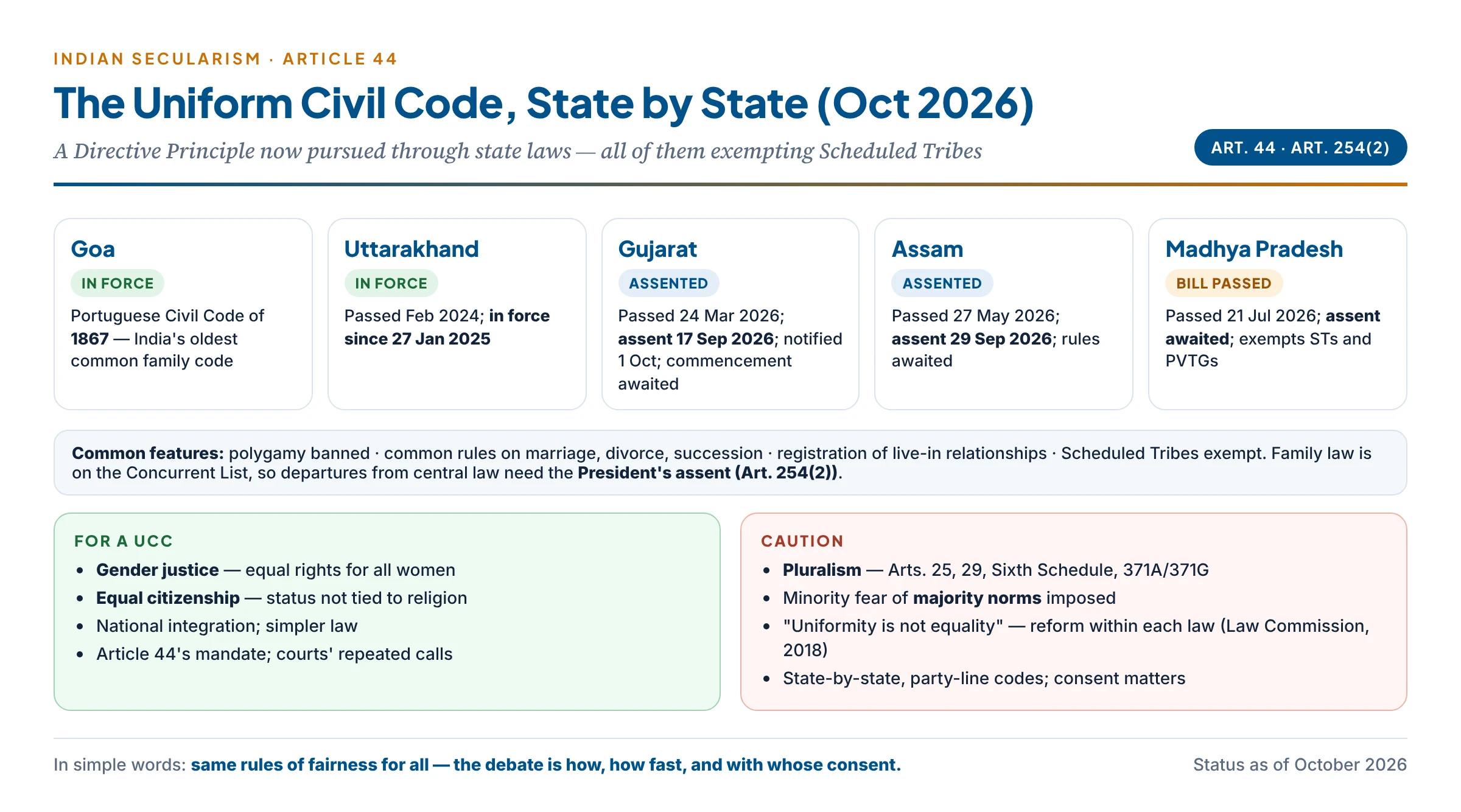
The state codes (as of October 2026):
| State | Assembly passed | Status | Scheduled Tribes |
|---|---|---|---|
| Goa | — (1867 code) | In force | — |
| Uttarakhand | February 2024 | In force since 27 January 2025 | Exempt |
| Gujarat | 24 March 2026 | President’s assent 17 September 2026; notified 1 October 2026; commencement awaited | Exempt |
| Assam | 27 May 2026 | President’s assent 29 September 2026; rules awaited | Exempt |
| Madhya Pradesh | 21 July 2026 | Assent awaited | Exempt (with PVTGs) |
- These codes typically ban polygamy, set common rules for marriage, divorce and succession, and require registration of live-in relationships. Marriage and succession are on the Concurrent List, so a state law departing from a central law needs the President’s assent under Article 254(2).
Arguments for a UCC:
- Equality and gender justice — the same rights for all women in marriage, divorce, maintenance and inheritance.
- Secularism as equal citizenship — personal status should not depend on religion.
- National integration and simplification of law.
- Constitutional mandate — Article 44.
Arguments against (or for caution):
- Pluralism — legal diversity is part of India’s multicultural compact (Articles 25, 29; Sixth Schedule; Articles 371A and 371G protect customary law in Nagaland and Mizoram).
- Minority fear — a “uniform” code may in practice impose the majority’s norms.
- Uniformity is not equality — the goal should be gender justice within each law (21st Law Commission).
- Piecemeal, state-by-state codes along party lines may weaken the idea of one national, consensual reform; tribal exemptions show that uniformity has limits.
- Consent — reforms imposed without community participation may provoke backlash (as after Shah Bano).
In simple words
A school can make every child wear the same uniform, or it can make the same rules for all — no bullying, equal marks for equal work — while letting a Sikh boy keep his turban and a girl wear a salwar instead of a skirt. Critics of a rigid UCC say India needs the second kind of “uniformity”: common principles of fairness, not identical clothes.
Balanced view. A secular, multicultural democracy should aim at gender-just personal law for all, reached gradually and with consultation, keeping voluntary civil options open (Special Marriage Act) and respecting genuine tribal and regional diversity. “Uniform” should mean common principles of equality, not identical customs.
Is Secularism, as a Western Ideal, Redundant in Multicultural India?
The case for “redundant”:
- Western origin — born of Europe’s church–state conflicts, which India never had (Madan).
- Religion is public in India — privatisation is unviable.
- Indigenous tolerance is enough — Ashoka, Akbar, Bhakti–Sufi traditions, Gandhi (Nandy).
- It has failed — riots and religious nationalism continued despite a secular constitution.
- It provokes backlash — perceived as anti-religious and elitist, it fuels the very fundamentalism it opposes.
The case against:
- India’s multicultural society needs it more, not less — many religions, sects, languages and castes require a state that belongs to no one group and treats all as equal citizens.
- Indian secularism is not the Western model — it is principled distance, multi-value and contextual (Bhargava): not redundant but distinctive.
- Indian roots — Sen shows an Indian tradition of toleration and reason; Gandhi and Ambedkar both demanded a secular state.
- Tolerance is not equality — Ashoka and Akbar tolerated subjects; only secular citizenship gives equal rights.
- Without it, majoritarianism — the alternative to secularism in a plural society is not tolerant tradition but religious nationalism.
- Intra-religious justice — only a secular, reforming state could abolish untouchability and reform personal laws.
Conclusion. The Western model (a rigid wall or a hostile laïcité) is indeed ill-suited to India. But secularism as an ideal — equal citizenship, freedom of conscience, no religious domination — is indispensable for multicultural India. India did not import a Western ideal; it reinvented it.
Indian Connect — Indian Connect — India’s contribution to world secularism
- Bhargava argues that Indian “principled distance” can help Europe and others facing new religious diversity from migration — where the old church–state settlements struggle with Muslim, Hindu and Sikh minorities.
- India’s model combines what Western models separate: protection of religion, reform of religion, and minority rights — “secularism for deep diversity”.
Critics and Defenders
Criticism — Critics
- Nandy: secularism is elite, alien and breeds religion-as-ideology; recover traditional tolerance instead.
- Madan: privatisation is impossible in South Asia; secularism is the dream of a minority.
- Chatterjee: a neutral secular state can serve majoritarianism; protect community autonomy instead.
- Hindu nationalists: pseudo-secularism, appeasement, asymmetric reform.
- Liberal individualists: principled distance gives the state too much discretion over religion.
- Feminists: “respect for communities” has protected patriarchal personal laws.
Defence — Defenders and strengths
- Sen: secularism is neutrality and symmetric treatment, with deep Indian roots; it guards against majoritarian hegemony.
- Bhargava: principled distance fights both inter- and intra-religious domination; it is India’s own model.
- Bilgrami: secularism can be renewed by negotiation among communities, with internal reasons.
- Ambedkar and the Constitution: equal citizenship and a reforming state are non-negotiable in a caste society.
- Gandhi: equal respect and a secular state are the conditions of Hindu–Muslim unity and swaraj.
- Courts: secularism is basic structure (Bommai, Balram Singh).
Cross-Tradition Comparison
Indian Debate and Western Debate
| Indian thinker | Western counterpart | Shared point |
|---|---|---|
| Nandy (faith vs ideology) | Talal Asad (secularism as Christian-modern) | Secularism is a historically specific, power-laden project |
| Madan (privatisation impossible) | Communitarians (MacIntyre, Sandel) | Persons are embedded in traditions; neutrality is a myth |
| Chatterjee (community autonomy + internal democracy) | Multiculturalists (Kymlicka, Parekh — Article 8) | Groups need rights, with limits |
| Sen (neutrality, symmetry, multiple identities) | Rawls (public reason), liberal egalitarians | The state must be fair to all citizens |
| Bilgrami (negotiated secularism) | Habermas (translation, post-secular dialogue) | Secular norms should be justified to believers in terms they can share |
| Bhargava (principled distance) | Maclure and Taylor (ends over means) | Equal respect and freedom of conscience matter more than rigid separation |
Synthesis (Siddhānta)
- The critics’ insight: secularism imposed from above, blind to religion’s public role, can alienate believers and even feed fundamentalism (Nandy, Madan); a “neutral” state can be captured by the majority (Chatterjee).
- The defenders’ insight: without secularism a plural society slides into majoritarianism and religious nationalism; secularism means equal citizenship, neutrality and symmetric treatment, and has Indian roots (Sen).
- The reformers’ synthesis: Indian secularism is a distinctive, contextual, multi-value model — principled distance — that fights inter- and intra-religious domination (Bhargava), and that gains legitimacy when its norms are negotiated with communities (Bilgrami).
- On equal respect: viable and consistent only as equal respect for citizens, joined to principled reform applied to every community.
- On religious nationalism: it threatens equal citizenship, peace and religion itself; the answer is constitutional patriotism and fraternity.
- On the UCC: aim at gender-just, consensual law — common principles rather than imposed uniformity; the 2026 state codes keep this debate alive.
- On redundancy: the Western model is unsuited; the secular ideal is indispensable — India has reinvented it.
- Contemporary relevance.
- State UCCs (Uttarakhand, Gujarat, Assam; Madhya Pradesh pending) — uniformity, pluralism and gender justice in practice.
- The Sabarimala reference (judgment reserved, 2026) — whether courts should keep the “essential religious practices” test.
- Waqf (Amendment) Act, 2025 — the limits of state regulation of community institutions (final hearing November 2026).
- Election campaigns and social media — religious polarisation tests Abhiram Singh’s rule against appeals to religion.
“If officers of Government as well as members of the public undertook the responsibility and worked wholeheartedly for the creation of a secular state, we could build a new India that would be the glory of the world.” — Mahatma Gandhi, August 1947
Previous Year Questions
- 2017Do you agree with the view that secularism as a western ideal is redundant in the Indian context? Discuss in the context of the multicultural Indian society.
- 2015How is religious nationalism a threat to secular society? Explain.
- 2013Does the idea of equal respect to all religion provide a viable and consistent state policy?