

Humanism; Secularism; Multi-culturalism.
Official Syllabus: Paper II, Section A, Unit 6
Classical liberalism promised to treat every citizen the same: one set of rights, a “difference-blind” state that is neutral among ways of life. From the 1980s a group of political philosophers argued that this promise was incomplete. Charles Taylor showed that identity is formed through recognition and that misrecognition is a real harm; Will Kymlicka argued that minority cultural rights are not opposed to liberal freedom but necessary for it; Iris Marion Young attacked the ideal of impartiality and called for a politics of difference; Bhikhu Parekh rejected the “moral monism” of Western philosophy and proposed intercultural dialogue. Against them, Susan Moller Okin asked “Is multiculturalism bad for women?“, Brian Barry defended equal treatment against cultural exemptions, and Amartya Sen warned against reducing people to a single identity. This article sets out each theory and its critics, shows how multiculturalism redefines the liberal notions of identity, freedom and equality, and examines the challenge highlighted in the 2026 paper: balancing group rights and individual rights in a multicultural society.
In simple words
A school gives every student the same uniform, the same holidays and the same canteen menu, and calls this “equal treatment”. But the Sikh student must remove his turban, the Muslim student has no break for Friday prayers, and the vegetarian Jain student finds nothing to eat. Liberal “sameness” turns out to suit the majority’s habits. Multicultural theorists ask: is treating everyone identically the same as treating everyone as equals?
Context & Problem
The Liberal Starting Point
- Individual rights. Liberalism (Locke, Kant, Mill, Rawls, Dworkin) takes the individual as the bearer of rights and the unit of moral concern.
- Neutrality and difference-blindness. The state should be neutral among conceptions of the good life and blind to differences of culture, religion and ethnicity — the same rights for all, culture left to private life.
- The unencumbered self. Rawls’s people in the “original position” choose principles without knowing their culture, religion or values.
Why Multiculturalism Challenged It
- Communitarian critique (Sandel, MacIntyre, Walzer, Taylor): the self is not unencumbered; we are constituted by communities, languages and traditions.
- Hidden majority bias: “neutral” states use the majority’s language, calendar, symbols and history.
- Persistent injustice towards minorities, indigenous peoples, immigrants and women despite formal equality.
- Political movements for recognition — Quebec, indigenous peoples, Black and LGBT movements.
- The question: Can liberalism accommodate group identities and group rights without giving up individual freedom and equality?
Core Doctrine
Charles Taylor — The Politics of Recognition (1992)
Background and context.
- In his essay “The Politics of Recognition” (1992), the Canadian philosopher Charles Taylor grounded multiculturalism in Hegel’s idea that self-consciousness requires recognition by others (the master–slave struggle), in Herder’s and Rousseau’s ideal of authenticity (each person and people has an original way of being human), and in G.H. Mead’s account of the dialogical self.
- Context: the growing phase of international migration is making societies multicultural, and the policy of rigorous assimilation has become less and less sustainable. Unlike earlier immigrants to Europe and North America, new arrivals want to keep their cultural identities intact; they tend to invoke the old religious doctrine that the earth has been given to human beings in common. Likewise feminists, cultural minorities and LGBTQ people should be accommodated in the mainstream instead of being treated as deviants.
Dialogical identity.
- Human identity is not generated in solitary isolation; it is forged in dialogue with “significant others” — parents, teachers, community — and with the cultural horizons we inherit.
- So how others see us — and how public institutions represent us — shapes how we see ourselves.
The harm of misrecognition.
- To deny public recognition to a culture, or to project a demeaning image of it (as colonialism did to native peoples, or as patriarchal societies did to women), inflicts a deep psychological wound:
“Nonrecognition or misrecognition can inflict harm, can be a form of oppression, imprisoning someone in a false, distorted, and reduced mode of being.” — Charles Taylor
- Due recognition is “not just a courtesy we owe people. It is a vital human need.”
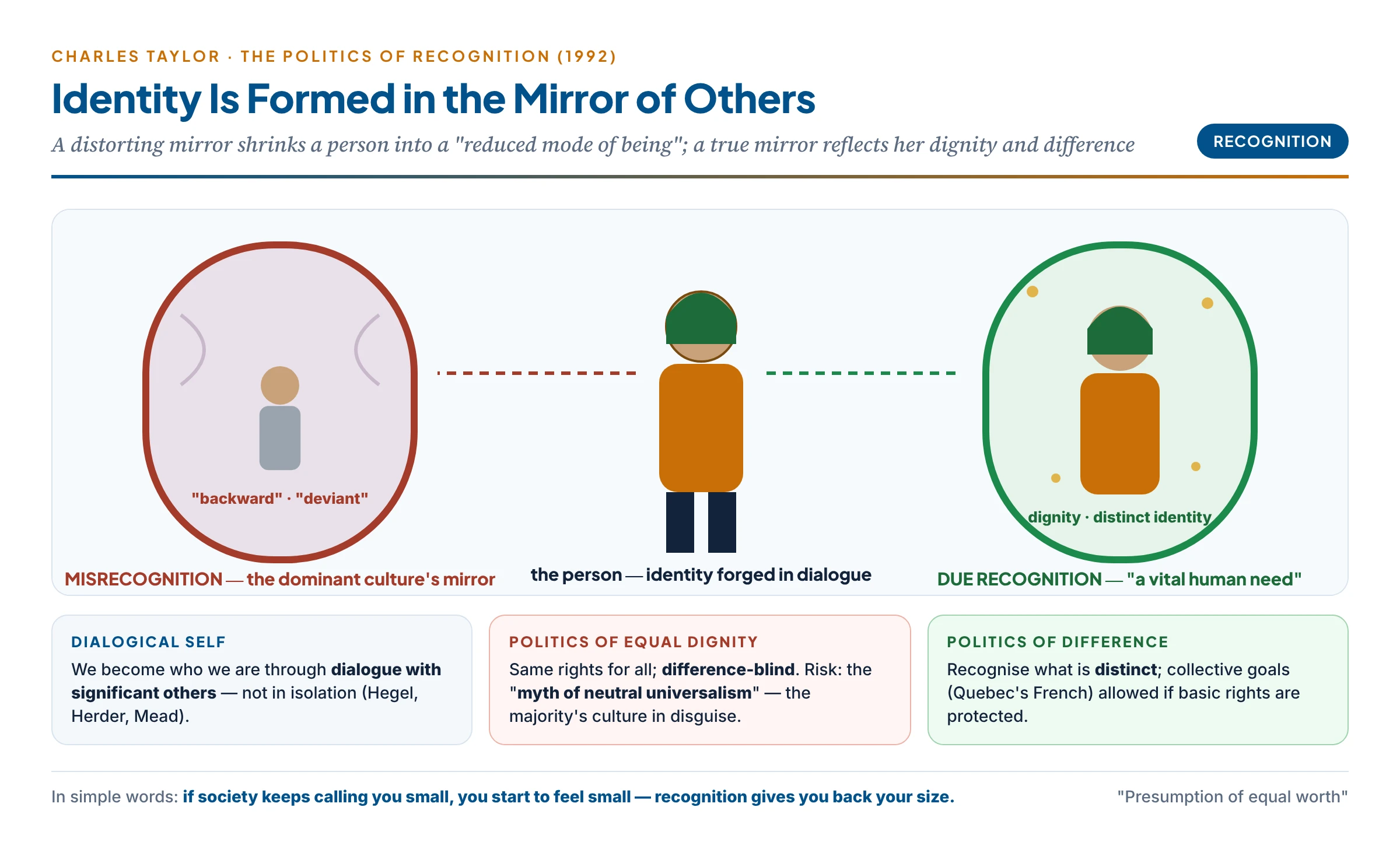
Two politics of recognition — and their tension.
| Politics of equal dignity | Politics of difference | |
|---|---|---|
| Basis | All human beings are equally worthy of respect (Kant) | Each person and group has a unique identity (Herder, authenticity) |
| Demand | The same rights and entitlements for all | Recognition of what is distinct about each |
| State | Difference-blind | Difference-sensitive |
| Danger seen by the other side | Ignores or assimilates minorities — “the myth of neutral universalism“, which is really the majority’s culture in disguise | Undermines equal citizenship; treats people differently |
- Taylor argues that the politics of equal dignity, rigidly applied, is “inhospitable to difference“; true equality requires affirming and accommodating distinct identities.
Quebec and two kinds of liberalism.
- Quebec’s French-language laws (from Bill 101, 1977 — French on signs, French schooling for immigrants’ children) aim at the survival (survivance) of a culture — a collective goal.
- Procedural liberalism (type 1): the state must be neutral; no collective goals.
- Taylor’s liberalism (type 2): a society may pursue collective goals (like cultural survival), provided it protects the fundamental rights of all (life, liberty, due process, free speech, religion) — but not every privilege or immunity.
The presumption of equal worth.
- Should we judge all cultures to be of equal worth? Taylor says that demand would be condescending and empty before we know them. What we owe is a presumption that cultures which have given meaning to large numbers of people over long periods have something important to say; we test it by genuine study and a “fusion of horizons” (Gadamer) that may change our own standards.
Will Kymlicka — Liberal Multiculturalism and Group-Differentiated Rights
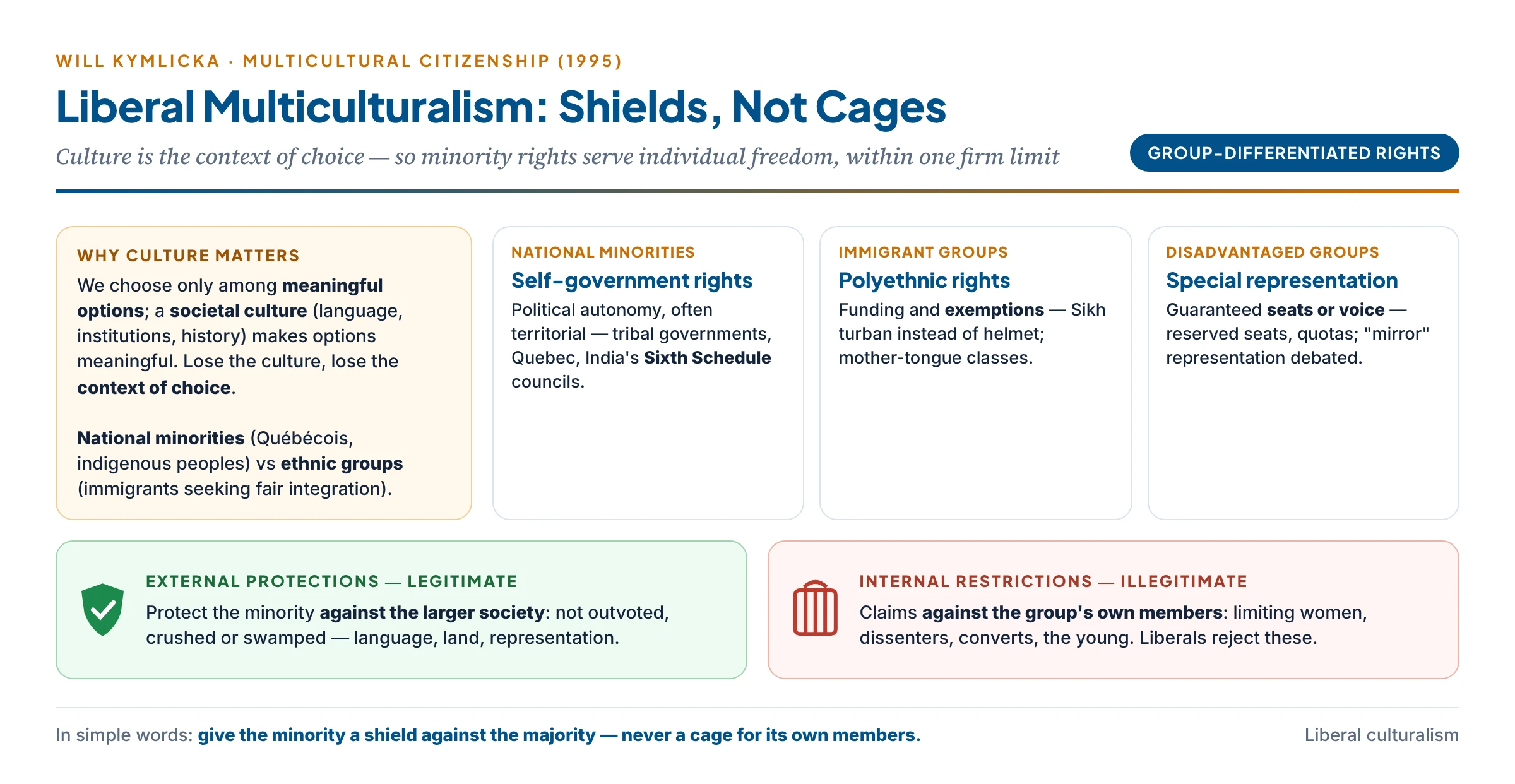
In Liberalism, Community and Culture (1989) and Multicultural Citizenship (1995), Will Kymlicka argued that minority rights are compatible with — indeed required by — liberal autonomy.
1. Culture as a context of choice.
- Liberals value individual autonomy — the freedom to choose and revise one’s way of life.
- But we can choose only among meaningful options, and options become meaningful through a “societal culture” — a territorially concentrated culture centred on a shared language, offering a full range of institutions (schools, media, economy, government).
- When a minority culture decays or is forcibly assimilated, its members lose their primary context of choice. So protecting culture protects freedom.
2. National minorities and ethnic (polyethnic) groups.
- National minorities — previously self-governing, territorially concentrated cultures incorporated into a larger state (the Québécois, Native Americans, Aboriginal peoples, Catalans, Scots).
- Ethnic or polyethnic groups — immigrants who chose to move and generally seek fair terms of integration, not separate nationhood.
3. Three types of group-differentiated rights.
| Right | For whom | Purpose | Example |
|---|---|---|---|
| Self-government rights | National minorities, indigenous peoples | Political autonomy, often territorial | Native American tribal governments; Quebec; India’s Sixth Schedule councils |
| Polyethnic rights | Immigrant ethnic and religious groups | Funding and legal exemptions so that they can express their culture without disadvantage | Exempting Sikh motorcyclists from helmet laws so they can wear turbans; funding mother-tongue classes |
| Special representation rights | Disadvantaged groups | Guaranteed seats or voice in legislatures and public bodies | Reserved seats; women’s quotas |
- Mirror representation. Kymlicka discusses the idea that legislatures should mirror society — different cultural and ethnic groups represented by their own members — and adds that representatives who do not belong to these groups also remain accountable for their interests. He treats special representation as justified mainly where groups face systemic disadvantage or where self-government needs a voice at the centre.
4. External protections vs internal restrictions — the crucial distinction.
- External protections (legitimate) — rights that protect a minority against the larger society: from being outvoted, economically crushed or culturally swamped by the majority (language rights, land rights, representation).
- Internal restrictions (illegitimate) — claims by a group against its own members: to limit their freedom to question, dissent or leave in the name of tradition (forbidding conversion, denying women education, forced marriage).
- Liberals should endorse external protections and reject internal restrictions.
In simple words
A shield protects you from outside attackers; a cage holds you inside. Kymlicka says a minority may have a shield against the majority — its language, its land, its seats in Parliament — but must never be given a cage to lock in its own women, dissenters or young people.
Iris Marion Young — The Politics of Difference
In Justice and the Politics of Difference (1990), the American philosopher Iris Marion Young argued that justice must address oppression and domination, not just the distribution of goods.
1. Against assimilation and impartiality.
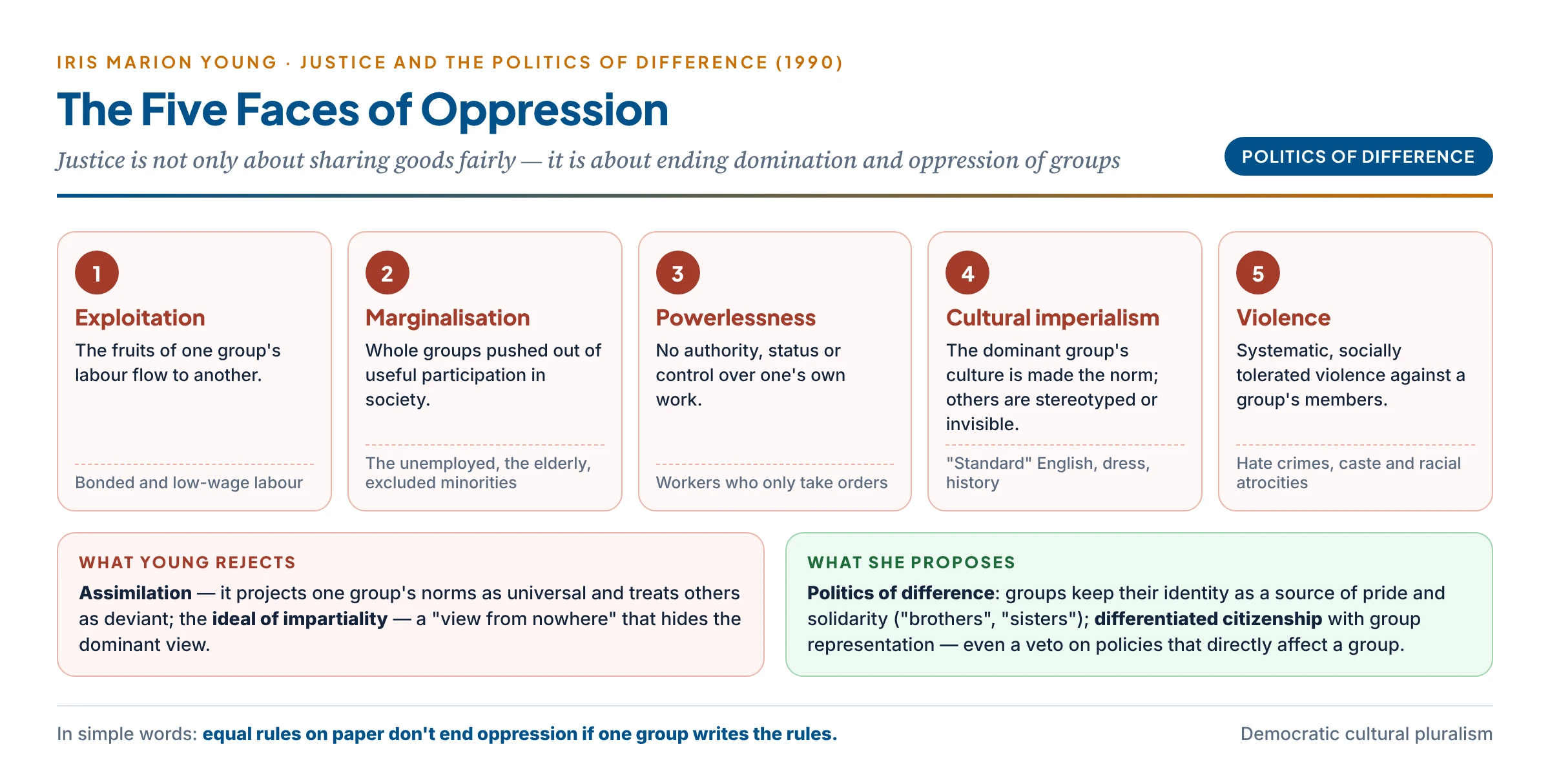
- Assimilationist models falsely project the norms of one group (white, male, middle-class, able-bodied) as standard and universal norms, while other groups are treated as deviant or “other”.
- The ideal of impartiality — a view from nowhere — is a myth that hides the perspective of the dominant group.
2. The five faces of oppression.
- Exploitation — the fruits of one group’s labour are transferred to another.
- Marginalisation — whole groups are expelled from useful participation in social life (the unemployed, the elderly, some minorities).
- Powerlessness — lack of authority, status and control over one’s work.
- Cultural imperialism — the dominant group’s experience and culture are made the norm; others are stereotyped and made invisible.
- Violence — systematic, socially tolerated violence against members of a group.
3. The politics of difference.
- A disadvantaged group wants to preserve its identity in order to maintain its “difference” from other groups — difference is not deviance but a source of perspective and pride.
- The politics of difference itself implies the ideal of liberation and emancipation; it promotes “democratic cultural pluralism“.
- It promotes group solidarity — for example, Black Americans refer to their members as “brothers” and “sisters“.
- Social movements of the oppressed expose the faults of the dominant culture and show the way to a new culture based on human values — Black solidarity; American Indian culture tied to nature, which challenges the self-centred European culture of conquest.
4. Differentiated citizenship and group representation.
- Universal citizenship that ignores group difference reproduces privilege; justice requires differentiated citizenship — mechanisms for the representation of oppressed groups: public funds for group self-organisation, group voice in policy formation, and in some cases veto power on policies directly affecting a group (her example: women’s say over reproductive-rights policy).
Bhikhu Parekh — Pluralist Multiculturalism and Intercultural Dialogue
In Rethinking Multiculturalism (2000), Bhikhu Parekh (Lord Parekh, an Indian-born British political theorist) offered a dialogical theory.
1. Critique of moral monism.
- Traditional and contemporary philosophy stood for “moral monism” — the belief that there is one true way of life that reason can discover (from Plato and Aquinas to Mill and liberal theory). Liberalism itself is one cultural perspective among many; it cannot set itself up as the neutral judge of all others.
2. Neither naturalism nor culturalism.
- Naturalism holds that a universal human nature fixes the good life for all — Parekh rejects it as ignoring culture.
- Culturalism holds that human beings are wholly products of their culture — Parekh rejects it too, because we share a common humanity and can criticise our own cultures.
- His view: human beings are both naturally alike and culturally embedded.
3. Three insights.
- Human beings are culturally embedded.
- Different cultures represent different systems of meaning and visions of the good life; each realises some human capacities and neglects others — no culture is complete.
- Every culture is internally plural, contested and changing.
4. Intercultural dialogue.
- Since every culture captures only a partial glimpse of human possibility, justice requires an ongoing, respectful dialogue in which cultures illuminate, criticise and enrich one another.
- Disputed practices (polygamy, dress, slaughter methods, arranged marriage) should be settled by dialogue in the light of the society’s “operative public values” — the values actually embodied in its constitution, laws and civic life — which themselves can change through dialogue.
5. Recognition needs power.
- No cultural recognition would be successful without a “just share of economic and political power” — recognition without redistribution is hollow.
6. A community of communities.
- The Parekh Report, The Future of Multi-Ethnic Britain (2000), described Britain as “a community of citizens and a community of communities“.
- His concept of multiculturalism comes very close to Tagore’s “synthetic universalism” — each culture develops its own genius and enters into a creative relationship with humanity as a whole.
Indian Connect — Indian Connect — Parekh, Tagore and anekāntavāda
- Parekh’s claim that no culture is complete echoes the Jaina doctrine of anekāntavāda — reality has many aspects, and each standpoint (naya) grasps only part.
- His “dialogue of cultures” recalls Akbar’s Ibādat Khāna, where scholars of many faiths debated, and Tagore’s Visva-Bharati, “where the world makes its home in a single nest”.
- Parekh often cited India as a society that long practised a pluralism of communities — while warning against the hardening of communal identities.
Susan Moller Okin — “Is Multiculturalism Bad for Women?” (1997/1999)
The thesis.
- Two progressive causes — minority cultural rights and gender equality — can clash.
- Most cultures are patriarchal, and many minority cultures are more patriarchal than the surrounding liberal society.
- Culture is concentrated in the private sphere — marriage, family, sexuality, reproduction, inheritance — exactly where women’s lives are shaped. Cultures regulate women’s bodies, sexuality and marriage far more strictly than men’s.
- So when liberal states grant cultural autonomy or exempt religious communities from gender-neutral laws, they empower male elders to control women behind closed doors.
Examples she used.
- Polygamy among some immigrants in France in the 1980s, tolerated by the state, which harmed the co-wives.
- “Cultural defence” pleas in American courts — men from immigrant communities seeking lighter sentences for violence against women by appeal to their culture.
- Female genital cutting, child marriage, forced marriage, unequal inheritance and polygamy defended as tradition.
Okin’s verdict.
- Group rights should not be granted to minority groups unless their internal practices respect the equality of women — and women (especially young women) must be represented in any negotiation over group rights.
Replies.
- Kymlicka: liberal multiculturalism already rejects internal restrictions; there is no conflict in principle.
- Okin’s rejoinder: in practice, cultural traditions and internal restrictions are deeply intertwined; the most important oppression of women is informal and private, beyond the reach of formal rights.
- Parekh and multicultural feminists: Okin overgeneralises about minority cultures, treats Western culture as already egalitarian, and denies minority women’s agency — many women want both their culture and their rights and work to reform tradition from within.
- Ayelet Shachar (Multicultural Jurisdictions, 2001) names the “paradox of multicultural vulnerability” — accommodating a group can make its most vulnerable members more vulnerable — and proposes joint governance: the state and the group share jurisdiction (in marriage and divorce, say), and women can switch to state law when the group fails them.
Indian Connect — Indian Connect — the Shah Bano case as Okin’s dilemma
- In Shah Bano (1985) the Supreme Court granted a divorced Muslim woman maintenance under secular criminal law; under community pressure, Parliament’s 1986 Act narrowed it. “Respect for community” was set against “rights of women”.
- Danial Latifi (2001) later read the 1986 Act to secure a fair provision; Shayara Bano (2017) set aside instant triple talaq. These cases show how courts in a multicultural democracy try to protect women within community law — close to Shachar’s joint governance.
Brian Barry — The Egalitarian Liberal Critique (Culture and Equality, 2001)
- Equal treatment means the same rules for all. Cultural exemptions (“rule-and-exemption”: turbans and helmets, the Sikh kirpān, ritual slaughter, Sunday trading) are usually unfair: either the rule is justified for everyone, or it should be dropped for everyone.
- People matter, not cultures. Cultures have no intrinsic value; they are valuable only insofar as they serve their members.
- Multiculturalism divides the left and diverts attention from economic redistribution — class inequality is ignored while symbolic identity battles rage.
- Related debate: Nancy Fraser argued that justice needs both redistribution (economic) and recognition (cultural); some groups (e.g. women, racial minorities) suffer both kinds of injustice and need both remedies.
In simple words
Parekh and Barry disagree like two cricket coaches. Parekh says: “Each player bats differently — let us learn from each other’s styles.” Barry says: “Fine, but one rulebook for everyone — no special bat for one player.” Sen adds: “And don’t label a player only as ‘the Hindu batsman’ or ‘the Muslim bowler’ — he is also a student, a Bengali, a fan of jazz.”
Amartya Sen — Plural Monoculturalism (Identity and Violence, 2006)
- Individuals have multiple identities — nationality, language, religion, gender, profession, politics, taste in music — but multiculturalism often focuses on a single identity named “culture” (usually religion).
- “Solitarist” identity — reducing a person to one identity — makes people easier to mobilise for violence.
- Plural monoculturalism: many cultures living side by side in separate boxes is not real multiculturalism; true multiculturalism means freedom to choose and reasoned engagement across cultures.
- Policies that hand people over to “community leaders” (e.g. faith schools for all) can diminish individual freedom.
Critical Evaluation
How Multiculturalism Redefines Liberal Notions
| Liberal notion | Classical liberal assumption | Multicultural redefinition |
|---|---|---|
| Identity | The self is an autonomous, “unencumbered” chooser; culture is private | The self is dialogical and culturally embedded; identity needs recognition (Taylor) |
| Freedom | Freedom = absence of interference and freedom of individual choice | Choice needs a context of choice — a secure culture (Kymlicka); freedom also means non-domination by majority norms (Young, Pettit) |
| Equality | Equality = identical treatment, difference-blind | Equality = equal recognition of different value systems; treating people as equals may require treating them differently (exemptions, group rights) |
| Neutrality | The state can be neutral among cultures | Neutrality is impossible; the “neutral” state carries the majority’s culture |
| Justice | Elimination of distributive injustice (income, wealth, opportunity) | Also elimination of cultural injustice — misrecognition, stereotyping, cultural imperialism |
| Politics | Interest politics and distribution | Identity politics — the real cause of some groups’ backwardness is non-recognition of their identity |
| Citizenship | Uniform citizenship | Differentiated citizenship — citizens recognised with their cultural identities |
| Nationality | One nation, one culture | National identity should not be imposed over cultural identities; a multicultural (multinational) state |
Reformulated assumptions:
- The individual is culturally constituted, not prior to all community.
- Groups — not only individuals — can have morally relevant claims.
- Formal equality is insufficient; substantive equality may require differential treatment.
- State neutrality is a myth; the state should be even-handed among cultures.
- Justice is two-dimensional — recognition and redistribution.
But the redefinition has limits (liberal replies): individual rights remain the floor; groups cannot override them (Kymlicka’s internal restrictions); identities are multiple and chosen (Sen); redistribution must not be forgotten (Barry, Fraser).
Common confusion
Does multiculturalism reject liberalism? Not necessarily. Kymlicka is a liberal multiculturalist — he defends group rights because they serve individual autonomy. Taylor proposes a different, but still rights-protecting, liberalism. Parekh is the most critical — he rejects liberalism’s claim to be the neutral judge of all cultures, but still accepts human rights and democratic dialogue. Only communitarian and some culturalist positions go further. The debate is mostly within the liberal-democratic family about how to accommodate difference.
Challenges of Balancing Group Rights and Individual Rights
Why the balance is hard:
- Internal restrictions. Group rights can be used to control women, dissenters, converts and the young (Okin) — the Dawoodi Bohra excommunication case (Sardar Syedna, 1962, which upheld the power to excommunicate) and the pending challenge to female genital cutting in the same community.
- Hollow exit rights. The right to leave a group means little to those who are economically dependent, uneducated or would lose family and community.
- Who speaks for the group? “Community leaders” are often older, male, orthodox elites; claims made “for the group” may serve them.
- Essentialism. Treating a group as fixed and uniform ignores internal diversity and freezes change (Sen, Parekh).
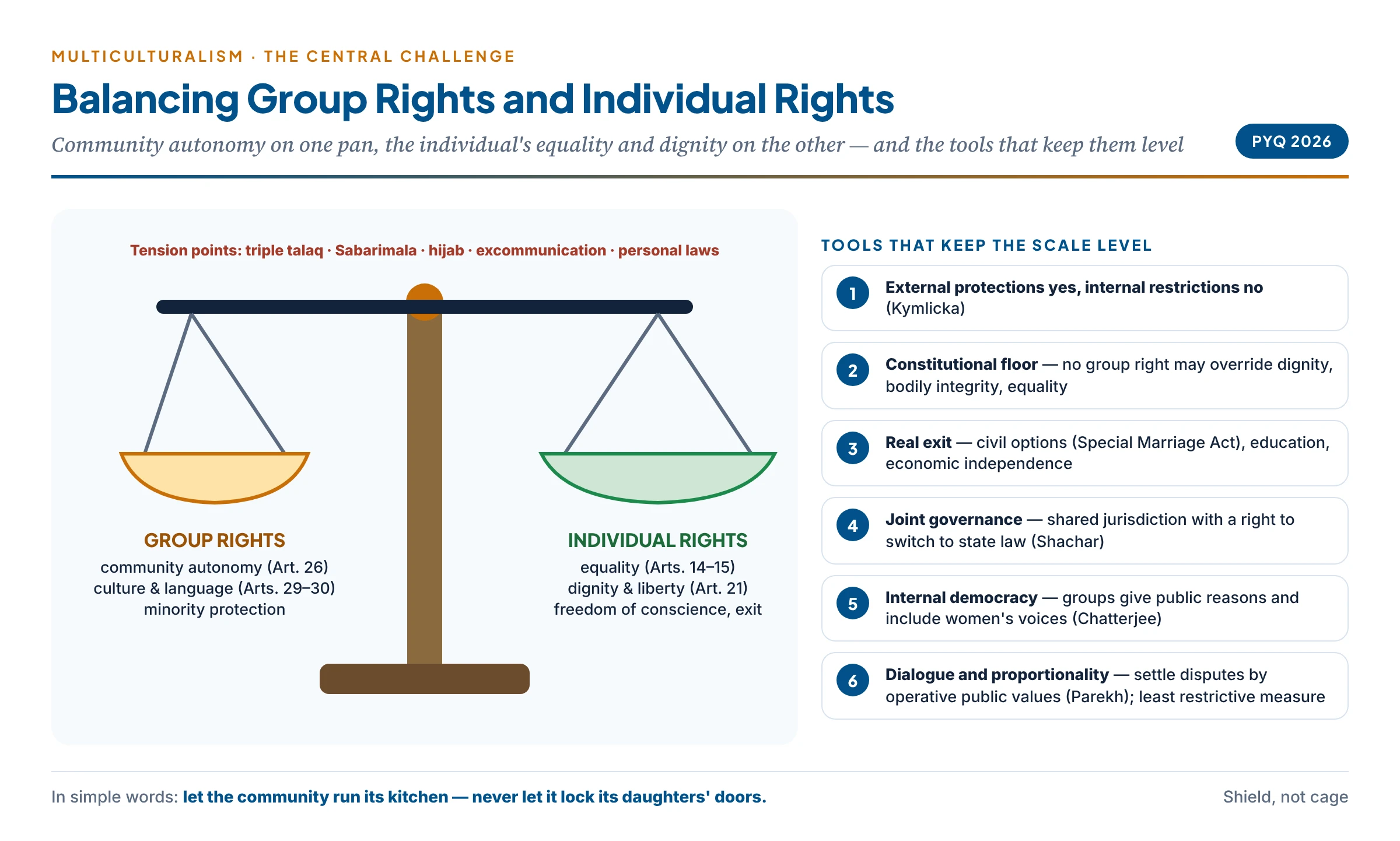
- Rights in conflict. Group autonomy (Article 26) collides with individual equality and dignity (Articles 14, 15, 21) — temple entry (Sabarimala), mosque entry, triple talaq, hijab in schools.
- Courts as theologians. Deciding what is “essential” to a religion pulls judges into theology — the issue before the nine-judge Sabarimala reference (judgment reserved in 2026).
- Majority resentment. Group rights for minorities may be portrayed as “appeasement”, provoking backlash and religious nationalism.
- Intersectionality. A poor Dalit woman, an Adivasi Christian, a Muslim OBC — individuals belong to several groups whose claims may conflict.
- Fragmentation vs integration. Strong group rights may create parallel societies; weak ones may force assimilation.
Ways of balancing:
- Kymlicka’s rule — allow external protections, forbid internal restrictions.
- A constitutional floor — fundamental rights apply to all; no group right may violate human dignity, bodily integrity or equality.
- Real exit options — civil alternatives (the Special Marriage Act, 1954), education, economic independence.
- Joint governance (Shachar) — shared jurisdiction with the right to switch to state law.
- Internal democratisation (Partha Chatterjee) — communities must give public reasons to their own members and include women’s voices.
- Intercultural dialogue (Parekh) — settle contested practices by dialogue in the light of operative public values.
- Proportionality and reasonable accommodation — accommodate unless there is a strong reason not to, and then choose the least restrictive measure.
- Reform from within — support reformers inside communities (Muslim women’s groups against triple talaq; Dalit temple-entry movements).
In simple words
A joint family may decide its own festivals, recipes and rituals — that is group autonomy. But if the elders decide that a daughter cannot study or must marry against her will, the law steps in — that is the individual’s floor. A good multicultural state lets the family run its kitchen, but not lock its daughters’ doors.
Critics and Defenders
Criticism — Critics
- Okin and liberal feminists: group rights entrench patriarchy in the private sphere.
- Barry: exemptions violate equal treatment; multiculturalism diverts the left from redistribution.
- Sen: plural monoculturalism and solitarist identities diminish freedom and feed violence.
- Fraser: recognition without redistribution leaves material injustice untouched.
- Nationalists: group rights weaken national unity.
- Cosmopolitans: cultures are hybrid; group rights freeze them.
Defence — Defenders and strengths
- Taylor: misrecognition is a real harm; recognition is a vital human need.
- Kymlicka: minority rights complete liberal autonomy; internal restrictions are already excluded.
- Young: difference is a resource; oppression has cultural faces that equal treatment cannot cure.
- Parekh: no culture is complete; dialogue enriches all and corrects liberal monism.
- Shachar: joint governance protects both culture and vulnerable members.
- Practice: Canada, India and others combine group rights with individual rights under constitutional floors.
Cross-Tradition Comparison
The Theorists Compared
| Theorist | Starting point | Key concept | Group rights | Main critic’s objection |
|---|---|---|---|---|
| Taylor | Identity and recognition (Hegel) | Politics of recognition; dialogical self | Collective goals allowed if basic rights protected | May essentialise cultures |
| Kymlicka | Liberal autonomy | Societal culture; context of choice | Yes: self-government, polyethnic, representation; external not internal | Internal restrictions hard to separate (Okin) |
| Young | Oppression and domination | Five faces of oppression; politics of difference | Group representation, differentiated citizenship | Groups hard to define; may fragment |
| Parekh | Critique of moral monism | Intercultural dialogue; operative public values | Contextual, through dialogue | Vague procedure; relativism risk |
| Okin | Gender equality | “Is multiculturalism bad for women?” | Only if internally gender-equal | Overgeneralises; denies minority women’s agency |
| Barry | Egalitarian liberalism | Equal treatment; against rule-and-exemption | Rarely | Ignores hidden majority bias |
| Sen | Freedom and reason | Multiple identities; plural monoculturalism | Wary | Underplays real group disadvantage |
Western Theory and Indian Practice
| Western idea | Indian counterpart |
|---|---|
| Kymlicka’s self-government rights | Sixth Schedule autonomous councils; linguistic states; Articles 371A–371J |
| Polyethnic rights | Articles 29–30; personal laws; exemptions (Sikhs carrying the kirpān — Explanation I to Article 25) |
| Special representation | Reserved seats for SCs and STs; women’s reservation (106th Amendment, 2023, to take effect after delimitation) |
| External vs internal restrictions | Article 17, temple-entry laws, triple talaq judgment — the state limits internal restrictions |
| Taylor’s recognition | Official recognition of 22 scheduled languages; recognition of tribal identities |
| Okin’s dilemma | Shah Bano, Sabarimala, hijab cases |
Synthesis (Siddhānta)
- Taylor showed that identity is dialogical and that misrecognition is oppression; Kymlicka that culture is the context of choice, justifying external protections but not internal restrictions; Young that oppression has cultural faces and that difference is a resource; Parekh that no culture is complete, so cultures must meet in dialogue.
- Okin, Barry and Sen set the limits: group rights must not become cages for women and dissenters, must not displace economic justice, and must not reduce persons to a single identity.
- Multiculturalism redefines liberal identity (embedded, dialogical), freedom (context of choice, non-domination) and equality (equal recognition, treating people as equals rather than identically) — while the individual’s rights remain the floor.
- Balancing group and individual rights is the central practical challenge; the best tools are a constitutional floor, real exit, internal democratisation, joint governance and dialogue.
- Contemporary relevance.
- Hijab, temple-entry and mosque-entry disputes — individual rights versus community autonomy.
- State UCCs (2024–26) — uniform rules versus group personal laws (Articles 6 and 9).
- Indigenous rights — gram sabha consent over forests and mining (the Niyamgiri decision, 2013) as group rights protecting a way of life.
“Due recognition is not just a courtesy we owe people. It is a vital human need.” — Charles Taylor
Previous Year Questions
- 2026Examine the challenges faced by a multicultural society in creating a harmonious balance between group rights and individual rights.
- 2016Can we consider “freedom from domination” as one of the justifications for multiculturalism? Give reasons for your answer.
- 2015How are individual and group rights reconciled in democracy? Explain.
- 2014How does multiculturalism redefine liberal notions like identity, freedom and equality and reformulate its assumptions?