

Humanism; Secularism; Multi-culturalism.
Official Syllabus: Paper II, Section A, Unit 6
After the theories (Articles 7–8) comes the hard question: does multiculturalism work? Its supporters credit it with peace, justice and creativity in diverse societies; its critics blame it for fragmentation, relativism, the oppression of “minorities within minorities” and even for blocking development. In 2010–11 the leaders of Germany, Britain and France declared that multiculturalism had “failed”, while Canada and India continued to live by it in their own ways. This article evaluates multiculturalism — boon or bane, impediment to development or not — examines India as a multicultural society and the challenges it faces (including the balance between group and individual rights), takes up Ambedkar’s idea of “social endosmosis” in relation to today’s politics of difference, asks whether Indian cultural identity must integrate multiculturalism with respect for the dignity of each person, and closes the unit by showing how humanism, secularism and multiculturalism fit together.
In simple words
A joint family with many members can be a source of strength — many skills, shared resources, help in bad times — or a source of endless quarrels, factions and a bullied daughter-in-law. The same family can be either, depending on how it is run: whether everyone is respected, whether the strong control the weak, whether there are fair rules. Multiculturalism is like that family. Whether it is a boon or a bane depends on the rules that govern it.
Context & Problem
The Issues Multiculturalism Raises
Multiculturalism believes that culture plays a central role in an individual’s life, and so it gives new meanings to key political ideas:
- Equality — defined as recognition of difference: equal recognition of different value systems.
- Politics — conventional politics focuses on distributive justice; multiculturalism emphasises identity politics — the various identities must be recognised; the real cause of backwardness is the non-recognition of identity.
- Justice — conventionally the elimination of distributive injustice; multiculturalism adds the elimination of cultural injustice.
- Citizenship — differentiated citizenship: citizens recognised with their cultural identities.
- Nationality — national identity should not be imposed over cultural identity; a multicultural state.
And the doubts it raises:
- Amartya Sen: individuals have multiple identities, but multiculturalism focuses on a single identity named culture.
- Optimists assert that the modern world gives individuals a wider choice of identities and a greater opportunity of self-actualisation; a person is no longer a slave of narrowly defined tradition, culture or religion — so why tie him to one inherited culture?
- “Purifying” a culture — as some claim, purifying Indian culture by insulating it from the influences of other cultures runs the risk of heading for a moral degeneration of India.
- Too much emphasis on difference and rejection of prevalent norms can make a society unfit for the avenues of modern society.
- Cultural distortion — some groups are victims of their own culture’s distortions, like the “untouchables”. Ambedkar exhorted them to give up their age-old traditions and occupations, migrate to towns, gain education and mix with the mainstream.
- A static society — if we identify strictly with inherited culture, society becomes static and the state becomes an instrument for maintaining the status quo.
- Choosing an identity is hard — a poor woman may find it difficult to choose between joining the poor men of her class in a socialist movement and the rich women of another class in a feminist movement.
- Identity voting — in India, when people vote on the basis of identity alone, it can make way for law-breakers to become lawmakers (analysis by the Association for Democratic Reforms found that about 46% of the Lok Sabha members elected in 2024 had declared criminal cases).
Core Doctrine
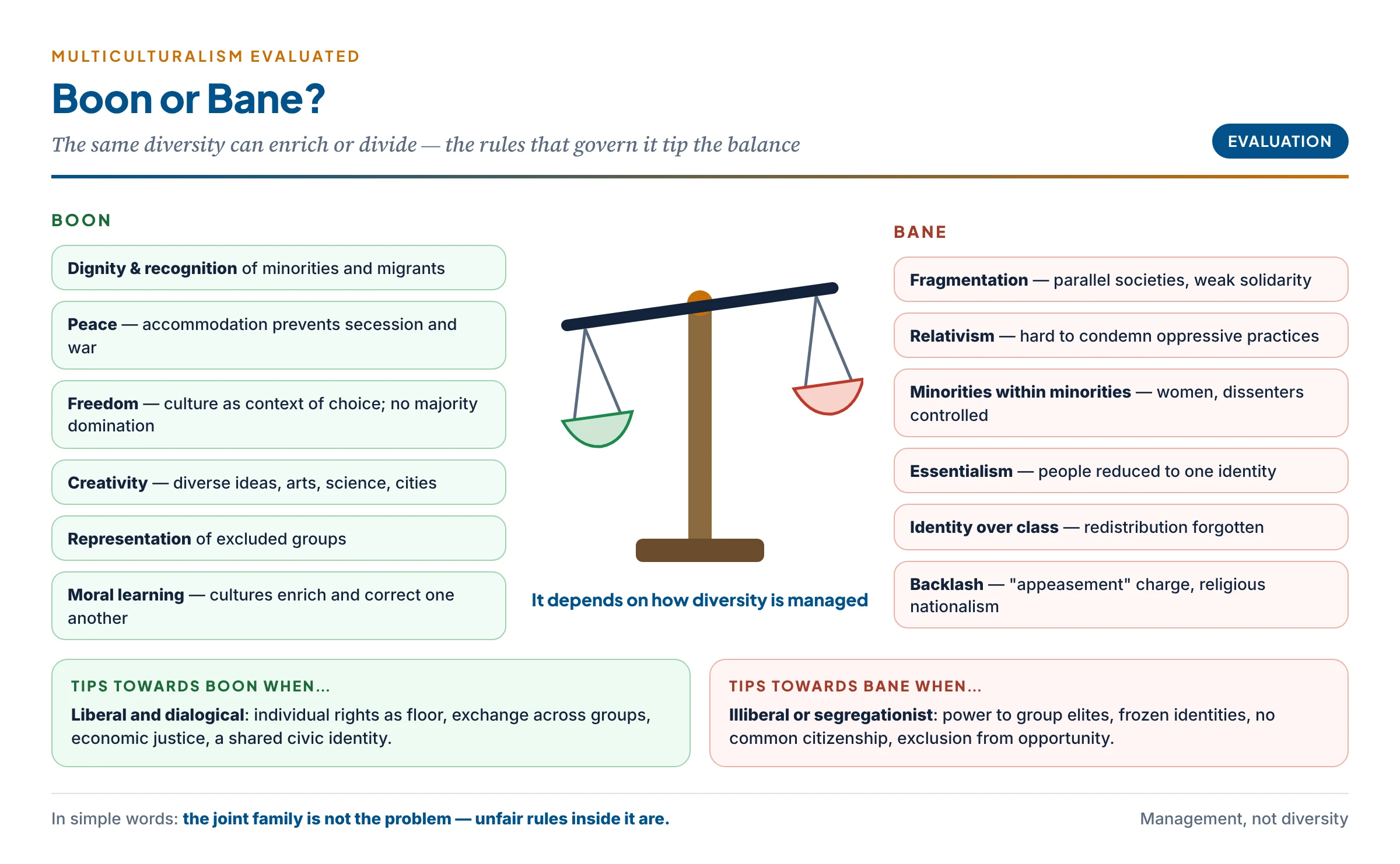
Is Multiculturalism a Boon or a Bane?
| Boon | Bane |
|---|---|
| Dignity and recognition of minorities, indigenous peoples and immigrants (Taylor) | Fragmentation — “balkanisation” into separate, mutually suspicious groups; weak national solidarity |
| Peace and stability — accommodation prevents secession and civil war (avoids Yugoslavia, Sri Lanka) | Relativism — if no culture is superior, oppressive practices are hard to condemn |
| Freedom — culture as the context of choice (Kymlicka); protection from majority domination | Minorities within minorities — women, dissenters and the young controlled by group elites (Okin) |
| Creativity and innovation — diverse ideas, cuisines, arts, sciences; global cities thrive on diversity | Essentialism — cultures frozen into fixed blocks; individuals reduced to one identity (Sen) |
| Democratic deepening — representation of excluded groups | Identity politics displaces class and economic justice (Barry, Fraser) |
| Moral learning — cultures criticise and enrich one another (Parekh) | Backlash — majority resentment and religious nationalism (“appeasement”) |
| Global relevance — migration makes diversity inevitable; multiculturalism is a need of global society | Parallel societies — segregated neighbourhoods and schools, weak integration (European worry) |
Balanced verdict. Multiculturalism is a boon when it is liberal and dialogical — recognising cultures while protecting individual rights, encouraging exchange, and joined to economic justice and a shared civic identity. It becomes a bane when it is illiberal or segregationist — handing power to group elites, freezing identities, or abandoning common citizenship. The problem is not diversity but bad management of diversity.
The European Retreat from Multiculturalism
- October 2010 — German Chancellor Angela Merkel: the attempt to build a multicultural society in which people “live side by side and enjoy each other” had “failed, utterly failed“.
- February 2011 — British Prime Minister David Cameron (Munich): “state multiculturalism” had encouraged communities to live “separate lives”; he called for a “muscular liberalism” and shared values.
- February 2011 — French President Nicolas Sarkozy said multiculturalism had been “a failure”.
- Policy shifts: civic-integration tests, language requirements for citizenship, bans on face coverings, emphasis on “national values”.
- Why: terrorist attacks, segregated neighbourhoods, unemployment among immigrants, the rise of far-right parties.
- The scholarly reply (Kymlicka): the “retreat” was more rhetoric than reality — many multicultural policies continued under new names; what failed was often segregation and neglect, not recognition; and countries like Canada remain committed to multiculturalism with high levels of immigrant integration.
- Lesson: multiculturalism must be joined to integration, shared civic values and equal opportunity — the interculturalism of Article 7.
Common confusion
Did Europe’s leaders prove that multiculturalism has failed? Not exactly. Their speeches criticised a particular version — communities living separate lives with little shared identity, sometimes called “plural monoculturalism” (Sen). The theorists of multiculturalism (Taylor, Kymlicka, Parekh) never advocated separation; they argued for recognition within a common citizenship. Studies of actual policies show that many European states kept multicultural measures while adding integration requirements. The debate is about the right mix of recognition and integration, not a simple “success or failure”.
Can Multiculturalism Be an Impediment to Development and Progress?
The case that it can:
- Diversity and public goods — economists William Easterly and Ross Levine (1997) linked high ethno-linguistic fragmentation in Africa to lower growth and poorer public goods: divided groups find it harder to agree on schools, roads and taxes.
- Conflict — unmanaged diversity can lead to violence, which destroys development (Rwanda, Sri Lanka, the Balkans).
- Rent-seeking identity politics — groups compete for state spoils rather than common goods.
- Resistance to change — strong attachment to tradition may resist modern education, science, women’s work or new technology; “if we identify strictly with our culture, society becomes static“.
- Development projects — dams, mines and industries often clash with tribal and community rights over land and forests.
The case that it need not:
- Institutions matter more than diversity — diversity hurts growth mainly under weak or authoritarian institutions; inclusive, democratic institutions turn diversity into a strength (India, Switzerland, Canada, Malaysia).
- The diversity dividend — diverse societies and cities are more innovative (Silicon Valley’s immigrant founders; the Indian diaspora in technology; Mumbai and Bengaluru as melting pots of talent).
- Development as freedom — Amartya Sen: development is the expansion of people’s real freedoms, and cultural liberty is one of them. The UNDP’s Human Development Report 2004, Cultural Liberty in Today’s Diverse World, argued that accommodating cultural identities is part of human development, not an obstacle to it.
- Inclusion fuels growth — excluded groups (Dalits, tribals, women, minorities) who gain education and opportunity add to growth; reservations and minority education expand human capital.
- Sustainable development — indigenous cultures often protect forests and biodiversity; the Niyamgiri case (2013), in which the Supreme Court left the decision on bauxite mining to the Dongria Kondh gram sabhas (which rejected it), shows how cultural rights can redirect development towards sustainability and consent.
In simple words
A cricket team of players from many states can be the strongest team — if the captain picks on merit, everyone gets a fair chance and they play together. The same team loses if players sulk in regional cliques or some are never allowed to bat. Diversity is not the weakness; unfair selection and no team spirit are.
Conclusion. Multiculturalism is an impediment only when diversity is mismanaged — through exclusion, conflict or frozen traditions. Managed through inclusive institutions, shared civic values and cultural liberty, it is a resource for development and progress. Progress itself must be redefined as human development, not only GDP.
Critical Evaluation
India as a Multicultural Society
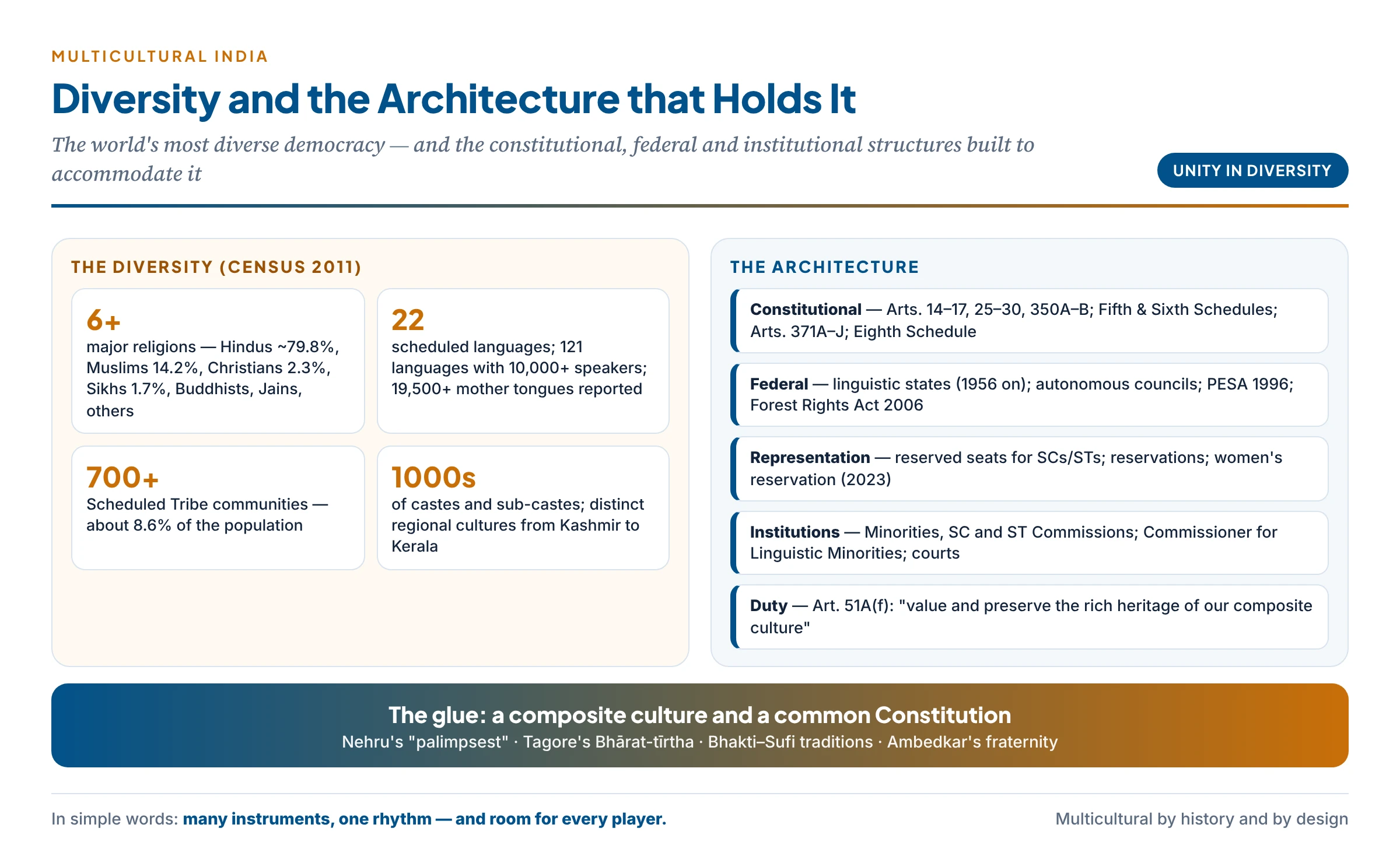
India’s diversity:
- Religion — Census 2011: Hindus about 79.8%, Muslims 14.2%, Christians 2.3%, Sikhs 1.7%, Buddhists 0.7%, Jains 0.4%, and others.
- Language — 22 scheduled languages, 121 languages with at least 10,000 speakers, and 19,500-plus mother tongues reported (Census 2011).
- Tribes — over 700 Scheduled Tribe communities (8.6% of the population).
- Caste, region, ecology — thousands of castes and sub-castes; regional cultures from Kashmir to Kerala, Kutch to Kohima.
India’s multicultural architecture (see Articles 5 and 7):
- Constitutional — Articles 14–17, 25–30, 350A–350B; the Fifth and Sixth Schedules; Articles 371A–371J; the Eighth Schedule; Article 51A(f) — the duty to “value and preserve the rich heritage of our composite culture“.
- Federal — linguistic reorganisation of states (from 1956); autonomous district councils; PESA (1996) and the Forest Rights Act (2006) for tribal self-governance.
- Representation — reserved seats for SCs and STs; reservation in education and jobs; women’s reservation (106th Amendment, 2023, to take effect after the next delimitation).
- Institutions — National Commission for Minorities, National Commissions for SCs and STs, the Commissioner for Linguistic Minorities.
- Civic culture — “unity in diversity”, the composite culture of shared festivals, saints, music, architecture and languages (Hindustani, Indo-Islamic art, Bhakti–Sufi traditions).
Two classic images of India’s composite identity:
- Nehru (The Discovery of India): India was “like some ancient palimpsest on which layer upon layer of thought and reverie had been inscribed, and yet no succeeding layer had completely hidden or erased what had been written previously.”
- Tagore (Bhārat-tīrtha): on the shores of India, “Aryans and non-Aryans, Dravidians and Chinese, Śakas, Huns, Pathans and Mughals” came and merged into one body.
Challenges Faced by Multicultural India
- Communalism — religious polarisation, riots, hate speech and mob violence (the Supreme Court issued guidelines against lynching in Tehseen Poonawalla, 2018).
- Caste — untouchability, atrocities, endogamy and the caste basis of politics; caste is the oldest internal challenge to fraternity.
- Regionalism and linguistic tensions — “sons of the soil” movements, hostility to migrant workers, disputes over Hindi and the three-language formula, inter-state river disputes.
- The North-East — insurgencies, demands for autonomy, ethnic clashes (the Meitei–Kuki conflict in Manipur since 2023), questions of indigenous identity and migration (the NRC in Assam).
- Tribal marginalisation — displacement by dams and mines, forest-rights conflicts, the Naxal insurgency in tribal belts.
- Majoritarianism and minority insecurity — fear among minorities of second-class status; debates over citizenship (the Citizenship (Amendment) Act, 2019), conversion and inter-faith marriage laws.
- Personal laws and gender justice — the conflict between community autonomy and women’s rights (Shah Bano, triple talaq, Sabarimala), and the Uniform Civil Code debate revived by the state codes of 2024–26.
- Group rights versus individual rights — internal restrictions, hollow exit rights, community leaders speaking for members (Article 8).
- Identity politics and criminalisation — voting on identity alone, allowing law-breakers to become lawmakers.
- Economic inequality along identity lines — poverty concentrated among Dalits, Adivasis and some minorities turns cultural difference into resentment.
- Globalisation and homogenisation — consumer culture and English threaten local languages, crafts and ways of life, while also provoking revivalist reactions.
Responses:
- Constitutional morality (Ambedkar) — courts and institutions enforcing equal citizenship.
- Federal flexibility — autonomy arrangements for regions and tribes.
- Inclusive development — education, employment and welfare reaching the excluded.
- Dialogue and composite culture — inter-faith initiatives, shared festivals, school curricula that teach diversity.
- Firm law and order against hate crimes, with fair policing.
- Gender-just reform with consent — reform of personal laws through consultation.
In simple words
India is like a big orchestra with sitars, tablas, violins, drums and flutes. The challenge is not that the instruments are different — that is what makes the music rich. The challenge is when one instrument tries to drown the others, when some players are not allowed to play at all, or when there is no common rhythm. Multicultural India needs a common rhythm (the Constitution) and room for every instrument.
Ambedkar’s “Social Endosmosis” and the Politics of Difference
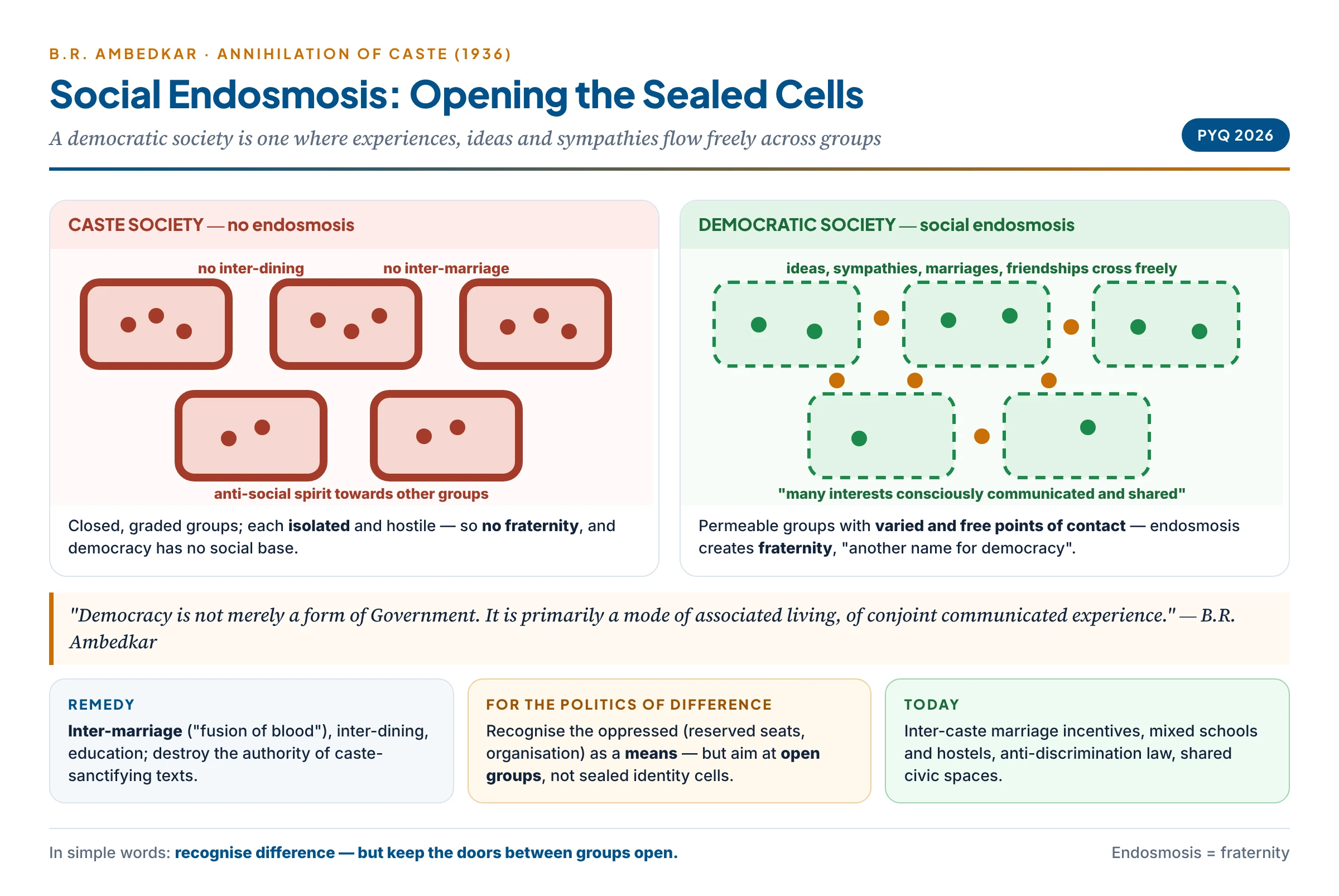
The idea. In Annihilation of Caste (1936), Ambedkar, drawing on his teacher John Dewey, described an ideal society as one in which there are “many interests consciously communicated and shared” and “varied and free points of contact with other modes of association” — in a word, social endosmosis: the free flow of experiences, ideas and sympathies across groups, as fluids pass through a permeable membrane.
- Why caste is the enemy. Caste divides Hindus into closed, isolated groups — no inter-dining, no inter-marriage, no shared life. Each caste becomes anti-social towards the others; there is no endosmosis, hence no fraternity, hence no real democracy.
- The remedy. “The real remedy for breaking caste is inter-marriage. Fusion of blood can alone create the feeling of being kith and kin.” He also called for inter-dining, the destruction of the authority of the śāstras that sanctify caste, and education.
- Democracy as associated living. For Ambedkar, democracy is “primarily a mode of associated living, of conjoint communicated experience” — endosmosis is the social basis of political democracy.
Relevance to today’s debates on identity and the politics of difference:
- A warning against hardened identities. The politics of difference (Young, Taylor) asks that group identities be recognised. Ambedkar warns that identities can become sealed cells — if recognition hardens boundaries, it repeats the logic of caste. Endosmosis is a test: does a policy open groups to each other or close them?
- But recognition of the oppressed is necessary. Ambedkar himself demanded separate political recognition for the Depressed Classes (separate electorates, then reserved seats under the Poona Pact) and organised them as a political force. Recognition of Dalit identity was a means; endosmosis and fraternity were the end.
- Against “plural monoculturalism”. Ambedkar’s endosmosis matches Sen’s critique: real multiculturalism means interaction and choice, not separate boxes.
- Internal critique of culture. Unlike conservative multiculturalism, Ambedkar did not treat every tradition as worthy of protection; he asked the oppressed to leave degrading traditions (the point made above) — the right to exit and to reinterpret culture (his Navayāna Buddhism).
- Policy today — inter-caste marriage incentives, mixed residential schools and hostels, anti-discrimination law, shared civic spaces — all apply endosmosis.
Indian Connect — Indian Connect — endosmosis and composite culture
- India’s composite culture (Article 51A(f)) is endosmosis in history: Bhakti and Sufi poets, Hindustani music, shared shrines (dargahs visited by all faiths).
- Ambedkar’s point is that caste blocks this flow even within one religion — so India’s multiculturalism must fight internal walls as much as celebrate external diversity.
Should Indian Cultural Identity Integrate Multiculturalism and Respect for the Dignity of Each Person?
Yes — for these reasons:
- India’s identity is already multicultural — Nehru’s palimpsest, Tagore’s Bhārat-tīrtha, the composite culture of Article 51A(f); a monocultural “pure” identity would be historically false.
- Unity requires recognition — a nation of many languages, faiths and tribes holds together only if every group feels it belongs (failure of recognition breeds secession — Bangladesh 1971).
- “Purification” degenerates — insulating Indian culture from others risks moral degeneration, as some have warned; cultures grow by exchange (Parekh, Tagore).
- Dignity of each person is the constitutional core — the Preamble promises “the dignity of the individual“; Article 21 protects a life of dignity (Maneka Gandhi, 1978; Puttaswamy, 2017, on privacy; Navtej Singh Johar, 2018, on the dignity and identity of LGBT persons).
- Dignity checks culture — multiculturalism without individual dignity can protect caste, patriarchy and untouchability; dignity without multiculturalism can become uniformity imposed by the majority. Each needs the other.
In simple words
A good Indian wedding welcomes relatives from every side, every custom and every cuisine — that is multiculturalism. But if one custom says the bride may not refuse, or a guest may not eat because of his caste, the celebration must change. Diversity is welcomed; humiliation is not — that is what “dignity of each person” adds.
Qualifications:
- Dignity is the limit — no cultural practice that denies a person’s dignity (untouchability, child marriage, honour killing, witch-hunting) can claim protection.
- Shared civic identity — integration of multiculturalism must not dissolve the common bond of the Constitution.
- Indian traditions supply both — vasudhaiva kuṭumbakam and anekāntavāda for pluralism; the Buddha, the Bhakti saints, Gandhi and Ambedkar for the dignity of every person.
Conclusion: Indian cultural identity is best understood as a composite, multicultural identity anchored in the dignity of each person — “unity in diversity” with dignity as its keel.
Group Rights and Individual Rights in India — the Balance
- The tension — Articles 26, 29–30 (group autonomy, culture, minority institutions) and personal laws on one side; Articles 14, 15, 21 (equality, non-discrimination, dignity) on the other.
- Flashpoints — Shah Bano (1985), Sardar Syedna (1962, excommunication), Shayara Bano (2017), Sabarimala (2018; nine-judge reference, judgment reserved 2026), the hijab case (2022), the challenge to female genital cutting among Dawoodi Bohras (pending), the state UCCs (2024–26).
- India’s balancing methods — a constitutional floor of fundamental rights; civil alternatives (Special Marriage Act); judicial review; reform with consultation; protection of reformers within communities; minority institutions with reasonable regulation (T.M.A. Pai Foundation, 2002: minorities’ right to administer institutions is subject to regulations ensuring standards and fairness).
- Lesson (Article 8): shield, not cage — external protections for communities, internal freedom for individuals.
Critics and Defenders
Criticism — Critics
- European leaders (2010–11): multiculturalism produced parallel lives and weak national cohesion.
- Development economists: unmanaged ethnic fragmentation lowers public goods and growth.
- Okin and feminists: group autonomy shields patriarchal practices.
- Sen: plural monoculturalism reduces persons to one identity.
- Ambedkar’s warning: closed group identities destroy endosmosis and fraternity.
- Majoritarian nationalists: minority rights are appeasement and divide the nation.
Defence — Defenders and strengths
- Kymlicka: the “retreat” was rhetoric; multicultural policies continued and Canada shows they work.
- UNDP (2004) and Sen: cultural liberty is part of human development.
- Taylor and Parekh: recognition and dialogue strengthen, not weaken, common citizenship.
- India’s record: a democracy of unmatched diversity held together for over seventy-five years by federal and multicultural accommodation.
- Inclusive-institutions research: diversity becomes an asset where institutions are fair.
- Ambedkar’s own method: recognition of the oppressed as a means to fraternity.
Cross-Tradition Comparison
Western and Indian Multiculturalism
| Point | Western (Canada, Europe) | India |
|---|---|---|
| Source of diversity | Mainly immigration; indigenous peoples; national minorities | Ancient internal diversity — religion, language, caste, tribe, region |
| Main tension | Integration of immigrants (especially Muslims in Europe) | Communalism, caste, regionalism, tribal autonomy, personal laws |
| Instruments | Multiculturalism Acts, exemptions, integration programmes | Constitution (Arts. 25–30, 350A, Schedules), linguistic states, reservations |
| Recent trend | Retreat to “integration” and civic values | Debate over majoritarianism, UCC and minority rights |
| Philosophical resources | Taylor, Kymlicka, Parekh, Young | Ashoka, Akbar, Tagore, Gandhi, Ambedkar, anekāntavāda |
Humanism, Secularism and Multiculturalism Together
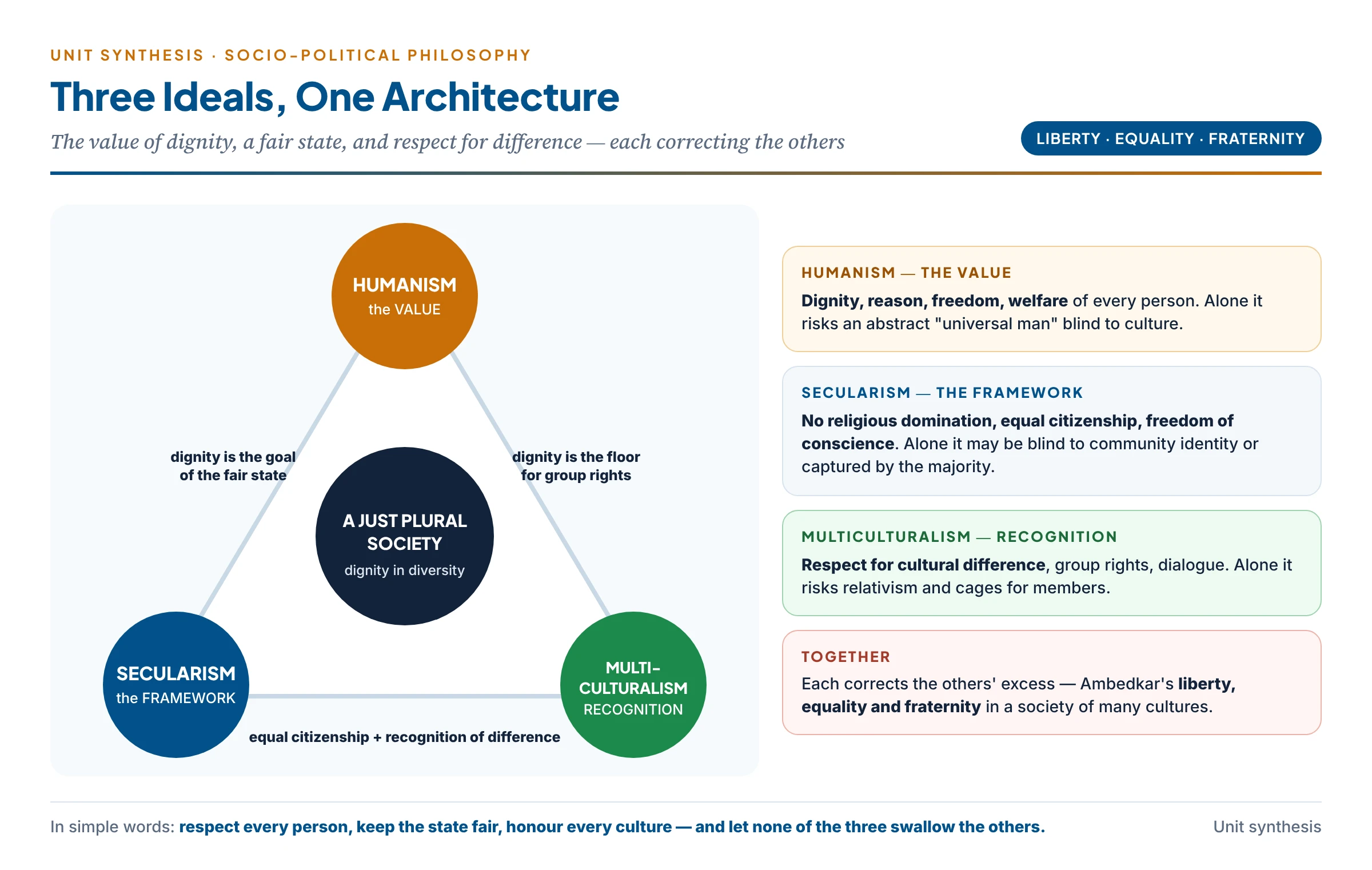
| Ideal | What it contributes | Its danger if alone | Corrected by |
|---|---|---|---|
| Humanism | The value: dignity, reason, freedom and welfare of every person | Abstract, “universal man” blind to culture; anthropocentric | Multiculturalism (cultural embeddedness), ecological and spiritual humanism |
| Secularism | The state framework: no religious domination, equal citizenship, freedom of conscience | Rigid separation blind to community identity; or capture by the majority | Multiculturalism (recognition), humanism (dignity as the goal) |
| Multiculturalism | The recognition of difference: cultural identity, group rights, dialogue | Relativism, cages for members, fragmentation | Humanism (dignity as floor), secularism (equal citizenship) |
Synthesis (Siddhānta)
- Boon or bane? Multiculturalism is a boon when liberal, dialogical and joined to economic justice and shared citizenship; a bane when it freezes identities, hands power to group elites or abandons common bonds. The issue is the management of diversity, not diversity itself.
- Development: diversity hinders progress only under exclusion and weak institutions; with inclusive institutions and cultural liberty, it is a source of innovation and human development.
- Europe’s retreat shows the need to combine recognition with integration and civic values; it does not show that recognition is wrong.
- India is the world’s most diverse democracy, with a remarkable constitutional architecture of accommodation — and serious challenges: communalism, caste, regionalism, the North-East, tribal marginalisation, majoritarian pressure, and the balance of group and individual rights.
- Ambedkar’s social endosmosis gives the politics of difference its necessary corrective: recognise the oppressed, but aim at open, communicating groups and fraternity, not sealed cells.
- Indian cultural identity should be a composite, multicultural identity with the dignity of each person as its keel.
- The unit as a whole: humanism gives the value (dignity), secularism gives the framework (a fair state), multiculturalism gives recognition (respect for difference). Together they form the normative architecture of a just plural society — in Ambedkar’s words, a society built on liberty, equality and fraternity.
- Contemporary relevance.
- Manipur and the North-East — ethnic identity, land and autonomy.
- Language policy — mother-tongue education and the three-language debate.
- State UCCs (2024–26) and the Sabarimala reference — the balance of group autonomy and individual rights.
- Migration and cities — integration of internal migrants, the everyday multiculturalism of Indian metros.
“India was like some ancient palimpsest on which layer upon layer of thought and reverie had been inscribed, and yet no succeeding layer had completely hidden or erased what had been written previously.” — Jawaharlal Nehru
Previous Year Questions
- 2026Examine the challenges faced by a multicultural society in creating a harmonious balance between group rights and individual rights.
- 2026How has Ambedkar applied the concept of ‘Social Endosmosis’ for annihilation of castes. Evaluate its relevance for contemporary debates on identity and the politics of difference.
- 2023Critically examine the challenges faced by a multicultural society with reference to India.
- 2018Do you subscribe to the view that Indian cultural identity needs to integrate the principles of multiculturalism and respect for the dignity of each person? Justify your answer.
- 2012What is multiculturalism? Can it be an impediment for development and progress? Discuss.
- 2008Is multiculturalism a boon or a bane? Discuss.