

- Non-metallic minerals contain no metal in the form that is extracted. Mica, limestone, dolomite, asbestos, magnesite, kyanite, sillimanite, gypsum, potash, sulphur and salt are the main ones treated here.
- Coal and petroleum are non-metallic too, but they are studied apart as mineral fuels.
- Few of them match the metallic ores in value, yet they supply large industries: cement, fertilizers, steel flux, refractories and electricals.
- Geology and climate set their pattern.
- Limestone follows the old sedimentary basins, including the Cuddapah and Vindhyan rocks.
- Soluble minerals such as limestone, gypsum and salts are scarce in areas of high rainfall, and gypsum and salt concentrate in the dry north-west and on the coast.
- Dolomite, mica and gypsum were declared minor minerals on 10 February 2015. Their latest national resource figures therefore date from 1 April 2015, and their output comes from partial State returns. Mica became a major mineral again on 20 February 2025. The other minerals here have 1 April 2020 inventories.
Mica and Limestone
Mica
- Mica is a naturally occurring non-metallic mineral based on a collection of silicates, known as abhrak in Ayurveda. It occurs in the veins of metamorphic rocks, chiefly pegmatites.
- It is common in igneous and metamorphic rock and occurs occasionally as small flakes in sedimentary rock.
- Main types in India: muscovite (white or potash mica), phlogopite (amber or magnesium mica) and biotite.
- Properties:
- Chemically inert and stable, and it does not absorb water.
- A unique combination of elasticity, toughness, flexibility and transparency. It splits along its layers into very thin sheets.
- A very good insulator, with a wide range of uses in the electrical and electronics industry. It withstands high voltage with a low power loss factor.
- Other uses: toothpaste and cosmetics, for its glittery look. It also acts as a mild abrasive in toothpaste.
Mica Reserves in India
- Mica is widely distributed. The most important mica-bearing rocks are in Andhra Pradesh, Maharashtra, Jharkhand, Odisha, Rajasthan and Bihar, with others in Gujarat, Haryana, Karnataka, Keralam (Kerala), Tamil Nadu and West Bengal.
- Total resources: 6,35,302 tonnes (1 April 2015), of which reserves are 1,14,433 tonnes. An earlier inventory gave 5,32,237 tonnes.
| State | Share of resources, older | Share of resources, 1 April 2015 |
|---|---|---|
| Andhra Pradesh | 41% | 41% |
| Rajasthan | 21% | 28% |
| Odisha | 20% | 17% |
| Maharashtra | 15% | 13% |
| Bihar | 2% | 2% |
| Jharkhand and Telangana | 1% together | a small quantity |
Mica Distribution in India
- Andhra Pradesh: long the largest mica producing State.
- Nellore district produces the best quality mica. Its belt is about 100 km by 25 km, and the mica is light green, often stained and spotted.
- Gudur taluka has the deep Shah mine, worked at about 300 m.
- Visakhapatnam, West Godavari and Krishna are other important districts.
- State returns show 16,822 tonnes in 2019-20 and 16,717 tonnes in 2020-21.
- Rajasthan: the second largest producer in classical accounts.
- The mica belt runs about 320 km from Jaipur to Bhilwara and around Udaipur, about 96 km wide on average. It broadens around Kumbhalgarh and Bhilwara.
- Bhilwara is the most important district. Jaipur, Tonk, Sikar, Dungarpur and Ajmer also produce.
- State returns rose to 42,600 tonnes in 2021-22, from 16,000 tonnes in 2019-20. These recent figures are not on the same basis as the older dressed-mica output.
- Jharkhand: the third largest producer in classical accounts.
- Mica lies in a belt about 150 km long and 32 km wide, running east-west from the Gaya district of Bihar through Hazaribagh and Koderma and on across Giridih and Munger to Bhagalpur.
- It is the country’s richest source of high-quality ruby mica.
- Kodarma was long described as the largest reserve of mica in the world. Kodarma, Giridih and Domchanch are the chief collecting centres, where mica is processed.
- Munger in Bihar also has sufficient deposits.
- Main centres of production in this belt: Kodarma, Dhorhakola, Domchanch, Dhab, Gawan, Tisri, Chakai and Chakapathal.
- Outside the belt, mica occurs in Dhanbad, Palamu, Ranchi and Singhbhum.
- Other occurrences:
| State | Districts |
|---|---|
| Karnataka | Mysuru, Hassan |
| Tamil Nadu | Coimbatore, Tiruchirappalli, Madurai, Kanniyakumari, Nilgiri, Salem |
| Keralam | Alappuzha (Alleppey), Kollam |
| Maharashtra | Ratnagiri |
| West Bengal | Purulia, Bankura |
| Gujarat | Banaskantha, Vadodara, Sabarkantha |
| Madhya Pradesh | Balaghat, Chhindwara |
| Chhattisgarh | Bilaspur, Bastar, Surguja |
| Uttar Pradesh | Mirzapur |
- Production trend:
- Output climbed from 772 tonnes in 1947-48 to a record 28,347 tonnes in 1960-61, and stood at only 1,807 tonnes in 2011-12, with Andhra Pradesh giving 93%.
- Plastics and synthetic substitutes, along with reconstituted mica, cut world demand for natural sheet.
Mica Exports
- India held a near monopoly of sheet mica for over a hundred years, and older accounts credit it with about 60% of world output and the place of largest exporter.
- Some grades of Indian mica stay essential to electrical manufacture worldwide.
- Exports still run high, as powder and scrap more than as sheet: 1,18,778 tonnes in 2023-24, of which powder was 76,315 tonnes and splittings 24,098 tonnes. Quantities were 28.4 thousand tonnes in 1960-61 and 126.4 thousand tonnes in 2013-14.
- Major exports are carried through Kolkata and Visakhapatnam ports.
- Older list of importers: Japan (19%), the USA (17%), the UK (7%), Norway (7%), then Russia, Poland, Germany and others.
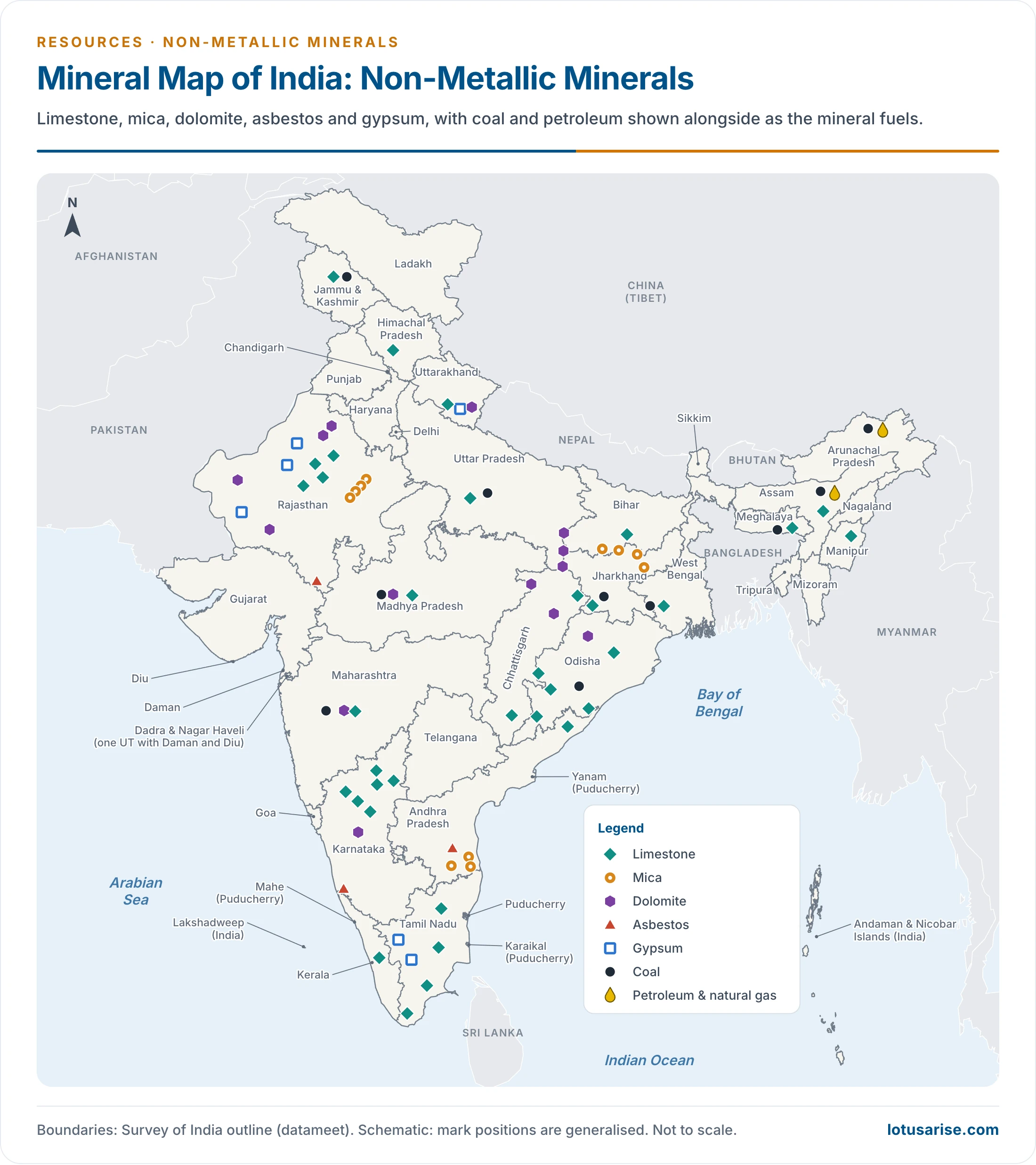
- Coal and petroleum in this legend are the mineral fuels, not part of the group described here.
Limestone
- Limestone is a rock made of calcium carbonate, calcium magnesium carbonate, or both. Silica, alumina, iron oxides, phosphorus and sulphur occur in it in small amounts.
- Deposits are sedimentary and appear in rocks of every age from the Pre-Cambrian to Recent, with the Gondwana as the one exception.
- The two most important constituents are calcite and dolomite.
- Uses, on the older break-up of consumption:
- Cement 75%, iron and steel 16%, chemicals 4%.
- The rest feeds fertilizers, paper, sugar, glass, rubber and ferromanganese.
- The latest output is even more one-sided: about 97.5% of limestone mined in 2023-24 was of cement grade.
Limestone Distribution in India
- Limestone holds the top position among non-fuel solid minerals by volume of annual extraction. Urban growth, housing and infrastructure keep raising demand.
- Total resources (1 April 2020): 2,27,589 million tonnes, of which 8% are reserves (19,028 million tonnes). An earlier inventory gave about 1,84,935 million tonnes. Portland cement grade is about 68%.
| State | Share of resources, older | Share of resources, 1 April 2020 |
|---|---|---|
| Karnataka | 28% | 24% |
| Andhra Pradesh | 11% | 13% |
| Rajasthan | 11% | 12% |
| Gujarat | 11% | 10% |
| Meghalaya | in others | 10% |
| Telangana | 9% | 7% |
| Chhattisgarh | 5% | 5% |
| Madhya Pradesh | 4% | 4% |
| Others | 21% | 15% |
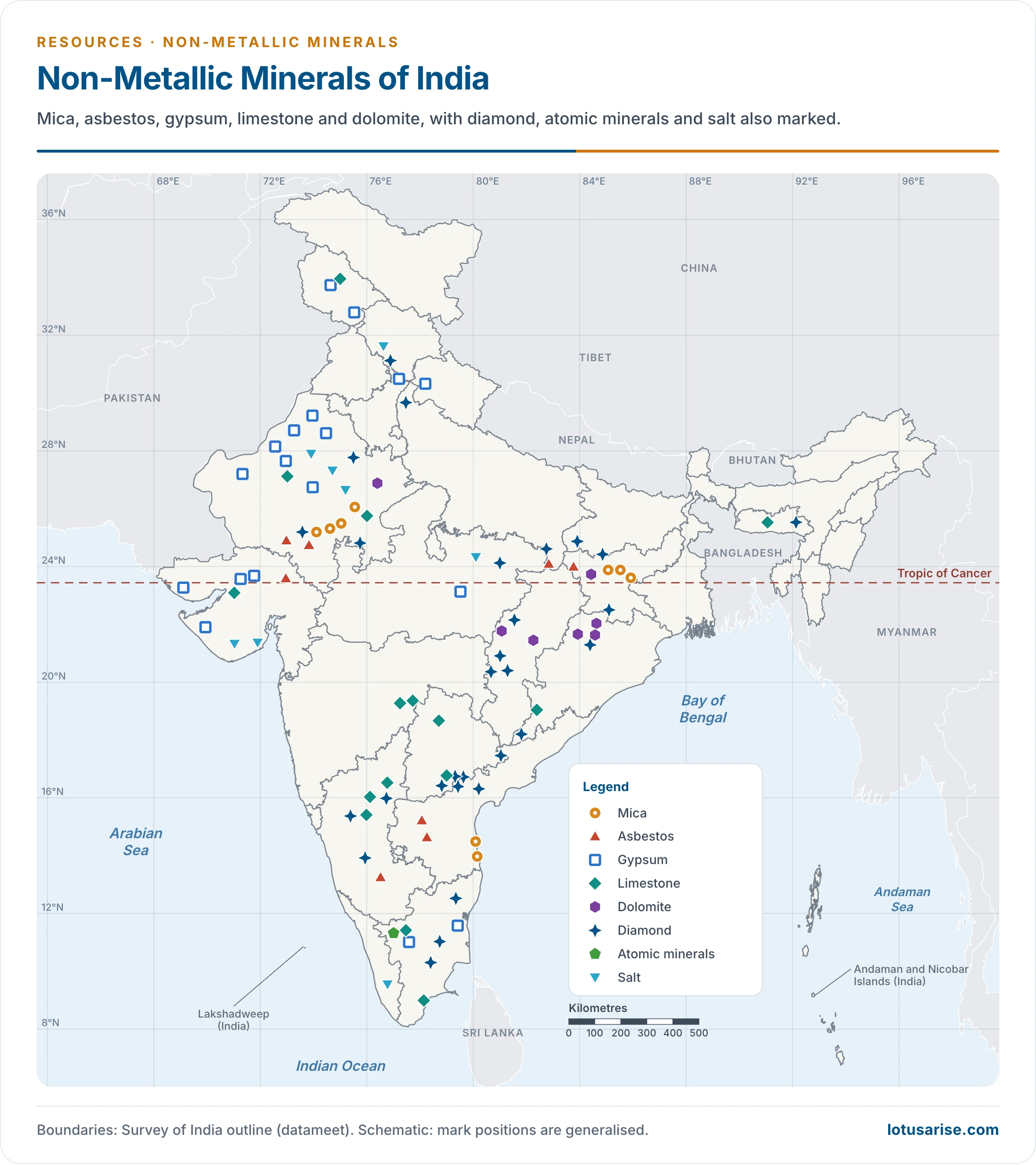
- This map also marks diamond, atomic minerals and salt, which do not belong to this section.
Limestone Production
- Production: 30.2 million tonnes (1980-81), 256.6 million tonnes (2011-12), 392 million tonnes (2021-22), 406 million tonnes (2022-23) and 452 million tonnes (2023-24). In 2023-24 India also imported 33.8 million tonnes.
| State | Share, 2014-15 | Share, 2023-24 | Major districts |
|---|---|---|---|
| Rajasthan | 21% | 22.9% | Jhunjhunu, Banswara, Jodhpur, Ajmer, Bikaner, Dungarpur, Kota, Tonk, Alwar, Sawai Madhopur, Nagaur, Sirohi, Bundi, Chittaurgarh, Udaipur, Pali |
| Madhya Pradesh | 13% | 13.8% | Jabalpur, Satna, Betul, Sagar, Damoh, Rewa |
| Andhra Pradesh | 12% | 13.5% | Kadapa (Cuddapah), Kurnool, Guntur, Krishna |
| Chhattisgarh | 8% | 10.9% | Bastar, Bilaspur, Raigarh, Raipur, Durg |
| Karnataka | 8% | 9% | Kalaburagi (Gulbarga), Chitradurga, Tumakuru, Belagavi, Vijayapura (Bijapur), Mysuru, Shivamogga |
| Tamil Nadu | 8% | 5.9% | Ramanathapuram, Tirunelveli, Tiruchirappalli, Salem, Coimbatore, Madurai, Thanjavur, Ariyalur |
| Telangana | 8% | 5.8% | Nalgonda, Adilabad, Warangal, Mahabubnagar, Karimnagar |
| Gujarat | 9% | 5.2% | Amreli, Kachchh, Surat, Junagadh, Kheda, Panchmahals, Banaskantha |
| Others | 5% | about 13% | Maharashtra, Himachal Pradesh, Meghalaya, Odisha and others |
- Others, 2014-15: Meghalaya, Odisha, Uttar Pradesh, Jharkhand, Assam, Keralam, Bihar, and Jammu & Kashmir gave the remaining 5%. In 2023-24 Maharashtra and Himachal Pradesh lead this group.
- Further districts:
- Maharashtra: Yavatmal, Chandrapur, Nanded and Ahmednagar.
- Odisha: Sundargarh, Sambalpur and Kalahandi.
- Jharkhand: Palamu, Hazaribagh, Ranchi and Singhbhum.
- Himachal Pradesh: Bilaspur, Kangra and Chamba.
- Meghalaya: Garo, Khasi and Jaintia hills.
- Uttar Pradesh: Mirzapur and Sonbhadra. Uttarakhand: Dehradun and Mussoorie. Jammu and Kashmir: Anantnag and Jammu.
- Cement-grade concentration: Kurnool, Kadapa and adjoining Andhra Pradesh, along with Kalaburagi, Vijayapura and Shivamogga in Karnataka, hold much of the cement-grade stone. Most Tamil Nadu deposits outside Salem are also of cement grade.
Other Non-Metallic Minerals
Dolomite
- Dolomite is an anhydrous carbonate mineral of calcium magnesium carbonate, ideally CaMg(CO₃)₂.
- The term also means a sedimentary carbonate rock composed mostly of that mineral. Another name for the rock is dolostone.
- Dolomite rock that also has calcite, or a mix of calcite and magnesite, is called dolomitic limestone.
- A classical rule: limestone with more than 10% magnesium is called dolomite, and at 45% it is true dolomite.
- Uses: mainly blast furnace flux, a source of magnesium salts, refractories, and the making of fertilizer and glass.
- Iron and steel take about 90%, with fertilizer next (4%), and ferro-alloys and glass (2% each).
- Dolomite is widely distributed in all parts of the country.
Dolomite Distribution in India
- Total resources (1 April 2015): 8,415 million tonnes, of which reserves are 677.8 million tonnes. An earlier inventory gave 7,730 million tonnes.
- Madhya Pradesh 27%, Andhra Pradesh 15%, Chhattisgarh 11%, Odisha 10%, Karnataka and Rajasthan 7% each, Gujarat 6%, Maharashtra 5%.
| State | Share of output, 2014-15 | Main districts |
|---|---|---|
| Chhattisgarh | 39% | Bastar, Bilaspur, Durg, Raigarh |
| Andhra Pradesh | 11% | Anantapur, Kurnool |
| Karnataka | 10% | Belagavi, Vijayapura, Chitradurga, Mysuru, Uttara Kannada, Tumakuru |
| Madhya Pradesh | 9% | Along the Vindhya Range |
| Telangana | 8% | Khammam |
| Odisha | 7% | Sundargarh, Sambalpur, Koraput |
| Gujarat | 6% | Junagadh, Kheda, Jamnagar, Amreli |
| Rajasthan | 6% | Ajmer, Alwar, Bhilwara, Jaipur, Jaisalmer, Jhunjhunu, Jodhpur, Nagaur, Pali, Sikar, Udaipur |
| Jharkhand, Maharashtra, Uttarakhand | 4% together | Jharkhand: bands north of Chaibasa in Singhbhum, and Palamu |
- Variation by year: in 2011-12 Chhattisgarh gave about 30% and Odisha about 22%. Recent State returns are partial: Andhra Pradesh about 21.3 lakh tonnes (2020-21) and Odisha about 15.5 lakh tonnes (2021-22).
- Odisha (Orissa): Birmitrapur alone was credited with 256 million tonnes of recoverable dolomite. In the Gangapur area, beds near Sukra run for about 100 km.
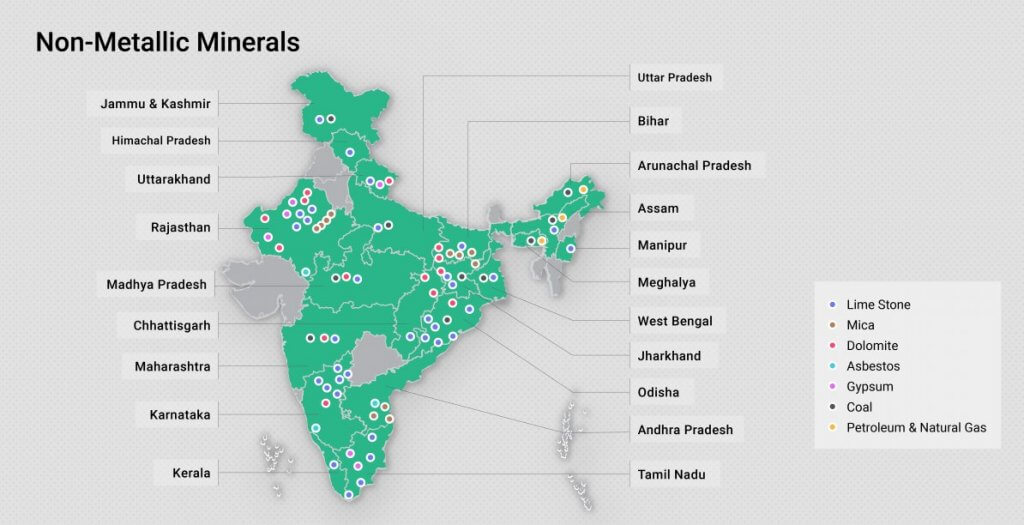
- On this map, “Meghalya” is Meghalaya.
Asbestos
- Asbestos is a group of six naturally occurring fibrous silicate minerals.
- It is commercially important for its fibrous character, infusibility, low heat conductivity and high resistance to electricity, sound and corrosion by acids.
- Two quite different minerals fall under the name:
- A variety of amphibole, resembling tremolite.
- A fibrous variety of serpentine (chrysotile), the more important, and about 80% of commercial asbestos.
- Its great value lies in its fibrous structure, filaments of high tensile strength and great resistance to fire.
- Uses:
- Fireproof cloth, rope, paper, millboard and sheeting.
- Aprons, gloves and brake linings in automobiles.
- Asbestos cement sheets, pipes and tiles for building.
- Brittle asbestos makes filter pads for acids, and with magnesia it makes magnesia bricks for heat insulation.
- Health hazard: breathing its fibres raises the risk of mesothelioma, asbestosis and lung cancer.
Asbestos Distribution
- Total resources (1 April 2020): 22.90 million tonnes, all remaining resources.
- Rajasthan 13.61 million tonnes (59%) and Karnataka 8.28 million tonnes (36%). Older shares were 13.6 million tonnes (61%) and 8.28 million tonnes (37%), with the remaining two percent elsewhere.
- The remaining 5% lies in Jharkhand, Andhra Pradesh, Odisha and Uttarakhand.
- Occurrences:
- Rajasthan: Udaipur, Dungarpur, Alwar, Ajmer and Pali.
- Andhra Pradesh: fine quality in Pulivendla taluk of Kadapa (Cuddapah) district, especially in a zone of about 15 km between the Chitravati and Papaghni rivers.
- Karnataka: Hassan, Mandya, Shimoga, Mysore and Chikmaglur.
- Jharkhand: Singhbhum district.
- Uttarakhand: Chamoli district.
- Production has ended.
- Output was 42,699 tonnes in 1993-94 and fell to 280 tonnes in 2011-12.
- India has no working asbestos mine, and none reported output in 2022-23 or 2023-24.
- All demand is met by imports of 4,65,449 tonnes in 2023-24, from Russia, Kazakhstan, Brazil, China and others.
Magnesite
- Magnesite is a carbonate of magnesium, formed when dunite (peridotite) and similar magnesian rocks are altered.
- Uses: primarily refractory bricks.
- It is also the ore of metallic magnesium, a bonding agent in abrasives, and an ingredient of special cement for artificial stone and tiles.
- Steelmaking consumes it too.
- Total resources (1 April 2020): about 459 million tonnes, with 66 million tonnes of reserves. An earlier inventory gave about 335 million tonnes.
- Major deposits: Uttarakhand (Uttaranchal) 52%, Tamil Nadu 34% and Rajasthan 12%.
- Smaller resources: Andhra Pradesh, Himachal Pradesh, Jammu & Kashmir, Karnataka and Keralam.
- Tamil Nadu’s ore carries little lime and much silica. Uttarakhand’s is the reverse.
- Tamil Nadu is the largest producer. It has one of the largest deposits in the world and the largest in India, at the Chalk Hills near Salem town.
| State | Share of output, 2014-15 | Output, 2023-24 (tonnes) | Share, 2023-24 |
|---|---|---|---|
| Tamil Nadu | 78% | 78,085 | about 59% |
| Uttarakhand | 19% | 47,104 | about 36% |
| Karnataka | 3% | 6,816 | about 5% |
| India | 1,32,005 |
- Trend: output rose from 1.19 lakh tonnes (1951) to a peak of 5.28 lakh tonnes (1990-91), and dropped to 2.17 lakh tonnes (2011-12).
- Other deposits:
- Uttarakhand: Almora, with a belt about 3.2 km long, and Chamoli, Bageshwar and Pithoragarh.
- Karnataka: Hassan, Mysuru and Kodagu.
- Rajasthan: Ajmer, Udaipur and Pali. Himachal Pradesh: Chamba. Jammu and Kashmir: Udhampur.
Kyanite
- Kyanite is a mineral of metamorphic rocks rich in aluminium.
- It goes mainly into refractories, metallurgy, ceramics, electricals, glass and cement, because it withstands high temperatures. Heating forms mullite, the basis of high-alumina furnace linings.
- It is also used in making spark plugs in automobiles.
- India has long been credited with the world’s largest kyanite deposits. It has all three commercial grades, and quality rises with alumina content:
- First grade 62–64%, second grade 58–62% and third grade 54–58%.
- Almost all resources are now low grade or kyanite rock: high and medium grade together are only about 1.4%.
- Total resources (1 April 2020): 105.68 million tonnes, of which only 0.84 million tonnes are reserves.
| State | Share of resources, older | Share of resources, 1 April 2020 |
|---|---|---|
| Telangana | 47% | 45.75% |
| Andhra Pradesh | 31% | 30.28% |
| Karnataka | 13% | 12.47% |
| Jharkhand | 6% | 7.83% |
| Keralam, Maharashtra, Rajasthan, Tamil Nadu, West Bengal | 3% | 3.67% |
- Producers:
- Jharkhand, Maharashtra and Karnataka long gave practically the whole of Indian output, and in 2011-12 Jharkhand gave about 98%.
- Output is now tiny and has shifted: 3,324 tonnes in 2023-24, about 94% from Maharashtra and the rest from Jharkhand.
- Major deposits:
- Saraikela in Jharkhand, where a bed of about 130 km runs from Lapsa Buru to Kharsawan. Once the world’s largest and best, it is nearly exhausted.
- Bhandara and Nagpur districts in Maharashtra.
- Chikkamagaluru (Chickmaglur), Chitradurga, Mandya, Mysuru, Dakshina Kannada (Dakshin Kannad) and Shivamogga in Karnataka.
- Smaller: Odisha (Dhenkanal, Sundargarh, Mayurbhanj), Rajasthan (Udaipur, Bhilwara, Dungarpur), Tamil Nadu (Kanniyakumari, Tiruchirappalli), Andhra Pradesh (Nellore) and Telangana (Khammam).
Sillimanite
- Sillimanite closely resembles kyanite in both occurrence and use. Its main use is in refractory bricks.
- The main concentrations are in Tamil Nadu, Odisha (Orissa), Keralam, Andhra Pradesh and West Bengal.
- Total resources (1 April 2020): 72.27 million tonnes, of which 8.26 million tonnes are reserves. Granular high grade is about 74%.
| State | Share of resources, older | Share of resources, 1 April 2020 |
|---|---|---|
| Odisha | 20% | 24.50% |
| Tamil Nadu | 26% | 24.01% |
| Uttar Pradesh | 17% | 15.84% |
| Andhra Pradesh | 14% | 15.31% |
| Keralam | 11% | 9.57% |
| Assam | 7% | 6.37% |
| Jharkhand, Karnataka, Madhya Pradesh, Maharashtra, Meghalaya, Rajasthan, West Bengal | 5% | 4.39% |
- Major deposits:
- Ganjam district in Odisha.
- Kozhikode, Palakkad, Ernakulam and Kottayam districts in Keralam, where beach sands hold about 5–6% sillimanite.
- Bhandara district in Maharashtra.
- Udaipur district in Rajasthan.
- Hassan, Mysuru and Dakshina Kannada districts in Karnataka.
- Smaller: Meghalaya (Khasi hills), Assam (Karbi Anglong), Madhya Pradesh (Sidhi), West Bengal (Darjeeling, Bankura, Purulia).
- Production: older accounts gave Odisha about 56% and Keralam about a third. Reported mine output in 2023-24 was only 771 tonnes, all from Maharashtra, as an associate of kyanite.
Gypsum
- Gypsum is hydrated calcium sulphate, white and opaque or transparent. Its beds lie among limestones, sandstones and shales.
- Uses:
- Mainly ammonium sulphate fertilizer and the cement industry, where it makes up 4–5% of cement.
- Plaster of Paris, moulds in the ceramic industry, tiles and plastics.
- In agriculture, spread on the surface to hold soil moisture and help nitrogen uptake.
- Total resources (1 April 2015): 1,330 million tonnes, of which 37 million tonnes are reserves. An earlier inventory gave 1,286 million tonnes.
- Rajasthan 81%, Jammu & Kashmir 14% and Tamil Nadu 2%. The remaining 3% is in Gujarat, Himachal Pradesh, Karnataka, Uttarakhand, Andhra Pradesh and Madhya Pradesh.
- About 80% is fertilizer or pottery grade, and 13% cement or paint grade.
- Rajasthan dominates output.
- Its share was once given as 81%, then over 90% (2011-12), and about 99% by 2014-15.
- Latest State returns: 35.47 lakh tonnes in 2021-22, after 67.88 lakh tonnes in 2020-21.
- Main deposits: Tertiary clays and shales at Jodhpur, Nagaur and Bikaner. Jaisalmer, Barmer, Churu, Pali and Ganganagar also have gypsum-bearing rocks.
- Elsewhere, in classical order of production:
- Tamil Nadu: Tiruchirappalli district.
- Jammu and Kashmir: Baramula, Doda and Uri.
- Gujarat: Bhavnagar, Junagadh, Jamnagar and Kachchh.
- Uttar Pradesh, with the former hill districts now in Uttarakhand: Tehri Garhwal, Dehradun and Mussoorie.
- Smaller: Andhra Pradesh (Nellore, Guntur, Prakasam), Himachal Pradesh (Spiti, Sirmaur, Chamba), Karnataka (Kalaburagi) and Madhya Pradesh (Shahdol).
- By-product gypsum now exceeds mineral gypsum in quantity.
- Marine gypsum comes from salt pans, mainly in Gujarat and Tamil Nadu.
- Phospho-gypsum, fluoro-gypsum and boro-gypsum come from chemical plants.
Potash
- Potash is the common name of the fertilizer form of potassium (K), which is abundant in nature. Potassium is one of the three primary crop nutrients, and over 90% of potash goes into fertilizer. It is on India’s list of critical minerals.
- Total resources (1 April 2020): 23,091 million tonnes, all in the remaining-resources category.
- Rajasthan about 89%, Madhya Pradesh 5%, Uttar Pradesh 4%, Bihar and Jharkhand about 1% each. Older shares were Rajasthan 94%, Madhya Pradesh 5% and Uttar Pradesh 1%.
- Polyhalite makes up about 70%, with glauconite and sylvite much smaller.
- Production: the Indian occurrences have not been commercially worked, and no potash production is reported.
- The entire fertilizer requirement is met by imports: about 3.43 million tonnes of potash fertilizer in 2023-24.
- Occurrences:
- Evaporites: the Nagaur-Ganganagar basin in Rajasthan, Tso Kar in Ladakh, the Little Rann of Kachchh, and Rohtak and Sirsa in Haryana.
- Glauconite sandstones and shales:
- Madhya Pradesh: Satna and Sidhi.
- Uttar Pradesh: Sonbhadra, Banda and Mirzapur.
- Rajasthan: Jaisalmer, Chittorgarh, Kota, Karauli and Barmer.
Sulphur
- India has no mineable elemental sulphur reserves. Native sulphur resources are only about 0.21 million tonnes, all inferred, in the Puga Valley of Ladakh.
- Pyrites were used as a substitute for sulphur in sulphuric acid manufacture.
- Pyrite resources stand at 1,674 million tonnes (1 April 2020), about 94% of them in Bihar.
- The Saladipura unit in Rajasthan and the Amjhore unit in Bihar were closed in 2002–03, and there has been no pyrite production activity since 2003.
- Domestic elemental sulphur is a by-product, recovered from petroleum refineries and from fuel oil used as fertilizer feedstock.
- Output was 9,76,615 tonnes in 2023-24, led by Odisha (26%), Keralam (22%), Haryana (17%) and Gujarat (14%).
Salt
- Salt is obtained from seawater, brine springs (salt water springs), wells, salt pans in lakes and rocks. Sea salt is about 82% of Indian output.
- India is the world’s third-largest producer of salt, after China and the USA, with about 280 lakh tonnes in 2022-23. It became self-sufficient in 1953.
- Gujarat is the leading State, at about 87%, a far larger share than the “nearly half” of older accounts.
- Rajasthan gives about 6%, from Sambhar and other lakes, and Tamil Nadu about 4.7%.
- Others: Andhra Pradesh, Maharashtra, West Bengal, Karnataka, Odisha and Goa.
- Rock salt is worked at Mandi in Himachal Pradesh, and older accounts also place it in Gujarat.
- It is under 1% of Indian salt. The Mandi mine gave 1,002 tonnes in 2022-23 and nothing in 2023-24.
- It holds only about 68% sodium chloride, so it goes to cattle feed rather than to table use.
Previous Year Questions
2021Map item: Koderma





 History Optional Mains Master Kit 2027 Complete Self-Study System — Notes, Mapping & Premium Articles by LotusArise IAS
 History Optional PYQ Master Pack: Topic-wise Model Answers (1985–2025) by LotusArise IAS
Thank you so much for such a good information may God bless you
Notes all subjects
content is so good sir,kindly update the data as these are of 2014-15 ,very old..not relevant now