

Reason, Revelation and Faith.
Official Syllabus: Paper II, Section B, Unit 5
Many people in history have claimed that God spoke to them — prophets, saints, visionaries, and also cult leaders and impostors. Their messages often disagree. So the believer and the philosopher face the same question: how can a claim to revelation be justified? Does revelation need confirmation from outside, or does it carry its own authority? This article sets out the problem, the main criteria proposed for genuine revelation, the views of Aquinas, Locke, Hobbes, Hume and Kant, the relation of faith and revelation as correlatives, whether reason can justify revelation at all — and finally compares the Western idea of revelation with the Indian śruti, which in its leading schools has no divine author at all.
In simple words
Suppose a letter arrives saying, “This is from the Prime Minister.” Before acting on it you would check the seal (outside signs), see whether its contents are consistent and sensible, whether it asks you to do something wrong, and whether others who received such letters found them genuine. You would not simply trust the letter because it says it is from the Prime Minister — that would be going in a circle. Claims to revelation face exactly the same tests.
Context & Problem
Why Revelation Needs Justifying
- Revelation transcends reason: its content lies beyond the categories of ordinary thought, so reason cannot simply check it as it checks a scientific claim.
- Revelation is second-hand for most believers: it is usually passed on through authoritative records — scriptures, traditions — whose contents the believer cannot verify for himself. Only the prophet had the revelation; everyone else has testimony about it.
- The Hellenistic challenge: Judaism, Christianity and Islam grew up in contact with Greek culture, which held up rationally certified knowledge as the basis of the good life. They had to ask: can assent to an authoritative revelation be justified before the bar of reason?
- Three historical answers:
- Fideist (faith-based): reason must in all things submit to revelation.
- Rationalist: reason has primacy; revelation is reinterpreted to agree with science and philosophy.
- Thomist (Aquinas): keep the primacy of faith without sacrificing the dignity of reason.
- The western tension is sharpest because revelation there comes not only in books but in prophetic words demanding definite assent and often a precise course of action; the ambiguities of scripture are settled by creeds and dogmas calling for the believer’s assent.
- In India: Buddhism allows some scope for individual reason to criticise authoritative writings (though it faces the charge that its illumination may be illusory); orthodox Hindus, giving full authority to the Veda, hold that human reason errs whenever, on the ground of perception, it takes issue with scripture in its own sphere.
The Philosophical Problems of Revelation
- Meaningless to the unbeliever — revelation or śruti has no force for one who has no faith in God or the supernatural; and the source, God, is itself a debatable issue.
- Unverifiable — it cannot be checked by experiment or observation, and is intensely subjective; this affects its credibility.
- Contradiction and inconsistency — scriptures vary and even contradict each other, and even within one religion there are differences; it becomes hard to judge which is the certain truth.
- No place for reason — authority replaces argument.
- Strengthens blind faith — since its authenticity does not rest on evidence, it can feed superstition in society.
- Circularity — “the book is authoritative because it is God’s word, and it is God’s word because the book says so.”
- Impostors and delusions — false prophets, self-deception, illness and ambition can all produce sincere but false claims.
Core Doctrine
Does Revelation Need Confirmation?
Answer 1 — No: revelation authenticates itself
- Mīmāṃsā: all knowledge is intrinsically valid (svataḥ prāmāṇya) — it is accepted unless defeated. The Veda, being authorless, has no speaker whose defects (ignorance, deceit, carelessness) could spoil it; so it needs no outside confirmation.
- Calvin: scripture is confirmed by the inner testimony of the Holy Spirit (testimonium Spiritus Sancti internum) — the believer is assured from within, not by external proofs.
- Karl Barth: God’s Word creates its own hearing; to test it by a human standard would be to put man above God.
- Kierkegaard: a revelation proved by evidence would leave no room for faith (Article 6).
- Strength: it respects the transcendence of revelation — what comes from beyond cannot be measured by what is below.
- Weakness: every claimant can say the same — the Veda, the Qur’ān, the Book of Mormon, a cult leader’s vision. Self-authentication cannot decide between rival claims.
Answer 2 — Yes: revelation needs confirmation
- Aquinas: reason can see the credibility of revelation through the external signs God has given it — especially prophecies and miracles (and, he adds, the astonishing spread of the faith). Reason does not prove the content (the Trinity), but it shows that believing is reasonable. Reason also lets the believer understand, in some measure, the revealed mysteries.
- Locke: reason must decide whether something is a revelation and what its words mean (below).
- Hobbes: a man’s report of a private revelation obliges no one else to believe him (below).
- Kant: no alleged revelation can be accepted if it contradicts the moral law (below).
- Strength: it protects believers from fraud, delusion and fanaticism.
- Weakness: if the test is human reason, does revelation still have any authority of its own? The intellectualist position also overlooks the qualitative difference between faith — a trans-rational assent to mystery — and scientific knowledge, which works within the categories of objective reason.
The Criteria of Genuine Revelation — What Justifications Are Possible?
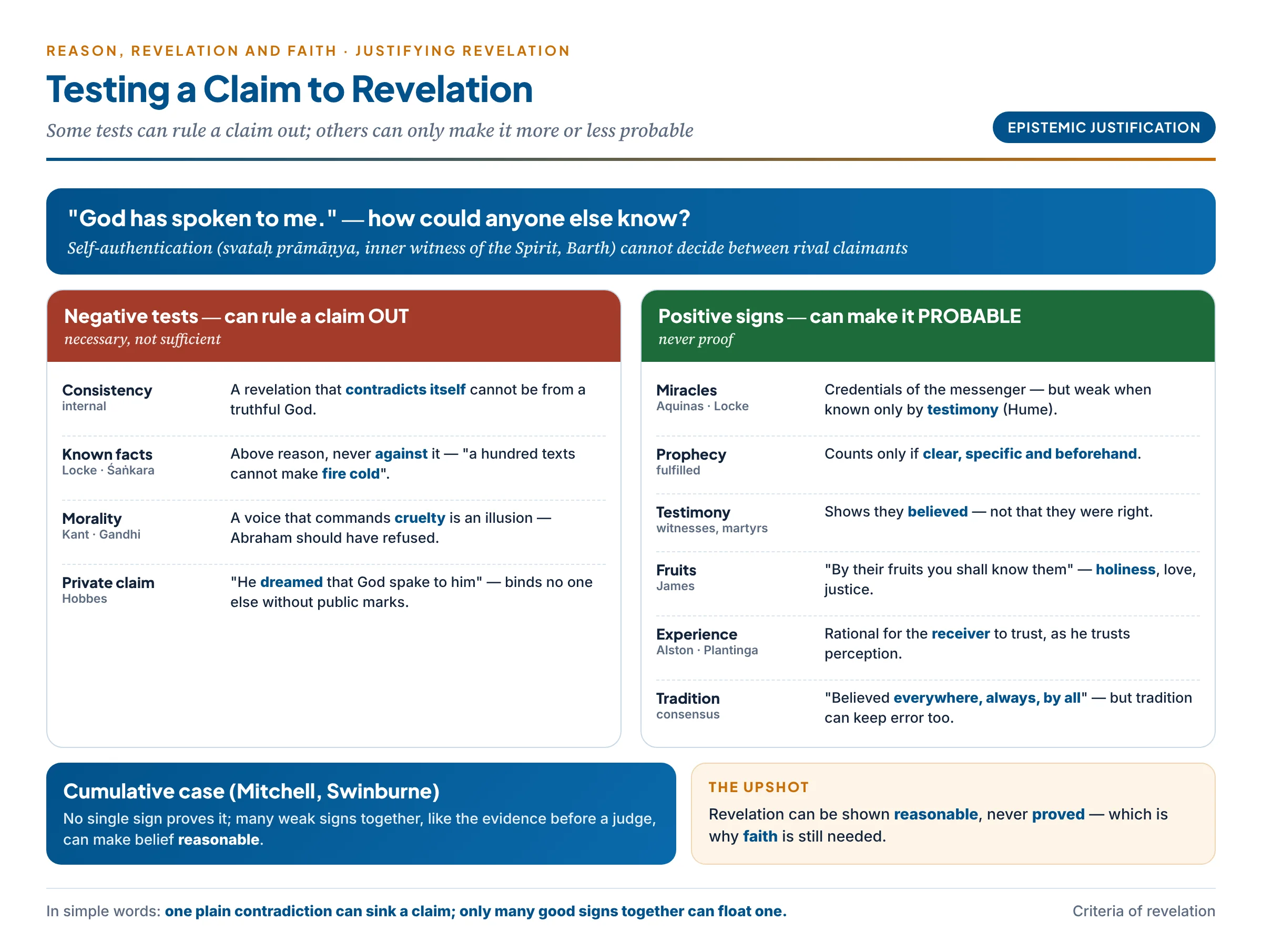
The 2024 paper asked what epistemic justifications (justifications concerning knowledge) are possible for claims to revelation. The main ones, with their worth:
- Miracles — signs that accompany the message and show divine backing (Moses before Pharaoh, Jesus’ healings). Comment: strong for eyewitnesses, weak for later believers who have only testimony about them (Hume, below); and rival religions all report miracles.
- Fulfilled prophecy — predictions that later come true. Comment: impressive only if the prophecy was clear, specific and made beforehand; vague prophecies can be fitted to anything.
- Testimony — the number, character and sincerity of witnesses, even their martyrdom. Comment: sincerity shows they believed, not that they were right.
- Inner consistency — a genuine revelation should not contradict itself. Comment: a necessary condition, not a sufficient one; a consistent novel is still fiction.
- Agreement with reason and known facts — it may go beyond reason but not against it (Aquinas, Locke, Śaṅkara’s “fire is not cold”). Comment: a good negative test; it rules claims out, it cannot rule them in.
- The moral test — a voice commanding cruelty cannot be God’s (Kant, Gandhi). Comment: very strong — but it makes conscience the judge of revelation.
- Fruits and transformation — “by their fruits you shall know them“: a genuine revelation produces holiness, love, peace, justice in the receiver and the community (William James’s test of saintliness). Comment: persuasive, but good fruits can come from mistaken beliefs too, and bad fruits from true ones misused.
- Experience and proper basicality — for one who has the experience, it is as rational to trust it as to trust sense perception (Alston, Plantinga; Swinburne’s principle that things are probably as they seem unless there are special reasons to doubt). Comment: justifies the receiver, less so the outsider.
- Tradition and consensus — the community’s long testing of a revelation: “what has been believed everywhere, always and by all” (Vincent of Lérins, 5th century); canon formation; the guru-paramparā. Comment: tradition can preserve error as well as truth.
- Self-validation — intrinsic validity (Mīmāṃsā), inner testimony of the Spirit (Calvin). Comment: cannot settle rival claims.
- Cumulative case — no single proof, but many weak arguments together (miracles + fruits + coherence + experience) can make belief reasonable, as a judge decides on the whole evidence (Basil Mitchell, Swinburne). Comment: the most balanced modern view; it yields reasonable belief, not certainty.
- Own comment — the overall picture: the negative tests (consistency, agreement with known facts, morality) are strong — they can show a claim is not genuine. The positive tests (miracles, prophecy, fruits, experience) give at most probability. So revelation can be shown to be reasonable to accept, never proved — which is exactly why faith is still required.
In simple words
A doctor cannot prove a patient has a disease from a single symptom, but fever + rash + a blood test + the patient’s history together make the diagnosis reasonable. The negative test is even sharper: if the blood test is clear, the disease is ruled out. Claims to revelation are judged the same way — many weak signs can add up, and one plain contradiction can rule a claim out.
Locke: Reason as the Last Judge of Revelation
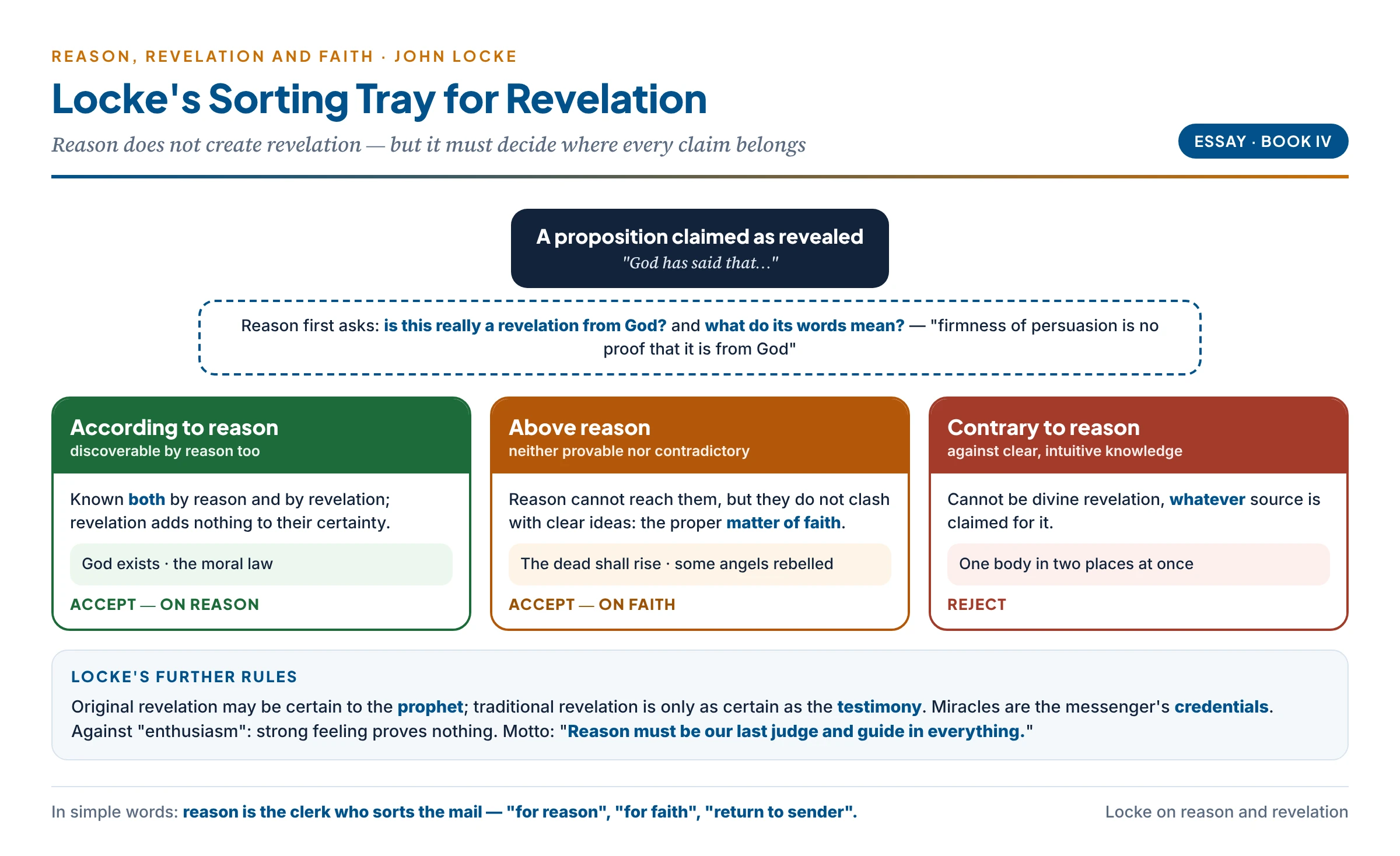
- Three kinds of propositions (Essay concerning Human Understanding, 1689):
- According to reason — truths reason can discover by itself, such as the existence of God and the moral law. These can be known both by reason and by revelation; revelation adds nothing to their certainty.
- Contrary to reason — inconsistent with clear ideas: for example, that one and the same body is in two places at the same time. Such statements must not be accepted even if someone claims revelation as their source — “no proposition can be received for divine revelation… if it be contradictory to our clear intuitive knowledge.”
- Above reason — neither provable nor contradictory: for example, that the dead shall rise again (resurrection) or that some angels rebelled against God. These are the proper matter of faith.
- Reason’s indispensable function even for faith:
- Reason must decide whether something really is a revelation from God.
- Reason must examine the meaning of the words in which the revelation is expressed.
- Original and traditional revelation: the prophet who receives a revelation directly may be certain; we who receive it by tradition can be no more certain than the testimony allows. Locke accepted miracles as the credentials of a true messenger.
- Against “enthusiasm”: Locke attacks those who take the strength of their own feelings as proof of inspiration — “firmness of persuasion is no proof that any proposition is from God.”
- His motto: “Reason must be our last judge and guide in everything.“
Hobbes: “He Dreamed that God Spake to Him”
- In Leviathan (1651), Hobbes asks how a man can know that God has spoken to someone else. God may speak by dreams, visions, voice and inspiration; but if a man claims it, “to say he hath spoken to him in a dream, is no more than to say he dreamed that God spake to him“, which cannot win belief from anyone who knows dreams are mostly natural. To claim a vision is to say one dreamed between sleeping and waking; to claim inspiration is to report a strong desire to speak.
- God “obliges no man to believe he hath so done to him that pretends it; who (being a man) may err, and (which is more) may lie.”
- Hobbes’s two marks of a true prophet: he must work miracles, and he must not teach any religion other than the one already established.
- Lesson: private revelation may bind the receiver; it does not bind others without public marks.
Hume: Testimony and Miracles
- Definition: a miracle is “a violation of the laws of nature” brought about by a particular act of God.
- The principle: “A wise man proportions his belief to the evidence.” Our evidence for the laws of nature is uniform experience — the strongest possible. So testimony for a miracle must be weighed against it.
- Hume’s maxim: no testimony is sufficient to establish a miracle “unless the testimony be of such a kind that its falsehood would be more miraculous than the fact which it endeavours to establish“. Since it is always more likely that witnesses are mistaken or lying than that nature’s laws were broken, we should reject the report.
- Four further reasons:
- No miracle has ever been attested by a sufficient number of witnesses of good sense, education and integrity, in a public place where fraud would be exposed.
- Human nature loves surprise and wonder; people enjoy telling marvellous stories.
- Miracle stories abound among ignorant and barbarous nations and fade as knowledge grows.
- Contrary religions cancel each other: every religion’s miracles support its own claims, so they destroy each other’s evidential force.
- Conclusion: a miracle can never be proved so as to be the foundation of a system of religion.
In simple words
If a neighbour tells you he saw a man walk across the Ganga on foot, which is more likely — that the law that heavy bodies sink was suspended, or that your neighbour was mistaken, joking or deceived? Hume says a wise person always picks the second, because our experience of people being mistaken is far larger than our experience of laws being broken.
- Replies:
- Hume assumes experience is uniform against miracles — which is the very point in dispute.
- A law of nature says what happens when nothing interferes; a divine act would be an exception, not a refutation of the law.
- Point 4 ignores the possibility that several religions are partly right.
- Verdict: Hume does not prove miracles impossible; he shows that miracles reported by testimony are a weak public foundation for revelation — which pushes believers toward the other criteria (fruits, experience, cumulative case).
Common confusion
Did Hume prove that miracles are impossible? No. Hume’s argument is about evidence, not possibility. He argues that a wise person should never believe a report of a miracle, because the evidence for the laws of nature will always outweigh the testimony. He leaves open that a miracle might happen; he denies that we could ever have good reason to believe one did, on testimony alone.
Kant: The Moral Test of Revelation
- Kant holds that we can never be certain a voice or vision comes from God — the senses cannot recognise the infinite. But we can be certain when it does not: if it commands something contrary to the moral law, then “no matter how majestic the apparition may be”, it must be an illusion.
- Abraham: commanded to sacrifice his son, Abraham should have replied: “That I ought not to kill my good son is quite certain. But that you, this apparition, are God — of that I am not certain, and never can be, not even if this voice rings down to me from (visible) heaven.“
- Even the highest revelation is judged by conscience: “Even the Holy One of the Gospel must first be compared with our ideal of moral perfection before he is recognised as such.“
- Scripture and practical reason: if a sacred text contains statements that contradict practical reason, it must be interpreted in the interests of practical reason.
- Indian echo: Gandhi — “I reject any religious doctrine that does not appeal to reason and is in conflict with morality“; “Scriptures cannot transcend reason and truth. They are intended to purify reason and illuminate truth.“
- Contrast: Kierkegaard read the same Abraham story as the teleological suspension of the ethical — faith rising above ethics (Article 6).
Faith and Revelation as Correlatives
- The classic statement: faith and revelation are correlative. If revelation is the work of God, faith is the receptivity of man to acknowledge it. Revelation is accepted on the basis of faith.
- St Paul: on the road to Damascus he received a revelation — and the revelation became his life only through faith; the same event left his companions merely bewildered.
- Faith’s place: faith has the same place in religion that reason has in philosophy. A faithless religious person is a contradiction; faith is the heart of religion — its necessary and sufficient condition. Kant: faith has “subjective certainty, sufficient for action, but insufficient for objective knowledge“.
- Hick’s development: the events of revelation are ambiguous — they can be seen naturally or religiously. The Exodus can be read as a lucky migration; Jesus as a failed prophet. Revelation happens as revelation only when someone experiences the event as God’s act — that is faith (Article 5). So “revelation without faith” is like a message with no one to read it.
- Tillich: revelation is “the experience in which an ultimate concern grasps the human mind and creates a community” — revelation and faith are two sides of one event (Article 4).
Is Faith Indispensable for Revelation?
The 2022 paper asked this directly.
- Yes:
- Correlativity — revelation is something received; reception is faith.
- Ambiguity — without faith the revelatory event is just history or nature.
- Personal revelation needs trust — a person can reveal himself only to one who trusts him, as a friend opens his heart only to one who does not treat him as a suspect.
- Second-hand revelation reaches later generations only through faith in testimony and tradition.
- No, or not wholly:
- General revelation is open to everyone’s reason — Paul says God’s power is “clearly seen” in creation; natural theology needs no faith.
- Aquinas: the credibility of revelation is shown by reason before faith (miracles, prophecy).
- Mīmāṃsā: the Veda’s validity is intrinsic — it does not depend on anyone’s faith, though one needs śraddhā to act on it.
- Buddhism: the Dhamma invites “come and see” — initial confidence is only provisional, confirmed by one’s own practice.
- Verdict: faith is indispensable for receiving special revelation as revelation and for living by it; it is not needed for the revelatory event to occur, nor for reason to assess its credibility.
Can Revelation Be Justified by Reason?
- What reason can do: show that revelation is possible (no contradiction in a God who speaks), credible (external signs, fruits), consistent (no self-contradiction), morally acceptable, and coherent with known facts; and interpret its meaning.
- What reason cannot do: prove its content — if reason could, it would not be revelation; and guarantee that a particular experience came from God.
- The relation of reason and revelation in summary:
- Revealed truth is accepted by reason (not imposed against it).
- Reason is needed to make revealed truth permanent and to send its message to others.
- Revealed truth contains vagueness; reason clarifies it.
- Revelation is the primary source of religious knowledge, reason the secondary — a guiding help, but a necessary one.
- Why they are often seen as opposed: revelation proceeds on the presupposition of God’s reality, which reason does not grant in advance. Believers hold that reason can approach divine truths in its own way and build demonstrations — but it must ultimately lean on revelation, both for its materials and for their final guarantee.
| Position | Reason’s role toward revelation | Thinker |
|---|---|---|
| Fideism | None — reason must submit | Tertullian, Kierkegaard, Barth |
| Thomism | Shows credibility; content above reason | Aquinas |
| Lockean rationalism | Judges whether it is revelation and what it means | Locke |
| Moral rationalism | Tests it by the moral law | Kant, Gandhi |
| Scepticism | Testimony never suffices | Hume, Hobbes (for others) |
| Rationalist reinterpretation | Rewrites revelation to fit science | Deists, liberal theology |
| Indian orthodoxy | Interprets śruti; may not contradict it in its sphere | Mīmāṃsā, Śaṅkara |
In simple words
Think of a translator given a letter in a language he partly knows. He can confirm that it is a real language, that the sentences are grammatical, that it does not contradict itself, and roughly what it says. But he cannot, by grammar alone, prove that the letter was really written by the king. Reason is that translator for revelation.
Revelation and Śruti — Similarities and Differences
The 2006 paper asked what revelation is, whether it needs confirmation, and how it compares with śruti.
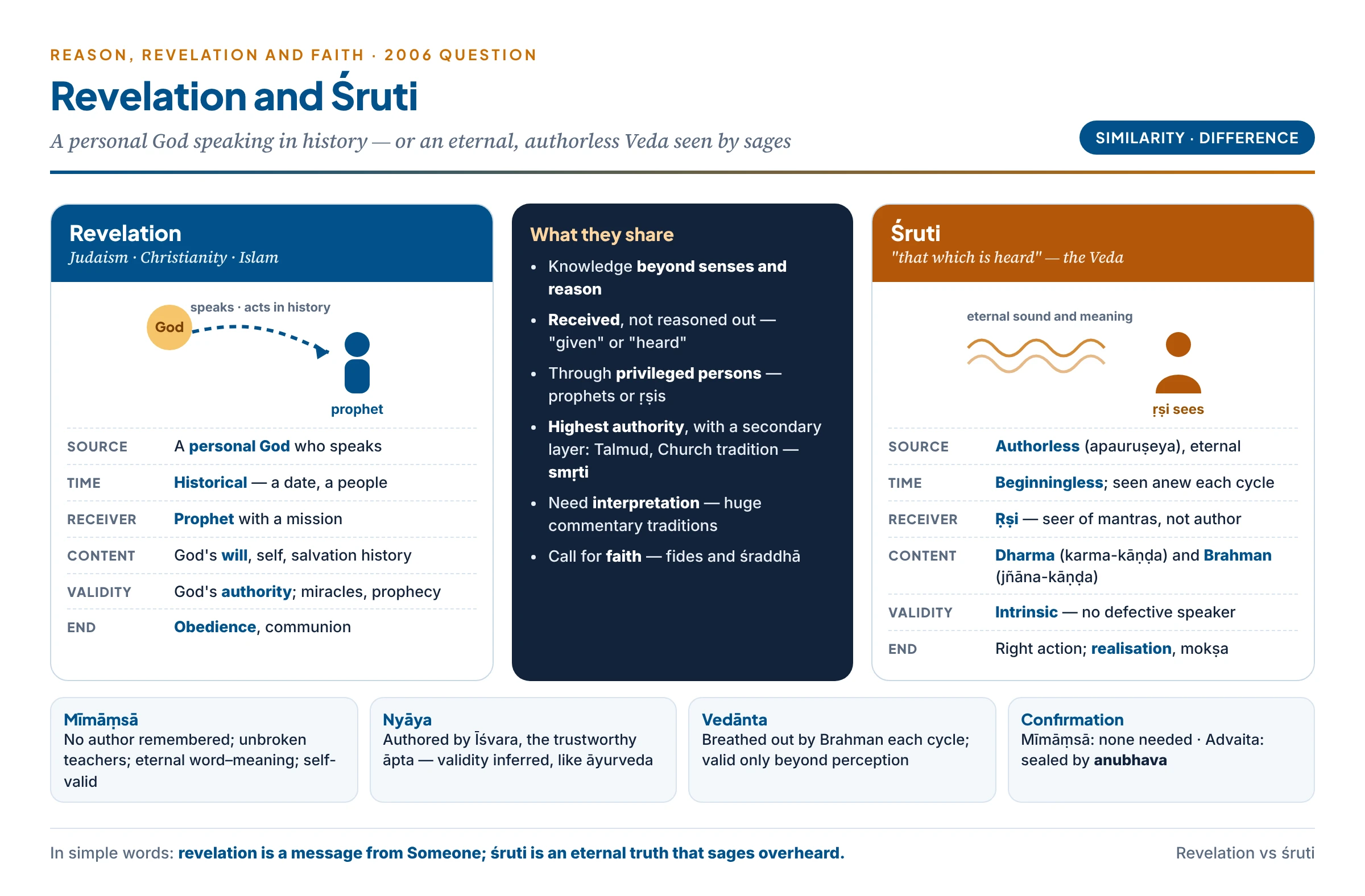
- Śruti means “that which is heard” — the Vedas: the Saṃhitās (hymns), Brāhmaṇas (ritual texts), Āraṇyakas (forest texts) and Upaniṣads. Its karma-kāṇḍa (action part) teaches dharma; its jñāna-kāṇḍa (knowledge part, the Upaniṣads) teaches Brahman.
- The ṛṣis are not authors but seers of the mantras (mantra-draṣṭā) — they saw or heard an eternal truth in deep meditation.
- The schools disagree on its source:
- Mīmāṃsā: the Veda is authorless (apauruṣeya) and eternal. Arguments: no author is remembered, though authors of other works are; it has come down through an unbroken line of teachers; the relation between word and meaning is eternal, not made by convention; and being authorless, it is free from the defects of any speaker, hence self-valid.
- Nyāya: the Veda is authored by Īśvara, the supremely trustworthy person (āpta); its validity rests on the reliability of its speaker — as the reliability of medical texts (āyurveda) is confirmed by their observed success.
- Vedānta: the Veda is authorless in the sense that it is not composed by any person; Brahman “breathes it out” effortlessly at the start of each world-cycle, the same each time. Śaṅkara confines its authority to what lies beyond perception — “even a hundred texts cannot make fire cold”.
- Cārvāka, Buddhism, Jainism reject the Veda’s authority (Article 7).
- Similarities with revelation:
- Both give knowledge of what is beyond the senses and reason (God, dharma, Brahman, salvation).
- Both are received, not discovered by reasoning — “heard” or “given”.
- Both come through privileged persons — prophets or ṛṣis.
- Both are the highest authority in their tradition, with a secondary layer of tradition (Talmud, Church tradition; smṛti).
- Both need interpretation — hence vast commentarial traditions (Mīmāṃsā is itself a science of interpretation).
- Both call for faith — fides and śraddhā.
- Differences:
| Point | Revelation (Semitic) | Śruti (Mīmāṃsā / Vedānta) |
|---|---|---|
| Source | A personal God who speaks | Authorless, eternal (Nyāya: Īśvara) |
| Time | Historical — at a date, to a people | Eternal, beginningless; seen anew each cycle |
| Receiver | Prophet as messenger with a mission | Ṛṣi as seer; no mission to a nation |
| Nature | Word and deeds in history; God’s self-disclosure | Eternal sound and meaning; an impersonal order |
| Content | God’s will, commands, salvation history | Dharma (ritual duty) and Brahman |
| Validity | God’s authority; signs, miracles | Intrinsic (svataḥ); no defective speaker |
| Confirmation | Often demanded (miracles, prophecy) | Not needed (Mīmāṃsā); sealed by anubhava (Advaita) |
| End | Obedience, communion with God | Right action; realisation and liberation |
| Finality | Often a closed canon, a “final” prophet | Fixed Veda, but realisation goes beyond it |
- Does śruti need confirmation? For Mīmāṃsā, no — it is self-valid. For Nyāya, its validity is inferred from the trustworthiness of its author. For Advaita, śruti is the pramāṇa for Brahman, but its teaching culminates in direct realisation (anubhava), which is the final confirmation — after which “the Vedas are no Vedas“.
Common confusion
Does “śruti” simply mean “revelation from God”, as in the Bible or the Qur’ān? Only for Nyāya (and theistic schools that follow it), which makes Īśvara the Veda’s author. For Mīmāṃsā the Veda has no author at all, human or divine — Mīmāṃsā does not even need God; for Advaita God “breathes out” an eternal Veda but does not compose it. So “śruti” is best translated as authoritative, heard scripture, not as a message from a personal God.
Indian Connect — Indian Connect — Mīmāṃsā’s answer to Hume
- Hume asks for evidence before accepting testimony. Mīmāṃsā reverses the burden: every cognition is valid until a defeater appears (svataḥ prāmāṇya). The Veda has no speaker who could be mistaken or lying, and nothing in experience can contradict it, because it speaks only of what lies beyond experience (dharma).
- The cost: the same principle would protect any authorless claim — which is why Nyāya preferred to ground the Veda’s authority on a trustworthy author whose reliability can be inferred.
Critical Evaluation
Critics and Defenders
Criticism — Against justifying revelation
- Hume: testimony to miracles is always outweighed by the laws of nature.
- Hobbes: private revelation obliges no one else; it may be a dream or a lie.
- Circularity: scripture vouches for scripture.
- Rival claims: self-authentication cannot choose among them.
- Positivists: claims about a speaking God are unverifiable.
- Kant’s sting: if conscience judges revelation, revelation adds nothing to morality.
Defence — For the reasonableness of revelation
- Aquinas: signs make belief credible though content stays above reason.
- Locke: reason can sort claims — rejecting the contrary, accepting the above.
- Cumulative case (Mitchell, Swinburne): many signs together make belief reasonable.
- Alston, Plantinga: the receiver is rational to trust his experience.
- Fruits: transformed lives and communities count as evidence.
- Mīmāṃsā: knowledge is innocent until proved guilty; an authorless text has no speaker to doubt.
Cross-Tradition Comparison
| Question | Western answers | Indian answers |
|---|---|---|
| Is revelation self-validating? | Calvin, Barth: yes; Locke, Hume: no | Mīmāṃsā: yes (svataḥ); Nyāya: validity from the author |
| External signs? | Aquinas, Locke: miracles, prophecy | Nyāya: success of āpta’s other words (āyurveda) |
| Limit set by reason? | Locke: not contrary to reason | Śaṅkara: not against perception (“fire is cold”) |
| Moral limit? | Kant: Abraham must refuse | Gandhi: reject doctrines against morality |
| Final confirmation | Faith; eschatological vision | Anubhava — direct realisation |
Indian Connect — Indian Connect — Nyāya’s āpta and Locke’s credentials
- Nyāya trusts the Veda because its author is āpta — one who knows the truth, wishes to tell it, and can tell it. Locke trusts a revelation if its messenger shows credentials (miracles) and teaches nothing contrary to reason. Both make the reliability of the source the ground of trust — a theory of testimony rather than of mystery.
Synthesis (Siddhānta)
- Claims to revelation must be justified because they are second-hand for most believers, often conflicting, and open to delusion and fraud.
- Two answers compete: revelation is self-authenticating (Mīmāṃsā, Calvin, Barth) or it needs confirmation (Aquinas, Locke, Hobbes, Kant). The first respects transcendence but cannot settle rival claims; the second protects against fraud but risks making reason the master.
- Possible justifications form two groups: negative tests (consistency, agreement with known facts, moral acceptability) that can rule claims out, and positive signs (miracles, prophecy, testimony, fruits, experience, tradition) that can only make them probable; together they build a cumulative case.
- Locke sorts claims into according to, above and contrary to reason; Hume shows that miracles on testimony are a weak foundation; Hobbes shows private revelation binds only its receiver; Kant makes the moral law the final test.
- Faith and revelation are correlatives: faith is indispensable for receiving special revelation as revelation, not for its occurrence or for reason’s assessment of its credibility.
- Śruti shares with revelation its supersensuous content, authority and need for interpretation and faith, but differs in having (for Mīmāṃsā and Vedānta) no personal author, being eternal rather than historical, being self-valid, and pointing beyond itself to realisation.
- Verdict: revelation can be shown reasonable to accept but never proved; reason is its guardian and interpreter, not its source.
“Reason must be our last judge and guide in everything.” — John Locke
Previous Year Questions
- 2024What kind of epistemic justifications are possible with regard to claims to revelation? Discuss with your own comments.
- 2022Is the notion of faith indispensable for the idea of revelation? Critically comment.
- 2015Can revelation be justified by reason? Discuss.
- 2006Explain the notion of revelation. Does revelation stand in need of confirmation? Discuss and also explain the difference or similarity between revelation and Śruti.
- 2002Point out the relative importance of reason and revelation in religion. Are the two compatible? Discuss.