

Reason, Revelation and Faith.
Official Syllabus: Paper II, Section B, Unit 5
Faith is the most central — and most misunderstood — idea in religion. Believers call it the heart of religious life; critics call it belief without evidence. Both cannot be wholly right. This article clarifies what faith is: its definitions, the difference between belief-in and belief-that and between faith and belief, its basic features, its classic elements (knowledge, assent, trust), its kinds, its rational and irrational aspects, the challenge of Hare’s “blik”, Paul Tillich’s famous account of faith as ultimate concern (with its view of doubt and reason), and the Indian idea of śraddhā. Theories of how faith is produced — by intellect or will — follow in Article 5; the relation of faith to reason in Article 6.
In simple words
Before an operation you sign the consent form. You have not checked the surgeon’s degrees, studied medicine or watched her last hundred operations — yet you are not being foolish. You have some reasons (her reputation, the hospital, others’ experience), you commit your body to her, and you act on that trust. That mix of some knowledge, personal trust and total commitment going beyond full proof is the shape of faith.
Context & Problem
The Place of Faith in Religion
- The core tenet: faith is the most crucial, fundamental and significant element of religious life and behaviour. It is both a necessary and a sufficient condition of religious life — there can be no religion without faith.
- Depth for depth: there is a direct relation between the depth of religious life and the depth of faith. If faith is simplistic or superficial, religious commitment too will lack firmness and depth.
- Why faith arises: religion accepts God or transcendent entities, which cannot be objects of ordinary knowledge. Here the importance of faith appears — Kant: “I had to deny knowledge in order to make room for faith.“
Definitions of Faith
- The Bible: faith is “the substance of things hoped for, the evidence of things not seen“.
- Kant: faith has “subjective certainty, sufficient for action, but insufficient for objective knowledge“; it belongs to practical reason, not theoretical reason.
- Tillich: faith is “the state of being ultimately concerned” — “a passionate concern for the ultimate”.
- A general definition: belief in God or in the doctrines of a religion; confidence or trust in a person, deity or teaching, even without full empirical evidence.
- Two attitudes to the word: religious people usually see faith as confidence based on some degree of warrant; sceptics see it as belief without evidence — Russell defined it as “a firm belief in something for which there is no evidence”.
- The words: Latin fides (trust, loyalty, fidelity), Greek pistis (trust, confidence), Arabic īmān (secure trust), Sanskrit śraddhā (literally “placing one’s heart” on something).
Faith and Knowledge
- Ayer’s definition of knowledge as justified true belief has three marks:
- Knowledge is factual — it concerns some fact.
- The knower believes there is such a fact.
- If doubt arises, the belief can be verified objectively and publicly.
- Faith fails the third mark: its object belongs to religious consciousness and cannot be publicly checked. So, by Ayer’s standard, faith is not knowledge.
- The believer’s reply: faith is a different kind of cognition — firm without public proof, like trust in a friend; and some (Plantinga) argue that faith can be warranted without public proof (Article 6).
Core Doctrine
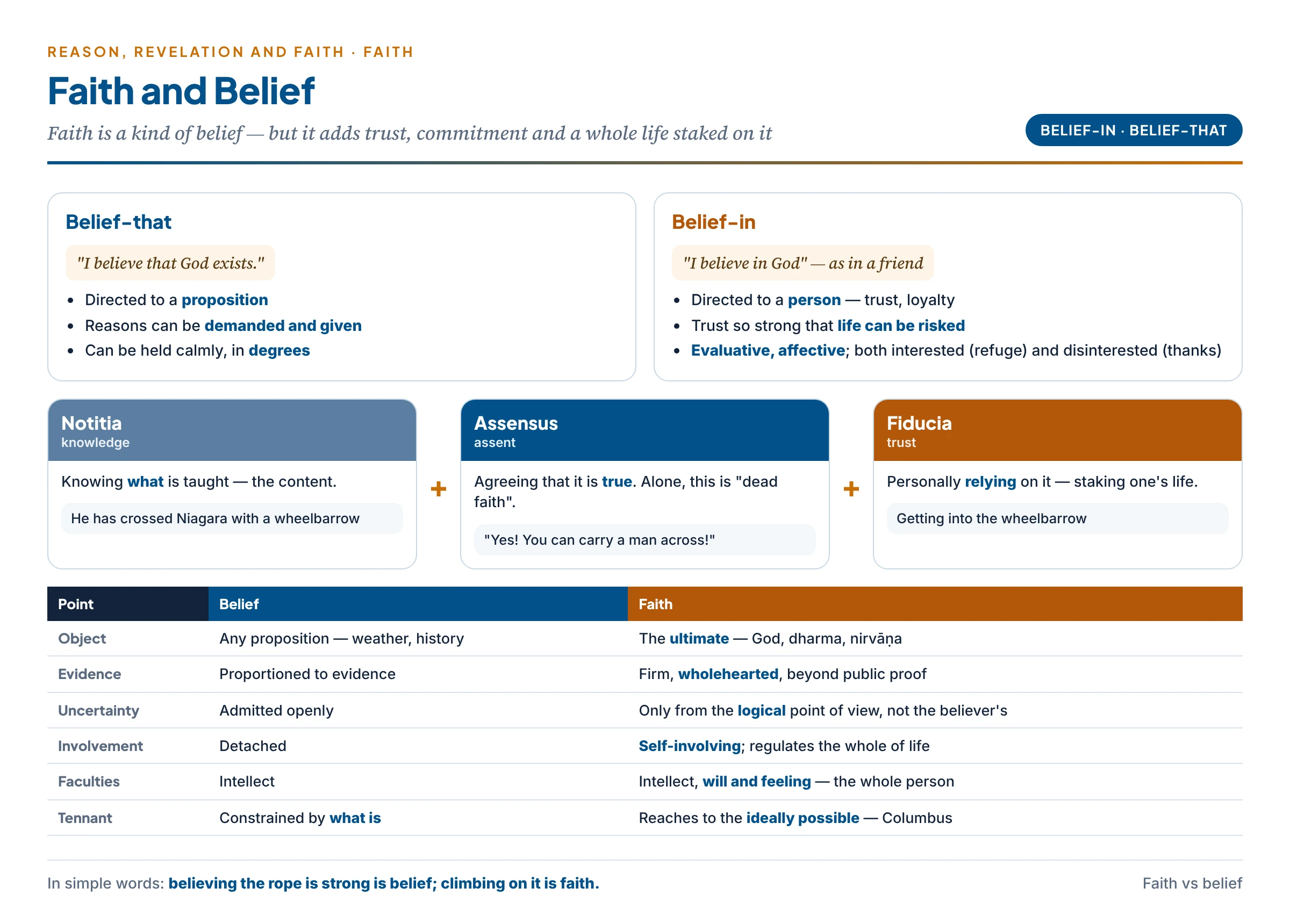
Belief-in and Belief-that
- Belief-that is acceptance of a proposition — “I believe that God exists”, “I believe that the train leaves at nine”. Reasons can be demanded and given for it.
- Belief-in is an attitude to a person, human or divine — “I believe in God”, “I believe in my doctor”. It is trust, loyalty and reliance.
- Three points of contrast:
- Belief-in is directed to a person; belief-that to a proposition.
- Both contain trust, but in belief-in the trust is so strong that even life can be risked on it.
- Believers believe in God with their whole heart, and this cannot be reduced to belief-that — it is like believing in a friend.
In simple words
“I believe that Ravi exists” — even a stranger who saw his photo can say this. “I believe in Ravi” — only a friend can say it: it means “I trust him, I will lend him money, I will stand by him.” The first is information about Ravi; the second is a relationship with him. Faith in God is mainly of the second kind.
- The relation: belief-in usually presupposes some belief-that (one cannot trust God without believing that he exists), but it adds commitment, love and reliance that no proposition contains.
- Belief in God has special marks:
- It is highly evaluative, not merely factual — not just accepting the proposition “God exists”.
- It is not merely cognitive and cannot be assimilated to factual or scientific knowledge.
- It is both interested and disinterested: interested, because God is our refuge and a “tower of strength” in times of gloom; disinterested, when we thank him for his favours without asking for more.
- It is affective — full of warmth of feeling.
- Its nearest analogue is belief in a friend — absolute trust in God as “the fundamental good thing without which there would be no others”.
Faith and Belief
The 2020 paper asked for the basic tenets of faith and the difference between faith and belief.
- Faith is a kind of belief, but its nature and aim differ.
- Characteristics of faith that distinguish it from ordinary belief:
- Not about scientific or factual matters — about a weather forecast we say “I believe“, not “I have faith“.
- An element of uncertainty — what is publicly certain and verified is not a matter of faith. But this uncertainty exists only from the logical or scientific point of view, not from the religious person’s.
- Self-involvement and commitment — faith brings dedication by which all aspects of life are regulated.
- Tennant’s contrast: belief is “more or less constrained by fact“, by what already is; faith “reaches beyond the actual to the ideally possible“, which it first imagines and then, by action, may realise — every machine was once a faith-venture; Columbus found America by such a venture.
| Point | Belief | Faith |
|---|---|---|
| Object | Any proposition — weather, history, science | The ultimate — God, dharma, nirvāṇa |
| Form | Mainly belief-that | Belief-that plus belief-in (trust) |
| Evidence | Proportioned to evidence; held in degrees | Firm, wholehearted, beyond public proof |
| Involvement | Detached; changes nothing in me | Self-involving; regulates the whole life |
| Response to doubt | Dropped when evidence turns | Holds through trials; doubt within faith |
| Elements | Intellect | Intellect, will and feeling — the whole person |
| Expression | Assertion | Worship, obedience, sacrifice, action |
The General Features — the Basic Tenets — of Faith
- Belief in the uniqueness and superior value of its object — the object of faith is held to be supremely great: in intellect, character, leadership, or in the universality and inevitability of a cause. Faith lasts as long as this superior value is not proved false.
- Commitment — we feel allegiance to the object of faith and try to be loyal to it in thought and action. Without loyalty, devotion and dedication, faith is nothing but cynicism.
- Action — William James defined belief as that upon which we are prepared to act. Faith without action is like a tree without fruit — barren, sterile, stagnant. There is not sufficient evidence for reasonable certainty, but there is felt certainty for action.
- Self-surrender — dedication alone does not explain why people make supreme sacrifices; that needs self-surrender — giving up one’s personal will and regarding oneself as an instrument of a supreme will. (A dedicated communist sees himself as an instrument of the inevitable march of history — faith need not be religious.)
- Source of inspiration — whether the feeling of inspiration comes from auto-suggestion or a supernatural agency cannot be finally settled; but it is an undeniable fact that faith inspires, and that this inspiration plays a great role in life.
- Trust in the unseen — the most characteristic feature: religious faith implies belief in the reality of the unseen and invisible.
- Holistic — faith is both the attitude of ultimate concern and its object. It is the product of the whole person and cannot be analysed into precise steps of cognition alone; it cannot be reduced to ordinary or scientific knowledge. Cardinal Newman called the relevant capacity the illative sense — our ability to see a large field of evidence as a whole and divine its significance.
- A person reasons, not a mind — faith results from a global impression; it means the whole person at work, an all-pervasive attitude to the whole of reality, to society and to one’s total relationships.
- The function of faith — becoming: the function of faith is not so much to know as to become. A Christian wants to become like Christ; a follower of the Buddha aims at becoming a Buddha.
The Three Elements of Faith — Notitia, Assensus, Fiducia
Classical Protestant theology analysed faith into three elements:
- Notitia (knowledge) — knowing what is believed: the content of the teaching.
- Assensus (assent) — agreeing that it is true.
- Fiducia (trust) — personally relying on it: heartfelt trust and commitment, staking one’s life on it.
- Why all three matter: knowledge without assent is mere information; assent without trust is “dead faith” — even devils, says the Letter of James, believe that God exists “and tremble”. Saving faith requires fiducia.
- Fides quae and fides qua: Augustine distinguished the faith which is believed (fides quae — the content, the creed) from the faith by which one believes (fides qua — the personal act of trusting).
In simple words
A popular story tells of a tightrope walker who crossed Niagara Falls pushing a wheelbarrow. “Do you believe I can take a man across in it?” he asked the crowd. “Yes!” they shouted. “Then get in.” Knowing he had done it is notitia; shouting “yes” is assensus; getting into the wheelbarrow is fiducia. Religious faith, in the full sense, is getting in.
Kinds of Faith
- Evidence-sensitive and evidence-insensitive:
- Evidence-sensitive faith is closely coordinated with demonstrable truths and responds to evidence — including the testimony and works of other believers.
- Evidence-insensitive faith is more strictly an act of the will of the believer alone, independent of evidence.
- Living and dead faith — faith that shows itself in works and faith that is mere assent (“faith without works is dead”).
- Implicit and explicit faith — trusting the church or guru’s teaching as a whole, versus personally knowing and assenting to each article.
- Reasoned faith and blind faith (andha-viśvāsa) — faith that has reflected on its grounds, versus credulity that accepts anything on authority.
- Cognitive and non-cognitive accounts — whether faith claims truth about reality (Aquinas, Plantinga, Hick) or is an attitude, commitment or way of seeing (Braithwaite, Hare, Wittgenstein) — see below.
Is Faith Cognitive? Hare’s “Blik”
The 2006 paper quoted the view, associated with R.M. Hare, that “religious faith consists of a set of profoundly unfalsifiable assumptions that govern all of a person’s other beliefs.”
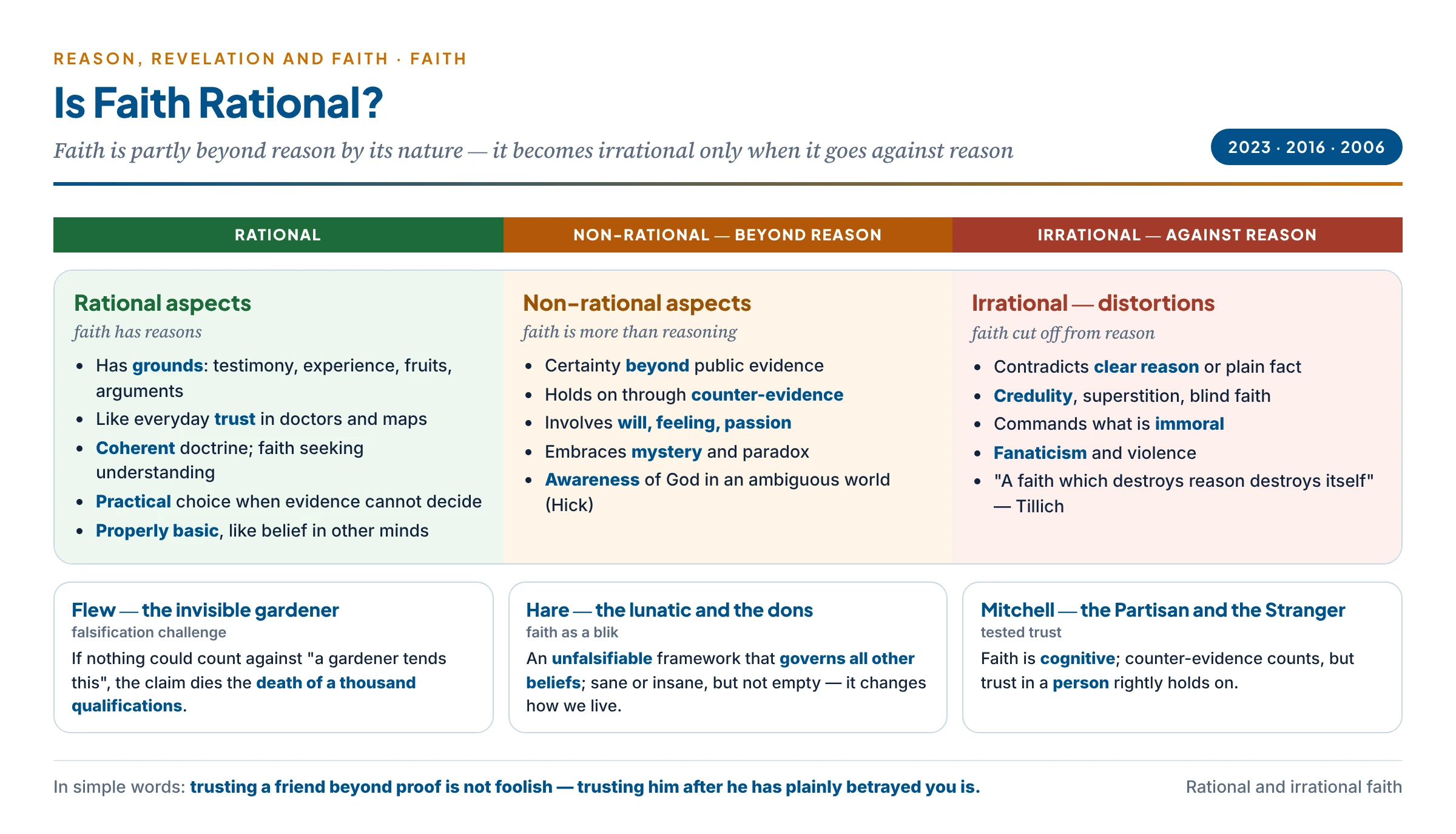
- The challenge — Flew’s falsification test (1950): using John Wisdom’s parable of the gardener, Antony Flew pictured two explorers who find a clearing; one says a gardener tends it. No gardener is ever seen, heard or caught by electric fences and bloodhounds; the believer keeps saying the gardener is invisible, intangible, silent. What remains of the claim? A statement that nothing could count against is not a real assertion; religious claims die “the death of a thousand qualifications“.
- Hare’s reply — the lunatic and the dons: a student is convinced that all the dons (teachers) want to murder him. However kind they are, he takes it as proof of their cunning. Nothing can falsify his belief; yet it is not empty — it governs how he sees and responds to everything. Hare calls such a framework a blik.
- Everyone has bliks — Hare’s own example: his belief that the steel joints of his car will hold; nothing in ordinary experience tests it, yet it shapes how he drives.
- Bliks are unfalsifiable but not meaningless: they make a difference to life.
- There are sane and insane bliks — the difference between them matters greatly, though it is not settled by evidence.
- Religious faith is such a blik — a basic way of seeing the world that governs all other beliefs.
- Mitchell’s alternative — the Partisan and the Stranger: a resistance fighter meets a Stranger who claims to lead the resistance. Afterwards the Stranger is sometimes seen helping the partisans and sometimes with the enemy. The partisan keeps trusting him — not because nothing counts against his faith, but because his trust in the person lets him hold on despite counter-evidence. Faith is cognitive (it claims the Stranger is on our side), tested, yet not easily abandoned.
- Evaluation of Hare’s view:
- Strength: it explains why faith resists counter-evidence and why it shapes a whole outlook, not single beliefs.
- Weakness: if faith is only a blik, it is neither true nor false — but believers think “God loves us” is true, not just a way of seeing.
- No criterion: Hare gives no way to tell a sane blik from an insane one — which matters for fanaticism.
- Hick’s reply: religious claims are verifiable in principle at the end of life (eschatological verification) — like two travellers on a road who disagree about whether it leads to a Celestial City; only arrival will settle it.
- Other non-cognitive accounts: Braithwaite — religious assertions declare an intention to follow a way of life (for Christians, the agapeistic, loving way), supported by stories; Wittgenstein — religious belief is a form of life, not a hypothesis (Unit 10).
The Rational and Irrational Aspects of Faith
The 2023 paper asked for both sides.
Rational aspects of faith:
- Faith has grounds — testimony, religious experience, tradition, fruits, arguments — even if they fall short of proof (evidence-sensitive faith).
- Ordinary life is full of rational trust — we trust doctors, maps, history books and scientists we have never checked. Trust beyond proof is not automatically irrational.
- Coherence — faith is expressed in systems of doctrine that are reasoned out (theology, darśana); Augustine and Anselm show faith seeking understanding.
- Practical rationality — when evidence cannot decide a momentous question, it may be rational to choose (Pascal’s Wager, James’s will to believe — Article 5); Kant makes God a postulate of practical reason.
- Proper basicality — belief in God may be as rational as belief in other minds or the past (Plantinga — Article 6).
- Open to critique — mature faith accepts that doctrines may not contradict clear reason, known fact and morality (Aquinas, Locke, Śaṅkara, Gandhi).
Irrational (or non-rational) aspects of faith:
- Going beyond evidence — faith’s certainty is greater than the public evidence warrants.
- Resistance to counter-evidence — faith often survives evidence that would overturn an ordinary belief (Hare’s blik).
- Paradox — Kierkegaard: faith embraces the absurd (the eternal becoming temporal); Tertullian’s paradox.
- Passion and will — faith involves emotion, desire and decision, not only cognition.
- Dangers — credulity, superstition, fanaticism and violence when faith is cut off from reason.
The key distinction:
- Non-rational (beyond reason — involving trust, will, feeling) is not the same as irrational (against reason — contradicting known truth or logic). Faith is necessarily non-rational in part, since it involves the whole person; it need not be irrational.
“Faith Means Human Awareness of God — but It Cannot Be Irrational”
The 2016 paper put this thesis, which closely follows John Hick.
- Faith as awareness: Hick notes that the universe is religiously ambiguous — it can be construed both naturalistically and religiously. The traditional term for the human awareness of God, as distinct from knowledge, is faith. Faith is the interpretative element in religious experience — experiencing life as the presence of God (Article 5).
- Why it need not be irrational:
- Like perception: we are rational to trust our sense experience without proving the external world; so a person who experiences God’s presence is rational to believe in God (Hick, Alston, Plantinga).
- Grounded, not groundless: such belief arises from experience, not from wishful thinking.
- Open to testing: it can be checked for consistency, moral fruit and coherence.
- Tillich: “a faith which destroys reason destroys itself and the humanity of man.”
- Limit: the awareness is rational for the one who has it; it is not a public proof for others.
Tillich: Faith as Ultimate Concern
Paul Tillich (1886–1965) gave the most influential 20th-century account of faith, in Dynamics of Faith (1957) and Systematic Theology. The 2026 paper asked how it handles faith, doubt and reason.
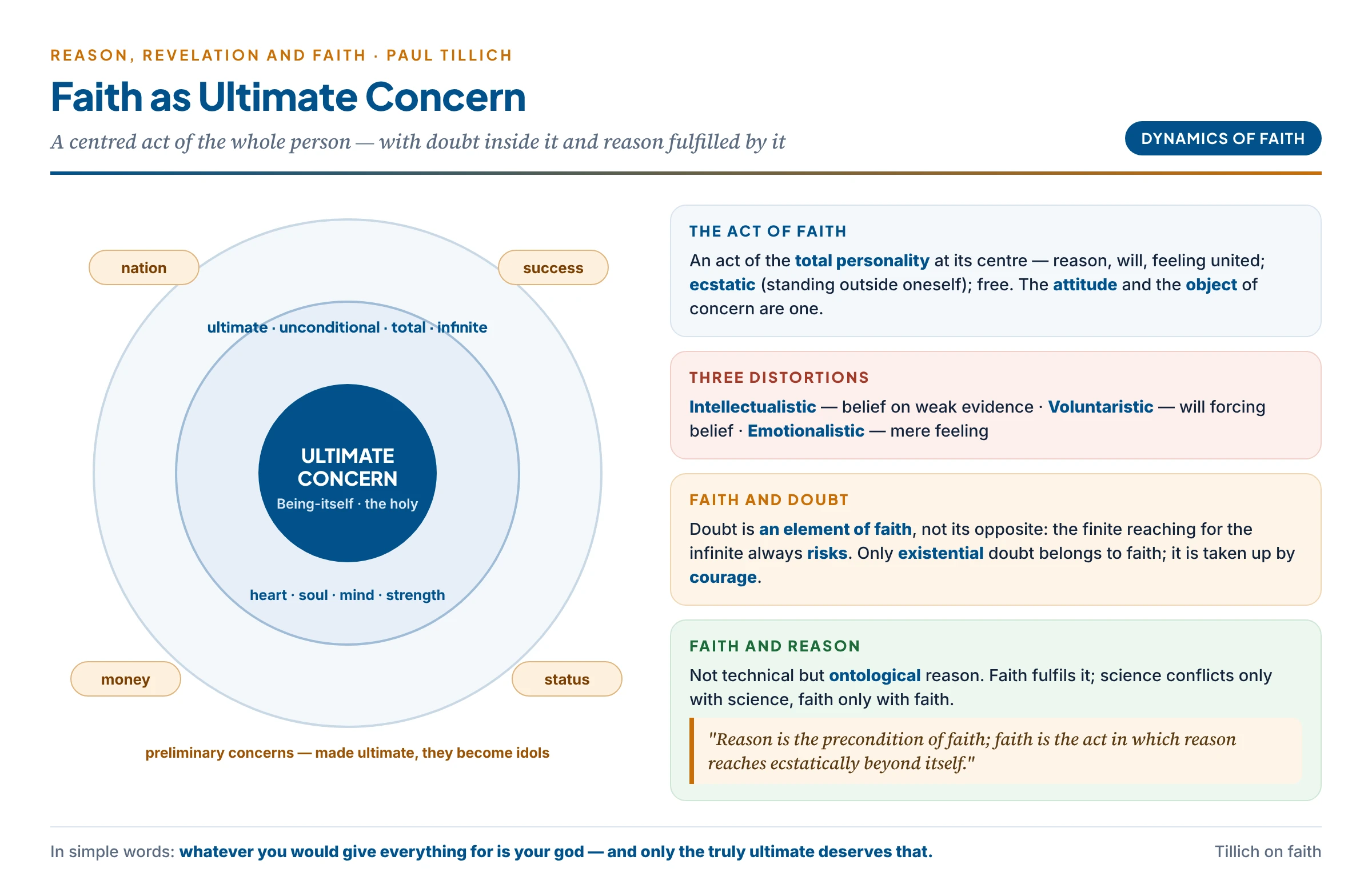
- Definition: “Faith is the state of being ultimately concerned.“
- Ultimate concern is concern for what determines our being or non-being — not physical survival but “the reality, the structure, the meaning and the aim of existence”.
- Its source: the great commandment — “You shall love the Lord your God with all your heart, and with all your soul, and with all your mind, and with all your strength.” The religious concern is:
- Ultimate — it makes all other concerns preliminary.
- Unconditional — independent of character, desire or circumstance.
- Total — no part of ourselves or our world is excluded.
- Infinite — no moment of relaxation is possible before it.
- Faith as a centred act: faith is an act of the total personality, at the centre of personal life, uniting reason, will and emotion. It is ecstatic — “standing outside oneself” without ceasing to be oneself. It is an act of freedom.
- Idolatry: people are in fact ultimately concerned about many things — nation, success, money, status. These are properly preliminary concerns; raising a preliminary concern to ultimacy is idolatry, and it ends in disappointment (“existential disappointment”).
- Attitude and object made one: “ultimate concern” can mean the attitude of concern or its object. In Dynamics of Faith Tillich identifies them: “the ultimate of the act of faith and the ultimate that is meant in the act of faith are one and the same” — the ordinary subject–object split disappears.
- God as Being-itself: Tillich contrasts the cosmological type of philosophy of religion (Aquinas: God “out there”, reached at the end of inference — “meeting a Stranger“) with the ontological type (Augustine: God already present as the ground of our being). God is not a being but Being-itself, in which we participate by existing. Hence: “whatever concerns a man ultimately becomes god for him.”
- Three distortions of faith — faith is misunderstood when reduced to one function of the mind:
- Intellectualistic — faith as belief in propositions with low evidence, a kind of weak knowledge.
- Voluntaristic — faith as an act of will forcing belief where evidence is lacking (“the will to believe”).
- Emotionalistic — faith as mere feeling, with no content or truth.
Faith and doubt
- Doubt is not the opposite of faith but an element within it: “if faith is understood as the state of being ultimately concerned, doubt is a necessary element in it.” Because faith is the act of a finite being concerned with the infinite, it always involves risk — and risk brings doubt.
- Three kinds of doubt: methodological doubt (the scientist’s), sceptical doubt (rejecting all certainty) and existential doubt — the doubt of one who cares. Only existential doubt belongs to faith.
- Courage: faith takes doubt into itself through courage — “the daring self-affirmation of one’s own being in spite of the powers of non-being”. The person who doubts seriously shows that he is ultimately concerned, and so already has faith.
- Consequence: there is no faith without risk, and no honest faith that has never doubted.
Faith and reason
- Two meanings of reason: technical reason (logic, calculation, method — reason as a tool for means) and ontological reason (the meaningful structure of mind and reality — the source of meaning, norms, language, freedom and creativity). Faith is related to reason in the second sense.
- No conflict: “Reason is the precondition of faith; faith is the act in which reason reaches ecstatically beyond itself.” Only a being with the structure of reason can be ultimately concerned and can tell ultimate from preliminary concerns.
- Reason fulfilled: “Ecstasy is fulfilled, not denied, rationality.” Without faith, reason “exhausts itself” in finite contents and becomes filled with irrational or demonic contents — “the road leads from reason fulfilled in faith, through reason without faith, to reason filled with demonic-destructive faith.”
- Faith that destroys reason destroys itself — authoritarian religious and political systems show this.
- Faith and science: their truths belong to different dimensions. “Science can conflict only with science, and faith only with faith“; apparent conflicts arise when faith makes factual claims (a literal six-day creation) or science makes ultimate claims (scientism).
- Faith and history: faith cannot guarantee factual truth; it interprets the meaning of facts from the standpoint of ultimate concern.
- Faith and symbols: faith speaks in symbols, which participate in what they point to; “God is a symbol for God“. Taking symbols literally turns faith into idolatry.
Evaluation of Tillich
- Strengths:
- It makes faith universal — everyone has some ultimate concern — and explains secular faiths (nationalism, Marxism, money).
- It dignifies doubt and makes honest questioning part of faith.
- It removes the false war between faith and science.
- It gives a test for idolatry — anything finite made ultimate.
- Criticisms:
- Ambiguity (Hick): “ultimate concern” slides between the attitude and its object; by merging them Tillich risks making faith an attitude that operates whether God exists or not.
- Too broad: if the nationalist and the miser have “faith”, the word loses its religious meaning.
- Obscure: “Being-itself” and “ground of being” are hard to give definite content; Tillich’s God seems to some impersonal, unable to love or answer prayer.
- Truth question: a theist wants to know whether God really exists; Tillich’s definition seems to bypass that question.
Common confusion
Is doubt the opposite of faith? Not for Tillich, and not for much of the religious tradition. The opposite of faith is indifference — not caring about the ultimate at all. Existential doubt — doubt felt by someone who cares — is a part of faith, taken up by courage. Even the Gītā’s warning that “the doubting self perishes” refers to a mind paralysed by doubt, not to honest questioning on the way to knowledge.
In simple words
A mountaineer roped to a partner over a crevasse is afraid the rope might break — yet he steps forward. His fear does not cancel his trust; it shows that the step matters to him. Tillich says doubt in faith is like that fear: the sign that something ultimate is at stake.
Śraddhā — Faith in Indian Thought
- Meaning: śraddhā is not blind belief but serene, reverent confidence — “placing one’s heart” on what is taught. Śaṅkara defines it as the firm conviction that the words of the scripture and of the guru are true.
- A working hypothesis to be verified: śraddhā accepts the teaching provisionally, as a seeker accepts the directions of a guide, and is meant to be verified in one’s own realisation (anubhava).
- In Advaita’s discipline: śraddhā is one of the six treasures (ṣaṭ-sampatti — calm, self-control, withdrawal, endurance, faith, concentration) that qualify a seeker for the study of Vedānta.
- The Bhagavad Gītā:
- “The one who has faith attains knowledge” (śraddhāvān labhate jñānam); “the one who doubts perishes” (saṃśayātmā vinaśyati) — doubt that paralyses action and inquiry.
- “A person is made of his faith; as his faith is, so is he” (śraddhāmayo ‘yaṃ puruṣaḥ).
- Faith is threefold, according to the guṇas: sāttvika (worship of the gods), rājasika (worship of yakṣas and rākṣasas — powers), tāmasika (worship of ghosts and spirits). Faith is only as good as its object.
- The Upaniṣads: when the boy Naciketas saw his father giving away worthless cows, “faith entered him” (śraddhā āviveśa), and he set out on the quest that led him to Yama and the knowledge of the Self.
- Buddhism: saddhā (confidence in the Buddha, Dhamma and Saṅgha) is the first of the five spiritual faculties — faith, energy, mindfulness, concentration, wisdom — and must be balanced by wisdom (paññā); faith without wisdom becomes credulity.
- Jainism: samyag-darśana, “right faith” or right insight — “faith in the true nature of the categories” — is the first of the three jewels, with right knowledge and right conduct.
Indian Connect — Indian Connect — śraddhā and Tillich
- The Gītā’s “as his faith is, so is he” matches Tillich’s claim that our ultimate concern shapes our being; its threefold faith matches Tillich’s warning about idolatrous objects of faith.
- Śraddhā verified in anubhava is close to the Buddhist “come and see” — faith as the first step of a path whose end is direct seeing, not a substitute for it.
Critical Evaluation
Critics and Defenders
Criticism — Against faith
- Clifford: believing on insufficient evidence is morally wrong.
- Russell: faith is firm belief without evidence.
- Freud: faith is wish-fulfilment, an illusion.
- Flew: faith-claims that nothing can falsify say nothing.
- Fanaticism: faith cut off from reason has justified persecution and violence.
- Plurality: rival faiths are equally firm — firmness cannot be a guide to truth.
Defence — For faith
- Hick: faith is the rational awareness of God in an ambiguous universe.
- Plantinga: belief in God can be properly basic and warranted.
- Mitchell: faith is cognitive and tested, yet rightly persistent, like trust in a person.
- Tillich: faith includes doubt and fulfils reason; everyone has an ultimate concern.
- James: faith is a lawful choice where evidence cannot decide.
- Śaṅkara and the Buddha: faith is a working hypothesis verified in experience.
Cross-Tradition Comparison
| Tradition | Word | Core meaning | Relation to knowledge |
|---|---|---|---|
| Christianity | pistis, fides | Trust in God and assent to his revelation | “Faith seeking understanding” |
| Islam | īmān | Secure trust in God, his angels, books, prophets, last day and decree | Joined with practice (islām) and excellence (iḥsān) |
| Hinduism | śraddhā | Reverent conviction in scripture and guru | Leads to jñāna; verified in anubhava |
| Bhakti | bhakti, prapatti | Loving devotion; surrender | Grace gives knowledge |
| Buddhism | saddhā | Confidence in the Three Jewels | First faculty, balanced by wisdom |
| Jainism | samyag-darśana | Right faith in the true categories | First jewel, with right knowledge and conduct |
| Tillich | Ultimate concern | Centred act of the whole person | Reason’s ecstatic fulfilment |
Indian Connect — Indian Connect — faith as the first step, not the last word
- In most Indian systems faith is the entrance to a path (sādhana) that ends in direct knowledge — Advaita’s anubhava, Buddhist wisdom, Jaina omniscience (kevala-jñāna). Western theism more often treats faith as a lasting relation of trust with a personal God, which even the vision of God completes but does not abolish.
Synthesis (Siddhānta)
- Faith is the heart of religion — its necessary and sufficient condition — and the depth of faith measures the depth of religious life.
- It is a kind of belief, but distinct: belief-in (trust in a person) as well as belief-that; directed to the ultimate; self-involving; held firmly beyond public proof; expressed in action, surrender and inspiration; and the act of the whole person, whose function is becoming.
- Its elements are knowledge, assent and trust; its kinds include evidence-sensitive and evidence-insensitive, living and dead, reasoned and blind.
- Whether faith is cognitive is disputed: Hare’s blik makes it an unfalsifiable framework; Mitchell makes it a tested but persistent trust; Hick makes it rational awareness of God, verifiable at the end.
- Faith has rational aspects (grounds, ordinary trust, coherence, practical choice) and non-rational aspects (beyond evidence, passion, will). It is necessarily non-rational in part but need not be irrational — and becomes irrational only when it contradicts clear reason, fact or morality.
- Tillich makes faith ultimate concern, a centred act in which doubt is an element taken up by courage and reason is fulfilled, not destroyed.
- Śraddhā shows the Indian balance: reverent confidence as a working hypothesis, “as his faith is, so is he”, to be verified in realisation.
“Reason is the precondition of faith; faith is the act in which reason reaches ecstatically beyond itself.” — Paul Tillich
Previous Year Questions
- 2026How does Paul Tillich’s idea of faith as ultimate concern address the relation between faith, doubt and reason? Evaluate.
- 2026Analyse R. M. Hare’s concept of ‘blik’ and assess whether it successfully defends the meaningfulness of religious language.
- 2023Explain the rational and irrational aspects of faith in the discourse of religion.
- 2020What are the basic tenets of faith? Distinguish between faith and belief.
- 2016“Faith means human awareness of God; but it cannot be irrational.” Analyse.
- 2006“Religious faith consists of a set of profoundly unfalsifiable assumptions that govern all of a person’s other beliefs.” (R.M. Hare). Critical notes.