

Reason, Revelation and Faith.
Official Syllabus: Paper II, Section B, Unit 5
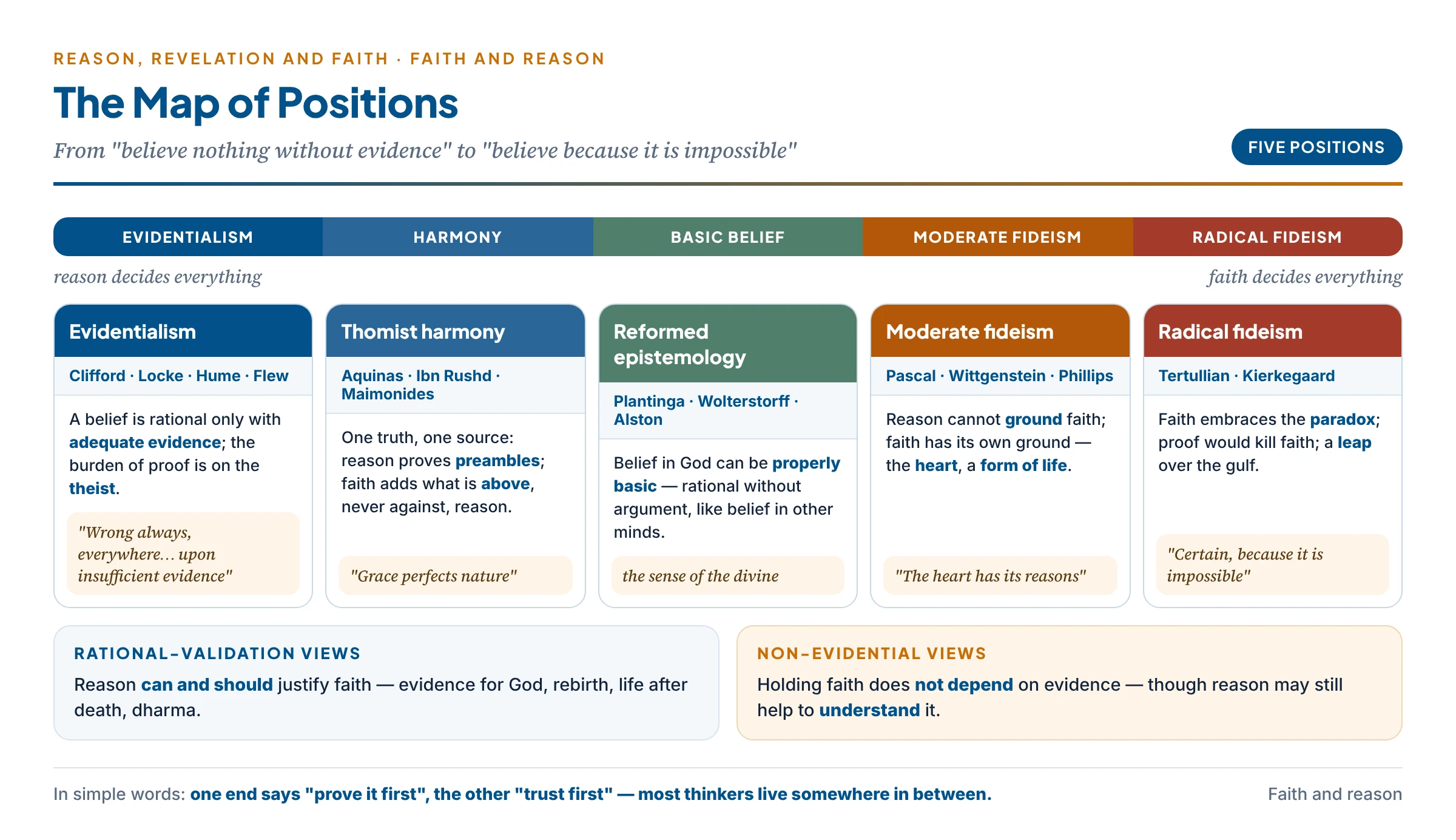
Are faith and reason friends, rivals or strangers? Traditionally both have been treated as sources of justification for religious belief, so philosophers have long asked how a rational person should treat claims that come from each. Some hold that reason properly used and faith properly understood can never conflict; others that they can — or even must — conflict, and they disagree about which should win. This article sets out the main positions — evidentialism (Clifford, Locke, Flew), fideism (Tertullian, Pascal, Kierkegaard, Wittgensteinian fideism), the Thomist harmony, and Reformed epistemology (Plantinga) — and then answers the questions UPSC keeps asking: Is faith opposed to reason? Do they go together? Can reason justify faith? Can religious beliefs be justified at all? Is faith or reason the way to self-revelation? And can modern sensibility live with total obedience to a despotic God?
In simple words
A scientist trusts her instruments, her textbooks and her colleagues long before she checks any of them — she could not do science otherwise. Yet she also tests what she trusts, and drops what fails. That is the middle path between two extremes: the person who believes nothing without proof (and so can do nothing), and the person who believes anything without question (and so can be fooled by anyone). The debate about faith and reason is a debate about where religious belief stands on that line.
Context & Problem
Why Faith and Reason Clash
- Both claim authority over the same beliefs — that God exists, that the soul survives. If they give different answers, which one should a rational person follow?
- The source of tension: most religions rest on a revelation, recorded in oral tradition or canonical writing and backed by divine authority. It is usually presented as narrative, parable or discourse, and so is in some measure immune from rational critique. Some even say that trying to verify religious beliefs rationally is a category mistake — like weighing a poem on a scale. Yet most religions allow and even encourage rational examination of their beliefs.
- The range of opinion:
- Kierkegaard puts faith first, even to the point that it becomes positively irrational.
- Locke stresses the reasonableness of faith so much that a doctrine’s irrationality — conflict with itself or with known facts — is a sign that it is unsound.
- The logical positivists deny that there is any domain rightly governed by faith; all meaningful statements are open to thorough rational examination.
- Unusual combinations are possible: one may hold a religious belief on faith alone or on reason alone; one may even lack faith in God, or deny his existence, and still find solace in the practice of religion.
Two Basic Views of the Interplay
- Rational-validation views — reason can and should be used to justify or validate faith: looking for evidence for God’s existence, for reincarnation or life after death, or justifying one’s beliefs about dharma.
- Non-evidential views — reason and evidence should not be used to justify faith. These views do not deny using reason to understand religious beliefs; they deny that holding them depends on having reasons or evidence that they are objectively true.
Two Medieval Formulas
- “Reason is the servant (slave) of faith” — Augustine, Aquinas: religion rests on holy scripture; reason’s tasks are to explain scripture, to answer unbelievers’ objections, and to give faith rational support. Faith primary, reason secondary.
- “Reason shows the path to faith” — Pascal, Kant, Kierkegaard in different ways: reason, knowing its limits, points beyond itself — to the wager, to the postulates of practical reason, to the leap.
Core Doctrine
Evidentialism: “Proportion Belief to the Evidence”
Evidentialism holds that a belief — religious or not — is rational only if it is supported by adequate evidence.
Clifford’s “The Ethics of Belief” (1877)
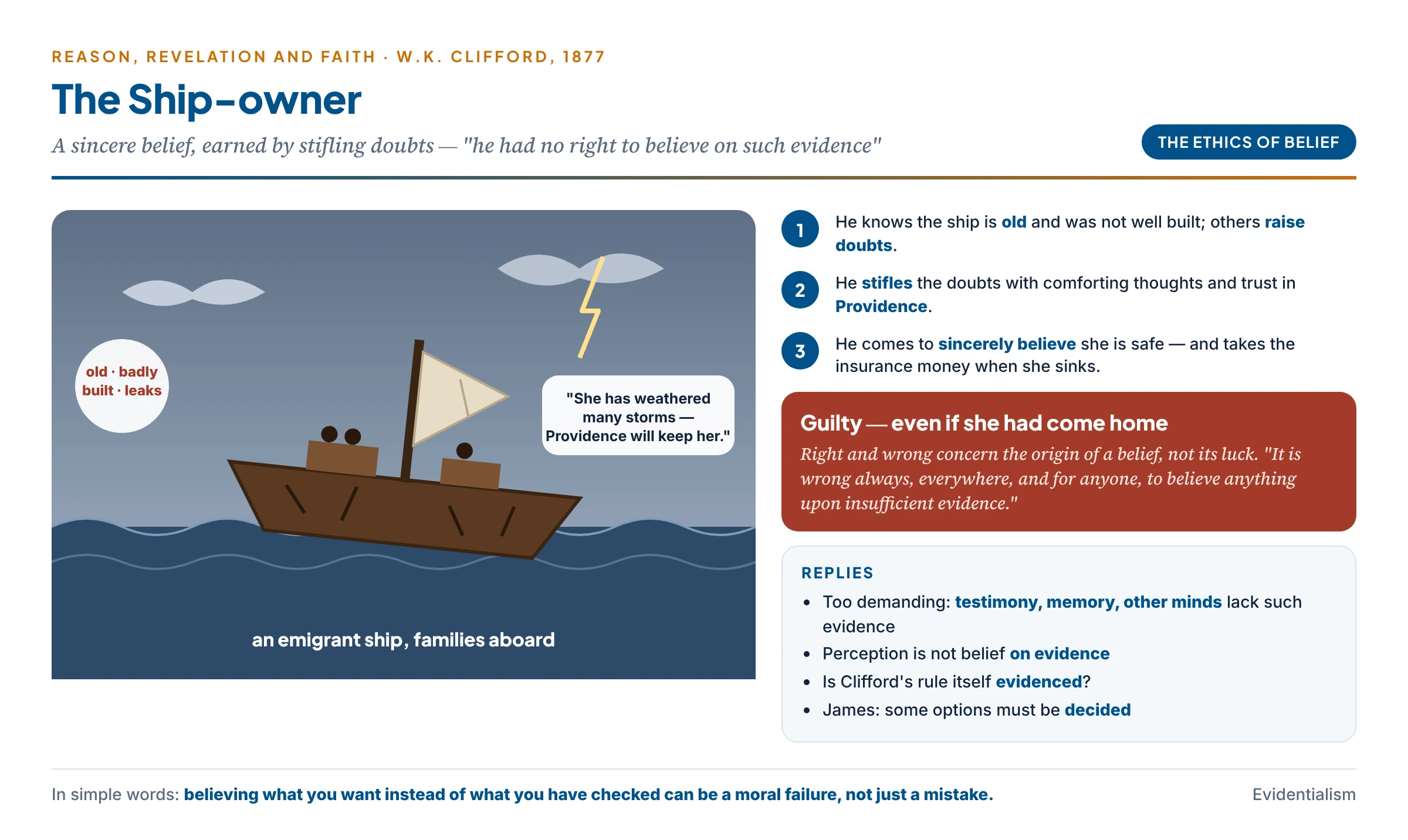
- The ship-owner: a ship-owner is about to send an emigrant ship to sea. He knows the ship is old and was not well built; doubts are raised about its seaworthiness. He puts the doubts aside, tells himself that the ship has survived many voyages and that Providence will protect the families aboard, and comes to sincerely believe the ship is safe. The ship sinks in mid-ocean.
- Clifford’s verdict: he is guilty of the deaths. His sincerity does not help, for “he had no right to believe on such evidence as was before him.”
- Even if the ship had arrived safely, he would be equally guilty — “the question of right or wrong has to do with the origin of his belief, not the matter of it.” He acquired his belief not by patient investigation but by stifling his doubts.
- Belief is a public matter: every belief we hold shapes our actions and is passed to others; credulity weakens the habit of testing and makes a society credulous. “No one man’s belief is in any case a private matter.”
- The principle: “It is wrong always, everywhere, and for anyone, to believe anything upon insufficient evidence.“
- Applied to religion: belief in God, on this view, is a moral fault as well as an intellectual one if the evidence is insufficient — believing without evidence is a crime against society, breeding gullibility.
Other evidentialists
- Locke: one should hold a proposition with “no greater assurance than the proofs it is built upon will warrant”; “Reason must be our last judge and guide in everything” (Article 3).
- Hume: “A wise man proportions his belief to the evidence.“
- Antony Flew, The Presumption of Atheism (1976): the burden of proof lies on the theist. As a court presumes innocence until guilt is proved, reason should presume atheism — in the negative sense of simply not being a theist — until good grounds for God are given.
- Russell’s teapot (1952): if someone claimed that a china teapot orbits the sun between Earth and Mars, too small to be seen by any telescope, we would not be obliged to believe him merely because we cannot disprove it. The burden lies on the one who asserts.
- The logical positivists go further: claims about God are not merely unsupported but meaningless.
Criticisms of evidentialism
- Too demanding: most of our ordinary beliefs — that other people have minds, that the past happened, what our parents told us, what we read in textbooks — rest on no sufficient evidence we have personally checked. A strict Cliffordian could hardly live.
- “Evidence” is too narrow: seeing my hand in front of my face is not believing on evidence; I simply see it. Perceptual beliefs arise directly from experience, with no gap between evidence and conclusion for reasoning to bridge. Rational belief can be grounded in experience without being based on evidence.
- Self-referential problem: is Clifford’s principle itself believed on sufficient evidence? It is not self-evident, and no evidence proves it.
- Genuine options (James): where evidence cannot decide and the choice is forced and momentous, refusing to believe is also a risk — “dupery through fear” is no better than “dupery through hope” (Article 5).
- Faith in persons: trust in friends, doctors and teachers outruns evidence, yet it is often rational and good.
- What survives: evidentialism rightly condemns wilful credulity — stifling doubts, as the ship-owner did. The issue is whether religious belief must be like the ship-owner’s.
Fideism: Faith above or against Reason
Fideism (from fides, faith) is the view that it is inappropriate to justify religious belief rationally — faith is independent of, superior to, or even opposed to reason.
- Two strengths of fideism:
- Moderate fideism: reason cannot ground faith; faith rests on its own foundation (trust, revelation, grace), though it is not against reason — Pascal, Wittgensteinian fideism.
- Radical fideism: faith may contradict reason, and that contradiction is part of its greatness — some readings of Tertullian and Kierkegaard.
Tertullian
- “What has Athens to do with Jerusalem? What has the Academy to do with the Church?” — Greek philosophy only breeds heresy; after Christ we need no curious inquiry.
- On the Incarnation and Resurrection: “the Son of God died — it is credible, because it is absurd; he was buried and rose again — it is certain, because it is impossible.”
Common confusion
Did Tertullian say “Credo quia absurdum” — “I believe because it is absurd”? Not in those words. The famous slogan is a later summary. What Tertullian wrote (in On the Flesh of Christ) is that the death of God’s Son is “credible because it is foolish” and his resurrection “certain because it is impossible” — a rhetorical way of saying that the gospel reverses worldly wisdom, as Paul said the cross is “folly to the Greeks”. Tertullian himself argued with considerable logical skill; he was not against all reasoning.
Pascal
- “The heart has its reasons which reason does not know.” “It is the heart which perceives God, and not the reason. That is what faith is: God perceived by the heart, not by the reason.”
- The God of faith is “the God of Abraham, Isaac and Jacob — not of the philosophers and scholars“.
- Reason, being finite, cannot know the infinite God; it can only show that the wager is prudent (Article 5).
Kierkegaard (1813–1855) — the best-known fideist
- No proofs, and none wanted: Kierkegaard held there are no solid proofs for religious faith, and that even if there were, they would be useless for real faith — a God proved like a geometry theorem leaves no room for faith.
- The absolute paradox: Christianity’s central claim — that the infinite, eternal God became a finite man in time — is a paradox that reason cannot sustain. It requires a leap of faith.
- The gulf: the gulf between a transcendent God and man cannot be bridged by dialectical thinking (Hegel’s system); only a leap — a voluntary act by which a person relates himself to God — can cross it.
- Truth is subjectivity: in Concluding Unscientific Postscript (1846), the objective approach — historical scholarship, speculative philosophy — gives only approximations, never enough for an eternal happiness. Faith is “an objective uncertainty held fast through appropriation with the most passionate inwardness“. “Without risk there is no faith.“
- The knight of faith: in Fear and Trembling (1843), Abraham, ready to sacrifice Isaac at God’s command, shows the teleological suspension of the ethical — the individual’s absolute relation to God rises above the universal moral law. He believes “by virtue of the absurd” that he will receive Isaac back.
- The self and faith: in The Sickness unto Death (1849) the cure for despair is faith, in which “the self, in relating to itself and in willing to be itself, rests transparently in the power that established it“.
Wittgensteinian fideism
- Wittgenstein (in his lectures on religious belief) said that a believer who thinks of the Last Judgement is not holding a hypothesis that evidence might confirm; his belief regulates his whole life. A non-believer does not contradict him; they are not on the same plane.
- Kai Nielsen (1967) called the view that follows “Wittgensteinian fideism“: religion is a form of life with its own language-game and its own internal criteria of meaning and truth; outsiders cannot judge it by scientific standards. D.Z. Phillips developed it.
Fideism in other traditions
- Buddhism: saddhā — acceptance of the Buddha’s teaching — comes before right understanding and right thought; entering the Eightfold Path involves a faith step, an acquiescence to the teaching without argument or evidence.
- Islam: al-Ghazālī attacked the philosophers’ claim to demonstrate religious truths and gave priority to mystical experience and revelation.
- Bhakti: many saints (Caitanya, Tulsīdās, Mīrā) place loving devotion above learning — “the Lord is reached by love, not by argument”.
Criticisms of fideism
- Which faith? In a religiously plural culture with many live options, how is one to decide which religion to commit to? Fideism gives no guidance — every faith can equally claim to be above reason.
- It protects error as well as truth: if faith is immune from criticism, so is superstition, cruelty and fanaticism — there is no way to tell a saint’s faith from a cult’s.
- Self-undermining: fideists argue for fideism, using the reason they reject.
- The Abraham problem: if faith can suspend ethics, what stops a murderer who claims a divine command? (Kant’s reply, Article 3.)
- Compartmentalisation: Wittgensteinian fideism isolates religion from the rest of life and knowledge, whereas believers think their faith says something true about reality.
- What survives: fideism rightly insists that faith is not a hypothesis, that it involves passion, trust and risk, and that reason has limits.
In simple words
Imagine a man who says, “My love for my wife is above all argument — I don’t need reasons.” That is touching. But if he says, “My love tells me she wants me to lock her up,” we would want reasons fast. Fideism is attractive while faith is loving; it becomes dangerous when faith commands something — because then there is no court of appeal.
The Thomist Harmony
- Aquinas (Article 5): reason and revelation come from the same God, so they cannot truly conflict; reason proves the preambles, revelation adds what is above reason, nothing is against reason; “grace does not destroy nature but perfects it”.
- Parallels: Ibn Rushd — “truth does not contradict truth”; Maimonides — reinterpret scripture where it seems to clash with demonstrated truth.
- Modern statement: the First Vatican Council (1870) taught that “faith and reason can never disagree“; Pope John Paul II’s Fides et Ratio (1998) opens: “Faith and reason are like two wings on which the human spirit rises to the contemplation of truth.“
- Strength: it honours both the dignity of reason and the mystery of faith.
- Weakness: it depends on natural theology succeeding and on a propositional view of faith.
Reformed Epistemology: Belief in God as “Properly Basic”
Alvin Plantinga (Reason and Belief in God, 1983; Warranted Christian Belief, 2000), with Nicholas Wolterstorff and William Alston, attacked evidentialism at its root. The name honours the Reformed (Calvinist) tradition.
- The evidentialist objection: belief in God is irrational because there is insufficient evidence for it.
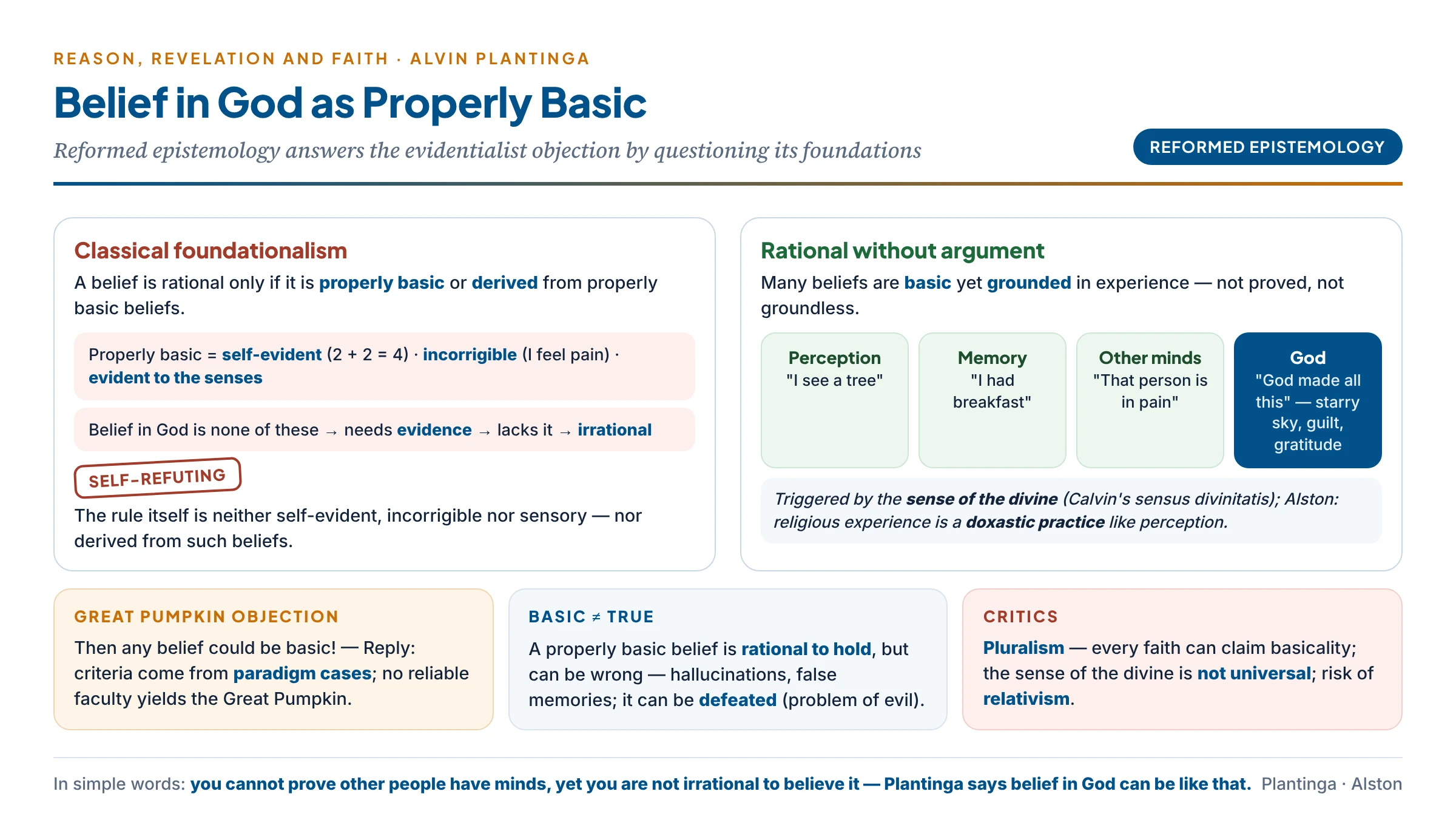
- Its hidden premise — classical foundationalism: a belief is rational only if it is properly basic — self-evident (2 + 2 = 4), incorrigible (I feel pain) or evident to the senses — or is supported by such beliefs. Belief in God is none of these, so it needs evidence.
- Plantinga’s first blow — self-refutation: classical foundationalism is itself neither self-evident, incorrigible nor evident to the senses, nor is it supported by such beliefs. By its own standard, it is irrational to accept it.
- Many rational beliefs are basic: we rationally believe in the external world, the past, and other minds without proving them. Such beliefs are basic (not inferred) but not groundless: “I see a tree”, “I had breakfast this morning”, “That person is in pain” are grounded in experience — the experience justifies them, though it is not used as evidence in an argument.
- Belief in God can be properly basic too: in the right circumstances — gazing at the starry heavens, feeling guilt or gratitude, reading scripture, in danger — people find themselves believing “God made all this”, “God forgives me”. These beliefs are triggered by a natural faculty, the sense of the divine (sensus divinitatis) that Calvin said God implanted in all humans. They are basic, grounded, and rational without argument — as rational for Moses at Sinai as his belief in the mountain itself.
In simple words
You believe your friend feels pain when she cries out after stubbing her toe. You have never proved that other people have minds at all — philosophers have tried for centuries and failed. Yet nobody calls you irrational. Your belief is basic: it arises directly from what you experience. Plantinga says that when a believer, looking at the night sky, simply finds herself believing that God made this, her belief may be basic in the same way.
- Alston’s “perceiving God”: religious experience is a doxastic practice (a socially established way of forming beliefs) like sense perception; beliefs that God is comforting, guiding or strengthening one (“M-beliefs“, beliefs about God’s manifestation) are prima facie justified.
- Basic, foundational and true: Hick distinguishes particular basic beliefs (“I see a tree”) from the foundational belief beneath them — that our senses put us in touch with a real world. That foundational belief cannot be proved without circularity; yet it is rational to accept it — Hume: nature has made it “an affair of too great importance to be trusted to our uncertain reasoning“. The believer claims the same for the foundational belief in a divine reality. But note: a properly basic belief is rational to hold, not thereby true — perceptions can be hallucinations, memories mistaken.
- The Great Pumpkin objection: if belief in God can be properly basic, why not belief that the Great Pumpkin returns every Halloween? Plantinga replies that proper basicality is not a free-for-all: criteria are built up from paradigm cases within a community, and nothing makes belief in the Great Pumpkin arise from a reliable faculty.
- Defeaters: a basic belief can be defeated by strong counter-arguments (for example the problem of evil); the believer must answer them — with a defence, if not a proof.
- Criticisms:
- Pluralism: Hindus, Buddhists and Muslims can equally claim their beliefs are properly basic — Reformed epistemology cannot choose among them.
- The sense of the divine is not universal — many sincere people never feel it.
- Relativism: any community could declare its favourite beliefs basic.
- It defends rationality, not truth: showing a belief is permissible is not showing it is correct.
Rational-Validation and Non-Evidential Views Compared
| Point | Rational-validation views | Non-evidential views |
|---|---|---|
| Claim | Faith should be backed by reasons and evidence | Holding faith does not depend on evidence |
| Use of reason | To prove or support faith | To understand faith, not to ground it |
| Thinkers | Aquinas (preambles), Locke, Swinburne, Nyāya | Kierkegaard, Pascal, Wittgenstein, Plantinga, Barth |
| Model of faith | A justified belief | Trust, passion, form of life, basic belief |
| Danger | Faith rises and falls with arguments | Faith becomes immune to criticism |
Faith and Reason: The Key Debates
Is Religious Faith Opposed to Reason? Do They Go Together?
- Opposed — in three senses:
- To rationalism that admits nothing beyond reason (deism, positivism).
- To evidentialism that demands public proof for every belief.
- In radical fideism, which glories in the absurd.
- Not opposed — in the deeper sense:
- Faith and reason are different functions of one person: reason analyses, infers and tests; faith trusts, commits and relates. Different is not opposed.
- Tillich: reason in the full sense (the meaningful structure of mind) is the precondition of faith; faith is reason “reaching ecstatically beyond itself” (Article 4).
- Aquinas: faith is above, never against reason.
- Reason needs faith too — every reasoning starts from trusted premises (that the senses are reliable, that the world is orderly); science itself rests on such faith.
- Faith needs reason — to understand its content, to test claims to revelation, to reject what is cruel or contradictory.
In simple words
A pilot flying through cloud trusts her instruments — she cannot see the ground. Trust (faith) keeps her flying; checking the instruments against each other (reason) keeps her alive. A pilot who refuses to fly until she sees the runway never takes off; a pilot who never cross-checks her instruments crashes. Faith and reason are the two habits of a good pilot.
Common confusion
Does fideism mean rejecting reason altogether? Only in its radical form. Most fideists — Pascal, the Wittgensteinians, much of the bhakti tradition — are moderate: they deny that reason can ground faith, but use reason freely to understand, defend and live their faith. Pascal was one of the greatest mathematicians of his age; Kierkegaard wrote some of the most closely argued books of the 19th century.
- Verdict: faith and reason go together when each keeps to its role — reason as critic and interpreter, faith as trust and commitment. They clash when reason claims to be the whole of knowledge, or faith claims immunity from all criticism. “Faith without reason is blind; reason without faith is sterile” sums up the balance.
Can Reason Be Used to Justify Faith?
- Strong justification (proof) — reason proving faith’s content: mostly fails (Hume, Kant) for the central claims; and if it succeeded, faith would become knowledge.
- Weak or permissive justification — reason showing faith is not unreasonable: largely succeeds:
- Coherence — faith’s doctrines are not self-contradictory.
- Defence — objections (the problem of evil, the paradox of omnipotence) can be answered (Plantinga’s free will defence).
- Credibility — signs, fruits and experience make it reasonable (Aquinas, James).
- Pragmatic and moral reasons — Pascal, James, Kant.
- Proper basicality — faith may be rational without argument (Plantinga).
- Cumulative case — many considerations together (Mitchell, Swinburne).
- Verdict: reason cannot compel faith, but it can justify holding it — show that it is rational to believe and that unbelief is not the only rational option.
Can Religious Beliefs Be Justified?
The 2023 paper asked this directly.
- Kinds of justification:
- Evidential — arguments and evidence (the theistic proofs; Nyāya’s inferences for Īśvara). Status: contested; at best probable.
- Experiential — religious experience as a ground, like perception (Alston, Swinburne’s principle of credulity; Advaita’s anubhava). Status: strong for the experiencer, weaker for others.
- Basic — beliefs properly basic, needing no argument (Plantinga). Status: shows rational permission, not truth.
- Pragmatic — beliefs justified by their benefits or by the stakes (Pascal, James). Status: justifies acting, not truth.
- Moral — beliefs required by the moral life (Kant). Status: depends on accepting Kant’s moral argument.
- Testimonial — trust in reliable witnesses, scripture, tradition (Nyāya’s āpta). Status: as good as the witness.
- Coherence and cumulative — the whole picture makes best sense of the world and experience (Mitchell, Swinburne).
- Objections: the evidential gaps (Hume, Kant); falsification and verification challenges (Flew, Ayer); rival religions with equal justification; naturalistic explanations of belief (Freud, Marx, evolutionary psychology).
- Verdict: religious beliefs can be justified in the sense of being rationally held, through experience, testimony, cumulative argument and proper basicality — but not demonstrated to everyone. Justification is person-relative and defeasible (open to defeat), as most important human beliefs are.
What Is Instrumental to Self-Revelation — Faith or Reason?
The 2019 question can be read in two ways, and both should be addressed.
- (a) God’s self-revelation:
- Faith is the organ of reception — revelation and faith are correlatives; an event is received as God’s self-disclosure only by faith (Barth, Hick).
- Reason prepares (the preambles), interprets and tests (Locke, Kant).
- (b) The revelation of the Self (ātma-sākṣātkāra, self-realisation):
- Advaita: the Self is revealed by knowledge (jñāna) arising from the śruti “Tat tvam asi” (That thou art); the seeker needs śraddhā (faith in scripture and guru) and manana (reasoned reflection), crowned by nididhyāsana and anubhava. Both faith and reason are instruments; neither alone suffices.
- Socrates: “The unexamined life is not worth living” — self-knowledge through reason and dialogue.
- Kierkegaard: the self becomes truly itself only in faith, “resting transparently” in God.
- Buddhism: insight (prajñā) into no-self is reached through saddhā at the start and wisdom at the end.
- Verdict: for revelation from God, faith is the primary instrument and reason the guardian; for the revelation of the Self, faith opens the path, reason clears it, and direct experience completes it.
Modern Sensibility and Total Obedience to a Despotic God
The 2016 paper asked to discuss critically the view that “modern sensibility” and “total obedience to a despotic God” do not go hand in hand.
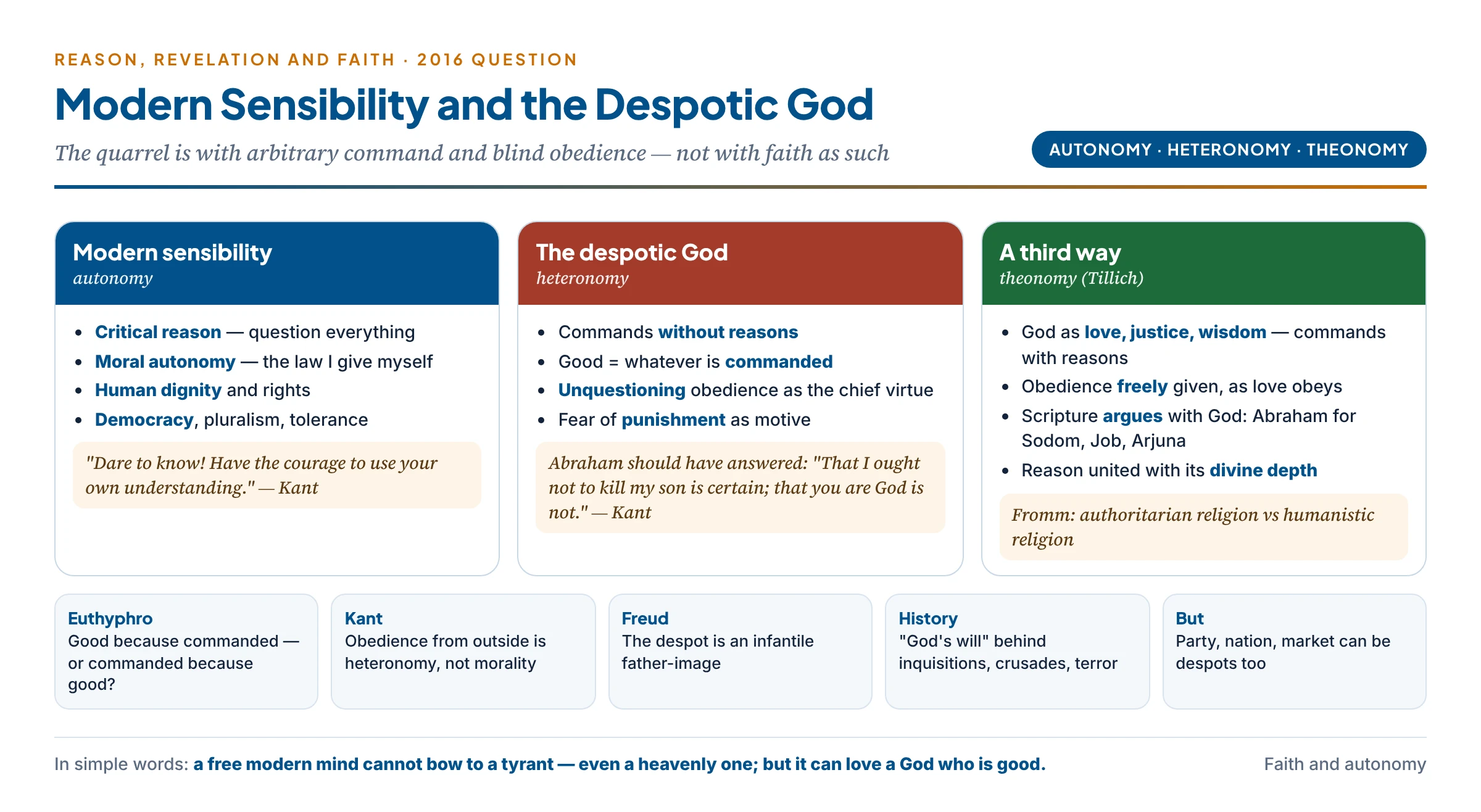
- What “modern sensibility” means: the outlook shaped by the Enlightenment — Kant‘s motto “Dare to know! Have the courage to use your own understanding” (1784); moral autonomy, human dignity and rights, critical reason, democracy and pluralism.
- What a “despotic God” means: a God pictured as an arbitrary ruler who commands without reasons and demands unquestioning obedience — an extreme form of divine command theory (some medieval voluntarists held that God could even command what we now call evil, and it would become right).
- Why they seem incompatible:
- Autonomy vs heteronomy (Kant): morality obeyed only because commanded from outside is heteronomous and not truly moral; Abraham should have refused the voice (Article 3).
- Euthyphro’s dilemma: is something good because God commands it (then goodness is arbitrary), or does God command it because it is good (then goodness is independent of God)?
- Psychological critiques: Freud — the despotic God is an infantile father-image; Erich Fromm distinguished authoritarian religion (submission to a power, obedience as the chief virtue) from humanistic religion (human growth, love and reason).
- Social history: absolute obedience to “God’s will” has justified inquisitions, crusades, caste cruelty and terror.
- Nietzsche: such religion is a slave morality that crushes human greatness.
- Why the opposition may be overstated:
- God need not be despotic: in most theism God is love, justice and wisdom; his commands are reasons, not whims — Aquinas held that God’s will follows his wisdom.
- Obedience can be free: love obeys gladly — the bhakta’s surrender, the Islamic islām (submission) understood as peace, Kierkegaard’s knight of faith acting from love.
- Scripture itself argues with God: Abraham bargains with God for Sodom; Job protests; the Gītā’s Arjuna questions Kṛṣṇa for eighteen chapters before acting.
- Tillich’s third way — between autonomy (reason cut off from depth) and heteronomy (authority imposed from outside) lies theonomy: autonomous reason united with its own divine depth.
- Modern sensibility has its own idols — total obedience to party, nation or market has proved as despotic as any religion.
- Verdict: modern sensibility and total obedience to a despotic God indeed do not go together; but modern sensibility can go together with faith in a God of love and reason, freely trusted, whose commands can be understood and even questioned. The tension is with despotism, not with faith as such.
Indian Connect — Indian Connect — faith and reason in Indian schools
- Rational validation: Nyāya proves Īśvara by inference and defends śabda by the reliability of its author; Buddhism invites testing — “come and see“.
- Non-evidential: Mīmāṃsā treats the Veda as self-valid (svataḥ); the bhakti saints put love above argument.
- Synthesis: Advaita places śraddhā and manana side by side on the path to anubhava (Article 7) — the Indian version of “faith seeking understanding”.
Critical Evaluation
Critics and Defenders
Criticism — Against harmonising faith and reason
- Clifford: believing beyond evidence is always wrong.
- Flew and Russell: the burden of proof is on the believer.
- Positivists: religious claims are not even meaningful.
- Kierkegaard: a reasoned faith is no faith; proof kills risk.
- Tertullian, Luther: reason is proud and corrupts faith.
- Wittgensteinians: religion is a form of life, not a hypothesis for reason to test.
Defence — For the partnership of faith and reason
- Aquinas, Ibn Rushd: one truth from one source; faith above, not against, reason.
- Plantinga, Alston: belief in God can be rational without argument.
- James: in genuine options the will may rightly decide.
- Tillich: reason is the precondition of faith; faith fulfils reason.
- Mitchell, Swinburne: a cumulative case makes faith reasonable.
- Fides et Ratio: faith and reason are two wings of one spirit.
Cross-Tradition Comparison
| Position | Western exponents | Indian counterparts |
|---|---|---|
| Evidentialism | Clifford, Locke, Hume, Flew | Cārvāka (perception only); Buddha’s Kālāma Sutta (test before accepting) |
| Harmony | Aquinas, Ibn Rushd, Maimonides | Nyāya (anumāna + śabda); Rāmānuja (reason in support of scripture) |
| Experience-based | Plantinga, Alston, Hick | Advaita (anubhava); Vivekananda, Radhakrishnan |
| Moderate fideism | Pascal, Wittgenstein | Bhakti (love above learning); Buddhist saddhā before insight |
| Radical fideism | Tertullian, Kierkegaard | Rare — Indian schools seldom glorify contradiction |
| Self-validating authority | Barth, Calvin’s inner witness | Mīmāṃsā (svataḥ prāmāṇya of the Veda) |
Synthesis (Siddhānta)
- Faith and reason both claim to justify religious belief; thinkers range from evidentialists (only evidence justifies) to fideists (faith needs no justification), with the Thomist harmony and Reformed epistemology between them.
- Evidentialism (Clifford’s ship-owner, Flew’s presumption of atheism) rightly condemns wilful credulity but is too demanding and too narrow about evidence, and may refute itself.
- Fideism (Tertullian, Pascal, Kierkegaard, Wittgenstein) rightly stresses trust, passion and risk and the limits of reason, but gives no way to choose among faiths and protects error along with truth.
- Aquinas keeps faith above but not against reason; Plantinga shows that belief in God, like belief in other minds, may be properly basic — rational without argument, though not thereby true.
- Faith is not opposed to reason in the deeper sense; they are different functions of one person and go together when reason acts as critic and interpreter and faith as trust and commitment.
- Reason can justify faith weakly — showing it coherent, defensible, credible and reasonable — but cannot compel it; religious beliefs can be justified in this person-relative, defeasible way.
- For self-revelation, faith receives God’s disclosure and opens the path to the Self; reason clears and tests the path; experience completes it.
- Modern sensibility cannot accept total obedience to a despotic God, but can accept a God of love and reason freely trusted — the problem is despotism, not faith.
“Faith and reason are like two wings on which the human spirit rises to the contemplation of truth.” — Pope John Paul II, Fides et Ratio
Previous Year Questions
- 2023Can religious beliefs be justified? Discuss.
- 2019What is instrumental to self-revelation: Faith or Reason? Justify your position.
- 2016Critically discuss the view that ‘modern sensibility and total obedience to a despotic God‘ do not go hand in hand.
- 2015Do reason and faith go together? Discuss.
- 2014Can reason be used to justify faith?
- 2013Is religious faith opposed to reason?