

Reason, Revelation and Faith.
Official Syllabus: Paper II, Section B, Unit 5
Revelation is the religious name for knowledge that comes from the other side — truth about God, the soul and salvation that human beings could not find by their own senses or reasoning, but which is disclosed to them by God, or (in some Indian schools) given in an authorless, eternal scripture. The prophetic religions — Judaism, Christianity, Islam and Zoroastrianism — are built on it; Hindu thought speaks of śruti, “that which was heard”. This article explains what revelation means, its kinds (general and special, public and private), the key distinction between natural and revealed theology, the two great models — propositional and non-propositional — and how revelation is related to scripture, tradition and experience in the world’s religions. It closes with the question whether revelation is opposed to religious pluralism.
In simple words
Imagine two ways of getting to know a friend who lives far away. In the first, he sends you a letter listing true facts about himself — his views, his rules, his plans. In the second, he visits you, and you come to know him by living with him; later you write down what you understood. The first is like the propositional view of revelation (God gives statements); the second is like the non-propositional view (God gives himself, in events and encounters, and people record their understanding of it).
Context & Problem
The Meaning of Revelation
- The word: Latin revelatio and Greek apokalypsis both mean unveiling — drawing back a cover from what was hidden.
- Definition: revelation is the disclosure of divine or sacred reality or purpose to human beings — the making known of truth about God, the cosmos, the soul and salvation, through communication from the divine.
- Why it is needed:
- God is hidden. The Bible says, “Truly you are a God who hides himself”; the Upaniṣads say Brahman is that “from which words turn back, together with the mind, not reaching it”.
- So God is supersensuous — known neither by perception nor by inference. He can be known only if he makes himself known.
- Yet human beings have an inner urge to know God. Hence, according to the prophetic religions, man stands in need of some prompting from God.
- To whom: revelation is usually given to privileged persons — prophets, ṛṣis, apostles, the “chosen ones” — and through them to a community.
- How it comes: through revealed scriptures (Bible, Qur’ān, Veda), angels (Gabriel brought the Qur’ān to Muhammad), dreams and visions, special messengers, God’s creation, the Holy Spirit, trance; often with signs such as voices, visions and ecstasies, and through mystical insights, historical events or spiritual experiences that transform individuals and groups.
The Nature of Revelation
- Not inference, but illumination: revelation is accepted not as the conclusion of an argument but through sudden, unexpected illuminations that “invade and transform” the human spirit.
- Intuitive insight: it is immediate (direct) and sudden, yet its immediacy is not given by the senses — it is trans-empirical and supra-sensory but still direct.
- A mystery made manifest: it is “a mystery which is mysteriously manifested, a knowledge that comes from outside the normal sphere of knowledge, which cannot be achieved by man, but must be given to him, and enters suddenly and unexpectedly into his life.”
- Epistemological weight: revelation is a source or foundation of religious knowledge. For the religious person it is certain and indubitable — a pramāṇa (valid means of knowledge) in itself.
- Personal effect: it deeply shapes the personality of the one through whom it comes — the prophet is never the same again.
Core Doctrine
Kinds of Revelation
- Public and private:
- Public revelation is received on behalf of the whole community of the faithful — the Torah at Sinai, the Qur’ān, the Gospel.
- Private revelation is given for the guidance or edification of the recipient himself — a saint’s vision, a devotee’s dream.
- General revelation — God made known through the general order of nature, conscience and history, open to everyone:
- “The heavens declare the glory of God” (Psalms); God’s invisible power is “clearly seen through the things that are made” (Paul).
- Eastern religions, on the whole, place less emphasis on a special, exclusive revelation to a chosen people, and speak rather of the manifestation of the Absolute through the order of nature.
- Special revelation — God made known in particular events, persons and words to particular people: the call of Abraham, the Exodus, the prophets, Jesus, the Qur’ān.
- Some focus on the direct inspiration of chosen prophets.
- Others see the prophets as witnesses and interpreters of what God is doing in history.
- Revelation through deeds is often thought more basic than revelation through words, though words are needed to clarify the meaning of the deeds. The Hebrew word davar means both “word” and “deed“, so the Bible draws no sharp line between them.
- The biblical writers read the national fortunes of Israel as revelations of God’s love, fidelity, power, justice and forgiveness; the full meaning of history will be disclosed only at the end of time.
- The Bible and the Qur’ān combine both: God has specially manifested himself to the biblical peoples, but he also makes himself known through the order of nature.
In simple words
You can learn something about a painter just by walking through a gallery of her paintings — her skill, her taste, her love of colour. That is general revelation: God known through his works, open to every visitor. But you learn far more if she writes you a letter or meets you and tells you her plans. That is special revelation: God known through particular words and acts, given to particular people.
Natural Theology and Revealed Theology
The propositional view of revelation (below) has always gone with a famous distinction, accepted by almost all Christian theologians until the 20th century.
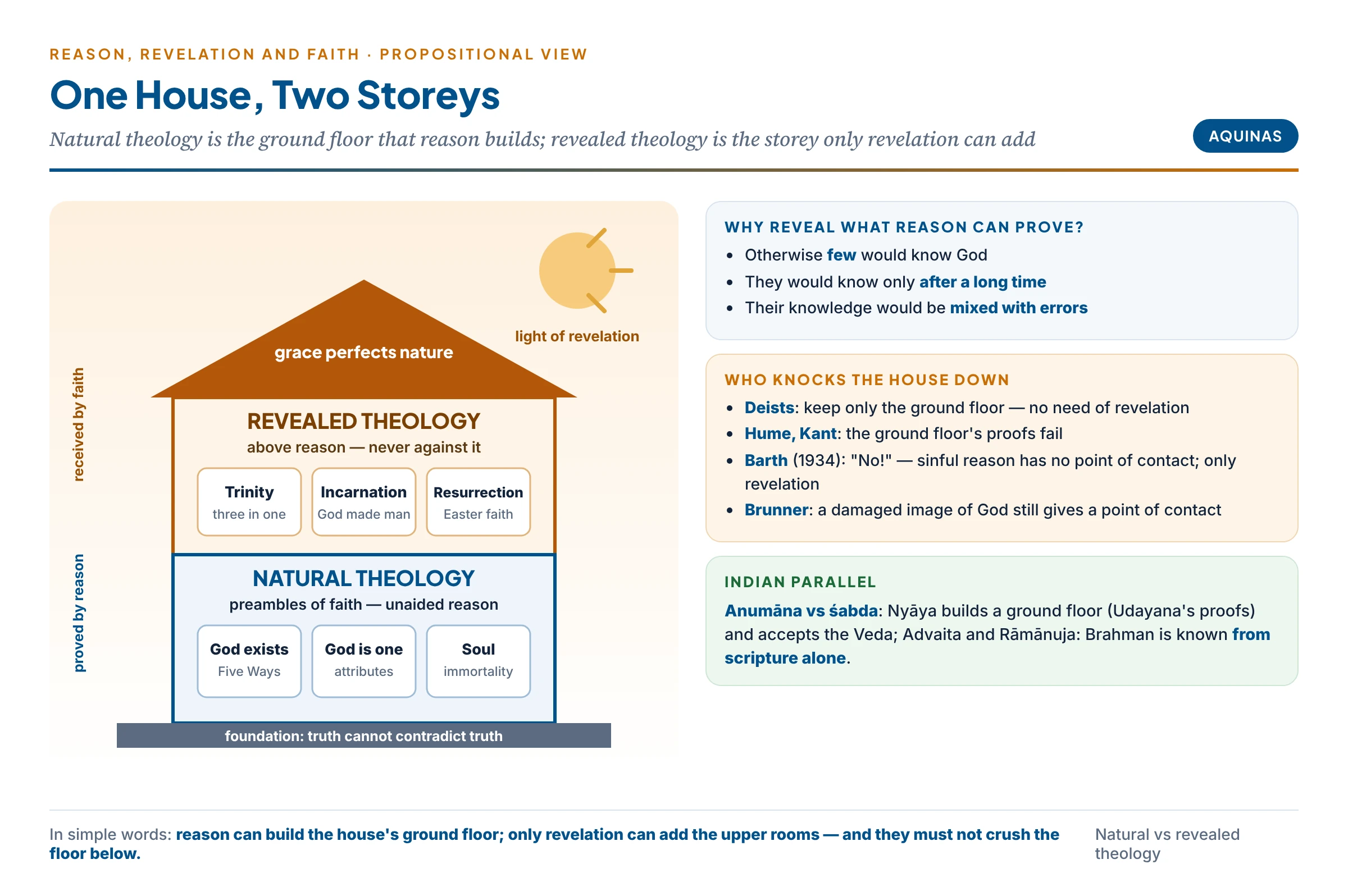
- Natural theology — all theological truths that can be worked out by the unaided human intellect: for example, that God exists, his attributes, and the immortality of the soul, proved by strict argument with no appeal to revelation.
- Revealed theology — further truths not accessible to reason, known only because God has specially revealed them: for example, that God is three Persons in one (the Trinity), the Incarnation, the Resurrection. These are accepted by faith.
- The two overlap: the truths of natural theology were believed to be revealed as well, for the benefit of those who lack the time or mental equipment to reach them by argument. Aquinas gives three reasons why God revealed even what reason can prove:
- Otherwise few would know God — most people lack the ability or leisure.
- Those who did would reach the truth only after a long time.
- And it would be mixed with errors, since human reasoning often goes wrong.
- The architecture: natural theology forms the preambles of faith (praeambula fidei) — the ground floor; revealed theology is the upper storey, above reason but never against reason (Article 5).
| Point | Natural theology | Revealed theology |
|---|---|---|
| Source | Unaided human reason | God’s special revelation |
| Examples | God exists; God is one; soul immortal | Trinity; Incarnation; Resurrection |
| Method | Proof — Five Ways, ontological argument | Scripture, church teaching, faith |
| Who can know | In principle anyone | Those who receive revelation |
| Status | Preambles of faith | Articles of faith — above reason |
| Modern critics | Hume, Kant (proofs fail); Barth (proud human effort) | Deists, rationalists (no need of it) |
- Twentieth-century quarrel: Karl Barth said a stern “No!” (1934) to natural theology — sinful reason has no point of contact with God, who is known only in his self-revelation in Christ. Emil Brunner replied that the image of God in man, though damaged, leaves a point of contact for revelation.
- Philosophical critics: Hume and Kant attacked natural theology’s proofs; the deists went the other way and kept only natural religion, dismissing special revelation as unnecessary.
- Indian parallel: the same division appears as anumāna versus śabda. Nyāya builds a natural theology (Udayana’s inferences for Īśvara) and also accepts the Veda; Advaita and Rāmānuja hold that Brahman is known only from scripture (śāstra-yonitvāt) — revealed theology alone.
Common confusion
Is “natural theology” the same as “natural religion”? Not quite. Natural theology is a method — reasoning about God without appeal to revelation — and it is usually meant to support revealed religion (Aquinas). Natural religion (the deists’ term) is a complete religion of reason that claims revelation is unnecessary or merely a republication of what reason knows. Aquinas was a natural theologian but not a believer in “natural religion”.
The Propositional View of Revelation and Faith
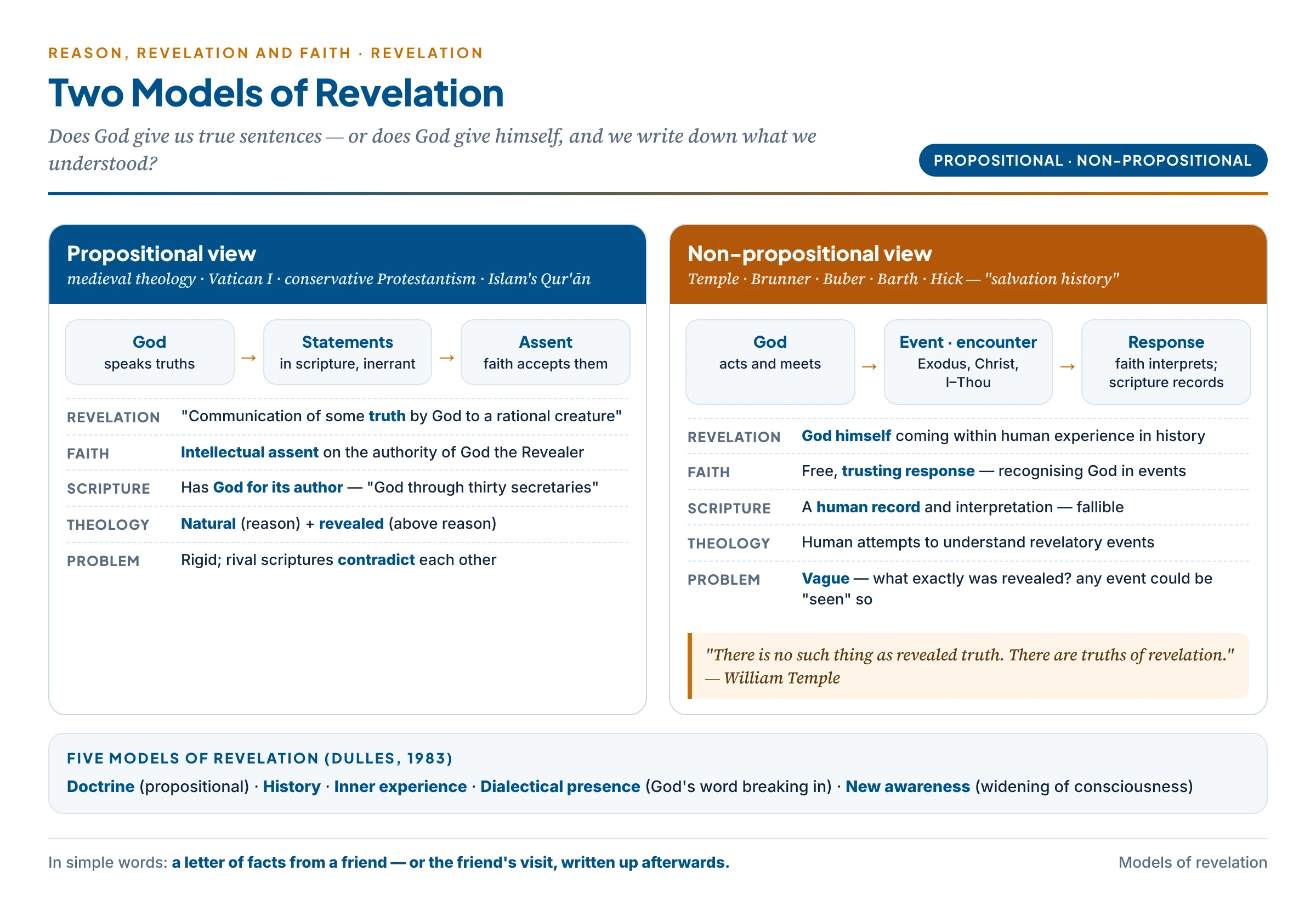
- The view: the content of revelation is a body of truths expressed in statements or propositions. Revelation is “the communication of some truth by God to a rational creature through means which are beyond the ordinary course of nature” (the older Catholic Encyclopedia).
- Its history: it dominated the medieval period and is held today by traditional Roman Catholicism and — “in a curious meeting of opposites” — by conservative Protestantism; Islam’s understanding of the Qur’ān is strongly propositional too.
- Faith on this view is the obedient acceptance of revealed truths. The First Vatican Council (1870) defined faith as “a supernatural virtue whereby, inspired and assisted by the grace of God, we believe that the things which He has revealed are true.” A 20th-century Jesuit put it: faith is “an intellectual assent to the content of revelation as true because of the witnessing authority of God the Revealer“.
- The Bible on this view is the place where revealed truths are authoritatively written down — first through the prophets, then fully through Christ and the apostles. It is not a merely human, fallible book: the books “having been written by inspiration of the Holy Ghost, have God for their author” (Vatican I). The evangelist Billy Graham said the Bible is “a book written by God through thirty secretaries“.
- Scripture and tradition:
- Catholic theology sets scripture within tradition — the Council of Trent (1546–1563) accepts with equal reverence the scriptures and the unwritten traditions received from Christ and preserved in the Church.
- Protestantism recognises no oral tradition of equal authority; God speaks directly through the Bible to the Church and to each believer (sola scriptura).
- Theology on this view is reasoning upon revealed propositions — and it brings with it the natural/revealed theology division above.
- Philosophers often assume it: many critics of religion (for example Walter Kaufmann) take “revelation” to mean propositions God is supposed to have declared, and define faith as believing propositions on insufficient evidence. Many defenders accept the same picture and try to bridge the evidence gap by an act of will — faith as “a yes of self-commitment” (the voluntarist theories, Article 5).
In simple words
On the propositional view, revelation is like a sealed government notification: its sentences are true because of who issued it, and the citizen’s duty is to accept them. The notification may be explained by officials, but not edited by them.
“Revealed Propositions Cannot Be against Reason”
The 2016 paper put this exact claim. Even those who hold the propositional view usually insist that revelation, though it may go beyond reason, can never contradict it.
- Aquinas: truth cannot contradict truth, because both reason and revelation come from God. Revealed mysteries are above reason (supra rationem), not against reason (contra rationem). Any argument against a doctrine of faith must therefore contain an error that reason itself can expose.
- Locke: no proposition can be accepted as revealed if it contradicts clear reason; reason must judge whether something is a revelation and what its words mean (Article 3).
- Ibn Rushd (Averroes): in the Decisive Treatise (12th century) he argued that “truth does not contradict truth“; where scripture seems to conflict with demonstrated truth, scripture must be read allegorically.
- Maimonides: biblical passages that speak of God’s hand, eye or anger must be read figuratively, because reason shows God has no body.
- Galileo quoted a churchman’s saying that the Bible teaches “how to go to heaven, not how the heavens go” — scripture is not a textbook of astronomy.
- Śaṅkara: “Even a hundred scriptural texts cannot make fire cold“; scripture’s authority covers what is beyond perception, not what contradicts it.
- Why the principle matters: it lets a believer accept revelation without sacrificing intelligence, and it forces interpreters to separate the message of scripture from the science of its age.
- Its difficulty: who decides what is “against reason”? The Trinity (three Persons, one God) and the Incarnation (the infinite becoming finite) look to many critics like contradictions; defenders reply that they are mysteries, not contradictions, because “person” and “nature” are not used in the same sense.
The Non-propositional View of Revelation and Faith
- The view: the content of revelation is not a body of truths about God but God himself coming within the orbit of human experience by acting in history. Theological propositions are not revealed; they are human attempts to understand the meaning of revelatory events. It is sometimes called the “salvation-history” view (Heilsgeschichte).
- Its roots: it claims descent from the Reformers (Luther, Calvin) and the New Testament, and became widespread in 20th-century Protestant thought; it goes with a renewed stress on the personal character of God — a relationship with a person is more than receiving information from him.
- William Temple (Nature, Man and God, 1934): “There is no such thing as revealed truth. There are truths of revelation, that is to say, propositions which express the results of correct thinking concerning revelation; but they are not themselves directly revealed.” Revelation is “the coincidence of divinely controlled event and minds divinely illumined to read it aright“.
- Emil Brunner: revelation is truth as encounter — the meeting of God and man, not the delivery of doctrines.
- Martin Buber (I and Thou, 1923): there are two basic attitudes — I–It (treating something as an object to use or study) and I–Thou (meeting another as a person, wholly and directly). Revelation is an I–Thou encounter with the Eternal Thou: it gives not information but presence, and a person comes out of it transformed.
- Karl Barth: God’s Word is first Jesus Christ himself; the Bible becomes God’s word when God speaks through it — it witnesses to revelation rather than being revelation in itself.
- John Hick: the Bible is a human response to divine events — the record of prophets and apostles who experienced history as God’s activity. The Exodus, for example, could be described by a secular historian as a migration; the prophets experienced it as God’s deliverance (Article 5, “experiencing-as”).
- Faith on this view is not assent to propositions but a free, interpretative response — recognising God’s presence in events that could also be read naturally.
- Five models: the Catholic theologian Avery Dulles (Models of Revelation, 1983) mapped the debate into five models — revelation as doctrine, as history, as inner experience, as dialectical presence (God’s word breaking in, as in Barth) and as new awareness (a widening of consciousness). The first is the propositional model; the others are forms of the non-propositional model.
| Point | Propositional view | Non-propositional view |
|---|---|---|
| What is revealed | Truths — statements about God | God himself in events and encounter |
| Faith | Assent to revealed truths (assensus) | Trust and response to a person (fiducia) |
| Scripture | God’s own word; inerrant | Human record and interpretation; fallible |
| Theology | Reasoning on revealed premises | Human attempts to understand events |
| Key names | Aquinas, Vatican I, Islam’s Qur’ān | Temple, Brunner, Buber, Barth, Hick |
| Strength | Clear, definite, authoritative content | Personal, historical, open to pluralism |
| Weakness | Rigid; conflicts between scriptures | Vague; what exactly is revealed? |
- Criticisms of the propositional view:
- It freezes the cultural and historical setting of a text into eternal dogma (Hick).
- It makes religions mutually incompatible — if two scriptures are both literally God’s statements and they disagree, one must be false.
- Historical study of scripture shows human authorship, editing and variant readings.
- It reduces faith to accepting information, leaving out trust and love.
- Criticisms of the non-propositional view:
- It is vague — if nothing definite is revealed, how can one tell true revelation from imagination?
- Any event might be “seen” as God’s act; there is no check.
- It still needs some propositions — at least that the event happened and that it was God’s act.
- Conservative critics say it makes scripture merely human, so its authority collapses.
Revelation in Different Types of Religion
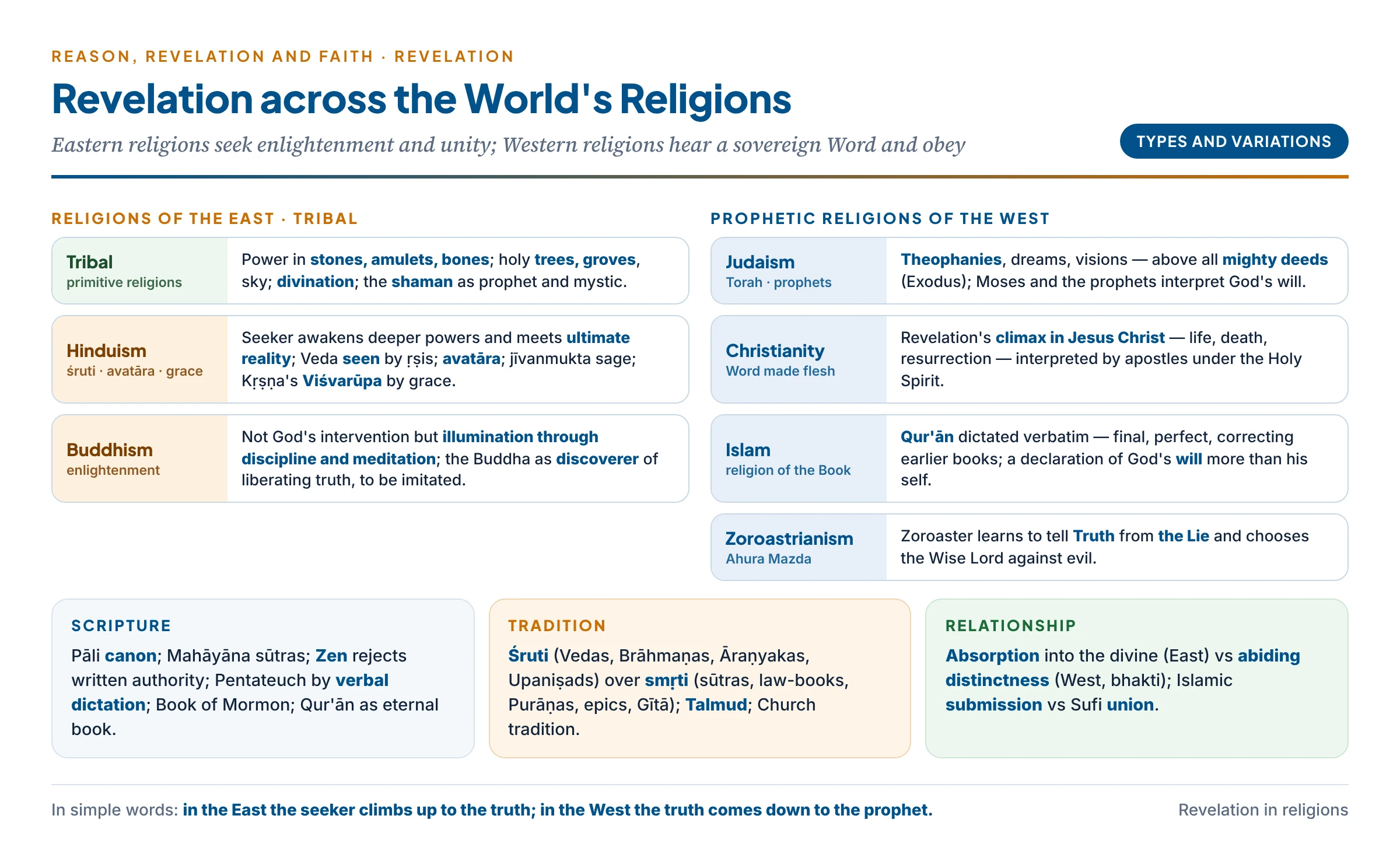
- Primitive or tribal religions — revelation is often tied to magical techniques of divination, and to supernatural power in particular objects: stones, amulets, bones of the dead, unusual animals; the holy is present in sacred trees, groves and shrines and in earth, water, sky and the heavenly bodies. Such objects take on symbolic value and mediate numinous experience. Shamans, believed to be in communion with the sacred, do what prophets and mystics do in later religions.
- Prophetic religions (Judaism, Christianity, Islam, Zoroastrianism) — revelation is primarily the “Word of God“, a message communicated by God to an accredited spokesman who must proclaim it to a whole people; it lets the prophet speak with certainty about God’s actions and intentions.
- Mystical religions (Islamic Sufism, Tantric Buddhism) — revelation is an ineffable experience of the transcendent.
- Religions of a personal God — where God is a free and personal spirit distinct from the world, revelation is a divine self-disclosure, pictured on the model of human inter-personal relationships.
- The Indian tradition recognises several modes:
- Nature — Brahman or God revealed through the world.
- Scripture — the Vedas. The Mīmāṃsakas hold them eternal and authorless; the Naiyāyikas hold them inspired by God; all orthodox schools stress śruti.
- Incarnation (avatāra) — the Absolute takes forms that ordinary souls can grasp. The Gītā: “Whenever there is a decline of righteousness and a rise of unrighteousness, then I manifest myself.“
- The liberated sage (brahma-sākṣātkāra, direct realisation of Brahman) — Śaṅkara accepts jīvanmukti, liberation in this very life, and such souls teach Brahman’s reality; Ramakrishna Paramahamsa‘s vision of Mother Kālī and his realisation of Brahman are a modern example — “the pure in heart shall see God“. Rāmānuja does not accept jīvanmukti, but grants that direct knowledge of God is possible in this life. For Śaṅkara this knowledge is brahma-jñāna; Rāmānuja equates it with the highest bhakti.
- Grace — God reveals himself to devotees according to his own will, a doctrine associated with Madhva and developed by the bhakti traditions; in the Gītā Kṛṣṇa chooses to reveal his cosmic form (Viśvarūpa) to Arjuna.
- Miracles — signs of divine power.
Revelation and Sacred Scripture
- Religions that look to an ancient source attach great importance to sacred books, and many regard them as inspired and inerrant.
- Theravāda Buddhism, though it professes no doctrine of inspiration, fixed a strict canon — the Pāli Canon — to preserve the most original traditions about the Buddha.
- Mahāyāna Buddhism has no such strict canon but requires acceptance of the authority of the sūtras; Zen sometimes goes so far as to reject written authority, describing itself as “a special transmission outside the scriptures, not dependent on words”.
- Hinduism: an ancient tradition holds that the sages “composed” — more precisely, saw — the Vedas through an impersonal inspiration, the cosmic vibrations of eternal truth.
- Judaism regards the Bible as divinely inspired; some rabbis applied the idea of verbal dictation to the Pentateuch, believed to have been written by Moses under verbal inspiration, and even to the whole Bible.
- Christianity accepts both Testaments as inspired and has at times entertained theories of verbal dictation.
- Mormonism holds that the Book of Mormon was revealed to Joseph Smith from golden plates shown to him by an angel.
- Islam holds that the Qur’ān, an eternal heavenly book, was dictated verbatim to Muhammad; his companions reported that he would turn red, sweat profusely and fall into trance-like states while receiving revelations. It is the clearest case of the propositional view.
Revelation and Tradition
- The great religions distinguish scriptures that contain the initial revelation from others, at the outer edge of the canon, that contain authoritative commentary.
- Hinduism: the four Vedas with the Brāhmaṇas, Āraṇyakas and Upaniṣads are śruti (“that which has been heard” — constitutive revelation); the other sacred writings — sūtras, law-books, Purāṇas, the two epics (Rāmāyaṇa and Mahābhārata, which includes the Bhagavad Gītā) — are smṛti (“that which has been remembered” — tradition). Where smṛti conflicts with śruti, śruti prevails.
- Later Judaism gives the Talmud — traditional commentary — authority beside the written Bible.
- Catholicism accepts tradition alongside scripture; Protestantism does not (above).
Revelation and Experience
- Non-verbal communication plays a large part in transmitting revelation: art (icons, statues, images), sacred music, the liturgy, and popular religious dramas — the mystery plays of medieval Europe or the Rāmlīlā still performed in Indian villages.
- A teacher is needed — for deeper initiation one must live under a guru, monk or holy man.
- Preparation of the receiver — prayer and asceticism prepare the mind to receive revelation.
- Supra-rational experience — there is wide agreement among living religions that revelation cannot be fully communicated by books and sermons, but only by an ineffable, supra-rational experience; hence the stress on ecstatic contemplation.
- Mystical experience and revelation (Unit 06 link):
- Overlap: many revelations begin as mystical experiences — Muhammad in the cave of Ḥirā, the Upaniṣadic ṛṣis in meditation, Paul on the road to Damascus.
- Difference: revelation is usually public, normative and communicable — a message for a community, often in words; mystical experience is usually private, ineffable and aims at union with the divine.
- Two types of piety: scholars of religion distinguish a prophetic type (God speaks, man obeys and acts in the world) from a mystical type (man turns inward and seeks union).
- Significance in religious life: revelation gives a tradition its content and authority; mystical experience keeps it alive and first-hand, and lets later believers verify in themselves what the founders received.
In simple words
A mystic is like a diver who goes down to the bottom of the sea and comes back speechless with wonder — what he saw is his own. A prophet is like a messenger who comes back from the king’s palace with a letter for the whole village. Both have been “beyond”; the prophet returns with a message, the mystic with a taste.
Revelatory Relationships
- Absorption: in certain forms of mysticism, especially in Eastern religions, the goal is absorption into the divine, with the loss of individual consciousness — a drop merging in the ocean.
- Abiding distinctness: Western religions and bhakti Hinduism affirm that the individual personality remains distinct even in the closest relation to God.
- Islamic orthodoxy stresses communion with God and man’s obedient submission to the Creator; Islamic Sufism aspires to personal union with God.
Revelation across the World’s Religions
- East and West compared: Eastern religions are concerned with man’s struggle to understand and cope with his predicament and to achieve emancipation, enlightenment and unity with the Absolute; Western religions stress man’s obedient response to the sovereign Word of God. Revelation as divine self-communication is more apparent in the West than in the East.
- Hinduism — revelation is generally a process in which the seeker, awakening his deeper spiritual powers, escapes the world of change and illusion and comes into contact with ultimate reality. The sacred books embody revelation insofar as they reflect the eternal and necessary order of things. Vedānta has two main tendencies: the monistic (Advaita) and the theistic (bhakti).
- Buddhism — revelation is not a personal intervention of the Absolute but enlightenment gained through discipline and meditation. After a striking experience of human transitoriness and a period of ascetic contemplation, Gautama received an illumination that made him the supreme teacher. Buddhists do not speak of supernatural revelation, but regard the Buddha as the eminent discoverer of liberating truth; some venerate him, some worship him, all seek to imitate him as the ideal that he in some way “reveals”.
- Judaism — the first five books of the Bible are its fundamental revelation. God revealed himself to the patriarchs and prophets through theophanies (visible manifestations), dreams, visions, auditions and ecstasies, and above all through mighty deeds — bringing Israel out of Egypt, giving it the Holy Land. Moses and the prophets interpreted God’s will; their words were to be accepted in loving obedience as the Word of God.
- Christianity — accepts the Hebrew Scriptures as preparatory revelation and holds that revelation reaches its unsurpassable climax in Jesus Christ, God’s Son and eternal Word, the perfect image of the Father — in his life, teaching, death and resurrection, interpreted by the apostles under the Holy Spirit.
- Islam — based on revelations to Muhammad (7th century), collected into the Qur’ān, the final, perfect revelation — a copy of the eternal book. Islam gives prophetic status to Moses and Jesus but sees the Qur’ān as the correction and completion of all before it. More than Judaism or Christianity, it is a religion of the Book; revelation is a declaration of God’s will rather than his personal self-disclosure.
- Zoroastrianism — Zoroaster received a revelation from Ahura Mazda (“the Wise Lord”) and chose to follow him in the battle against evil; it let him distinguish Truth (aša) from the Lie (druj) and know the one true God.
Indian Connect — Indian Connect — revelation without a revealer
- In the Semitic religions revelation needs a Revealer — a personal God who speaks. In Mīmāṃsā, the Veda is authorless (apauruṣeya) and eternal; the ṛṣis are seers (mantra-draṣṭā), not authors. Revelation here is closer to the discovery of an eternal order than to a message from a person (Article 3).
- Buddhism and Jainism reject a revealing God altogether, yet both have canonical scriptures and a founder’s insight that functions like revelation — showing that “revelation” in the broad sense of authoritative disclosure is wider than theism.
Critical Evaluation
Is Revelation Essentially Opposed to Religious Pluralism?
Religious pluralism holds that several religions may be equally valid paths to the ultimate. The 2012 paper asked whether the concept of revelation is essentially opposed to it.
- The case for “yes”:
- Exclusive revelation: if God has revealed the final truth in one book or person, other faiths must be false or incomplete. Hence slogans such as “no salvation outside the Church” and claims to the final prophet or the only way.
- Conflicting propositions: on the propositional view, contradictory revelations (Jesus is God’s Son; God has no son) cannot both be true.
- History: revelation-based religions have often justified missions, crusades and forced conversion on the ground of possessing the one truth.
- Chosen people: special revelation to a chosen group seems to leave others outside.
- The case for “no”:
- General revelation is given to all humanity through nature and conscience; many Christian fathers saw “seeds of the Word” in pagan philosophy.
- The non-propositional view: if revelation is God’s self-disclosure, each culture may receive and describe it in its own terms. John Hick argues that the one Real is experienced through different cultural lenses — as personal (God, Allah, Viṣṇu) or impersonal (Brahman, Śūnyatā); scriptures are human responses, so their differences need not be contradictions (Unit 09).
- Inclusivism: Karl Rahner held that sincere followers of other faiths may be “anonymous Christians“, saved by the grace revealed in Christ — a middle path.
- Revelation that itself affirms plurality: the Ṛgveda — “Truth is one; the wise call it by many names” (ekaṃ sad viprā bahudhā vadanti); the Gītā — “In whatever way people approach me, so do I receive them“; the Qur’ān — “There is no compulsion in religion“, and to each community God has given “a law and a way“.
- Living examples: the Guru Granth Sahib includes hymns of Kabir, Namdev, Ravidas and Sheikh Farid — revelation drawn from saints of different faiths; Ramakrishna practised several religions and taught “as many faiths, so many paths“.
- Verdict: revelation is not essentially opposed to pluralism. What is opposed to it is a particular concept of revelation — exclusive, final and purely propositional. A concept of revelation as general, self-disclosing and received through human culture is compatible with — even supports — pluralism.
Common confusion
Does “revelation” always mean a book dictated by God? No. That is only the strongest propositional form (the Qur’ān as dictated, verbal-inspiration theories of the Bible). Revelation may also be God’s deeds in history (the Exodus), a person (Christ for Christians), an encounter (Buber), an inner illumination (the Buddha’s enlightenment), the order of nature (general revelation), or an authorless eternal Veda (Mīmāṃsā). Questions about revelation should always ask: which model?
Critics and Defenders
Criticism — Against the concept of revelation
- Unverifiable: it rests on private, extraordinary events no one else can check.
- Conflicting: scriptures disagree with each other and within themselves.
- Mythological: some theologians reject it as bound up with anthropomorphic, magical ideas.
- Exclusivist: an exclusive final revelation breeds intolerance.
- No place for reason: authority replaces argument.
- Propositional rigidity: freezes one culture’s ideas into eternal dogma.
Defence — For revelation
- Need: a hidden, transcendent God can be known only if he discloses himself.
- Purifiable: the concept can be freed of myth — the self-disclosure of the divine in extraordinary experiences and symbols.
- Above, not against, reason: Aquinas, Ibn Rushd, Śaṅkara keep reason as a check.
- Non-propositional model: personal, historical and open to pluralism.
- Universal fact: revelation is found in almost every religion — a primary theme for inter-religious dialogue.
- Transforming power: it shapes prophets, communities and civilisations.
Cross-Tradition Comparison
| Point | Semitic revelation | Indian śruti and its kin |
|---|---|---|
| Source | A personal God speaks | Authorless Veda (Mīmāṃsā); God-inspired (Nyāya) |
| Receiver | Prophet — chosen spokesman | Ṛṣi — seer of eternal truth |
| Mode | Word and historical deeds | Seeing/hearing an eternal order; meditation |
| Content | God’s will, commands, self | Dharma (karma-kāṇḍa) and Brahman (jñāna-kāṇḍa) |
| Tradition | Talmud, Church tradition | Smṛti — subordinate to śruti |
| Goal | Obedience, communion | Realisation (anubhava), liberation |
| Without God? | Impossible | Possible — Mīmāṃsā, Buddhism, Jainism |
Indian Connect — Indian Connect — avatāra and incarnation
- The Gītā’s avatāra (“whenever dharma declines, I manifest myself”) and the Christian Incarnation both say that the divine reveals itself in a living form. But avatāras are many and recurring, age after age, while the Incarnation is once for all. The first suits pluralism; the second, a unique revelation.
Synthesis (Siddhānta)
- Revelation is the unveiling of divine reality to human beings — needed because God is hidden and beyond perception and inference, and wanted because humans have an urge to know him. It comes as sudden illumination, immediate but not sensory, and is for the believer certain.
- It has kinds: public and private; general (through nature, stressed in the East) and special (through particular events, persons and words, stressed in the West).
- The propositional view makes revelation a body of revealed truths, faith assent, scripture God’s word, and theology divided into natural (reason) and revealed (above reason). The non-propositional view makes revelation God’s self-disclosure in history and encounter, faith a free response, and scripture a human record.
- Across religions revelation takes many forms — divination and sacred objects, the prophetic Word, mystical union, the Indian śruti, avatāra, sage and grace, Buddhist enlightenment — and is linked with scripture, tradition and experience.
- Even the propositional view insists that revelation is above but not against reason (Aquinas, Ibn Rushd, Śaṅkara), which keeps reason as a check.
- Revelation is not essentially opposed to pluralism; only an exclusive, final, propositional concept is. In a plural world, the non-propositional and general understandings of revelation make inter-religious dialogue possible.
“There is no such thing as revealed truth. There are truths of revelation.” — William Temple
Previous Year Questions
- 2025Distinguish between Natural Theology and Revealed Theology in the context of the Propositional view of Revelation.
- 2023Examine the relation between mystical experience and revelation and expound their significance in the religious life.
- 2016“The content of revelation is a body of truths expressed in statements or propositions. But it cannot be against reason.” Discuss.
- 2012“The concept of revelation is essentially opposed to religious pluralism.” Do you agree? Give reasons for your answer.