

Sovereignty: Austin, Bodin, Laski, Kautilya.
Official Syllabus: Paper II, Section A, Unit 2
Every state answers one question before all others: who has the final say? Laws can be made, taxes collected and wars declared only because somewhere in the political system there is an authority whose decision is the last word. Political philosophy calls this final, supreme, legal authority sovereignty. It is what turns a group of people living on a piece of land into a state, and what separates the state from a club, a church or a company. This article lays the foundation for the whole unit: the meaning and origin of sovereignty, its link with power, authority and legitimacy, its characteristics, its internal and external faces, its kinds (legal, political, popular, de jure, de facto and others), its history from Aristotle to the age of globalisation, the classic debate on whether sovereignty is illimitable and indivisible, its relevance and its critics. The four thinkers of the syllabus — Bodin, Austin, Laski and Kautilya — each get their own article after this one.
In simple words
In a cricket match the on-field umpire decides, but a player can ask for a review. The third umpire then decides — and after that no one can appeal further. That last, final decision-maker is what sovereignty means inside a state. If the third umpire’s decision could also be overruled by someone else, then that someone else would be the real final authority. Sovereignty is simply the place where the chain of appeals stops.
Context & Problem
What Is the State?
- The state is the set of institutions in a society that takes binding public decisions, makes and enforces law, keeps public order and safety, and does justice.
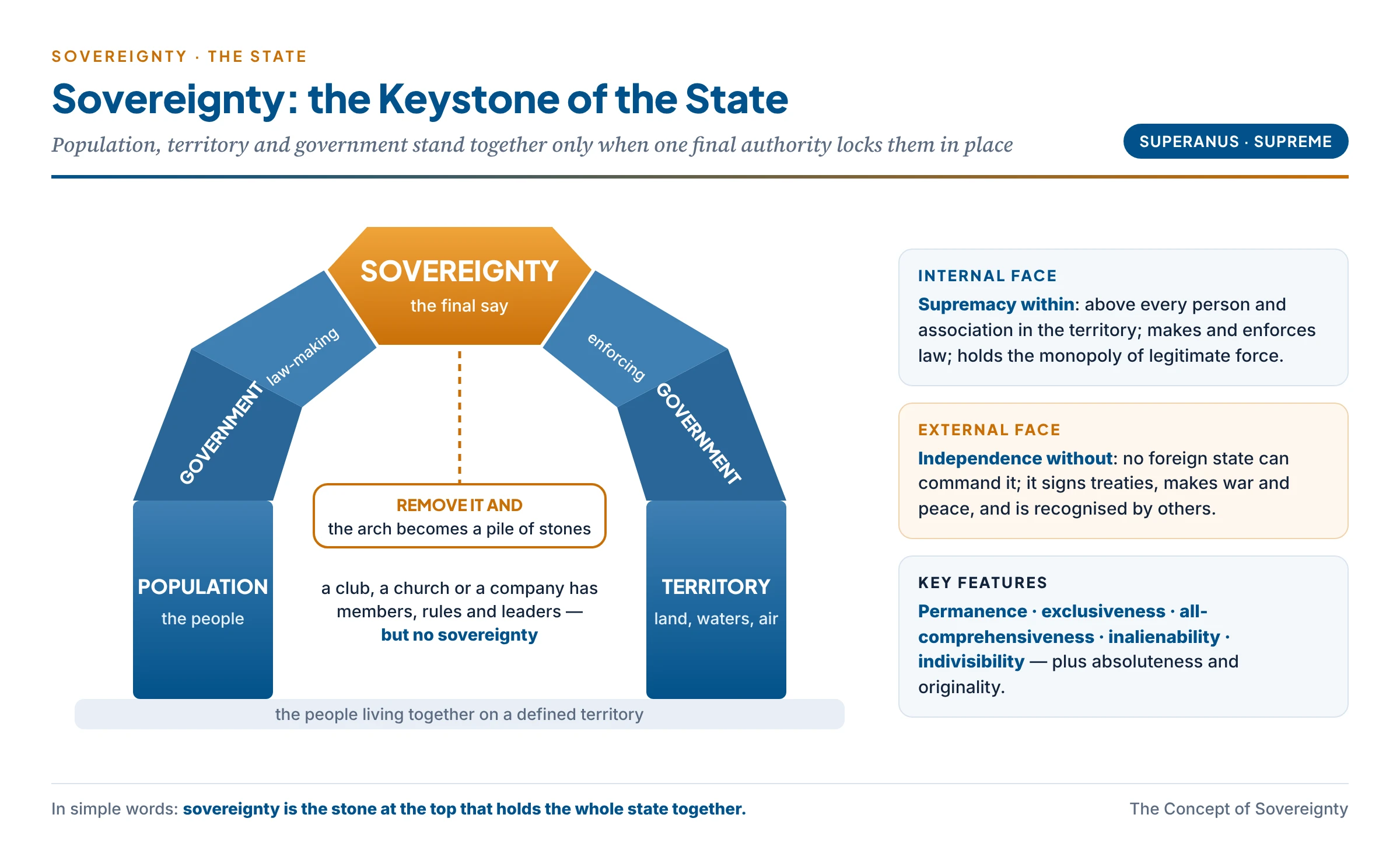
- Four elements. Modern political science names four elements of the state:
- Population — a group of people living together.
- Territory — a fixed area of land (with its waters and airspace).
- Government — the machinery through which the state’s will is formed and carried out.
- Sovereignty — supreme authority within the territory and independence from outside control.
- Sovereignty is the distinguishing mark. A trade union has members, a company has a head office and a board, a church has rules — but none of them is supreme. Only the state claims the final authority to make laws binding on all and to enforce them by force. That is why sovereignty is called the soul of the state: remove it and what remains is only an association.
- The international test. The Montevideo Convention (1933) lists a permanent population, a defined territory, a government and the capacity to enter into relations with other states — the outward side of sovereignty.
Indian Connect — The state in Indian thought
Long before the European theory of sovereignty, Indian thought had its own list of the elements of a state. Kautilya’s Saptāṅga (seven limbs) theory names the ruler (svāmī), minister (amātya), territory with people (janapada), fort (durga), treasury (kośa), army (daṇḍa) and ally (mitra). The modern list of four elements is shorter, but the idea is the same: the state is an organised whole with a supreme head. Article 5 studies this theory in detail.
Meaning and Origin of the Word
- Etymology. “Sovereignty” comes from the Latin superanus — supreme, highest. The French form souveraineté entered political writing in the sixteenth century.
- The definition in one line: sovereignty is the supreme, legitimate, legal authority within a territory, which is not subject to any higher authority, inside or outside.
- A modern idea. The word belongs to the end of the medieval period, when the power of feudal nobles and the Church was weakening and states such as France and England were becoming centralised and unified under one crown. A theory was needed to explain — and justify — why the king’s law should override the lord’s custom and the Pope’s command.
- Its first systematic theorist was the French jurist Jean Bodin (Six Books of the Commonwealth, 1576). Every later theory — Hobbes, Rousseau, Austin, the pluralists — is a reply to the problem Bodin stated.
The Three Big Questions
The problem of sovereignty breaks into three questions, and the four thinkers of this unit give different answers to each:
| Question | What it asks | Typical answers |
|---|---|---|
| Where does it reside? (the holder) | Who is the final authority — God, a monarch, an assembly, the people, the constitution? | Bodin: the prince; Austin: a determinate human superior; Rousseau: the people’s general will; Kautilya: the king (svāmī) |
| What is its nature? (absoluteness) | Is it absolute, unified and indivisible (monism), or limited and shared (pluralism)? | Bodin and Austin: absolute and indivisible; Laski: divided among associations |
| What is it for? (the ethical question) | Is it an instrument of order, freedom and welfare, or of organised coercion? | Kautilya: welfare of subjects; Marx and anarchists: coercion; Gandhi: the state is violence in concentrated form |
- Three dimensions sum up all historical variants of sovereignty: the holder of sovereignty, its absoluteness, and its internal and external scope.
In simple words
A school is a useful picture. The holder question asks: is the principal the final authority, or the management committee, or the parents’ body? The nature question asks: can the principal decide everything, or do the sports committee and the teachers’ association have their own final say in their own areas? The purpose question asks: is all this authority there to help students learn, or only to keep them in line?
Core Doctrine
Sovereignty, Power, Authority and Legitimacy
- Power is the capacity to get a decision obeyed — even against people’s will.
- Legitimacy is the people’s acceptance that the ruler has the right to rule.
- Authority = power + legitimacy. When power comes with legitimacy, people obey spontaneously, out of a sense that they ought to. When legitimacy fails, power has to fall back on force.
- Sovereignty is supreme legal authority, not mere force. A gang that controls a street has power but no sovereignty. The concept refers to the state’s rightful, legal supremacy, not simply to its ability to coerce.
- Weber’s formula. Max Weber defined the state as the community that successfully claims the monopoly of the legitimate use of physical force within a territory. Any group that claims a right to violence on its own account — a militia, a private army — challenges sovereignty.
- Allegiance and protection. Citizens give allegiance and obedience; in return the state gives protection. This exchange is the moral core of sovereignty.
- Not arbitrary power. If sovereignty is used without justice or reason, its legitimacy erodes quickly and can be lost altogether. The Bolshevik Revolution (1917), the collapse of the USSR (1991) and the Arab Spring (2011) show regimes whose power remained but whose legitimacy drained away.
Characteristics of Sovereignty
Classical theory lists the following features. The first five are the “key features” that every account repeats.
| Characteristic | Meaning | Example |
|---|---|---|
| Permanence | Sovereignty lasts as long as the state lasts; rulers die or change, sovereignty does not | When a prime minister resigns, India’s sovereignty is not interrupted |
| Exclusiveness | There can be only one sovereign in one state; two sovereigns would mean two states | A province cannot claim its own sovereignty against the Union |
| All-comprehensiveness (universality) | It extends to every person, group and thing in the territory | Even the largest corporation must obey the law of the land |
| Inalienability | The state cannot give it away without destroying itself | A state that hands over its sovereignty ceases to be a state |
| Indivisibility | It cannot be split; powers can be distributed, but final authority is one | Federal states divide functions, not the ultimate authority |
| Absoluteness (unlimitedness) | Legally, no higher authority can limit it | No court above the constitution-making power |
| Originality | It is not delegated by anyone else; it is the state’s own | The state’s power to make law does not come from a higher body |
A fuller modern list adds features that show how sovereignty works in practice:
- Supreme authority — the highest and final authority within the political unit.
- Territoriality — tied to a defined territory and its resources; the United Kingdom is sovereign over the British Isles, not over France.
- Internal and external reach — making laws and governing at home; making treaties and conducting diplomacy abroad.
- Legitimacy — in democracies, it rests on the consent of the governed expressed through elections; elsewhere, on history and tradition (the British monarchy’s legitimacy rests largely on tradition).
- Exclusive law-making — only the sovereign can make and enforce law for the territory, including economic regulation and justice.
- Monopoly of legitimate force — only the state’s police and army may lawfully use force.
- Recognition by other states — the recognition of Palestine by many countries is a claim to its legitimacy as an independent state.
- Treaty-making capacity — the Paris Agreement on climate change was signed by sovereign states.
- Immunity from foreign jurisdiction — one state’s courts do not normally judge another state’s sovereign acts.
- Evolutionary nature — the content of sovereignty changes; the European Union shows how states can pool parts of it.
Two Faces of Sovereignty: Internal and External
- Internal sovereignty is supremacy within the territory: the state is above every individual and association inside its borders. It concerns legitimacy, law-making, order and justice. In modern states it is often organised through several levels — Centre, states and local bodies — and in Britain it is vested in the “King-in-Parliament”.
- External sovereignty is independence from outside control: no foreign state or body can command it. It concerns recognition, non-intervention, treaty-making and the right to war and peace. Its test is de facto administrative control plus non-subordination to any other state.
- The two depend on each other. A state that cannot control its own territory (no internal sovereignty) soon loses its independence; a state under foreign command (no external sovereignty) cannot be supreme at home.
Four senses of sovereignty in modern international relations (Stephen D. Krasner):
- Domestic sovereignty — the actual organisation and control of authority within the state.
- Interdependence sovereignty — the ability to control movement across borders (goods, people, money, data).
- International legal sovereignty — formal recognition by other states.
- Westphalian sovereignty — the exclusion of outside actors from the state’s authority structures.
In simple words
A family home has two kinds of independence. Inside, the parents decide the house rules; no child can overrule them (internal). Outside, the neighbours cannot walk in and make rules for the family (external). If thieves keep entering at will, the family has lost control inside; if the landlord dictates everything, it has lost independence outside. A sovereign state needs both.
Kinds of Sovereignty
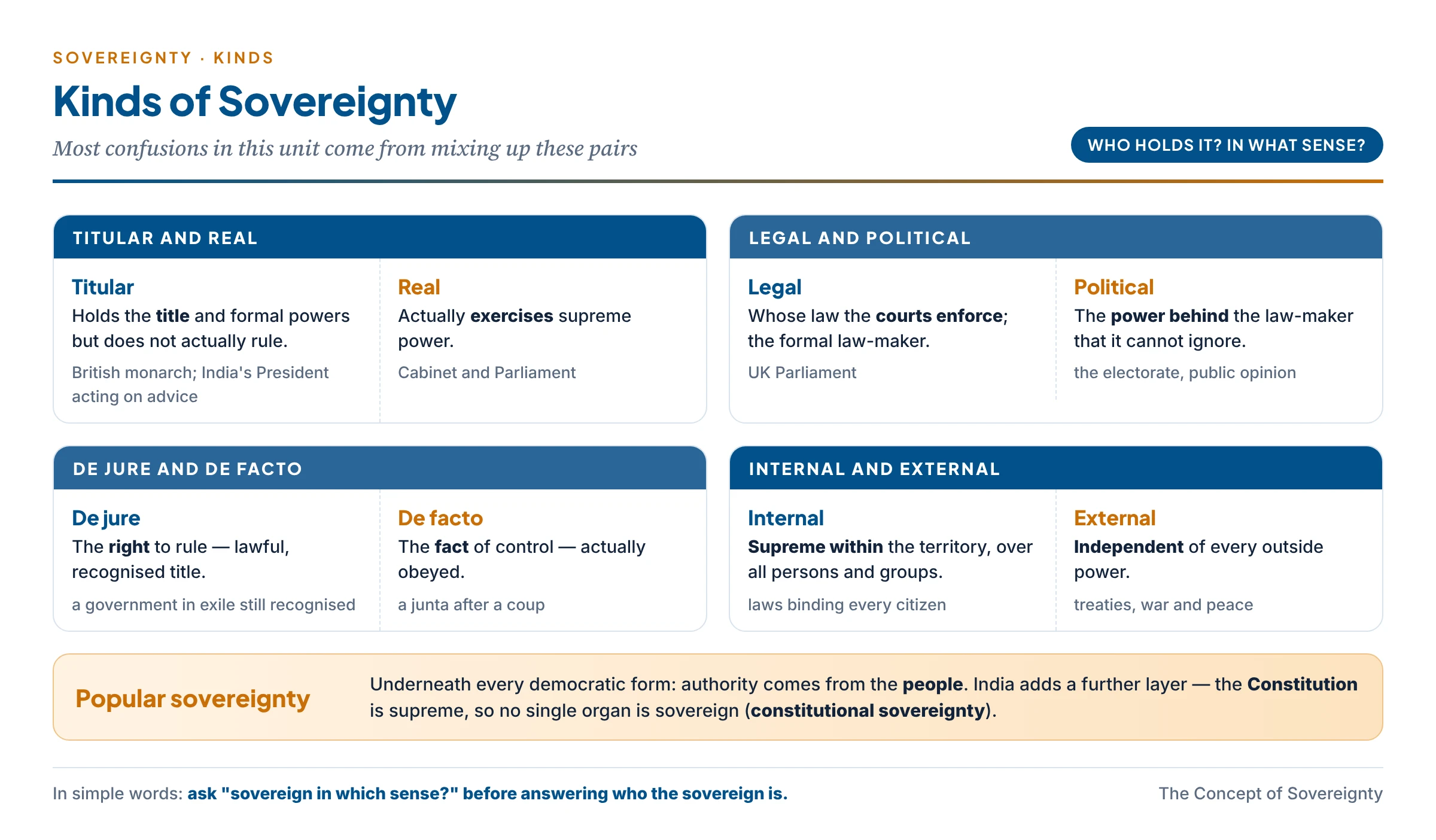
The word is used in several senses. Confusing them is the most common source of error in this unit.
(a) Titular and real sovereignty
- Titular (nominal) sovereignty belongs to a person who holds the title and formal powers but does not actually rule — the British monarch, or India’s President who acts on ministerial advice.
- Real (actual) sovereignty belongs to the body that actually exercises supreme power — the Cabinet and Parliament.
(b) Legal and political sovereignty
- Legal sovereignty is the authority that makes law in the eyes of the courts — the body whose command the judges will enforce. In Britain it is Parliament; the courts cannot set aside an Act of Parliament.
- Political sovereignty is the power behind the legal sovereign — the electorate, public opinion and the forces that a wise legislature cannot ignore. The constitutional lawyer A. V. Dicey put it simply: Parliament is the legal sovereign, the electorate is the political sovereign.
- Why the difference matters. A legal sovereign that ignores the political sovereign will be voted out, resisted or overthrown. Austin’s theory is criticised precisely for failing to draw this line clearly (Article 3).
(c) Popular sovereignty
- Authority and legitimacy come from the consent and will of the people. Political power belongs ultimately to the governed; this is the foundation of democracy.
- Its classical philosopher is Rousseau (the general will); its classical slogans are the American “We the People” and Lincoln’s “government of the people, by the people, for the people”.
- Weakness: “the people” is a vague body; it cannot itself make laws or command. Popular sovereignty therefore always needs institutions — elections, assemblies, a constitution.
(d) De jure and de facto sovereignty
- De jure (legal) sovereignty is the right to rule: recognised, lawful control over a territory.
- De facto (actual) sovereignty is the fact of control: the authority that actually commands obedience, collects taxes and enforces orders, whether or not it has a lawful title.
- They usually coincide; they separate in revolutions, coups and civil wars. After a coup, the military junta is de facto sovereign while the deposed government may still claim de jure sovereignty. When the Taliban took control of Kabul in 2021, they became the de facto authority in Afghanistan, though very few states recognised their government.
- Empirical and juridical sovereignty express the same pair in international relations: actual capacity to govern, and legal recognition by others.
(e) Other uses of the word
| Kind | Meaning | Example |
|---|---|---|
| National sovereignty | Each nation-state’s right to govern itself without outside interference | A country resisting foreign pressure on its internal policy |
| Parliamentary sovereignty | The legislature is the highest legal authority; courts cannot strike down its laws | United Kingdom |
| Constitutional (popular-constitutional) sovereignty | The people are the source of authority, and a written constitution — not any single organ — is supreme | United States; India |
| State sovereignty | The authority and independence of a state in the international system | China’s insistence on non-interference in its internal affairs |
| Westphalian sovereignty | Territorial integrity and non-intervention, from the Peace of Westphalia (1648) | States respecting each other’s borders |
| Shared or pooled sovereignty | Exercised jointly (a condominium) or pooled in a supranational body | The European Union; the Acts of Union (1707) joining the English and Scottish parliaments |
| Tribal sovereignty | Self-government of indigenous peoples within a larger state | The Navajo Nation in the United States |
| Global sovereignty | Pooling authority to meet global problems | Debates on world governance; the EU as a partial model |
- Sovereignty and independence are not identical. Independence is a fact that can be lost; sovereignty, as a legal title, can survive occupation. International law holds that a military occupation does not transfer sovereignty: the occupied state remains sovereign, and the occupier’s powers are limited by the law of occupation.
Indian Connect — Sovereignty in the Indian Constitution
- The Preamble declares India a “Sovereign Socialist Secular Democratic Republic” — sovereign meaning free from any external control, internally supreme.
- It begins “We, the people of India” — the source of authority is popular.
- But no single organ is sovereign in Austin’s sense. Parliament can amend the Constitution, yet in Kesavananda Bharati v. State of Kerala (1973) the Supreme Court held that it cannot alter the Constitution’s basic structure. The Constitution itself is supreme — a case of constitutional sovereignty.
- Federal, with a strong Centre. In In Re Article 370 (December 2023), the Supreme Court held that Jammu and Kashmir did not retain any element of internal sovereignty after accession; the states of the Indian Union have no independent sovereignty of their own. Powers are divided, sovereignty is not — a modern illustration of the classical rule of indivisibility.
Spheres of Sovereignty
The idea of supreme control is now applied to many fields:
- Political — a government’s ultimate power to make and enforce law, and a nation’s freedom to choose its own political system.
- Legal — the supremacy of law and of the constitution, which also defines the limits of governmental authority.
- Economic — control over monetary policy and currency, and the right to set trade policy and protect domestic resources.
- Cultural and linguistic — a community’s right to preserve its identity, customs and language without outside imposition.
- Individual (personal) — each person’s authority over their own life, body and choices, including privacy. India’s Supreme Court recognised privacy as a fundamental right in K. S. Puttaswamy v. Union of India (2017).
- International — recognition of nations as independent, and the tension between global governance and national autonomy.
- Cyber (digital) sovereignty — control over data, digital rights and online jurisdiction; India’s Digital Personal Data Protection Act, 2023 is an example.
- Environmental — a nation’s right to manage its natural resources and environmental policy.
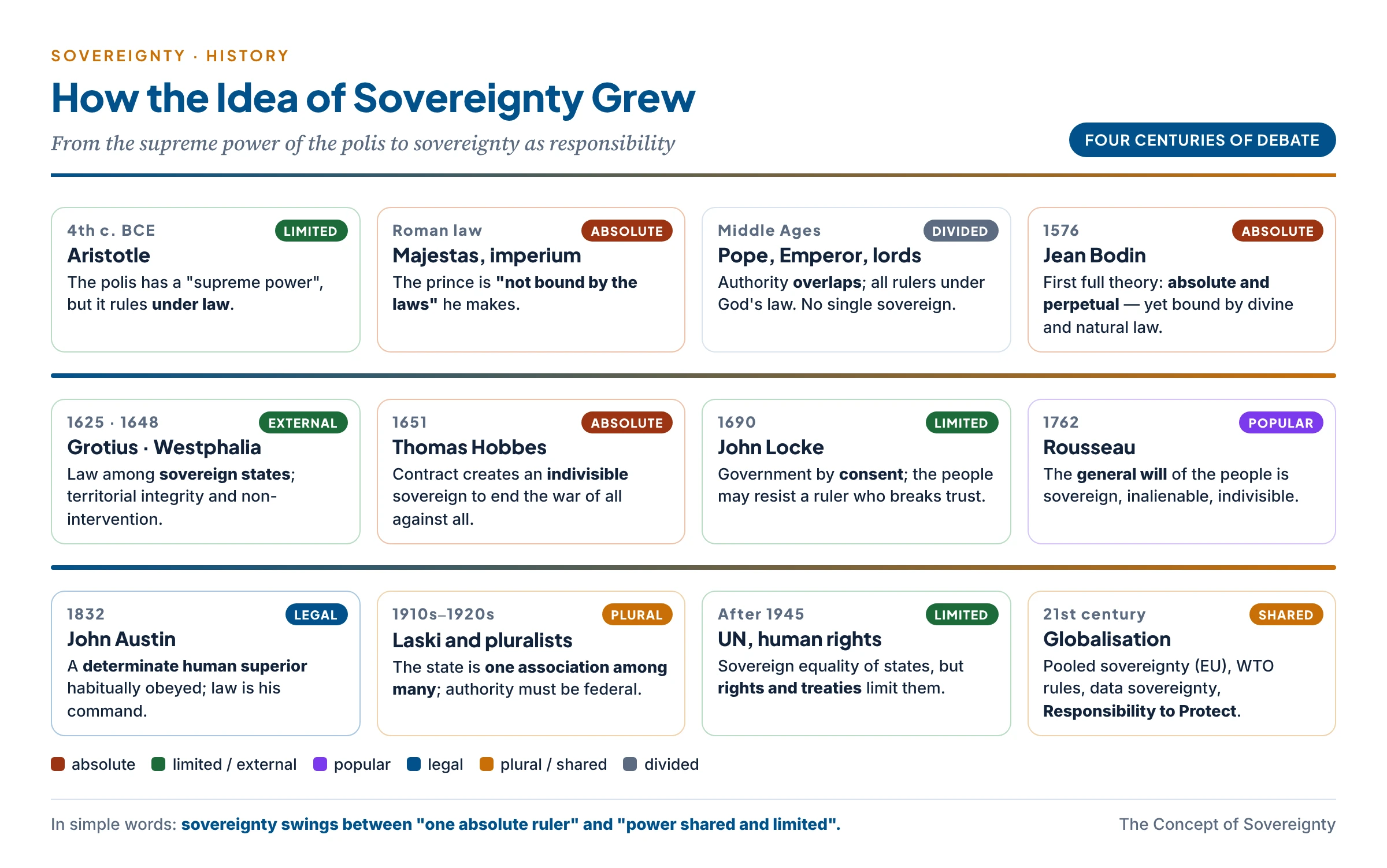
How the Idea Developed
| Period | Thinker or event | Contribution |
|---|---|---|
| Ancient Greece | Aristotle | Spoke of the “supreme power” of the polis, but placed it under the law and the constitution |
| Rome | Roman jurists | Majestas and imperium; the maxim that the prince is “not bound by the laws” (legibus solutus) |
| Middle Ages | Pope, Emperor, feudal lords | Authority was divided and overlapping; all rulers were held to be under God’s law and natural law; no single sovereign |
| Renaissance | Machiavelli (1513) | Separated politics from religion and ethics; the prince’s aim is to hold and strengthen the state |
| 1576 | Jean Bodin | First systematic theory: sovereignty is “absolute and perpetual power“, but bound by divine and natural law (Article 2) |
| 1625 | Grotius | Developed the external side — the law governing relations between sovereign states |
| 1648 | Peace of Westphalia | Ended Europe’s religious wars; established territorial sovereignty and non-intervention |
| 1651 | Thomas Hobbes | Sovereignty by social contract, absolute and indivisible, needed to escape the war of all against all |
| 1690 | John Locke | Limited government by consent; the people keep the right to resist a ruler who breaks his trust |
| 1762 | Rousseau | Popular sovereignty: the general will of the people is sovereign, inalienable and indivisible |
| 1832 | John Austin | Legal (monistic) theory: the sovereign is a determinate human superior whose commands are law (Article 3) |
| Early 20th century | Laski, Figgis, MacIver, Barker, Duguit | Pluralism: sovereignty is shared among associations; the state is one among many (Article 4) |
| After 1945 | UN Charter, human rights, globalisation | Sovereign equality of states, but growing limits from international law, human rights and global markets (Article 7) |
- Three classic quotations mark the turning points:
“During the time men live without a common power to keep them all in awe, they are in that condition which is called war; and such a war as is of every man against every man.” — Thomas Hobbes
“The end of law is not to abolish or restrain, but to preserve and enlarge freedom.” — John Locke
“The sovereign, being formed wholly of the individuals who compose it, neither has nor can have any interest contrary to theirs.” — Jean-Jacques Rousseau
- Hobbes gives the argument for absolute sovereignty (security), Locke the argument for limited sovereignty (freedom), Rousseau the argument for popular sovereignty (self-rule). The rest of the history is a debate among these three ideas.
Monism and Pluralism: The Two Approaches
The central debate of the syllabus is between two ways of understanding sovereignty. Article 7 examines it in full; the outline is:
| Point | Monistic approach | Pluralistic approach |
|---|---|---|
| Thinkers | Bodin, Hobbes, Austin; idealists such as Hegel | Laski, Figgis, MacIver, Barker, Duguit |
| Where sovereignty lies | In one determinate authority — the state | Shared by the state and other associations (churches, unions, universities) |
| Its nature | Absolute, unlimited, indivisible, inalienable | Limited, divisible, conditional |
| Law | Command of the sovereign backed by sanction | Expression of social needs and moral consciousness |
| State and society | The state stands above all associations | The state is one association among many |
| Danger | Can justify absolutism and totalitarianism | Can weaken the state’s ability to coordinate and act |
Is Sovereignty Illimitable and Logically Indivisible?
This question goes to the heart of the concept. Both sides have strong arguments.
Arguments that sovereignty must be illimitable and indivisible:
- The regress argument. If the sovereign were limited by some other authority, that authority would be the real sovereign. If it were limited by a third, the third would be sovereign — and so on. The chain must stop somewhere, and wherever it stops is the illimitable sovereign. Legally, therefore, sovereignty cannot be limited.
- The unity argument. If two authorities were each supreme in the same territory, their orders could clash, and there would be no way to settle the clash except by force. Two sovereigns mean two states. Hence the monist slogan: “To divide sovereignty is to destroy it.”
- Federalism divides functions, not sovereignty. In a federation such as the USA or India, powers are distributed between Centre and units, but the power to change the distribution — the amending power — is one. Austin located American sovereignty in the state governments acting together as one body through the amending process.
In simple words
Imagine a staircase of complaint desks. You complain to the clerk, then to the manager, then to the director. If every desk had another desk above it, your complaint would never end. Somewhere there has to be a last desk whose decision no one can overturn. The monist says: that last desk is the sovereign, and by definition nothing stands above it.
Arguments that sovereignty is limited and divisible in fact:
- Internal limits. No ruler can ignore custom, religion, public opinion and morality. Laws that defy them are disobeyed or provoke revolt. History offers no example of truly unlimited power.
- Constitutional limits. Written constitutions, fundamental rights and judicial review bind every organ of government. India’s Parliament cannot destroy the basic structure.
- Moral limits. Even Bodin held that the sovereign is bound by divine and natural law; human rights today play the same role.
- External limits. International law, treaties, the UN Charter, trade rules and the pressure of other states restrict what a state can do.
- Division in practice. In federal systems, courts settle disputes between Centre and units, and each acts as final within its own field. Pluralists say this simply is divided sovereignty.
How the debate is resolved:
- Legal sovereignty — the final legal authority of a system — is logically one and legally unlimited: some authority must have the last word, or the legal system has no end-point.
- Political sovereignty — the actual power behind the law — is always limited by opinion, morality and circumstance.
- What can be divided is the exercise of powers, not the ultimate authority. Where that authority rests in a constitution rather than in a person, it is unlimited in form but limited by the constitution’s own principles.
Common confusion
Does “absolute” sovereignty mean the ruler can do anything he likes? No. In the classical theory, “absolute” (from the Latin absolutus, “loosened from”) meant not bound by the positive laws the ruler or his predecessors had made — he can repeal or change them. It did not mean free from God’s law, natural law or the basic laws of the realm. Bodin himself insisted that the sovereign is bound by divine and natural law. Absolute is a legal idea, not a licence for tyranny.
“Supreme Power over Citizens and Subjects, Unrestrained by Law”
- This is Bodin’s famous definition, from the Latin edition of his Republic: sovereignty is the “supreme power over citizens and subjects, unrestrained by law“.
- What “unrestrained by law” means. The sovereign is the source of positive law, so positive law cannot bind him — a person cannot be commanded by his own command. He can make, change and repeal laws.
- What it does not mean. It does not free the sovereign from divine law, natural law, the fundamental laws of the kingdom (such as the rule of royal succession) or the property of subjects. Bodin’s sovereign is supreme over men but subordinate to God and nature.
- The criticism. If the sovereign is above all positive law but below natural law, who decides what natural law requires? If no one can enforce it, the limit is only moral. If someone can enforce it, that someone is the real sovereign. This tension is why critics say Bodin’s theory “floats in the air” (Article 2).
- Modern view. In a constitutional democracy the sovereign is restrained by law — the constitution — and that is precisely what protects citizens from arbitrary power.
Why Sovereignty Still Matters
- Social cohesion and stability. A recognised sovereign authority reduces conflict, settles disputes and keeps law and order.
- Democratic principles. Sovereignty exercised through democratic institutions gives citizens an equal voice and protects minorities.
- Social justice. Only a sovereign state can pass and enforce laws against discrimination and historical injustice.
- Economic and educational opportunity. Public education, welfare and policies that reduce inequality depend on sovereign authority.
- Public health. Health systems, vaccination drives and responses to epidemics need a state that can command and coordinate.
- Human rights and dignity. Rights on paper become real only when a sovereign enforces them.
- Social mobility and merit. Fair rules for opportunity are set and protected by the state.
- Political legitimacy. A state that uses its sovereignty fairly and transparently earns trust — and trust in turn strengthens sovereignty.
Indian Connect — Indian thinkers on sovereignty
- Kautilya places sovereignty within dharma: the king’s authority exists for the protection and happiness of the subjects (Articles 5–6).
- Swami Vivekananda speaks of a spiritual sovereignty — the sovereignty of the inner Self. Self-mastery and spiritual awakening come before political freedom: “We are the makers of our own fate.”
- Mahatma Gandhi makes the same move politically: swarāj first means self-rule over oneself, and only then self-government of the nation (Article 7).
- Amartya Sen’s capability approach suggests a test for any sovereign arrangement: does it expand what people are actually able to be and do? On this view, sovereignty is justified by the freedoms it creates.
Critical Evaluation
Objections to the Concept of Sovereignty
Each objection has a standard reply:
- It ignores individual and group differences.
- Objection: a single supreme authority oversimplifies the diverse cultural, social and historical needs of people.
- Reply: a common framework is exactly what allows diverse groups to live together and pursue shared goals.
- It can override merit.
- Objection: unchecked sovereign power can concentrate authority in ways that do not reflect merit.
- Reply: democratic institutions and accountability keep sovereign power tied to the common good.
- It can stifle initiative and innovation.
- Objection: a highly centralised sovereign may discourage individual enterprise.
- Reply: sovereignty can set a framework that supports innovation while ensuring fairness.
- It is a Western idea (cultural relativism).
- Objection: the European concept may not fit other cultures and may impose Western-centric models of government.
- Reply: the concept is adaptable; each society can express self-government in its own forms. Kautilya’s Saptāṅga theory shows that India had its own theory of the sovereign state.
- It creates new hierarchies.
- Objection: unchecked sovereignty breeds new power structures and inequalities.
- Reply: democratic checks and balances prevent unjust concentration of authority.
- It threatens individual freedom.
- Objection: too much emphasis on sovereignty, especially in autocracies, crushes liberty.
- Reply: a balanced view protects freedom while keeping order and justice.
- It is impractical in diverse societies.
- Objection: a one-size-fits-all sovereign does not suit multi-ethnic, multi-cultural states.
- Reply: federal and flexible arrangements adapt sovereignty to diversity while keeping its core.
- It has dangerous side-effects.
- Objection: unchecked sovereignty leads to abuse of power, lack of accountability and disregard for human rights.
- Reply: legal frameworks and international cooperation can contain these risks.
Thinkers Who Reject or Doubt the Concept
- The pluralists (Laski). Sovereignty is a dangerous legal fiction: “It would be of lasting benefit to political science if the whole concept of sovereignty were surrendered.” (Article 4)
- Jacques Maritain argued that the absolutist concept of sovereignty, taken from theology and applied to the state, should be dropped from political philosophy, because no human body is above the community it serves.
- Bertrand de Jouvenel studied how sovereign power, whatever its theory, tends to grow without limit, and questioned the traditional doctrine.
- Marxists see sovereignty as the cover for class rule; the state is an instrument of the ruling class and will wither away in a classless society.
- Anarchists reject the sovereign state altogether as organised coercion.
- Gandhi called the state “violence in a concentrated and organised form” and looked to self-rule and decentralisation in its place.
- Foucault argued that modern power no longer works mainly through a sovereign who commands, but through discipline spread across society (Article 8).
Critics and Defenders
Criticism — Critics
- Laski and the pluralists: sovereignty is a legal fiction that hides the real dispersal of power among groups.
- Historical school (Maine): no ruler in history has been truly unlimited; custom limits all.
- Marx and the anarchists: sovereignty masks class domination and organised coercion.
- Gandhi: the centralised sovereign state crushes moral agency; real sovereignty is self-rule.
- Globalisation theorists: markets, international law and supranational bodies have made “absolute” sovereignty a myth.
Defence — Defenders and strengths
- Logical necessity: every legal system needs a final authority; without it, disputes never end.
- Order and security: Hobbes’s argument still stands — without a common power, life becomes insecure.
- Democratic form: popular and constitutional sovereignty answer most objections by putting the people and the constitution at the top.
- Resilience: in crises — pandemics, wars — states reassert borders and emergency powers; sovereignty has not disappeared.
- Protection of the weak: only a sovereign state can enforce rights against powerful private actors.
Cross-Tradition Comparison
Western and Indian Ideas of Supreme Authority
| Point | Western theory of sovereignty | Indian theory of rājadharma |
|---|---|---|
| Source of authority | Will and command (Bodin, Hobbes, Austin) or the people’s will (Rousseau) | Protection of subjects under dharma; the king as protector (rakṣaka) |
| Law | Made by the sovereign | Mainly found in dharma, custom and usage; the king enforces it, and his edict (rājaśāsana) settles conflicts |
| Limits | Natural law (Bodin), constitution (modern) | Dharma, custom, ministers’ counsel, fear of revolt, the duty of welfare |
| Aim | Order, security, freedom | Yoga-kṣema — security and welfare; the happiness of subjects |
| Danger | Absolutism | Dependence on a virtuous king |
Indian Connect — Key takeaways
- Indian thought rarely spoke of an unlimited sovereign: the king was always under dharma. In this sense it is closer to Bodin (bound by higher law) than to Austin (bound by nothing).
- Yet Kautilya comes close to Austin in one respect: he treats the king’s edict as decisive when it conflicts with other sources of law (Article 5).
- The Indian Constitution combines both traditions: popular sovereignty from the West, and a duty-bound state (Directive Principles) that echoes rājadharma.
How Different Approaches Study Sovereignty
The way a scholar studies politics shapes how sovereignty is understood.
- Philosophical (normative) approach — Plato, Rousseau, Hegel: asks what sovereignty ought to be and what justifies it.
- Historical approach — Machiavelli, Maine: studies how sovereignty actually arose and changed; finds custom and history limiting every ruler.
- Legal-institutional approach — Austin, Dicey: asks who is the legal sovereign in a given constitution.
- Behavioural approach (twentieth century) — studies observable behaviour, voting and influence; treats “sovereignty” as less useful than measurable power.
- Post-behavioural approach — brings values back: relevance and action matter as much as measurement.
- Marxist approach — studies the state as an instrument of class rule; sovereignty is the political form of economic power.
| Theory of the state | Where it places supreme authority |
|---|---|
| Idealist (Hegel) | The state is the highest expression of reason and ethical life; sovereignty is its unity |
| Liberal | Authority comes from consent and is limited by rights |
| Pluralist | Authority is shared among associations; the state coordinates |
| Marxist | Authority belongs to the economically dominant class; the state is its instrument |
| Post-colonial | In many former colonies, the state inherited from colonial rule became “over-developed” — stronger than the social classes it governs |
| Feminist | Sovereign authority has historically been patriarchal; the public–private divide hides domestic domination |
| Gandhian | Real sovereignty is self-rule; the state should be decentralised and minimal |
Synthesis (Siddhānta)
- The core insight. Sovereignty is the answer to the question “who has the final say?” Every legal order needs such a final authority; in that legal sense, sovereignty is one and supreme.
- But no sovereign is unlimited in fact. Custom, morality, public opinion, constitutions, rights and the international order always limit political sovereignty. Even Bodin admitted higher law; modern democracies write those limits into constitutions.
- The modern resolution. In constitutional democracies like India, sovereignty rests with the people, is exercised through a constitution, and is limited by rights and a basic structure that no organ can destroy. Powers are divided; final authority is not.
- The unit’s map. Bodin defines sovereignty and ties it to higher law; Austin gives its sharpest legal form; Laski attacks its absolute and indivisible form; Kautilya shows an Indian theory of the sovereign state, internal and external. Article 7 brings them together.
- Contemporary relevance.
- Globalisation presses on sovereignty from above (WTO rules, climate treaties, global markets) and from below (regional movements, civil society).
- Digital and data sovereignty are the newest frontier — who controls data, platforms and cyberspace?
- Sovereignty as responsibility. The 2005 UN World Summit’s doctrine of the Responsibility to Protect treats sovereignty not as a shield for any action, but as a duty to protect one’s own people.
“Covenants, without the sword, are but words, and of no strength to secure a man at all.” — Thomas Hobbes
Previous Year Questions
- 2026Explain the contrast between the monistic and pluralistic approaches to sovereignty.
- 2016“Sovereignty is the supreme power over citizens and subjects, unrestrained by law.” Discuss.
- 2006Explain the notion of sovereignty. Critically consider in this context the claim that sovereignty is illimitable and logically indivisible.