

Sovereignty: Austin, Bodin, Laski, Kautilya.
Official Syllabus: Paper II, Section A, Unit 2
Jean Bodin (1530–1596) gave Europe its first complete theory of sovereignty. Writing while France was being torn apart by religious civil war, he argued that every well-ordered state needs one authority that is absolute, perpetual and undivided — the source of all law, bound by none of it. Yet the same Bodin insisted that this sovereign is bound by the law of God and of nature, by the fundamental laws of the kingdom, and by the property of its subjects, whom it cannot tax without their consent. This double claim — supreme over men, subject to God — is what makes Bodin both the father of the modern state and the target of the charge that his theory “floats in the air“. This article covers his life and problem, his definitions of the commonwealth and of sovereignty, the meaning of perpetual and absolute, the marks of sovereignty, the impossibility of a mixed state, the forms of state and government, the limits on the sovereign, his views on property, taxation and religious toleration, the importance of his theory, its compatibility with equality, justice and liberty, and its critics.
In simple words
A ship in a storm cannot be steered by three captains giving different orders. Someone must have the final command — and that command cannot be shared, or the ship goes down. But even the best captain cannot change the laws of the sea, the tides or the weather. Bodin’s sovereign is like this captain: supreme over the crew, but still under the laws of nature that no captain can repeal.
Context & Problem
Life and Works
- Born in Angers, France, in 1530; trained in law at Toulouse, where he lectured on Roman law; later an advocate before the Parlement of Paris and a royal official.
- A man of many fields. He wrote on history, law, economics, religion and even witchcraft. He claimed to have coined the term “political science”.
- Main works:
- Method for the Easy Comprehension of History (1566) — history as a science; the influence of climate and geography on the character of peoples (an idea Montesquieu later developed).
- Reply to Malestroit (1568) — explained the great price rise of his age by the inflow of American gold and silver; an early form of the quantity theory of money.
- Six Books of the Commonwealth (Les Six Livres de la République, 1576; his own Latin version, 1586) — the theory of sovereignty.
- Colloquium of the Seven (Colloquium Heptaplomeres) — a dialogue on religion among seven speakers of different faiths, pleading for toleration.
- On the Demon-Mania of Witches (1580) — a defence of witch-trials; a reminder that Bodin was a man of his century.
- Political courage. At the Estates-General of Blois (1576) he opposed the Crown’s demand for new taxes and its plan to renew war against the Protestants, and argued that the royal domain could not be sold — a stand that cost him royal favour.
The Problem He Faced
- Civil war. From 1562 France was torn by the Wars of Religion between Catholics and Protestants (Huguenots). The St Bartholomew’s Day Massacre (1572) killed thousands.
- Theories of resistance. Protestant writers (the “monarchomachs” — king-fighters) argued that subjects, or their magistrates, could resist and even kill a tyrant king. Catholic extremists later used the same arguments. Each side treated its religion as higher than the state.
- Divided authority. Feudal lords, the Church, provincial parlements and the Estates all claimed independent powers. Medieval thought had no clear answer to the question “who is finally in charge?“
- Bodin’s answer. Peace could return only if one authority stood above all factions and religions — a sovereign whose law binds everyone and whom no subject may lawfully resist. Bodin belonged to the “politiques“, moderates who put the survival of the state before victory for any religion.
In simple words
Imagine a school where the principal, the senior teachers and the parents’ committee each claim to make the final rules, and each group has its own followers. Arguments turn into fights. Bodin’s solution is to say clearly: one office makes the final rules for everyone, and no group may defy it on its own authority. That is the birth of modern sovereignty.
Core Doctrine
The Commonwealth and the Household
- Definition of the commonwealth (state). “A rightly ordered government of a number of households, and of those things which are their common concern, by a sovereign power.”
- Four parts of the definition:
- Rightly ordered — governed according to justice and natural law; this separates a state from a band of robbers.
- Households — the family, not the individual, is the basic unit. The father’s authority over his household is the model, in miniature, of the sovereign’s authority over the state.
- Common concerns — the state looks after what is public; what is private (above all, the family’s property) belongs to the households.
- Sovereign power — the defining mark; without it there is no commonwealth.
- Why the household matters. Because private property belongs to the households, and the households existed before the state, the sovereign cannot take that property without the owners’ consent. Bodin’s family-based theory is one source of his limits on sovereignty.
Bodin’s Definition of Sovereignty
“Sovereignty is the absolute and perpetual power of a commonwealth.” — Jean Bodin
- In the Latin version: sovereignty (majestas) is the “supreme power over citizens and subjects, unrestrained by law“.
- Three classic attributes follow: sovereignty is absolute, perpetual and indivisible (undivided). Bodin knew that his rejection of shared or “mixed” sovereignty went against the prevailing political opinion of his time.
“Perpetual”: Power That Is Not on Loan
- Power held for a limited time is not sovereignty, however great it is. A Roman dictator appointed for six months, a regent ruling for a child king, or a governor holding a royal commission all exercise great power — but they hold it in trust and must return it.
- Sovereignty belongs to its holder in his own right and lasts for his life (in a monarchy) or for the life of the ruling body (in an aristocracy or democracy).
- The test: whoever can take back the power from someone else is the real sovereign; the one who holds it only for a time is a trustee or agent.
“Absolute”: Not Bound by Its Own Laws
- Absolute (Latin absolutus, “released from”) means not bound by the positive laws — the laws made by human legislators.
- Why the sovereign cannot be bound by his own laws: law is the command of the sovereign. No one can command himself in a way that binds him, just as no one can make a promise to himself that he cannot cancel. So the sovereign may make, change and repeal laws.
- Nor by his predecessors’ laws: a new sovereign is not bound by the laws of earlier kings, since an equal cannot bind an equal.
- The sovereign does not need consent to make law. He may consult councils and Estates, and it is wise to do so, but their advice does not bind him.
- Law and contract. A law depends on the sovereign’s will and he can change it; a contract (covenant) is a mutual promise and binds him like anyone else — even a sovereign must keep his word.
In simple words
A class teacher writes the classroom rules on the board. Because they are her rules, she can rub one out and write a new one tomorrow — her own rules cannot bind her. But if she has promised the class a picnic in return for good results, she must keep her word; and she can never make cheating or cruelty “right” by writing it on the board. That is Bodin’s sovereign: free from his own laws, bound by his promises and by the moral law.
Common confusion
Does Bodin say the sovereign, once established, is no longer bound by natural law? No — this is a common error in popular notes. Bodin says the sovereign is free from positive (human-made) law, not from natural and divine law. In his own words, all the princes of the earth are subject to the laws of God and of nature. A sovereign who breaks them sins and becomes a tyrant. “Absolute” in Bodin is a legal term (free from human law), not permission to break the moral law.
The Marks of Sovereignty
How can we recognise who is sovereign in any state? Bodin answers with the marks (prerogatives) of sovereignty — powers that belong only to the sovereign.
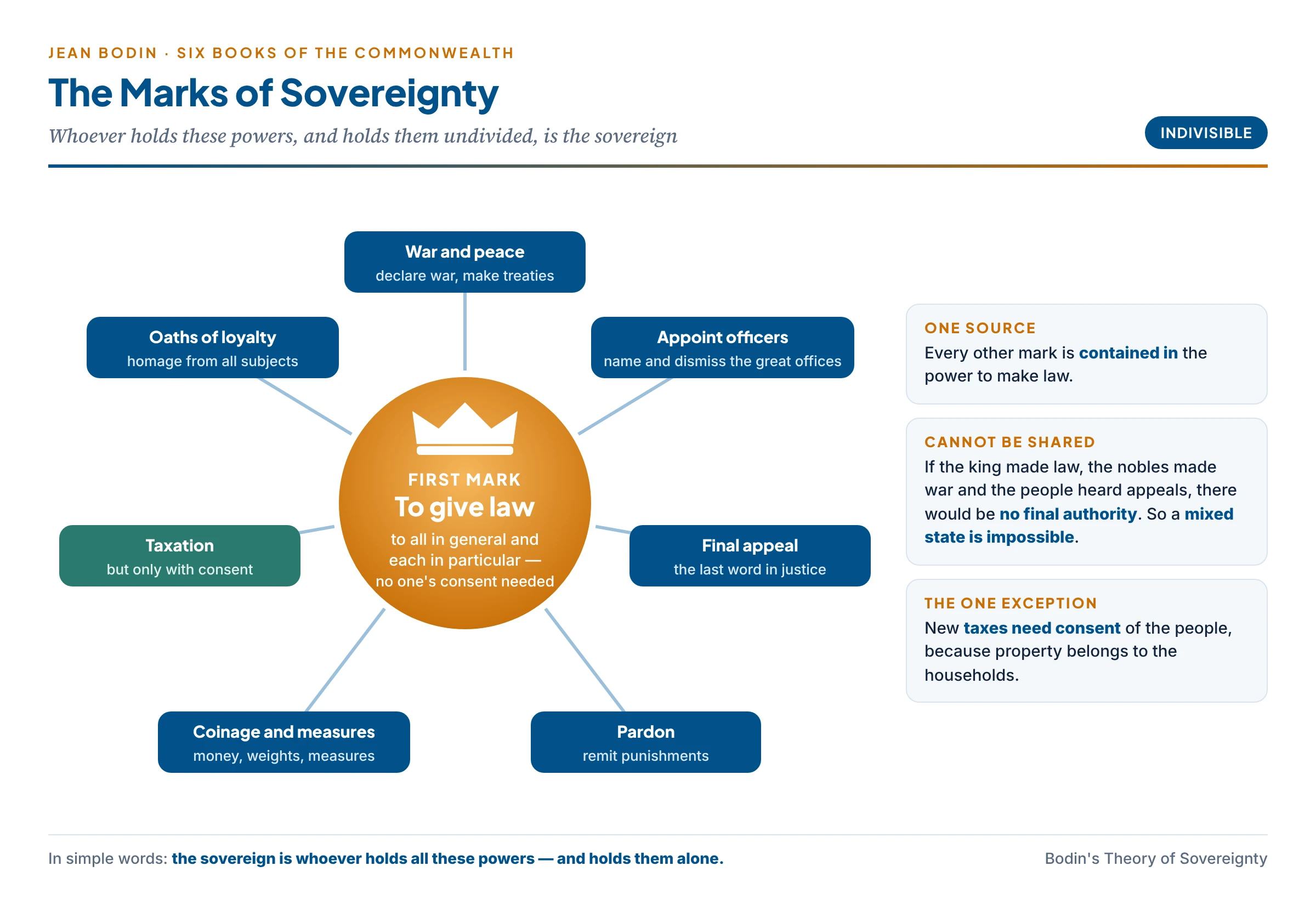
- The first and principal mark: the power to give law to all in general and to each in particular, without the consent of any superior, equal or inferior. All other marks are contained in it.
- The other marks:
- Declaring war and making peace.
- Appointing and dismissing the chief officers of state.
- Hearing the final appeal from all courts — the last word in justice.
- Granting pardons and remitting punishments.
- Coining money and fixing weights and measures.
- Taxation and granting exemptions — though, as we will see, taxes need the consent of the people.
- Receiving oaths of loyalty and homage from all subjects.
- Why “marks”? These powers are like a seal: whoever holds them is sovereign. If a subject held any of them independently, he would be a partner in sovereignty — which, for Bodin, is impossible.
Indivisible: Why a Mixed State Is Impossible
- Many writers since Aristotle and Polybius praised the mixed constitution — a blend of monarchy, aristocracy and democracy, as in Rome or Venice.
- Bodin’s reply: the marks of sovereignty are indivisible. If the king makes law, the nobles declare war and the people decide final appeals, then each part can block or overrule the others, and the state has no final authority — it is in a condition of permanent conflict. Such a state “has never existed and could never exist or even be clearly imagined”.
- Rome and Venice explained. Where a state looks mixed, a closer look shows where the final power really lies. Rome, he argued, was in truth a democracy, because the people held the final legislative power.
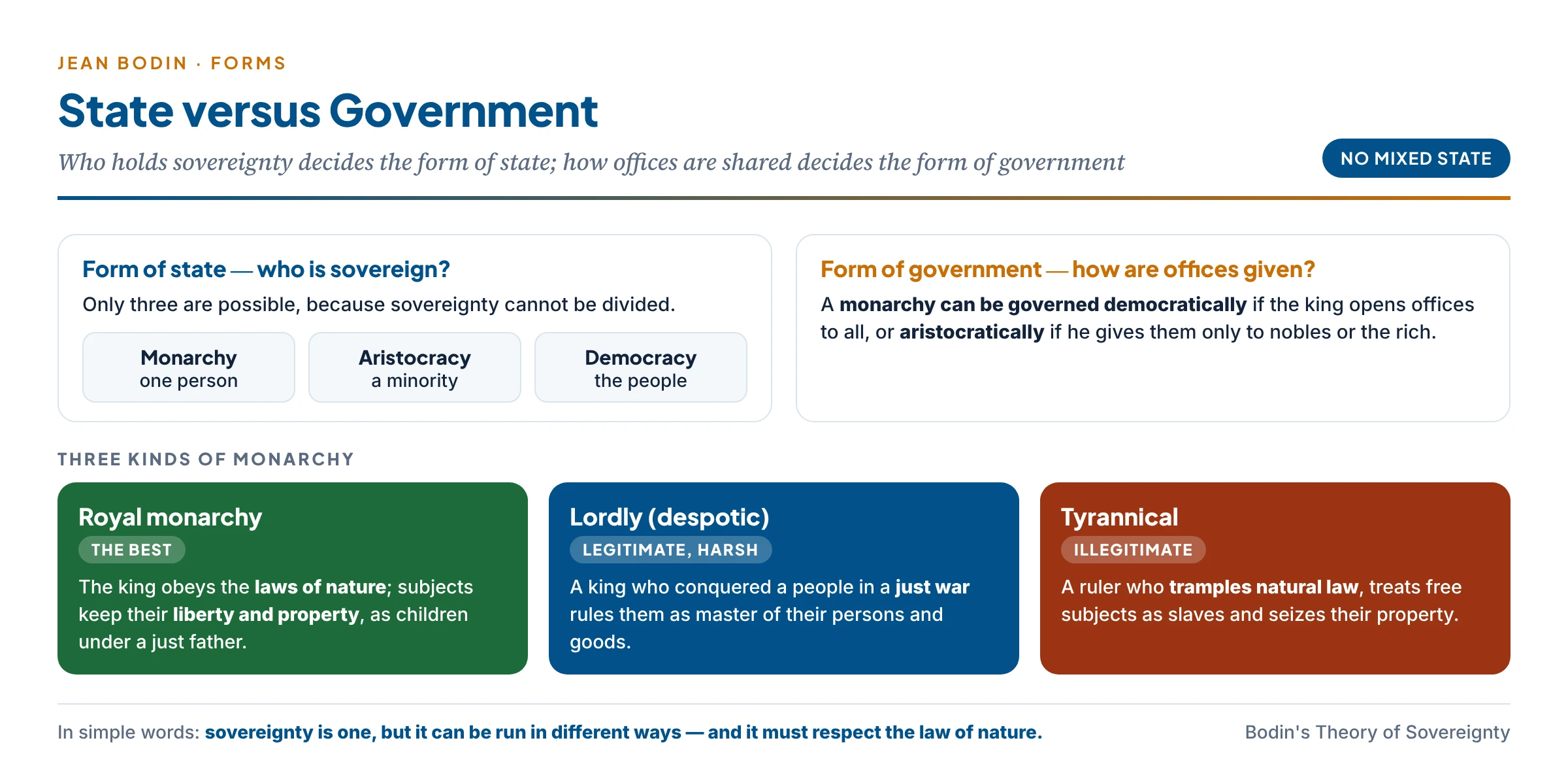
- Only three forms of state exist, depending on who holds sovereignty:
- Monarchy — sovereignty in one person.
- Aristocracy — sovereignty in a minority.
- Democracy (popular state) — sovereignty in the people as a whole, or a majority.
State and Government: Bodin’s Key Distinction
- The form of state depends on who holds sovereignty. The form of government depends on how offices and honours are distributed.
- So a monarchy can be governed democratically — if the king opens all offices to everyone regardless of birth or wealth — or aristocratically, if he gives them only to nobles or the rich.
- This distinction lets Bodin keep sovereignty undivided while admitting variety in the way states are run. It anticipates the modern distinction between the state (the permanent sovereign entity) and the government (the changing machinery of administration).
Three kinds of monarchy:
| Kind | What it means | Bodin’s verdict |
|---|---|---|
| Royal (legitimate) monarchy | The king obeys the laws of nature; subjects keep their natural liberty and their property | The best form of state |
| Lordly (despotic) monarchy | A king who has conquered a people in a just war rules them as master of their persons and goods | Legitimate, but harsh |
| Tyrannical monarchy | A ruler who tramples natural law, treats free subjects as slaves and seizes their property | Illegitimate |
- Despotism is not tyranny. A despot who wins a just war may lawfully rule the defeated as their master; a tyrant who enslaves a free people by an unjust war or by fraud is always illegitimate.
- The best regime. Bodin preferred a royal monarchy, governed with a “harmonious” mixture of principles, where the absolute power of the king is moderated by respect for natural and divine law. He doubted that the common people were capable of governing themselves wisely.
The Limits on Bodin’s Sovereign
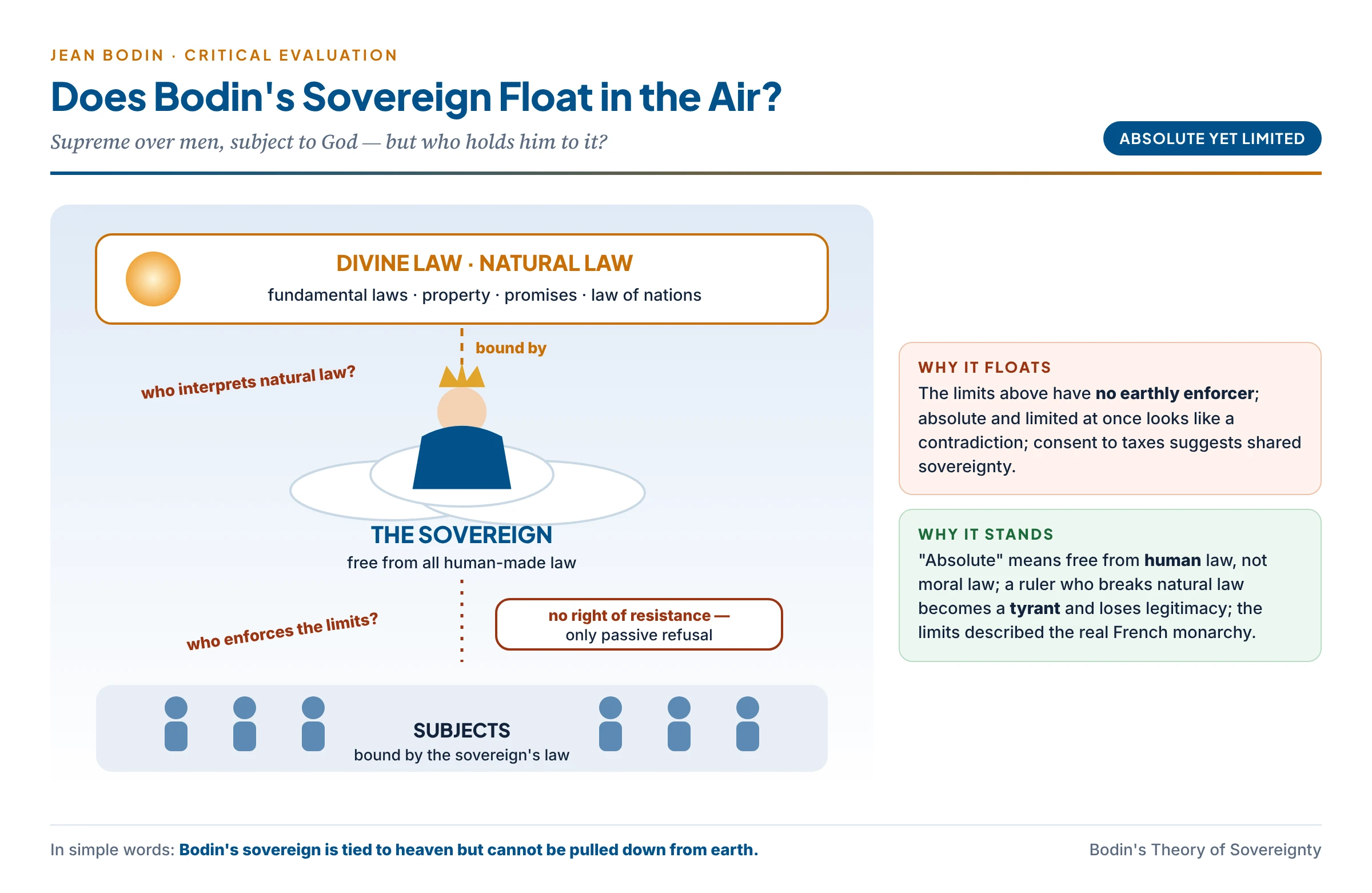
Bodin’s sovereign is supreme over men but subject to higher law. The limits are:
- Divine law — the commandments of God; no sovereign may order what God forbids.
- Natural law — the moral law knowable by reason: keep promises, do justice, do not take what belongs to others. The kings of France were glorious, he said, precisely because their sovereignty was limited by divine and natural law.
- The fundamental laws of the kingdom (leges imperii) — laws that concern the state itself rather than the king’s commands:
- the Salic law of succession, which settles who inherits the throne;
- the inalienability of the royal domain — the king cannot sell off the public lands of the Crown.
- Private property — following the Roman philosopher Seneca (“to kings belongs power over all things, to individuals ownership”), Bodin held that the sovereign cannot seize his subjects’ property without just cause and their consent.
- Contracts and promises — the sovereign is bound by agreements he has made with his subjects or with other princes.
- The law of nations — the common rules observed among all peoples, such as respect for ambassadors.
But who enforces these limits?
- No one on earth. Bodin insists that subjects may not rebel against or kill a true sovereign, “even though he has committed all the evil, impious and cruel deeds imaginable”.
- Passive disobedience only. A subject may refuse to carry out a command that is against God’s law — and accept the penalty — but may not take up arms.
- The sanction is God’s judgement and the sovereign’s own conscience. This is the root of the charge that his limits are not real limits.
Property, Taxation and Consent
- In both the Method (1566) and the Six Books (1576), Bodin presented private property as a limit on sovereign power.
- No taxation without consent. Unlike Hobbes, Bodin held that the king cannot impose new taxes without the consent of the subjects, normally given through the Estates. Taxation without consent, his followers concluded, amounts to theft — and some later writers used this to justify resistance.
- He practised what he taught. At Blois in 1576 he risked his career by opposing the Crown’s tax demands, insisting that even kings need the full consent of the citizens for new levies.
- A tension. If the Estates can refuse taxes, are they not partners in sovereignty? Bodin’s answer: they only consent to a particular use of property; they do not command. Critics find this unconvincing — it is one of the “medieval residues” in his theory.
- Influence. Unlike Locke, Bodin did not distinguish between individual consent and consent through representatives; his emphasis on the people’s (or their representatives’) consent to new taxes influenced Rousseau. Constitutional monarchists and republicans alike drew on this side of Bodin.
Sovereignty and Religious Toleration
- The Crown above the churches. Bodin’s answer to religious war was not separation of Church and State but the supremacy of the sovereign over religious affairs: the state decides how religions may be practised, so that no church can split the commonwealth.
- Toleration for peace. Since forcing consciences only breeds rebellion, the sovereign should tolerate different religions — though Bodin excluded atheism and witchcraft, which he thought destroyed the moral bonds of society.
- All religions useful. He held that religion is the foundation of obedience and morality; any religion is better than none.
- The Colloquium of the Seven. Seven learned men — a Catholic, a Lutheran, a Calvinist, a Jew, a Muslim, a follower of natural religion and a sceptic — discuss their faiths civilly and part as friends, each keeping his own belief. Bodin praised the Turkish sultan for keeping his own religion while allowing others freedom, and admired the Roman Republic.
- Civil religion. A shared civil religion free of intolerance, he believed, was needed to prevent immorality, tyranny and the use of faith to justify rebellion. The idea passed to Rousseau’s Social Contract.
- Later echoes. Enlightenment writers such as Mandeville, Voltaire and Diderot also urged state control over church affairs for the sake of religious peace; Hume and Mill saw value in a state-established religion that turns religious zeal into civic service.
Bodin’s Sovereignty in Different Spheres
| Sphere | Bodin’s position |
|---|---|
| Legal | Sovereignty is a supreme, indivisible legal authority; the sovereign is not bound by the laws of others, and the legal order he sets is final within the state |
| Political | The sovereign governs with absolute authority, commands obedience and makes final decisions |
| International | Sovereign states are independent and deal with each other on the basis of mutual recognition — the groundwork for the later Westphalian order and modern international law |
| Economic | Not a separate theme, but economic life falls under the sovereign’s law — limited by property rights and consent to taxation |
| Cultural and religious | Unified authority over religious affairs, with toleration for the sake of peace |
| Individual | Individuals are subjects; their rights flow from natural law and the legal order, not from any personal sovereignty in the modern sense |
Bodin’s Sovereignty Then and Now
- Then. In the sixteenth century, undivided sovereignty was more an ideal than a fact. It became real in the following century under Henri IV, Louis XIII and Cardinal Richelieu, and reached its height under Louis XIV — whose absolutism went further than Bodin intended.
- Westphalia (1648) turned Bodin’s idea into the founding rule of the European states-system: each state sovereign within its borders, the ruler’s religion tied to the state’s.
- Now. Some argue that the problems Bodin faced — warring factions with no common authority — have returned at the global level, with powerful corporations and financial markets acting beyond any state’s control. They propose “internationalising” Bodin: pooling sovereign powers over fiscal, monetary, trade and environmental policy, through bodies such as the G20 or even a world state. Critics reply that a world sovereign could become a global despotism, recalling the Bourbon absolutism that followed Bodin.
The Importance of Bodin’s Theory
- The first systematic theory of sovereignty. Earlier writers spoke of the “supreme power”; Bodin was the first to define it, list its marks and draw the consequences.
- The founding of the modern state. He gave the theoretical basis for the centralised, territorial state, free from Pope, Emperor and feudal lords.
- Secularisation of politics. By placing the sovereign above the churches and making peace, not religious truth, the aim of the state, he took politics out of the hands of theologians.
- Law as command. His idea that positive law is the command of the sovereign prepared the way for Hobbes and the legal positivism of Austin.
- State and government distinguished — a lasting conceptual tool.
- Seeds of constitutionalism. Limits of natural law, fundamental laws, property and consent to taxation point toward limited, constitutional government and rights against the state.
- International law. The idea of sovereign, mutually recognising states shaped the modern law of nations.
- Stability. In an age of civil war, his insistence on undivided authority was a powerful argument for peace and order.
Critical Evaluation
Does Bodin’s Theory “Float in the Air”?
The charge is that his sovereign hangs between heaven and earth, with nothing firm under it.
Why critics say it floats:
- Unenforceable limits. The sovereign is bound by divine law, natural law, fundamental laws and property — but no earthly authority can enforce these limits. A limit that no one can enforce is, in practice, no limit.
- Who interprets natural law? If the sovereign decides what natural law requires, he is unlimited. If someone else decides, that someone is the real sovereign.
- A self-contradiction. Sovereignty is defined as absolute, and then limited in many ways. It cannot be both. Many therefore call his theory logically inconsistent.
- Consent to taxes. If the Estates can refuse taxes, sovereignty is in fact shared — which contradicts indivisibility.
- No institutional base. Bodin explains what sovereignty is, but not how, in the actual French constitution of Parlements and Estates, it is located and checked.
Why defenders say it stands on firm ground:
- “Absolute” is a legal term. Bodin never claimed the sovereign is free from moral law — only from positive law. The limits are moral and religious, the absoluteness is legal. There is no contradiction between them.
- The limits work through conscience and legitimacy. A ruler who violates natural law becomes a tyrant and loses legitimacy; fear of this was a real restraint in a religious age.
- Realism about France. Fundamental laws and consent to taxation described the actual French monarchy; Bodin was analysing his world, not inventing an abstraction.
- Every legal system needs an unenforceable top. Even modern constitutions rely, at the top, on the good faith of the highest organs. Bodin simply admitted this openly.
A balanced verdict: the theory floats politically — it gives subjects no remedy against a sovereign who breaks the higher law — but it is anchored morally and legally, and its tensions mark the transition from medieval to modern thought.
In simple words
A referee in a football match has the final word on the field; no player can overrule him. But he must follow the rules of the game. If he openly cheats, the players cannot fire him during the match — they can only protest, refuse to play or hope the league will act later. Bodin’s sovereign is that referee: supreme on the field, bound by the rules, with no one on the field to enforce them against him.
Is Bodin’s Sovereignty Compatible with Equality, Justice and Liberty?
Equality
- For: all subjects are equal in their subjection to one sovereign; feudal privileges that placed lords beyond the king’s law are swept away. Bodin also argued against slavery, holding that it should not be restored in Europe.
- Against: his commonwealth is built on hierarchy — of estates, of fathers over families, of husbands over wives. Political equality — an equal share in sovereignty — is absent; he doubted the people’s capacity to govern.
Justice
- For: the commonwealth must be “rightly ordered“; the sovereign is bound by natural law to do justice, and the final mark of sovereignty is the last appeal — the duty to see justice done. In the last book of the Republic Bodin defends a “harmonic” justice that blends equality with merit.
- Against: if the sovereign does injustice, there is no legal remedy; justice depends on the sovereign’s conscience.
Liberty
- For: subjects keep their natural liberty and property; taxes need consent; religious toleration protects freedom of conscience. A royal monarch rules free subjects, not slaves.
- Against: there is no political liberty — no right to participate in law-making — and no right of resistance to tyranny. Liberty exists by the sovereign’s respect for natural law, not by enforceable rights.
Verdict: Bodin’s sovereignty is partly compatible with these ideals. It protects civil equality, natural justice and private liberty, and in that sense points toward constitutional government. But because it denies political participation and resistance, it cannot guarantee them. Modern democracies keep Bodin’s unity of the state and add what he lacked: popular sovereignty, rights and courts.
Strengths and Criticisms
Strengths:
- Unity and indivisibility — any division of supreme power weakens the state.
- Clear definition — sovereignty as the supreme power over citizens and subjects gives political authority a precise meaning.
- Legal and political foundation for later theorists.
- Focus on stability — preventing civil war and keeping the state coherent.
Criticisms:
- Absolutism and authoritarianism — concentrating power in one figure invites abuse; Louis XIV’s absolutism drew on him.
- Neglect of representative institutions and popular participation.
- Incompatible with pluralism — an indivisible sovereign struggles to accommodate diverse groups seeking autonomy.
- Potential for despotism — unchecked power may crush rights.
- Limited role of law — making the sovereign’s will the source of law weakens the rule of law.
- Too absolute in theory, underestimating social forces — custom, religion and opinion limit every ruler (the historical criticism later aimed at Austin).
- Logical inconsistency — absolute yet limited (above).
Critics and Defenders
Criticism — Critics
- Logical critics: sovereignty cannot be both absolute and limited; the theory contradicts itself.
- Constitutionalists: without enforceable limits, natural law is only a pious hope; tyranny has no remedy.
- Pluralists (Laski): an undivided sovereign ignores churches, guilds and other associations with their own authority.
- Democrats: the people are reduced to subjects; there is no popular sovereignty.
- Historians: his theory served absolute monarchy and Louis XIV’s “I am the State”.
Defence — Defenders and strengths
- Historical necessity: in a France at war with itself, undivided authority was the only path to peace.
- No contradiction: absolute means free from positive law, not from moral law.
- Constitutional seeds: fundamental laws, property and consent to taxation anticipate limited government.
- Toleration: he placed peace and conscience above religious victory.
- Lasting concepts: sovereignty, its marks, state versus government, and law as command remain basic tools of political science.
Cross-Tradition Comparison
Bodin, Hobbes and Austin
| Point | Bodin | Hobbes | Austin |
|---|---|---|---|
| Origin of sovereignty | Nature of the commonwealth, built on households | Social contract to escape the war of all against all | Habit of obedience — a fact, not a contract |
| Absolute? | Free from positive law | Free from all law; cannot do injustice | Legally unlimited |
| Bound by divine/natural law? | Yes | Only by self-preservation of subjects; natural law is advice | No legal bound; only positive morality |
| Property | Cannot be taken without consent | Belongs to subjects only by the sovereign’s grant | Rights come from the sovereign’s law |
| Taxation | Needs consent | Sovereign decides | Sovereign decides |
| Indivisible? | Yes | Yes | Yes |
| Right of resistance | No (only passive disobedience) | Only to save one’s own life | Not discussed — a legal, not moral, theory |
- Key takeaway: Bodin is the most limited of the three monists. Hobbes removes the natural-law limits; Austin removes moral considerations from the legal theory altogether (Article 3 and Article 7).
Indian Connect — Bodin and Indian thought
- Dharma and natural law. Bodin’s sovereign is above positive law but below divine and natural law; the Indian king is the enforcer of law but below dharma. In both, the ruler’s legitimacy depends on respecting a higher moral order.
- Kautilya compared. Like Bodin, Kautilya wants a strong, centralised monarch to end disorder (mātsya-nyāya, the law of the fishes). Unlike Bodin, he treats the king’s edict as overriding other sources of law in conflict, and makes welfare of the subjects the explicit end of rule. Articles 5 and 7 compare them in detail.
- Taxation. Both hold that taxes must be fair; Kautilya even requires the king to explain an emergency levy to the people and collect it according to their capacity.
Synthesis (Siddhānta)
- The core insight. Bodin saw that a state at war with itself needs one final authority — absolute in law-making, perpetual, indivisible — and he gave that authority its first precise definition and its “marks”.
- The other half of Bodin. He refused to make this sovereign morally unlimited. Divine and natural law, fundamental laws, property, promises and consent to taxation form a framework of higher law around the sovereign.
- The unresolved tension. Because no earthly power can enforce those limits, his theory “floats” between absolutism and constitutionalism. Hobbes and Austin resolved the tension by dropping the limits; Locke, Rousseau and modern constitutions resolved it by giving the limits institutions — elected assemblies, rights and courts.
- Contemporary relevance.
- Stable states — fragile states with competing armed factions show why undivided authority still matters.
- Consent to taxation — “no taxation without consent” remains the core of parliamentary control over the budget.
- Toleration and secular authority — Bodin’s argument that the state must stand above competing faiths to keep peace speaks directly to plural societies like India.
- Global sovereignty — the debate on pooling sovereign powers over trade, money and climate replays his question at world level.
“All the princes of the earth are subject to the laws of God and of nature.” — Jean Bodin
Previous Year Questions
- 2022What arguments does Bodin present to contend that sovereignty must be absolute, perpetual and undivided? Is Bodin’s conception of sovereignty compatible with the social and political ideals of equality, justice and liberty? Critically discuss.
- 2020Explain the importance of Bodin’s theory of sovereignty.
- 2017Discuss whether Kautilya’s concept of sovereignty turns into a despotic rule. How far is it comparable to Bodin’s concept? Discuss.
- 2016“Sovereignty is the supreme power over citizens and subjects, unrestrained by law.” Discuss.
- 2011Compare and contrast Kautilya’s ‘Saptanga’ theory of the sovereign state with Bodin’s theory of sovereignty.
- 2010Does Bodin’s theory of sovereignty float in the air? Critically examine.
- 2009Compare Bodin’s and Austin’s views on sovereignty.