

Sovereignty: Austin, Bodin, Laski, Kautilya.
Official Syllabus: Paper II, Section A, Unit 2
The theory of sovereignty asks who has the final say in a state. But behind that question lies a wider one: what is power itself? Bodin, Hobbes and Austin pictured power as something a sovereign possesses and uses from the top down — commanding, forbidding, punishing. Twentieth-century thinkers challenged this picture. Hannah Arendt argued that true power is not command at all but people acting together, and that it is the very opposite of violence. Michel Foucault argued that power is not a thing held by a king or a state but a network of relations running through prisons, schools, hospitals, factories and families — producing the very individuals it governs. In his famous phrase, political theory has still “not cut off the head of the king“: it keeps looking for power in a sovereign when power is everywhere. This article covers the main theories of power (elite, pluralist, Marxist, Weber’s types of authority, hegemony), Arendt’s distinction between power and violence, and Foucault’s disciplinary power, the panopticon and governmentality — and shows what each means for the doctrine of sovereignty.
In simple words
Think of a school. The principal’s order — “No phones in class” — is power as sovereignty: a command from the top. But a class that decides together to plant trees on the campus has a different power — the power of acting together, which no single person owns. And the timetable, the seating plan, the bell and the CCTV camera shape how every student walks, sits and behaves without anyone giving an order — that is power as discipline. Austin saw the first; Arendt saw the second; Foucault saw the third.
Context & Problem
Why Study Power alongside Sovereignty?
- Sovereignty is a theory of legal power. It locates the final, legitimate authority in a state.
- But real power is wider. Corporations, parties, elites, social classes, media, experts, religious bodies and everyday institutions influence people’s lives, often more than the law does.
- The pluralist challenge (Laski) had already said that the state is only one centre of power among many; theories of power take this further.
- Two questions:
- Who has power in society — a ruling elite, competing groups, a dominant class?
- What is power — a possession, a capacity of a group, or a web of relations?
Power, Authority and Legitimacy
- Power — in the common definition, the ability to get others to do what they would not otherwise do, or to bring about intended effects.
- Authority — legitimate power: power that is accepted as rightful by those subject to it.
- Legitimacy — the belief that power is rightly held and rightly exercised; it produces spontaneous obedience, while naked power must rely on force.
- Power is an “essentially contested concept” — thinkers disagree not only about who has it but about what it is.
Core Doctrine
Theories of Power
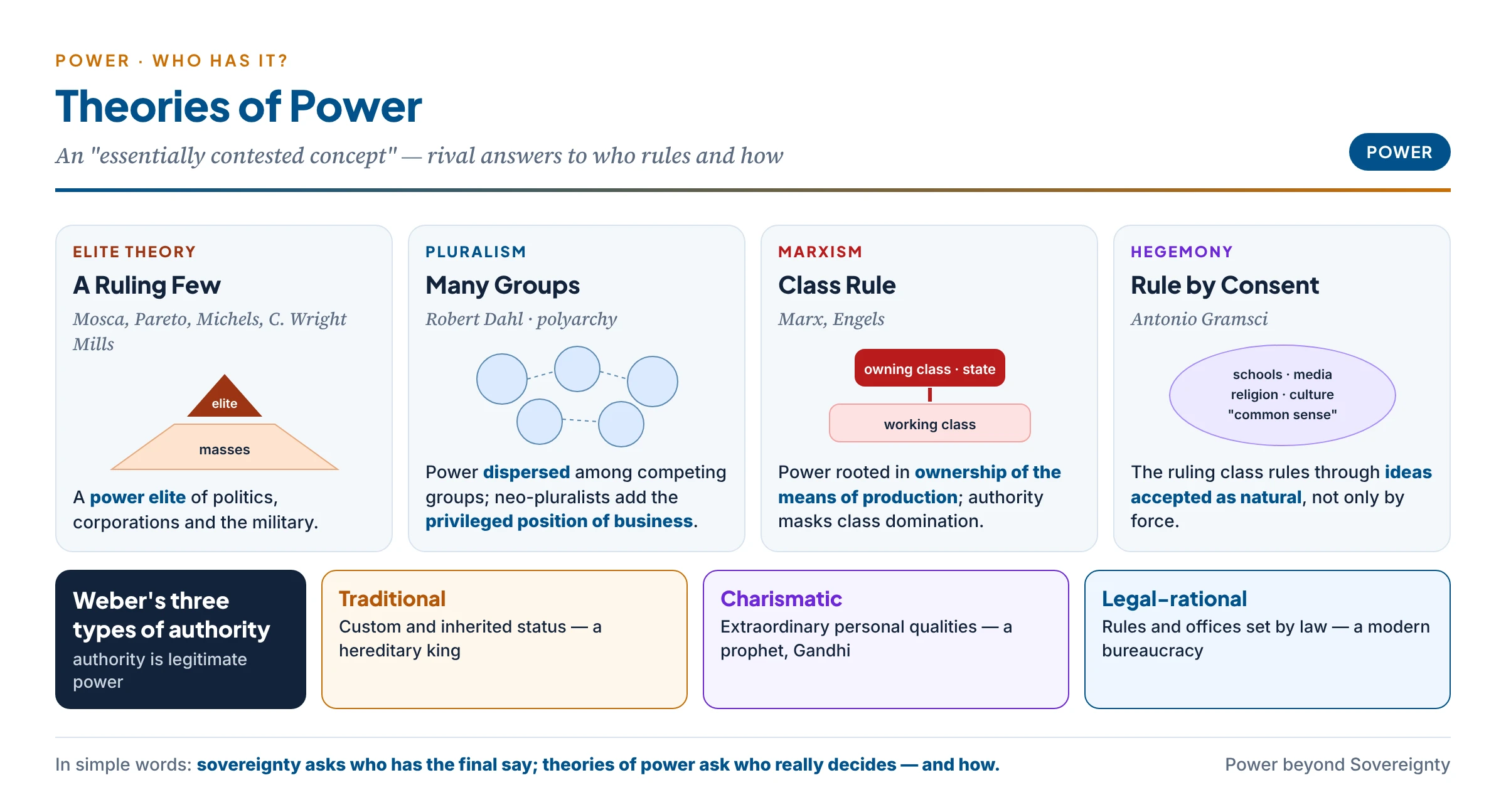
- Elite theory. In every society a small minority rules (Mosca, Pareto, Michels — the “iron law of oligarchy”). C. Wright Mills described a power elite in the United States: the leaders of federal politics, big corporations and the military, moving between these institutions and sharing interests.
- Pluralist theory. Robert Dahl studied who actually made decisions in an American city and found that power is dispersed among many competing groups; no single elite dominates all issues. Democracy is “polyarchy” — rule by many minorities.
- Neo-pluralism. Later pluralists (Lindblom, Galbraith) admitted that business corporations hold a privileged position: governments depend on them for investment and jobs.
- Three dimensions of power (Lukes).
- First face: power seen in open decisions — who wins on a disputed issue (Dahl).
- Second face: power to keep issues off the agenda — deciding what is not discussed.
- Third face: power to shape people’s wants and beliefs, so they accept what is against their real interests.
- Marxist theory. Power is rooted in class — in ownership of the means of production. The state is “a committee for managing the common affairs of the whole bourgeoisie”; authority masks class domination.
- Hegemony (Gramsci). The ruling class rules not only by force but by consent — through culture, education, religion and the media, its ideas become “common sense”.
- Systems view (Easton). Politics is the authoritative allocation of values for a society; power flows through demands, decisions and feedback.
Authority — Weber’s three types:
| Type | Basis of legitimacy | Example |
|---|---|---|
| Traditional | Custom, inherited status | A hereditary king, a village headman |
| Charismatic | Extraordinary personal qualities of a leader | Gandhi, a prophet, a revolutionary leader |
| Legal-rational | Rules and offices established by law | A modern bureaucracy, an elected government |
- Liberals see authority as resting on consent; Marxists see it as masking class domination; Weber sees the modern state as the community that successfully claims the monopoly of legitimate physical force within a territory.
Hannah Arendt: Power versus Violence
The tradition she rejects.
- Western political thought, says Arendt, has reduced politics to domination — the question of who rules whom.
- The sovereign nation-state of Bodin and Hobbes.
- The ancient classification of governments — monarchy, oligarchy, democracy — as rule of one, few or many over others.
- The command model of law inherited from religious tradition (God’s commandments).
- Max Weber’s definition of the state as the rule of men over men based on the means of legitimate (that is, allegedly legitimate) violence.
- C. Wright Mills: “All politics is a struggle for power; the ultimate kind of power is violence.”
- Clausewitz: “War is the continuation of politics by other means.”
- If politics is domination, then violence is the highest form of power. Arendt calls this a deep confusion — a “deafness to linguistic meanings” that leads to “blindness to the realities” those words refer to.
- Domination is pre-political. It comes from the household, where the master ruled slaves and the head of the family ruled its members, freeing himself from life’s necessities by compelling others to labour. Politics proper begins among equals.
What power really is.
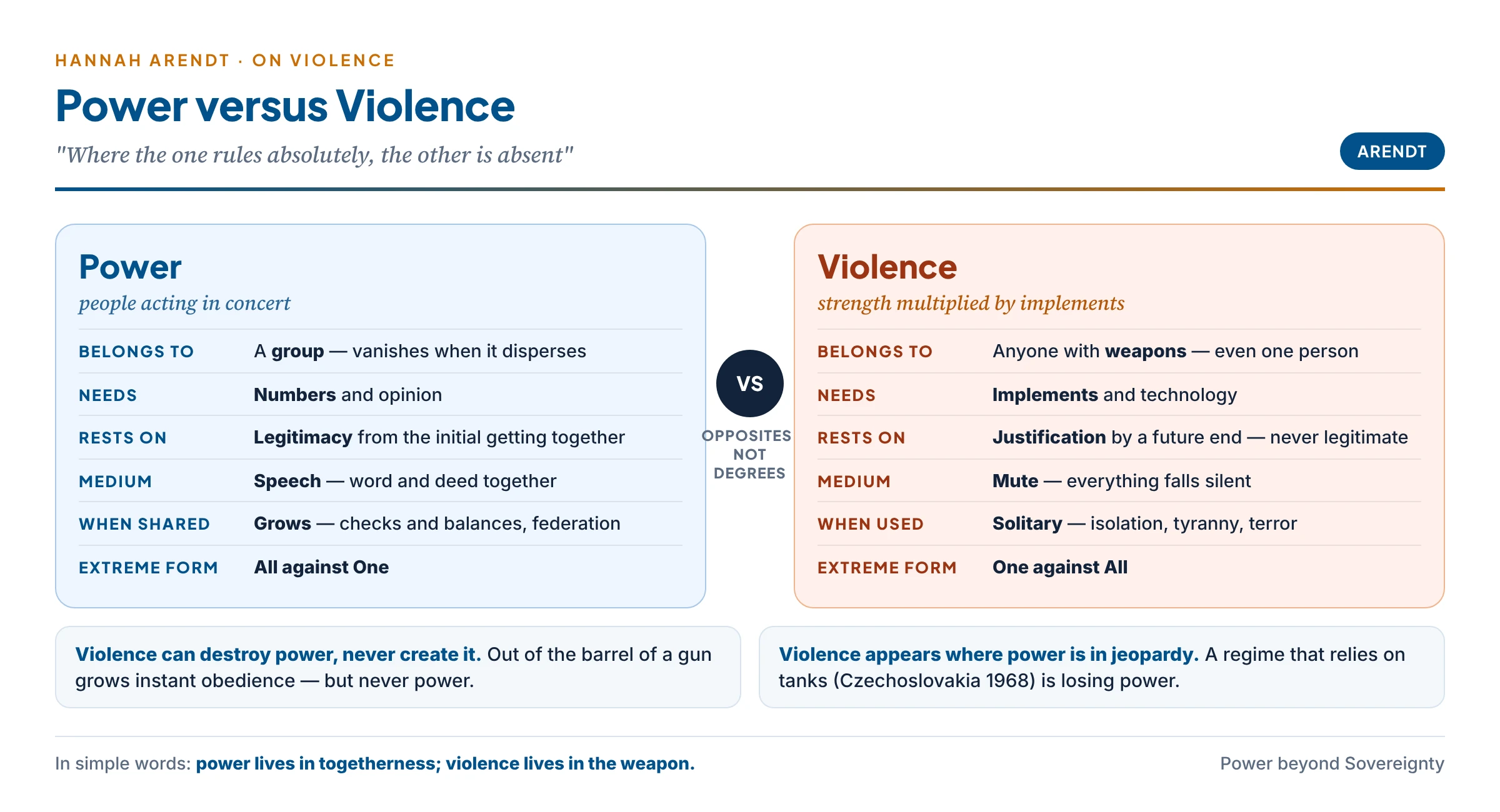
“Power corresponds to the human ability not just to act but to act in concert. Power is never the property of an individual; it belongs to a group and remains in existence only so long as the group keeps together.” — Hannah Arendt
- Power comes from plurality. It arises from “sheer human togetherness” — people who are equal and distinct acting together.
- To act is to begin. Action means starting something new together, not commanding others.
- Power rests on consent and support, not on obedience. Laws are directives that citizens support; in politics, obedience and support are the same.
- Power is relational. It springs up between people when they act together and vanishes the moment they disperse.
- Power is a potential (dynamis), not a store. It cannot be hoarded like money or weapons.
- Power is not material. It does not depend on numbers or means alone; a small, well-organised group can have great power, and a non-violent popular revolt — as in Hungary in 1956 — can paralyse a powerful state.
- Power is an end in itself. It is not an instrument for some other goal; it precedes and outlasts particular aims. Government is organised and institutionalised power.
Power, strength, force, authority, violence.
| Term | Arendt’s meaning |
|---|---|
| Power | The ability to act in concert; belongs to a group |
| Strength | A property of one person or thing; indivisible |
| Force | The energy of nature or circumstances (“the force of events”), not of persons |
| Authority | Unquestioning recognition — of a parent, a teacher, an office — requiring neither coercion nor persuasion |
| Violence | Instrumental — uses implements to multiply strength |
What violence is.
- Instrumental. Violence needs implements — weapons, tools — and is close to strength multiplied by technology. It is modelled on work: as the carpenter does violence to wood to make a table, the user of violence treats people as material.
- Needs justification, not legitimacy. Violence is justified only by the end it serves — and the more distant the end, the less believable the justification. Power needs legitimacy, which comes from people’s coming together.
- Mute. Where violence rules absolutely, everything must fall silent. Humans are speaking and political animals (Aristotle’s zōon logon echon and zōon politikon); power exists only where word and deed have not parted company.
- Solitary. Violence prefers isolation; the user of weapons can act alone and anonymously. Death, which violence brings, is the most anti-political experience.
“Power springs up whenever people get together and act in concert, but it derives its legitimacy from the initial getting together rather than from any action that then may follow.” — Hannah Arendt
Power and violence are opposites.
- “Where the one rules absolutely, the other is absent.” Violence appears where power is in jeopardy.
- Violence can destroy power, but it can never create it. “Out of the barrel of a gun grows the most effective command, resulting in the most instant and perfect obedience. What never can grow out of it is power.”
- The extreme form of power is All against One; the extreme form of violence is One against All.
- All against One — the whole community against a single person — shows that power needs numbers.
- One against All — the tyrant against everyone — shows that violence needs implements. Tyranny, as Montesquieu saw, rests on the isolation of the ruler from the ruled and of the ruled from one another; it replaces power with violence and produces impotence.
- No government rests on violence alone. Even totalitarian rulers need a power base — the secret police, informers, a loyal army. A revolution succeeds when the army refuses to obey; the outcome depends on opinion and numbers, not on weapons.
- Substituting violence for power is a sign of losing power. The Soviet invasion of Czechoslovakia in 1968 showed overwhelming force facing a people who would not cooperate.
- When means overwhelm ends, violence turns into terror — and terror turns even on its own friends.
How power is limited.
- The limit of power is other power. Because power belongs to groups, it is checked by other groups; “power can be stopped and still be kept intact only by power”.
- Power grows when divided. Unlike strength, power increases through checks and balances; it withers when monopolised. Arendt therefore prefers federal arrangements, councils and constitutions that multiply centres of power — a direct challenge to the monistic sovereign.
Violence is not always rejected.
- Violence often springs from rage and indignation at injustice, not from irrationality; sometimes it is the only fitting response.
- It is more effective for reform than for revolution, but unpredictable and irreversible; its most likely result is a more violent world.
- It may be justified as a last resort — to defend a political community against a criminal or a foreign enemy, or to confront radical evil such as the death camps, which could be ended only by military defeat; the Nuremberg trials became possible only after it.
- Modern examples test the line: the bombing of Dresden and the atomic bombs on Hiroshima and Nagasaki; superior weapons failing in Vietnam, where the My Lai massacre and napalm showed means overwhelming ends, and the “war on terror” bringing Abu Ghraib and Guantanamo. A power that acts as a “lone rider”, ignoring the UN and taking the law into its own hands, shows weakness rather than power.
- The danger today: the erosion of power, public space and a common world breeds violence.
In simple words
A thousand people marching silently and refusing to cooperate can stop a city — that is power. One man with a gun can stop a bus — that is violence. The gun-holder gets instant obedience, but the moment he lowers the gun, his “authority” vanishes. The marchers need no weapon, but if they go home, their power disappears too. Power lives in togetherness; violence lives in the weapon.
Michel Foucault: Power as a Network
A break with earlier views.
- Against the Marxist view: power is not a possession of a class or of state institutions, used from above to oppress. Against Althusser: individuals are not mere puppets of “ideological and repressive state apparatuses” working top-down.
- Power acts in everyday interactions — between doctor and patient, teacher and student, warden and prisoner, parent and child, employer and employee.
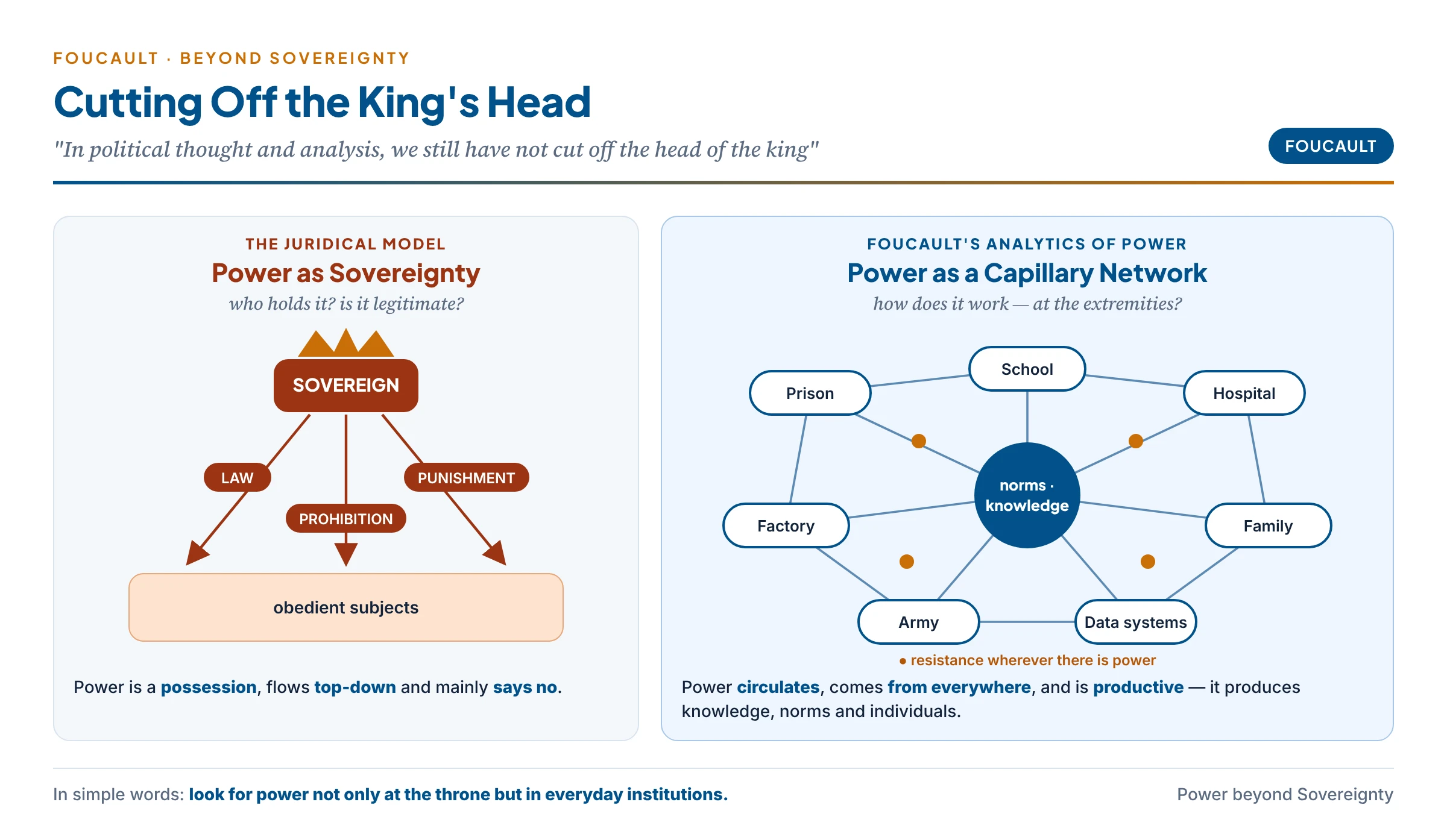
“Power must be analysed as something which circulates… It is never localised here or there, never in anybody’s hands… Power is employed and exercised through a net-like organisation… Individuals are the vehicles of power, not its points of application.” — Michel Foucault
Features of power (as commentators summarise them):
- Impersonal or subjectless — no single person or group “owns” it.
- Relational — it exists only in relations between people.
- Decentred — it has no single centre such as the king or the state.
- Multidirectional — it “comes from below” as well as from above, though relations are not equal.
- Strategic — it has aims and direction, even if no one designed the whole.
- Coextensive with resistance — “Where there is power, there is resistance.“
- Productive — it does not merely forbid; it creates.
- Ubiquitous — “Power is everywhere; not because it embraces everything, but because it comes from everywhere.”
- Not “Power” with a capital P. There are many power relations — in the family, institutions, administration — not one sovereign Power.
- If power only said no, would we obey it? Power holds because it also produces pleasure, knowledge and discourse.
“We must cease once and for all to describe the effects of power in negative terms: it ‘excludes’, it ‘represses’, it ‘censors’… In fact, power produces; it produces reality; it produces domains of objects and rituals of truth.” — Michel Foucault
From the scaffold to the prison (Discipline and Punish).
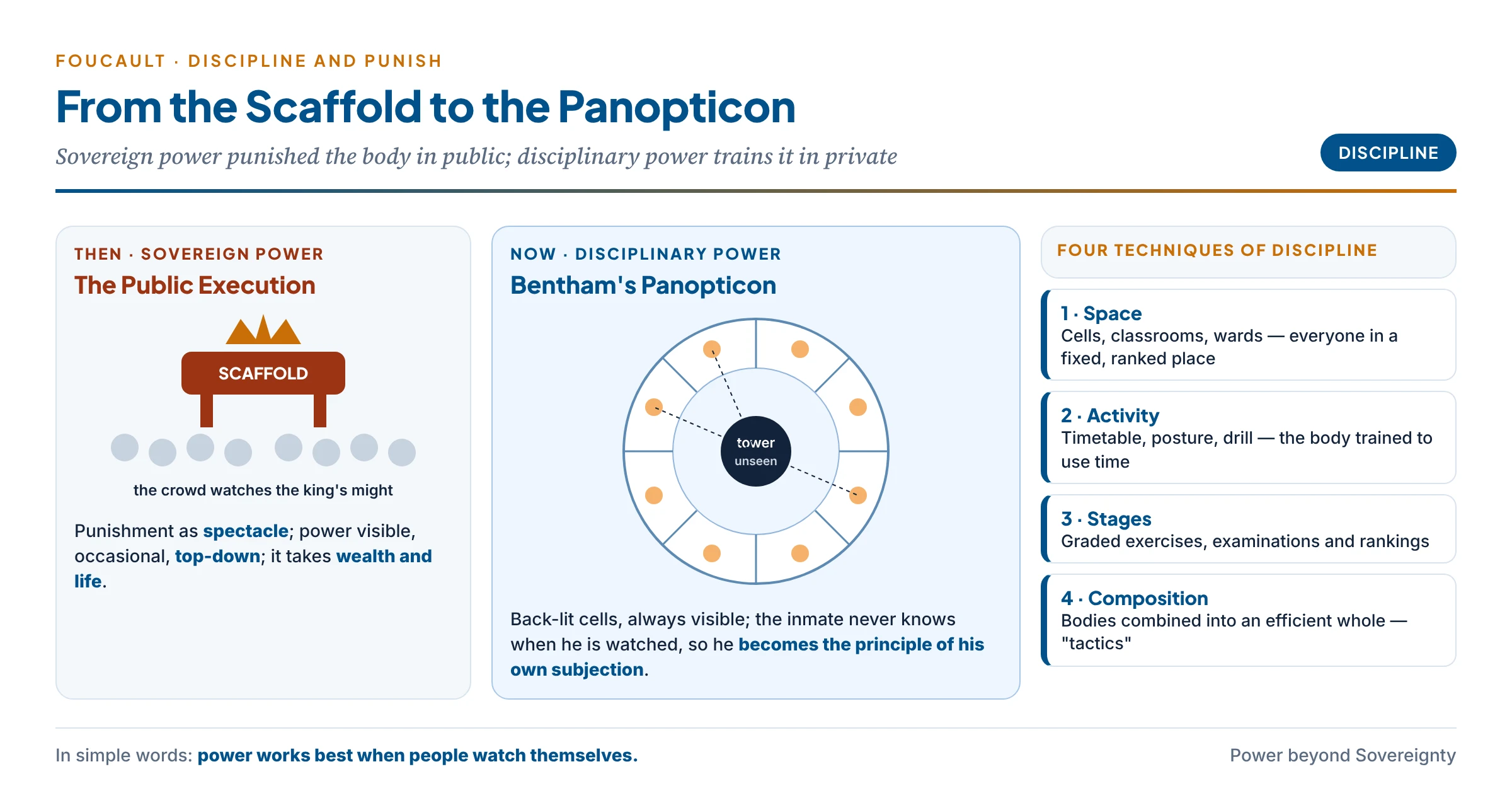
- Sovereign power (the age of monarchy): punishment as a public spectacle — the torture and execution of a criminal before a crowd, displaying the king’s might on the body of the offender. Power was discontinuous, visible and top-down; it took wealth and life.
- Disciplinary power (modern age): punishment moves inside the prison, away from public eyes; the aim is to correct and train. The new mechanism works on bodies and what they do, extracts time and labour rather than goods, and operates through constant surveillance rather than occasional levies — “material coercions rather than the physical existence of a sovereign”. It increases both the forces of those subjected and the efficiency of the system that subjects them.
- The same techniques spread to schools, barracks, hospitals, clinics, factories and universities.
Four techniques of discipline:
- Distribution in space — cells, classrooms, wards, factory floors; each person in a fixed place, segregated and ranked (“knowing one’s place”).
- Control of activity — the timetable, correct posture, handwriting drill, rifle drill; the body is trained to make the most of time.
- Organisation of stages — graded training, exercises, examinations and rankings that monitor progress.
- Composition of forces — coordinating individuals into an efficient whole, like soldiers in a drill or workers on an assembly line (“tactics”).
The panopticon.
- Bentham’s design: a ring-shaped building of cells around a central watch-tower; each cell is back-lit, so the occupant is always visible, while the watcher cannot be seen.
- Visibility is a trap. Because the prisoner never knows whether he is being watched, he behaves as if he always is. The gaze is internalised; the oppressor may even be absent.
- Self-discipline. The prisoner “becomes the principle of his own subjection“. Discipline enters time, posture and even desires.
- Today: CCTV, workplace monitoring, online data collection and social media visibility are often described as a digital panopticon.
In simple words
On a highway, a sign says “Speed camera ahead“. Many drivers slow down even where there is no camera — the warning alone is enough. They begin to police themselves. That is the panopticon: power works best when people watch themselves.
The individual as an effect of power.
- Modern individuality is not a natural given standing against power; it is produced by disciplinary techniques — files, examinations, case histories, rankings. “The individual is not the vis-à-vis of power; it is, I believe, one of its prime effects.“
Governmentality.
- The word joins gouverner (to govern) and mentalité (way of thinking): the arts and rationalities of government — who governs, who is governed, and by what methods conduct is shaped.
- Government means “the conduct of conduct” — guiding how people behave, not only commanding them: through statistics, public health, education, economic incentives and self-improvement.
- Biopower. Modern power takes charge of life — births, deaths, health, population — rather than only the power to take life, as the old sovereign did.
- The state is not an all-powerful essence. Power relations are fragile, changeable and must be constantly renewed; they rarely reach total domination. The state is “no more than a composite reality and a mythicised abstraction“, and “for all the omnipotence of its apparatuses, is far from being able to occupy the whole field of actual power relations“.
In simple words
A government that wants people to save water can order it with fines — that is sovereign power. Or it can publish each household’s usage on the bill beside the neighbourhood average, run school campaigns, and offer rebates for efficient taps — and people start managing themselves. No law is broken, no one is punished, yet behaviour changes. That second way is governmentality: governing by shaping conduct rather than by command.
“Cutting off the king’s head.”
“In political thought and analysis, we still have not cut off the head of the king.” — Michel Foucault
- The meaning. Political theory still pictures power through the image of the sovereign — a central will that makes law, forbids and punishes. This “juridical” model keeps asking who holds sovereignty and whether it is legitimate.
- Foucault’s alternative. Study power at its extremities — in prisons, clinics, schools and families — where it actually works, not at the throne. Ask how power operates, not who owns it.
- Implication for sovereignty. Sovereignty is not abolished, but it is one form of power among others — and, in modern societies, not the most important one. The Austinian picture of a determinate sovereign commanding obedient subjects misses most of how people are governed.
Common confusion
Did Foucault say that the state and sovereignty do not matter, or that power is always bad? Neither. Foucault did not deny that states, laws and sovereigns exist; he argued that power cannot be understood only through them, because it also works through everyday institutions and techniques. And power for him is not simply repression: it is productive — it produces knowledge, skills, identities and even pleasures — and it always meets resistance. Critics who read him as saying “power is everywhere, so nothing can be done” miss his point that power relations are changeable and contestable.
Critical Evaluation
Arendt — Criticisms and Replies
- Too idealised. Real politics involves conflict, interests and coercion; Arendt’s “acting in concert” looks like an exception, not the rule.
- Does not explain domination. If power is only consensual, how do we describe the power of exploiters and tyrants? (Habermas praised her “communicative” concept of power but thought it neglected strategic power.)
- Sharp distinctions between power, strength, force, authority and violence rarely appear pure in practice; she herself admitted they usually occur together.
- Violence and power not fully separable — Arendt concedes that power sometimes needs violence but does not explain how much or when.
- Replies: the distinctions are meant to clarify, not to describe pure cases; her account explains why regimes armed to the teeth collapse when people withdraw support, and why non-violent movements can win.
Foucault — Criticisms and Replies
- No room for agency or freedom. If the individual is an effect of power, who resists, and in the name of what?
- No normative ground. Foucault criticises discipline but offers no standard — justice, rights — by which to judge one form of power better than another (Habermas).
- Power everywhere means power nowhere. If everything is power, the concept loses its edge.
- Neglects the state and class. Marxists say he underestimates economic structures and the coercive state.
- Historical accuracy of the shift from punishment to discipline has been questioned.
- Replies: Foucault insists on resistance and on the changeability of power relations; his work exposes hidden forms of control so that people can contest them; later writings on the “care of the self” give space to freedom.
Critics and Defenders
Criticism — Critics
- Liberals and Habermas: Foucault lacks a normative basis for criticism; Arendt’s power is too idealised.
- Marxists: both neglect class and the economic roots of power.
- Realists: violence and coercion remain central to politics and international relations.
- Legal theorists: sovereignty and law still provide the final authority that settles disputes.
Defence — Defenders and strengths
- Democrats and civil-rights movements: Arendt explains the strength of non-violent collective action.
- Critical theorists: Foucault reveals power in prisons, clinics, schools and data systems that legal theory overlooks.
- Pluralists: both thinkers confirm that power is shared and plural, not concentrated in one sovereign.
- Students of surveillance: the panopticon and governmentality explain modern digital monitoring and self-regulation.
Cross-Tradition Comparison
| Point | Sovereignty theory (Bodin, Hobbes, Austin) | Arendt | Foucault | Gandhi | Kautilya |
|---|---|---|---|---|---|
| What power is | Command of a sovereign | Acting in concert | Network of relations | Moral force of truth and non-violence | Daṇḍa and counsel serving welfare |
| Where it lies | In a determinate sovereign | In the group acting together | Everywhere, in institutions and practices | In the people, beginning with self-rule | In the king and the seven elements |
| Relation to violence | Sanction backs command | Opposite of violence | Discipline replaces public violence | Non-violence is the highest power | Force used justly; peace preferred |
| Direction | Top-down | Horizontal | Multidirectional | From the individual outward | Top-down but duty-bound |
| Resistance | Not permitted (or only in extremes) | Through collective action | Wherever there is power | Satyāgraha | Counsel and dharma restrain the king |
Indian Connect — Indian connections
- Gandhi and Arendt: both see non-violent collective action as true power — Gandhi’s satyāgraha showed people’s withdrawal of cooperation defeating an empire. Arendt added a caution: Gandhi’s strategy succeeded against Britain, but against a regime like Stalin’s or Hitler’s the outcome might have been massacre rather than freedom.
- Kautilya and Foucault: Kautilya’s elaborate spy system, surveillance of officials and markets and detailed regulation of daily life resemble a disciplinary apparatus — but serving a sovereign king, the very “head” Foucault wanted theory to cut off.
- Indian traditions of authority: the distinction between daṇḍa (coercive power) and dharma (rightful order) parallels the distinction between violence and legitimate authority.
Synthesis (Siddhānta)
- Sovereignty is one form of power, not the whole of it. Bodin, Hobbes and Austin described legal, top-down power; modern theories show power also as collective action (Arendt), group competition (Dahl), class domination (Marx), consent through culture (Gramsci) and discipline and normalisation (Foucault).
- Arendt’s lesson: legitimate power rests on people acting together; violence can destroy it but never create it. A sovereign that relies on violence is losing power.
- Foucault’s lesson: power works most effectively where it is least visible — in routines, norms, surveillance and self-discipline. To understand how people are governed, look beyond the throne and the statute book.
- Implication for sovereignty: the monistic sovereign is a useful legal fiction that settles disputes, but real power is plural, relational and productive — which supports the pluralist critique and the need for checks, rights and democratic participation.
- Contemporary relevance:
- Non-violent mass movements — from India’s freedom struggle to recent civic protests — show Arendt’s “power in concert”.
- Digital surveillance, data collection and algorithms illustrate Foucault’s panopticon and governmentality.
- Public-health campaigns, statistics and welfare schemes are forms of biopower — the state managing life and population.
- Corporate and media power raise the elite and hegemony questions in new forms.
“Where there is power, there is resistance.” — Michel Foucault
Previous Year Questions
No direct PYQ found for this sub-topic in the archive. The following questions on sovereignty draw on it:
- 2026Explain the contrast between the monistic and pluralistic approaches to sovereignty.
- 2020State and explain the relevance of the doctrine of sovereignty in times of globalization.