

Social and Political Ideals: Equality, Justice, Liberty.
Official Syllabus: Paper II, Section A, Unit 1
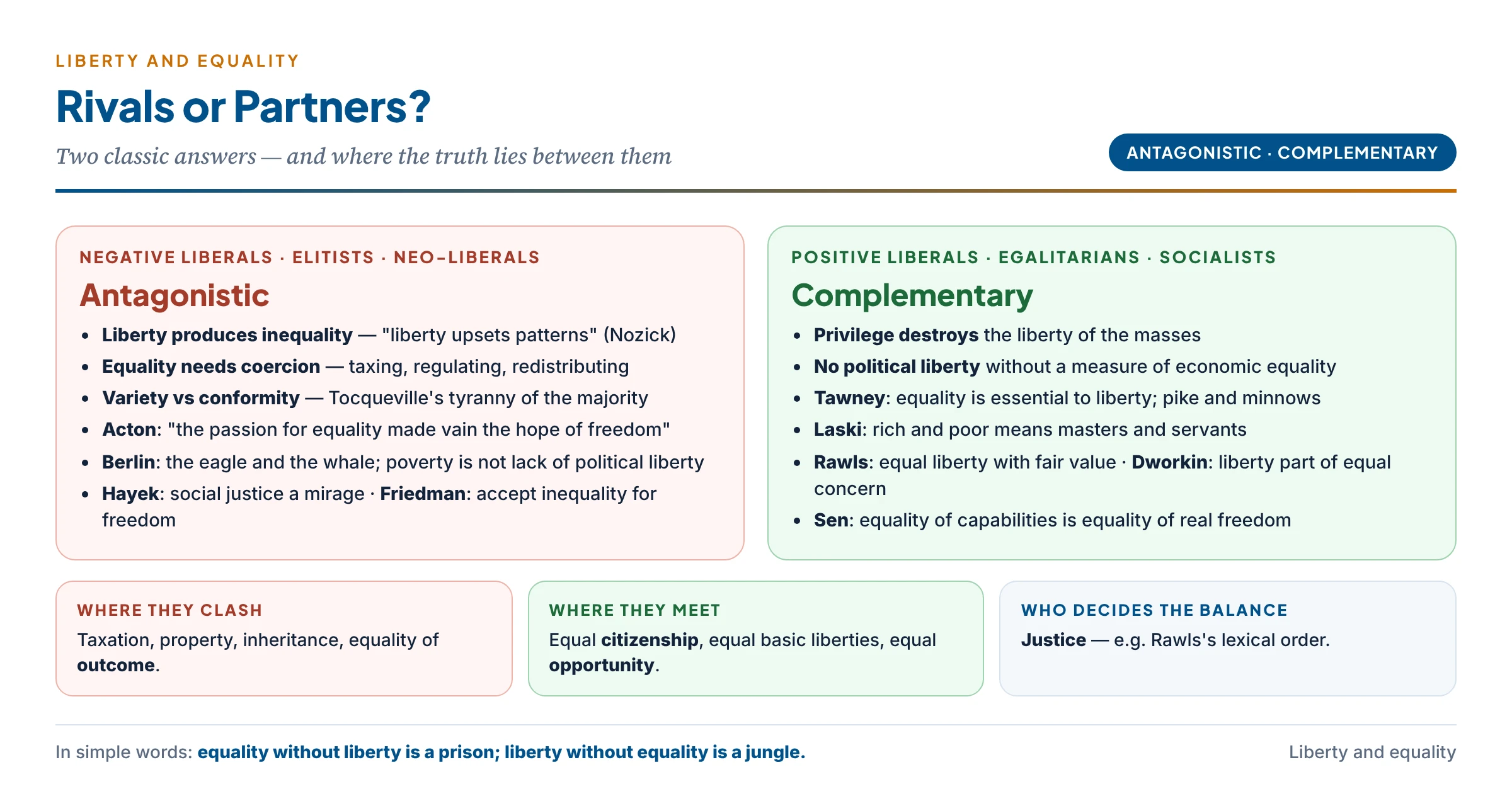
The three great ideals of modern politics — liberty, equality and justice — are often spoken of together, as in the Preamble to the Constitution of India. But do they support one another or pull apart? Negative liberals, elitists and neo-liberals — Tocqueville, Acton, Berlin, Hayek, Friedman, Nozick — argue that equality threatens liberty: free people produce unequal results, and enforcing equality needs coercion. Positive liberals, egalitarians and socialists — Rousseau, Green, Hobhouse, Laski, Tawney, Rawls, Dworkin, Sen — argue that liberty and equality are complementary: without a measure of equality, liberty is the privilege of the few. Justice, in turn, is the ideal that reconciles them, and fraternity, as Ambedkar insisted, is what makes them a living part of social life. This article brings together the earlier articles of the unit to answer the questions most often asked: how are liberty and equality related, does liberty limit equality, why are liberty and equality inadequate without justice, why equality is of no value without fraternity and liberty, and how far liberty and equality are the distinctive features of democracy.
In simple words
Think of a cricket match. Liberty is each batsman’s freedom to play his own shots. Equality is that both teams bat on the same pitch, with the same number of overs, under the same rules. Justice is the umpire and the laws of the game that keep freedom and equality in balance — no bowler may injure the batsman, no team may bat on a better pitch. And fraternity is the spirit that makes players shake hands after the match. Take away any one, and the game is spoiled.
Context & Problem
The Questions
- Are liberty and equality complementary or contradictory?
- Is equality compatible with justice — or does justice sometimes require inequality?
- What is the role of justice in relation to the other two ideals?
- What does fraternity add?
- Are liberty and equality the distinctive features of democracy?
- In brief: in contemporary thought, philosophers broadly agree that liberty and justice are positively related. The relation between liberty and equality, and between equality and justice, is more complex and contested.
Core Doctrine
View 1: Liberty and Equality Are Antagonistic
Who holds it: negative liberals, elitists and neo-liberals — Alexis de Tocqueville, Lord Acton, Isaiah Berlin, F. A. Hayek, Milton Friedman, Robert Nozick.
Their arguments:
- Liberty produces inequality. If all individuals are left free of restraints, the logical outcome is inequality — people differ in talent, effort and luck. Nozick: “liberty upsets patterns“.
- Equality needs coercion. To produce or maintain equality, the state must continually interfere — taxing, regulating, redistributing — which reduces liberty.
- Variety against conformity. The principle of liberty encourages variety of interests and opinions; the principle of equality tends to promote conformity of opinion and attitude. Hence the antithesis between liberty and equality.
- Tocqueville — democratic “equality of conditions” can lead to the tyranny of the majority and centralised power.
- Lord Acton — “The passion for equality made vain the hope of freedom” — his verdict on the French Revolution.
- Berlin:
- “If I cannot fly like an eagle or swim like a whale, I am by no means deprived of political liberty.” Likewise, if a man is too poor to afford something on which there is no legal ban, he cannot complain that he has been deprived of political liberty.
- Liberty is liberty, not equality; sacrificing liberty for equality may be justified but is still a loss of liberty.
- Critique: Berlin equates socio-economic inequalities with natural and moral inequalities and so projects a distorted view of equality — poverty, unlike the inability to fly, is man-made and removable.
- Hayek:
- Social justice is a mirage — an unrealisable principle; liberty alone is the principle worth pursuing.
- Economic equality destroys liberty and works against the progress of society. A society that allows economic inequality progresses more in technology, which ultimately leads to prosperity for all.
- Friedman:
- Liberty is possible only in a capitalist system, where everyone has the freedom to take decisions for himself.
- “If we want to live in an atmosphere of freedom, we must be ready to accept inequality.” “A society that puts equality — in the sense of equality of outcome — ahead of freedom will end up with neither equality nor freedom.”
View 2: Liberty and Equality Are Complementary
Who holds it: positive liberals, egalitarians and socialists — Rousseau, T. H. Green, L. T. Hobhouse, Harold Laski, R. H. Tawney, John Rawls, Ronald Dworkin, Amartya Sen, B. R. Ambedkar.
Their arguments:
- Vast inequality destroys the liberty of the masses. Where some individuals enjoy great privileges, these privileges destroy the liberty of the many — the landlord’s power over the tenant, the employer’s over the worker.
- No political and social liberty without economic equality. Political liberty is meaningless in the absence of a reasonable degree of economic equality: a starving man cannot use his vote freely, a poor man cannot afford justice in court.
- Substantive freedom needs substantive equality. The demand for real freedom requires a reduction of vast socio-economic disparities.
- Rousseau — no citizen should be so rich as to buy another, nor so poor as to have to sell himself; only then is the general will free.
- Tawney — “A large measure of equality, so far from being inimical to liberty, is essential to it.” Freedom for the pike is death for the minnows.
- Laski — liberty is the atmosphere in which people can be their best selves; it requires equality — absence of special privilege and adequate opportunities for all. “Where there are rich and poor, educated and uneducated, we find always masters and servants.”
- Rawls — equal basic liberties and the difference principle; liberty must have fair value for all.
- Dworkin — liberty and equality do not really conflict, because the liberties we have a right to are themselves derived from equal concern and respect; properly understood, liberty is part of equality.
- Sen — the capability approach unites them: equality of capabilities is equality of real freedom.
Does Liberty Put Limitations to Equality?
- Yes, in some ways:
- Free exchange, gifts and inheritance recreate inequality after any equal distribution (Wilt Chamberlain).
- Liberty of thought and expression produces diversity, not uniformity.
- Freedom of occupation and enterprise allows unequal rewards.
- Freedom of religion and association allows groups to maintain their own (sometimes unequal) practices.
- And equality limits liberty too: progressive taxes, anti-discrimination laws, reservations and land ceilings restrict some people’s freedom of action.
- But liberty also serves equality:
- Equal civil and political liberties are themselves a form of equality — equal citizenship.
- Freedom of speech and association let the disadvantaged organise and demand equality — the anti-caste and labour movements depended on liberty.
- A society of free people has room to correct its inequalities through debate and reform.
- Verdict. Liberty limits equality of outcome, but supports equality of status and of citizenship. The conflict is real at the margins (taxation, property), not at the core. Rawls’s lexical order — equal liberties first, then fair opportunity, then the difference principle — is one way of drawing the boundary.
“Complete Liberty May Lead to Inequality, While Order and Restrictions Imply a Necessary Loss of Freedom”
- The first half is true. Complete liberty — liberty as licence — lets the strong dominate the weak; in Indian terms it ends in matsya-nyāya; in Tawney’s, freedom for the pike is death for the minnows.
- The second half is partly true. Every restriction reduces some freedom — Bentham said every law is an infraction of liberty, and Berlin insisted that we call such restrictions a loss of liberty, not a gain.
- But it is also misleading. Restrictions that protect everyone — laws against violence and fraud, traffic rules, reasonable restrictions on speech that incites violence — enlarge the real freedom of most people (Hobhouse, Barker). The choice is not between complete liberty and loss of freedom, but between different distributions of freedom.
- Hobbes vs Locke. Hobbes accepted heavy loss of liberty for order; Locke limited government to protect liberty. Modern constitutional democracies follow Locke: order under law, with rights protected and authority itself restricted.
- Synthesis. The aim is ordered liberty — the greatest common measure of liberty for all, secured by laws that are general, reasonable and themselves limited. Justice decides the measure.
Equality and Justice: Contradictory or Complementary?
View 1: Contradictory
- Plato and Aristotle viewed justice with reference to classes with unequal rights. Plato’s rulers were men of gold, soldiers of silver, producers of bronze; justice meant each staying in his class.
- Aristotle held that distributive justice consists in treating people differently — and in practice his scheme favoured wealth and tradition and even justified slavery. He did not think the state should promote equality.
- Libertarians hold that the market is the means of just distribution, and inequality is its natural outcome; forcing equality would be unjust to those who earned more.
View 2: Complementary
- The purpose of justice is to give every individual his due — which is impossible in the absence of equality or of liberty.
- Justice demands that all individuals be treated as ends, never merely as means; this is impossible without equality of moral status.
- All forms of justice need equality: political justice requires equal participation and universal adult franchise; social justice cannot be realised without socio-economic equality; legal justice requires equality before law.
Equality without justice
- In modern times, equality is meaningful only when accompanied by a sense of justice — the rightful allocation of benefits and burdens.
- Equality without a genuine sense of justice loses its essence and can become a source of oppression.
- Example: a competent lawyer who chooses to defend all clients without distinguishing between the wicked and the innocent would be making a mockery of equality, because of his indifference to the dictates of justice.
- Example: if equality is understood as “an eye for an eye“, it ends in what Francis Bacon called “wild justice” — revenge.
- So in practice, the principle of equality is inseparable from the principle of justice.
Why Are Liberty and Equality Inadequate as Ideals without Justice?
The 2025 paper asked how both equality and liberty are inadequate without justice. Liberty without justice:
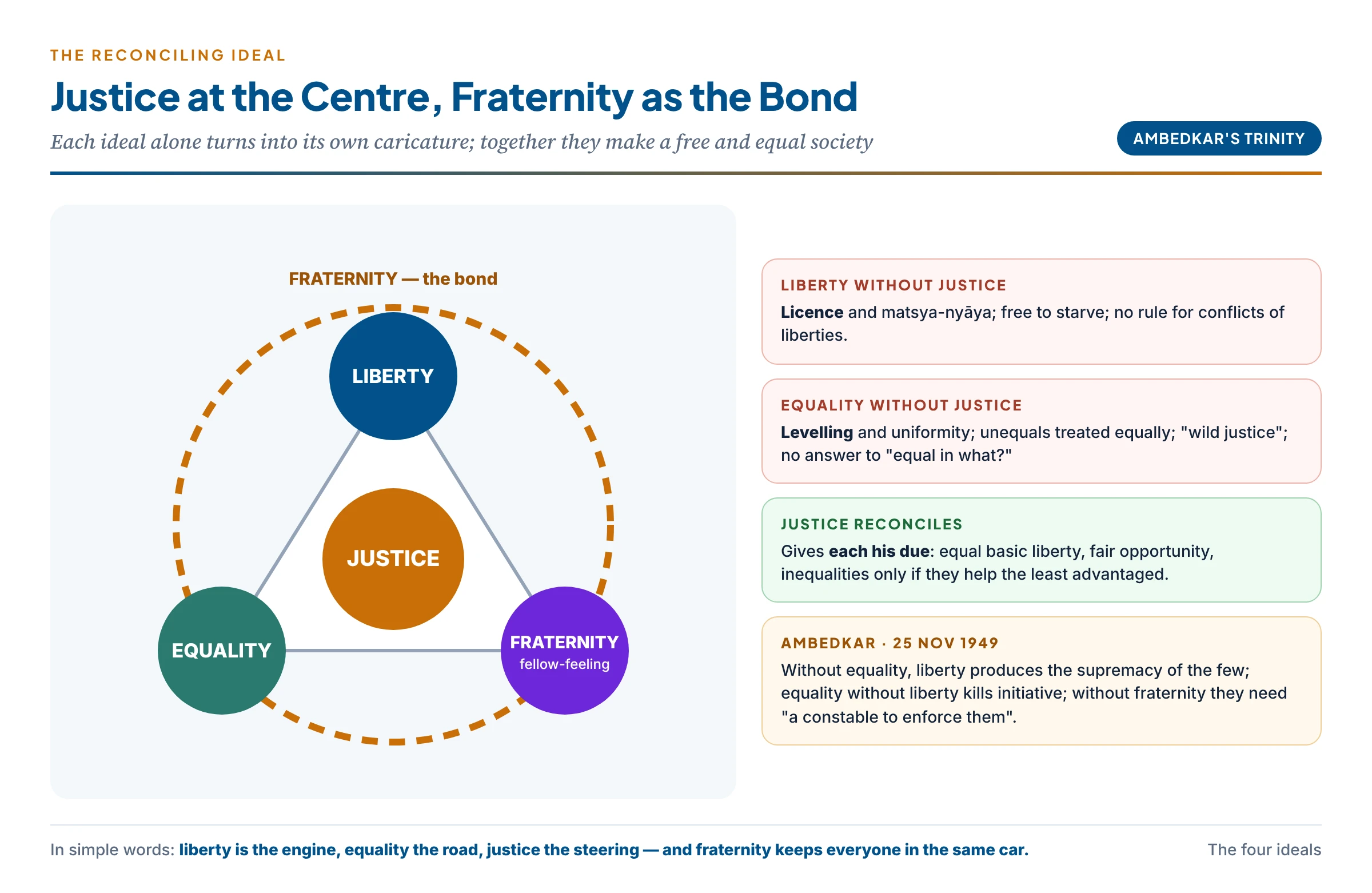
- Becomes licence — the strong use their freedom to exploit the weak (matsya-nyāya).
- Becomes formal — freedom to choose without the means to choose; “free to starve”.
- Cannot resolve conflicts — when one person’s liberty clashes with another’s, liberty itself gives no rule for deciding; a principle of justice is needed (Mill’s harm principle and Rawls’s equal liberty are principles of justice about liberty).
Equality without justice:
- Becomes levelling — making the better-off worse off even when no one gains; uniformity that suppresses talent and effort.
- Treats unequals equally — ignoring real differences of need and merit (the same shoes for every foot).
- Becomes revenge or mockery — the eye-for-an-eye and the indiscriminate lawyer examples.
- Has no content — “equal in what?” can only be answered by a theory of justice (Rawls’s primary goods, Dworkin’s resources, Sen’s capabilities).
Justice as the reconciling ideal:
- Justice is the ideal that synthesises conflicting claims — including the claims of liberty and equality — by giving each his due.
- Plato: justice is the harmony of the parts; Rawls: justice orders liberty and equality lexically — equal basic liberties first, then fair opportunity and the difference principle; Sen: justice compares arrangements to remove manifest injustice, weighing plural claims (the flute).
- So justice tells us how much liberty (equal liberty for all), what kind of equality (of status, opportunity, capability), and which inequalities are acceptable (those that benefit the least advantaged, those that reward real contribution).
In simple words
Liberty is the engine of a car, equality is the road that everyone may use, and justice is the traffic law and the steering. An engine without steering crashes; a road without engines goes nowhere; steering without engine or road is pointless. Only together do they take a society somewhere good.
“Equality Will Be of No Value without Fraternity and Liberty”
- Fraternity means a sense of common brotherhood among citizens — mutual respect, solidarity and a feeling that we belong to one community. It was the third watchword of the French Revolution: liberté, égalité, fraternité.
- Ambedkar’s trinity. In his last speech to the Constituent Assembly (25 November 1949), Ambedkar said that liberty, equality and fraternity form “a union of trinity“, in the sense that “to divorce one from the other is to defeat the very purpose of democracy”:
- “Liberty cannot be divorced from equality, equality cannot be divorced from liberty. Nor can liberty and equality be divorced from fraternity.“
- “Without equality, liberty would produce the supremacy of the few over the many.“
- “Equality without liberty would kill individual initiative.“
- “Without fraternity, liberty and equality could not become a natural course of things. It would require a constable to enforce them.”
- A life of contradictions. Ambedkar warned: on 26 January 1950, India would enter “a life of contradictions” — equality in politics (one person, one vote, one value) but inequality in social and economic life. If the contradiction was not removed, those who suffered from inequality would “blow up the structure of political democracy”.
- Source in the Buddha. Ambedkar said he did not borrow these ideals from the French Revolution; they had their roots in religion — in the teachings of the Buddha.
Common confusion
Did Ambedkar take liberty, equality and fraternity from the French Revolution? Not in his own account. The three words were the watchwords of the French Revolution, and many notes trace Ambedkar’s ideals there. But Ambedkar said explicitly (in a 1954 broadcast) that he had not borrowed his philosophy from the French Revolution; its roots were in religion — in the teachings of the Buddha. He also gave fraternity a special meaning: not only patriotic brotherhood, but the social endosmosis and fellow-feeling that caste destroys.
- Fraternity as social endosmosis. For Ambedkar, a democratic society needs free communication and shared experience across groups — “social endosmosis” — which caste prevents; fraternity is the name for this mutual sympathy.
In simple words
A housing society passes a rule that every family must share the common hall equally. If neighbours dislike each other, the rule needs a guard at the door and constant complaints to enforce it. If they feel like one community, they share the hall happily without any guard. Law can command equality; only fraternity makes it natural.
- Why equality needs fraternity:
- Without fraternity, equality must be enforced by law alone, which is fragile and resented.
- Fraternity turns equality from a legal rule into a habit of the heart.
- Fraternity protects dignity — the Preamble speaks of “fraternity assuring the dignity of the individual and the unity and integrity of the Nation“.
- Why equality needs liberty: equality without liberty means enforced uniformity, a totalitarian state, the death of initiative.
- Rawls on fraternity. Rawls argued that his difference principle expresses a natural meaning of fraternity: not wanting greater advantages unless they also benefit those less well off — as in a family.
Indian Connect — Ambedkar’s trinity and the Preamble
The Preamble lists the ideals in a telling order: Justice — social, economic and political; Liberty of thought, expression, belief, faith and worship; Equality of status and of opportunity; and Fraternity assuring the dignity of the individual and the unity and integrity of the Nation. Justice comes first as the organising ideal; liberty and equality are its main content; fraternity is the bond that makes them work. Ambedkar’s warning about a “life of contradictions” remains the test of Indian democracy: political equality must be completed by social and economic equality, achieved through liberty and sustained by fraternity.
Liberty and Equality as Distinctive Features of Democracy
Why they are distinctive:
- Aristotle observed that the basis of the democratic constitution is liberty, and that democrats define justice as numerical equality — one citizen, one share in rule; “to live as one likes” and “ruling and being ruled in turn” are its marks.
- Plato criticised democracy for exactly these features: excessive liberty and an equality given to equals and unequals alike.
- Modern democracy rests on equal citizenship (one person, one vote, one value) and civil liberties (speech, association, dissent) without which elections are meaningless.
- Liberal democracy emphasises liberty (limits on power, rights); social democracy emphasises equality (welfare, redistribution); constitutional democracy like India’s combines both.
- Without liberty, elections become plebiscites; without equality, democracy becomes plutocracy (rule by money).
In simple words
An election in which everyone may vote but no one may criticise the ruler has equality without liberty. An election in which anyone may speak but only the rich can afford to stand as candidates has liberty without equality. Neither is a real democracy; democracy needs both at once.
Why they are not the whole story:
- Non-democratic regimes also claim them: some authoritarian states claim to deliver economic equality; some oligarchies allow considerable private liberty.
- Democracy also needs the rule of law, an independent judiciary, free press, accountability, public reasoning (Sen) and fraternity (Ambedkar).
- Tension within democracy: majority rule (equality of votes) can threaten minority liberty (Tocqueville, Mill); hence constitutional limits on majorities.
- Ambedkar: political democracy cannot last unless there lies at its base social democracy — a way of life recognising liberty, equality and fraternity.
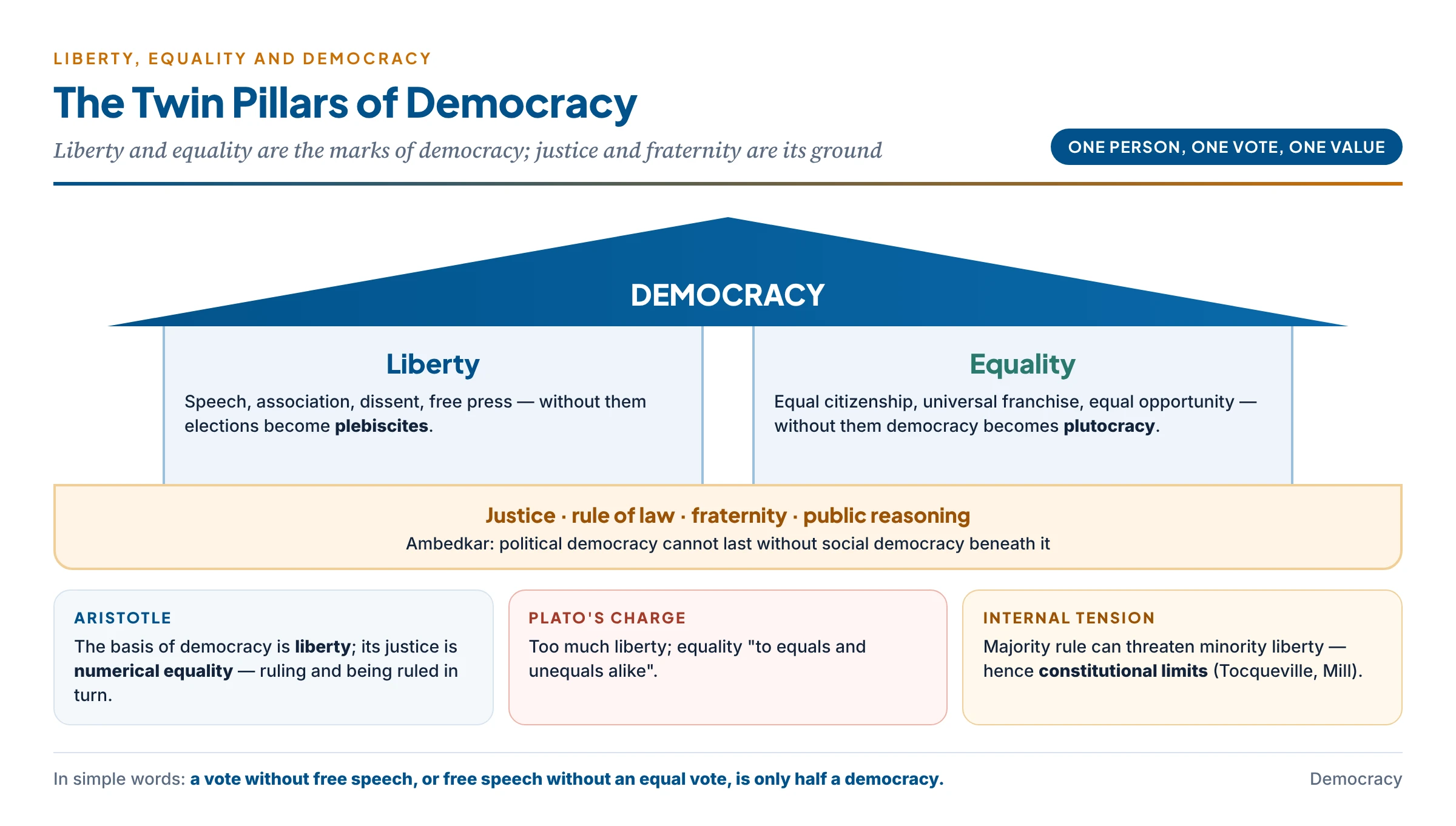
- Verdict. Liberty and equality are the twin foundations of democracy, and their combination is what distinguishes democracy from other regimes; but they need justice to balance them and fraternity to sustain them.
Critically Evaluating Liberty and Equality as Political Ideals
Liberty as a political ideal:
- Strengths: dignity and autonomy; diversity, creativity and progress (Mill); protection against tyranny; the basis of all other rights.
- Weaknesses: can become licence and formal freedom; ignores the conditions of freedom; can mask domination (Marx, Pettit).
Equality as a political ideal:
- Strengths: equal moral worth; removal of privilege and caste; makes liberty real for the many; social solidarity.
- Weaknesses: risk of levelling and conformity; coercion; “empty” without a theory of what to equalise.
Evaluation: each ideal, taken alone and absolutely, becomes dangerous — absolute liberty becomes the law of the fish; absolute equality becomes enforced uniformity. Each, taken together with the other and ordered by justice, becomes a principle of human emancipation.
The Ideals across Ideologies
| Ideology | Liberty | Equality | Justice |
|---|---|---|---|
| Classical liberalism / libertarianism | Negative liberty, supreme | Formal equality before law only | Procedural; market outcomes; entitlement (Nozick) |
| Egalitarian (welfare) liberalism | Equal basic liberties, with fair value | Fair opportunity; difference principle | Justice as fairness (Rawls), capabilities (Sen) |
| Democratic socialism | Civil liberties plus freedom from want | Substantive socio-economic equality | Social justice through the welfare state |
| Marxism | Freedom from exploitation; the free development of each | Classlessness; to each according to needs | Bourgeois justice transcended |
| Communitarianism | Liberty within community | Complex equality (Walzer) | Rooted in shared meanings and common good |
| Gandhian thought | Swarāj — self-rule and self-control | Equality of all labour; sarvodaya | Trusteeship, antyodaya, non-violence |
| Ambedkarite thought | Liberty against caste domination | Social and economic equality | Social democracy with fraternity |
Critical Evaluation
Critics and Defenders
Criticism — The antagonistic view
- Liberty upsets patterns (Nozick).
- Equality breeds conformity (Tocqueville).
- Passion for equality kills freedom (Acton).
- Social justice a mirage (Hayek).
- Accept inequality for freedom (Friedman).
Defence — The complementary view
- Pike and minnows (Tawney).
- Equal liberties with fair value (Rawls).
- Liberty as part of equal concern (Dworkin).
- Equality of real freedom (Sen).
- Trinity with fraternity (Ambedkar).
Cross-Tradition Comparison
| Theme | Western thought | Indian thought |
|---|---|---|
| Disorder without justice | Hobbes’s war of all against all | Matsya-nyāya |
| Liberty and equality joined | French Revolution; Tawney; Rawls | Ambedkar’s trinity; the Preamble |
| Source of fraternity | Christian brotherhood; republican civic friendship | The Buddha’s maitrī and karuṇā (friendliness, compassion) |
| Political vs social democracy | Tocqueville on equality of conditions | Ambedkar: “a life of contradictions” |
| Inner basis of the ideals | Kant’s respect for persons | Gandhi’s sarvodaya and swarāj; Vivekananda’s oneness of all |
Indian Connect — Gandhi on liberty and equality
Gandhi rarely used the language of “rights”, but his programme joined the two ideals. Swarāj was liberty — self-rule and the capacity to resist unjust authority; sarvodaya and bread labour were equality — the equal dignity of the scavenger and the scholar. “Economic equality is the master key to non-violent independence“, he wrote in the Constructive Programme (1941). And he tied both to justice through non-violence: equality forced by violence would destroy liberty, and liberty that ignored the poor would betray swarāj.
Synthesis (Siddhānta)
- Liberty and equality are in tension at the margins (taxation, property, outcomes) but complementary at the core: equal liberty is a form of equality, and a measure of equality is the condition of real liberty.
- Equality and justice were opposed in the hierarchical theories of Plato and Aristotle and in market libertarianism, but are complementary in modern thought: justice gives each his due, and that requires equal moral worth.
- Justice is the reconciling ideal: without it, liberty becomes licence and equality becomes levelling; justice decides how much liberty, what equality, and which inequalities are acceptable.
- Fraternity turns the ideals from legal rules into social habits — Ambedkar’s union of trinity.
- Democracy is distinguished by the combination of liberty and equality, ordered by justice and sustained by fraternity.
- Contemporary relevance. Every major public debate in India — reservations and merit, free speech and hate speech, privacy and security, welfare and taxation, uniform laws and community rights — is a debate about balancing liberty, equality and justice with fraternity. The Constitution’s answer is not to choose one ideal over the others but to hold all four together.
“Without equality, liberty would produce the supremacy of the few over the many. Equality without liberty would kill individual initiative.” — B. R. Ambedkar
Previous Year Questions
- 2025How are both equality and liberty inadequate as social and political ideals without justice? Discuss.
- 2024Critically evaluate the concepts of liberty and equality as political ideals.
- 2022“Complete liberty may lead to inequality while order and restrictions imply a necessary loss of freedom.” Critically discuss.
- 2019Does liberty put limitations to equality? Discuss.
- 2018How far can liberty and equality be considered as distinctive features of democracy? Discuss.
- 2015“Equality will be of no value without fraternity and liberty.” Discuss.
- 2010Discuss the nature of relationship between liberty and equality.
- 2009Comment on the relationship between equality and freedom.