- The Aspirational Districts Programme (ADP), launched by the Prime Minister in January 2018 and anchored by NITI Aayog, aims at the rapid transformation of India’s least developed districts: 112 since 2018, and 117 since five West Bengal districts joined in June 2026.
- The Aspirational Blocks Programme (ABP), launched in January 2023, carries the same method down to 500 blocks, now 513.
- Both rest on the 3Cs: Convergence of Central and State schemes, Collaboration among governments, officials and partners, and Competition among districts and blocks through delta ranking on a public dashboard.
- They are the latest stage of backward area planning. They replace “backwardness” with aspiration, untied grants with measured outcomes, and the State with the district and block as the unit of planning.
The Aspirational Districts Programme

Origin and Aim
- India’s growth had widened gaps within States as well as between them. A State’s average hid districts such as Gadchiroli in Maharashtra or Nuh in Haryana.
- The ADP’s premise is that the poorest districts can catch up quickly if existing schemes are delivered well, progress is measured, and administrators are held to it.
- Districts first try to catch up with the best district in their own State, then with the best in the country.
- It is a way of localising the Sustainable Development Goals. Its themes map onto SDGs 1–4, 6–8, 11 and 13.
- It succeeded the Backward Regions Grant Fund, which ended in 2015–16 when the 14th Finance Commission raised the States’ share of central taxes from 32% to 42%.
What Changed from Earlier Backward-Area Programmes
- From inputs to outcomes: earlier programmes counted money released and works completed; the ADP counts children immunised, girls enrolled and households electrified.
- From grants to convergence: the BRGF gave untied grants; the ADP improves the delivery of schemes that already reach the district.
- From static lists to live ranking: backward-district lists were drawn once and left unchanged for years. ADP districts are re-ranked every month or quarter on fresh data.
- From sector departments to one district team: the Collector, line departments, the Central Prabhari Officer and partners work to one set of targets.
- From stigma to aspiration: the label “aspirational” was chosen to signal potential rather than deficiency, and to make officials and citizens owners of the change.
Selection of Districts
- A committee of senior Union officials, in consultation with States, ranked districts on a composite index:
- deprivation recorded in the Socio-Economic and Caste Census (2011);
- health and nutrition, such as institutional deliveries and child stunting and wasting;
- education outcomes;
- basic infrastructure: electricity, toilets, rural roads and drinking water.
- At least one district was taken from every State, so the list is not purely a national bottom tier.
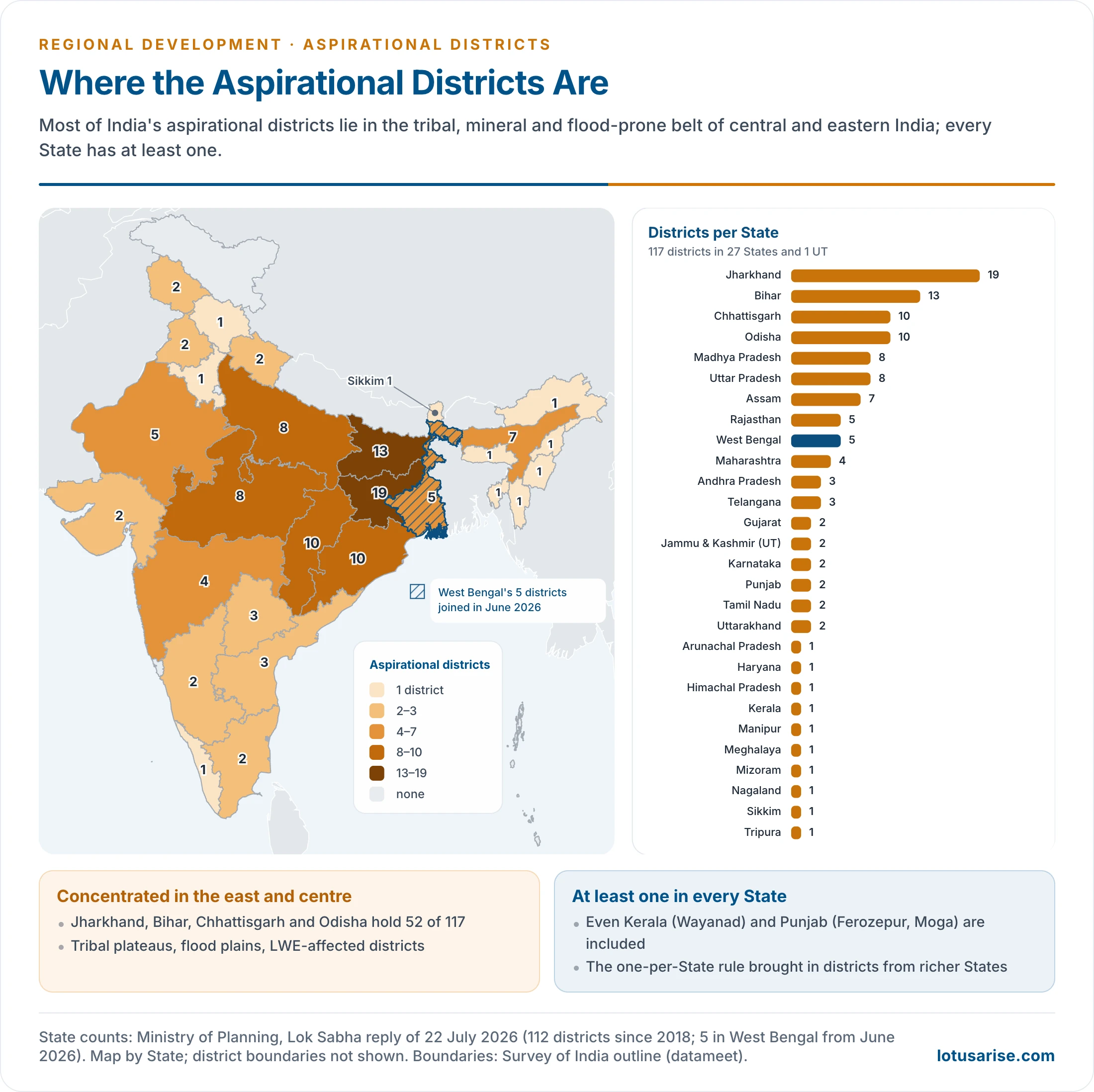
- 117 districts were identified. West Bengal’s five did not take part, so 112 districts in 26 States and one UT ran from 2018.
- The five West Bengal districts, Nadia, Malda, Birbhum, Purba Bardhaman and Dakshin Dinajpur, joined in June 2026, taking the total to 117.
- Distribution:
- Jharkhand (19), Bihar (13), Chhattisgarh (10), Odisha (10), Madhya Pradesh (8), Uttar Pradesh (8), Assam (7), Rajasthan and West Bengal (5 each).
- More than half lie in the central and eastern tribal and mineral belt. Many are affected by left-wing extremism.
- Geography: the districts fall into a few recurring landscapes of backwardness.
- Tribal plateaus and forests: most of Jharkhand’s 19, Bastar, Dantewada, Sukma and Narayanpur in Chhattisgarh, Koraput, Malkangiri and Rayagada in Odisha, Gadchiroli and Nandurbar in Maharashtra.
- Flood plains: north Bihar (Araria, Purnea, Katihar, Khagaria, Sitamarhi) and the Brahmaputra valley (Dhubri, Barpeta, Goalpara, Darrang).
- Drought-prone Deccan and dry west: Osmanabad and Washim, Raichur and Yadgir, YSR Kadapa, Jaisalmer and Sirohi.
- Hill and border districts: Chamba, Kupwara, Baramulla, Kiphire, Mamit, Namsai and Chandel.
- Districts with mixed economies: Haridwar, Udham Singh Nagar, Ranchi and Bokaro combine industry or cities with poor social indicators.
- At the start, NITI Aayog took 30 districts, 12 Union ministries 50, and the Ministry of Home Affairs the 35 districts affected by left-wing extremism.
Themes and Indicators
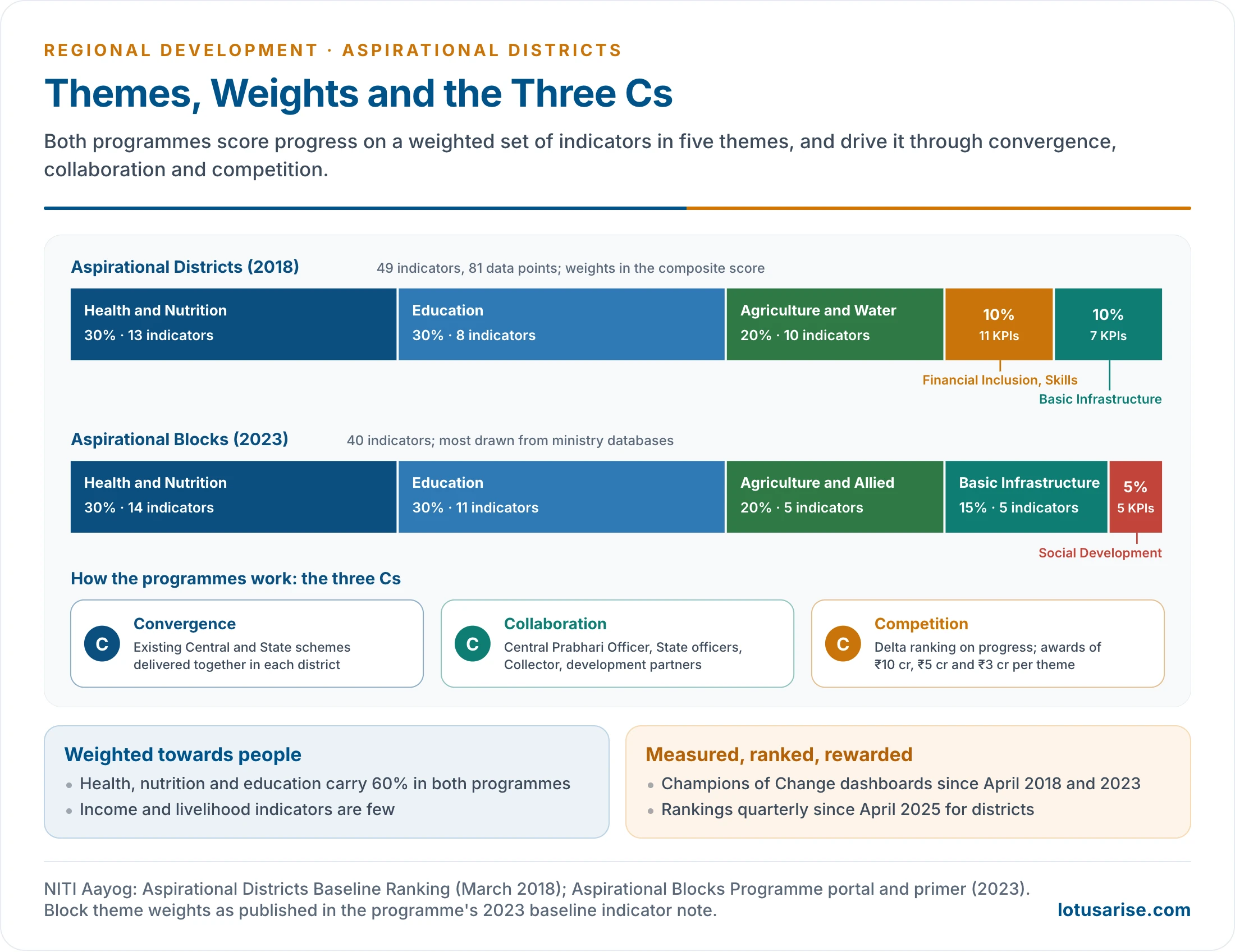
- Progress is tracked on 49 key performance indicators (81 data points) under five themes, weighted to reflect policy priority:
| Theme | Weight | Indicators | Examples |
|---|---|---|---|
| Health and Nutrition | 30% | 13 | Antenatal care, institutional delivery, low birth weight, stunting, immunisation |
| Education | 30% | 8 | Learning outcomes, transition rates, toilets for girls, pupil–teacher ratio |
| Agriculture and Water Resources | 20% | 10 | Crop yield, irrigation, soil health cards, crop insurance, animal vaccination |
| Financial Inclusion and Skill Development | 10% | 6 + 5 | Jan Dhan accounts, insurance enrolment, Mudra loans, youth trained and placed |
| Basic Infrastructure | 10% | 7 | Household electricity, road connectivity, drinking water, Gram Panchayats with internet |
- Health, nutrition and education carry 60% of the weight. The programme treats human capability as the first condition of development.
- The indicators are mostly outputs and service coverage that a district administration can move within months.
Strategy: the 3Cs
- Convergence:
- The programme adds no large scheme of its own. It pulls together existing Central and State schemes for health, nutrition, schooling, farm support, banking and infrastructure in each district.
- The District Collector is the point of convergence.
- Collaboration:
- Each district has a Central Prabhari Officer of Additional Secretary rank, and State nodal and prabhari officers.
- An empowered committee resolves bottlenecks across ministries.
- Development partners, civil society organisations, foundations and corporate social responsibility funds support districts in specific themes.
- Competition:
- Districts are ranked on incremental progress (the delta), not on absolute level, so the poorest can win.
- Rankings are public on the Champions of Change dashboard.
Champions of Change and Delta Ranking
- Baseline ranking: March 2018, for 101 districts with data.
- Dashboard: districts began entering data on 1 April 2018. Monthly delta rankings were published from mid-2018.
- The upgraded Champions of Change 2.0 portal adds citizen reports, geospatial maps and analytics.
- Awards through the challenge route:
- ₹10 crore for the first and ₹5 crore for the second district overall;
- ₹3 crore for the top district in each of the five themes.
- From April 2025 rankings and awards are quarterly, under the programme’s third phase (2024–25 and 2025–26).
- By August 2024 about ₹1,583 crore had been sanctioned to districts as award money.
- Districts also use distance to frontier: how far each indicator is from the best district in the State and the country.
Results and Appraisals
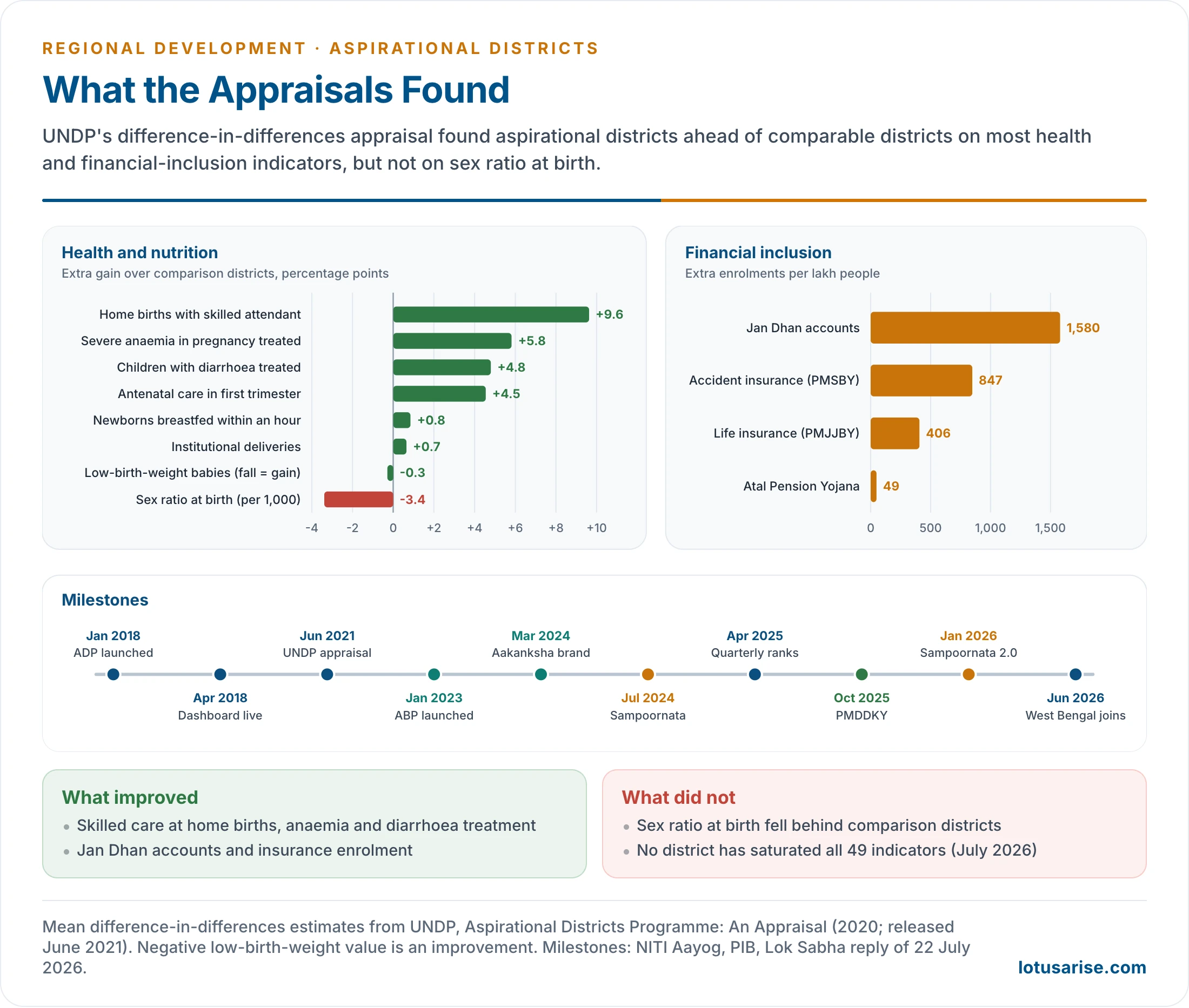
- UNDP appraisal (Aspirational Districts Programme: An Appraisal, 2020; released June 2021):
- It compared aspirational districts with similar non-aspirational ones by difference-in-differences.
- Aspirational districts outperformed their counterparts in health, nutrition and financial inclusion:
- 9.6% more home deliveries attended by a skilled birth attendant;
- 5.8% more pregnant women with severe anaemia treated;
- 4.8% more children with diarrhoea treated;
- 4.5% more antenatal registrations in the first trimester;
- about 406 more life-insurance (PMJJBY) enrolments, 847 more accident-insurance (PMSBY) enrolments and 1,580 more Jan Dhan accounts per lakh population.
- The sex ratio at birth did not improve relative to the comparison districts.
- It cited Malaria Mukt Bastar Abhiyaan, which cut malaria by 71% in Bijapur and 54% in Dantewada, as a best practice.
- Institute for Competitiveness assessment (2020):
- Almost all districts had progressed from the baseline, with the largest gains in health and basic infrastructure.
- Financial inclusion and skill development lagged furthest, and most districts remained 40–90% away from their targets.
- Saturation campaigns:
- Sampoornata Abhiyan (July–September 2024) targeted saturation of six indicators in districts and blocks.
- Sampoornata Abhiyan 2.0 (28 January–14 April 2026) targeted five indicators in districts and six in blocks. They include children weighed at birth, TB case notification, girls’ toilets in schools, Anganwadi facilities and animal vaccination.
- Status (July 2026): no district has saturated all 49 indicators, so none has left the programme.
The Aspirational Blocks Programme
Design
- Launch: by the Prime Minister on 7 January 2023, at the second National Conference of Chief Secretaries.
- Rationale: a district average hides poor blocks inside it. The block is closer to service delivery.
- Selection: an inter-ministerial committee, with the States, built an index of backwardness from Mission Antyodaya and SECC data on health, nutrition, education, basic infrastructure and poverty.
- Blocks were shared among States by population (25% weight) and per capita GDP (75%).
- At least one block was taken from each aspirational district.
- Coverage: 500 blocks in 329 districts of 27 States and 4 UTs, extended to 513 blocks in 2025.
- 160 of the original blocks lie in aspirational districts.
- At launch, more than half were in six States: Uttar Pradesh (68), Bihar (61), Madhya Pradesh (42), Jharkhand (34), Odisha (29) and West Bengal (29).
- Indicators: 40 key performance indicators under five themes: Health and Nutrition, Education, Agriculture and Allied Services, Basic Infrastructure and Social Development.
- Most data come directly from ministries’ information systems, and States may add up to five of their own indicators.
- Method:
- each block prepares a Block Development Strategy after a SWOT analysis;
- block officials are trained as “leaders of change”, with over 3,000 trained in leadership by 2025;
- quarterly delta rankings have run since the March 2023 baseline.
- Additions:
- the “Aakanksha” brand (March 2024) markets traditional products of aspirational blocks;
- NEvolution targets the 43 aspirational blocks of the North-East;
- a PVTG initiative works with PM-JANMAN in blocks with particularly vulnerable tribal groups.
Districts and Blocks Compared
| Basis | Aspirational Districts | Aspirational Blocks |
|---|---|---|
| Launch | January 2018 | 7 January 2023 |
| Units | 112 districts (117 from June 2026) | 500 blocks (513 from 2025) in 329 districts |
| Indicators | 49 KPIs, 81 data points, 5 themes | 40 KPIs, 5 themes |
| Heaviest themes | Health and nutrition 30%, education 30% | Health and nutrition, education |
| Data | Entered by districts on the dashboard | Mostly drawn from ministry databases |
| Ranking | Monthly, quarterly since April 2025 | Quarterly |
| Key official | District Collector, Central Prabhari Officer | Block Development Officer and block team |
- A related agricultural programme follows the same model. The Pradhan Mantri Dhan-Dhaanya Krishi Yojana (launched 11 October 2025) is a six-year programme for 100 aspirational agricultural districts. It converges 36 schemes of 11 ministries around productivity, irrigation, crop diversification, storage and credit.
Significance
- Governance by data: it turns development into measurable targets, tracked publicly and in near real time. Administrators are judged on outcomes, not on money spent.
- Cooperative and competitive federalism: States drive the programme; districts compete but also learn from each other’s practices.
- The district and the block as planning regions: the programme gives the micro levels of the hierarchy of planning regions a clear task and a clear measure.
- Convergence over new schemes: it shows how much improvement is possible by delivering existing schemes properly, especially health, nutrition and banking.
- Targeting the core of regional imbalance: it focuses on the central and eastern districts that decades of programmes had not lifted.
- A model abroad: UNDP has presented it as a model for localising the SDGs.
Critique
- Little new money: the programme depends on schemes that were already failing in these districts. Award money (about ₹1,583 crore sanctioned by 2024) is small beside the needs of 112 districts.
- Outputs, not outcomes: most indicators measure coverage: accounts opened, cards issued, children weighed. Learning, incomes and nutrition change more slowly.
- Data quality: much ADP data is self-reported by the districts that are ranked on it, which invites optimistic reporting. The ABP’s shift to ministry databases answers this only in part.
- Delta ranking: rewarding the rate of change favours districts with low baselines and short bursts of effort. Indicators near saturation stop moving.
- Narrow scope:
- Livelihoods, incomes, industry, land rights and forest rights are barely tracked, though they are the roots of backwardness in tribal districts.
- Financial inclusion and skills, the indicators closest to income, improved least.
- Selection: the one-district-per-State rule and SECC-based ranks brought in some districts, such as Haridwar or Udham Singh Nagar, that are relatively prosperous but weak on social indicators. Poorer districts elsewhere were left out.
- Centralisation: the programme runs through Union officers and collectors. Panchayats and elected representatives have a limited role.
- Federal friction: West Bengal stayed out for eight years. Programme success depends on the political will of each State.
- Sustainability: saturation campaigns lift indicators quickly; whether services stay staffed and funded after the campaign is less certain.
Way Forward
- Add outcome indicators: learning levels, stunting, household income and non-farm employment should carry more weight as coverage indicators saturate.
- Verify the data: independent household surveys and third-party checks should sit beside self-reported figures.
- Fund the gaps: where infrastructure is missing (roads, power, school buildings, health staff), convergence alone is not enough. A dedicated, predictable gap fund is needed.
- Bring in Panchayats: link Block Development Strategies with Gram Panchayat Development Plans, so that elected bodies own the targets.
- Focus on livelihoods: value chains, forest produce, irrigation and skills tied to local industry address the causes of backwardness, not only its symptoms.
- Plan for exit: define saturation and graduation, so that districts and blocks can leave the programme and others can enter.
- Keep the spatial view: many aspirational districts share hill, forest, drought or mining landscapes across State boundaries. Region-wide plans for belts such as Chota Nagpur or Bundelkhand would add what district rankings miss.