- Fishing is one of the oldest primary activities and the most valuable of the biotic marine resources: the capture or culture of fish and other aquatic animals and plants for food, feed, oil and other products.
- The FAO describes a fishery by the people involved, the species, the water body or seabed, the method and the purpose.
- It covers wild capture fisheries and farmed aquaculture.
- Scale (2024):
- World fisheries and aquaculture produced a record 235 million tonnes: about 195 million tonnes of aquatic animals and 40 million tonnes of algae.
- Aquaculture of aquatic animals passed 100 million tonnes, overtaking capture fisheries, which have stayed near 92 million tonnes for three decades.
- Importance:
- aquatic foods supply over 21 kg per person a year;
- they are a vital source of protein and micronutrients for food security, especially in coastal Asia, West Africa and small island states;
- they directly employ about 65 million people;
- trade in aquatic animals (about US$183 billion) is now almost equal to world trade in beef, pork and poultry.
- The geography of fishing is shaped by the physical productivity of waters and by demand, technology and capital. This explains why mid-latitude seas of the Northern Hemisphere and upwelling coasts dominate capture fisheries, while tropical Asia now dominates aquaculture.
Nature and Types of Fisheries

Types of Fisheries
| Basis | Types | Examples |
|---|---|---|
| Water body | Marine (coastal, offshore, deep-sea); inland (rivers, lakes, reservoirs, ponds); brackish (estuaries, lagoons) | North Sea; Ganga–Brahmaputra; Chilika lagoon |
| Depth of habitat | Pelagic (surface and mid-water); demersal (near the bottom) | Herring, sardine, tuna; cod, haddock, hake, sole |
| Method | Capture (wild catch); culture (aquaculture, mariculture) | Peruvian anchoveta; Andhra Pradesh shrimp ponds |
| Scale and purpose | Artisanal or subsistence; commercial or industrial | Kerala country craft; factory trawlers of the North Pacific |
- Pelagic fish move in large shoals near the surface and are caught with purse seines and drift nets.
- Demersal fish are caught with bottom trawls and long lines.
- Mariculture farms marine species (seaweed, oysters, salmon, sea bass) in coastal waters.
- Ocean ranching is a hybrid of the two:
- hatchery-reared juveniles are released into the open sea to grow on natural food and are recaptured later, as with salmon ranching in Japan and Alaska;
- experiments in the USA trained fish to return to a cage at a sound signal, an idea popularly described as fish farmers acting as “aqua-cowboys” herding free-ranging stock.
Trends in World Fish Production and Trade
- Capture plateau: world capture fisheries grew rapidly from about 20 million tonnes in 1950 with motorised fleets, nylon nets and fish-finding sonar. They have stagnated at about 90 million tonnes since the late 1980s, as most accessible stocks are fully fished.
- Aquaculture boom: almost all growth since 1990 has come from farming. Farmed animals overtook wild catch for the first time in 2022.
- Rising consumption: per capita supply has more than doubled, from 9.1 kg in 1961 to about 21 kg. It ranges from about 9 kg in Africa to 26 kg in Asia.
- Inland waters: inland capture supplies roughly an eighth of the wild catch, mostly from Asian and African rivers, lakes and floodplains (the Ganga–Brahmaputra delta, Mekong, Lake Victoria). It is vital for the rural poor.
- Trade: fish is one of the most traded food commodities.
- China, Norway, Viet Nam and Ecuador are leading exporters.
- The USA, the EU, Japan and China are the main importers.
- Fishmeal from Peru and Chile feeds aquaculture and livestock worldwide.
- Uses: about nine-tenths of production goes to direct human consumption. The rest becomes fishmeal, fish oil and other non-food products.
Geography of Fishing Grounds
Factors Favouring the Development of Fishing Grounds
Physical Factors
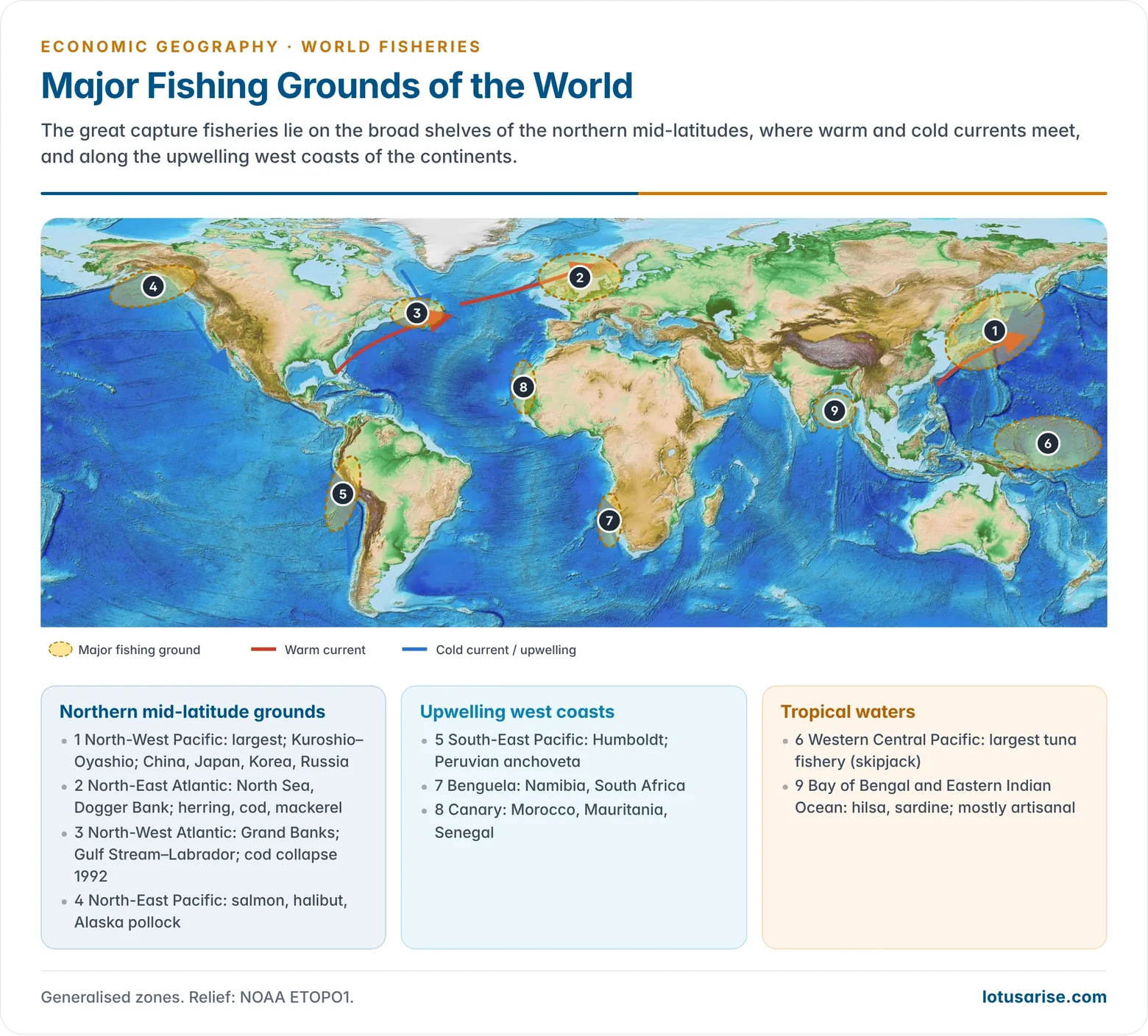
- Broad continental shelves:
- shallow waters (up to about 200 m) receive sunlight to the bottom, so plankton, the base of the food chain, flourish;
- fish breed and feed here, and nets reach them easily;
- banks (shallow raised parts of the shelf) such as the Grand Banks of Newfoundland, Georges Bank and Dogger Bank are especially rich.
- Meeting of warm and cold ocean currents: mixing brings nutrients and plankton to the surface and attracts fish. Examples:
- the Gulf Stream and the Labrador Current off Newfoundland;
- the Kuroshio and the Oyashio off Japan.
- Upwelling: cold, nutrient-rich water rises along the western coasts of continents, mainly in the tropics and subtropics. The main upwelling currents are:
- the Humboldt (Peru) current;
- the California current;
- the Canary current;
- the Benguela current.
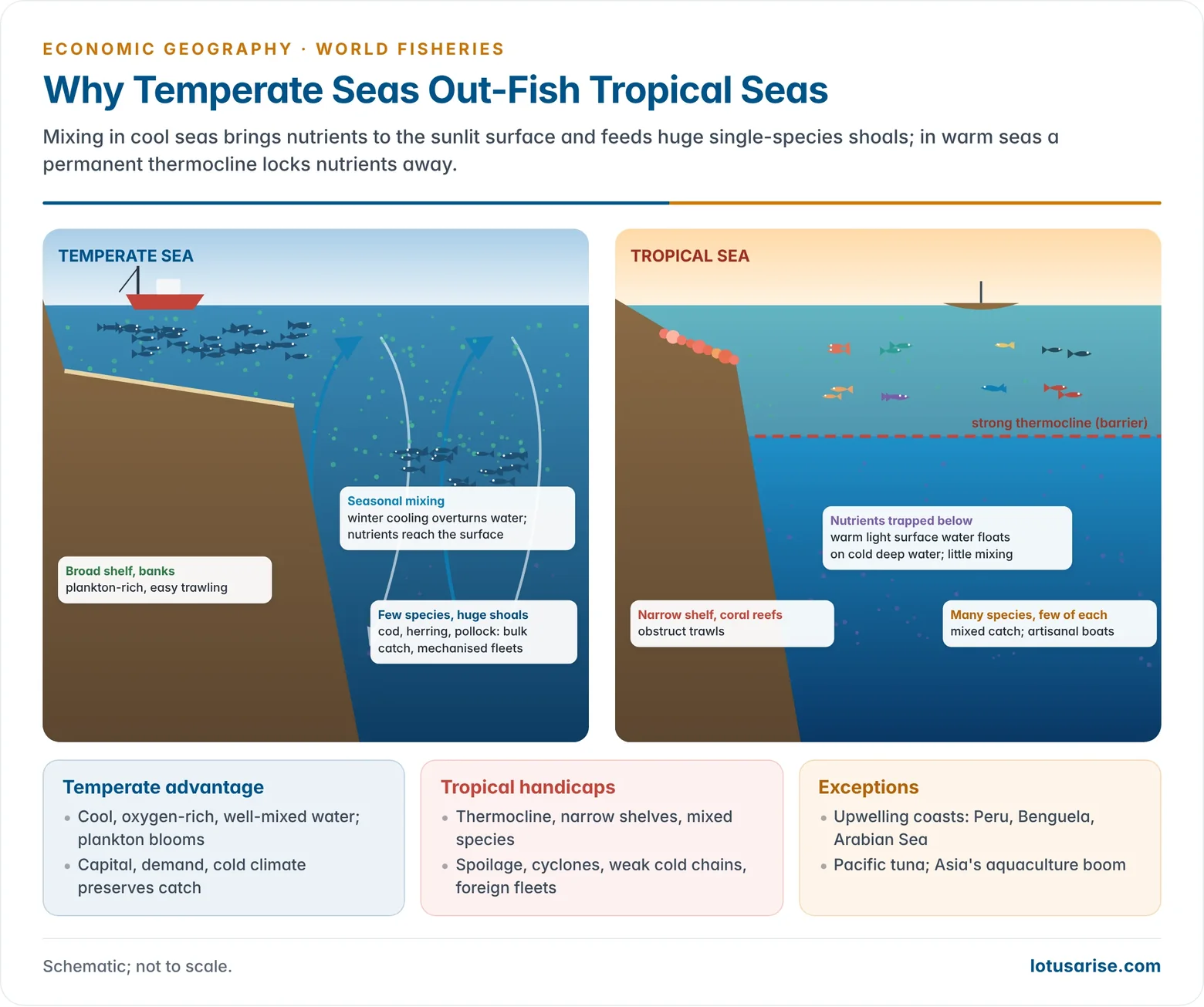
- Cool temperate waters: cold water holds more dissolved oxygen and supports dense plankton. Fish of a few species gather in huge shoals, which suits commercial fishing.
- Indented coastlines: fjords, bays and estuaries give sheltered harbours, as in Norway, Japan, Newfoundland and the British Isles.
- Cool climate: low temperatures help preserve fish. Historically, coniferous forests supplied timber for boats.
- Little farmland: mountainous or glaciated lands with poor soils, such as Norway, Iceland, Japan and Newfoundland, pushed people towards the sea.
Economic and Human Factors
- Demand: large, dense populations with a fish-eating tradition, as in Japan, China, Korea, Norway and coastal India.
- Capital and technology: trawlers, factory ships, sonar and satellite fish-finding, refrigeration and freezing.
- Infrastructure: fishing harbours, cold chains, processing plants and fast transport to urban markets.
- Skilled labour and tradition, research, and government support through credit, subsidies and harbours.
Major Fishing Grounds of the World
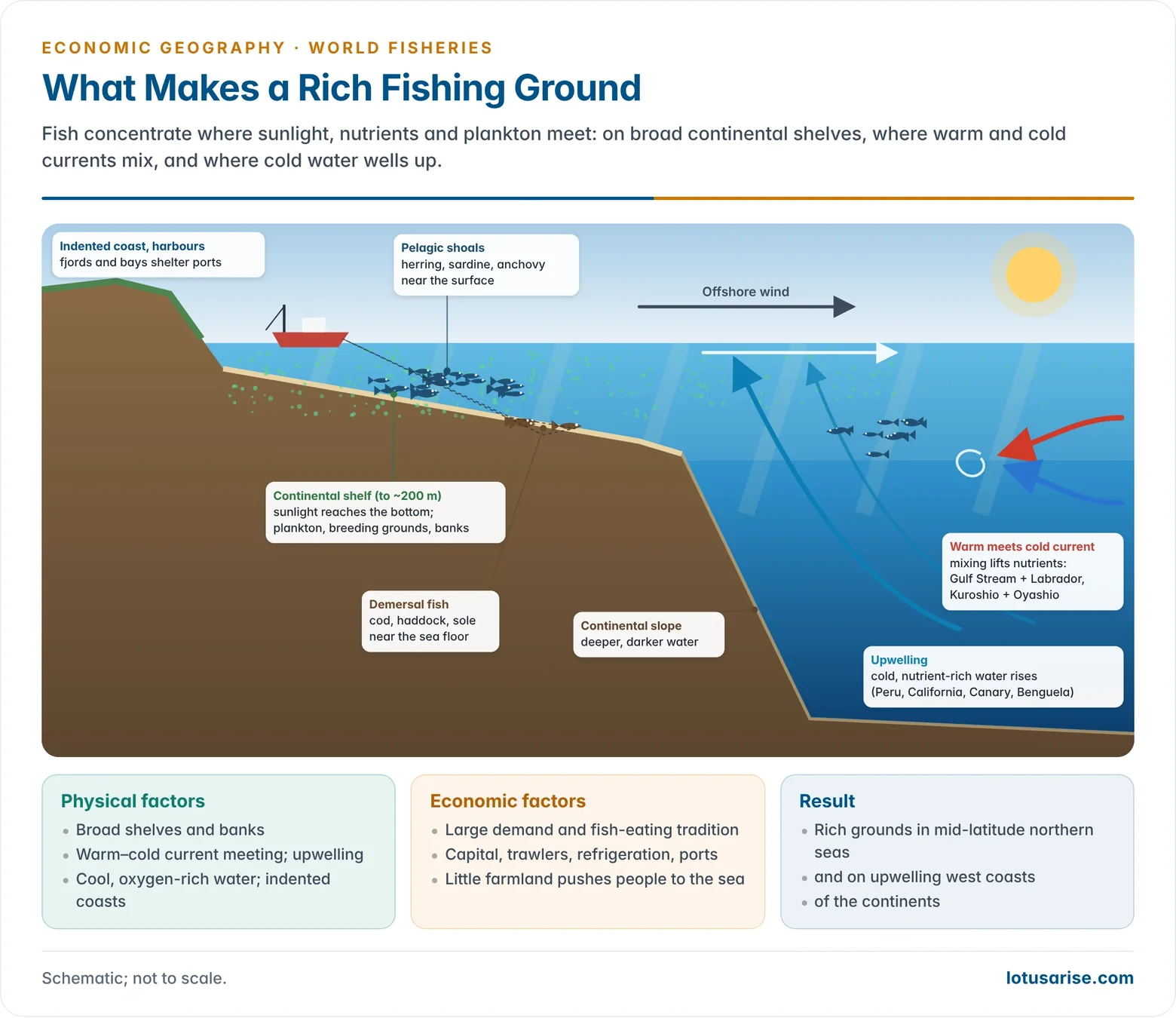
- North-West Pacific: the largest fishing ground in the world, off China, Japan, Korea and the Russian Far East.
- Wide shelves, the Kuroshio–Oyashio convergence and huge demand support it.
- Catches include sardine, mackerel, saury, squid, pollock and salmon. China is the world’s largest producer of both capture and farmed fish.
- North-East Atlantic: from the Bay of Biscay to the Barents Sea, including the North Sea and Dogger Bank.
- The North Atlantic Drift keeps ports ice-free.
- Herring, mackerel, cod and haddock are taken by Norway, Iceland, Russia, the UK, Denmark and others.
- North-West Atlantic: the Grand Banks of Newfoundland and Georges Bank, where the Labrador Current meets the Gulf Stream.
- Once the richest cod fishery, it collapsed from overfishing, and Canada imposed a cod moratorium in 1992.
- North-East Pacific: from California to Alaska and the Bering Sea, with salmon, halibut and Alaska pollock. It is one of the best-managed regions: over 90% of its assessed stocks are sustainable.
- South-East Pacific (Peru–Chile): the Humboldt Current upwelling supports the anchoveta, the world’s largest single-species fishery, used mostly for fishmeal and fish oil.
- It is highly sensitive to El Niño, which cuts off upwelling. The fishery collapsed in 1972–73.
- Other important grounds:
- the Western Central Pacific, the world’s largest tuna fishery (skipjack);
- the Eastern Indian Ocean and Bay of Bengal;
- the Benguela upwelling off Namibia and South Africa;
- the Canary upwelling off Morocco, Mauritania and Senegal;
- the Southern Ocean (Antarctic krill and toothfish).
- Indian Ocean: its fisheries are smaller but growing.
- The south-west monsoon drives seasonal upwelling off Somalia, Oman and the Kerala coast, which supports the oil sardine and mackerel fisheries of India’s west coast.
- Tuna fleets from Europe and Asia work the western Indian Ocean.
- The Bay of Bengal supports hilsa, which is shared by India, Bangladesh and Myanmar.
Why Tropical Fishing Grounds Are Less Developed
- Tropical seas hold great biodiversity, but their commercial capture fisheries are poorer than those of temperate seas, outside the upwelling zones.
Physical Reasons
- Nutrient-poor surface water: warm water forms a strong, permanent thermocline, which blocks the mixing of deep nutrients into the sunlit layer. Plankton are scarce, so the open tropical ocean is a biological desert.
- Less dissolved oxygen in warm water.
- Narrow continental shelves along many tropical coasts, such as East Africa, the Gulf of Guinea and India’s east coast, reduce breeding and feeding grounds.
- Many species, few of each: tropical fish rarely form large single-species shoals. Mixed catches of many species suit artisanal fishing, not mechanised bulk fishing and processing.
- Coral reefs and mangroves: these fragile habitats obstruct trawl nets and are damaged by them.
- Rapid spoilage of fish in heat and humidity.
- Tropical cyclones and monsoon storms limit the fishing season.
Economic and Social Reasons
- Artisanal fishing with small country craft, low capital and little mechanisation.
- Weak infrastructure: few fishing harbours, ice plants, cold chains and processing units, and poor transport to distant markets.
- Lower demand for preserved and processed fish in many tropical societies, where cereals and pulses dominate diets.
- Foreign fleets and illegal fishing: distant-water fleets and illegal, unreported and unregulated (IUU) fishing take much of the catch off West Africa and in the Indian Ocean. Local communities gain little.
- Limited research and weak management institutions.
| Feature | Temperate grounds | Tropical grounds |
|---|---|---|
| Plankton | Abundant (mixing, cool water) | Scarce except at upwellings |
| Continental shelf | Broad, with banks | Often narrow |
| Species pattern | Few species, huge shoals | Many species, small numbers |
| Fishing type | Commercial, mechanised | Artisanal, subsistence |
| Preservation | Cold climate helps | Rapid spoilage |
| Infrastructure and capital | Well developed | Poor |
| Examples | North Sea, Grand Banks, Japan | East African coast, Bay of Bengal |
- The picture is changing:
- Upwelling coasts (Peru, Benguela, the Arabian Sea’s south-west monsoon upwelling) are highly productive.
- The tuna fisheries of the Western Central Pacific are tropical.
- Tropical Asia now leads world aquaculture: Indonesia, India, Viet Nam and Bangladesh.
Aquaculture, Problems and Management
Aquaculture and the Shifting Geography of Fish Production
- Asia produces about 89% of farmed aquatic animals.
- China, Indonesia, India, Viet Nam and Bangladesh together account for about four-fifths of output, and 47 countries now farm more than they catch.
- Main farmed products:
- carps in China and India;
- shrimp in India, Viet Nam, Ecuador and Indonesia;
- tilapia and pangasius catfish;
- Atlantic salmon in Norway and Chile;
- seaweeds in China, Indonesia and Korea.
- Advantages: it supplies fish while wild stocks stagnate, provides rural incomes and can use ponds, reservoirs and coastal waters.
- Problems:
- conversion of mangroves into shrimp ponds;
- disease outbreaks and heavy use of antibiotics;
- water pollution;
- dependence on fishmeal from wild-caught fish;
- escaped farmed fish mixing with wild stocks.
Problems of World Fisheries
- Overfishing, the most serious of the threats facing the oceans:
- 37.6% of assessed marine stocks were overfished in 2023, up from about 10% in 1974;
- the share fished sustainably fell to 62.4%;
- weighted by catch volume, about 73% of landings come from sustainable stocks.
- Tragedy of the commons: Garrett Hardin (1968) described how open-access resources are over-used when each user gains from taking more. Fish in international waters are a classic case.
- Destructive methods: bottom trawling of the seabed, dynamite and cyanide fishing on reefs, and bycatch of dolphins, turtles and sharks.
- IUU fishing and harmful subsidies, which keep excess fleets at sea.
- Pollution: oil spills, plastics, sewage and nutrient run-off create dead zones.
- Climate change:
- ocean warming pushes fish towards the poles and to deeper water;
- ocean acidification harms shellfish and corals;
- marine heatwaves and coral bleaching reduce reef fisheries.
- El Niño events collapse upwelling fisheries off Peru and Chile.
- Conflicts over fishing grounds: the Cod Wars between Iceland and the UK (1958–76), the India–Sri Lanka dispute over trawling in the Palk Bay, and rival claims in the South China Sea.
Conservation and Management
- Exclusive Economic Zones (EEZ) of 200 nautical miles under UNCLOS (1982) gave coastal states control over about 90% of the world’s fish catch.
- Quotas and catch limits: total allowable catch (TAC), individual transferable quotas (Iceland, New Zealand), minimum mesh sizes and closed seasons.
- India bans fishing during the monsoon breeding season: 61 days on each coast.
- Regional Fisheries Management Organisations such as the Indian Ocean Tuna Commission (IOTC) manage shared and migratory stocks.
- Marine Protected Areas: the “30 by 30” target of the Kunming–Montreal Global Biodiversity Framework (2022) aims to protect 30% of oceans by 2030.
- New global rules:
- the WTO Agreement on Fisheries Subsidies came into force on 15 September 2025, curbing subsidies for IUU fishing and for overfished stocks;
- the High Seas Treaty (BBNJ Agreement) came into force in January 2026, enabling protected areas beyond national waters.
- Certification and traceability: eco-labels, catch documentation and satellite tracking of vessels.
- Blue economy: sustainable use of ocean resources for growth, livelihoods and ecosystem health, as in FAO’s Blue Transformation roadmap.
Fisheries in India
- India is the world’s second-largest producer of aquatic animals, with about 9% of world output. It ranks first in inland capture fisheries and second in aquaculture.
- Production rose from 141.6 lakh tonnes in 2019–20 to a record 197.75 lakh tonnes in 2024–25. About three-quarters now comes from inland fisheries and aquaculture.
- Resource base:
- a coastline of 11,098 km (as remeasured in 2024);
- an EEZ of over 2 million km²;
- large rivers, reservoirs, tanks and brackish lagoons such as Chilika and Pulicat.
- Leading states:
- Andhra Pradesh leads, mainly through freshwater aquaculture and shrimp;
- West Bengal leads in inland fish seed and carp;
- Gujarat, Kerala and Tamil Nadu lead in marine catch.
- Exports: frozen shrimp is the largest export item, going mainly to the USA, China, the EU and Japan.
- Policies:
- the Blue Revolution scheme (2015);
- the Pradhan Mantri Matsya Sampada Yojana (PMMSY, 2020), with an outlay of ₹20,050 crore;
- the Fisheries and Aquaculture Infrastructure Development Fund;
- Kisan Credit Cards for fishers;
- deep-sea fishing support and fishing harbours.
- Problems:
- overfishing of the inshore zone by mechanised trawlers;
- weak cold chains;
- pollution of rivers and coasts;
- conflicts in the Palk Bay;
- diseases in shrimp farms;
- mangrove loss;
- vulnerability of small fishers to cyclones and climate change.