

Reason, Revelation and Faith.
Official Syllabus: Paper II, Section B, Unit 5
Every religion makes claims that go beyond ordinary experience — that God exists, that the soul survives death, that mokṣa or salvation is possible. How can anyone know such things? Philosophy of religion names three main sources: reason (thinking things out for ourselves), revelation (truth disclosed by God or by an authorless scripture) and faith (trust and commitment beyond proof) — with religious experience (Unit 06) as a fourth. This article takes up the first: what religious knowledge is, whether it is really knowledge or only belief, the four functions of reason in religion, how far natural theology can go, where reason meets its limits (Hume, Kant, Śaṅkara), what it means to call reason a regulative force, and whether a religion of reason alone would miss the experience at the heart of religion.
In simple words
Think of a lawyer handed a will. She can check whether the signature is genuine, explain what an unclear clause means, point out where two clauses contradict each other, and tell the family which reading is most reasonable. But she cannot write the will — its content comes from the person who made it. Reason does the same work in religion: it tests, explains, interprets and defends religious beliefs, but the content of those beliefs mostly comes from revelation, experience and faith.
Context & Problem
What Is Religious Knowledge?
- Religious knowledge is knowledge about supernatural or transcendental realities — God, soul, heaven, karma, mokṣa, nirvāṇa — and about the spiritual aims of life (nirvāṇa, kaivalya, salvation).
- The standard test of knowledge: a claim counts as knowledge only if it is certain, distinct, indubitable (beyond reasonable doubt) and verifiable (open to public checking).
- The problem: the subject matter of religion is transcendental — beyond sense experience and beyond ordinary reasoning. So, judged by the philosopher’s test, religious “knowledge” fails every criterion. It is more accurate to call it religious belief.
- The believer’s side: for a religious person there is no doubt at all. God’s reality is clear, distinct and indubitable to him, and it is accepted on faith, which is for him the guarantee of truth.
- Main sources of religious knowledge: revelation (scripture, prophecy), mysticism and religious experience, miracles, reason, faith, and the authority of tradition, guru or church.
Characteristics of Religious Knowledge
- Related to transcendental reality — God — or to a spiritual ideal — nirvāṇa, kaivalya.
- Reaffirms faith — it strengthens the believer’s trust in God rather than satisfying curiosity.
- Verification is not demanded — the believer does not wait for an experiment.
- Always regarded as true — within the religion, its teachings are not held as “probable”.
Is Religious Knowledge Objective or Subjective?
- A.J. Ayer’s test: knowledge is justified true belief, where “justified” means backed by experiment and observation — hence objective and universal.
- Why religious knowledge looks subjective:
- It rests on revelation and mystical experience, not on public observation.
- Its statements are not universal — they hold for believers of a tradition.
- Its object is beyond space and time, while objectivity is tied to space and time.
- Religions hold different and often conflicting doctrines, which suggests subjectivity.
- Kierkegaard himself calls belief in God a subjective truth — truth lived with passion, not proved.
- The other side: within a religion, the faithful treat their beliefs as absolute and objective. Since religion is about God as the Absolute Reality, believers say religious knowledge must be objective too — even more objective than science, which changes.
In simple words
A child is completely certain that her mother loves her — more certain than of anything in her schoolbook. Yet she cannot prove it in a laboratory, and a stranger may doubt it. Religious “knowledge” is like that: certain from inside the relationship, unproven from outside it. That gap between inside certainty and outside proof is exactly where reason, revelation and faith meet.
Is Religious Knowledge Formal or Factual?
- Formal (analytic) knowledge is necessary because it depends only on the meaning of words: “All red roses are red“. Religious statements are not like this — “God loves the world” is not true merely by the meaning of words; it claims something about reality.
- Factual (empirical) knowledge rests on experiment and observation and is therefore always probable — theories change. But believers never hold religious truths as merely probable.
- Result: religious knowledge is neither formal nor factual in the usual sense. It forms a class of its own — which is exactly why its relation to reason is a problem.
| Religious knowledge | Scientific knowledge |
|---|---|
| About transcendental entities and ideals | About empirical events |
| Based on faith, revelation, mystical experience | Based on experiment and observation |
| Generally considered subjective | Objective |
| Being subjective, it is individual | Being objective, it is universal |
| An accepted belief | A justified belief |
| Reason plays a secondary role | Reason plays the primary role |
The Religious a priori — Why Humans Believe at All
- Many religious thinkers speak of a religious a priori: something in the very structure of human nature that turns a person “heavenward” — an inborn predisposition to the spiritual quest. This spiritual urge gives rise to religious belief.
- Versions of the idea:
- Schleiermacher — the feeling of absolute dependence on something infinite.
- Rudolf Otto — the sense of the holy or numinous is a category of the mind that cannot be reduced to reason or morality.
- Calvin — a sense of the divine (sensus divinitatis) planted in every person (Article 6).
- Indian thought — the longing for mokṣa and the restlessness of the soul in saṃsāra (mumukṣutva, the desire for liberation).
- Why it matters here: if belief springs from this deep urge, then reason does not create religion — it meets a religious life already under way and tries to guide it.
- Two kinds of religious belief: belief-in (trust in a person — “I believe in God”) and belief-that (acceptance of a proposition — “I believe that God exists”). Reason deals mainly with belief-that; faith lives mainly in belief-in (Article 4).
What Is Reason?
- Reason is the human capacity to make sense of things consciously — to apply logic, draw inferences, analyse concepts, weigh evidence, and adapt or justify practices, institutions and beliefs in the light of new or existing information. It is distinct from feeling and emotion.
- Its forms: deduction (from general to particular), induction (from many cases to a general rule), conceptual analysis (clarifying what words mean), critical evaluation (testing for consistency and evidence).
- Indian terms: anumāna (inference, a pramāṇa), tarka (hypothetical or critical reasoning — in Nyāya the “suppose not” argument that supports a pramāṇa; in Vedānta, discursive argument in general), yukti (reasoned argument) and manana (reflective thinking on what scripture teaches).
- The function of reason in human life is to control and guide the conative trends — our drives, desires and choices. Religion, too, is a whole-person tendency that drives a person in search of his ideal self; reason’s job is to help him become well grounded in the kind of deity or ideal he worships.
Theoretical and Practical Reason
- A long debate: is reason purely theoretical (aimed at knowing) or practical (aimed at acting)?
- Plato, Aristotle, Whitehead treat reason as mainly theoretical — contemplation of truth.
- Coleridge and Jaspers treat it as practical — bound up with how we live.
- Kant takes a middle course: there is pure (theoretical) reason and practical reason.
- Theoretical reason seeks only to satisfy intellectual curiosity — it is speculative and has no interested purpose. Practical reason is tied to the fulfilment of purposes — its aim is not intellectual satisfaction but the realisation of actual ends of life.
- Kant’s pure reason has two functions:
- A cognitive function — it establishes judgements of knowledge about the world of experience.
- A regulative function — it goes beyond the categories and forms Ideas (soul, world, God). These Ideas are not objects of knowledge; they only guide thought.
- Kant’s practical reason is concerned with the question “What ought I to do?” It discovers the postulates on which moral action rests — freedom, immortality of the soul and God — and these are objects of faith, not knowledge.
Core Doctrine
The Four Functions of Reason in Religion
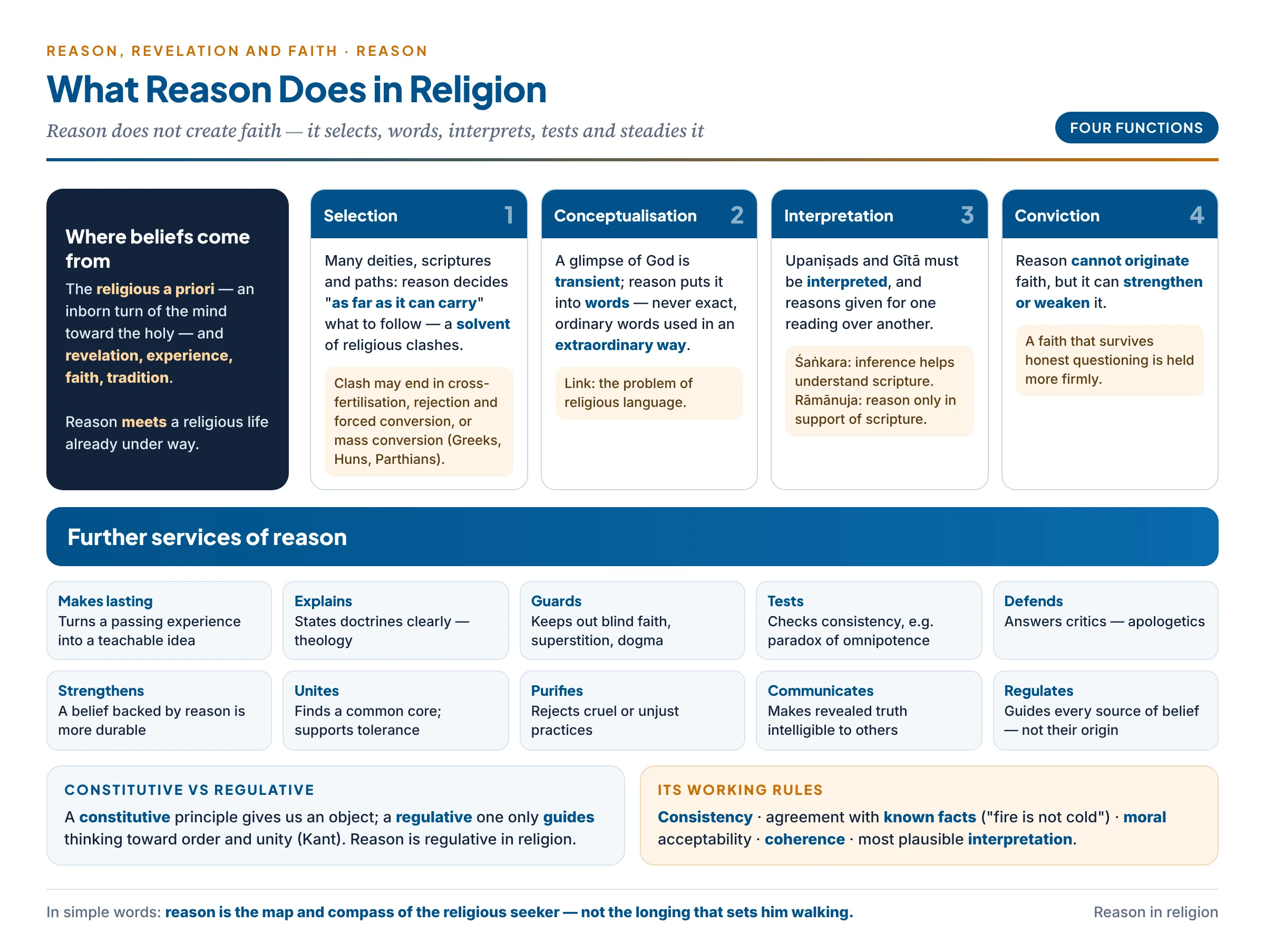
Reason can and does play definite roles in religious life. Four are classic:
- Selection — there are many deities, scriptures and paths; a person must use reason “as far as it can carry him” to decide what to follow. Reason thus acts as a solvent of many religious issues. The clash of religions it must sort out can end in three ways:
- Cross-fertilisation of ideas about beliefs and practices — each tradition learns from the other.
- Rejection of other deities — which may lead to forced conversion.
- Wholesale mass conversion — as in ancient India, where many foreigners such as the Greeks, Huns and Parthians were absorbed into Hinduism.
- Conceptualisation — religious experience, the contact with God, is transient: a momentary glimpse. To be kept and shared, it must be put into words. Because the experience is extraordinary, words can never be exact; ordinary words are used in an extraordinary way (the problem of religious language, Unit 10).
- Interpretation of scripture — the Upaniṣads and the Gītā come down to us as holy scriptures, but their statements must be interpreted, and reasons must be given for one interpretation over another.
- Śaṅkara: Brahman, being formless, is not an object of perception or inference; yet inference must be used as a means of understanding scripture.
- Rāmānuja: Brahman is supersensuous and cannot rest on arguments alone; scripture is authoritative, and reason is to be applied only in support of scripture.
- Conviction in faith — reason by itself cannot originate faith, but it can strengthen or weaken it. A believer who finds that his faith survives honest questioning holds it more firmly; one who finds it contradicted by facts may lose it.
In simple words
A mountaineer does not get his love of the mountains from a map — the longing comes first. But the map and compass decide which route he takes, warn him of a cliff, help him describe the climb to others, and steady him when the mist comes down. Reason is that map and compass for the religious seeker.
Further Services of Reason
- Makes experience lasting — a religious experience is temporary; an idea of it, formed by reason, makes it permanent and teachable.
- Explains religion — doctrines must be stated clearly and their connections shown (theology is “faith expressed in reasoned form”).
- Keeps out blind faith and presumption — reason guards against superstition and dogmatism.
- Strengthens belief — by nature we rely on reason; a belief backed by one’s own reason becomes more durable.
- Supports universal religion and tolerance — reason finds the common core in different faiths and makes dialogue possible.
- Tests consistency — reason checks whether doctrines contradict each other (for example, the paradox of omnipotence, PoR Unit 01).
- Defends the faith — answers objections of critics (apologetics).
- Purifies religion morally — reason, with conscience, rejects practices that are cruel or unjust.
- Communicates revealed truth to others — a message must be made intelligible.
Natural Theology: How Far Can Unaided Reason Go?
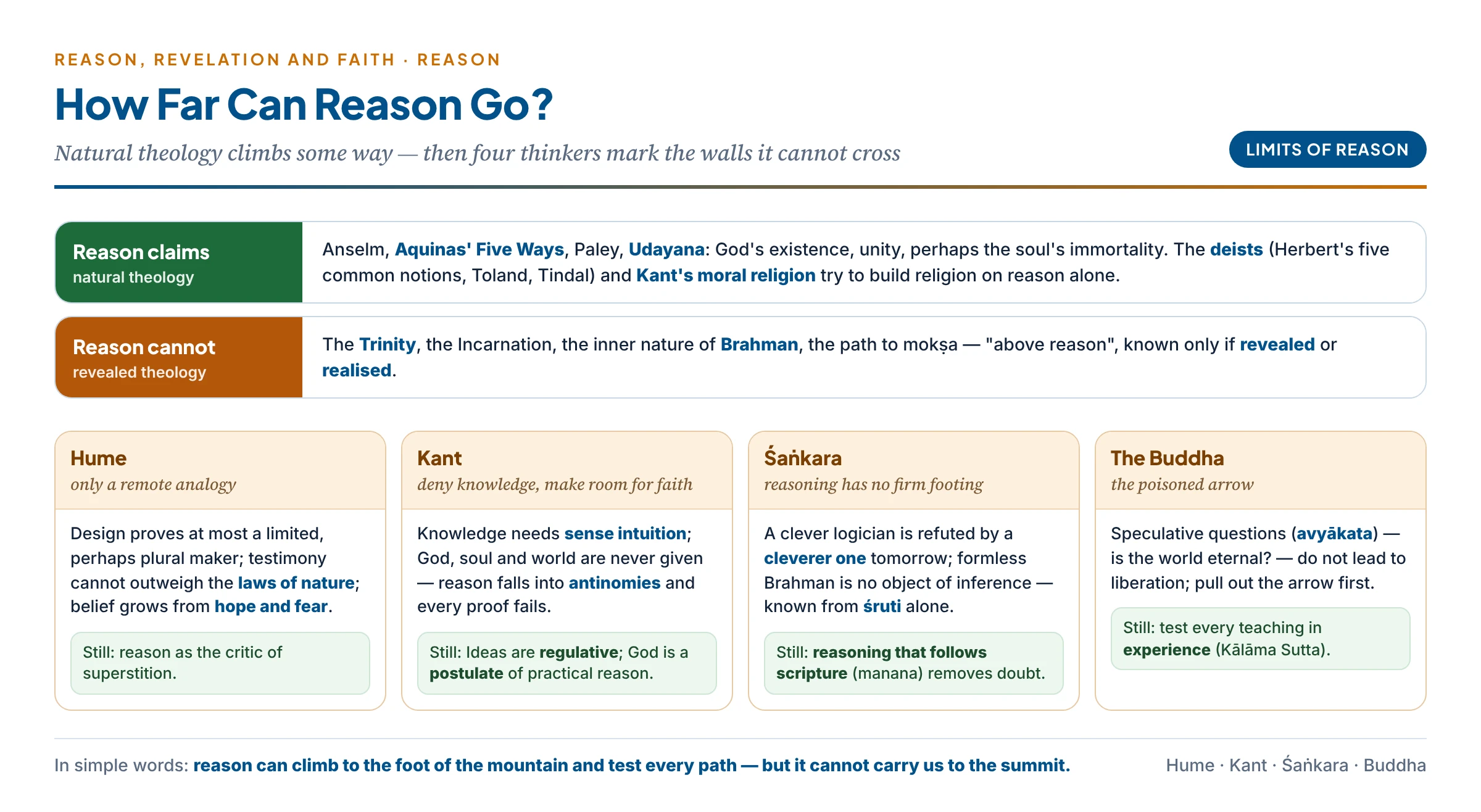
- Natural theology is the attempt to establish the existence, nature and attributes of God — and sometimes the immortality of the soul — by unaided human reason, without appeal to any special revelation.
- Classic examples: Anselm’s ontological argument, Aquinas’ Five Ways, the design argument of Paley, Kant’s moral argument, and in India Udayana’s proofs for Īśvara (PoR Unit 02).
- Its opposite is revealed theology — truths known only because God has revealed them, such as the Trinity (Article 2).
- Aquinas’ position: reason can demonstrate that God exists and is one; these truths form the preambles of faith (praeambula fidei). Mysteries like the Trinity are above reason, though never against it (Article 5).
- The religion of reason (Deism): in the 17th–18th centuries some thinkers tried to build religion on reason alone.
- Herbert of Cherbury (De Veritate, 1624) found five common notions that every rational person accepts: there is a supreme God; he ought to be worshipped; virtue and piety are the chief part of worship; wrongdoing must be repented; there is reward and punishment after this life.
- John Toland, Christianity Not Mysterious (1696) — nothing in true religion is contrary to or above reason.
- Matthew Tindal, Christianity as Old as the Creation (1730) — the gospel only republishes the religion of nature that reason already knows.
- Kant’s rational religion: in Religion within the Boundaries of Mere Reason (1793) Kant defines religion as “the recognition of all our duties as divine commands“. The pure moral religion of reason is the true core; historical faiths with scriptures and churches are only its vehicle.
- Hegel: religion and philosophy have the same content — the Absolute — but religion grasps it in images and stories (Vorstellung), philosophy in concepts (Begriff). Reason does not abolish religion; it completes it.
The Limits of Reason
Reason’s claims in religion have met powerful objections — many from within philosophy itself.
- Hume’s limit — reason cannot reach a God worth worshipping:
- In the Dialogues concerning Natural Religion, the design argument proves at most a remote analogy — perhaps a committee of gods, an infant or a senile deity, certainly not the infinite, perfectly good God of religion.
- In “Of Miracles“, testimony to a miracle can never outweigh the uniform experience that supports the laws of nature (Article 3).
- In The Natural History of Religion, belief is traced not to reasoning but to hope and fear.
- Kant’s limit — theoretical reason is bound to experience:
- Knowledge needs both concepts and sense intuition; God, soul and the world-as-a-whole are never given in experience.
- When reason tries to know them, it falls into antinomies (equally strong arguments on both sides), paralogisms and the illusions of the Ideal — and all three classical proofs of God fail (P-I Unit 04).
- Yet the Ideas keep a regulative use, and God returns as a postulate of practical reason. Kant’s famous verdict: “I had to deny knowledge in order to make room for faith.“
- Śaṅkara’s limit — reasoning is “without a firm footing” (tarkāpratiṣṭhāna):
- Arguments built by one clever logician are demolished by a cleverer one tomorrow; reasoners disagree endlessly, so reasoning alone can settle nothing about what lies beyond the senses.
- Brahman has no form, colour or mark, so it cannot be an object of perception or inference. It is known from scripture alone (śāstra-yonitvāt — “because scripture is its source”).
- Reason is not thrown away: reasoning that follows scripture (śruty-anugṛhīta tarka) is welcome (Article 7).
- Rāmānuja’s limit: inference cannot prove that the world was made by one all-knowing creator — it might have many makers, as a palace has many builders. God is known through scripture only.
- The Buddha’s limit: he refused to answer speculative questions (avyākata — whether the world is eternal, whether the Tathāgata exists after death) because they do not lead to liberation — like a man shot with a poisoned arrow who will not let it be removed until he knows who shot it.
- Pascal’s limit: the finite cannot comprehend the infinite. “The heart has its reasons which reason does not know.“
- Wittgenstein’s limit: religious belief is not a hypothesis weighed on evidence; it is a way of life. Treating it as an empirical theory misunderstands it (Article 6).
Common confusion
Does “reason in religion” simply mean proving that God exists? No. Proving God (natural theology) is only one task of reason, and the most disputed one. Even thinkers who deny that reason can prove God — Kant, Śaṅkara, Rāmānuja, Pascal — give reason other indispensable jobs: selecting among faiths, conceptualising experience, interpreting scripture, testing consistency and guarding against superstition. A religion can reject natural theology and still be deeply reasonable.
Reason as a Regulative Force
- The distinction comes from Kant:
- A constitutive principle produces knowledge of an object.
- A regulative principle does not give us an object; it guides and unifies our thinking. Kant’s Ideas of reason work like a “focus” point that no ray actually reaches but toward which all the rays are directed — they push inquiry toward the greatest unity and order. We study nature as if it were the work of a wise designer, without claiming to know that it is.
- Applied to religion: reason does not originate religious beliefs — they come from revelation, experience, faith and tradition. But reason regulates all of them. In the words of one classic formulation, reason remains “at most merely a regulative force in all possible sources of religious belief” — mystical experience, revelation and faith are each responsible for beliefs, and reason remains a helpful guide in every one.
- How reason regulates — its working rules:
- Consistency: a belief that contradicts itself cannot be accepted (God cannot both create and not create the same thing).
- Agreement with established knowledge: a reading of scripture that contradicts plain perception must be reinterpreted — Śaṅkara: “even a hundred scriptural texts cannot make fire cold“.
- Moral acceptability: a doctrine that commands cruelty is suspect. Gandhi: “I reject any religious doctrine that does not appeal to reason and is in conflict with morality.“
- Coherence: beliefs should fit together into a system (theology, darśana).
- Interpretation: where scripture is vague, reason chooses the most plausible meaning.
- Indian examples of regulation: Raja Ram Mohan Roy used both reason and the Upaniṣads to campaign against satī and idol worship; Dayananda Saraswati reasoned against image worship and caste by birth in the name of the Vedas; Sir Syed Ahmad Khan held that God’s word (the Qur’ān) and God’s work (nature) cannot contradict each other.
- Limits of the regulative role:
- Reason can rule out what is inconsistent or immoral, but it often cannot decide between several faiths that are each consistent.
- A religion ruled only by reason tends to become cold and abstract (the deist’s distant God, PoR Unit 01).
- Reason itself must be humble about its range — Kant’s whole point.
In simple words
A referee does not score the goals — the players do. But without a referee who checks fouls, offside and the rules, the game turns into a brawl. Reason is the referee of religious life: the goals (devotion, insight, experience) come from elsewhere, but reason keeps the game fair and sane.
Can Religion Be a Matter of Reason Alone?
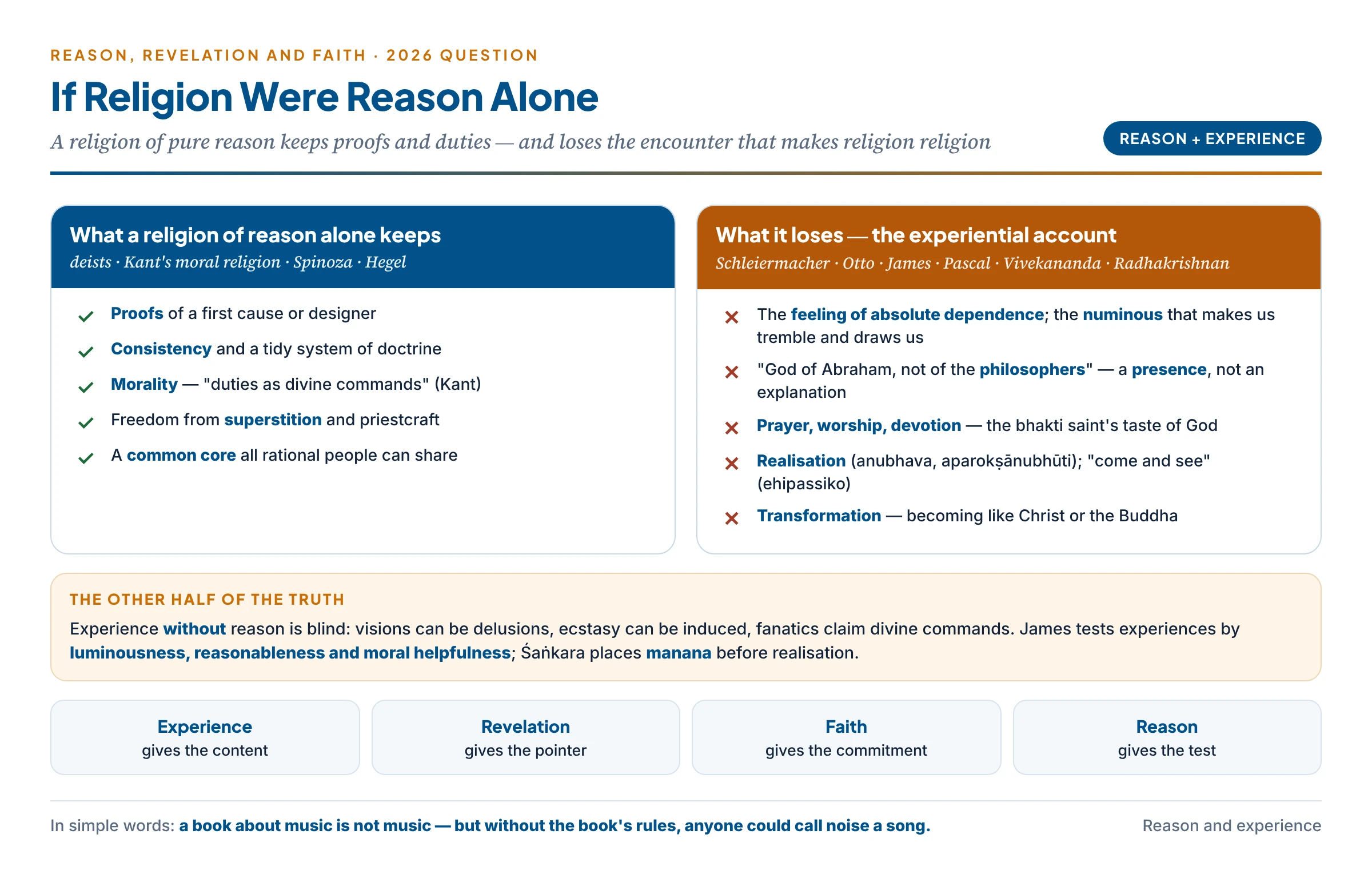
The 2026 paper asked whether a religion of reason alone would lack an experiential account. The answer requires seeing what religion is at its root.
- Attempts at a religion of reason alone: the deists (Herbert, Toland, Tindal), Kant’s moral religion, Spinoza’s “intellectual love of God”, Hegel’s philosophy of religion. All keep religion’s content but derive it from reasoning.
- Why such a religion lacks an experiential account:
- Religion begins in experience, not argument. Schleiermacher: religion is neither a way of thinking (metaphysics) nor of acting (morals), but of feeling — the sense of absolute dependence. Otto: its root is the numinous, the mysterium tremendum et fascinans — a mystery that makes us tremble and yet draws us. William James: personal religion — “the feelings, acts and experiences of individual men in their solitude” — is more fundamental than theology or church.
- The God of experience differs from the God of argument. Pascal, after a night of overwhelming experience (1654), wrote: “God of Abraham, God of Isaac, God of Jacob — not of the philosophers and scholars.” A God reached by proof is an explanation; a God met in experience is a presence.
- Reason works only on material it is given. As Kant said of knowledge in general, “thoughts without content are empty”. Reason can analyse a religious experience; it cannot produce one, as a book on music cannot produce the experience of hearing a raga.
- Worship, prayer and devotion disappear. In Kant’s religion of duty, prayer as asking and worship as service are close to superstition; the deist’s God needs no devotion. But for the believer these are the heart of religion.
- Indian traditions place experience at the summit. Advaita: knowledge must culminate in direct realisation (aparokṣānubhūti); Vivekananda: “religion is realisation“, not talk or theory; Radhakrishnan: religion is “an insight into reality“, rooted in experience (anubhava), not a creed; Buddhism: the Dharma is ehipassiko — “come and see“; the bhakti saints sing of tasting God, not of proving him.
- Transformation is experiential. Religion aims at becoming — the Christian wants to become like Christ, the Buddhist like the Buddha. A conclusion of reason informs; an experience transforms.
- But the statement is only half the truth:
- Experience without reason is blind — visions can be delusions, ecstasy can be induced by drugs or illness, and fanatics claim experiences that command violence.
- Experience itself needs reason to be understood: James tested religious experiences by “immediate luminousness, philosophical reasonableness and moral helpfulness“; Śaṅkara insists that realisation be prepared by manana (reflection).
- Reason guards the community — against impostors, against cruelty done “in God’s name”, and against confusing a passing emotion with truth.
- Verdict: a religion of reason alone would indeed lack the experiential account — the encounter, the awe, the love and the transformation that make religion religion rather than metaphysics or ethics. Equally, a religion of experience alone would lack a critical account. Mature religion holds both: experience gives the content; reason gives the test.
Indian Connect — Indian Connect — reason inside a path of experience
- Advaita’s threefold discipline: śravaṇa (hearing scripture) → manana (reasoned reflection that removes doubt) → nididhyāsana (deep meditation) → anubhava (realisation). Reason has a fixed place in the middle — never the start, never the end.
- Nyāya gives reason (anumāna) the strongest role in India — it builds proofs for Īśvara — yet even Nyāya treats the Veda as valid testimony (śabda).
- The Buddha’s Kālāma Sutta advises not to accept a teaching merely because of tradition, scripture or logic, but to test it in one’s own experience — a striking union of critical reason and experience (Article 7).
Critical Evaluation
Objections to Giving Reason a Large Role
- From faith (fideism):
- Tertullian: “What has Athens to do with Jerusalem?” — philosophy only breeds heresy.
- Luther called reason, when it sets itself up as judge of God’s word, “the devil’s whore“.
- Al-Ghazālī in The Incoherence of the Philosophers (1095) argued that the philosophers’ proofs about God and the world are not demonstrations at all.
- Kierkegaard: a God proved like a theorem leaves no room for faith (Article 6).
- From scepticism and positivism: reason, used strictly, does not support religion but undermines it — Hume’s critiques; Ayer: “God exists” is neither verifiable nor analytic, hence meaningless.
- From psychology and sociology: Freud (The Future of an Illusion, 1927) — religion is wish-fulfilment, a longing for a protecting father; Marx — religion is “the opium of the people“. On this view reason’s real task is to explain religion away.
- From pluralism: reason cannot settle which of many religions is true — each is consistent within itself.
Replies
- To the fideist: rejecting reason leaves faith defenceless against superstition and makes it impossible to tell true prophets from false. Even Tertullian argued — with great logical skill.
- To the positivist: the verification principle is itself unverifiable; and religious language may have non-factual meaning (Unit 10).
- To Freud: that a belief satisfies a wish does not prove it false — a thirsty man’s wish for water does not show that water does not exist.
- To the pluralist objection: reason cannot decide everything, but it can narrow the field — ruling out the immoral, the contradictory and the plainly false.
Critics and Defenders
Criticism — Against reason’s authority in religion
- Tertullian, Luther, al-Ghazālī: reason is proud and breeds heresy.
- Kierkegaard: proof destroys the risk that faith requires.
- Hume and Ayer: strict reason supports unbelief, not belief.
- Freud and Marx: reason explains religion away as wish or ideology.
- Pascal: the heart knows God; reason does not.
- Pluralists: reason cannot choose among consistent faiths.
Defence — For reason’s place in religion
- Aquinas: reason proves the preambles and shows mysteries are not absurd.
- Locke: reason must be our last judge and guide in everything.
- Kant: reason purifies religion into morality and keeps God as a postulate.
- Śaṅkara: reasoning that follows scripture removes doubt.
- Gandhi: doctrines against reason and morality must be rejected.
- James: even experience is tested by reasonableness and fruits.
Cross-Tradition Comparison
| Thinker / School | Can reason reach God? | Role of reason | Final authority |
|---|---|---|---|
| Aquinas | Yes — existence and unity of God | Proves preambles; defends mysteries | Revelation, with reason |
| Locke | Yes — God’s existence | Judges whether a revelation is genuine | Reason |
| Hume | No — only a remote analogy | Criticises proofs and miracles | Experience |
| Kant | Not theoretically; yes as a postulate | Purifies religion; regulates | Practical reason |
| Kierkegaard | No | None in faith itself | Passionate faith |
| Nyāya | Yes — Udayana’s proofs | Builds proofs; defends Veda | Pramāṇas incl. śabda |
| Mīmāṃsā | No God needed | Interprets Vedic injunctions | Authorless Veda |
| Śaṅkara | No — Brahman beyond inference | Reflection (manana) on śruti | Śruti, sealed by anubhava |
| Rāmānuja | No — inference fails | Supports scripture | Scripture and bhakti |
| Buddha | Not a question to pursue | Test teachings in experience | Own realisation |
Indian Connect — Indian Connect — no war between reason and religion
- India had no long war between reason and faith of the kind Europe saw, because most darśanas treated philosophy as ānvīkṣikī — reasoned inquiry in the service of liberation. Reason was a path (sādhana), not a rival to the goal.
- Yet India also had the sharpest rationalist critic of religion in the Cārvāka, who rejected inference beyond perception and the authority of the Veda altogether (Article 7).
Synthesis (Siddhānta)
- Religious knowledge fails the strict test of public, verifiable knowledge; it is better described as religious belief — certain for the believer, uncertain for the philosopher. It is neither formal nor merely factual.
- Religion does not start from reason. It springs from a religious a priori — a deep human orientation toward the holy — and from experience, revelation and faith.
- Reason’s functions are nonetheless real and many: selection, conceptualisation, interpretation, conviction, and further services of testing, explaining, defending, purifying and communicating.
- Natural theology can go some way, but Hume, Kant, Śaṅkara, Rāmānuja and the Buddha show its limits: unaided reason does not reach the living God or Brahman.
- Reason is best seen as a regulative force — it does not create religious beliefs, but guides and checks all of them by the rules of consistency, agreement with known facts, moral acceptability and coherence.
- A religion of reason alone would lack the experiential account — encounter, awe, worship and transformation — while a religion of experience alone would lack a critical account. The balanced view: experience gives the content, revelation the pointer, faith the commitment, and reason the test.
- Contemporary relevance: in plural, scientific societies reason is the common language in which different faiths can talk to each other and to secular citizens — and the safeguard against fanaticism, superstition and religious violence.
“I reject any religious doctrine that does not appeal to reason and is in conflict with morality.” — Mahatma Gandhi
Previous Year Questions
- 2026“If religion were a subject of reason alone, it would have lacked an experiential account.” Do you agree with this statement? Give reasons in support of your answer.
- 2024Discuss the role of reason in religion.
- 2021Discuss the role of reason and faith in religion. Can reason be a regulative force in the formulation of religious beliefs? Explain.
- 2002Point out the relative importance of reason and revelation in religion. Are the two compatible? Discuss.