

Soul: Immortality; Rebirth and Liberation.
Official Syllabus: Paper II, Section B, Unit 4
If liberation is the highest goal (Article 7), how is it reached — by knowledge, by selfless action, by devotion, by meditation, or only by the grace of God? And what is liberation’s relation to the other ideas of this unit: is immortality really the “absence of karma and rebirth“? Are rebirth and liberation analogous? Is a robust idea of liberation possible without belief in immortality and rebirth? This article covers the three paths of the Gītā (jñāna, karma, bhakti), the evaluation of bhakti, the place of divine grace (with the famous monkey and cat schools), theological and non-theological ideas of liberation, religion and salvation, and the answers of modern Indian thinkers — Vivekananda, Aurobindo, Gandhi, Tagore and Ambedkar.
In simple words
Several people climb the same mountain by different routes. One studies maps and reasons out the shortest way (knowledge); one works steadily, step after step, without worrying about the summit (selfless action); one walks singing out of love for the friend waiting at the top (devotion). And some say no one reaches the top unless a helping hand reaches down from above (grace). The Indian traditions argue about which route is best — but most agree the summit is the same: freedom.
Context & Problem
The Question of Means
- Every school agrees that bondage is due to ignorance and desire; they differ on what removes them:
- Knowledge (jñāna) — if bondage is ignorance, only knowledge can end it (Advaita, Sāṃkhya, Nyāya).
- Action (karma) — duty done without desire exhausts old karma and binds no new (Mīmāṃsā; the Gītā’s karma-yoga).
- Devotion (bhakti) — loving surrender to God, who grants release (Rāmānuja, Madhva, the bhakti saints).
- Meditation (dhyāna, yoga) — stilling the mind (Yoga, Buddhism, Jainism).
- Grace (prasāda, anugraha) — liberation as God’s gift, not a human achievement.
- Behind this lies a deeper question: is liberation a human achievement or a divine gift?
Liberation and the Other Ideas of the Unit
- Immortality: in India, true immortality is freedom from rebirth, not endless life (Article 4).
- Rebirth: the cycle from which liberation frees us (Articles 5–6).
- So we must ask whether liberation depends on belief in an immortal self and in rebirth — or can stand on its own.
Core Doctrine
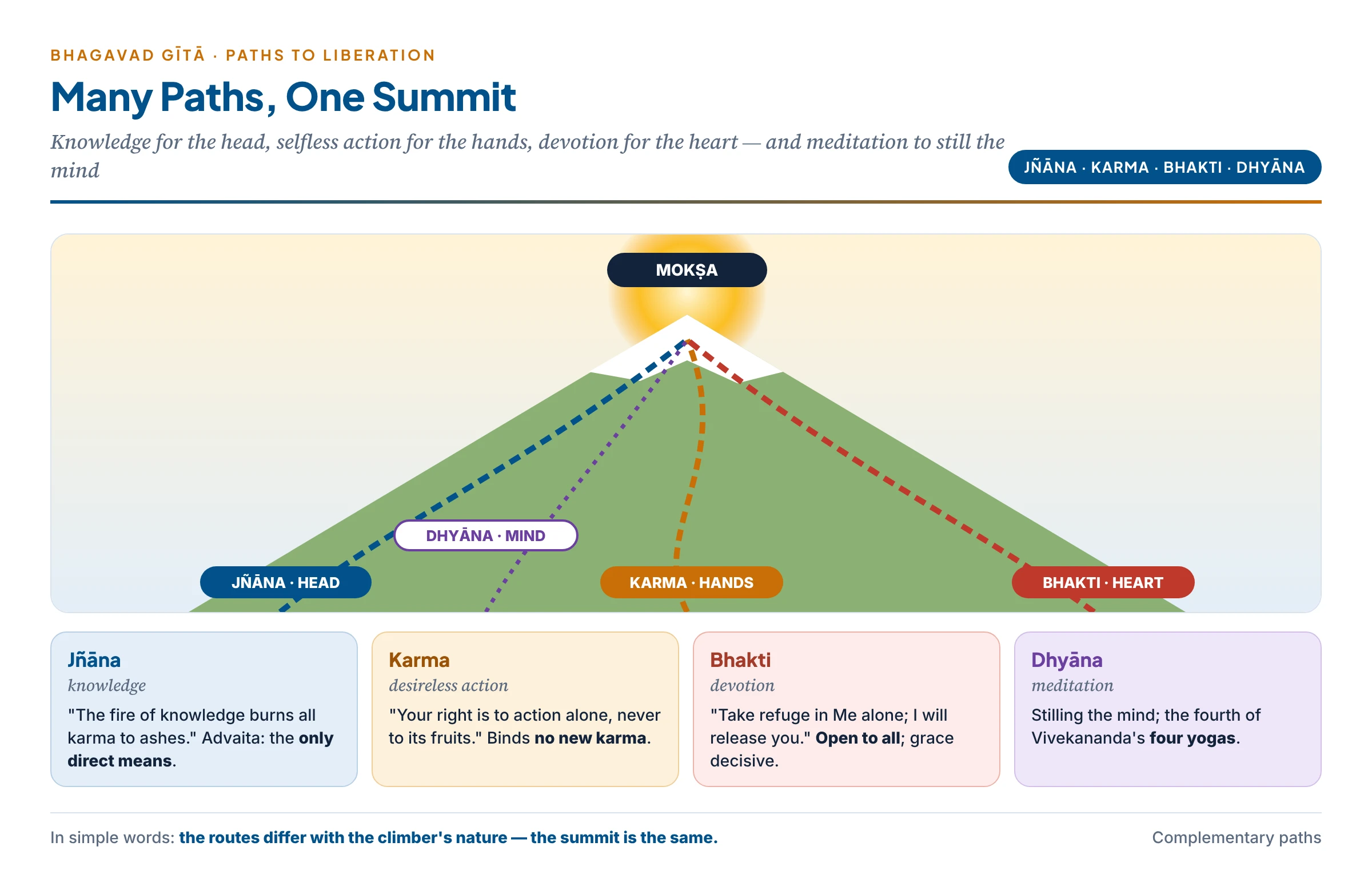
The Three Paths of the Bhagavad Gītā
1. The path of knowledge (jñāna-mārga)
- What it is: discrimination between the self and the not-self, the eternal and the perishable, leading to realisation of the self.
- The Gītā: “As a blazing fire reduces fuel to ashes, so the fire of knowledge reduces all karma to ashes“; “there is no purifier in this world equal to knowledge“.
- Suited to: the reflective, detached temperament.
- Advaita makes it the only direct means to liberation.
2. The path of action (karma-mārga)
- What it is: doing one’s duty (svadharma) without attachment to its fruits — desireless action (niṣkāma karma), offered as a sacrifice (yajña) to God.
- The Gītā: “Your right is to action alone, never to its fruits; let not the fruit be your motive, nor let your attachment be to inaction”; “yoga is skill in action“.
- Why it liberates: action done without desire binds no new karma and purifies the mind; it is done for the welfare of the world (lokasaṅgraha), as King Janaka attained perfection through action.
- The path of disinterested action: not inaction (impossible — “no one can remain without action even for a moment”) but action freed from ego and greed. Tilak read the Gītā as above all a gospel of energetic action (karma-yoga); Gandhi called it the gospel of non-attachment (anāsakti yoga).
3. The path of devotion (bhakti-mārga)
- What it is: supreme love of God, expressed as constant remembrance, worship, service and surrender.
- Nine forms of devotion (Bhāgavata Purāṇa): hearing of God, singing his praise, remembering him, serving his feet, worship, salutation, servanthood, friendship, and complete self-offering.
- The Gītā: “Fix your mind on Me, be devoted to Me, sacrifice to Me, bow down to Me; you will come to Me“; and at the end: “Abandoning all duties, take refuge in Me alone; I will release you from all sins — do not grieve.“
- Open to all: the Gītā says even those of “low birth“, women and labourers reach the highest goal through devotion — a radically inclusive path.
- Two levels: lower devotion (aparā, ritual worship with expectations) and supreme devotion (parā, love for its own sake); devotion to God with attributes (saguṇa — Tulsīdās, Mīrā, Sūrdās) and without attributes (nirguṇa — Kabīr, Nānak).
A fourth path — meditation (dhyāna / rāja-yoga)
- The Gītā’s sixth chapter describes the meditating yogi; Vivekananda later spoke of four yogas — jñāna, karma, bhakti and rāja.
How Are the Paths Related?
- Advaita (Śaṅkara): knowledge alone liberates; action and devotion are preparatory — they purify the mind and make it fit for knowledge.
- Viśiṣṭādvaita (Rāmānuja): devotion is the culmination; action leads to knowledge, knowledge ripens into devotion, and devotion (with surrender) wins God’s grace.
- Mīmāṃsā: action — duty without desire — is the means.
- The Gītā’s synthesis: the three are complementary — knowledge for the head, action for the hands, devotion for the heart. True knowledge expresses itself in selfless action and love; true devotion includes understanding and service; true action is offered to God and done with wisdom.
- Aurobindo: an integral yoga that unites all three — “all life is yoga“.
Are knowledge, action and devotion the means in the whole Indian tradition?
- Broadly yes: every school combines some form of knowing, acting rightly and faith or devotion — even the non-theistic ones. The Jaina three jewels (right faith, right knowledge, right conduct) and the Buddhist Eightfold Path (wisdom, morality, concentration) mirror the same triad.
- With qualifications:
- The schools weight them differently — knowledge (Advaita, Sāṃkhya, Nyāya), action (Mīmāṃsā), devotion (theistic Vedānta).
- Meditation and moral discipline are distinct means (Yoga, Buddhism, Jainism).
- Grace is, for the theistic schools, not a human means at all but God’s gift.
- Buddhism and Jainism reject devotion to a creator, though they have faith in the teacher and the teaching.
In simple words
Think of a lamp: it needs oil, a wick and a flame. Knowledge is the flame that gives light; action is the wick that keeps the light steady and useful; devotion is the oil that keeps it burning. Take away any one and the lamp fails. The Gītā’s genius is to refuse to choose between them — it asks for the whole lamp.
Bhakti as a Pathway to Liberation — An Evaluation
Merits
- Accessible to all — no need for learning, rituals or austerity; open to every caste, gender and class.
- Engages the whole person — the emotions, not only the intellect; it turns desire into love of God.
- Ethical transformation — humility, compassion, freedom from ego (“I am the servant”).
- Social power — the bhakti movement (Āḻvārs, Nāyanārs, Basava, Kabīr, Mīrā, Tukārām, Caitanya) challenged caste and ritualism and created a spiritual equality.
- Grace and hope — the devotee need not rely on his own weak efforts.
Criticisms
- Advaita: bhakti presupposes duality (devotee and God) and so belongs to the level of appearance; it is a means to knowledge, not the final truth.
- Buddhists and Jainas: liberation must be won by one’s own effort; dependence on a God is unnecessary.
- Risk of emotionalism, blind faith and sectarianism; devotion can decay into ritual and superstition.
- Problem of evil and arbitrariness: if liberation depends on God’s choice, why does he choose some and not others?
- Social passivity: surrender may be misread as acceptance of injustice.
Replies: the highest bhakti includes knowledge (Rāmānuja’s bhakti is itself a form of meditation) and service (Vivekananda, Gandhi); and the bhakti saints were among India’s boldest social reformers.
Grace — Why Is It Needed for Liberation?
Arguments for the necessity of grace
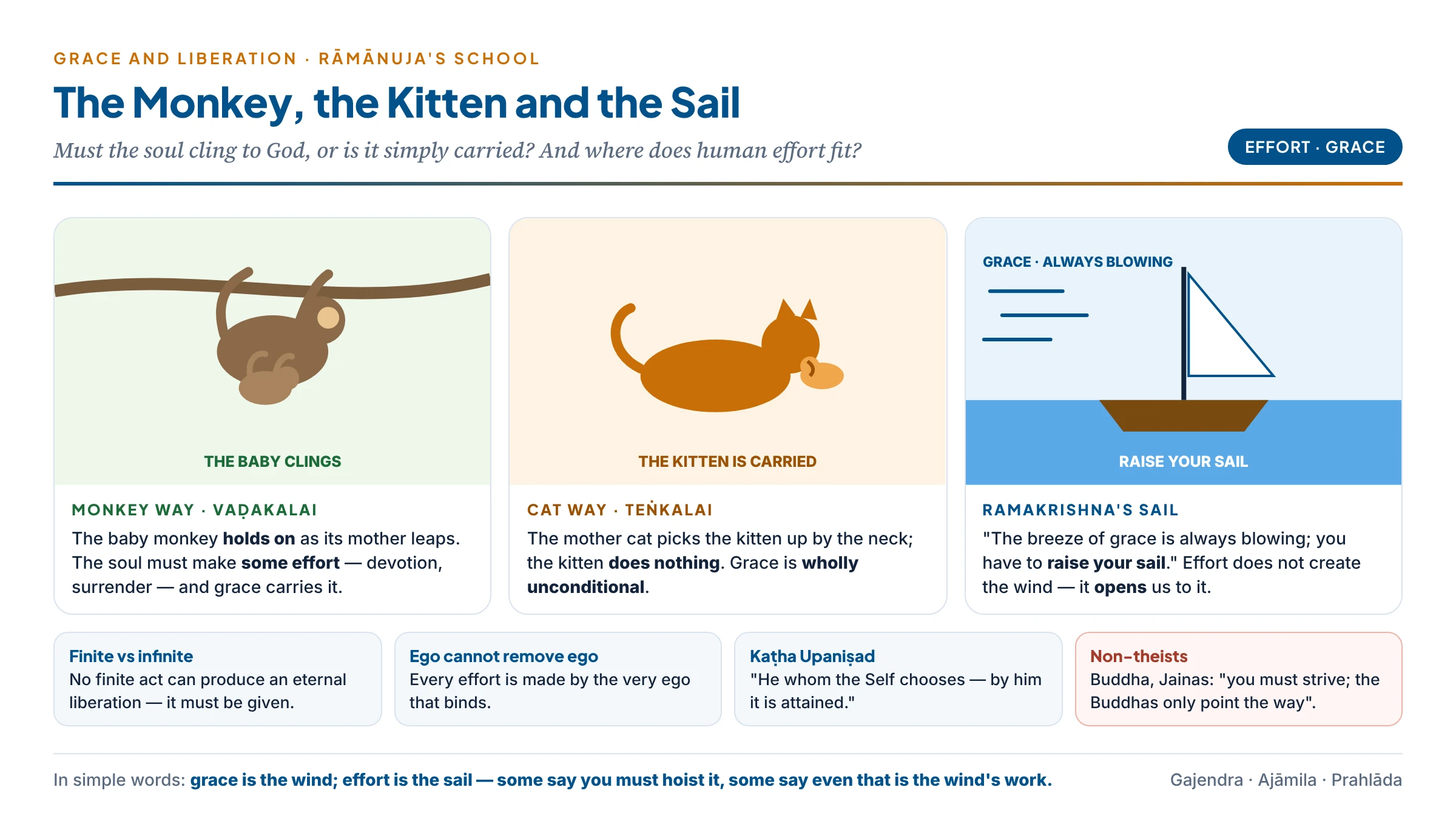
- Finite effort cannot produce an infinite result: liberation is eternal and infinite; no finite human act can cause it — it must be given.
- The ego cannot remove the ego: every effort to become free is made by the ego, which is itself the bondage; only a power beyond the ego can free it.
- God’s sovereignty: the soul is wholly dependent on God (Rāmānuja: God is the master, the soul his servant; Madhva: souls are dependent, God alone independent).
- Scripture: “This Self is not attained by instruction, nor by intellect, nor by much learning. He whom the Self chooses — by him it is attained” (Kaṭha Upaniṣad); the Gītā’s promise, “I will release you from all sins“.
- Experience of devotees: saints testify that liberation came unexpectedly, as a gift, when effort was exhausted.
Examples of grace
- Gajendra: the elephant king, seized by a crocodile, struggled with all his strength for a thousand years; only when he gave up his own strength and cried out to Viṣṇu with a lotus in his trunk was he rescued and freed — the classic image of liberation by grace.
- Prahlāda: protected by God’s grace against his father’s persecution because of his unwavering devotion.
- Ajāmila: a sinner who, at death, called the name “Nārāyaṇa” (his son’s name) and was saved — the power of the divine name.
- Christianity: “By grace you have been saved through faith; and this is not your own doing, it is the gift of God” (Paul). Augustine defended grace against Pelagius, who held that human beings can achieve righteousness by their own will; Luther taught salvation by grace alone.
- Islam: no one enters Paradise by his deeds alone, but by God’s mercy.
- Śaiva Siddhānta: grace (anugraha) is one of God’s five acts; the “descent of grace” (śaktipāta) comes when the soul is ripe.
The monkey and the cat — effort and grace in Rāmānuja’s school
- The northern school (Vaḍakalai) — “the way of the monkey” (markaṭa-nyāya): the baby monkey clings to its mother as she leaps; the soul must make some effort (devotion, surrender) and God’s grace carries it.
- The southern school (Teṅkalai) — “the way of the cat” (mārjāra-nyāya): the kitten does nothing; the mother picks it up by the neck. Grace is wholly unconditional; even surrender is God’s doing.
Common confusion
Does grace make human effort useless? Most theistic thinkers say no. Grace is not arbitrary favour; it answers readiness — devotion, surrender, purity. Ramakrishna put it simply: “The breeze of grace is always blowing; you have to raise your sail.” Even the “cat” school, which makes grace unconditional, expects the devotee to stop resisting it. The real disagreement is whether effort is a condition of grace or only a response to it.
Is Anything Other than Human Effort Conducive to Liberation?
- Divine grace — for the theistic schools, decisive (above).
- The grace of the teacher (guru-kṛpā) — the guru awakens knowledge; Advaita requires a teacher “learned in scripture and established in Brahman”.
- The company of the good (satsaṅga) — the saints’ presence transforms; the Bhāgavata praises even a moment’s company of the holy.
- The divine name — chanting the name (nāma-japa) as a power in itself (Caitanya, the Sant poets).
- The rare human birth and ripeness of karma — liberation needs a human birth, the right time and the maturity of past effort; one does not choose these.
- Prakṛti’s own purpose (Sāṃkhya): unconscious nature works for the release of puruṣa, “as unconscious milk flows for the nourishment of the calf” — a non-theistic “something other than human effort”.
- Non-theistic answer (Buddhism, Jainism): no — “you yourselves must strive; the Buddhas only point the way“; liberation is won by one’s own light.
- Balanced view: effort and grace are complementary — effort prepares the ground, grace (or nature, or the teacher) brings the fruit.
Theological and Non-Theological Approaches to Liberation
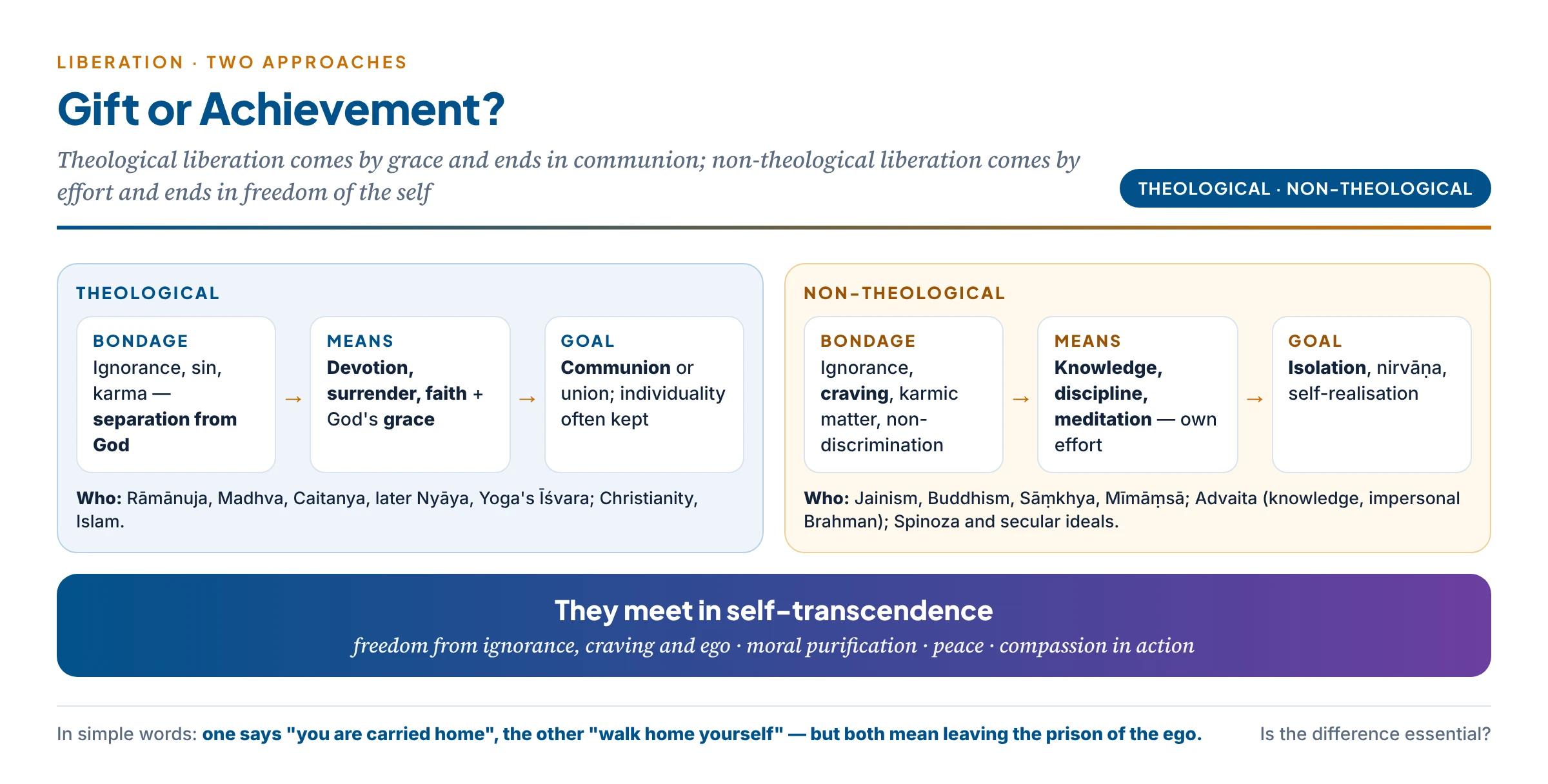
Theological approaches
- Who: theistic Vedānta (Rāmānuja, Madhva, Nimbārka, Vallabha, Caitanya), later Nyāya, Yoga (Īśvara as a special help), Christianity, Islam, Śaiva and Śākta schools.
- Features: God is the goal (union or communion) and the giver (grace) of liberation; liberation is often personal — the soul remains distinct, in loving relationship; devotion and surrender are central.
Non-theological approaches
- Who: Jainism, Buddhism, Sāṃkhya, Mīmāṃsā; in a sense Advaita (Brahman is not a personal God, and knowledge, not grace, liberates); modern secular ideas of liberation — Spinoza‘s freedom through understanding, Marx‘s emancipation from alienation, existentialist authenticity, psychological freedom.
- Features: liberation by one’s own effort — knowledge, discipline, meditation; the state is isolation, extinction of craving, or self-realisation; no grace, no worship of a creator.
Is there an essential difference?
| Point | Theological | Non-theological |
|---|---|---|
| Source of release | God’s grace (with or without effort) | Self-effort — knowledge, discipline |
| Final state | Union or communion with God | Isolation, extinction of craving, self-realisation |
| Individuality | Often retained (Rāmānuja, Madhva, Christianity) | Varies — retained (Jaina, Sāṃkhya), transcended (Buddhism, Advaita) |
| Central virtue | Love, surrender, faith | Wisdom, detachment, mindfulness |
| Exemplar | The saint or devotee | The arhat, kevalin, jīvanmukta |
- Points of convergence:
- Both seek freedom from suffering, ignorance and egoism.
- Both require moral purification and inner discipline.
- Their mystical experiences are strikingly similar (peace, unity, selflessness).
- Both produce lives of compassion and service.
- Verdict: the difference is real in metaphysics and means (gift vs achievement; relation vs aloneness), but not essential in the existential core — both are paths of self-transcendence, from a self-centred life to a life centred on what is ultimately real.
Religion and Salvation
- Salvation (Greek sōtēria, “safety, deliverance”): the ultimate deliverance offered by a religion.
- Christianity: salvation from sin and death through Christ, by grace and faith, leading to eternal life and the resurrection.
- Islam: salvation through submission to God, right belief and deeds, and above all God’s mercy at the Judgement.
- Judaism: salvation as God’s deliverance of his people within the covenant — more communal and historical.
- Indian religions: liberation from ignorance, karma and rebirth.
- The relation: for most religions, salvation is the heart of religion — religion is the way (mārga) to it. One philosopher of religion describes the great traditions as different ways of transforming human life from self-centredness to Reality-centredness.
- But not every religion is salvation-centred: Confucianism and much folk religion focus on right living, harmony and ancestors in this world.
- Salvation and liberation compared:
| Point | Salvation (Semitic) | Liberation (Indian) |
|---|---|---|
| From what | Sin and death | Ignorance, karma, rebirth |
| By what | Grace and faith (with works) | Knowledge, action, devotion — and grace in theistic schools |
| Number of lives | One | Many until release |
| Final state | Eternal life with God, resurrected body | Release — identity, isolation, nirvāṇa or communion |
| Exclusiveness | Often tied to one true faith | Usually many paths to one goal |
- Pluralism and salvation: exclusivists hold that salvation is found in one religion only; inclusivists that it is fully present in one but can be reached through others; pluralists that the great religions are equally valid paths — a debate taken up in the unit on religious pluralism.
“Immortality Means Absence of Karma and Rebirth”
- In Indian thought the statement is true: true immortality (amṛtatva) is not endless continuation — endless rebirth is “repeated death” (punarmṛtyu). The deathless is reached only when karma and rebirth cease:
- Upaniṣads: “When all desires dwelling in the heart are cast away, the mortal becomes immortal and attains Brahman here.“
- Buddhism: nirvāṇa is “the deathless” (amata) — the end of the cycle.
- Jainism: the liberated soul, free of all karma, is eternal at the top of the universe.
- The Nirvāṇist idea (Article 4): eternity is won within time when karma is exhausted.
- Qualifications:
- “Absence of karma” does not mean absence of action: the jīvanmukta acts, but his action, being desireless, binds no karma — “the burnt rope cannot bind”.
- In the Western sense, immortality is the endless survival of the person, which may include continued moral growth (Kant’s endless progress) — there, immortality does not mean the absence of action and change.
- The theistic schools add that liberated souls live eternally in loving service — an active immortality.
- Verdict: the statement captures the Indian idea of immortality as freedom from bondage, contrasted with the Western idea of endless personal existence.
Are Rebirth and Liberation Analogous?
Where they differ (largely opposite)
- Bondage vs freedom: rebirth is the continuation of bondage; liberation is its end.
- Cause: rebirth is caused by ignorance, desire and karma; liberation by knowledge, desirelessness, devotion and grace.
- Time: rebirth is in time, repeated without end; liberation is timeless, once and for all.
- Body: rebirth always brings a new body; final liberation is freedom from bodies.
- Value: rebirth is suffering (duḥkha); liberation is peace and bliss.
Where they are analogous
- Both are transitions of the self (or stream) from one state of being to another; liberation is sometimes called a “second birth” — birth into Brahman.
- Both are post-mortem destinies (rebirth, and final liberation at death — videhamukti).
- Both presuppose a continuing self or stream that passes through them.
- Both are governed by a moral-spiritual order — karma and knowledge.
- Rebirth is the opportunity for liberation: only in a (human) birth can liberation be won.
In simple words
A fever that keeps coming back every few weeks and the cure that ends it for good are both “about” the fever — but no one would call them the same kind of thing. Rebirth is the recurring fever of existence; liberation is the cure. They belong together, as illness and recovery, but they are opposites, not two versions of one idea.
Verdict: rebirth and liberation are related but not analogous — rebirth is the problem and liberation the solution; they belong together as disease and cure, not as two forms of the same thing.
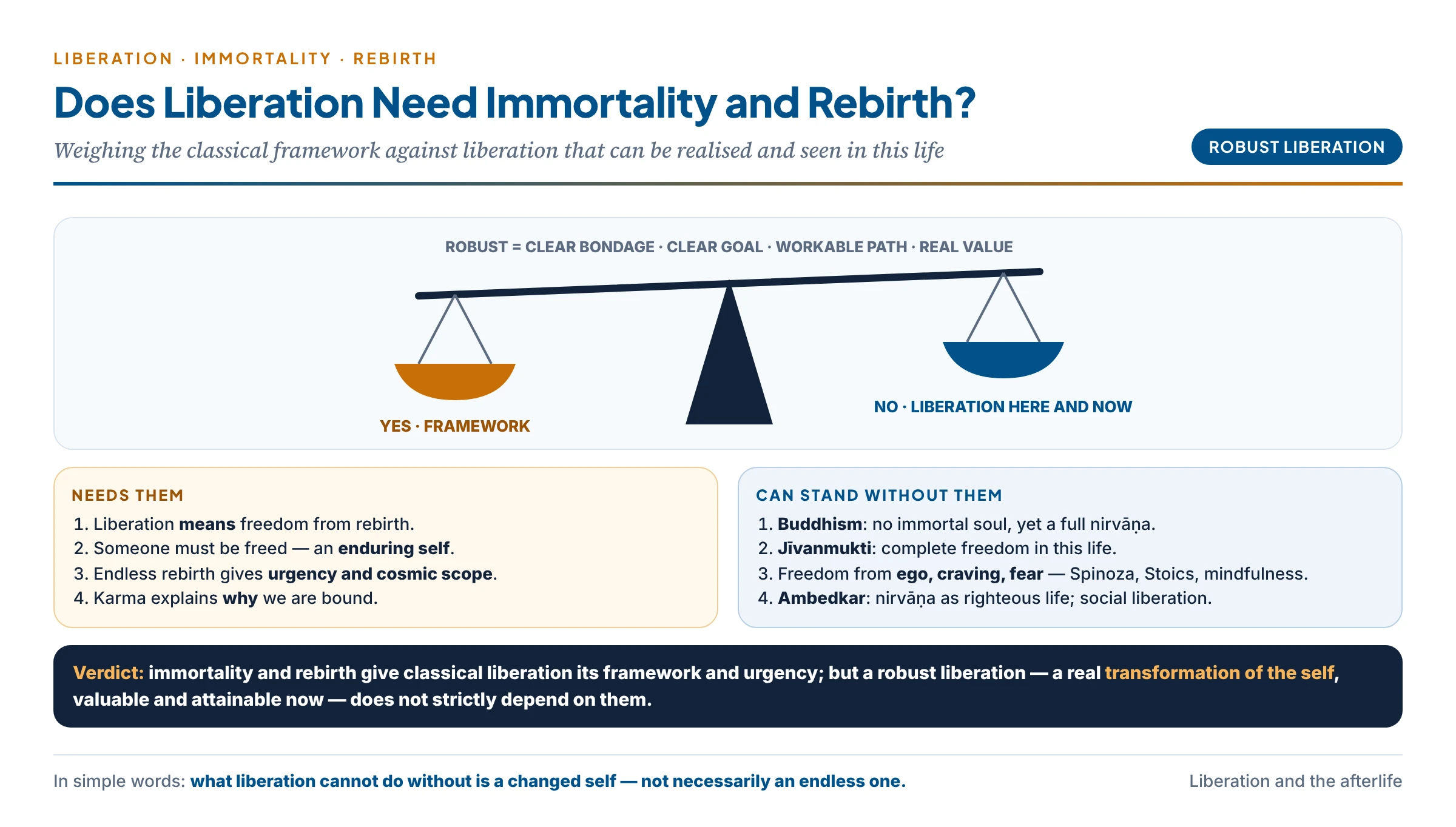
Must We Believe in Immortality and Rebirth to Have a Robust Idea of Liberation?
What makes an idea of liberation “robust”?
- A clear account of what binds us.
- A clear account of the liberated state.
- A path that can actually be followed.
- A value worth seeking.
The case for “yes”
- Definition: in the Indian systems liberation means freedom from rebirth — without rebirth, the core meaning disappears.
- A subject: liberation needs someone to be liberated, and an eternal subject to enjoy an eternal state — hence the immortal self.
- Urgency and scale: endless rebirth gives liberation its urgency (the suffering of countless lives) and its cosmic scope.
- Moral framework: karma and rebirth explain why we are bound and why discipline is needed.
The case for “no”
- Buddhism denies an immortal soul, yet has the most developed idea of nirvāṇa — robust by every standard.
- Jīvanmukti: if liberation can be fully attained in this life, its reality does not depend on what happens after death.
- Advaita itself does not promise the survival of the person; the ātman’s eternity is not personal immortality.
- Non-metaphysical liberations — freedom from ego, craving, fear and ignorance — are intelligible and attainable here and now: Spinoza‘s freedom, the Stoic sage, modern mindfulness, Krishnamurti‘s “freedom from the known”.
- Ambedkar’s Navayāna Buddhism reinterpreted rebirth (as the return of the body’s elements to nature, not of a soul) and nirvāṇa as a righteous, happy life in this world — liberation as personal and social freedom.
- Social liberation: Gandhi’s swaraj, the liberation theologies of Latin America, and Ambedkar’s struggle show liberation as freedom from oppression.
In simple words
A person who breaks free from a lifelong addiction to anger, greed or fear does not need to know what happens after death to know that something real has been gained — he is freer today. This is the strongest point for the “no” side: if liberation is freedom from craving and ego, its value can be felt and seen in this life, whatever one believes about the next.
Verdict
- Immortality and rebirth give the traditional idea of liberation its framework, urgency and cosmic meaning.
- But a robust idea of liberation — freedom from ignorance, craving and ego, attainable in this life and of supreme value — is possible without them, as Buddhism, jīvanmukti and modern reinterpretations show.
- What liberation cannot do without is a real transformation of the self — not necessarily its endless survival.
The Value of Mokṣa and the Unity of the Paths
- Supreme value: mokṣa is the highest goal (parama puruṣārtha) — intrinsically valuable, not a means to anything else; it gives meaning to dharma, artha and kāma, which are pursued in the light of it.
- Dharma leads to mokṣa: righteous living purifies; the liberated person goes beyond merit and demerit but lives righteously by nature.
- Individual and social value: the liberated person becomes a source of peace and moral authority — Vivekananda’s ideal: “for one’s own liberation and for the welfare of the world” (ātmano mokṣārthaṃ jagad-hitāya ca).
- Interrelationship of the paths: knowledge, action, devotion and meditation are stages and aspects of one journey, suited to different temperaments and meeting at the summit.
Modern Indian Views of Liberation
- Vivekananda: four yogas for four temperaments; Practical Vedānta — “serve man as God” (seeing Śiva in every being); liberation that does not turn away from the suffering world.
- Sri Aurobindo: liberation is not escape from the world but its transformation; through integral yoga the individual rises to the supermind and brings it down into life — a divine life on earth, and liberation not only individual but collective.
- Gandhi: “What I want to achieve … is self-realisation, to see God face to face, to attain mokṣa” — through truth, non-violence and service; politics itself as part of the spiritual path; the Gītā as the gospel of non-attachment.
- Tagore: “Deliverance is not for me in renunciation. I feel the embrace of freedom in a thousand bonds of delight.” — liberation in the world, through love and beauty.
- Radhakrishnan: the liberated soul continues to work for the liberation of all — universal liberation (sarvamukti).
- Ambedkar: nirvāṇa as righteous living in this world; liberation as freedom from caste and injustice.
Indian Connect — Indian Connect — from individual release to collective freedom
- Classical schools mostly speak of the individual’s release from rebirth.
- Modern thinkers widen the idea: Vivekananda (welfare of the world), Aurobindo (collective transformation), Gandhi (swaraj as self-rule of the individual and the nation), Ambedkar (liberation from caste), Radhakrishnan (no one is fully free until all are free).
- The Mahāyāna bodhisattva, who postpones his own nirvāṇa until all beings are freed, is the ancient model of this ideal.
Critical Evaluation
Assessing the Debates
- Knowledge vs devotion vs action: the Gītā’s synthesis is more convincing than any one-sided claim; temperaments differ, and each path, followed truly, includes the others.
- Grace vs effort: pure grace risks arbitrariness; pure effort risks spiritual pride (“I liberated myself”). The best accounts make them complementary.
- Theological vs non-theological: the metaphysics differs, the transformation of the person is strikingly similar.
- Immortality and rebirth: they frame the classical idea of liberation but are not strictly necessary for a robust one.
Critics and Defenders
Criticism — The critics
- Advaita (on bhakti): devotion assumes duality and belongs to the level of appearance.
- Buddhists and Jainas (on grace): dependence on God weakens self-reliance; “be a lamp unto yourselves”.
- Rationalist critics: grace makes liberation arbitrary — why some and not others?
- Social critics: other-worldly liberation may breed indifference to injustice.
- Sceptics: liberation defined by rebirth stands or falls with an unproved doctrine.
Defence — The defenders
- Gītā: knowledge, action and devotion are one lamp — flame, wick and oil.
- Rāmānuja and Madhva: grace answers surrender; finite effort cannot produce an infinite good.
- Ramakrishna: the breeze of grace is always blowing — raise your sail.
- Modern thinkers: liberation includes service, social justice and collective transformation.
- Buddhism and jīvanmukti: liberation is real and testable in this life, whatever happens after death.
Cross-Tradition Comparison
| Theme | Indian | Western |
|---|---|---|
| Grace vs effort | Monkey and cat schools; Kaṭha: “he whom the Self chooses” | Augustine vs Pelagius; Luther’s grace alone |
| Path of knowledge | Jñāna-yoga, Advaita | Plato‘s dialectic; Spinoza‘s intellectual love of God |
| Path of devotion | Bhakti saints | Christian mystics (Bernard, Teresa); Sufi love of God |
| Path of action | Niṣkāma karma | Kant‘s duty for duty’s sake; Stoic indifference to outcomes |
| Liberation in the world | Jīvanmukta, Aurobindo, Gandhi | Liberation theology; Marx’s emancipation |
| Immortality as quality | Amṛtatva = end of karma and rebirth | New Testament “eternal life” as present quality |
Synthesis (Siddhānta)
- Liberation is sought through knowledge, selfless action, devotion and meditation — the Gītā’s three paths (with rāja-yoga as a fourth) — which are best seen as complementary: head, hand and heart.
- Bhakti is the most accessible and socially transformative path, though Advaita treats it as preparatory and the non-theistic schools reject dependence on God.
- Grace is needed, say the theistic schools, because finite effort cannot produce an infinite good and the ego cannot remove itself; the monkey and cat schools differ on whether effort is a condition of grace. Other aids — the guru, the company of saints, the divine name, and even (for Sāṃkhya) prakṛti’s purpose — show that liberation is not only a human achievement.
- Theological and non-theological liberation differ in source and final state but converge in self-transcendence.
- In Indian thought, immortality means the absence of (binding) karma and rebirth; rebirth and liberation are related as disease and cure, not analogous.
- A robust idea of liberation does not strictly require belief in immortality and rebirth — Buddhism, jīvanmukti and modern reinterpretations show it — though these beliefs give the classical idea its framework and urgency.
- Contemporary relevance:
- Gandhi’s non-attachment and Vivekananda’s service ideal shape modern Indian public ethics.
- Mindfulness and yoga, now global, offer non-theological paths to inner freedom.
- Liberation is increasingly understood as social as well as spiritual — freedom from caste, poverty and oppression.
- Balanced view: whatever the metaphysics, liberation means a life free from ignorance, craving and ego — and, as the modern thinkers insist, a life given to the good of all.
“Deliverance is not for me in renunciation. I feel the embrace of freedom in a thousand bonds of delight.” — Rabindranath Tagore
Previous Year Questions
- 2024Is it necessary to adhere to the notions of immortality of soul and rebirth in order to have a robust conception of liberation? Give reasons and justifications for your answer.
- 2020Do you accept that knowledge, Action and Devotion are the means to attain liberation in Indian tradition? Discuss.
- 2018Evaluate the concept of Bhakti (Devotion) as a pathway to attain liberation.
- 2017Is there an essential difference between the concept of liberation in theological and non-theological approaches of life? Discuss.
- 2015“Immortality means absence of karma and rebirth.” Discuss.
- 2013Is there anything else other than human efforts which may be conducive to attainment of liberation?
- 2012Are rebirth and liberation analogous concepts? Explain.
- 2010Why is grace of God needed for liberation? Discuss with an example.
- 2004Relation between religion and salvation. Critical notes.
- 1997The path of Disinterested Action. (Short Notes)
- 1995Bring out the inter-relationship between various paths leading to Moksha and indicate the value of Moksha.